How to record fruit division between estate and custom crush production
TL;DR
- When fruit from one vineyard feeds both your estate label and a custom crush client, you need contemporaneous weight records, separate lot numbers, and written agreements signed before harvest.
- TTB requires a bonded winery to account for all fruit it receives, and a custom crush client must hold their own bonded permit to own the wine.
- Miss either piece and a federal audit will find the gap.
Why does fruit division between estate and custom crush production matter legally?
Federal law treats wine ownership as a function of who holds the bond. Under 27 CFR Part 19, a Bonded Wine Premises must account for all wine produced on its premises, including wine produced for someone else. Crush fruit for a client who doesn't hold their own TTB permit, and on paper that wine belongs to you. That creates tax liability and label-approval knots that are genuinely painful to unwind. [1]
The division of fruit before crush is where the recordkeeping clock starts. Once grapes cross the scale at your crush pad, every pound needs an owner. Estate fruit stays in your production record. Custom crush fruit enters a separate lot under the client's name, tied to a written agreement that defines ownership transfer at the point of receiving.
State alcohol boards layer on top of the federal rules. California's ABC, Washington's LCB, and New York's SLA each set their own requirements for custom crush licensing and record production, and they audit against your federal records. Get the federal records right first. That's the cleanest path through a state audit too.
The stakes are real. A TTB finding of unaccounted fruit or unrecorded wine can trigger back taxes assessed at the full rate on the entire lot, not only the unrecorded portion. For a 10-ton lot of Cabernet, that's no rounding error.
What records does TTB actually require for bonded winery operations?
TTB's regulations at 27 CFR 19.591 through 19.618 spell out winery record requirements in detail. For any fruit-division scenario, the core documents are these:
- A receiving record (sometimes called a fruit receipt) showing date, weight, variety, vineyard block of origin, and the name of the grower or supplier
- A production record that links that received fruit to a specific lot number
- A bond number or TTB permit number for the party who will own the finished wine
- A record of any materials added during crush (sulfur dioxide, enzymes, and the like) tied to that same lot number [1]
For custom crush specifically, TTB Industry Circular 2007-4 (guidance on alternating proprietors and custom crush) makes clear that the client must hold a Bonded Winery permit of their own. Otherwise the licensed winery is producing wine for its own account and then reselling it, which is a different legal arrangement entirely. [1]
Here's what that means at the crush pad: before you accept a single bin of a client's fruit, you need their TTB permit number in hand. Write it on the fruit receipt. This one step prevents the most common custom crush compliance failure there is.
The records must be "kept on the bonded wine premises and be available for inspection by appropriate TTB officers," per 27 CFR 19.591. "Available for inspection" means contemporaneous, not reconstructed. Harvest-day records typed three weeks later won't satisfy an auditor reading the date metadata on your files.
What should a fruit division log look like at harvest?
A working fruit division log captures six things at the moment of receiving, before any fruit moves to a tank or press:
| Field | Estate Lot Example | Custom Crush Lot Example |
|---|---|---|
| Date/Time | 2024-09-14 07:42 | 2024-09-14 09:15 |
| Grower/Block | Home Ranch, Block 4N | Smith Vineyard, Block 2 (owned by client) |
| Variety | Pinot Noir | Chardonnay |
| Gross Weight (tons) | 8.40 | 5.10 |
| Lot Number | PN-2024-001 | CC-Smith-2024-001 |
| Client Permit | N/A (estate) | TTB BWP-WA-XXXXX |
The lot number convention matters more than people think. A prefix that flags custom crush lots ("CC-" works fine) lets you sort production records without digging through narrative notes. When an auditor asks to see all custom crush production from a given vintage, you pull it in seconds.
Weigh tickets from your scale should attach to or reference the log entry. If you use a third-party receiving facility or a portable scale, keep those tickets. A photographed weigh ticket is fine. A number somebody remembered and jotted down after lunch is not.
Block-level GPS coordinates or the APN (Assessor's Parcel Number) are worth including if your state has AVA-sourcing rules that require vineyard designation substantiation. California, for one, reports crush tonnage by variety and county of origin, and your receiving records are the proof behind those numbers. [2]
For operations moving several custom crush clients through the same facility, a spreadsheet isn't wrong, but it breaks down fast. A dedicated field record or winery management system that timestamps entries and links lot numbers to client permit files earns back its setup time. That's the kind of problem tools like VitiScribe are built around, connecting harvest-day weight entries to compliance lot records without manual re-entry.
How do you handle a split block where one row goes to estate and the next to a custom crush client?
Split-block harvests are the hardest scenario to document cleanly, and they happen constantly. A client owns or leases two rows in your home block. You pick everything in a single morning. The bins have to be separated, weighed, and logged before anything moves to the crush pad.
The only compliant way to handle this is sequential picking with a dedicated bin run for each owner. Pick the client's rows, run those bins across the scale, record the weight under their lot number, then pick your estate rows and do the same. Mixing bins and splitting by estimated percentage won't satisfy TTB, and it won't hold up with a client who later questions their yield.
If the vineyard layout makes sequential picking painful, put one harvest crew on each ownership segment. Two crews, two weigh streams, one morning. The labor cost is real but small against the cost of a compliance dispute.
WSU Extension's wine business resources note that custom crush agreements should name the exact blocks (by APN or block map reference) belonging to each party, precisely because split-block scenarios need a written reference point for fruit allocation. [3] That agreement language is what you point to when a client says their tonnage looks low.
One more thing. If fruit gets commingled even briefly (say a bin fills with mixed fruit by mistake), document the discovery, record the best available weight estimate for each owner's portion, have both parties sign off on the allocation, and keep the correction in the record. Not ideal. But a documented correction beats a silent gap every time.
What goes into a custom crush agreement to protect both parties?
A custom crush agreement is a legal contract, and it does double duty. It defines the business relationship, and it's a compliance document auditors may ask to see. At minimum it should cover:
- Full legal name, address, and TTB permit number of the client
- Description of fruit by variety, vineyard block, and approximate tonnage (with language letting actual weighed tonnage govern)
- Point of ownership transfer (typically at receiving, when the weigh ticket is signed)
- Who pays for what: winemaking services, materials, storage, bottling
- Who owns the wine if a lot is lost or condemned
- How overages or underages in yield are reconciled
- Label approval responsibility (the permit holder whose name appears on the label owns COLA compliance)
- Insurance and liability terms
UC Davis's Viticulture and Enology department publishes guidance on winery business structures noting that ownership transfer language is the clause most often litigated in custom crush agreements. [4] Get clear language in writing before fruit arrives. Handshake deals work fine right up until yield comes in under estimate.
For AVA-designated wines, the agreement should also require the client to supply vineyard source documentation (a vineyard register, crop insurance records, or a signed affidavit of origin) that you attach to your production record. Your license is on the line for any AVA claim you can't substantiate, even on a client's wine made at your place.
How do state ABC agencies audit custom crush records, and how do estate records interact?
State audits tend to follow one path. They pull your total fruit received for the vintage, compare it to your total wine produced (adjusting for standard loss percentages), and hunt for unexplained gaps. Show 80 tons received but only 70 tons of wine accounted for, and an auditor will ask where the other 10 tons went. [5]
This is where clean lot-level records save you. Show 10 tons logged under three custom crush client lots, each with a client permit number and a fruit receipt, and the question is answered. If you can't, the auditor's default assumption is that the wine was produced and sold without reporting.
California ABC audits the relationship between a licensed winery's production records and its client lot records. Title 4 of the California Code of Regulations, Section 53.1, covers what a licensed premise must produce on inspection. Washington's LCB has similar authority under RCW 66.28. [5][6]
The practical advice from extension programs at both Cornell and WSU is to run a monthly reconciliation of estate lots against custom crush lots during harvest season, not once at year-end. Catch a mislabeled lot in October and it's a five-minute fix. Catch it in February during an audit and it's a full-day problem. [3]
What are the tax implications of misattributing fruit to the wrong lot?
Federal excise tax on wine is assessed against the entity that removed the wine from bond. Record a custom crush client's wine under your estate lot, remove it under your permit, and you owe the tax. Run the error the other way, with your estate wine removed under a client's lot, and they owe tax on wine they never produced, which fouls up their permit. [1]
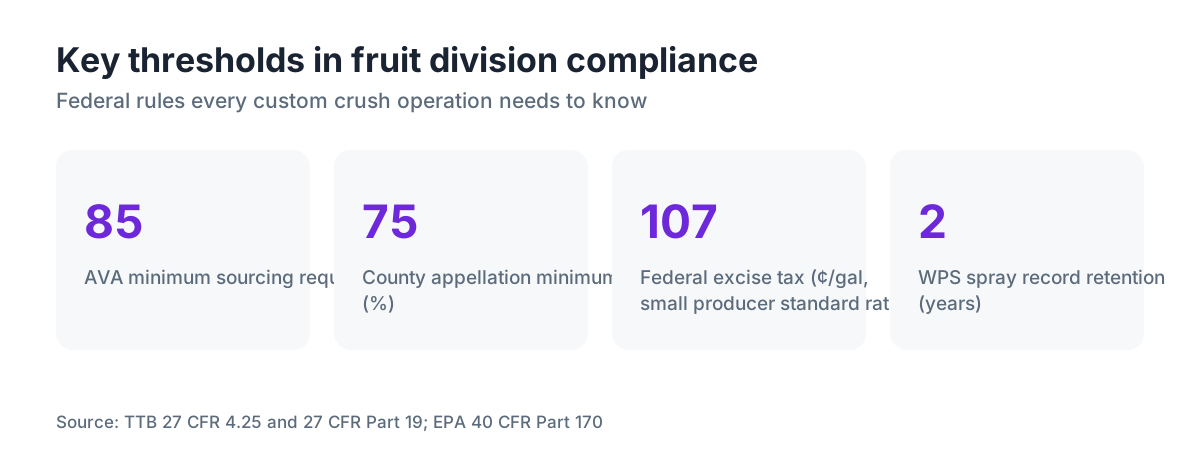
The current federal excise tax rate for wine runs from $1.07 per gallon (16% alcohol or under) for most small producers taking the Craft Beverage Modernization Act credit, up to $3.40 per gallon at standard rates for still wine above 21% alcohol. [7] Misattribute a 5-ton custom crush lot at typical Chardonnay yields of roughly 150 gallons per ton, and you're moving 750 gallons. At the $1.07 rate, the exposure is about $802 plus penalty and interest. Not catastrophic. Entirely avoidable.
The CBMA, made permanent in 2020, provides a reduced rate on the first 30,000 gallons removed by an eligible taxpayer. If a custom crush client claims that credit but their wine was inadvertently produced under your permit, the credit calculation can be thrown off for both operations. [7]
The cleanest protection is simple. Every lot removal should carry a document naming the permit holder, the lot number, and the date. Keep it with your excise tax records.
How should vineyard records connect to winery production records?
The chain of custody auditors look for runs like this: vineyard block identifier, to fruit receipt, to production lot, to tax record. Break any link and you have a gap.
At the vineyard level, you need a block map with unique identifiers for each block, a harvest log showing date picked, tons per block, and the destination (estate or client), plus any spray or WPS records required for worker protection. The EPA's Worker Protection Standard (40 CFR Part 170) requires pesticide application records to be kept for two years, with re-entry intervals and hazard information posted at a central location workers can reach. [8] Those spray records may also matter for residue questions from clients.
At the winery level, each production lot should reference the vineyard block it came from, using the same identifier the vineyard log uses. Sounds obvious. It breaks down constantly when the field crew names blocks one way and the winery names them another.
For vineyards farming for multiple clients or shipping to multiple facilities, a vineyard register (a running log of every block, variety, ownership, and annual disposition of fruit) is the single most useful compliance document you can keep. Cornell's extension viticulture program publishes a vineyard record template in its production planning resources, with block-level tracking that suits estate and contract fruit alike. [9]
If you run multiple custom crush clients through one facility, a system like VitiScribe links vineyard-block records straight to winery lot numbers, so the chain of custody lives in one place instead of scattered across three spreadsheets.
What happens when fruit yields are different from the contract estimate?
Contracts almost always name an estimated tonnage. Actual harvest rarely matches it. That's normal, and handling it properly is a recordkeeping question as much as a business one.
The answer is plain: actual weighed tonnage governs. Your fruit receipt shows the real number. The contract should say so outright, but even if it doesn't, a signed weigh ticket is strong evidence.
It gets complicated when a client believes their yield came in low because of how fruit was handled or allocated during picking. This is exactly why contemporaneous block-level records earn their keep. If your harvest log shows 4.2 tons received from a client's block at 9:15 AM on September 14 and you have the scale ticket to back it, the dispute is short. If you have a handwritten note reading "about 4 tons of Smith Chard" with no timestamp, the dispute drags.
Some wineries include a right-to-audit clause in custom crush agreements, giving the client the right to request records showing their lot's weight, additions, and production notes. That's a fair term and it keeps everyone honest. UC Davis extension recommends winery service agreements include explicit record-sharing provisions so clients can verify their wine's provenance for labeling. [4]
Are there any AVA or geographic designation rules that affect how you record fruit origin?
Yes, and they're stricter than people expect. Under TTB regulations at 27 CFR 4.25, a wine labeled with an American Viticultural Area must contain at least 85% fruit from that AVA. A county appellation drops the threshold to 75%. An estate designation demands 100% of the fruit from grapes grown on land owned or controlled by the winery and located within the labeled AVA. [10]
For custom crush clients who want an AVA or estate designation on their label, the burden of proof falls on whoever signs the COLA application. That's usually the permit holder whose name appears on the label. Their supporting documentation traces straight back to your fruit receipt and production records.
That creates a real obligation. Your receiving records have to capture more than weight and variety. They need the specific vineyard block and its location (APN, GPS coordinates, or a reference to a vineyard map on file with your AVA petition). "Smith Vineyard Chardonnay" isn't enough if Smith Vineyard straddles two AVA boundaries.
For estate-designated wines, TTB requires the winery to own or control the vineyard under a lease of at least three years. The lease terms and the vineyard's location within the AVA should live in your winery records and be referenced in your fruit receipt. [10]
How do you create a system that holds up over multiple vintages?
The biggest mistake small wineries make isn't getting the first vintage wrong. It's failing to document the system itself, so that when a new harvest manager starts or a bookkeeper asks questions two years on, nobody remembers why the lot numbering works the way it does.
Write your record system down. A one-page standard operating procedure for fruit receiving should cover how lot numbers are assigned, where weight tickets are stored, what goes on a fruit receipt, which fields are required versus optional, and how custom crush lots stay segregated from estate lots. Post it in the crush pad.
TTB requires winery records to be kept for at least three years, with certain records (bond records, excise tax returns) kept for five. [1] Your SOP and your blank record templates should be part of what you retain, so an auditor sees the system that generated the records, not only the records themselves.
Run a vintage-end reconciliation every year before you file your Operations Report with TTB. The Operations Report (TTB Form 5120.17) requires you to report total wine produced, total wine removed from bond, and ending inventory. If your lot records don't add up to those numbers, find out why before TTB does. [11]
For vineyards sending fruit to multiple destinations, a simple vineyard dispatch log, kept separate from the winery's receiving log, closes the loop from the field side. You know what left the vineyard. The receiving winery confirms what arrived. If the two numbers disagree by more than normal shrink (roughly 1 to 2% for transport), you have a question to resolve before the records are filed.
Frequently asked questions
Does a custom crush client need their own TTB permit?
Yes. Under 27 CFR Part 19 and TTB's custom crush guidance, a client who wants to own wine produced at another winery must hold their own Bonded Winery permit. Without it, the wine belongs to the licensed winery that produced it. Some states add a licensing layer on top of the federal requirement, so clients should check both TTB rules and their state ABC or LCB.
What's the minimum information a fruit receipt needs to include?
Date and time of receiving, grower name, vineyard block identifier, variety, gross weight from a calibrated scale, the lot number the winery assigns, and the client's TTB permit number for any custom crush fruit. If the fruit carries an AVA or estate designation for label purposes, add the specific block location or APN. Weight tickets from your scale should attach to or reference this document.
How long do winery production records need to be kept?
TTB requires most winery records to be kept for at least three years. Bond records and excise tax returns must be kept for five years. State agencies may set different or longer requirements. California's ABC, for example, can audit records going back three years from the date of an audit notice. Keep records in a format readable without specialized software, as a practical safeguard.
Can I use a spreadsheet to track fruit division, or do I need special software?
A spreadsheet works legally, provided it captures all required fields and entries are made contemporaneously. The practical problem is version control and audit trail: spreadsheets can be edited after the fact with no automatic timestamp, which creates credibility problems in an audit. Manage three or more custom crush clients and a winery management system with timestamped lot records is worth the cost. For one or two clients, a well-structured spreadsheet plus your paper weigh tickets is defensible.
What happens if fruit is accidentally commingled during harvest?
Document the commingling immediately, estimate the best available weight for each owner's portion using row counts, average row weights from adjacent blocks, or the picking crew's recollection, and have both parties sign off on the allocation. Attach the correction document to both lot records. A documented, agreed correction is compliant. A silent gap is not. Prevent commingling with sequential picking and dedicated bin streams.
Who is responsible for the COLA (Certificate of Label Approval) for a custom crush client's wine?
The permit holder whose name appears on the label owns the COLA application. In a custom crush arrangement, that's usually the client. The licensed winery that produced the wine may be listed as the bottling facility, but the client signs the COLA. Your production records (lot number, fruit source, additions) are what the client uses to complete the application, so clean records directly affect how smoothly their label approval goes.
How does a vineyard worker protection standard (WPS) spray record relate to fruit division records?
Spray records under EPA's Worker Protection Standard (40 CFR Part 170) must be kept for two years and must identify the product applied, application date, block treated, and re-entry interval. For custom crush clients, those records matter if a client's wine is tested for pesticide residues or if a label makes a production practice claim. Link your spray records to block identifiers that match your fruit receipt system and you can answer those questions fast.
Can a winery produce wine for a client under an alternating proprietorship instead of custom crush?
Yes, and the difference is worth knowing. In an alternating proprietorship, the client's bond covers the licensed premises for a defined period, and the client takes legal possession of the premises, not only the wine. Custom crush means the host winery's bond covers production, and the client simply owns the wine made for them. TTB's Industry Circular 2007-4 covers both. The records differ: alternating proprietorships require production reports filed under the client's permit number.
What's the AVA percentage requirement for a custom crush client's labeled wine?
Under TTB regulations at 27 CFR 4.25, wine labeled with an AVA must contain at least 85% fruit from that AVA. A county appellation drops the threshold to 75%. An estate designation demands 100% of the fruit from grapes grown on land owned or controlled by the winery within the labeled AVA. Your fruit receipt, with block location documented, is the client's proof of compliance when they file for label approval.
Does fruit going to a custom crush client affect my TTB Operations Report?
Only if you receive the fruit on your bonded premises. Receive it, crush it, and transfer the resulting wine out to a client's bond, and you report the wine received into your bond and the transfer out. If the client's fruit goes directly to a third-party facility you operate under their permit (alternating proprietorship), it appears under their report. Misrouting these entries is one of the most common Operations Report errors TTB staff flag in correspondence audits.
How do I document fruit from a shared-farming arrangement where I manage the vineyard but a client owns the vines?
The farming management agreement and any lease or ownership document should be on file and referenced in your vineyard register. At harvest, the fruit receipt identifies the block owner (the client), assigns a custom crush lot number, and notes your role as harvest manager. Ownership of the fruit, and therefore the wine, follows the vineyard ownership documented in that agreement. TTB may ask to see the farming contract to verify an estate wine claim, so keep it current.
Is there a standard lot numbering system I should use?
TTB doesn't mandate a specific format, so design one that works for your operation. A practical convention includes a prefix for production type (E for estate, CC for custom crush), the vintage year, a variety abbreviation, and a sequence number: CC-2024-PN-001, for example. Use the same identifier across your fruit receipt, production log, tank card, and excise tax record. Inconsistent lot references across documents are one of the first things auditors note.
What extension resources are available for custom crush record templates?
UC Davis Viticulture and Enology publishes winery business guidance covering custom crush agreements and record requirements. WSU Extension covers wine business operations, including custom crush compliance for Pacific Northwest producers. Cornell's viticulture program offers vineyard record templates with block-level tracking. All three programs have publicly accessible publications online, and UC Davis's extension courses periodically cover winery regulatory compliance in depth.
Sources
- TTB, 27 CFR Part 19, Distilled Spirits Plants (Winery Records sections 19.591-19.618): TTB requires bonded wineries to keep contemporaneous records of all fruit received, wine produced, and wine removed from bond; records must be available for inspection; custom crush clients must hold their own TTB permit.
- California Department of Food and Agriculture, Grape Crush Report: California requires reporting of grape tons received by variety and county of origin, supporting AVA sourcing verification.
- Washington State University Extension, Wine Business Resources: WSU Extension recommends custom crush agreements specify exact vineyard blocks by APN or block map reference, and recommends monthly lot reconciliation during harvest season.
- UC Davis Department of Viticulture and Enology, Winery Business Guidance: UC Davis notes that ownership transfer language is the most frequently litigated clause in custom crush agreements, and recommends record-sharing provisions in service agreements.
- California Department of Alcoholic Beverage Control, Title 4 CCR Section 53.1: California ABC requires licensed premises to produce records on inspection, including production logs and client lot records for custom crush operations.
- Washington State Liquor and Cannabis Board, RCW 66.28: Washington's LCB has authority to audit winery production records including custom crush client lot documentation.
- TTB, Craft Beverage Modernization Act, Tax Rates for Wine: Federal excise tax on wine ranges from $1.07 per gallon (under 16% ABV, eligible small producer) to $3.40 per gallon (over 21% ABV, standard rate); CBMA made permanent in 2020.
- EPA, Worker Protection Standard 40 CFR Part 170: EPA's WPS requires pesticide application records to be kept for two years and re-entry intervals posted at a central location accessible to agricultural workers.
- Cornell University Cooperative Extension, Viticulture and Enology Program: Cornell extension offers vineyard record templates covering block-level tracking suitable for estate and contract fruit, and recommends vineyard registers for multi-client farming operations.
- TTB, 27 CFR 4.25, American Viticultural Areas, Appellation Requirements: AVA-designated wine must contain at least 85% fruit from the named AVA; estate wine requires 100% from grapes grown on land owned or controlled by the winery within the labeled AVA under a lease of at least three years.
- TTB, Form 5120.17, Winery Operations Report Instructions: TTB Operations Report requires wineries to report total wine produced, total removed from bond, and ending inventory; transfers to client bonds must be reported separately from estate removals.
Last updated 2026-07-11