How to record habitat enhancement projects for sustainability certification
TL;DR
- Most vineyard sustainability programs (CSWA, LIVE, Lodi Rules, SIP) require you to document habitat enhancement with dated field notes, GPS-referenced maps, species lists, and photo logs.
- Start a dedicated habitat binder or digital folder, link each project to the specific certification standard it satisfies, and keep records for at least three years so auditors can verify progress over time.
What do sustainability certifications actually require for habitat records?
The short answer: more than most growers keep by default, but less than you probably fear.
Every major vineyard sustainability program treats habitat enhancement as a scored or verified category, more than a checkbox. California Sustainable Winegrowing Alliance (CSWA) uses a self-assessment workbook where habitat questions ask you to describe actions taken, acreage affected, and the year implementation started. LIVE Certified (Pacific Northwest) requires documented management plans for riparian buffers and hedgerows. Lodi Rules for Sustainable Winegrowing scores habitat under its Ecosystem Function module and wants evidence of both installation and ongoing monitoring. SIP (Sustainability in Practice) asks for a farm map showing non-cropped areas plus notes on what you did there and when.
The common thread across all four is traceability. An auditor should be able to pick up your record, look at the date, look at your field, and confirm that what you wrote matches what's on the ground. That means dated entries, location references (GPS coordinates or a labeled farm map), and enough species or practice detail to distinguish "we planted a hedgerow" from "we planted a 200-foot hedgerow of native coffeeberry, toyon, and buckwheat along the north fence line in March 2023."
Nobody has published a single uniform habitat record standard across all programs. The closest thing to common ground is the Ecological Stewardship section of CSWA's Sustainable Winegrowing Program Workbook [1], which lists the practice categories auditors look for: habitat corridors, beneficial insect habitat, raptor perches, owl boxes, riparian restoration, and cover crops managed for wildlife value.
Which sustainability programs cover vineyard habitat and how do their requirements differ?
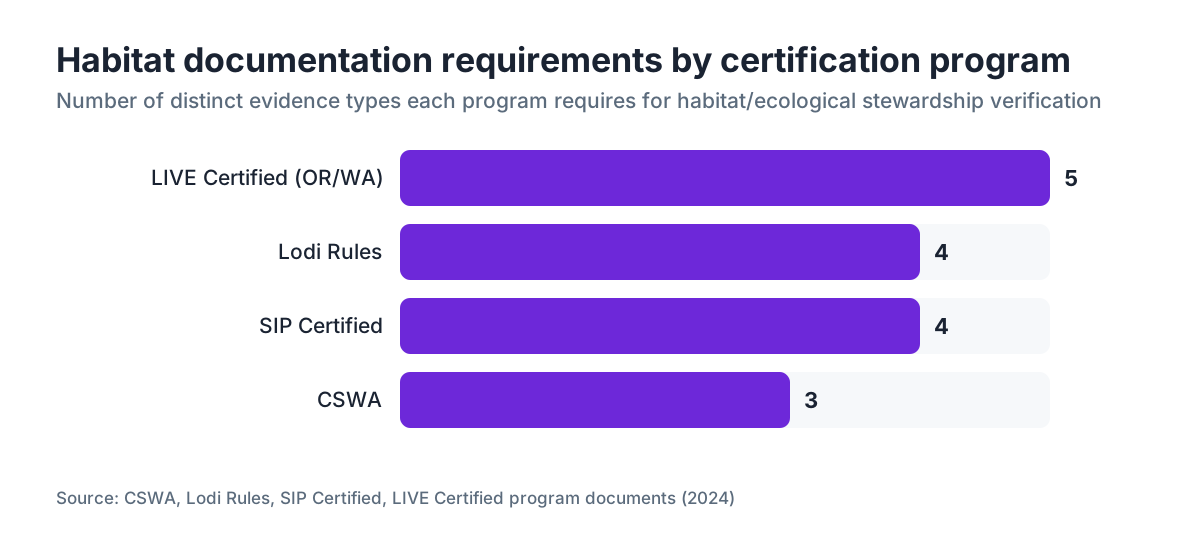
Here's a side-by-side comparison of what the four most common U.S. vineyard sustainability certifications ask for in their habitat documentation:
| Program | Habitat category name | Key evidence required | Minimum record retention |
|---|---|---|---|
| CSWA (California) | Ecological Stewardship | Workbook self-assessment, practice descriptions, acreage, year started | 3 years (audit cycle) |
| Lodi Rules | Ecosystem Function | Scored worksheets, species lists encouraged, farm map | 3 years |
| LIVE Certified (OR/WA) | Biodiversity & Ecosystem | Management plan, riparian buffer map, monitoring notes | Current plan + 2 prior years |
| SIP Certified | Land Stewardship | Farm map, non-cropped area description, dated activity log | 3 years |
Location matters here. LIVE Certified is specific to Oregon and Washington and follows Oregon Department of Agriculture requirements for buffer zones near waterways [2]. If you're in Paso Robles or the Central Coast, you're almost certainly working under CSWA or SIP. Growers in the Pacific Northwest who export to certain European buyers sometimes layer LIVE Certified on top of a USDA organic certification, which means your habitat records need to satisfy both programs at once.
The one area where programs split most is whether a third-party site visit is required. Lodi Rules and LIVE both include third-party audits. CSWA's main program is self-assessed, though its Certified California Sustainable Winegrowing seal does require third-party verification. Know which track you're on before you decide how detailed your records need to be, because a self-assessment with no audit visit is a very different burden than one where an auditor walks your hedgerows with you.
What specific records should you create for each type of habitat project?
Different habitat practices generate different record types. Here's what to capture for the most common projects:
Hedgerows and windbreaks. Record the date planted, linear footage, plant species with common and scientific names, plant source (nursery name and location), spacing, and survival rate at one year. A photo taken at planting and a follow-up photo at 12 months tells a stronger story than words alone. If the hedgerow borders a waterway, note the buffer width in feet.
Cover crops managed for wildlife or beneficial insects. Document the seed mix (species and percentages), seeding date, acres seeded, and your mowing or termination date and method. If you're using a mix designed to attract beneficials, note the intended insect guild. UC Davis Cooperative Extension has published cover crop species lists specifically for beneficial insect habitat in California vineyards, and citing that guidance in your records shows the auditor you made an intentional selection [3].
Owl boxes and raptor perches. Log installation date, GPS location or map reference, box/perch type, height, and monitoring observations (date observed, species, nesting activity). This takes five minutes per box per season and turns a physical structure into documented evidence.
Riparian buffer restoration. This one needs the most paperwork. Record the stream or waterway name, buffer width, total linear feet and acres, species planted, any invasive species removed (with method and date), and any water quality monitoring you do. If you worked with an NRCS cost-share program like EQIP, keep copies of your conservation plan, because that document doubles as your habitat record [4].
Fallow or set-aside areas. Note the acreage, location on your farm map, the management objective (pollinators, ground-nesting birds, etc.), and any active management actions like mowing schedules or invasive removal.
For every project, the date is non-negotiable. Undated records carry almost no weight in an audit.
How do you create a farm map that satisfies certification requirements?
You don't need GIS software. You need a map accurate enough for an auditor to orient themselves on your property and confirm that the features you describe actually exist.
The minimum viable habitat map shows: vineyard block boundaries labeled with block names or numbers, non-cropped areas (hedgerows, riparian buffers, fallow blocks, cover crop blocks) outlined and labeled, any water features, and a north arrow and approximate scale. A screenshot from Google Earth or NRCS Web Soil Survey with hand annotations is acceptable for most programs.
If you want to do this properly without spending money, the USDA's Web Soil Survey (websoilsurvey.usda.gov) lets you pull an aerial image of your property, delineate features, and print a labeled map for free [5]. For anything near a waterway, the USDA NRCS also maintains field office maps that show riparian zones and conservation easements.
For the GPS coordinates, your phone's native map app is fine. Drop a pin at each habitat feature, record the coordinates, and store them in your record. That's all most programs ask for.
Update your farm map whenever a significant habitat feature is added or removed. Date the map version. Keeping two or three dated map versions over time shows auditors that your program is evolving, which is exactly the story sustainability certification rewards.
How should you organize your habitat records so an auditor can actually find things?
Organization is where most growers fall apart. They have the information somewhere, in field notebooks, on their phone, in a folder named "misc 2022," but they can't assemble it on short notice when an auditor shows up.
The structure that works: one binder or one digital folder per certification cycle (typically three years), with a tab or subfolder for each habitat project type. Inside each tab, keep a one-page project summary at the front (project name, location, date started, program standard it satisfies, current status) followed by supporting documents in reverse chronological order.
Digital record-keeping has a real advantage here because you can attach geotagged photos directly to entries, search by date or practice type, and share records with a third-party auditor without physical logistics. Tools like VitiScribe are built specifically for vineyard compliance records and let you log habitat activities alongside spray records and irrigation data in one place, which matters when auditors want to see the whole farm picture.
If you stay paper-based, a three-ring binder works fine as long as every page is dated and every location reference maps to your farm map. The biggest paper-based mistake is loose photos with no dates or labels. Write the date and location on the back of every printed photo before it goes in the binder.
Store a backup somewhere off the farm. A house fire or flood shouldn't wipe out three years of certification records.
What photo documentation do certifiers actually want?
Photos are your strongest evidence and the easiest type of record to generate badly.
What makes a useful habitat photo: a clear date stamp (use your phone's camera, which embeds the date in the file metadata), enough context to identify the location (stand near a vineyard block sign, a fence line, or a recognizable feature), and a shot that shows the practice itself. For a hedgerow, one photo of the whole hedgerow width and one close-up of the plants. For an owl box, one shot showing the box mounted on the post and one showing its location relative to the vineyard.
What doesn't work: a blurry shot of some plants with no location context, dated three days after the work was allegedly done, with nothing in frame that an auditor could use to identify the spot.
Organize photos in folders named by project and date: "North-fence-hedgerow-2023-03-15." That naming convention takes two seconds and saves twenty minutes of searching when you're prepping for an audit.
Most certifiers don't prescribe a minimum photo count. They want enough to verify the practice exists and is being maintained. For a hedgerow, two to four photos per year is plenty. For something like a cover crop program across multiple blocks, one representative photo per block per season covers it.
Can you get USDA cost-share funding for habitat projects and does that change your record-keeping?
Yes and yes.
The USDA Natural Resources Conservation Service Environmental Quality Incentives Program (EQIP) and the Regional Conservation Partnership Program (RCPP) both fund habitat practices in vineyards, including hedgerow installation, riparian buffer restoration, and pollinator habitat establishment [4]. Payment rates vary by state and practice, but hedgerow installation under EQIP Practice Standard 422 has paid $2,000 to $6,000 per acre in some California counties in recent years (rates are updated annually by each state NRCS office, so check your local office for current numbers).
When you're in an EQIP contract, NRCS generates a Conservation Activity Plan or conservation practice standard documentation that is detailed, professionally formatted, and already contains most of what a sustainability certifier wants to see: practice description, location, specifications, and planned monitoring. Keep copies of everything NRCS gives you and file it directly in your habitat records binder. You're essentially getting your documentation written for you.
The record-keeping obligation runs both directions, though. EQIP requires you to implement practices to NRCS standards and document that you did. If an auditor for your sustainability certification later finds a discrepancy between what you reported to NRCS and what's on the ground, that's a serious problem. Keep your records consistent across both programs from the start.
How does cover crop documentation count toward habitat certification?
Cover crops are the most common habitat practice in vineyards and also the most commonly under-documented one.
For cover crops to count as habitat enhancement under certification programs, you generally need to show two things: intentional species selection for habitat value (more than erosion control) and management that leaves the crop available for wildlife or beneficials during the relevant season. A cover crop you terminate in February before bloom doesn't do much for pollinators. A mix you let flower before mowing in May does.
WSU Extension has published guidance on pollinator-friendly cover crop mixes for Pacific Northwest vineyards, which is a useful reference to cite in your records even if you're adapting it to your region [6]. Cornell's viticulture program has similar resources for eastern producers [7].
Your cover crop log should include: seeding date, mix species and percentages, seeding rate, total acres, any in-season management (mowing, rolling, cultivation) with dates, and termination date and method. If you're using a purchased seed mix, keep the seed bag tag or invoice. It proves species composition in a way a written note alone doesn't.
For CSWA specifically, cover crops managed for beneficial insect habitat count under the Integrated Pest Management chapter as well as the Ecological Stewardship chapter. If you log them correctly, one practice gives you credit in two categories.
What are the most common habitat record-keeping mistakes that fail audits?
After reviewing what auditors for Lodi Rules, CSWA, and LIVE typically flag, the failure modes cluster around a few repeatable errors.
No dates. Records that say "we planted a hedgerow along the east fence" with no year, let alone a month and day, are nearly useless. The date is the foundation of any verifiable record.
No location reference. A description that can't be matched to a specific spot on the farm isn't auditable. Every entry needs a block name, GPS coordinate, or labeled map reference.
Practices described but not implemented. Some growers write up beautiful plans and then don't execute them, or execute them differently than described. Auditors compare your records to the physical farm. Discrepancies matter more than gaps.
Records stored only in someone's head. The vineyard manager who planned all the habitat work knows exactly where everything is. If that person leaves, or is unavailable during an audit, the records need to stand on their own.
Species lists that use only common names. "Native grasses" or "wildflowers" don't tell an auditor anything meaningful. Scientific names or at least specific common names (purple needlegrass, California poppy, phacelia) show that you made real selections.
No evidence of monitoring. Planting something and never checking on it doesn't satisfy the spirit of any certification program. Annual observation notes, even brief ones, show that your habitat program is actively managed.
How do you tie habitat records to specific certification standards and scoring criteria?
This is the step most growers skip, and it's the one that turns good records into good scores.
Every certification program has a workbook, scorecard, or checklist that maps practices to point values or verification requirements. Get that document and work backward. For each habitat project you're running, identify the specific section or question it addresses and note that reference in your project record. "This hedgerow satisfies CSWA Workbook Chapter 8, Question 8.3" is more useful to an auditor than any amount of general description.
For Lodi Rules, the Workbook is publicly available and lists point values for each practice [8]. A 200-foot hedgerow of diverse native species might score differently than a monoculture windbreak, so knowing the scoring criteria before you plant helps you make choices that raise your certification score, more than your compliance.
For SIP, the verification process includes a scorecard review where evidence for each practice is matched to a threshold. If you've done the work but can't produce the evidence in the right format, you lose the credit.
When you set up your record system at the beginning of a certification cycle, create a cross-reference sheet: one row per habitat project, columns for the project name, location, date started, the specific certification standard it satisfies, and the evidence document type (photo, map, species list, NRCS plan). Update it as you add projects. That single sheet can cut your pre-audit assembly time in half.
For growers managing records across multiple blocks and practices, a field operations platform like VitiScribe can link individual activity logs to the relevant certification standard automatically, which makes that cross-reference essentially self-generating.
How long do you need to keep habitat enhancement records?
Three years is the standard minimum across CSWA, Lodi Rules, and SIP, because most programs operate on a three-year certification cycle.
LIVE Certified requires your current management plan plus two prior years of documentation, which is effectively the same window.
Keep records longer than the minimum if you can. Habitat work tells a better story over five or ten years than over three. A grower who can show a hedgerow planted in 2015 that's now 12 feet tall and supporting a documented raptor population has a stronger case than one who planted something last spring. Long records also protect you if a certification program changes its standards, because you have documented continuity.
For EQIP participants, NRCS record retention requirements run with the contract term plus three years. A five-year EQIP contract means you hold records for eight years minimum [4]. File your sustainability and EQIP records together to avoid accidentally discarding something you're legally required to keep.
Electronic records are fine for all major programs as long as they're backed up and retrievable. A PDF that lives only on a laptop that gets stolen doesn't count.
What is the role of monitoring data in habitat certification, and how do you collect it without a biology degree?
Monitoring means you check on your habitat projects periodically and write down what you find. That's it.
You don't need transect surveys or scientific protocols for most certification programs. What they want to see is evidence that you're paying attention: annual observations of plant survival and vigor, notes on wildlife use, and records of any management actions like invasive removal or supplemental watering.
A practical monitoring routine for a hedgerow: once in early spring and once in fall, walk the hedgerow, note the approximate percent of plants that survived and are healthy, list any bird or insect species you observe (even approximate ones are fine: "several species of native bees observed foraging on buckwheat flowers"), and note any invasive species that need attention. Write this down with the date. Five minutes per hedgerow.
For owl boxes: check once in late winter before the nesting season, note condition of the box, and again in late summer, note any evidence of use (pellets, feathers, nesting material). Record findings with the date.
Citizen science platforms like iNaturalist are free and let you upload geotagged species observations that automatically generate a timestamped, location-specific record. Those observations are citable and verifiable by auditors. UC Davis has incorporated iNaturalist into some of its vineyard biodiversity research, which adds credibility to the platform as a documentation tool [3].
The monitoring data compounds in value over time. Three years of consistent observation notes is far more persuasive than a one-time species list.
Frequently asked questions
Do I need a professional ecologist to document vineyard habitat projects for certification?
No. All major U.S. vineyard sustainability programs (CSWA, Lodi Rules, SIP, LIVE) accept self-documented habitat records. You need dated entries, location references, species names, and photos, not a certified ecologist's sign-off. NRCS conservation planners can help you design projects for free if you're considering EQIP cost-share, and their documentation then doubles as your certification evidence.
Can existing habitat features count toward certification if I didn't plant them?
Generally yes, as long as you document them and show active stewardship. A naturally occurring riparian buffer counts if you log its location, acreage, current condition, and any management actions like invasive removal. The key is demonstrating intentional management, more than passive presence. Most programs distinguish between features you're actively managing and features you simply haven't cleared.
How specific do species lists need to be for certification auditors?
Specific common names or scientific names are strongly preferred over general terms like "native grasses" or "wildflowers." For planted species, list what you actually put in the ground. For observed wildlife, approximate identification is acceptable: "Anna's hummingbird" is better than "bird." More specificity signals informed management and holds up better when an auditor visits the site.
What's the difference between a hedgerow and a riparian buffer in certification records?
A hedgerow is a planted linear feature that doesn't necessarily border water. A riparian buffer is a vegetated area next to a stream, creek, or seasonal waterway. Both qualify as habitat enhancement, but riparian buffers often carry additional regulatory significance (setback requirements, water quality benefits) and may satisfy separate certification questions. Document them separately and map each to the relevant waterway.
Does cover crop species selection affect how much certification credit I get for habitat?
Yes, meaningfully. A monoculture annual ryegrass cover crop managed purely for erosion control typically gets little or no habitat credit. A diverse mix including flowering species (phacelia, crimson clover, California poppy) managed to allow bloom before termination qualifies as beneficial insect habitat under CSWA and Lodi Rules. The difference in credit can affect your overall certification score, so choose mixes with that in mind.
How do I document habitat records if I use a farm labor contractor and they do the planting work?
You're responsible for the record regardless of who does the physical work. Get the planting date, species, materials, and location from your labor contractor in writing the same day the work is done. A simple job ticket or text message with those details, which you then transcribe into your official record, is enough. Don't rely on the contractor to maintain records; that's your obligation under every certification program.
Can geotagged smartphone photos replace GPS coordinates in habitat records?
For most programs, yes. A geotagged photo has location data embedded in its EXIF metadata, which is verifiable and tied to a date and time. Make sure location services are enabled on your camera app. Store photos in a folder structure organized by project and date, and keep them in a format (JPEG with EXIF intact) that preserves the metadata. Don't screenshot or re-export photos in ways that strip that data.
What happens to my habitat records if I sell the vineyard during a certification cycle?
Certification typically follows the operator, not the land. If you sell, the new owner needs to apply for certification fresh unless the program specifically allows transfer. You should hand over your complete habitat record binder as part of the transition, both as a courtesy and because any EQIP contracts tied to the property have record retention obligations that transfer with the land. Confirm transfer terms directly with your certifying body.
Do I need to record habitat projects differently for organic certification versus sustainability certification?
Yes, though there's overlap. USDA organic certification under the National Organic Program focuses on prohibited substance avoidance and doesn't score habitat per se. Sustainability certifications explicitly score ecological stewardship practices. If you hold both, your habitat records satisfy sustainability requirements but your organic certificate doesn't automatically satisfy sustainability habitat questions. Keep a single record that addresses both programs' evidence needs.
How do LIVE Certified requirements differ from CSWA for habitat documentation in the Pacific Northwest?
LIVE Certified requires a written biodiversity management plan and documented monitoring, which is a higher bar than CSWA's self-assessment workbook approach. LIVE also follows Oregon Department of Agriculture buffer zone guidance near waterways, so riparian documentation needs to match those standards. LIVE uses third-party audits, meaning your records will be physically verified on-site, more than self-reported.
What records do I need if I received NRCS EQIP funding for habitat installation?
Keep copies of your Conservation Activity Plan, practice standard documentation, payment requests, and any site visit reports from your NRCS field office. NRCS requires records to be retained for the contract term plus three years. These documents contain the species lists, specifications, and location data that sustainability certifiers also want, so filing them together saves you from creating duplicate records.
Is there a standard format or template for habitat project records?
No universal template exists. CSWA provides a workbook with guided questions, and Lodi Rules has its own scored worksheet; both are available on their program websites. For practices between certification cycles, a simple dated log with project name, location, actions taken, and species observed covers the core need. WSU and UC Davis Extension both offer farm record templates adaptable for habitat use.
How many years of records do I need before applying for vineyard sustainability certification for the first time?
Most programs will accept your first-cycle application with whatever records you have from the past 12 months, including baseline documentation of existing features. You don't need three years of prior records to start. The cycle-one assessment typically establishes your baseline; subsequent cycles evaluate improvement. Starting a rigorous record-keeping practice now is worth more than trying to reconstruct past activity from memory.
Sources
- California Sustainable Winegrowing Alliance, Sustainable Winegrowing Program Workbook: CSWA workbook lists habitat practice categories auditors evaluate including habitat corridors, beneficial insect habitat, raptor perches, owl boxes, and riparian restoration under Ecological Stewardship
- Oregon Department of Agriculture, Agricultural Water Quality Program: Oregon Department of Agriculture maintains buffer zone requirements near waterways that LIVE Certified follows for riparian buffer documentation
- UC Davis Cooperative Extension, Cover Crops for Vineyard Pest Management: UC Davis Cooperative Extension has published cover crop species lists for beneficial insect habitat in California vineyards and has incorporated iNaturalist into vineyard biodiversity research
- USDA Natural Resources Conservation Service, Web Soil Survey: USDA Web Soil Survey provides free aerial imagery and lets users delineate and print labeled property maps
- Washington State University Extension, Cover Crops for Pacific Northwest Vineyards: WSU Extension has published guidance on pollinator-friendly cover crop mixes for Pacific Northwest vineyards
- Cornell University College of Agriculture and Life Sciences, Viticulture and Enology Extension: Cornell viticulture program has published resources on cover crop and habitat management for eastern wine grape producers
- Lodi Winegrape Commission, Lodi Rules for Sustainable Winegrowing Workbook: The Lodi Rules Workbook is publicly available and lists point values for each habitat and ecosystem function practice
- SIP Certified, Sustainability in Practice Certification Program: SIP requires a farm map showing non-cropped areas plus dated activity notes and uses a scorecard verification process matching evidence to practice thresholds
- LIVE Certified, Biodiversity and Ecosystem Standards: LIVE Certified requires a documented biodiversity management plan, riparian buffer map, and monitoring notes; retains current plan plus two prior years
- USDA Agricultural Marketing Service, National Organic Program: USDA organic certification focuses on prohibited substance avoidance and does not score habitat enhancement as sustainability programs do
- iNaturalist, About iNaturalist: iNaturalist is a free citizen science platform that generates timestamped, geotagged species observation records usable as habitat monitoring documentation
Last updated 2026-07-11