How to record mating disruption dispensers as a pest management decision
TL;DR
- Mating disruption dispensers rarely need a spray-style application log, but they do need a documented pest management decision.
- Record the target pest, product name and EPA registration number, placement date, rate in dispensers per acre, field ID, and the scouting data that justified the timing.
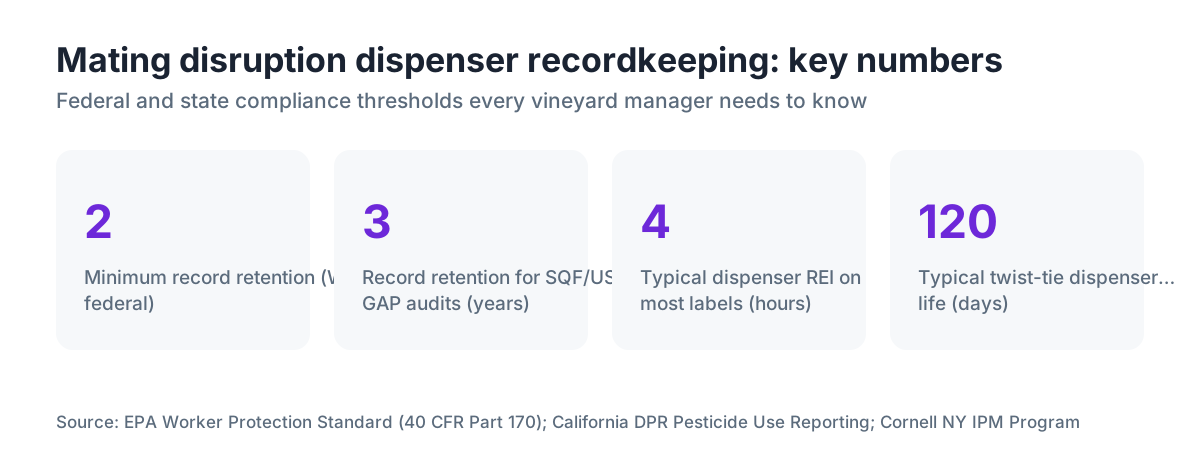
- Keep everything at least two years to satisfy the EPA Worker Protection Standard.
Do mating disruption dispensers count as pesticide applications for recordkeeping?
Technically no, and also kind of yes. Mating disruption products registered with EPA are classified as biochemical pesticides under FIFRA, which means they carry an EPA registration number and are regulated as pesticides.[1] That registration triggers label compliance obligations. What it usually doesn't trigger, in most states, is the commercial pesticide application record that spray operators fill out for organophosphates or fungicides.
The practical upshot: you probably aren't legally required to keep a spray-style application log for dispensers. But you are required to prove you used a registered pesticide according to its label. And if you operate under a food-safety audit program (USDA GAP, California Leafy Greens, SQF), your auditor will look for evidence that every pest management input was decided on purpose and written down.
Record it. The burden is tiny. The hole in your files if you skip it is not.
What information belongs in a mating disruption dispenser record?
A solid dispenser record covers seven fields. None of them are hard to collect. They just need to land somewhere you can find them later.
| Field | What to record | Example |
|---|---|---|
| Date applied | Day dispensers were hung | 2025-04-15 |
| Pest target | Common name + scientific name | Grape berry moth (Paralobesia viteana) |
| Product name | Full label name | Isomate-GBM |
| EPA Reg. No. | From the label | 53575-40 |
| Field/block ID | Your internal block name | Block 7 / Cabernet North |
| Rate | Dispensers per acre | 200 dispensers/ac |
| Applicator name | Person who hung them | J. Martinez |
Two more fields turn a basic log into an actual decision record: the scouting data or degree-day model output that set the timing, and the threshold rationale behind the choice. If you hung dispensers at biofix plus 100 degree-days Fahrenheit for grape berry moth, write that. If you used a UC IPM degree-day model, name it.[2]
A future auditor, a crop insurance adjuster, or you yourself eighteen months from now will be glad you wrote the detail down.
Which pests in the vineyard are mating disruption products registered for?
The practical targets in North American vineyards right now are grape berry moth (Paralobesia viteana, most common east of the Rockies), European grapevine moth (Lobesia botrana, a regulated pest in California), grape leaffolder (Desmia funeralis), and to a lesser degree orange tortrix. Western grape leafhopper has no viable mating disruption product yet.
Product lines shift by region. In the East, Isomate-GBM and Suterra Puffer GBM dominate for Paralobesia viteana. In California, Isomate and several Suterra products are labeled for Lobesia botrana in blocks under regulatory programs.[3] Cornell's grape IPM program publishes degree-day benchmarks for grape berry moth timing that growers in New York and Pennsylvania lean on heavily.[4] WSU's Pacific Northwest Pest Management Handbooks cover the western targets.[5]
When you record the target pest, write both the common name and the scientific name. If your operation ever faces a regulatory review or an insurance claim, the scientific name kills any ambiguity about what you were managing.
How does EPA registration number tracking work for dispenser products?
Every mating disruption dispenser sold in the US that contains a synthesized pheromone is registered with EPA under FIFRA Section 3, or exempted under 40 CFR Part 152.[1] The label carries the EPA Reg. No. in a bottom corner. That number is the anchor for your record.
Why does it matter? If EPA or your state ag department audits your pesticide use records, they cross-reference your logged EPA Reg. No. against the registered label to confirm you stayed within labeled rates and crops. Record no EPA number and your entry is uncorroborated. Record the number and the label rate and you've done the job.
One habit worth building: photograph the label from one dispenser in each lot when you open the case. A phone photo in your records folder costs nothing and proves product identity long after the empty dispensers are gone and the auditor shows up.
What does the EPA Worker Protection Standard require for dispenser recordkeeping?
The EPA Worker Protection Standard (WPS), revised in 2015 and enforced under 40 CFR Part 170, requires agricultural employers to keep records of any pesticide application for at least two years.[6] The WPS defines "application" broadly enough to cover hanging or placing any EPA-registered pesticide product in the field, which pulls mating disruption dispensers in.
The record must include the product name, EPA registration number, active ingredient(s), location, date, and the restricted-entry interval (REI) if one appears on the label. Most dispenser labels carry a 4-hour or 0-hour REI, but read your specific label. EPA's Worker Protection Standard guidance states that employers must keep pesticide application records for two years and make them available to workers and handlers on request.[6]
Got H-2A workers or any employees who might enter treated blocks? The REI documentation isn't optional. Log it, post it at the central location WPS requires, and keep the record the full two years.
How should the pest management decision itself be documented, beyond the product?
A product log and a decision record are two different animals, and only one of them holds up under a food-safety auditor or a PCA inspection.
A decision record answers three questions. Why this pest? Why now? Why this tactic?
For mating disruption, that usually reads like this: trap catches or degree-day accumulation set the timing (the why now), historical block pressure or a regional forecast favored mating disruption over a conventional spray (the why this tactic), and last year's damage assessment or a threshold comparison justified spending the money (the why this pest).
You don't need a dissertation. A two-sentence entry in your block notes does it: "GBM trap catch exceeded 5 moths per trap per week on 4/10. Hung Isomate-GBM at 200/ac on 4/15 per Cornell biofix + 100 DD model." That's a decision record. Compare it to a bare log reading "hung dispensers 4/15 Block 7." The second version tells you nothing about whether the call was defensible.
Scouting data is the keystone. UC Davis's statewide IPM program recommends documenting the action threshold behind any treatment decision, more than the treatment.[2] The data that drove your choice is as much a compliance document as the product label.
What's the right placement rate to record, and why does it matter for compliance?
Record placement rate in dispensers per acre, which reads nothing like a liquid pesticide rate in ounces per acre or per 100 gallons. Most commercial mating disruption labels in US vineyards call for 100 to 400 dispensers per acre depending on the product and canopy. The Isomate line generally lists 150 to 200 per acre for typical trellis systems. Suterra Puffer units run at far lower unit counts because each aerosol unit covers a wider radius.
Record the rate you actually hung, not the label maximum. Put up 180 dispensers in a 12-acre block and the honest entry is 180 dispensers in Block 7 (12 ac), 15 per row, roughly 200/ac equivalent. Some auditors reconcile your unit count against your invoice, so the count by block and the invoice quantity should match within reason. Keep the invoice attached to the record.
Over-applying a pheromone product isn't an agronomic worry the way over-applying a fungicide is. But going above or below the label rate is still an off-label use under FIFRA, and that's a violation.[8] Record what you did.
How do you handle mid-season dispenser replenishment or removal in the records?
Seasonal programs often need a second placement mid-season, especially in regions with two or three generations of grape berry moth a year. Each placement date is its own entry. You don't edit the first entry. You add a new one with its own date, rate, and block ID.
Remove dispensers before season end (rare, but it happens when a block changes hands or you switch tactics) and you log the removal date and reason. The reason it matters: the dispenser keeps releasing pheromone for its rated lifespan, typically 90 to 150 days for twist-tie products, so your records should reflect the real protection window.
For Puffer-style units with longer service intervals, note the activation date and the manufacturer's stated active period. A unit rated for 150 days that you activate May 1 should show a protection window running to roughly September 28. That window documentation can matter for a crop insurance claim if berry moth damage shows up late in the season.
How do record systems and software handle mating disruption entries differently from spray records?
Most spray record platforms were built around liquid applications, so they default to fields like gallons per acre or dilution rate that mean nothing for a twist-tie dispenser. You want a system flexible enough to log dispensers per acre as the rate unit and to flag the entry as a non-spray pesticide application.
Spreadsheets work fine for a small operation. A shared Google Sheet with columns for date, block, product, EPA Reg. No., rate (units/ac), applicator, REI, and a notes field for scouting data is genuinely enough for a 20-acre vineyard. The weak spot with spreadsheets is version control and backup, not structure.
Bigger operations, or anyone juggling several certifications at once, get more from a purpose-built platform. VitiScribe, for example, lets you log non-spray pest management inputs next to conventional spray records so your full decision history lives in one place and exports clean for audits. That unified log earns its keep when you're running mating disruption and conventional sprays in the same block across the same season.
Whatever you use, the records have to be retrievable by block and by date range. An auditor asking for every pest management input in Block 7 between April and August shouldn't cost you more than two minutes.
Do state pesticide use reporting laws apply to mating disruption dispensers?
This varies by state, and your state Department of Agriculture requirements matter more here than FIFRA does.
California has the strictest rules. Under California Food and Agricultural Code Section 12981, licensed pesticide applicators must report all pesticide use to the County Agricultural Commissioner, and pheromone products with EPA registration numbers are reportable.[7] California's Department of Pesticide Regulation runs the state's pesticide use report database, and mating disruption products do show up in it.
New York requires commercial applicators to keep records but doesn't demand the county-level reporting California does. Washington State runs similar commercial applicator recordkeeping without the mandatory county reporting.
If you're a licensed PCA or a custom applicator running a client's vineyard, your obligation sits higher than an owner-operator's in most states. Read your license conditions. For owner-operators applying their own products, FIFRA and WPS set the federal floor. State rules can only be stricter, never looser.
What do university extension programs recommend for documenting mating disruption programs?
Cornell's New York State IPM Program publishes a grape pest management guide that recommends documenting trap monitoring data alongside any treatment decision, mating disruption placements included, so season-end program reviews tie back to actual pest pressure.[4] The guidance notes that dispenser placement dates should be cross-referenced with degree-day accumulations to check timing accuracy at season end.
UC Davis's UC IPM Program recommends a block-level decision log for all IPM tactics, pheromone applications included, and says the log should capture the scouting threshold used and the alternative tactics considered.[2] That "alternatives considered" note earns its place: if you weighed a conventional spray and chose mating disruption instead, a one-line note to that effect turns your entry into an affirmative IPM decision rather than a product hang.
WSU's Pacific Northwest Pest Management Handbooks give placement guidance for western vineyard pests and recommend recording dispenser lot numbers on top of the product name, since pheromone load can vary between lots and lot tracking helps chase down efficacy questions later.[5]
These programs agree on one thing: the record should capture the decision logic, more than the product details. That's the bar worth clearing.
How long do you have to keep mating disruption dispenser records?
The federal floor under WPS is two years.[6] California's pesticide use reporting rules require records kept for two years from the date of application.[7] Some food-safety certification programs (SQF, USDA GAP) want three years of pest management records to cover a full audit cycle.
The practical answer for most vineyards: keep records three years. That one retention policy clears WPS, California DPR, and most third-party food-safety audits at once. Three years of block-level records for a 50-acre vineyard is a small file, especially in a digital system.
Here's what trips up small operations. Records that exist but can't be found fast during an audit are functionally the same as records that don't exist. An auditor asking for 2022 pest management records in a 2025 inspection shouldn't set off a two-hour dig through filing boxes. Organize by year and block from day one.
What's a practical record template you can use right now?
Here's a plain-text format that meets WPS requirements, satisfies common food-safety audit expectations, and drops into a spreadsheet, a notes app, or a printed log book without fuss.
MATING DISRUPTION DISPENSER APPLICATION RECORD
Date: ___________
Applicator name: ___________
Block/Field ID: ___________ Total acres: ___________
Target pest (common name): ___________ (scientific name): ___________
Product name: ___________ EPA Reg. No.: ___________
Pheromone active ingredient: ___________
Rate: ___ dispensers/ac Total dispensers hung: ___
Dispenser lot number: ___________
REI on label: ___________
Worker notification posted: Yes / No Date posted: ___________
Scouting data / decision basis:
(e.g., "Trap catch 6 moths/trap/wk week of 4/10; degree-day model at biofix + 95 DD")
___________________________________________
Alternatives considered:
___________________________________________
Notes (replenishment date, removal date, efficacy observations):
___________________________________________
Print it, fill it in, scan it, and name the file by block and year. Or copy these fields into whatever recordkeeping system you run. The structure is what matters. The medium is secondary. VitiScribe's block activity log supports this field set and keeps the record searchable by block, date range, and pest target, which is exactly what you want when you're pulling records at audit time.
Frequently asked questions
Are mating disruption dispensers considered pesticides under FIFRA?
Yes. Pheromone-based mating disruption products with EPA registration numbers are classified as biochemical pesticides under FIFRA and are subject to label compliance requirements. Some pheromone products qualify for a 25(b) minimum-risk exemption and carry no EPA Reg. No., but products sold commercially for vineyard use are nearly all fully registered. Check the label for the EPA Reg. No. to confirm registration status.
Do I need a pesticide applicator license to hang mating disruption dispensers?
In most states, owner-operators applying pesticides on their own property don't need a commercial applicator license. If you're a PCA or custom applicator working someone else's vineyard, your state's licensing rules apply. California requires a Qualified Applicator License or certificate for anyone who applies pesticides for hire, pheromone products included. Check your state Department of Agriculture's requirements for your situation.
What's the restricted-entry interval for mating disruption dispensers?
Most commercial mating disruption dispenser labels carry a 4-hour or 0-hour REI under the EPA Worker Protection Standard. The exact interval depends on the product. Read the label of each product you use, because REI can vary between formulations even from the same manufacturer. Log the REI from the label in your application record and post worker notification at the field entrance per WPS.
Can I record mating disruption as an IPM tactic instead of a pesticide application in my records?
You can categorize it as an IPM tactic in your system for organizational purposes, but you still have to capture the fields WPS requires for any EPA-registered pesticide product: product name, EPA registration number, active ingredient, location, date, and REI. Calling it an IPM tactic doesn't remove the compliance fields. It just adds useful context about why you chose the approach.
How do I document mating disruption efficacy for a year-end program review?
Link your end-of-season trap catch data and harvest damage assessment to that season's placement records. A simple table showing degree-day timing of placements, peak trap catch dates, and observed berry damage percentage at harvest covers most program evaluations. Cornell's IPM program recommends this kind of season-end reconciliation for grape berry moth mating disruption programs so you can sharpen placement timing the following year.
Do California's pesticide use reporting requirements apply to pheromone dispensers?
Yes. California Food and Agricultural Code Section 12981 requires licensed applicators to report all pesticide use to the County Agricultural Commissioner, and EPA-registered pheromone products are reportable. California's DPR pesticide use report database includes mating disruption product entries. Owner-operators in California should confirm with their County Ag Commissioner whether self-application reporting obligations apply to their operation.
What scouting data should I record to justify a mating disruption treatment decision?
Record trap catch counts (moths per trap per week) and the biofix date if you're running a degree-day model. Note the action threshold you're comparing against, such as the Cornell grape berry moth threshold of 5 or more moths per trap per week, and include the degree-day accumulation from your nearest monitoring station if that set your timing. This data is what separates a documented IPM decision from a bare product log.
How do I record mating disruption in a vineyard that uses both conventional sprays and dispensers in the same season?
Keep them as separate entries in the same log, organized by block and date. Both need the same core fields: date, product, EPA Reg. No., rate, applicator, and REI. A notes field can flag which entries were mating disruption and which were conventional sprays. Some systems let you tag application type so you can filter by category at audit time, which helps when you're running a mixed program across multiple blocks.
What happens if I don't record mating disruption dispenser applications?
Under WPS, failing to keep records of any EPA-registered pesticide application for two years is a violation subject to civil penalties. In California, failing to report pesticide use is a separate violation under state law. Beyond legal risk, missing records create gaps in your food-safety audit trail, complicate crop insurance claims, and leave you without documentation if a worker or neighbor raises a complaint about pesticide use.
Should I record the lot number of mating disruption dispensers?
WSU's Pacific Northwest Pest Management Handbook recommends recording lot numbers because pheromone load can vary between production lots and lot tracking helps chase efficacy problems at season end. It's not a WPS requirement, but it costs you ten seconds to write down and can save real detective work if you have a poor season and want to evaluate whether product variability was a factor.
How do mating disruption records differ from conventional spray records in a compliance audit?
The required data fields are similar under WPS, but auditors examining mating disruption programs often scrutinize the decision rationale harder because the mode of action is less intuitive than a contact spray. Scouting data, degree-day model outputs, and a note on alternatives considered make your record much stronger. The product and rate fields alone clear the minimum WPS bar, but they won't satisfy a rigorous third-party food-safety audit.
Is there a federal form I have to use for mating disruption recordkeeping?
No. The EPA WPS doesn't mandate a specific form. It specifies required data fields. You can use any format, paper or digital, as long as all required fields are captured and the record is retrievable for two years. State ag departments similarly don't mandate a specific form for grower records, though California's county ag commissioner reporting has its own submission format for licensed applicators.
Sources
- EPA, Biopesticides overview: Mating disruption pheromone products are classified as biochemical pesticides under FIFRA and carry EPA registration numbers.
- UC Davis UC IPM Program, Grape Pest Management: UC IPM recommends documenting the action threshold and alternatives considered alongside any pest management treatment decision, including pheromone applications.
- California Department of Pesticide Regulation: Pheromone mating disruption products registered for use on grapes in California carry California registration status and appear in the CDPR product database.
- Cornell New York State IPM Program, Grapes: Cornell's NY IPM Program publishes degree-day benchmarks for grape berry moth biofix and recommends cross-referencing dispenser placement dates with degree-day accumulations for season-end program evaluation.
- Washington State University, Pacific Northwest Pest Management Handbooks: WSU's PNW Pest Management Handbooks provide dispenser placement guidance for western vineyard pests and recommend recording lot numbers for mating disruption products.
- EPA, Agricultural Worker Protection Standard (WPS): The EPA Worker Protection Standard requires agricultural employers to keep records of pesticide applications for two years and make them available to workers and handlers on request.
- California Department of Pesticide Regulation, Pesticide Use Reporting: California Food and Agricultural Code Section 12981 requires licensed pesticide applicators to report all pesticide use to the County Agricultural Commissioner; pheromone products with EPA registration numbers are reportable, and records must be kept for two years.
- EPA, Pesticide Registration: Pesticide products must carry an EPA Reg. No. and be used in accordance with the registered label, including rate and crop site restrictions; deviation constitutes an off-label use under FIFRA.
Last updated 2026-07-10