How to record pressure and output test results for spray equipment

TL;DR
- Calibrate each sprayer before the season and after any nozzle change.
- Record operating pressure (PSI), individual nozzle output (fluid ounces per minute or GPA), total output, date, operator, and equipment ID.
- Keep records at least two years for the EPA Worker Protection Standard and most state pesticide laws.
- A paper log or spreadsheet works fine.
- Consistency matters more than the format.
Why do you need a written record of spray equipment tests?
Most vineyard managers calibrate by feel, or they do it once in spring and assume nothing drifts the rest of the year. That assumption costs money and creates legal exposure. A sprayer delivering 10% more than intended on a restricted-use pesticide means you applied a rate that isn't on the label, and the label is the law under FIFRA [1]. A sprayer running 10% low means you're leaving disease pressure unaddressed while thinking you covered it.
The written record exists for three reasons. First, it gives you a baseline so drift is visible: if October output differs from April output, you know something changed. Second, it satisfies state pesticide recordkeeping rules, most of which want the application rate you actually used, which you can only verify if you tested the equipment. Third, it documents due diligence if a neighbor complaint or a drift investigation lands on your desk.
EPA's Worker Protection Standard (40 CFR Part 170) doesn't mandate a specific calibration form. It does require that pesticide applications be made in compliance with the label [2]. A label-compliant application means you knew your actual output. That's hard to prove without a test record.
Any vineyard handling Restricted Use Pesticides has to keep written application records including the amount applied and the equipment used, under EPA and most state departments of agriculture [3]. A pressure and output test log is the foundation that makes those application records defensible.
What measurements do you actually need to capture?
No universal federal form exists for spray equipment testing, so people record different things. Here's what you actually need, and why each number earns its place on the page.
Operating pressure at the boom or manifold (PSI). This is the pressure where the nozzles are working, not at the pump. Pressure drops through hoses, filters, and fittings. Record the gauge reading at the point closest to the nozzles. Most airblast nozzles for vineyards run between 50 and 150 PSI depending on nozzle type; flat-fan nozzles for cover sprays commonly run 15 to 60 PSI [4].
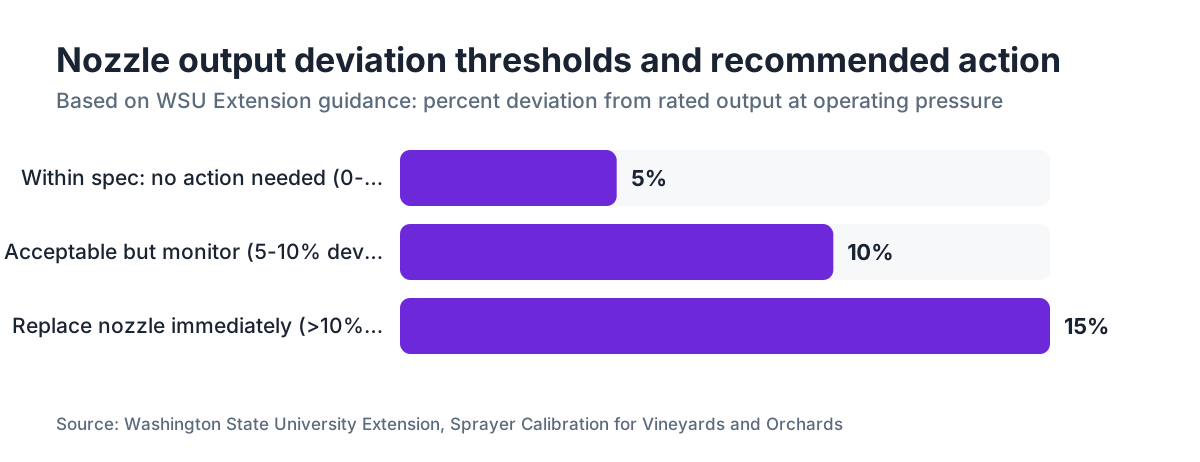
Individual nozzle output (fluid ounces per minute). Catch output from each nozzle separately with a collection jug and a stopwatch. Thirty seconds is a common interval; multiply by two for ounces per minute. WSU Extension recommends replacing any nozzle that varies more than 10% from the manufacturer's rated output at the tested pressure [4].
Average nozzle output across the boom. Calculate this after testing every nozzle. It becomes the input for your GPA calculation.
Gallons per acre (GPA) delivered. This ties nozzle output to your actual travel speed and spacing. The formula is: GPA = (GPM per nozzle × 5,940) / (nozzle spacing in inches × travel speed in MPH). Record the travel speed you used during the test, not your target speed.
Date, operator name, equipment ID, and total hours on the pump. These turn a snapshot into a maintenance history.
Filter condition and nozzle type/age. Note whether screens were clean and which tips were installed. If you swap tips, retest.
One number a lot of managers skip: uniformity across the boom. Knowing the average isn't enough. A boom where every other nozzle runs 20% high and low averages out on paper but sprays unevenly in the row. Test every nozzle, not a sample.
What does a spray equipment test record actually look like?
Here's a table format you can reproduce on paper or in a spreadsheet. You don't need software for this. A $2 notebook works if you fill it out the same way every time.
| Field | What to write |
|---|---|
| Date | MM/DD/YYYY |
| Equipment ID / Name | Tractor #2 + 200-gal airblast |
| Operator | Full name |
| Pump hours at test | Hours from meter |
| Operating pressure (PSI) | Reading at boom gauge |
| Nozzle type and size | e.g., TeeJet TXR8002 |
| Collection interval (sec) | 30 or 60 |
| Nozzle 1 output (fl oz) | Measured volume |
| Nozzle 2 output (fl oz) | Measured volume |
| ... (repeat per nozzle) | |
| Average nozzle output (fl oz/min) | Calculated |
| % deviation from rated output | ((actual - rated) / rated) × 100 |
| Travel speed at test (MPH) | GPS-verified |
| Row spacing (ft) | Measured |
| Calculated GPA | Formula result |
| Filter condition | Clean / replaced / note |
| Action taken | None / nozzles replaced / pressure adjusted |
| Next test due | Date |
If any nozzle deviates more than 10% from rated output, replace it before the next application. Mark that action in the record. That note is what makes an inspection go smoothly.
UC Davis Cooperative Extension publishes a calibration worksheet for airblast sprayers that follows this structure closely [5]. Cornell's vineyard team has a similar form for the tower sprayers common in Finger Lakes operations [6]. Both are free to download. Print them and keep a copy in the equipment shed even if you build your own version.
How often should you test spray equipment?
More often than most people do it. That's the honest answer.
WSU Extension recommends calibrating before each spray season, after any nozzle replacement, after any significant change in product or carrier volume, and at least once mid-season [4]. For a vineyard running a standard dormant-to-harvest program, that's a minimum of two tests a year. Running 15 or more applications? Test at the beginning, middle, and end of the season.
Nozzles wear. Ceramic tips outlast stainless, which outlast plastic, but all of them drift. A nozzle that has pushed 50 cumulative hours of abrasive fungicide slurry is not the same nozzle it was new, even if it looks fine. Without a logged test, you won't know when the drift started.
For equipment shared between operators or across blocks, log who tested it and when. Shared equipment is where calibration records go to die. One person thinks the other did it. Neither did.
After any filter cleaning or screen replacement, run at least a quick pressure check and sample a few nozzles. Screen changes shift flow resistance enough to move output in some systems.
How do you calculate gallons per acre from your test data?
This calculation connects your bench test to what's actually happening in the field, and it's where most errors compound.
The standard formula, published by Penn State Extension and used across the industry, is [7]:
GPA = (GPM × 5,940) / (W × S)
Where:
- GPM = total gallons per minute from all nozzles covering one side of one row (or the full boom for broadcast)
- 5,940 is a unit conversion constant
- W = effective width covered per pass, in inches (for row crops, usually row spacing)
- S = travel speed in miles per hour
Run a real example. Say you have an airblast sprayer covering one row at a time. Row spacing is 8 feet (96 inches). You measured average nozzle output at 0.28 GPM, 12 nozzles per side, total 3.36 GPM. Travel speed verified at 3.2 MPH.
GPA = (3.36 × 5,940) / (96 × 3.2) = 19,958 / 307.2 = 65 GPA
Record that number. When you fill out your pesticide application record and write down the rate you applied, you're vouching that your equipment delivered 65 GPA at that pressure and speed. If the test record supports it, you have documentation. If you're guessing, you don't.
Travel speed is the most common source of error. A GPS device, or even counting seconds over a marked distance, beats a tractor speedometer, which can be off by 10 to 20%.
What records are legally required, and for how long do you keep them?
Federal FIFRA rules require any applicator of a Restricted Use Pesticide to keep application records for at least two years [3]. Those records have to include the product name and EPA registration number, total amount applied, date, location, and the name and certification number of the applicator. They don't explicitly demand a calibration log, but the "amount applied" entry is only defensible if you know your equipment's output.
The EPA WPS (40 CFR Part 170) requires agricultural employers to keep records of all pesticide applications and to give workers access to central posting information [2]. Calibration test records aren't spelled out under WPS, but they support the accuracy of the application records that are.
State rules vary, and many run stricter. California requires pesticide use reports filed with the county agricultural commissioner within a set window, and the supporting records (including equipment used and rates applied) must be kept for three years under California Food and Agricultural Code Section 12981 [8]. Washington requires two years under WAC 16-228 [9]. Oregon, New York, and Pennsylvania set their own requirements in the two-to-three-year range.
The practical answer: keep calibration test records for at least three years to cover the most common state requirement. File them in a binder with your pesticide application records so everything sits in one place at inspection. Digital copies are fine as backup, but keep a printed copy on-site.
For vineyards running multiple blocks or several pieces of equipment, a tool like VitiScribe can tie each test record to the equipment ID and the specific application records it supports, which helps at inspection time.
What's the right way to handle a nozzle that fails the output test?
Replace it. That's the whole answer.
A nozzle more than 10% out of spec costs you more in over- or under-application than a new tip costs to buy. A single TeeJet or Albuz ceramic nozzle runs roughly $2 to $8 depending on type [10]. Even re-tipping a 20-nozzle airblast comes in under $200 for most standard tips. A misapplied fungicide pass, or the paperwork from a drift complaint, costs orders of magnitude more.
When you replace nozzles, record it. Write the date, the nozzle position numbers you replaced, the replacement tip type and lot number if you have it, and who did the work. Then run a full calibration test on the new tips before the next application. New nozzles are made to spec, but the only way to confirm they're performing at spec in your system, at your operating pressure, is to test them.
Don't mix old and new nozzles unless you've confirmed the old ones are still in spec. A boom with one worn nozzle and ten fresh ones sprays unevenly at that position.
How do you record results for different sprayer types (airblast vs. boom vs. backpack)?
The core data is the same for every type: pressure, individual nozzle output, average output, date, operator, equipment. The method for collecting it changes.
Airblast sprayers (the most common type in vineyards) have multiple nozzles arranged around a fan housing. Test each nozzle position by catching output in a collection jug. Running the sprayer into a tarp or calibration frame while measuring is safer than catching from a running fan. Some managers use a capture system that routes each nozzle's output through a tube into a graduated container. See the UC Davis airblast calibration guide for the setup [5].
Boom sprayers (used for cover crops and some floor applications) are simpler. Each nozzle is stationary and easy to reach. Catch output from every nozzle, calculate the average, and use the GPA formula above with your boom width.
Handgun or backpack sprayers used for spot treatments need pressure and output recorded too, especially if they carry pesticides. For a backpack, collect spray from the nozzle for 30 seconds into a graduated container at your normal operating pressure (read the gauge if it has one, estimate from pump stroke rate if it doesn't). Record that alongside the product used and the area treated.
Tower and tunnel sprayers follow the same principles as airblast but may have more nozzle positions. Cornell's guidance addresses tower sprayer calibration for high-density plantings and recommends testing each zone separately [6].
For every type, the record should identify the sprayer uniquely (by serial number, asset tag, or a name you've assigned) so you can track performance over time for that specific machine.
How does spray test documentation connect to pesticide application records?
Pesticide application records and equipment calibration records are separate documents, but they reference each other. The application record says what you applied, where, when, at what rate. The calibration record is the evidence that your equipment actually delivered that rate.
When you fill out an application record for a Restricted Use Pesticide, the "amount applied" or "rate applied" field should match what your calibration test says your equipment delivers at the settings you used. If the application record says 50 GPA and your calibration log shows the sprayer set to deliver 65 GPA, you have a discrepancy that becomes a problem in an audit.
Best practice, and what most experienced managers do, is to note the equipment ID and the test date right on the application record. Something like "Equipment: Airblast #1, calibrated 04/10/2025, delivering 58 GPA at 100 PSI, 3.0 MPH." That cross-reference lets an auditor or a county ag commissioner pull both documents and check they agree.
For California vineyards, this link carries extra weight because county agricultural commissioners have authority to audit pesticide use records and request supporting documentation, equipment records included [8]. Having the calibration log already cross-referenced makes that process fast.
This is also where a vineyard operations platform earns its keep. Paper works fine, but cross-referencing paper is slow. VitiScribe links calibration events to the equipment record and surfaces them when you fill out an application log, which cuts paperwork time and the chance of a mismatch.
What are common mistakes in spray equipment recordkeeping?
Recording pressure at the pump instead of at the boom is the most common. Pressure drops between pump and nozzles, sometimes by 20 to 30 PSI, so the number you write down should be the pressure where the nozzles are actually working.
Skipping travel speed is the second big one. A lot of logs have PSI and nozzle output but no speed, which leaves no way to calculate GPA from the record. Speed is also where field calibration goes wrong: operators speed up on long rows and slow down at row ends. If your GPA calculation assumes 3.0 MPH and you're running 3.8 MPH, you're under-applying by about 20%.
Using an average instead of individual nozzle readings. If you record "average output: 0.28 GPM" but never checked each nozzle, you don't know which ones are worn. That average can hide one nozzle spitting 0.50 GPM and another dribbling 0.06 GPM.
Leaving out nozzle type and size. When something goes sideways six months later, "TeeJet 8003" tells you something. "Nozzle" tells you nothing.
Leaving the "action taken" field blank. Find a problem and fix it, write it down. Find nothing, write "no action required." A blank field looks like you never finished the record.
Storing records somewhere other than with the pesticide application records. At inspection, hunting through three places for your calibration logs, spray records, and purchase receipts makes for a bad day. Keep them together.
Is there a minimum frequency or format required by state extension programs?
No state or federal regulation mandates a specific calibration form or a specific frequency beyond the general requirement that applications be label-compliant. The extension programs offer guidance, not law.
WSU Extension recommends calibrating at the start of the season and any time output might have changed [4]. UC Davis recommends the same and notes that California's Department of Pesticide Regulation expects calibration to be regularly performed and documented, without setting a specific interval [5]. Cornell Extension recommends pre-season and mid-season calibration as a minimum for commercial vineyards [6].
The standard the industry has settled on is this: before the first application of the year, after any nozzle change, after any filter replacement that might affect flow, and any time your coverage looks uneven in the field.
For format, extension programs publish worksheets you can use directly or adapt. The UC Davis worksheet for airblast sprayers, the Cornell worksheet for tower sprayers, and the Penn State boom sprayer worksheet all cover the same core fields described here [5][6][7]. Starting from one of those beats building your own from scratch.
The one thing that matters most about format is that it captures individual nozzle outputs, more than totals. Everything else is secondary.
Frequently asked questions
How do I measure individual nozzle output for an airblast sprayer?
Run the sprayer at your normal operating pressure with water only. Hold a collection jug under each nozzle for exactly 30 seconds, then measure the volume in fluid ounces. Multiply by 2 for ounces per minute, then divide by 128 to convert to gallons per minute. Do every nozzle position separately. WSU Extension recommends replacing any nozzle more than 10% above or below its rated output at tested pressure.
What PSI should I record, pump pressure or boom pressure?
Record boom pressure, meaning the gauge reading at or nearest the nozzle manifold. Pump pressure runs higher than what the nozzles see because of friction loss through hoses, filters, and fittings. Using pump pressure overstates the actual operating pressure and throws off your output calculations. If your sprayer only has a pump-mounted gauge, note that in the record and measure the actual pressure drop in your system at least once.
How long do I need to keep spray equipment calibration records?
Federal FIFRA rules require two years for Restricted Use Pesticide application records. California requires three years under the California Food and Agricultural Code. Washington requires two years under WAC 16-228. A safe default for any commercial vineyard is three years, kept with your application records. Calibration logs tied to a specific application should be retained as long as that application record is retained.
What formula converts nozzle output to gallons per acre?
GPA = (GPM × 5,940) / (W × S), where GPM is total output for the area covered per pass, W is effective width in inches, and S is travel speed in MPH. Penn State Extension publishes this formula as the standard for row crop calibration. Verify your travel speed with a GPS reading, not a tractor speedometer; speedometer error of 10 to 20% is common and skews your GPA calculation badly.
Does the EPA Worker Protection Standard require written calibration records?
The WPS (40 CFR Part 170) does not explicitly mandate a calibration log. It requires that applications comply with the pesticide label, which specifies application rates. A calibration record is the practical documentation that your equipment delivered the label rate. Without it, you can't verify label compliance in an audit. Most state pesticide programs expect calibration documentation as supporting evidence for application records.
How do I record spray test results for a backpack or handgun sprayer?
Record date, operator, nozzle tip type, operating pressure (from the gauge or estimated from pump stroke), output measured by collecting 30-second spray volume in a graduated jug, and the area or conditions where it will be used. Note the nozzle tip age. For spot treatments under WPS, record enough information to reconstruct the approximate rate applied. The same two-year minimum retention applies if a Restricted Use Pesticide is involved.
How often should nozzle tips be replaced in a vineyard sprayer?
Replace any nozzle that tests more than 10% above or below its rated output at operating pressure, per WSU Extension guidance. In practice, nozzles delivering abrasive materials (wettable powders, kaolin clay) wear faster than water-based products. Testing at the start of each season catches most wear. High-volume operations should test mid-season too. Ceramic tips last far longer than plastic but still drift over time and need testing.
What should I write in the 'action taken' field of a calibration record?
Write exactly what you did or confirmed. 'No action required, all nozzles within 5% of rated output' is a complete entry. 'Replaced nozzles 3, 7, and 11 with TeeJet TXR8003 ceramic tips; retested, all within 4% of rated' is better. If you adjusted pressure, note the before and after PSI. A blank field looks incomplete; 'no action required' tells an auditor you actually reviewed the results.
Can I use a phone or tablet to record calibration data in the field?
Yes. A spreadsheet app, a notes app, or vineyard record-keeping software all work. The format doesn't matter as long as it captures every required field: date, equipment ID, pressure, individual nozzle outputs, calculated GPA, travel speed, operator, and action taken. Whatever you use, back it up or sync it off-device right away. A phone that falls in the vineyard is not a reliable archive.
Do calibration records help if there's a pesticide drift complaint?
They help a lot. A drift investigation typically asks whether the applicator followed the label, used appropriate equipment, and applied at the correct rate. A calibration log showing the sprayer was tested before the application, was delivering the recorded rate, and had pressure set correctly demonstrates you operated the equipment properly. Without records, the investigation relies only on what you say, not what you documented.
What's the difference between a calibration record and a pesticide application record?
A calibration record documents what your equipment can deliver: pressure, nozzle output, GPA at a given speed. A pesticide application record documents what you actually applied on a specific date to a specific field: product, rate, operator, timing. The calibration record supports the application record by proving the equipment was set up to deliver the rate you claimed. Both should be filed together and cross-referenced.
Is there a standard form provided by a state extension program I can use?
Yes. UC Davis Cooperative Extension publishes an airblast sprayer calibration worksheet for California vineyards. Cornell University Extension has calibration forms for tower and airblast sprayers used in New York. Penn State Extension provides a boom sprayer calibration worksheet. All three are free and cover the core fields this article describes. Search the institution's agricultural extension website for 'sprayer calibration worksheet' to find the current version.
How do I account for multiple nozzle sizes on the same sprayer?
Test each nozzle size separately and record outputs by position and nozzle type. Some airblast sprayers use different tip sizes at different positions to achieve a target distribution pattern. For GPA calculations, use the total output from all nozzles covering the row per pass, regardless of whether they're the same size. Note each nozzle's type and size in the record so a future tester can verify like-for-like performance.
Sources
- EPA, Federal Insecticide, Fungicide, and Rodenticide Act (FIFRA, 7 U.S.C. §136), Pesticide Registration: The label is the law under FIFRA; applying at a rate not on the label is a violation.
- EPA, Worker Protection Standard, 40 CFR Part 170: EPA WPS requires that pesticide applications be made in compliance with the label and that application records be maintained.
- EPA, Restricted Use Products and Recordkeeping Requirements: Applicators of Restricted Use Pesticides must keep written application records including amount applied and equipment used for at least two years.
- Washington State University Extension, Sprayer Calibration for Vineyards and Orchards: WSU Extension recommends replacing any nozzle that deviates more than 10% from rated output and calibrating at the start of each season and after any nozzle replacement.
- UC Davis Cooperative Extension (UC ANR), Airblast Sprayer Calibration for Vineyards: UC Davis publishes a calibration worksheet for airblast sprayers and notes that California DPR expects calibration to be regularly performed and documented.
- Cornell University Cooperative Extension, Vineyard Spray Equipment Calibration: Cornell Extension recommends pre-season and mid-season calibration as minimum for commercial vineyards and provides worksheets for tower sprayer calibration in high-density plantings.
- Penn State Extension, Boom Sprayer Calibration: Penn State Extension publishes the standard GPA formula: GPA = (GPM × 5,940) / (nozzle spacing in inches × travel speed in MPH).
- California Department of Pesticide Regulation, Pesticide Use Reporting (California Food and Agricultural Code Section 12981): California requires pesticide use records to be kept for three years and county agricultural commissioners have authority to audit and request supporting documentation including equipment records.
- Washington State Department of Agriculture, Pesticide Application Records (WAC 16-228): Washington State requires pesticide application records to be retained for two years under WAC 16-228.
- TeeJet Technologies, Spray Nozzle Catalog and Product Specifications: Standard vineyard nozzle tips for airblast and boom applications typically cost $2 to $8 per nozzle depending on material (plastic, stainless, ceramic).
- EPA, Pesticide Labels: Operating a sprayer at a rate that differs from the label constitutes a misuse under FIFRA regardless of intent.
Last updated 2026-07-09