How to record spray applications timed to phenological growth stages
TL;DR
- Tie every spray record to a specific BBCH or Eichhorn-Lorenz growth stage, more than a calendar date.
- Record the stage code, product, rate, REI, PHI, and applicator at the moment of application.
- This satisfies EPA Worker Protection Standard requirements, makes audits fast, and builds season-to-season data that sharpens your spray timing decisions.
Why tie spray records to growth stages instead of just dates?
Calendar dates lie. A spray applied on April 15 in a warm Central Valley year hits vines at shoot emergence. The same date in a cool Willamette Valley year might catch dormant wood. When you review records later, or when an inspector asks why you applied a fungicide, "April 15" tells you almost nothing. "BBCH 53, green tip to half-inch green" tells you everything.
Growth-stage tagging also makes your records useful for future seasons. If you see that powdery mildew always breaks your threshold at Eichhorn-Lorenz stage 12 (two leaves separated), you can set a standing protocol instead of reacting every year. UC Cooperative Extension recommends recording both calendar date and growth stage in spray logs precisely because the two pieces of data together let you correlate disease pressure with vine development rather than with the weather on a specific day [1].
There's a compliance angle too. State departments of agriculture and the EPA's Worker Protection Standard require that pesticide application records capture enough information to reconstruct the application event. Linking to growth stage doesn't satisfy a specific federal checkbox, but it protects you when an adjudicator asks whether a pre-harvest interval was observed: if you know your harvest date and you know you sprayed at véraison, the math is unambiguous.
Short version: date-only records are legally marginal and agronomically useless. Stage-coded records are neither.
What phenological scales do vineyards actually use?
Two scales dominate practical vineyard work. You'll see both in extension recommendations and on pesticide labels.
The Eichhorn-Lorenz (E-L) scale was published in 1977 and runs from stage 1 (dormant bud) through stage 47 (after harvest, leaves beginning to fall). It's the scale most commonly cited in Australian and New Zealand literature and it's widely used in research. The original scale defines all 47 stages and remains the reference growers reach for [8].
The BBCH scale is a broader, internationally standardized system that covers all crops. For grapevines it runs from BBCH 00 (dormancy) to BBCH 99 (senescence). Many European and Pacific Northwest spray programs use BBCH codes because they print neatly on integrated pest management worksheets and stay unambiguous across languages [9].
For record-keeping, the difference matters less than consistency. Pick one scale, use it every time, and make sure everyone who fills in records knows which one you're using. Standardize on a single system within your operation and stop translating between two.
A third option shows up on older California records: descriptive stages like "budbreak," "woolly bud," "2-inch shoot," "pre-bloom," "50% bloom," "fruit set," and "véraison." These work fine for internal records, but they're not numeric, so they don't sort or filter cleanly in a spreadsheet. If you're doing any analysis across blocks or years, numeric codes are worth the small learning curve.
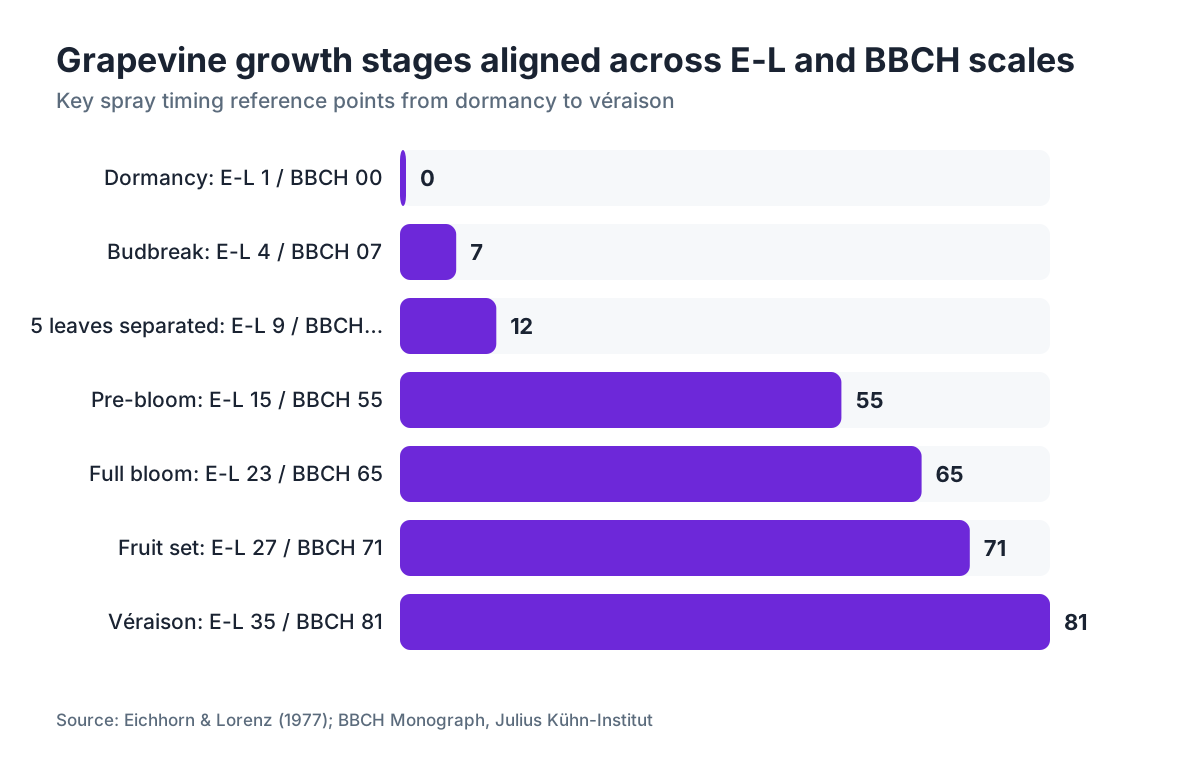
| Scale | Dormancy | Budbreak | 5-leaf | Pre-bloom | Full bloom | Fruit set | Véraison |
|---|---|---|---|---|---|---|---|
| E-L | 1 | 4 | 9 | 15 | 23 | 27 | 35 |
| BBCH | 00 | 07 | 12 | 55 | 65 | 71 | 81 |
| Descriptive | Dormant | Budbreak | 5-leaf | Pre-bloom | Full bloom | Fruit set | Véraison |
What information does a legally compliant spray record need to include?
The federal baseline comes from the EPA Worker Protection Standard (40 CFR Part 170), which requires agricultural employers to keep pesticide application information for two years after the date of application [4]. The WPS specifies that records contain the product name, EPA registration number, active ingredient(s), location and description of the treated area, date of application, and the restricted-entry interval (REI) for the product used.
EPA guidance is blunt about the retention rule: records "must be kept for 2 years" and made available to workers, handlers, and their designated representatives on request [4]. That two-year window catches a lot of small operations off guard, especially during pre-harvest interval disputes.
State requirements often go further. California's Department of Pesticide Regulation requires a monthly pesticide use report (PUR) that includes the site, commodity, acres treated, product, pounds of active ingredient applied, and applicator license number [5]. Oregon and Washington run similar county-level reporting systems. The growth stage field is almost never mandatory at the state level, but nothing stops you from adding it, and it never hurts your compliance position.
Here's the minimum field list I'd put in any spray record, paper or digital:
- Block/vineyard identifier
- Date and time of application
- Growth stage (E-L or BBCH code plus a brief description)
- Operator and applicator name and license number
- Equipment used
- Product name, EPA registration number, formulation
- Rate per acre (and per unit area if different)
- Total volume applied
- Water volume per acre
- Wind speed, temperature, relative humidity at application time
- REI (in hours)
- PHI (in days)
- Any re-entry restrictions or PPE notes
- Signature or initials of the person completing the record
That's 15 fields. On paper it's a cramped form. In a spreadsheet or a dedicated platform it takes about 90 seconds to complete after an application.
How do you identify and record the correct growth stage at application time?
Walk the block the day of application, or the morning before. Don't guess from last week's scouting note. Vine development across a 10-acre block can vary by a full E-L stage between the warmest end-rows and the coolest interior rows. Record the majority stage: what do 70% or more of the shoots show?
For fungicide timing, the precise stage matters a lot. The critical powdery mildew infection window runs from E-L 9 (5 leaves separated) through E-L 29 (end of flowering). A record that says "E-L 12, 4 leaves separated" is more defensible than "early shoot growth" if you're ever asked why you applied a DMI fungicide on a particular day.
WSU's powdery mildew management guidance keys spray timing to E-L stages, and identifies E-L 12 through E-L 27 as the highest-risk window for Erysiphe necator [3]. UC Cooperative Extension resources similarly tie Botrytis management timing to bloom, roughly E-L 23 to E-L 29 [1].
Keep a laminated E-L or BBCH reference card in the cab of your spray rig. The University of California IPM program publishes grapevine growth stage references that are worth laminating [1]. When you finish an application, fill in the stage field before you drive back to the shop. Memory is unreliable by end of day, especially during a 14-hour spray window.
For records that cover multiple blocks sprayed in a single day, record the stage for each block separately. A Chardonnay block on a south-facing slope is often a full week ahead of a Cabernet block on heavier soil. Treating them as identical for record purposes is an error that compounds over time.
How should you record growth stage when blocks are at different stages?
This is the practical problem nobody talks about in extension publications. On a real farm you might have six varieties across four soil types across three aspects. On any given spray day, your earliest block sits at E-L 23 (beginning of flowering) and your latest at E-L 15 (pre-bloom, inflorescences separate).
The right answer: one record line per block, per application. Not one record for the whole farm per day. This adds paperwork, but it's the only approach that gives you accurate stage-specific data, and the only approach that holds up if two blocks needed different products at different rates because of their development difference.
On paper, that means your spray log has six rows for a six-block spray day. In a spreadsheet or software, set the block as a required field so you can't accidentally aggregate. Software that links blocks to spray records, like VitiScribe, lets you filter by block and stage so you can see every application you've made at E-L 23 across all blocks across all years. That query is impossible in a paper log.
For organic operations, the block-by-block approach matters even more, because your certifier reviews records to confirm that allowed materials were used and that rotational restrictions between sulfur and oil sprays were respected. Organic certifiers under the USDA National Organic Program need application records that trace back to specific field locations [6].
What's the best way to handle REI and PHI tracking alongside growth stage?
REI (restricted-entry interval) and PHI (pre-harvest interval) are fixed by the pesticide label and can't be negotiated. The label is the law under FIFRA [7]. What growth-stage recording adds to these fields is context: if you know you sprayed a 14-day PHI product at E-L 35 (véraison), you know exactly how many days remain before that PHI clears relative to your expected harvest date.
The calculation is straightforward. If véraison in your block historically runs 45 days before harvest, and you spray a product with a 28-day PHI at E-L 35, you have a 17-day buffer. Record it in the notes field of the log. Don't leave this as a mental calculation you'll try to remember in September.
For REI tracking, the growth stage doesn't change the interval, but it reminds you who was in the block. If you're suckering at E-L 12 and you spray the same morning (please don't, but it happens), the REI means no re-entry without full PPE for the labeled interval. EPA WPS requires that the REI be posted at a central location accessible to workers, and that workers be notified verbally if the REI is 48 hours or longer [4].
One practical system: after logging an application, write the REI expiration date and time on a whiteboard at the block entrance or the equipment barn. Cross-reference it to your spray log entry by date. When the REI clears, note it in the log. This dual-confirmation approach keeps growers out of trouble in inspections where the inspector asks "how did you know it was safe to re-enter?"
Should you record weather conditions and how do they interact with growth stage data?
Yes, record weather. Not because it's required everywhere (it isn't), but because weather at application time decides whether the application worked. A fungicide applied at 90°F with 5% relative humidity under an inversion layer behaves nothing like the same product at 68°F with 55% RH on a calm morning.
The minimum weather fields are wind speed (mph), wind direction, temperature (°F), and relative humidity (%). If you have a weather station in the vineyard, pull the data from it. If you don't, a $15 handheld weather meter from any agricultural supplier gives you adequate readings. Record these at the start of the application and, for long spray days, at midpoint.
Combine weather data with growth stage and the record becomes analytical. You can answer questions like: "We had poor Botrytis control in 2022 during bloom. Were we spraying in adverse conditions?" If your records show E-L 23, 88°F, 8% RH, that tells you something. If they show E-L 23, 72°F, 55% RH, you look elsewhere for the problem.
UC IPM and WSU guidance both recommend capturing temperature and RH at application time as part of a complete spray record, because efficacy problems trace back to application conditions at least as often as to product choice [3]. This is especially true for copper applications, where tank mix compatibility and phytotoxicity risk both shift with temperature.
How do you set up a paper spray log that captures growth stage efficiently?
Paper is not dead on small farms. If you run fewer than 20 acres and one spray rig, a well-designed paper log is completely adequate for compliance and reasonably good for agronomic review.
Design the form so growth stage gets its own column, not a spot buried in a notes field. A pre-printed column labeled "Growth Stage (E-L #)" with a second narrow column for a one-word description ("pre-bloom", "véraison") takes about five seconds to fill in.
Print the form on card stock or use a clipboard with a weatherproof cover. Keep a spare laminated E-L reference card attached to the clipboard. Store completed logs in a binder organized by season, with a divider per block if you have multiple blocks.
The two-year retention requirement under EPA WPS means you need logs from the current season plus two prior seasons accessible and legible [4]. Store them somewhere dry. Paper spray records that turn into a moist brick in a barn corner are not "accessible."
For paper-to-digital conversion, some operations photograph each log page at the end of the season and store images in a labeled folder. It isn't a perfect backup, but it beats nothing if the paper is lost. A monthly 10-minute photo session at the end of each spray period costs almost nothing and has saved more than a few growers from reconstruction headaches during audits.
How do digital tools change growth-stage spray recordkeeping?
The core benefit of a digital system isn't convenience, it's queryability. A paper log tells you what happened. A digital log tells you what happened AND lets you ask questions across time and blocks.
A reasonable digital workflow looks like this: after each application, open a mobile-friendly form on your phone or tablet, enter the block, select the growth stage from a dropdown coded to BBCH or E-L, enter product and rate, and submit. The system timestamps the entry, logs your GPS location if you want it, and files the record against that block's history. The whole entry takes under two minutes.
Things to look for in any digital spray record tool: offline functionality (you're often in dead zones), growth stage codes as a structured field (not free text), automatic REI/PHI calculation from the product database, and export to a format your state ag department accepts. Most California growers must submit pesticide use reports to their county agricultural commissioner, and some digital platforms pre-format the export for that submission [5].
VitiScribe is built for vineyard compliance and links spray records to block-level phenology tracking, so growth stage, application history, and worker safety information live in one record rather than across three notebooks.
One honest caveat: no digital tool removes the need to walk the block and assess the growth stage yourself. The software records what you tell it. Enter the wrong stage because you guessed from last week's notes, and the record is wrong. Garbage in, garbage out. Physically staging the block before spraying is the human step nothing replaces.
How do organic certification records differ from conventional spray records?
Organic spray records need to satisfy both state pesticide law and your USDA NOP certifier's audit trail. The NOP requires certified organic operations to keep records for five years, not two [6]. That's a meaningful gap over the WPS minimum.
For allowed materials under NOP, you record everything a conventional grower records, plus you often document why a material was necessary and confirm you're using an approved brand on the NOP materials list. Not every brand of copper hydroxide or sulfur is NOP-approved. The brand and registration number in your spray record are how your certifier verifies compliance.
Growth stage is particularly handy in organic records because your certifier may ask whether your sulfur-oil rotation was timed correctly. Sulfur sprayed within 14 days of a narrow-range oil application can cause phytotoxicity, and the label and most organic extension guidelines say avoid that combination. If your records show sulfur at E-L 12 and oil at E-L 9 (seven days prior), the certifier can read the timeline at a glance.
Audit-ready organic spray records should include product, rate, date, target pest, and field location at a minimum, with growth stage strongly recommended for any timing-sensitive application [6].
What are the most common spray recordkeeping mistakes and how do you fix them?
Mistake 1: Recording date but not stage. Fix: add a "Growth Stage" column to your log form and make it required. Empty columns get filled in; missing columns don't.
Mistake 2: One record for the whole farm when blocks were at different stages. Fix: one row per block, every time. If that feels like too much paper, it's a sign you need a digital form.
Mistake 3: Filling in records at the end of the week from memory. Fix: record at the rig, same day, before you leave the block. A five-day-old memory of which block was at which stage is not reliable.
Mistake 4: Recording only the interval, not the REI expiration time. "REI: 48 hours" is less useful than "REI expires: April 16, 7:00 AM." The second one is something a field worker can act on.
Mistake 5: Losing records. Paper burns, floods, and molds. Digital records get deleted. Back up every record in a second location at least monthly. A free cloud folder or a USB drive in the house works.
Mistake 6: Using product nicknames instead of full product names and EPA registration numbers. "Sulfur" is not a record. "Microthiol Disperss, EPA Reg. No. 70506-187" is a record.
Mistake 7: Leaving out the applicator's license number. Most states require a licensed applicator for restricted-use pesticides, and the license number needs to be in the record [5]. Forgetting it is a citation-level mistake in a California DPR inspection.
How do you use historical spray records to improve future timing decisions?
This is the payoff most growers leave on the table. After three or four seasons of growth-stage-coded records, you own a dataset that tells you at which stage disease pressure first crossed your threshold, which products performed best at which stages, and where your spray timing ran consistently off.
The simplest review is an annual end-of-season walkthrough. Pull your records for the past season and ask: did any disease break through a spray program? At what growth stage? Was the prior spray timely relative to the disease's infection window? UC IPM publishes infection risk windows by stage for the major grapevine diseases, so you can benchmark your timing against established science [1].
With three or more years of records, patterns surface. Maybe your Chardonnay on Block 4 runs 10 days ahead of your Cabernet on Block 7, meaning a farm-wide spray program always hits them at different stages. Knowing that, you might split your pre-bloom application into two passes timed to each block's actual stage rather than spraying both on the same day.
Nobody has good industry-wide data on how much yield or quality improvement comes from stage-optimized timing versus calendar timing. The closest published estimates come from extension trial work, not randomized controlled studies. WSU viticulture guidance has documented 15-30% reductions in fungicide applications when programs shift from calendar to stage-based timing, though results vary considerably by variety and disease pressure [3]. Treat that range as directional, not a prediction for your specific site.
Frequently asked questions
Is recording growth stage required by law on spray records?
No federal or state pesticide law specifically requires a growth stage field. EPA WPS (40 CFR Part 170) requires product name, EPA registration number, active ingredient, treated area, date, and REI. Growth stage is a best-practice addition that improves compliance documentation and agronomic value. Some organic certifiers and private buyers require it contractually, but it's not a statutory mandate.
What's the difference between the E-L scale and BBCH scale for grapevines?
Eichhorn-Lorenz (E-L) is a 47-stage scale developed specifically for grapevines in 1977, widely used in research and Australian/New Zealand viticulture. BBCH is an internationally standardized multi-crop scale that runs to 99 for grapevines, common in European and Pacific Northwest programs. Both cover the same biological events. Pick one and use it consistently; the choice matters less than the consistency.
How long do I have to keep spray application records?
EPA WPS requires two years from the application date. USDA NOP certified organic operations must keep records five years. California DPR requires pesticide use reports be kept for two years. Some states require three years. Check your state ag department's rules, then keep to the longest applicable period if you're subject to multiple requirements. Store records somewhere dry and accessible.
Can I record the same spray across multiple blocks in one log entry?
Not if the blocks are at different growth stages, using different rates, or covering different acreages. EPA WPS and state pesticide reporting expect records that accurately represent the treated area and conditions. If Block 1 is at E-L 15 and Block 3 is at E-L 23, those are two separate entries. Combining them hides information that could matter in an audit or an efficacy review.
What weather conditions should I record alongside the growth stage?
At minimum: wind speed (mph), wind direction, temperature (°F), and relative humidity (%). Record at the start of the application. For spray days longer than four hours, take a midday reading too. This data helps you diagnose efficacy failures and demonstrates responsible practices if a neighbor complaint or drift incident arises. A basic handheld weather meter costs $15 to $40 and lasts years.
How do I handle spray records for a mixed-variety vineyard where blocks are at different stages?
Create a separate record line for each block, each application day. Note the growth stage observed in that specific block rather than averaging across the farm. This adds record volume but gives you accurate data for each variety's spray program. Over time, the per-block records reveal which varieties run early or late, letting you plan spray passes more efficiently.
Do spray records need to include the applicator's pesticide license number?
For restricted-use pesticides, yes. Most states require the certified applicator's license number in the record. California DPR inspections check for it specifically. For general-use pesticides, some states still require applicator identification. Include the license number on every record regardless of use classification; it costs nothing to add and protects you in an inspection.
How do I track pre-harvest intervals when spraying is timed to growth stages?
Record the exact date of application and the product's PHI in days. Also note your estimated harvest date for that block. Calculate and write down the PHI expiration date explicitly (application date plus PHI days). When you know a spray occurred at véraison and your block historically runs 45 days to harvest, you can quickly flag any product whose PHI exceeds that window.
What's the best way to assess growth stage before a spray application?
Walk the block the morning of the application. Assess 10 to 20 representative vines across the block, including border rows and interior rows. Identify the stage that describes 70% or more of the shoots. Use a laminated E-L or BBCH reference card. Don't rely on last week's scouting note; vines can advance a full stage in five days during active shoot growth in warm weather.
Can I use descriptive stage names instead of numeric codes in my spray records?
Descriptive terms like 'pre-bloom' or 'véraison' work fine for compliance. The problem is sorting and analysis. If you ever want to filter records by stage across multiple seasons, numeric codes (E-L or BBCH) sort cleanly in a spreadsheet or database. Descriptive terms require manual interpretation. For small single-variety operations, descriptive terms are adequate. For multi-block, multi-variety farms, numeric codes pay off.
How do spray records tie into worker re-entry rules under the EPA WPS?
EPA WPS (40 CFR Part 170) requires that after each application, the REI be posted at a central location accessible to workers, and that workers be notified verbally if the REI is 48 hours or longer. Your spray record should capture the REI in hours and the calculated expiration time, so there's no ambiguity about when the block is safe for unprotected entry. Keep the spray record and the posted notice synchronized.
How do organic certifiers use spray records during audits?
Organic certifiers under the USDA NOP review spray records to confirm that only approved materials were used, that the brand and EPA registration number match an approved product list, and that records are retained for five years. They may also check that material use was 'necessary' under NOP requirements. Growth stage data helps show that timing-sensitive applications were made appropriately and that incompatible products (like sulfur and oil) were not applied within harmful intervals.
What's the right way to correct an error in a spray record?
On paper: draw a single line through the error, write the correction next to it, initial and date the correction. Never use correction fluid or obliterate the original entry. Regulators view obliterated entries with suspicion. In digital systems, most platforms create an audit trail automatically when a record is edited. If your system doesn't log edits, add a notes field documenting what was corrected and when.
How many spray records do I actually need per season in a typical wine grape vineyard?
It varies enormously by disease pressure and variety, but a typical wine grape block in a humid eastern region might need 8 to 14 fungicide applications per season, plus insecticide and nutrient passes. In arid western regions, 4 to 8 fungicide applications is more common. Each application per block is one record entry. A 10-block farm doing 10 applications per season generates 100 entries, which sounds like a lot until you realize each takes under two minutes.
Sources
- University of California Statewide IPM Program (UC IPM), Grape Pest Management: UC recommends recording both calendar date and growth stage, publishes grapevine growth stage references, and provides infection risk windows by stage for the major grapevine diseases including Botrytis timing around bloom (E-L 23 to E-L 29).
- Washington State University Viticulture and Enology Program, Grape Powdery Mildew Management: WSU keys spray timing to E-L stages, identifies E-L 12 through E-L 27 as the highest-risk window for Erysiphe necator, recommends capturing temperature and RH at application, and documents 15-30% reductions in fungicide applications in stage-based vs. calendar-based programs.
- U.S. Environmental Protection Agency, Agricultural Worker Protection Standard (40 CFR Part 170): WPS requires application records (product name, EPA registration number, active ingredient, treated area, date, REI) be kept for two years and made available to workers upon request; workers must be notified verbally if REI is 48 hours or longer.
- California Department of Pesticide Regulation, Pesticide Use Reporting: California requires monthly pesticide use reports including site, commodity, acres treated, product, pounds of active ingredient, and applicator license number submitted to the county agricultural commissioner.
- USDA Agricultural Marketing Service, National Organic Program (7 CFR Part 205): USDA NOP certified organic operations must maintain records for five years, document that materials used are approved under the National List, and keep application records that trace to specific field locations.
- U.S. Environmental Protection Agency, Federal Insecticide, Fungicide, and Rodenticide Act (FIFRA): Under FIFRA, the pesticide label is a legal document and applicators are required to follow all label directions, including pre-harvest intervals and restricted-entry intervals.
- Eichhorn, K.W. and Lorenz, D.H. (1977), Phenological development stages of the grapevine, Julius Kuhn-Institut: The Eichhorn-Lorenz scale defines 47 development stages for grapevines from dormancy (stage 1) through post-harvest leaf fall (stage 47), published in 1977.
- BBCH Monograph, Julius Kuhn-Institut (Germany), Grapevine growth stages: The BBCH scale for grapevines runs from BBCH 00 (dormancy) to BBCH 99 (senescence) and is an internationally standardized coding system applicable across crop species.
Last updated 2026-07-10