What vineyard management software includes spray record and compliance features
TL;DR
- Several platforms handle spray records and compliance in one place, including AgCode, Vine Vision, Conservis, and newer purpose-built tools.
- The non-negotiables are restricted-entry interval tracking, California DPR or state-equivalent report export, EPA Worker Protection Standard documentation, and audit-ready PDF output.
- Prices run roughly $500 to $4,000 per year depending on acreage and feature tier.
Why spray record software matters more than a spreadsheet
Every vineyard manager knows they need spray records. Fewer know how fast a spreadsheet falls apart under a real compliance audit. California's Department of Pesticide Regulation requires a pesticide use report within seven days of the end of the month in which the application happened [1]. Washington State's Department of Agriculture mandates records be kept for two years [2]. Oregon, New York, and most other wine-producing states set their own intervals. Miss a field, forget an REI (restricted-entry interval), or transpose a registration number, and you're looking at fines that start around $1,000 per violation in California and climb from there.
Spreadsheets don't push back. They won't warn you that the pre-harvest interval for a fungicide you're about to apply is 14 days and harvest is in 10. Software does. That's the difference that shows up in the field.
The other pressure is the EPA Worker Protection Standard. Under 40 CFR Part 170, growers must keep records of all pesticide applications on agricultural establishments, hold them for two years, and make them available to workers or their representatives on request [3]. The WPS got tighter recordkeeping language in the 2015 revision, and audits from state lead agencies have picked up since. Compliance-built spray software generates the paperwork as you log applications, so you're audit-ready without hiring a compliance staffer.
What features actually belong in vineyard spray record software
Not every platform that calls itself "farm management software" handles the wine-specific compliance layer well. Get clear on what your operation genuinely needs before you sit through a single demo.
Pesticide use reporting (PUR) export. Farm in California and you need DPR-compliant output in the format your county agricultural commissioner accepts [1]. Some platforms generate this natively. Others make you export a CSV and reformat it by hand. That manual step is a liability.
REI and PHI tracking. Restricted-entry intervals (the time workers must stay out of a treated area) and pre-harvest intervals (the minimum days between last application and harvest) are both label requirements with legal weight. Software should flag conflicts the moment you schedule an application.
Worker Protection Standard documentation. The WPS requires you to record the crop, location, product name, EPA registration number, total amount applied, and date. Good software captures all of this in one application log entry and stores it in a searchable, printable format [3].
Tank-mix compatibility and label access. Some platforms link to the National Pesticide Information Retrieval System or similar databases so you can check labels without leaving the app. This isn't universal, but it's handy.
Organic certification records. If any of your blocks are certified organic or transitioning, your records need to satisfy the NOP rule at 7 CFR Part 205 too [4]. Not all spray software flags organic-approved inputs automatically, so confirm this before committing.
Audit-ready output. The whole point is handing an inspector a complete, legible record. That means printable reports, more than dashboard views.
Scout and phenology tracking, inventory, and cost-per-acre reporting are genuinely useful, but they sit behind the compliance core. Don't let a flashy yield-prediction module distract you from whether the spray log produces what your state agency wants.
Which platforms include spray records and compliance tools
Here's an honest comparison of the main options. Pricing comes from publicly available information and vendor-published ranges as of mid-2025. Small operations should get a direct quote, because tiered pricing moves with acreage and add-on modules.
| Platform | Spray/PUR Reporting | REI/PHI Alerts | WPS Docs | Organic Cert Support | Approx. Annual Cost |
|---|---|---|---|---|---|
| AgCode | Yes, CA DPR native | Yes | Yes | Partial | $1,800 - $4,000+ |
| Vine Vision | Yes | Yes | Yes | Yes | $900 - $2,500 |
| Conservis | Yes | Yes | Partial | Yes | $1,200 - $3,500 |
| FarmLogs (now Bushel Farm) | Limited | Limited | No | No | $600 - $1,500 |
| VitiScribe | Yes | Yes | Yes | Yes | Trial available |
| Granular (Corteva) | Yes | Yes | Partial | Partial | $2,000 - $5,000+ |
AgCode is the longest-standing viticulture-specific platform, with the deepest tie-in to California's county PUR submission workflow. If you file with a county ag commissioner, it's the one most of their staff have seen before. The tradeoff is cost and a UI that hasn't changed much in years.
Vine Vision started in Australia and moved into U.S. markets. It handles small to mid-size wine estates well and has a better organic certification workflow than most competitors.
Conservis and Granular are row-crop platforms that vineyard operations sometimes adopt. They work. But the viticulture-specific features (block-level vine counts, canopy management records, variety-level spray history) are thinner than the purpose-built options.
FarmLogs, rebranded to Bushel Farm after Bushel acquired it, has drifted toward grain farming. Its spray recordkeeping works, but it wasn't built for the compliance depth a vineyard in a regulated state needs.
For smaller operations without complex multi-county reporting, free state extension templates are a real starting point (covered further down), and the lighter-weight paid tiers of Vine Vision or VitiScribe close the gap once transcription becomes a risk.
How does EPA Worker Protection Standard compliance fit into spray software
The 2015 revision of the EPA's Worker Protection Standard is the federal floor for pesticide recordkeeping on farms [3]. Under 40 CFR Part 170.309, you must keep records of applications that include the crop or commodity treated, the location, the product name, the EPA registration number, the total amount applied, the date of application, and the restricted-entry interval.
The EPA's guidance is blunt about retention. As the regulation puts it: "The agricultural employer must retain pesticide application and hazard information for a minimum of 2 years following the date of the application" [3]. Those records must reach workers, handlers, or their representatives within 15 days of a request during that window.
What this means in practice: your software needs to store every field in that list and pull it back in seconds. Paper binders technically comply, but retrieval bogs down past about 50 applications a season. Software with searchable application history solves that.
Some platforms also generate the WPS Central Posting, a physical document you're required to display at a central location on the property. Not all do this automatically, so ask vendors specifically about WPS posting output, more than record storage.
Extension programs at UC Davis and Cornell have both published WPS compliance checklists worth running against whatever software you're weighing [6] [7]. WSU Extension has practical guides for Pacific Northwest growers working across Washington, Oregon, and Idaho rules at once [8].
What do California DPR spray records require specifically
California runs the most demanding pesticide use reporting framework in the country. Under California Food and Agricultural Code Section 12981 and the implementing regulations at 3 CCR Section 6624, growers must submit a Pesticide Use Report (PUR) to their county agricultural commissioner within seven days of the end of the month in which the application occurred [1].
A California PUR needs the grower license number, county, township/range/section location, commodity, acres planted, acres treated, product name, registration number, pounds of active ingredient, application method, and the name of the person making the application. Missing or wrong fields get kicked back, which drops you into a paperwork loop that eats hours.
Software that integrates with the California DPR system (AgCode is the best-known example, and Vine Vision and others have built the connection) pre-populates most of these fields from your operation profile and application log. You review, confirm, submit. Meaningfully faster than any manual process.
Farm across multiple California counties, common on the Central Coast, and each county may have slightly different submission preferences even though the underlying data requirements match. Ask any vendor how they handle multi-county operations.
How much does vineyard spray record software cost
Two things drive cost: acreage and the feature tier you need. A 20-acre estate with one grape variety has very different needs than a 500-acre operation managing 30 blocks across several AVAs.
Based on public pricing and industry conversations, expect:
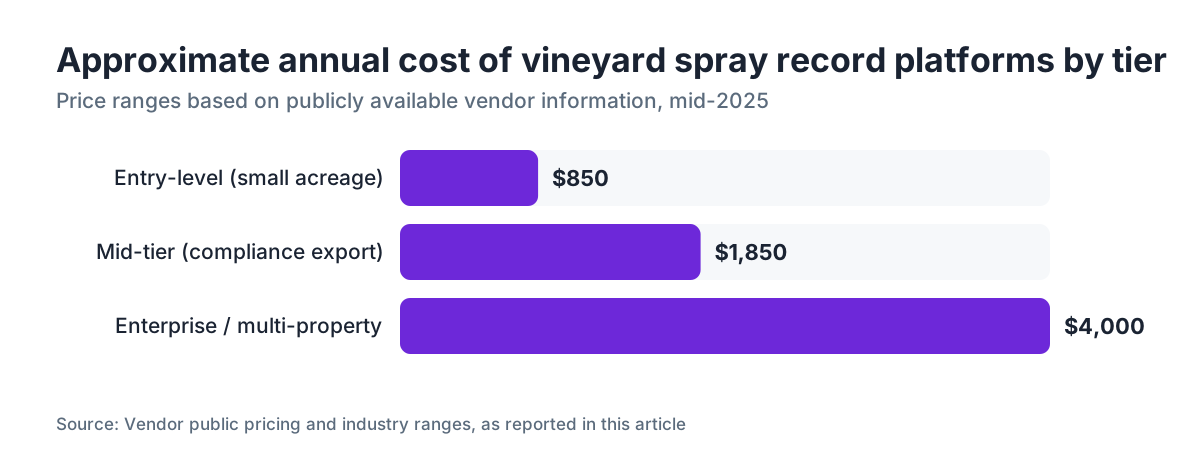
- Entry-level or small-acreage plans: $500 to $1,200 per year
- Mid-tier plans with full compliance exports: $1,200 to $2,500 per year
- Enterprise or multi-property platforms: $3,000 to $5,000 or more per year
Some platforms charge per block or per user instead of per acre, which makes pricing unpredictable as you grow. Ask vendors to quote you at 1.5 times your current scale so you know what scaling costs.
Implementation time is a real cost too. Moving from spreadsheets or paper typically takes 20 to 40 hours of setup for a mid-size vineyard once you factor in uploading historical block data, configuring products and rates, and training field staff. Budget for that before you sign.
Free trials are worth taking seriously. Most platforms offer 14 to 30 day trials. Spend at least one full spray event logging applications in the trial before you commit. If a single application takes more than three minutes to enter, your field foreman won't use it.
Can spray record software handle organic and biodynamic certification records
Organic certification under the USDA National Organic Program (7 CFR Part 205) requires records that fully disclose all activities and transactions of your operation for five years [4]. That covers every input applied to your vineyard, even inputs allowed under organic rules, plus documentation that prohibited substances weren't used.
Most spray platforms can store organic input records. Not all flag whether a product is NOP-compliant. Run a mixed operation with conventional and certified organic blocks, and you need software that keeps the two record streams separate and clear.
Vine Vision and a few other viticulture-focused platforms keep a product database that tags inputs as NOP-approved, NOP-prohibited, or jurisdiction-dependent (some materials are allowed under one certifier's reading but not another's). Genuinely useful. Finding out after the fact that you logged a conventional wettable sulfur product on an organic block because the software didn't distinguish is the kind of mistake that costs a season's organic premium.
Biodynamic certification through Demeter adds another layer. Demeter USA doesn't have the digital integration that NOP certifiers do, so you'll likely still export reports and submit them manually. Software that produces clean, date-sorted application histories makes that a lot less painful.
What questions should you ask a vendor before buying
Most vendor demos are built to impress, not to surface the edge cases that break your workflow at 6 a.m. on a spray day. Here's what to press on.
Does your PUR export match my county ag commissioner's current format? California counties update. If the software uses a static template, a format change at the state level can leave you filing incorrectly.
How are REI and PHI alerts triggered? Some platforms alert at scheduling. Others only alert at application logging. The first is more useful. An alert that fires after you've already logged the application is too late to matter.
What happens to my data if I cancel? You need to export your full application history in a portable format (CSV at minimum, ideally PDF reports) if you leave. Compliance records belong to you.
Is the mobile app functional offline? Connectivity in vineyard blocks is unreliable. If the app needs a live connection to log an application, you'll end up with a paper-then-transcribe workflow anyway, which defeats the purpose.
Who handles compliance updates when regulations change? California updated its PUR data elements in 2022. Some vendors pushed the update automatically. Others made you reconfigure by hand. Ask for their track record.
Do you have other vineyards in my state as customers? A vendor with active customers in your state is more likely to stay current on your specific rules than one that treats wine grapes as a small slice of a diversified ag portfolio.
How do spray records connect to food safety and third-party audits
Beyond state DPR and EPA WPS compliance, spray records keep showing up in food safety audits. GlobalG.A.P. certification, which some grocery retailers and export markets require, scores pesticide use records as a graded element [9]. SQF (Safe Quality Food) audits at wineries that do any production touch input records too. Supply grapes to a winery with third-party food safety certification and your spray records may become part of their supplier verification program.
This isn't hypothetical. Major retail buyers pushing sustainability commitments have added pesticide record requirements to supplier questionnaires over the past five years. Software that generates a dated, signed application history you can share electronically gives you an edge in those conversations.
VitiScribe is one of the purpose-built options that structures its spray records to satisfy both state regulatory formats and GlobalG.A.P. field activity documentation at once, which cuts the duplicate data entry problem when you're chasing multiple audit standards from one application log.
If you're on the Paso Robles wineries circuit or selling to estates in export-oriented regions, the third-party certification angle is worth thinking about now rather than retrofitting later.
What does WSU, UC Davis, or Cornell Extension recommend for small vineyards
The three major viticultural extension programs in the U.S. have each published practical recordkeeping guidance, and their advice converges on a few points.
UC Davis Cooperative Extension has been explicit that digital spray records reduce reporting errors, and that growers should look for tools that integrate with California's county submission workflow rather than treating PUR as a separate step [6]. Its integrated pest management (IPM) program also publishes treatment threshold guidelines that the better software platforms fold into their scouting and spray scheduling features.
Cornell Cooperative Extension's viticulture team has published guidance on New York State DEC pesticide record requirements and recommends recording application timing relative to growth stage, more than calendar date, because that's what matters for resistance management documentation [7].
WSU Extension's viticulture resources address Pacific Northwest conditions directly, including managing records across the Washington-Oregon border, where two separate state systems apply to operations that farm in both [8]. Their recommendation is to use software that supports multi-state regulatory profiles rather than juggling state-specific records in separate systems.
All three programs offer free downloadable spray record templates for operations not ready to invest in software yet. Those are a legitimate starting point for a very small operation. The honest caveat: once you pass about 30 to 40 spray applications per season, manual templates become a meaningful audit risk because transcription errors compound.
Are there free or low-cost options for very small vineyards
Yes, with real limits.
The USDA's National Agricultural Library maintains links to state extension spray record templates that are legally compliant for most states when filled out correctly [10]. California's DPR publishes its own blank PUR form. These cost nothing and work fine for 10 to 15 applications a year on a small estate.
At the low-cost end of paid software, some viticulture platforms sell a light tier aimed at small acreage. Vine Vision's lower plans start near $900 per year, and VitiScribe offers a trial you can run through a full spray event before paying anything.
Some crop insurance platforms bundle basic spray recordkeeping if you're already using them for coverage documentation. This varies by provider and usually doesn't include state-specific PUR output, but it works as a stopgap.
The honest tradeoff: free tools require you to know the regulations. The software doesn't check whether you're compliant. It just stores what you enter. Paid platforms that maintain regulatory databases and push alerts for REI violations or missing fields earn their price the moment compliance errors become a real risk, which for most vineyards lands around 50 acres or 40-plus spray events per year.
Frequently asked questions
Does vineyard management software automatically submit pesticide use reports to the county?
Some platforms, notably AgCode for California operations, integrate directly with county ag commissioner submission workflows and generate the exact file format required. Most others produce a compliant report you then submit manually or by email. Full automatic submission to the county system isn't universal, so ask vendors specifically about submission workflow rather than assuming report generation equals submission.
What is the EPA Worker Protection Standard recordkeeping requirement for vineyards?
Under 40 CFR Part 170.309, agricultural employers must keep records of pesticide applications for two years, including crop, location, product name, EPA registration number, amount applied, date, and restricted-entry interval. Records must reach workers or representatives within 15 days of a request. This is a federal floor; state requirements may be stricter. Vineyard spray software that meets WPS captures all these fields in a single log entry.
How long do I have to keep vineyard spray records?
Under the EPA WPS, two years from the date of application. California requires pesticide use reports be retained for two years as well, consistent with 3 CCR Section 6624. Oregon and Washington also require two-year retention. For organic certification under USDA NOP, the requirement is five years. If your operation spans organic and conventional blocks, keep everything for five years to cover the longer NOP obligation.
Can one platform handle spray records for both organic and conventional vineyard blocks?
Yes, though quality varies. Vine Vision and a few other viticulture-focused platforms keep product databases that tag inputs as NOP-approved or NOP-prohibited and run separate record streams for organic and conventional blocks. Most row-crop platforms don't distinguish at this level. If you manage mixed certification status, test this feature specifically during any trial period before you buy.
What's the difference between a restricted-entry interval and a pre-harvest interval in spray software?
A restricted-entry interval (REI) is the time workers must stay out of a treated area after application, a worker safety requirement under WPS and product labels. A pre-harvest interval (PHI) is the minimum days between last application and harvest, a food safety and label-compliance requirement. Good spray software tracks both independently and flags scheduling conflicts. A product can carry a 4-hour REI but a 21-day PHI, so they're genuinely different constraints.
Is there vineyard management software that works offline for remote blocks?
Offline functionality varies a lot. Some platforms cache the application logging form locally and sync when connectivity returns; others need a live connection. Vine Vision has offline-capable mobile modes. During your trial, test the app with airplane mode on to confirm it stores entries locally. If the spray log fails without a signal, your crew reverts to paper and transcribes later, which is exactly the error source software is supposed to eliminate.
How do spray records factor into GlobalG.A.P. or third-party food safety audits?
GlobalG.A.P. certification scores pesticide use records as a graded requirement, and grape suppliers to export-oriented wineries increasingly face audit requests for digitally retrievable application histories. Software that structures spray records to match both state regulatory formats and GlobalG.A.P. field activity documentation cuts duplicate data entry. If your grapes enter retail supply chains or international markets, factor this third-party audit angle into your software choice now.
What does California DPR require on a pesticide use report for vineyards?
California's PUR must include grower license number, county, township/range/section, commodity (wine grapes), acres planted, acres treated, product name, EPA registration number, pounds of active ingredient, application method, and the applicator's name. Reports are due within seven days after the end of the month in which application occurred, submitted to the county agricultural commissioner. Missing or incorrect fields get kicked back, so software that pre-populates from your operation profile saves real time.
How much does vineyard spray record software cost per year?
Expect $500 to $1,200 for small-acreage entry-level plans, $1,200 to $2,500 for mid-tier plans with full compliance export, and $3,000 to $5,000-plus for enterprise or multi-property platforms. Some platforms charge per block or per user rather than per acre, which makes costs unpredictable as you scale. Request quotes at 1.5 times your current acreage so you know the cost trajectory before you sign.
Do I need separate software for spray records and block management, or can one tool handle both?
Purpose-built viticulture platforms like AgCode, Vine Vision, and VitiScribe handle both in one system, linking spray applications to specific blocks, varieties, and growth stages. Row-crop platforms sometimes require workarounds to attach spray records to vineyard-specific spatial data. If block-level traceability matters for quality or certification, one integrated platform is cleaner than bridging two separate tools with CSV exports.
What do UC Davis and Cornell Extension recommend for spray record compliance?
UC Davis Cooperative Extension recommends digital spray records integrated with California's county submission workflow to reduce PUR errors. Cornell Cooperative Extension emphasizes recording application timing relative to vine growth stage, more than calendar date, for better resistance management documentation. Both programs offer free downloadable spray record templates for very small operations, but note that manual templates become a real audit risk once a vineyard passes about 30 to 40 spray events per year.
How do I migrate historical spray records from spreadsheets into new vineyard management software?
Most platforms accept CSV imports for historical application data, but field mapping (matching your spreadsheet columns to the software's data model) takes a few hours of careful work. Expect 20 to 40 hours of setup for a mid-size vineyard. Migrate the most recent two years first, since that's what WPS and most state regulations require to be accessible. Confirm before signing that the platform supports historical import and ask whether their onboarding team assists.
Can vineyard spray software track applications across multiple AVAs or counties?
Yes, most platform tiers support multi-block, multi-county configurations. California operations farming across multiple counties face the added wrinkle that each county ag commissioner may have slightly different submission preferences even though state data requirements are uniform. Ask vendors specifically how they handle multi-county PUR submission. AgCode has the longest track record here for California, but other platforms have built this out too.
What happens to my spray records if I switch software or the company closes?
Before signing any contract, confirm you can export your full application history in a portable format, at minimum CSV, ideally dated PDF reports. Compliance records are legally yours, and a platform that locks them in a proprietary format is a real risk. Include data export rights in any contract review. If a vendor can't show you how to export a two-year application history in under five minutes during the demo, treat that as a red flag.
Sources
- California Department of Pesticide Regulation, Pesticide Use Reporting: California requires pesticide use reports within seven days of the end of the month of application, submitted to the county agricultural commissioner, under California Food and Agricultural Code Section 12981 and 3 CCR Section 6624.
- Washington State Department of Agriculture, Pesticides and Fertilizers: Washington State requires pesticide application records be kept for two years.
- U.S. EPA, Agricultural Worker Protection Standard, 40 CFR Part 170: Under 40 CFR Part 170.309, agricultural employers must retain pesticide application records for a minimum of two years and make them available to workers or representatives within 15 days of request; required fields include crop, location, product name, EPA registration number, total amount applied, date, and REI.
- USDA Agricultural Marketing Service, National Organic Program, 7 CFR Part 205: USDA NOP requires certified organic operations to keep records that fully disclose all activities and transactions for five years, including all inputs applied.
- UC Statewide Integrated Pest Management Program, Grape guidelines: UC Cooperative Extension recommends digital spray records integrated with California county submission workflows to reduce pesticide use reporting errors and publishes IPM treatment threshold guidelines for grapes.
- Cornell University, Grapes and Wine (Cornell CALS): Cornell Cooperative Extension guidance recommends capturing application timing relative to vine growth stage for resistance management documentation and New York State DEC pesticide record compliance.
- Washington State University, Viticulture and Enology Program: WSU Extension addresses multi-state compliance challenges for operations farming across Washington-Oregon borders and recommends software that supports multi-state regulatory profiles.
- GlobalG.A.P., Integrated Farm Assurance: GlobalG.A.P. IFA certification includes pesticide use records as a scored requirement for growers supplying export-oriented markets and retail supply chains.
- USDA National Agricultural Library: The USDA National Agricultural Library maintains links to state extension spray record templates that satisfy state recordkeeping requirements for small operations filing manually.
Last updated 2026-07-11