How to respond to a notice of violation for incomplete spray records

TL;DR
- When you get a notice of violation for incomplete pesticide records, you usually have 10 to 30 days to respond in writing, depending on your state.
- Acknowledge the gap, attach corrected or supplemental records where you can, and ask for an informal conference if a penalty is proposed.
- Moving fast and showing good faith almost always cuts the fine.
What is a notice of violation for spray records, and why did you get one?
A notice of violation, usually called an NOV, is a written notice from a regulatory agency telling you your pesticide application records don't meet legal requirements. In most states that agency is the county agricultural commissioner's office, acting under authority delegated by the state department of pesticide regulation or department of agriculture. At the federal level, the EPA's Worker Protection Standard has recordkeeping teeth too, though WPS complaints usually flow through the state lead agency first [1].
The most common trigger is an inspector showing up for a routine WPS audit or a pesticide use report (PUR) check and finding records missing or half-filled. A blank applicator license number. A missing EPA registration number for the product. An application rate left empty. No record at all for a spray that a PUR or tank mix log says happened. Any one of these can generate an NOV [2].
Sometimes the notice comes after a complaint from a farmworker or a neighbor. Other times it's a pure desk audit, where the commissioner's office cross-references the PURs you (or your PCA) filed against your on-site records and spots a mismatch.
Either way, the NOV is the starting gun. The clock is already running when it lands in your mailbox.
What are the legal deadlines for responding to a spray record violation notice?
Deadlines vary by state and some are short enough to catch you off guard. California's county agricultural commissioners typically give 10 to 30 days for an informal written response before a citation becomes final [3]. Washington State Department of Agriculture notices of intent to assess a civil penalty give you 20 days to request an informal conference [4]. Oregon's Department of Agriculture generally allows 20 days to contest. Read the NOV itself first, because the deadline is almost always printed on the face of the letter.
Missing the response deadline is the single most common mistake growers make. Do nothing, and the violation is treated as uncontested. The proposed penalty becomes final. You lose the informal conference, which is exactly where fines get reduced or waived for first offenses.
Need more time to pull documentation? Call the issuing agency before the deadline runs out and ask for an extension in writing. Inspectors have discretion, and most will grant 5 to 10 extra days to a grower who calls early. Confirm that call with a follow-up email. Never let a deadline slide without contact.
What should a written response to a spray record NOV actually include?
Your response letter should do four things. Acknowledge you received the NOV. Explain what happened without arguing or making excuses. Attach any corrective documentation you have. Request the next step, which is usually an informal conference.
Here is a structure that works:
| Section | What to include |
|---|---|
| Opening | Your name, license or operator number, property APN, NOV number, date received |
| Acknowledgment | State that you received and reviewed the notice |
| Factual statement | Brief, honest explanation of what happened and why the record gap occurred |
| Corrective documentation | Attached corrected records, training certificates, new SOPs |
| Mitigating factors | First offense, no adverse incidents, cooperative history with the office |
| Request | Ask for an informal conference or hearing before any penalty is finalized |
| Signature | Signed by the licensee or operator of record, not an employee |
Be factual. Be brief. Skip the legal brief and skip the emotional appeal. Inspectors read dozens of these. A clean one-page letter with organized attachments does more for you than three pages of explanation.
If the proposed penalty is significant, say above $1,000, call an agricultural law attorney or your farm bureau before you send anything. Some responses accidentally admit facts that make a follow-on enforcement action easier to pursue.
Can you reconstruct or supplement incomplete pesticide records after the fact?
Sometimes yes, and it's often the right move, but you have to be honest about what you're doing. Reconstructed records are not original records. Label them clearly as reconstructions and note the date you created them.
Here's what can legitimately support a reconstruction: purchase receipts or invoices from your ag supplier showing the product, quantity, and date; PCA recommendations that name the product and rate; tank mix logs or spray journals kept by the crew; GPS application data from a sprayer with data logging; and pesticide use reports you filed with the county, which are public record and can corroborate your date and field [5].
Here's what you cannot do. You cannot create a record that looks like it was made at the time of application when it wasn't. That crosses from correction into falsification, which is far worse than a missing record. California's Food and Agricultural Code Section 12999 makes falsification of pesticide records a misdemeanor [6]. The penalty for faking a record is categorically harsher than the penalty for an incomplete one.
If you genuinely can't reconstruct the missing information, say so. An honest gap is manageable. A falsified record is not.
The UC Statewide IPM Program has long pointed out that good PCA-grower communication, specifically keeping a copy of the PCA's written recommendation on file, covers most of the fields inspectors flag as missing [7]. That's a fix for next season, not this crisis, but naming it in your response shows the office you've already addressed the root cause.
How much can the fine actually be for incomplete spray records?
It depends on the state and on whether penalties get counted per violation, per day, or per application event.
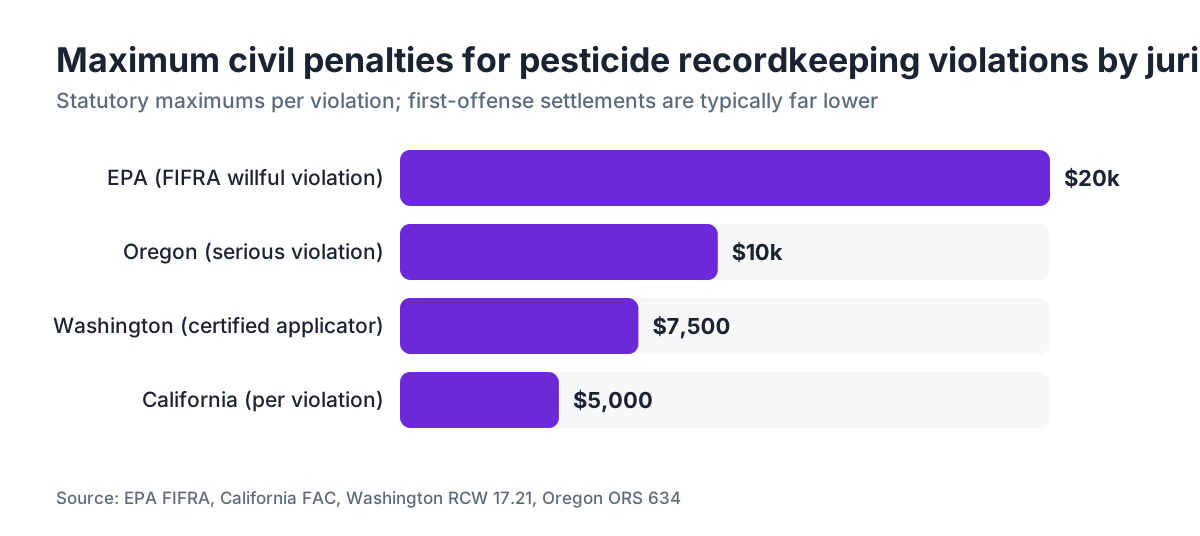
In California, civil penalties for pesticide recordkeeping violations can reach $5,000 per violation under Food and Agricultural Code Section 11503, and the state can stack violations when multiple application records are deficient [6]. For commercial applicators, repeat violations can start license suspension proceedings.
Washington's pesticide rules under RCW 17.21 allow civil penalties up to $7,500 per violation for certified applicators [4]. Oregon's ORS Chapter 634 sets penalties up to $10,000 for serious violations, though a first-offense recordkeeping gap with no adverse incident rarely reaches that ceiling.
For WPS recordkeeping, EPA can assess up to $20,450 per violation under FIFRA Section 14 for willful or knowing violations. The agency's own penalty policy usually lands on much smaller proposed penalties for small agricultural employers with a clean history [1].
A first-offense, good-faith, no-incident violation almost always settles for far less than the statutory maximum. Sometimes it settles for zero, with a corrective action agreement instead of a check. The informal conference is where that happens. Show up, bring your documentation, and ask directly what corrective action would close the file without a monetary penalty.
What happens at an informal conference with the county agricultural commissioner?
An informal conference is not a hearing in the legal sense. It's a meeting, usually 30 to 60 minutes, between you (and optionally your attorney or farm bureau rep) and the inspector or their supervisor. You review the facts, look at the corrective documentation you brought, and reach agreement on whether a penalty is warranted and how much.
Come prepared. Bring your corrected records, evidence of any training or system changes you've made since the violation, your pesticide use permit, and a timeline showing when you found the problem and what you did about it. Inspectors respond well to growers who can prove they already fixed the underlying issue.
Ask the inspector to walk you through which regulatory section each alleged violation falls under. Some NOVs bundle several deficiencies into one notice, and knowing the structure lets you address each piece on its own terms.
Request a written summary of the outcome afterward. Do it. That summary protects you if anyone later remembers the agreement differently than you do.
Growers who engage the commissioner's office early and show genuine corrective action consistently do better than those who ignore the process or walk in swinging. Washington State University's pesticide education program teaches this same point in its compliance training [8].
What records are actually required, so you know exactly what was missing?
The federal baseline comes from FIFRA and the EPA Worker Protection Standard [1]. State requirements layer on top and are generally more detailed.
In California, the required fields for each pesticide application record are set in the Food and Agricultural Code and the implementing Title 3 CCR regulations. They include [6]:
- Date of application
- Name and address of the grower
- Legal description or GPS boundary of the field
- Commodity and acres treated
- Product name and EPA registration number
- Amount of product applied (in units consistent with the label)
- Application method
- Name and license number of the applicator
- Pest targeted
- Restricted-entry interval (REI) and pre-harvest interval (PHI)
The WPS also requires that handlers be told about pesticide applications so they know where not to enter during a restricted-entry interval. That requirement ties straight into your records [1].
Cornell Cooperative Extension and WSU Extension both publish field-ready spray record templates that cover every federally required field and most state fields [8][9]. Downloading one of those templates as your standard form is an easy corrective action you can show an inspector.
If you manage multiple blocks across a season, a purpose-built system beats paper notebooks for cutting field omissions. Tools like VitiScribe are built around these exact required fields, so the form prompts you before it lets you save an incomplete entry.
Does a spray record violation go on your license or permit record permanently?
In most states, yes. Violations create a record at the county agricultural commissioner's office and the state lead agency, and that record sticks around. California's DPR, for example, keeps an enforcement history that inspectors pull when they evaluate future cases and when they review license renewal for pest control advisors and commercial applicators [3].
That said, a single corrected, good-faith recordkeeping violation almost never leads to license denial or suspension on its own. The risk climbs fast with repeat violations, with violations involving product use inconsistent with the label, or with violations tied to an adverse incident like a worker illness, a drift complaint, or environmental harm.
If the violation touches your Qualified Applicator License or your PCA license, call your licensing board and ask directly how it will appear on your record. Many boards separate formal disciplinary actions from advisory notices. Usually only the formal actions are reportable or visible to the public.
For a small farm operator without a commercial applicator license, the enforcement record lives at the county level and shapes your relationship with the commissioner's office on future inspections. That's not nothing. But it also won't show up in a Google search.
How do you prevent spray record violations from happening again?
The root cause of most spray record violations isn't carelessness. It's a system that lets incomplete records get filed. The fix is structural, not motivational.
Here's what actually works.
First, fill in the record at the tank, not back at the office. Every field you leave blank depends on a memory that fades by the hour. If your applicator writes down the date, product, rate, and field ID before starting the sprayer, you've captured about 80% of the required fields in real time.
Second, set a hard rule: no tank gets filled without a written PCA recommendation in hand. That recommendation covers pest target, product, rate, and REI, which fills most of the remaining fields automatically.
Third, run a self-audit at the end of each spray season. Pull every application record, check it against the required field list, and flag gaps before an inspector does. California's county agricultural commissioners publish their own inspection checklists, free to download, and they mirror exactly what an inspection covers [3].
Fourth, if you're still on paper, ask whether that's the right tool for your scale. Cornell Cooperative Extension's pesticide management resources note that digital systems with required-field validation cut omission errors compared to paper, for one simple reason: the form won't let you submit without the information [9]. A spreadsheet with data validation does this. So does something like VitiScribe, built for vineyard spray records. Same mechanism either way. The system catches the gap before it becomes a violation.
Should you hire an attorney to respond to a spray record NOV?
For most first-offense recordkeeping violations with no adverse incident attached, you probably don't need an attorney for the informal conference stage. The process is administrative and informal. A well-prepared grower with clean documentation usually does fine without one.
Get an attorney involved when: the proposed penalty is above $5,000; the NOV alleges product use inconsistent with the label (a different and more serious violation than a missing record); there's a connected worker illness or environmental complaint; the violation could hit your or your PCA's professional license; or the agency has floated a criminal referral. Any one of those changes the math.
Your county or state farm bureau often runs a legal assistance line or can refer you to attorneys who handle ag enforcement specifically. That's usually the fastest first call when you're unsure. California Farm Bureau, Washington Farm Bureau, and Oregon Farm Bureau all offer member services that include regulatory help [10].
What if the violation was your PCA's fault, not yours?
This happens more than people admit, and the legal structure matters. The duty to keep pesticide application records falls on the grower (the person who owns or controls the land or commodity being treated) and, separately, on the licensed applicator or PCA who supervised or directed the application [2][6].
So both of you can be on the hook. Blaming the PCA in your response letter is not a strategy that ends well. The commissioner's office will note your response, and if they pursue action against the PCA separately, your letter may show up in that proceeding.
What you can do is document, clearly, that you've addressed the issue with your PCA, changed your recordkeeping workflow, and set up a system for verifying record completeness going forward. That's a corrective action narrative that helps you without throwing anyone under the bus.
If your PCA keeps failing to provide complete recommendations or records and it's creating compliance exposure for you, that's a contract and relationship problem to handle separately. California's DPR publishes guidance on grower-PCA responsibilities that's worth reading if you're fuzzy on where your obligation ends and theirs begins [3].
Frequently asked questions
How long do I have to keep pesticide application records?
Federal law under FIFRA requires records for restricted-use pesticides to be kept for two years. California requires pesticide application records be retained for three years. Washington requires two years. Check your state's specific rule, because some states treat records for restricted-use products differently from records for general-use products applied commercially.
Can a notice of violation be dismissed entirely?
Yes, and it happens more often than growers expect when the violation is a first offense, involves no adverse incident, and the grower shows up to the informal conference with corrected documentation and a credible corrective action plan. It's not guaranteed. But asking directly for dismissal in exchange for a corrective action agreement is a reasonable opening position.
What is the difference between a notice of violation and a citation?
An NOV is typically a pre-citation notice that gives you a chance to respond or contest the finding before any penalty is finalized. A citation, or civil penalty assessment, is a more formal document that either accompanies the NOV or follows it if you don't respond. Some states use the terms interchangeably, so read your specific document to see whether a penalty has already been assessed.
Do I need to report a spray record NOV to my crop insurance carrier?
Review your crop insurance policy's terms and conditions. Most standard multi-peril crop insurance policies don't require disclosure of administrative pesticide recordkeeping NOVs unless they result in a formal suspension or restriction on your farming operation. If you're unsure, call your agent and ask specifically about administrative compliance notices rather than claims.
What counts as the 'applicator' for record purposes if a labor contractor applies pesticides on my vineyard?
The licensed applicator on whose license the application is made is responsible for the application record. But as the grower, you're responsible for making sure records exist and stay accessible on-site. Both parties have obligations. Get a copy of the application record from the contractor within 24 hours of each application, and verify it contains all required fields before you file it.
Does the EPA Worker Protection Standard require separate records from state pesticide records?
The WPS requires that specific information, including product name, EPA registration number, active ingredient, REI, and location of the treated area, be made available to workers and handlers. This overlaps heavily with state application records. Most growers satisfy both by keeping thorough state-required records and posting or communicating the relevant details to workers as required.
Can an incomplete spray record NOV affect my pesticide use permit?
A single first-offense recordkeeping NOV rarely jeopardizes a pesticide use permit. Repeated violations, or violations combined with label-use violations or adverse incidents, can trigger permit suspension or extra permit conditions. California DPR can recommend permit revocation to county commissioners for serious or repeat violators. Staying current on corrective action agreements matters.
What if I was never notified of the specific inspection that led to the NOV?
Routine pesticide compliance inspections in most states don't require advance notice. Your due process comes after the fact, through the NOV response and informal conference. If you think the inspection itself was procedurally improper, document that concern separately and raise it at the conference, but don't make it your only defense.
How do I know if my spray records are compliant before an inspection happens?
Pull your own records quarterly and run them against the required field list published by your county agricultural commissioner or state department of agriculture. Cornell Cooperative Extension and WSU Extension both publish pesticide recordkeeping checklists that match what inspectors use. A 30-minute self-audit at the end of each spray season catches most problems before they become NOVs.
Is there any difference in how organic vineyards are treated for pesticide record violations?
Organic operations face the same state pesticide recordkeeping requirements as conventional operations for any pesticide products they apply. They also carry additional USDA National Organic Program record requirements for all inputs. An incomplete spray record on an organic operation can trigger both a state pesticide violation and a potential NOP compliance issue with your certifier.
Can I appeal a penalty after the informal conference if I'm not satisfied with the outcome?
Yes. Most states have a formal hearing process run by the state department of agriculture or an administrative law judge where you can appeal a civil penalty assessment after the informal conference. The window to request a formal hearing is usually 30 days from the date the penalty is confirmed in writing. After that, judicial review may be available, though attorney involvement becomes more necessary at that stage.
What should I do if I receive an NOV but I'm pretty sure the records were complete and the inspector is wrong?
Gather your original records and any corroborating documentation, such as PCA recommendations, purchase receipts, and GPS data, and request an informal conference. Bring everything organized by application date. Calmly walk the inspector through each record and identify which field they found deficient. Factual errors by inspectors do happen, and they get corrected at this stage.
Sources
- EPA, Worker Protection Standard for Agricultural Pesticides: WPS recordkeeping requirements for pesticide applications and handler exposure information, and FIFRA Section 14 civil penalty authority up to $20,450 per violation
- EPA, Summary of the Federal Insecticide, Fungicide, and Rodenticide Act: Federal requirements for pesticide application recordkeeping for restricted-use pesticides including two-year retention requirement
- California Department of Pesticide Regulation: California county agricultural commissioners enforce pesticide recordkeeping with 10-30 day response windows before citations become final; DPR maintains enforcement history
- Washington State Department of Agriculture, Pesticides: WSDA notices of intent to assess civil penalties give 20 days to request informal conference; RCW 17.21 allows penalties up to $7,500 per violation for certified applicators
- EPA, Pesticides: Required fields for restricted-use pesticide application records including product name, EPA registration number, application rate, location, date, and applicator information
- California Food and Agricultural Code, Sections 11503 and 12999: California civil penalties up to $5,000 per pesticide violation; falsification of pesticide records is a misdemeanor under FAC Section 12999; required application record fields under Title 3 CCR
- UC Statewide Integrated Pest Management Program: UC IPM guidance that keeping PCA written recommendations on file is the simplest way to cover fields inspectors most frequently find missing
- Washington State University Extension: WSU pesticide education teaches that growers who engage the commissioner's office early and demonstrate genuine corrective action achieve better enforcement outcomes; WSU publishes spray record templates covering required fields
- Cornell Cooperative Extension: Cornell Cooperative Extension notes that digital record systems with required-field validation reduce omission errors compared to paper forms; Cornell publishes field-ready spray record templates
- California Farm Bureau Federation: California, Washington, and Oregon Farm Bureaus provide member regulatory assistance including referrals for agricultural enforcement matters
Last updated 2026-07-11