How to set up a monthly spray record review process for vineyard managers

TL;DR
- A monthly spray record review catches application errors, restricted-entry interval violations, and missing signatures before a state inspector does.
- Set a fixed review date, work through a five-point check (product, rate, REI, PPE, applicator license), reconcile inventory against what left the shed, and file any correction the same day.
- For most operations the whole thing takes under two hours.
Why do vineyard spray records get audited in the first place?
State departments of agriculture and the EPA can ask for your pesticide application records at any time, and in most states they can inspect without warning [1]. The EPA Worker Protection Standard, codified at 40 CFR Part 170, requires pesticide application and safety information to be available to workers and handlers on request. That means your records have to exist, be accurate, and be findable fast [2].
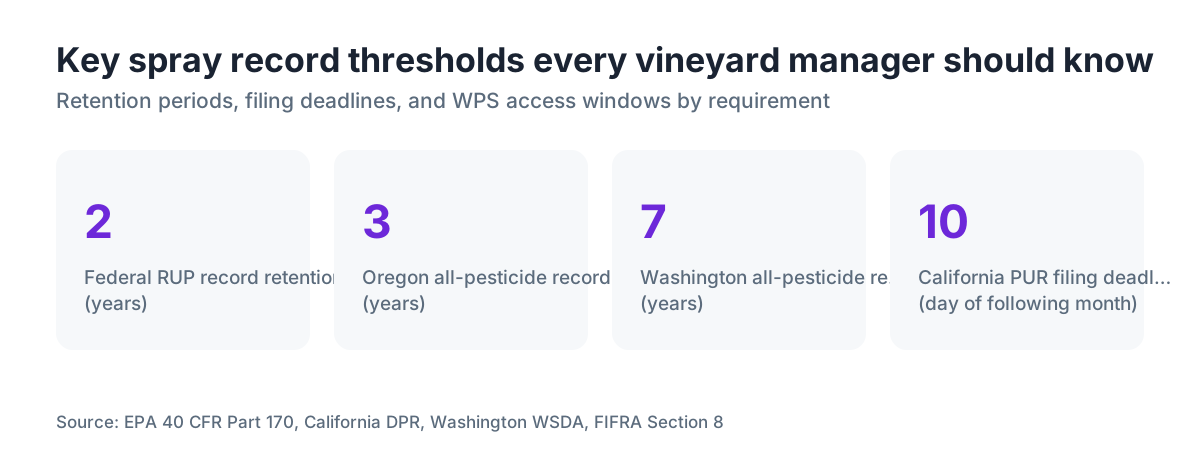
Most audits are not random. They follow a complaint, a reported illness, a groundwater report, or a property sale. California's Department of Pesticide Regulation requires growers to submit Pesticide Use Reports (PURs) to their county agricultural commissioner every month, and county staff read them for obvious errors, unreported restricted-material use, and rate problems [3]. Washington requires pesticide records to be kept for seven years and made available to the state Department of Agriculture on request [4].
The practical risk is simple. If your records show a product applied above the label maximum, or a crew back in a block before the Restricted Entry Interval expired, that is a violation even if nothing went wrong in the dirt. The record is the evidence.
What records does a vineyard legally have to keep?
Federal law under FIFRA Section 8 requires private and commercial applicators to keep records of restricted-use pesticide (RUP) applications for two years [5]. Those records include the product name, EPA registration number, total amount applied, the crop and location, the date, and the name and license number of the certified applicator.
For general-use pesticides, federal law sets no retention mandate. Almost every state fills that gap. California requires PUR records for all pesticides, not only RUPs, and county-held reporting data is retained on a longer state schedule [3]. Oregon requires records for three years; Washington requires seven [4]. If you farm across state lines, keep everything for the longest period any state you operate in demands.
The WPS stacks on top of FIFRA. The agricultural employer has to keep records of each pesticide application and make them accessible to workers who could have been exposed [2]. That accessibility duty is one reason a monthly cadence makes sense: you review records while corrections are still easy to explain, not months later when memories are gone.
Here is what each record has to contain:
| Field | Federal (FIFRA/RUP) | EPA WPS | California DPR | Washington WSDA |
|---|---|---|---|---|
| Product name + EPA Reg # | Required | Required | Required | Required |
| Rate per acre | Required | Required | Required | Required |
| Total amount applied | Required | Required | Required | Required |
| Application date | Required | Required | Required | Required |
| Certified applicator name + license # | Required | Required | Required | Required |
| Crop and location | Required | Required | Required | Required |
| REI posted/communicated | Not required | Required | Required | Required |
| PPE worn by handler | Not required | Required | Not required | Not required |
| Weather conditions at application | Not required | Not required | Required | Recommended |
Sources: EPA 40 CFR Part 170 [2], California DPR [3], WSDA Pesticide Management [4].
How often should you actually review spray records?
Monthly is right for most operations. Weekly is overkill unless you are spraying continuously and running a large crew. Quarterly is too slow: a missed REI entry from nine weeks back is much harder to reconstruct than one from two.
The monthly cadence lines up with real deadlines. California PURs are due to the county ag commissioner by the tenth of the following month [3]. If you file those, you are reviewing the records anyway. Washington's monthly reporting for certain applications creates the same forcing function [4]. Even where your state has no monthly report, the WPS accessibility duty means the current period's records should always be clean and current.
The other reason is inventory. Every spray you record should match product leaving your chemical storage. If your records show 50 gallons of fungicide applied but the shed is short 60, something is off: either a record is missing or there was an unreported application. You catch that gap in month one, not in month twelve when the trail is cold.
Small operations spraying a few times a season should still review monthly. A zero-application month takes five minutes to confirm and document, and it proves the process runs whether or not the sprayer did.
What is the step-by-step process for a monthly spray record review?
Here is the process I would actually run. It takes 45 minutes to two hours depending on how many applications happened.
Step 1: Gather every application record from the month.
Pull paper logs, digital entries, or both. If handwritten field logs get transcribed to a master spreadsheet, compare the two. Mismatches between the field log and the master are common and almost always innocent (a transcription slip, a wrong block number), but they need fixing before you file.
Step 2: Check each record against the product label.
For every product, confirm the rate per acre sits inside the label range, the crop use is listed (wine grapes, more than grapes), the method matches (ground vs. aerial), and the pre-harvest interval (PHI) and REI are correct. UC Davis IPM publishes grape pest management guidelines that list common fungicides and insecticides with their PHIs and REIs for California [6].
Step 3: Verify the certified applicator information.
Confirm the license number on each record matches a current, valid license. State license lookups are free. California's DPR runs an online lookup at cdpr.ca.gov [3]. Washington keeps an online database at agr.wa.gov [4]. Expirations sneak up on people. If a license lapsed mid-month and applications continued, that is a violation even if the person passed the exam years ago.
Step 4: Check REI compliance.
For each application, calculate when the REI expired (application time plus REI hours). Then check labor records or block entry logs to confirm no worker went into that block before the interval closed. Cornell's IPM program publishes plain guidance on REI documentation under the WPS worth bookmarking [7].
Step 5: Reconcile inventory.
Match total volume of each product applied (summed across the month's records) against the change in physical inventory. If the numbers do not agree within a reasonable rounding margin, find out why before you file.
Step 6: Collect signatures.
Every record should be signed by the certified applicator who made the application. If you are the manager reviewing another applicator's records, you sign as reviewer. Some states want a supervisor signature too. Unsigned records are the single most common deficiency in routine audits.
Step 7: File corrections immediately.
Found an error? Fix it the same day. Write a clear note: what was wrong, what is correct, the date, your signature. Never erase or white-out. Cross out the error with one line, write the correction next to it, and date it.
Step 8: Document that the review happened.
Keep a one-page monthly review log. Date, reviewer name, number of applications reviewed, corrections made, signature. The log is itself a record, and it shows an inspector you run a process instead of scrambling.
What common errors show up most often in spray records?
Read enough CDPR enforcement summaries and talk to enough extension advisors and the same errors keep surfacing: missing or expired applicator license numbers, REI not recorded, rate written per tank instead of per acre, wrong EPA registration number, block or APN listed incorrectly, and a trade-name shorthand that does not match the registered label name.
Rate errors do the most damage. If you mixed three tanks at one strength but the label rate is expressed differently (oz per 100 gallons vs. fl oz per acre), a conversion slip in transcription can make a compliant application read like an over-application. Record in the units on the label, and note the dilution when you use a per-100-gallon rate.
Blank weather fields come second. California requires wind speed, wind direction, and temperature at application for certain pesticides [3]. If applicators are not filling those in at the time of the spray, you cannot reconstruct them a week later. WSU's Pesticide Education Program publishes field forms with weather fields built into the layout [8].
A subtler one: the REI is recorded correctly, but nobody documented how it reached the crew. Under WPS the employer has to make sure workers know the REI before they enter a treated area. That communication, whether a posted sign, a verbal notice, or a block entry log, should be referenced in the record.
Who should be responsible for the monthly review?
Assign one person. Do not split it.
In most vineyard operations the right person is the vineyard manager or farm manager, not the operator who made the applications. The reviewer should be someone who can spot an error and has the authority to pause field work if a compliance gap is serious.
If you use a licensed pest control adviser (PCA) in California, their role is limited. PCAs write the recommendations. They do not sign the application records. The certified applicator does. Some PCAs sell record review as a service, which can pay off if your manager is buried during the growing season.
Larger operations with multiple blocks and several licensed applicators should build a short meeting into the review, manager and each applicator walking through corrections together. That does two things: it catches errors only the applicator can explain, and it reminds everyone that records matter as much as the spray itself.
How do you store and organize spray records so reviews are actually fast?
The biggest time-waster in a monthly review is hunting for records. Paper works fine if it is disciplined: one binder per year, tabbed by month, with a cover sheet for each month listing every application. That cover sheet is your review checklist. If a record is missing from the binder, the cover sheet shows the hole.
Digital can be faster with the right setup. A spreadsheet handles small operations. Each row is one application. Columns map to the required fields. You filter by month, check completeness, print, sign, and file. The risk is version control: if several people enter data, you need one canonical file, not copies drifting around in email.
For more complexity, dedicated spray record software cuts transcription errors and flags common mistakes automatically. VitiScribe is one option built for vineyard field operations, including spray records and compliance tracking. Whatever you use, records still have to export as PDFs or print cleanly. A state inspector is not going to log into your software account.
Whatever the system, keep product labels on file, paper or digital, for every product used that season. If you ever defend a rate calculation, the label is your primary source.
What should the monthly review checklist actually look like?
Keep it to one page. Here is a working template:
Monthly Spray Record Review Checklist
Review period: [Month / Year]
Reviewer: [Name, title]
Date of review: [Date]
| Check | Pass | Needs correction |
|---|---|---|
| All application records present for the month | ||
| Product name matches registered label name | ||
| EPA registration number recorded and correct | ||
| Application rate within label range (per acre) | ||
| Crop use listed on label (wine grapes) | ||
| Certified applicator name and license number present | ||
| License confirmed current and valid | ||
| REI hours recorded | ||
| Block re-entry date/time calculated and logged | ||
| Worker re-entry records cross-checked | ||
| PPE worn by handler recorded (WPS) | ||
| Weather conditions at application recorded | ||
| Applicator signature on each record | ||
| Inventory reconciliation complete | ||
| Any California PUR submitted to county ag commissioner (if applicable) |
Corrections made this review: [Describe or attach]
Reviewer signature: _________________________
This checklist is itself a record. File it with the month's application records.
How does the EPA Worker Protection Standard affect your monthly review?
The WPS is the one federal layer that applies whether you use restricted-use or general-use pesticides, and it shapes how you document almost every field application. Worth understanding in detail.
Agricultural employers must maintain records of all pesticide applications, including the product, the REI, and the crop or site [2]. Workers who may have been in a treated area have the right to request that information. The rule states the employer must provide it "promptly upon request." If you cannot produce the record, the requirement is violated regardless of whether the underlying application was done correctly.
The WPS also requires you to display specific application information at a central location accessible to workers, along with safety data sheets, during the application and through the REI [2]. Your monthly review should confirm the posting actually happened: was the information displayed, were the REI start and end times communicated, and were any early-entry exceptions properly authorized.
The EPA's 2015 revision to the WPS strengthened these requirements, especially handler training and decontamination supplies. Most provisions took full effect by January 2018 [9]. Cornell's IPM guidance for New York growers is one of the clearest plain-language explanations of what the 2015 rule changed [7].
The thing an audit checks first: are the records accessible, and are they accurate enough to tell whether a worker could have been in a treated block during the REI? Your monthly review is the mechanism that keeps them audit-ready.
What happens if your spray records are incomplete or wrong when an inspector shows up?
Consequences run from a warning letter to serious fines. The range is wide because it turns on the state, the severity, whether there is evidence of harm, and whether you have a violation history.
In California, a first-time PUR recordkeeping problem often draws a county ag commissioner notice and a deadline to correct. Repeated violations, or restricted-use pesticide use without a permit, can trigger civil penalties. CDPR's enforcement history is publicly searchable and shows individual penalties from a few hundred dollars for minor recordkeeping errors up to tens of thousands for unauthorized use or worker safety violations [3].
Federal WPS violations run through EPA regional offices. FIFRA sets the statutory ceiling for civil penalties, which the EPA adjusts for inflation, and current maximums run into the tens of thousands of dollars per violation [1]. The agency also has discretion to offer compliance assistance before formal enforcement when a violation was unintentional and the grower cooperates.
The less obvious cost is the paper trail an incomplete record creates. If a worker later reports a health concern and your records for that period are missing or contradictory, you have no defense. Complete, corrected records protect you as much as they arm the regulator.
One honest note: nobody has clean aggregate data on what share of violations end in fines versus warnings. The closest public dataset is CDPR's county enforcement summaries, which break outcomes down by violation type for California [3].
How do university extension programs recommend structuring spray record systems?
UC Davis IPM, Cornell, and WSU all publish guidance on vineyard pesticide recordkeeping. They agree on the fundamentals and differ mostly on state-specific detail.
UC Davis IPM recommends recording weather conditions at application, the equipment used and its calibration date, and location down to the block or APN, beyond the federal minimums [6]. Their grape pest management guidelines, updated regularly, also list pre-harvest intervals for materials registered in California, which is handy for cross-checking your PHI math during the review.
Cornell's IPM program stresses the WPS documentation layer, especially the REI communication requirement, and provides field-ready forms for New York growers [7]. Their guidance calls out plainly that the employer, not the applicator, is responsible for making sure records are complete and accessible.
WSU's Pesticide Education Program publishes bilingual English/Spanish field forms for application records, useful for crews more comfortable in Spanish [8]. The WPS requires safety information to reach workers in a language they understand, and bilingual documentation is a straightforward way to show it.
All three lean toward a physical logbook as the primary record, with any digital system as backup. The reasoning: a paper record with a wet signature is hard to argue with in an audit, while a digital record that can be edited without a clear audit trail is harder to defend.
How do you build the habit so the review actually happens every month?
Put the review date on the calendar before the season starts. Literally: open your calendar app and block two hours on the fifth of every month from March through November, plus one hour a month in the off-season. Name it something specific like "Spray record review and PUR filing," not "admin."
Tie the review to a reporting or payment trigger. In California the PUR is due by the tenth. Make your internal review due by the fifth so you have room to fix anything before the official filing. No monthly report in your state? Tie the review to payroll or your monthly PCA call.
Assign a backup. If the primary reviewer is sick or traveling during harvest, someone else runs it. Write that into your standard operating procedures. An audit does not care that you were slammed picking fruit.
Operations that want more structure can use tools like VitiScribe to send reminders and flag incomplete records before the review date. A recurring calendar alert and a printed checklist do the same job at zero cost.
The habit beats the software. A disciplined paper process wins over a fancy digital system nobody opens.
Frequently asked questions
How long do I have to keep vineyard spray records?
Federal law requires restricted-use pesticide records for two years. California requires records for all pesticides on a multi-year state schedule; Oregon requires three years, and Washington requires seven. If you farm across state lines, keep everything for the longest period any state you operate in demands. Separately, the EPA WPS requires application records to be accessible to potentially exposed workers on request.
Do I need to keep records for general-use pesticides, more than restricted-use?
Federal FIFRA only mandates records for restricted-use pesticides. But California requires Pesticide Use Reports for all pesticides, including general-use materials, and most western states have similar broad rules. The EPA WPS also requires application records for any pesticide with a re-entry interval, regardless of RUP status. In practice, record every application.
What is the difference between a pre-harvest interval and a restricted-entry interval?
A pre-harvest interval (PHI) is the number of days that must pass between the last application and grape harvest. A restricted-entry interval (REI) is the time that must pass before workers can re-enter the treated area without full protective equipment. PHIs protect the fruit and meet food safety rules. REIs protect worker health. Both are on the product label and both must be recorded in your spray records.
What does the EPA Worker Protection Standard require for vineyard spray records specifically?
Employers must keep records of each pesticide application including product name, EPA registration number, rate, crop, location, date, and REI. Workers who may have been exposed have the right to request this information and the employer must provide it promptly. The 2015 WPS revision, effective for most provisions by January 2018, strengthened handler training and decontamination requirements as well.
Can my spray applicator fill out the records, or does the vineyard manager have to do it?
The certified applicator who made the application signs and is primarily responsible for the accuracy of each record. The vineyard manager or employer is responsible for making sure records are complete, accessible, and retained. Both roles matter. In practice the applicator fills out the field log at application time, and the manager reviews, corrects, and files during the monthly review.
What do I do if I find an error in a spray record during my monthly review?
Correct it the same day. Do not erase or white-out original entries. Cross out the error with a single line, write the correct information next to it, and add the date of correction and your initials. Attach a correction note explaining what was wrong and what is right. This shows good faith and is the standard most state ag commissioners accept.
How do I reconcile pesticide inventory with my spray records?
Sum the total volume of each product recorded as applied across all records for the month. Compare that total to the change in physical inventory for the same product (opening inventory minus closing inventory). If the totals do not match within a small rounding margin, find the discrepancy before filing. Common causes are a missing record, a tank mix calculation error, or an unlogged spill.
What records do California vineyards have to submit to the county agricultural commissioner?
California growers must submit Pesticide Use Reports (PURs) to their county agricultural commissioner by the tenth of the month following application. PURs are required for all pesticides, not only restricted-use materials, and must include the product, rate, total applied, acreage, crop, location, and certified applicator information. CDPR compiles and publishes this data statewide. Missing or late PURs can trigger county enforcement action.
Do worker re-entry logs need to be cross-checked against spray records every month?
Yes. Your monthly review should confirm no worker entered a treated block before the REI expired. Check your block entry log or labor records against the calculated REI end time for each application. Under the WPS, re-entry before the REI closes is a violation whether or not harm occurred. If your operation keeps no block entry log, start one. It is the only way to show REI compliance.
What is the penalty for missing or incomplete spray records in California?
Penalties vary by violation type and history. Minor first-time recordkeeping errors usually draw a county notice to correct within a set period. Violations involving restricted-use pesticides without a permit, or cases with worker safety implications, can bring civil penalties. CDPR's publicly searchable enforcement database shows penalties from a few hundred dollars for minor errors to tens of thousands for serious or repeated violations.
How should spray records be formatted and stored for an audit?
Organize records by year and month, whether in a physical binder or a digital folder. Each record should include all required fields, the applicator's signature, and any correction notes. Include a copy of the product label for each product used. A one-page monthly review log showing the review happened adds credibility. Records must be available to workers on request under WPS and on demand for a state inspector.
Does the WPS require spray records to be in the worker's language?
The WPS requires pesticide safety information, including REI and application details, to be communicated to workers in a language they understand. This does not mean every record must be translated, but the information drawn from the record (product name, REI, treated area) must reach the worker in a language they understand. WSU Extension publishes bilingual English/Spanish field forms that help document that communication.
When should a pest control adviser be involved in the monthly review?
A PCA writes application recommendations, and their recommendation number should appear on your California records. They do not sign application records and are not responsible for the employer's recordkeeping. But if you find a rate discrepancy or a label question during your review, bring in your PCA. They know the registered materials and can help you read the label correctly. Some PCAs offer monthly record audit services.
Sources
- EPA, Enforcement (FIFRA Section 8 pesticide inspection and penalties): EPA can request pesticide application records and inspect under FIFRA enforcement authority; FIFRA civil penalty maximums are set by statute and adjusted for inflation
- EPA, Pesticide Worker Safety and the Worker Protection Standard (40 CFR Part 170): WPS requires agricultural employers to keep records of each pesticide application and make them accessible to potentially exposed workers on request; safety information must be displayed at a central location during application and through the REI
- California Department of Pesticide Regulation, Pesticide Use Reporting: California requires Pesticide Use Reports for all pesticides submitted to the county agricultural commissioner by the tenth of the following month; CDPR runs an online license lookup and a searchable enforcement database
- Washington State Department of Agriculture, Pesticides: Washington requires pesticide application records to be kept for seven years and made available to WSDA on request, and maintains an online applicator license database
- EPA, Pesticide Registration (FIFRA Section 8 Restricted Use Pesticide recordkeeping): Federal FIFRA Section 8 requires applicators of restricted-use pesticides to keep records for two years, including product name, EPA registration number, amount applied, crop, location, date, and certified applicator name and license number
- UC IPM, Grape Pest Management Guidelines (University of California): UC IPM recommends recording weather conditions, equipment and calibration, and block-level location, and publishes PHI and REI data for pesticides registered on California wine grapes
- Cornell Integrated Pest Management Program (Cornell University): Cornell IPM clarifies that under WPS the employer, not the applicator, is responsible for ensuring records are complete and accessible, and that REI communication must be documented
- Washington State University, Pesticide Education Program: WSU Extension provides bilingual English/Spanish pesticide application field forms including weather condition fields for WPS compliance documentation
- EPA, Agricultural Worker Protection Standard 2015 revision (80 FR 67496): The 2015 WPS revision strengthened handler training, decontamination, and documentation requirements, with most provisions taking effect by January 2018
Last updated 2026-07-11