How to set up a vineyard block numbering system for record consistency
TL;DR
- A good vineyard block numbering system uses short, fixed codes (2 to 4 characters) that encode location or variety, stay consistent across every record type, and map to a physical plat.
- Get it right before you plant row one.
- Renaming blocks mid-season breaks spray logs, harvest records, and restricted-entry interval tracking in ways that take years to untangle.
Why does block numbering matter for compliance and record-keeping?
Every pesticide application record you're legally required to keep ties to a specific location. Under EPA's Worker Protection Standard (40 CFR Part 170), restricted-entry interval (REI) information has to be available for each treated area, and your records have to identify that area clearly enough for an inspector to find it on the ground [1]. If block names drift between your spray log, your harvest crush report, and your TTB records, you have a compliance gap. Not a theoretical one. An actual one.
State departments of agriculture use block-level records to verify that pesticide applications match label restrictions. California's DPR requires pesticide use reports filed by site, and 'site' means something specific: a named or numbered unit that a field inspector can locate [2]. If your spray log says 'Block 4,' your map says 'Cab South,' and your harvest report says 'CS-1,' you've created three records that don't obviously connect. An auditor will ask you to prove they're the same place.
Messy block IDs cost you operationally too. You can't run a yield-per-acre analysis when the block name changes every few seasons. You can't train a new employee to read your records without a key. You can't hand your records to an accountant, a consultant, or a buyer without a long oral explanation. The block numbering system is the spine of your entire field documentation stack.
What are the basic components of a vineyard block ID?
A block ID is a short code that answers two questions: where is it, and what's in it. Most systems combine a location prefix, a variety or clone indicator, and a sequential number. A code like 'NW-CS-01' tells you it's in the northwest part of the property, it's Cabernet Sauvignon, and it's the first block of that type. A code like 'B03' just means block three, which is simpler but carries no self-documenting information.
Neither approach is universally correct. The right one depends on your property size, how many varieties you grow, and how many people read the records without a legend.
For small operations (under 20 acres, 4 to 6 varieties), a pure sequential system like B01 through B12 works fine as long as you keep a stable reference map. For larger or more complex vineyards, a structured code that encodes location and variety pays off fast in legibility. WSU's viticulture and enology extension program recommends that block identifiers be brief, unique, and tied to a stable physical reference so they survive staff turnover [3].
The components growers use most:
| Component | Example | What it encodes |
|---|---|---|
| Location prefix | NW, HT (hillside top), R (river block) | Physical location |
| Variety code | CS (Cab Sauv), CH (Chardonnay), ZIN | Grape variety |
| Sequential number | 01, 02, 03 | Multiple blocks of same type |
| Year planted | 98, 07, 19 | Vintage year of planting |
| Rootstock code | 110R, 5BB | Rootstock for disease tracking |
You don't need all of these. Adding too many components makes codes unwieldy. Four to six characters is usually the sweet spot: short enough to write by hand in the field, long enough to be unique and mean something.
How do you define a block in the first place?
A block is a contiguous planting unit that shares a single management identity. That usually means one variety, one rootstock, one row orientation, and one planting date. But 'usually' carries a lot of weight here.
Some vineyards define blocks by irrigation zone. Others by soil type. Others by spray program grouping. The honest answer is that a block boundary should fall wherever you'd make a different management decision. If the east half of a planting ripens two weeks ahead of the west half and you harvest them separately, they're two blocks, even if they're the same variety.
UC's statewide viticulture program frames the block around the management unit concept: the smallest area you'll manage uniformly to produce a uniform crop, defined before you plant [4]. That's a useful working definition. It means a block boundary can coincide with a variety change, a soil-type transition, a significant slope break, or a water availability difference.
Most growers draw block lines at physical features: a road, a row end, a fence line. That's fine as long as the feature is stable and you document it on a map. Use GPS coordinates for corners if you can. Parcel maps from your county assessor make a decent base layer.
One thing that creates problems later: defining blocks too small. Number every 10-row sub-section as its own block and you end up with 40 block IDs for a 15-acre vineyard, and filling out a spray record becomes a 20-minute data-entry exercise for a 30-minute spray. Group rows into units that reflect how you actually manage the vineyard.
What naming conventions should you avoid?
Avoid names that only exist in one person's head. 'Dave's Block.' 'The Knoll.' 'That weird corner by the pump house.' These names are common on small family operations, and they work until Dave leaves or the pump house gets torn down. They never appear in a pesticide label instruction or a county use report field, so they create a translation layer every time you file a record.
Avoid reusing block numbers. If you pull out Block 7 and replant it to a different variety, don't call the new planting Block 7. Retire the old number and assign a new one. Your spray records from the old Block 7 carry different management history than the new planting, and conflating them gives you bad data.
Avoid names that are too similar. Blocks B1 and BI (that's the letter I) look identical in handwriting. NW1 and NW01 get used interchangeably. Pick a format and enforce it: all numeric suffixes zero-padded to two digits, for example.
Avoid location names that can change. 'East Block' is fine until you buy the field to the east of it and you now have two east blocks. Directional names work for small, stable properties. For anything that might expand, use a grid-reference system instead.
Cornell's grape program makes a practical point about this: a naming system that seems obvious to its creator often confuses everyone else, so test any block ID system by asking a new hire to find a block on a map using only the code [5]. If they can't do it in under two minutes, the system needs more self-documentation.
How do you build a block map and keep it current?
Your block map is the ground truth. The numbering system only works if every block code on every record points to a physical location on a map anyone can read.
Start with whatever base layer you have: a USGS topo, a Google Earth screenshot, a county parcel map, or aerial cropland imagery from USDA NASS [6]. Print it at a scale where individual rows are visible if you can manage it. Draw block boundaries with a thick pen. Label each block with its ID. Add a legend that lists every ID with variety, rootstock, row spacing, vine spacing, and planting year.
Update the map every time anything changes. Pull-outs, new plantings, boundary adjustments, irrigation zone changes. Date the revision. Keep old versions. You may need to prove what a block contained in 2019 for a pesticide residue question in 2025.
Digital mapping is better for most operations above 10 acres. Google Earth Pro is free, and you can draw polygons, label them, and export KML files [7]. ESRI ArcGIS is more powerful but costs money most small vineyards don't need to spend. Vineyard-specific tools, including record-keeping platforms like VitiScribe, let you draw blocks on a satellite base map and tie every spray record and harvest record to a mapped polygon. That spatial link earns its keep when you're preparing for a DPR audit or a TTB review and need to show that every application on a block cleared its REI before harvest.
For paper operations: laminate the master map and hang it in the shop. Every employee who drives a tractor or carries a spray gun should be able to point to any block by its ID without asking.
How do block IDs connect to pesticide spray records?
This is where the system pays off most directly. Your pesticide application records, kept on paper or in software, have to identify the exact site of application. In California, the county agricultural commissioner's pesticide use report asks for a site location specific enough to locate the field [2]. In Washington, the State Department of Agriculture requires application records to include the location of the application by legal description or equivalent identifier [8].
A block ID is that equivalent identifier, as long as your map is available to connect ID to location. Without a map, a block ID is just a label. With a map, it becomes a legal location reference.
EPA's Worker Protection Standard is more specific about reentry. Under 40 CFR Part 170, the agricultural employer has to inform workers about treated areas, including the REI, and be able to identify when the REI expires for a given location [1]. Spray Block NW-CS-01 on Monday, work Block NW-CS-02 on Wednesday, and you need clean records showing which REI applies where. Blocks that bleed into each other on a bad map create exactly this confusion.
A clean block ID system also makes label compliance checks fast. When a label says 'do not apply within 30 days of harvest,' you check your harvest date by block against your last application date by block. That check takes 30 seconds with good records and two hours of back-calculation with bad ones.
The EPA's Agricultural Worker Protection Standard is public and worth reading in full for the record-keeping and hazard-notification provisions [1].
How should block numbers relate to your harvest and crush records?
Every load of fruit leaving a block should carry that block's ID. On the harvest tag, on the scale ticket, in the crush log. Pick Block NW-CS-01 in three passes over two weeks, and you want three entries in your harvest record, each keyed to NW-CS-01, each with a date and weight.
For TTB compliance, wine made from estate fruit has to document the location of origin if you're making a vineyard-designate or appellation-designated wine. Block-level harvest records are the upstream documentation that supports those claims. The TTB doesn't mandate block-level tracking, but if you're bottling a single-vineyard wine, your winery's records have to connect the juice in the tank to the fruit in the field, and block IDs are the link in that chain [9].
Block-level harvest data tells you which blocks are over- or under-performing against their own history. That drives replanting decisions, canopy management, and irrigation investments. None of it is possible if harvest records say 'Cab Sauv East' some years and 'Block 4' others.
Keep the same block ID in use as long as the planting persists. This seems obvious, and it breaks down in practice the moment a new vineyard manager wants to reorganize the naming system. Renaming blocks mid-history is the single most common record-keeping mistake I've seen. Don't do it. If you need better names, build a crosswalk table and preserve both the old and new IDs in your records.
How many blocks should a vineyard have?
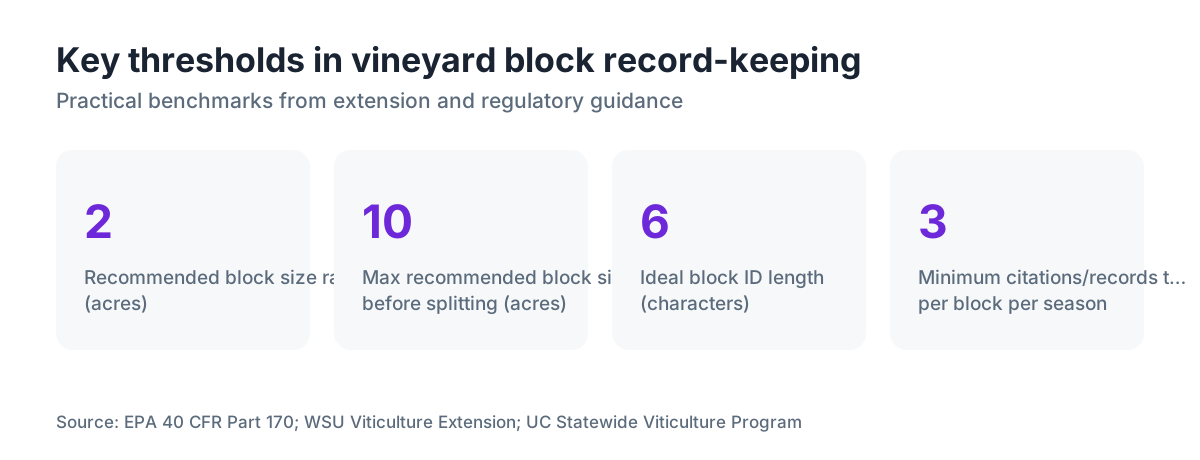
There's no rule, but there's a useful ratio. Most experienced vineyard managers aim for blocks that average between 2 and 10 acres. Below 2 acres, the record-keeping overhead per block runs high relative to the management benefit. Above 10 acres, you're probably managing too diverse a planting as a single block, unless it's genuinely homogeneous.
For a 50-acre vineyard with 6 varieties, somewhere between 10 and 25 blocks is typical. For a 5-acre backyard vineyard with 2 varieties, 2 to 4 blocks is fine.
The real constraint is spray record labor. If every spray application makes you enter 30 block IDs, the system is fighting you. Group sub-blocks that always get identical management into a parent block with sub-designations you split out only when needed. Block CS-01A and CS-01B can each be tracked independently for harvest but treated as CS-01 for spray purposes if they always get the same program.
WSU's viticulture extension team points to over-fragmentation as the most common record-keeping failure in small vineyards: growers create so many location IDs that accurate record completion becomes impractical, which leads to blank or guessed records that fail compliance reviews [3].
What does a complete block record look like, and what goes in it?
A block record is the permanent dossier for one planting unit. It should hold everything a new manager needs to manage that block well without asking anyone.
At minimum, include:
- Block ID (the code itself)
- Acreage (measured, not estimated)
- Variety and clone
- Rootstock
- Row orientation (compass bearing)
- Row spacing and vine spacing
- Planting date and planting source (nursery)
- Trellis system
- Irrigation type and zone
- Soil type or series if known
- GPS coordinates of corners or centroid
- History of spray applications (ongoing)
- History of yields by year (ongoing)
- History of any soil or tissue tests (ongoing)
- History of any replanting within the block
The USDA NRCS Web Soil Survey gives you official soil series data for any US location, worth adding to block records for any regulatory or grant documentation [10].
This record doesn't need to be a database. It can be a paper form in a binder. But it has to exist in a form that gets updated consistently and can be pulled fast. During a surprise DPR inspection, you don't have time to reconstruct what rootstock is in Block 7.
Can you use software for vineyard block management, and what should it do?
Software is genuinely useful here, with caveats. The core functions you need are a block-level data structure (every record links to a block ID), a map interface (you can see blocks spatially), and export capability (you can produce records an auditor or regulator can read).
Platforms built for vineyard operations, including VitiScribe, give you spray record templates tied to mapped blocks, REI tracking, and harvest logging in one system. That integration matters because the compliance value of block IDs only shows up when the same ID appears consistently across every record type.
That said, a well-maintained spreadsheet with a consistent ID column and a PDF map taped to your office wall will pass a DPR inspection. Software doesn't fix a conceptual problem with your naming system. It only makes a good system faster to use.
What software genuinely improves: REI tracking across multiple concurrent applications, pre-harvest interval (PHI) flagging, and year-over-year yield comparison by block. Those calculations are tedious by hand and easy to get wrong. An automated flag that says 'NW-CS-01 is within PHI for mancozeb, harvest not recommended until Aug 15' is worth real money in avoided violations.
For growers managing a vineyard across multiple sites or with heavy compliance requirements, the time savings from integrated block-level software add up quickly.
How do you migrate from a messy old system without breaking your history?
This is the most painful situation in vineyard record-keeping, and it's everywhere. You inherit a property with six naming conventions across six years of records. Or you've been winging it for a decade and now you need clean records for a bank, a buyer, or a regulatory audit.
Here's the approach.
First, inventory what you have. List every block name or number that appears anywhere in your records: spray logs, harvest records, soil tests, all of it. You'll probably find 20 names for 10 physical locations.
Second, build a crosswalk table. Columns: old name, canonical new ID, physical location description, date range the old name was in use. This table becomes a permanent part of your records. You never delete old names. You translate them.
Third, choose new IDs and freeze them. Apply the naming convention you've settled on, simple sequential or structured with variety and location codes. Assign every physical block a new canonical ID. Write it on the map. Put the map somewhere permanent.
Fourth, going forward, use only the new IDs. In any new document that references old records, note the crosswalk. 'Block NW-CS-01 (formerly Block 4 / Cab East / Dave's Block)' in the header of the updated block record.
Fifth, don't retroactively edit old spray logs. They're legal records in the state they were completed. Adding annotations is fine. Overwriting original entries is not. Note the crosswalk in a cover sheet instead.
Migration takes time. Budget a full day for a 20-block property if you do it properly. It's worth it. Clean records have real financial value: in land sales, in financing, and in avoiding the fines that come from failed compliance audits.
Frequently asked questions
Does the EPA require a specific block naming format for pesticide records?
No specific format is mandated. EPA's Worker Protection Standard (40 CFR Part 170) requires that treated areas be identifiable so REI information can be provided and records can be inspected, but the identifier can be any consistent system. What matters is that the ID on your spray record connects unambiguously to a physical location, which means a supporting map is effectively required even when not stated outright.
How do I number vineyard blocks that straddle a property line or lease boundary?
Assign separate block IDs to each parcel's portion even when the variety and management are identical. Pesticide records, lease agreements, and crop insurance documentation often track by legal parcel. Split a block that straddles two parcels: for example, NW-CS-01A (Parcel 123) and NW-CS-01B (Parcel 124). Keep a note in both block records explaining the connection.
What's the shortest viable block ID, and what's too long?
Two characters is technically enough if you have fewer than 100 blocks and don't need the ID to be self-documenting. Four to six characters is the practical sweet spot for most operations: enough to encode meaning, short enough to write by hand repeatedly on spray records. Beyond eight characters, field staff start abbreviating informally, which defeats the point of a fixed system.
Should block boundaries follow row lines or can they cut across rows?
Follow row lines wherever possible. A boundary that cuts mid-row creates a gray area for spray records: which block got sprayed when the boom overlaps? Align block boundaries with row ends, road edges, or other physical features where the equipment naturally stops. This keeps spray record completion unambiguous and REI tracking clean.
How do I handle a replant within an existing block?
Keep the block ID but document the replant event in the block record with an exact date and the rows affected. If the replant is a different variety, you have two choices: split the block with a new ID for the replanted section (cleaner for long-term records), or keep the original ID with a note that rows X through Y hold a different variety planted on a different date. Splitting is usually the better call once the replant exceeds 20% of block acreage.
Can I use GPS coordinates as block identifiers instead of alphanumeric codes?
Use them as the underlying spatial reference, not the primary identifier for field use. A centroid coordinate like 38.456, -122.789 is too long to write on a harvest tag or spray record without errors. Use alphanumeric block IDs as the operational identifier and store GPS corner coordinates in the block record as the spatial anchor. They serve different purposes and you want both.
How often should I update the vineyard block map?
Any time a boundary changes, a new planting goes in, a pull-out happens, or an irrigation zone is restructured. Date every revision and archive the previous version. Regulatory inspections and insurance claims sometimes require you to prove what a block contained in a prior year, and an archived map sequence is the clearest way to show it. Printing a fresh labeled map at the start of each season is a reasonable minimum discipline.
Do I need separate block IDs for different irrigation zones within the same variety planting?
Only if you manage them differently. If two irrigation zones within a Chardonnay block always get the same spray program, harvest date, and yield targets, one block ID is fine. If the deficit irrigation schedule differs between zones and that changes canopy management or harvest timing, treat them as separate blocks. The test is whether you'd make a different management decision, not whether they have different hardware.
What happens to my block numbering when I buy an adjacent property?
Assign new block IDs to every new planting on the acquired property using your existing naming convention. Don't inherit the previous owner's numbering even if it seems compatible. Their records are their records. Yours start fresh for those blocks. Keep a note of the prior naming for any spray or yield history you acquire, in a crosswalk table, so the historical data stays readable.
Is there a vineyard block numbering standard I should follow?
No single industry standard exists. WSU, UC's statewide viticulture program, and Cornell all publish vineyard record-keeping guidance with recommendations, but none mandates a specific format. The closest thing to a de facto standard in California is the structure required for DPR pesticide use reports, which needs a site description a county ag commissioner can locate. Within that constraint, the format is up to you. Consistency inside your own operation matters far more than matching any external template.
How do block IDs affect my ability to make AVA or vineyard-designate wine claims?
The TTB doesn't audit block-level records directly, but a vineyard-designate claim requires documentation that all fruit came from the named vineyard. If your crush and harvest records use consistent block IDs that map to a physical location within the AVA, you have a clean documentation chain. Inconsistent naming makes that chain harder to show and adds risk if the TTB ever requests supporting documentation for a labeling claim.
How do I train new employees to use the block numbering system?
Print the block map at a readable scale and give every field employee their own copy, laminated if possible. Run a 15-minute orientation where they walk or drive the property and locate three or four blocks using only the map and the ID. Test that they can write a block ID correctly on a simulated spray record. The system works only if everyone uses it the same way. One person abbreviating informally in the spray log can corrupt months of records.
Sources
- EPA, Agricultural Worker Protection Standard (40 CFR Part 170): Under 40 CFR Part 170, agricultural employers must inform workers about treated areas including the restricted-entry interval and maintain records identifying the treated location.
- California Department of Pesticide Regulation, Pesticide Use Reporting: California DPR requires pesticide use reports that identify the site of application by a location specific enough for a field inspector to locate.
- Washington State University Viticulture and Enology Extension: WSU's viticulture extension program recommends block identifiers be brief, unique, and tied to a stable physical reference to survive staff turnover, and warns that over-fragmentation leads to compliance gaps.
- University of California Statewide Integrated Viticulture Program: UC's viticulture guidance frames a management block as the smallest area managed uniformly to produce a uniform crop, recommending block definitions be established before planting.
- Cornell Cooperative Extension, Grapes and Wine Program: Cornell's grape program recommends testing any block ID system by asking a new hire to locate a block on a map using only the code.
- USDA National Agricultural Statistics Service: USDA NASS publishes cropland aerial imagery that can serve as a base layer for vineyard block mapping.
- Google, Google Earth Pro: Google Earth Pro is free and supports drawing labeled polygons with KML export, suitable for vineyard block mapping.
- Washington State Department of Agriculture, Pesticides: Washington State requires pesticide application records to include the location of the application by legal description or equivalent identifier.
- Alcohol and Tobacco Tax and Trade Bureau (TTB): TTB wine labeling regulations require documentation of fruit origin for appellation and vineyard-designate claims, which block-level harvest records support.
- USDA Natural Resources Conservation Service, Web Soil Survey: USDA NRCS Web Soil Survey provides official soil series data by location, useful for block record documentation.
Last updated 2026-07-11