How to set up a vineyard enterprise budget and link it to field records
TL;DR
- A vineyard enterprise budget tracks every cost from land prep through harvest by cost center, then ties each line to dated field records: spray logs, labor tickets, irrigation notes.
- UC Davis, Cornell, and WSU all publish free crop-specific templates.
- The link between budget and field record is what turns a spreadsheet into a defensible compliance document and a real management tool.
What is a vineyard enterprise budget and why does it matter?
A vineyard enterprise budget is a per-acre accounting of every cost and expected revenue across one crop year, or across all the years of an establishment period. It answers one question. Does this block of grapes make money at your yield target and your contract price?
The budget matters for three separate reasons. Lenders and grant programs (USDA NRCS EQIP, for example) want a documented enterprise budget before they approve financing or cost-share [1]. A budget forces you to assign costs to activities before you spend the money, so you catch drift while you can still act on it. And a budget disconnected from your field records is just a guess. When spray costs run 40 percent over plan, you need dated spray logs to know whether the overrun came from a bad mildew year, an applicator billing error, or a product substitution your crew made without telling you.
The USDA Economic Research Service defines an enterprise budget as a statement of the expected income and expenses tied to a specific production activity [1]. That definition is dry, but the takeaway is concrete: you have to be specific. "Spray program" is not specific enough. "Powdery mildew fungicide, dormant through preharvest, 8 passes at $X per acre per pass" is specific enough.
What cost categories belong in a vineyard enterprise budget?
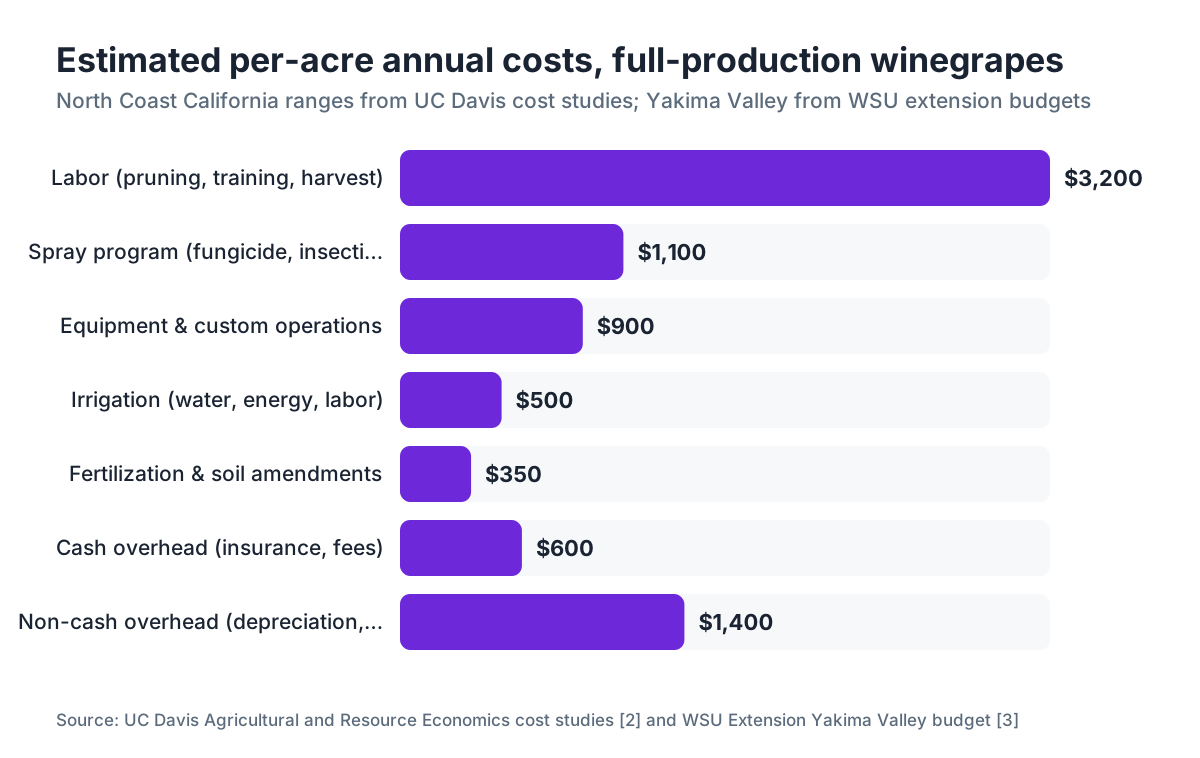
Most university extension templates sort costs into four buckets: pre-harvest cultural operations, harvest costs, cash overhead, and non-cash overhead (depreciation and land opportunity cost) [2][3].
Pre-harvest cultural operations are the biggest bucket and the one worth breaking down granularly, because each line maps to a field activity you can log.
| Cost Category | Typical Line Items | Ties to Field Record? |
|---|---|---|
| Dormant labor | Pruning, brush removal | Labor tickets by block |
| Trellising & training | Shoot positioning, tucking | Labor tickets |
| Spray program | Fungicide, insecticide, herbicide | Spray log (EPA WPS required) |
| Fertilization | Petiole/soil-driven N, K, micro | Application records |
| Irrigation | Water cost, labor, pump energy | Irrigation logs |
| Canopy management | Leaf removal, hedging | Labor tickets |
| Pest scouting | Contractor or in-house hours | Scout reports |
| Harvest | Picking labor, gondolas, lug bins | Harvest log, crush report |
| Equipment | Tractor passes, custom hire | Equipment use log |
| Cash overhead | Insurance, water district fees | Invoices |
| Non-cash overhead | Depreciation, land rent | Depreciation schedule |
WSU's publication "Cost Estimates for Establishing and Producing Wine Grapes in the Yakima Valley" breaks establishment-year costs into more than 30 line items with real per-acre figures you can use as benchmarks even if you farm nowhere near Washington [3].
Here's the discipline that makes it all work. Every pre-harvest line should have a matching field record type. If you can't point to a log, you can't verify the cost, and you can't defend it in an audit.
How do you structure a budget across establishment years versus full production?
Vineyards have a multi-year establishment phase, usually three to four years before you see commercial tonnage. Year one costs look nothing like year four costs. Budget them the same way and you'll misread your financial position every single year.
Use three separate budget sheets: Year 1 (establishment), Years 2-3 (development), and Year 4 and up (full production). UC Davis Agricultural and Resource Economics publishes separate templates for each phase, and its full-production North Coast winegrape studies land roughly in the $5,000 to $10,000 per acre per year range depending on variety, labor market, and infrastructure [2]. Those numbers move a lot by region, so treat them as a starting frame, not gospel.
In establishment years, your two biggest lines are usually vine purchase plus planting labor (which can run $3.00 to $5.50 per vine installed, depending on rootstock source and region) and trellis and irrigation infrastructure, which is a capital cost you depreciate rather than expense. That distinction matters for your taxes and for reading the budget correctly.
Link to field records during establishment by keeping a separate establishment cost ledger that captures every invoice, every labor ticket, and every material receipt by date and block. That ledger becomes the basis for your depreciation schedule and, if you ever sell the property, your cost basis for the improvements.
Once you reach full production, the structure settles down and the link to field records becomes a month-by-month reconciliation.
How do you link spray costs to spray records in the budget?
This is where the budget stops being a planning document and becomes a compliance tool. The EPA Worker Protection Standard (40 CFR Part 170) requires pesticide application records be kept for at least two years, including the date, product name, EPA registration number, active ingredient, application rate, target pest, and total amount applied [4]. Your state may require longer retention and more fields.
The link works like this. In your budget you have a line for each pest category: powdery mildew fungicides, botrytis fungicides, leafhopper insecticides, and so on. Each line shows an estimated number of applications and an estimated cost per application. When you spray, the log captures the date, the product, the rate, and the per-acre cost. At the end of the month or season, you reconcile actual spray cost against budgeted spray cost, line by line.
That reconciliation is where you catch problems. If your powdery mildew budget was 6 passes and you made 10, you know right away whether the overage came from disease pressure, a weather event, or a scheduling gap that let inoculum build up. That's a management insight, not a bookkeeping entry.
EPA guidance requires that agricultural employers keep pesticide application records available for inspection. A spray log that feeds your budget reconciliation is already organized for that. One that lives in a notebook on the tractor floor is not.
For multiple blocks, track spray costs by block or by variety rather than by total acreage. A Pinot Noir block and a Cabernet Sauvignon block on the same property often carry very different mildew pressure, and therefore very different spray costs. Lump them together and you hide both your budget variance and your real per-variety economics.
How do you connect labor records to the enterprise budget?
Labor is usually the single largest variable cost in a winegrape operation, often 40 to 60 percent of total pre-harvest costs [2][3]. Getting the budget-to-record link right here matters more than anywhere else.
Start at the budget level. Estimate labor hours per acre per activity, then price those hours at your actual wage rate plus burden (payroll taxes, workers' comp, housing if you provide it). WSU's Yakima Valley budget estimates pruning at roughly 60 to 80 hours per acre for cane-pruned Riesling, which at Washington's minimum wage of $16.28 per hour (January 2024) works out to roughly $1,000 to $1,300 per acre before burden [3][5].
On the field record side, labor tickets need to capture date, employee or crew ID, block or row number, activity code, hours worked, and piece-rate units where they apply. That detail lets you roll up actual labor cost by activity and compare it straight to your budget line.
One practical tip. Set up the activity codes in your labor system to match your budget categories exactly. If your budget says "Shoot Positioning" and your labor tickets say "SP" or "canopy work," you'll burn hours every month translating between two systems. Make them match from day one.
If you use a contractor or a custom harvester, the invoice is the field record. File it by date and block, and make sure it lists the activity, the acreage, and the rate. A lump-sum invoice for "harvest services" tells you nothing you can use to track variance or defend the expense.
Tools like VitiScribe let you build activity codes that map to your budget categories, so labor ticket entry and budget reconciliation happen in one workflow instead of two disconnected ones.
What does a full production-year budget reconciliation actually look like?
Reconciliation is the monthly or quarterly habit of comparing your budget to your actual field records. Here's how it plays out.
Take your dormant pruning line. Budget says 70 hours per acre at $18.00 an hour loaded, so $1,260 per acre. Your February labor tickets show 78 hours per acre at $18.00, so $1,404 per acre. Variance: $144 per acre over, or 11.4 percent. Is that a problem? Maybe. Was it a wet winter that slowed the crew? A hard-cut decision to leave more canes on a young block? Write a one-line note in the variance column. That note is worth more than the number, because it tells next year's planner why the number moved.
Do this every month for every major cost category. By mid-season you'll have a running picture of whether the year is tracking to plan or sliding off it. By harvest you'll have a complete record you can hand to your accountant, your lender, or a buyer doing due diligence.
Cornell's Dyson School of Applied Economics and Management publishes guidance on enterprise budget development that recommends reconciling at least quarterly and flagging any line item variance greater than 15 percent for a written explanation [6]. That's a reasonable threshold. Under 15 percent is normal noise. Over 15 percent is a signal that your estimate was off or something changed in the field.
If you want reconciliation to move fast, design the budget and the field record system together. The categories match. The acreage units match. The time periods match. If they don't, reconciliation turns into a translation exercise, and it will get skipped.
How do you budget for compliance costs like WPS training and pesticide record-keeping?
Compliance costs are real, and most enterprise budgets undercount them. The EPA Worker Protection Standard requires annual pesticide safety training for all agricultural workers and handlers who may be in or around treated areas [4]. That training takes time, and if you use a certified trainer or a purchased program, it costs money.
A realistic compliance line should include WPS training (materials plus staff time, budget $15 to $30 per worker per year at minimum), pesticide record-keeping labor (whoever logs the spray records, roughly 15 to 30 minutes per application), restricted-entry interval monitoring labor, and any state-required pesticide use reporting.
California growers carry extra requirements. The California Department of Pesticide Regulation requires a Pesticide Use Report for every application, submitted to the county agricultural commissioner, with data fields that go beyond the federal minimum [7]. If you farm in California and you're not budgeting the staff time to complete and submit those reports, you're already carrying a hidden cost that never shows up in your books.
State extension programs publish compliance cost guidance. UC ANR's Integrated Pest Management program includes accounting for regulatory compliance time, though the estimate varies widely by operation size [8].
Treat compliance as a fixed overhead line, not a variable cost. It barely moves with yield or weather. Budget it conservatively, track the actual time, and revisit it once a year.
What's the right software or spreadsheet format for linking a budget to field records?
There's no single right answer, and I'd rather give you an honest read on the tradeoffs than push you toward one tool.
Spreadsheets (Excel or Google Sheets) work fine for a single block or a small operation, especially if you're already comfortable with pivot tables. The free UC Davis enterprise budget templates are Excel-based and well built [2]. The catch is that a spreadsheet is always a separate artifact from your field records. You'll copy data from paper logs or another system into the sheet, and that copying step is where errors sneak in.
Dedicated vineyard management software solves the integration problem by keeping field records and budget categories in one database. Log a spray application and the product cost can flow straight to the right budget line. Same with labor tickets. Reconciliation shrinks to reviewing variances instead of entering data twice.
The honest tradeoff. Software costs money (typically $50 to $300 per month for small to mid-size operations, depending on the platform) and takes time to set up right. If you farm fewer than 20 acres and you already live in spreadsheets, a well-built sheet may be the better short-term call. If you're above 50 acres, or juggling multiple blocks with different ownership or contract structures, purpose-built software pays for itself in staff time fairly quickly.
Whatever you use, two habits make it work: enter field records in real time (or within 24 hours), and reconcile to the budget on a fixed schedule. Neither happens on its own. You have to build both into the workflow.
VitiScribe is built for exactly this, with spray log entry that maps to budget categories and generates the records EPA WPS and state reporting systems ask for. If you're weighing options, it's worth a free trial.
How do water and irrigation costs fit into the enterprise budget?
Irrigation varies enormously by region, water source, and infrastructure age, which makes it one of the harder lines to budget accurately.
For district water, you'll have a fixed assessment (per acre, billed regardless of use) and a variable charge tied to acre-feet applied. Budget both separately. Your district's published rate schedule is the starting point. In the Yakima Valley, water district assessments plus delivery charges have run roughly $150 to $400 per acre per year depending on the district and tier [3].
For well water, the cost is mostly electricity (or diesel on older systems) plus pump maintenance. Log each irrigation set by date, duration, block, and estimated volume applied. That log gives you an actual acre-feet-per-season figure you can compare against your water budget and, more useful, against your vine water status observations.
The field record link matters here for two reasons. It lets you calculate your real irrigation cost per acre and sharpen next year's budget. And some water districts and regulatory programs require growers to report applied water volumes. If you keep an irrigation log anyway, that report is trivial. If you don't, you'll spend hours reconstructing it from memory at season's end.
A workable irrigation log: date, block, set duration in hours, flow rate in gallons per minute (from a meter or pump nameplate), calculated gallons applied, and a notes field for anything worth remembering like a pressure drop or a broken emitter. That's enough to calculate acre-feet and feed your reconciliation.
How do you use the enterprise budget to price grape contracts or evaluate land investment?
This is where the budget stops being a compliance document and becomes a real business tool.
For contract pricing, your full-production budget tells you your total cost per ton at a given yield. If your costs run $8,500 per acre and your expected yield is 3.5 tons per acre, your breakeven is around $2,430 per ton before any return on land or capital. That number tells you at a glance whether a contract offer at $2,200 per ton is viable. Without the budget, you're guessing.
For land investment, a lender or buyer typically looks at the net present value of the cash flows the property can generate. Your enterprise budget is the primary input. The USDA Farm Service Agency and most agricultural lenders want at least three years of budget-to-actual history before they'll underwrite a vineyard acquisition loan. A well-kept budget with reconciled field records is worth real money in that negotiation.
For the Paso Robles or South Coast winery buyer deciding whether to plant more acres or buy fruit, the budget is the decision tool. If your cost of production plus a fair land return runs above what you'd pay for comparable fruit on the open market, planting doesn't pencil. If it comes in below, planting makes sense.
Cornell's viticulture program notes that enterprise budgets should carry a line for operator and manager labor even when the operator takes no salary, because that unpaid time has an opportunity cost that belongs in the economics [6]. Most small operations skip it, then wonder why the numbers look better on paper than they feel in the checkbook.
What are the most common mistakes growers make when building or maintaining a vineyard budget?
A few patterns show up again and again.
The first is building the budget in January and never touching it again. The budget should be a living document, reconciled monthly. A budget reviewed once a year at tax time is barely better than none.
The second is using regional average costs without adjusting for your own operation. UC Davis and WSU publish excellent benchmarks, but their labor assumptions, water costs, and input prices may not match your reality. Use the templates for structure and replace their numbers with yours.
The third is dropping non-cash costs entirely. Depreciation on your tractor, your trellis, and your irrigation system is a real cost even though no check goes out the door. Leave it out and your per-ton cost looks artificially low, and you'll underinvest in equipment replacement.
The fourth, and maybe the most operationally damaging, is building the budget and the field records in separate silos with nothing connecting them. If your crew logs spray events in one system and your accountant builds the budget in another, and nobody ever compares the two, you're running blind.
The fifth is forgetting to budget for yield swings. A 20 percent yield cut from frost, smoke, or drought can move your per-ton cost sharply. Model at least two scenarios: your expected yield, and 20 percent below. Know in advance what that does to your breakeven.
Frequently asked questions
How many hours does it take to set up a vineyard enterprise budget from scratch?
For a single-variety, single-block operation using a UC Davis or WSU template as a starting point, expect 8 to 16 hours to build a solid first-year budget. Most of that time goes into gathering your actual input prices, labor rates, and infrastructure depreciation schedules. Later years take 2 to 4 hours to update once the structure is in place.
Are there free vineyard enterprise budget templates I can download?
Yes. UC Davis Agricultural and Resource Economics publishes free Excel-based winegrape enterprise budgets by variety and region through its cost and return studies page. WSU Extension publishes Yakima Valley winegrape budgets that are equally detailed. Cornell's viticulture program also has templates, though they lean toward New York varieties. All three are free and updated periodically.
Does my spray log have to connect to my financial records for EPA compliance?
The EPA Worker Protection Standard doesn't require your spray log to link to your budget, but it does require that spray records be kept for at least two years and stay available for inspection. The financial link is a management practice, not a legal one. That said, California's pesticide use reporting rules require cost data on some forms, so California growers have more reason to connect the two.
What's the difference between a vineyard enterprise budget and a cash flow statement?
An enterprise budget shows total costs and returns per acre regardless of when cash changes hands. A cash flow statement shows when money actually moves. For a vineyard those pictures look very different, because dormant-season labor hits in February but grape revenue may not land until December or January. You need both. The enterprise budget tells you if the business works. The cash flow statement tells you if you can pay the crew in August.
How do you account for shared equipment costs across multiple vineyard blocks or enterprises?
Allocate equipment costs by hours of use per block, tracked in an equipment log. If your tractor spends 40 percent of its hours on Block A, allocate 40 percent of annual tractor costs (depreciation, fuel, repairs, insurance) to Block A's budget. Without that log you end up splitting costs arbitrarily and lose the ability to compare block-level economics honestly.
How often should I reconcile my actual field costs against the enterprise budget?
Monthly is the minimum that keeps the exercise useful. Quarterly beats nothing, but by the time you catch a spray overrun in October the season is over and you can't course-correct. Monthly reconciliation, with a variance flag at 15 percent or more per Cornell's guidance, gives you actionable information while there's still time to act. The reconciliation itself takes under an hour if your records are current.
Can a vineyard enterprise budget help me qualify for USDA EQIP funding?
Yes. USDA Natural Resources Conservation Service EQIP applications for practices like drip irrigation, frost protection, or soil health often require a documented enterprise budget to demonstrate financial need and repayment capacity. A budget with two to three years of actual cost history is more persuasive than a projections-only document. Contact your local NRCS service center for the documentation requirements specific to your state and practice type.
What yield assumption should I use in my vineyard enterprise budget?
Use your own five-year average if you have one. In the first few years, use the yield range published in your extension program's regional budget as a starting point, then model two scenarios: expected yield and 20 percent below. For California North Coast Cabernet, UC Davis budgets often use a 4.0 to 5.0 ton per acre assumption at full production. Your contract target and block history should override that if they differ.
How do I budget for a bad year with crop loss from frost, smoke, or drought?
Build a downside scenario into every year's budget, not after a bad event. Model what happens to your per-ton cost if yield drops 20 to 30 percent. Most fixed costs (irrigation infrastructure, trellising, land) don't shrink with yield, so cost per ton rises sharply on a short crop. That analysis should inform your crop insurance coverage and your cash reserve target. Many growers find out their coverage was too thin only after the loss.
Do I need to track field records by block or by variety?
By block is more useful than by variety, because a block is the physical unit you manage and the unit where costs actually occur. If you have two Chardonnay blocks with different row spacing, rootstocks, or disease pressure, their costs will differ and you want to see that. If a block has interplanted varieties, track by block and note the mix. Variety aggregates help with contract analysis; block-level data drives operational decisions.
How do I handle capital expenses like new trellis or irrigation installation in the enterprise budget?
Capital expenses go on a depreciation schedule, not as a single-year expense. Trellis systems typically depreciate over 15 to 20 years, irrigation systems over 10 to 15 years depending on materials. Each year the annual depreciation amount appears in your budget as a non-cash overhead line. That's how you get an honest total cost per acre that includes the infrastructure keeping the vineyard in production.
What's the best way to train a field crew to keep records that actually match the budget categories?
Keep the activity code list short and post it in the equipment shed or right on the labor ticket. If the crew has to remember more than 10 to 12 codes, they'll simplify on their own in ways that don't match your categories. Weekly check-ins between the field manager and whoever handles reconciliation catch mismatches early. The first season is always the hardest. By year two, if the codes are well built, entry becomes habit.
How does the enterprise budget interact with my vineyard's lease or land rent arrangement?
Land rent or a calculated land opportunity cost should appear as a non-cash overhead line even when you own the land outright. That gives you the full cost of the operation including the cost of the land. On a lease, the lease payment is a cash overhead line. Some grape-growing lease agreements tie profit-sharing to the enterprise budget, so the accuracy of the budget directly affects what you owe or receive at year end.
Sources
- USDA Economic Research Service, Farm Enterprise Budgets overview: USDA ERS defines an enterprise budget as a statement of expected income and expenses associated with a specific production activity.
- UC Davis Agricultural and Resource Economics, Cost and Return Studies for winegrapes: UC Davis publishes per-acre full-production winegrape budget templates by variety and region, with North Coast costs ranging from approximately $5,000 to $10,000 per acre per year.
- Washington State University Extension, Cost Estimates for Establishing and Producing Wine Grapes in the Yakima Valley: WSU's Yakima Valley winegrape enterprise budget breaks establishment-year costs into more than 30 line items and estimates pruning labor at 60 to 80 hours per acre for cane-pruned varieties; water district costs range from $150 to $400 per acre per year.
- U.S. EPA, Worker Protection Standard for Agricultural Pesticides, 40 CFR Part 170: EPA WPS requires pesticide application records be kept for a minimum of two years, includes date, product name, EPA registration number, active ingredient, rate, target pest, and total amount applied, and must be available for inspection at any time.
- Washington State Department of Labor and Industries, Minimum Wage: Washington State minimum wage was $16.28 per hour as of January 2024.
- Cornell University Dyson School of Applied Economics and Management, Enterprise Budget Development Guide: Cornell recommends reconciling enterprise budgets at least quarterly, flagging any line item variance greater than 15 percent for written explanation, and including an operator labor line even if the operator is unpaid.
- California Department of Pesticide Regulation, Pesticide Use Reporting: California requires a Pesticide Use Report for every agricultural pesticide application, submitted to the county agricultural commissioner, with data fields that exceed federal WPS minimum requirements.
- UC Agriculture and Natural Resources, Integrated Pest Management Program: UC ANR IPM program publishes compliance cost guidance including regulatory record-keeping time estimates for California growers.
- Cornell College of Agriculture and Life Sciences, Viticulture and Enology Program: Cornell viticulture program publishes enterprise budget templates oriented toward New York varieties, available free through Cooperative Extension.
Last updated 2026-07-11