How to set up a vineyard irrigation scheduling log
TL;DR
- A vineyard irrigation scheduling log records the date, block ID, run time, volume applied, soil moisture or plant water status readings, and the decision basis for every irrigation event.
- At minimum it matches your state's pesticide and water use recordkeeping rules.
- A good log goes further: it lets you spot trends, prove due diligence to an auditor, and sharpen your scheduling year over year.
What should a vineyard irrigation scheduling log actually contain?
The core of any irrigation log is simple: who irrigated, what block, when, how much, and why. That last field is the one most managers skip. It's also the one that makes the record worth keeping.
At minimum, each entry needs the date, the vineyard block or zone identifier, the irrigation method (drip, overhead, flood), the start and stop time or total run time, the volume applied in gallons or acre-inches, the trigger you used to make the decision (soil moisture reading, evapotranspiration deficit, visual wilt, calendar date), and a field for notes on any anomalies. A clogged emitter. A broken pressure regulator. A frost event that changed the plan.
If you run any fertigation through the same lines, that has to sit in the same record or cross-reference to a separate fertigation log. EPA's Worker Protection Standard [1] requires that workers and handlers have access to product-specific information. Fertigation adds pesticide-adjacent recordkeeping obligations when the material is a registered pesticide, so keep those records linked and reachable.
UC Davis Cooperative Extension recommends tracking both evapotranspiration (ET) data and actual applied water in the same log so you can compute your applied-to-ET ratio across the season [2]. That ratio tells you whether you're over- or under-irrigating relative to crop demand. That's the whole point of scheduling rather than just running timers.
What data fields go into each irrigation event record?
A well-built log entry breaks down into seven columns you fill in for every event. Here's how it looks in practice.
| Field | What to record | Example |
|---|---|---|
| Date | Calendar date of irrigation | 2025-07-14 |
| Block / Zone | Your internal block ID | Block 3B, Cabernet |
| Method | Drip, micro-spray, overhead | Drip |
| Start / Stop time | Or total run hours | 06:00 to 08:45 |
| Volume applied | Gallons or acre-inches | 1,840 gal / 0.08 ac-in |
| Trigger / Decision basis | ET deficit, soil moisture %, stem water potential | SWP: -12 bar at 14:00 prior day |
| Notes | System issues, weather events | Emitter #14 clogged, hand-irrigated |
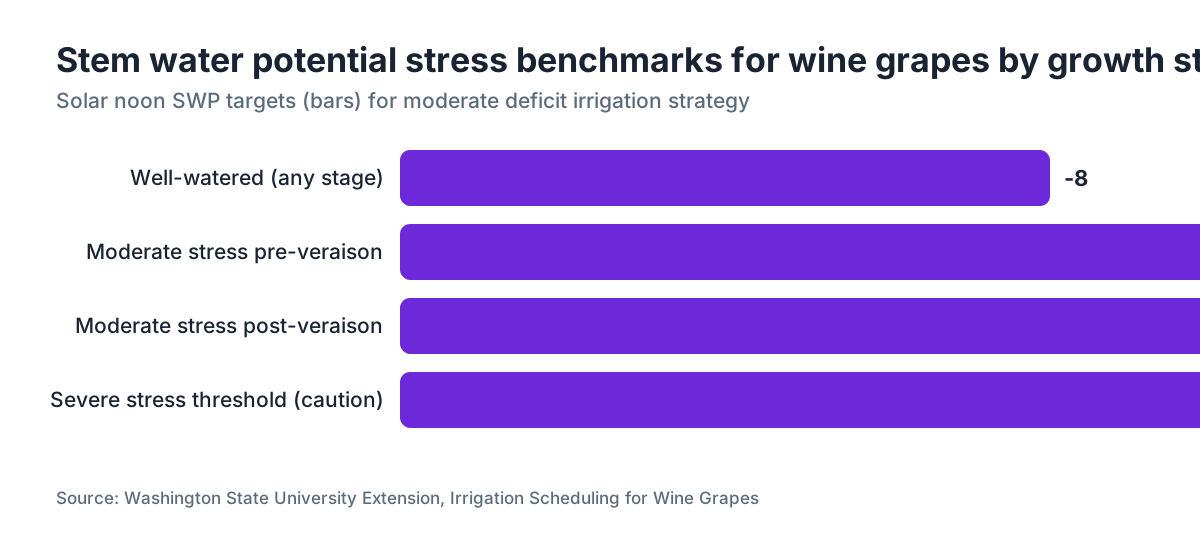
Two more columns earn their space if you're irrigating to a quality target rather than just keeping vines alive: the current growth stage (budbreak through veraison through harvest) and a "days since last irrigation" counter. Growth stage matters because your threshold changes between pre-veraison and post-veraison. WSU Extension publishes stage-specific stem water potential benchmarks for wine grapes, with moderate stress targets of roughly -12 to -14 bar pre-veraison and -14 to -16 bar post-veraison for most wine grape varieties in warm climates [3].
Keep the format consistent across blocks. Mixed formats mean you can't aggregate data at season end, and that kills your ability to compare years or justify water use to a district.
What format works best: paper, spreadsheet, or dedicated software?
Paper works fine for a single-block operation where one person does all the irrigating. A field notebook in a weatherproof sleeve, with dated entries, satisfies most state recordkeeping statutes. The trouble starts when you have multiple blocks, multiple employees, and an auditor asking to see three seasons of data sorted by block.
A spreadsheet (Google Sheets or Excel) is the step most mid-size vineyards take first. One tab per block, or one master tab with a block column you can filter. It's free, it's searchable, and you can build a running acre-inch total with a simple SUM formula. The catch is version control. When two people edit the same sheet from different devices, records get overwritten. And if you're also tracking spray records in a separate sheet, you now have two files to reconcile during an audit.
Dedicated farm management or vineyard record-keeping software connects irrigation logs to block maps, spray records, and harvest data in one place. VitiScribe was built for vineyard field operations and compliance paperwork, and it logs irrigation events alongside spray and scouting records. A well-maintained spreadsheet still beats poorly maintained software every time. Pick the format you'll actually use in the field, not the one that looks impressive in a demo.
One practical rule: fill it in the same day as the irrigation event, whatever format you use. Reconstructed records are obvious to auditors and less accurate anyway. Cornell Cooperative Extension's guidance on agricultural recordkeeping treats same-day entry as the single biggest factor in record accuracy [4].
How do you incorporate evapotranspiration (ET) data into the log?
ET-based scheduling grounds your irrigation decisions in measured atmospheric demand rather than feel, which is why most California and Pacific Northwest viticulture extension programs recommend it [2][5]. The idea is straightforward. Your vines lose water to the atmosphere at a rate you can estimate from weather data. You replace that water at an efficiency-adjusted rate. The log tracks how well you did.
Here's the math in practice. CIMIS (California Irrigation Management Information System) publishes daily reference ET (ETo) for stations across California [5]. You multiply ETo by a crop coefficient (Kc) for grapevines, which shifts with growth stage and canopy size. For a mature, full-canopy vineyard mid-season, Kc runs roughly 0.35 to 0.45 under deficit irrigation, per UC Davis Cooperative Extension guidelines [2]. The result is your estimated crop ET (ETc) in inches per day.
Add two columns to your log: the ETo value pulled from your nearest weather station for that period, and the ETc you calculated. Then record your applied water. The gap between cumulative ETc and cumulative applied water is your running deficit, and that deficit is your main trigger for the next irrigation.
Outside California, WSU operates the AgWeatherNet network for Washington [6], and NEWA (Network for Environment and Weather Applications) serves New York and northeastern states [7]. Every log entry should name which station you pulled ET data from, by station name or ID, so the record is reproducible.
How do soil moisture and plant water status readings fit into the log?
ET data tells you what should be happening. Soil moisture sensors and pressure chamber readings tell you what's actually happening in your specific soil and vine. Both belong in the log.
Soil moisture tools common in vineyards include tensiometers (read in centibars, with irrigation typically triggered at 30 to 50 cb for drip-irrigated wine grapes in loam soils), Watermark sensors (granular matrix sensors on the same centibar scale), and capacitance or TDR probes that read volumetric water content. Log the reading, the sensor depth, the reading date and time, and the threshold that triggers action for that block.
Stem water potential (SWP), measured with a pressure bomb at solar noon on leaves shaded since pre-dawn, is widely considered the most direct indicator of vine water status. WSU Extension's publication on irrigation scheduling for wine grapes lists -8 to -10 bar at solar noon as well-watered for Concord, with wine grape thresholds varying by cultivar and winemaker quality target [3]. In your log, record SWP values with the measurement time (always solar noon or the pre-dawn baseline), the canopy location (shaded leaf, fully expanded), and who took the reading.
One common mistake ruins otherwise good logs: recording only the trigger reading and not the decision it led to. Write down what you decided and why. "SWP -14 bar, within target range for post-veraison Cabernet, no irrigation" is a complete record. "No irrigation" with no context is almost useless when you're reviewing the season in January.
What state and federal compliance requirements apply to irrigation records?
Most states do not mandate a standalone irrigation log the way they mandate pesticide application records. But irrigation records turn compliance-relevant in several contexts you should know.
Start with water rights and water district reporting. Many western states require water users above certain diversion thresholds to report annual consumptive use. California's State Water Resources Control Board [8] requires electronic reporting from many agricultural water users. If your water comes from a district under a water budget allocation, your log is the documentation for that allocation. Keep at least three years of records.
Next, chemigation. If you irrigate through the same system you use to inject pesticides, those applications fall under EPA's Worker Protection Standard and, in many states, additional chemigation statutes [1]. The irrigation record and the pesticide application record have to reconcile. An inspector who sees a chemigation event in your spray log but no matching irrigation log entry will ask questions.
Third, sustainable certification. SIP Certified (Sustainability in Practice), Lodi Rules, LIVE Certification, and CCOF Organic all require documented irrigation management as part of their water stewardship standards. The specific fields differ, but every program expects you to show that irrigation decisions rested on measurable triggers, not arbitrary schedules.
Fourth, food safety. If you grow grapes sold to a winery under a FSMA-regulated supply chain, Good Agricultural Practices audits increasingly review water source and water use records. Your irrigation log is the primary evidence of responsible water sourcing.
How do you organize the log by block so it's actually usable?
Organize by block first, chronology second. That sounds obvious, but most people do the opposite and end up with a chronological list they have to sort by hand every time they want to review a single block's season.
The cleanest structure for a multi-block vineyard is one log file (or notebook section) per block, labeled with a block ID that matches your vineyard map, your spray records, and your harvest records. Inside each block's section, entries run chronologically by date. At season end, add a summary page for that block: total acre-inches applied, number of irrigation events, total hours run, average applied water per event, and any unusual conditions.
In a spreadsheet, use a single master sheet with one row per event and a block ID column. Then build a pivot table that sums applied water by block by month. That pivot table is what you hand to an auditor or certification inspector. It takes ten minutes to build and saves an hour of manual searching.
Block IDs need to be standardized across every field record. "Block 3," "Blk 3," "B3," and "Cab block north" all point to the same ground but will break any automated summary. Pick one naming convention at the start of the season and hold to it. A vineyard map with consistent block IDs is also the foundation for good spray records, scouting logs, and harvest yield tracking.
For operations with multiple water sources (well, district delivery, stored reservoir), add a "source" column to the master sheet. Water district audits and water rights filings will want that breakdown.
How far back do you need to keep irrigation records?
The retention period depends on which obligations apply to you, and the answers stack.
For water rights and water district reporting in California, State Water Board guidance suggests retaining measurement records for at least five years [8]. Washington's Department of Ecology holds similar multi-year expectations for water use reports.
For pesticide records, which overlap with any chemigation events in your irrigation system, federal regulations under FIFRA and EPA WPS require that employer and handler records be kept for two years [1]. California's DPR extends that to three years for most records [10].
For sustainable certification programs like Lodi Rules or SIP, program audits typically look back two to three seasons.
The practical answer is to keep everything for five years. That window covers water rights disputes, certification re-audits, and any food safety investigation timeline. Five years of spreadsheet data takes almost no storage. A paper log takes up a shoebox. Neither is a reason to throw records out early.
What's the right trigger for scheduling an irrigation event?
This is where recordkeeping and agronomy meet. The log documents what you did, but it also forces you to state why, and that makes you a more deliberate irrigator.
Three main trigger approaches show up in commercial viticulture, and they aren't mutually exclusive.
The ET-replacement approach uses your running ETc deficit as the trigger. When the deficit reaches a target amount (say, 1.5 to 2 inches for a drip system with 90% distribution uniformity), you irrigate to refill. This is the most data-driven approach and works well in regions with good weather station coverage.
The soil-based approach uses a tensiometer or capacitance probe at a defined depth (typically 12 inches and 24 inches) and triggers irrigation when the reading crosses a threshold. For fine-texture soils in warm climates, UC Davis recommends starting irrigation when tensiometers at 12 inches read 40 to 50 cb [2]. For sandy soils that threshold drops to 20 to 30 cb, because sand drains faster and the vine can't pull water from a dry sand profile the way it can from clay.
The plant-based approach uses pressure chamber SWP readings at solar noon as the primary trigger, matched to published benchmarks for your variety and quality target. It requires a pressure bomb (equipment cost roughly $800 to $1,500 depending on configuration) and trained staff, but it's the most direct measure of vine stress.
In your log, record which approach you used and what the measured value was. "ET deficit 1.8 in, irrigated 0.5 in" is a complete, auditable entry. "Vines looked dry" is not.
How do you calculate and record applied water volume accurately?
Your applied water figure is only as good as your measurement method. Three approaches are common in vineyards.
A flow meter on the mainline is the most accurate. If your drip system has a turbine or magnetic flow meter, log the meter reading before and after each event. The difference in gallons, divided by your irrigated acreage, gives you gallons per acre. Convert to acre-inches by dividing gallons per acre by 27,154 (there are 27,154 gallons in one acre-inch of water). Log both the raw gallon figure and the calculated acre-inches.
Run-time calculation works if you have no flow meter but know your emitter flow rate and spacing. Multiply run time in hours by emitter flow rate in gallons per hour by the number of emitters in the zone. This assumes all emitters run at rated flow, which is often not true. Catch-test a sample of emitters periodically to verify actual flow rates, and note any distribution uniformity problems in the log.
District delivery meters come third. If you're on a district system, the district bills you on a metered or calculated volume. Cross-reference your log totals to district statements at least monthly. A gap over 10% usually means a leak or a meter problem.
Record the method you used to calculate applied water in your log header or a notes field. An auditor or water district reviewer needs to know whether your numbers came from a calibrated meter or a run-time estimate. If you use VitiScribe or any other farm software to aggregate these records, export a raw data backup at season end in CSV format so your records exist independently of any software subscription.
How do you review the log at season end to improve next year's scheduling?
A log nobody reviews is just compliance theater. The review step is where the record becomes a management tool.
At harvest, or in the first weeks after, pull your block-level summaries and calculate three things for each block: total acre-inches applied for the season, the ratio of applied water to estimated ETc (your applied-to-ET ratio), and the number of days the vine spent above your stress threshold based on SWP or soil moisture readings.
An applied-to-ET ratio above 1.0 means you applied more water than evapotranspiration demanded. That's not automatically wrong. It can account for leaching in saline soils or system inefficiency. But if you sit at 1.3 or 1.4 with no justification, you're over-irrigating, and that shows up in berry size, flavor concentration, and bunch rot risk. A ratio consistently below 0.7 on a block with no deficit irrigation goal suggests you may be stressing the vines harder than you meant to.
Compare your notes on vine appearance during the season (flagging leaves, shoot tip die-back, berry shriveling before veraison) against the water status readings from that same period. That comparison tells you whether your thresholds were calibrated correctly for your specific site and variety.
Write a one-paragraph seasonal summary for each block before you close out the log. Document what worked, what you'd change, and what anomalies you want to watch next season. That paragraph is worth more than the raw data, because it captures your judgment while it's still fresh.
Frequently asked questions
Is a vineyard irrigation log legally required?
In most states, a standalone irrigation log is not explicitly required by law. But it becomes a compliance document in several scenarios: water rights reporting (many western states require annual water use data), chemigation records under EPA's Worker Protection Standard, sustainable certification audits (Lodi Rules, SIP, LIVE), and FSMA-related food safety audits. A detailed log protects you in all of those situations, even if no single regulation mandates it.
What's the difference between an irrigation schedule and an irrigation log?
An irrigation schedule is a plan, usually built before the season, that projects when and how much you expect to irrigate based on historical ET data, soil type, and variety. An irrigation log is the actual record of what happened. The schedule helps you plan system capacity and water allocations. The log is what you present to an auditor, a water district, or a certification body, because it reflects reality rather than intention.
How often should vineyard irrigation records be updated?
Same day as the irrigation event, always. Records filled in from memory two days later introduce errors and are obvious to experienced reviewers. If you have multiple irrigators, build a simple field card system: the person who turns on the water fills in a physical card at the valve box, and a designated person transfers that data to the master log each afternoon. Cornell Extension guidance treats same-day entry as the most reliable way to maintain accuracy in agricultural recordkeeping.
What is stem water potential and how do I record it in an irrigation log?
Stem water potential (SWP) is the pressure, in bars or megapascals, needed to force water out of a shaded leaf in a pressure chamber. It measures vine water stress directly. Record the date and time (always solar noon for SWP), the block, the SWP value in bars (negative numbers), the operator, and the action taken. WSU Extension benchmark targets for wine grapes range from -12 to -14 bar pre-veraison under moderate stress management.
Can I use CIMIS or AgWeatherNet data in my irrigation log?
Yes, and you should. CIMIS (California Irrigation Management Information System) provides daily reference ET values for hundreds of stations across California. AgWeatherNet covers Washington State. In your log, record the station name or ID, the date, and the ETo value you used. That documentation makes your scheduling decisions auditable and reproducible. Multiply ETo by a crop coefficient of roughly 0.35 to 0.45 for mature wine grapes under deficit irrigation to get your estimated crop ET.
How many years of irrigation records should a vineyard keep?
Keep five years as a practical standard. EPA's Worker Protection Standard requires two years for pesticide handler records, California DPR requires three years for most records, and water district and water rights disputes can look back further. Five years covers every likely audit window with no guesswork. The storage cost for five years of spreadsheet data is negligible, and paper records take one filing cabinet shelf.
How do I track irrigation for multiple vineyard blocks without the log becoming unmanageable?
Use a single master spreadsheet with one row per irrigation event and a block ID column. Filter or pivot by block when you need block-level summaries. Standardize block IDs across all field records, your vineyard map, spray logs, and harvest records. Inconsistent naming (Block 3, B3, Cab North) breaks any automated summary and wastes real time during audit season. Pick one naming convention at the start of each season and enforce it.
What's a good soil moisture threshold to use as an irrigation trigger for wine grapes?
For drip-irrigated wine grapes in loam or clay-loam soils, UC Davis Cooperative Extension recommends starting irrigation when tensiometers at 12 inches read 40 to 50 centibars. Sandy soils need earlier triggers, around 20 to 30 cb, because they drain faster and hold less plant-available water. Record the threshold you're using in your log header for each block, because the right number depends on your soil texture more than your variety.
What happens if my irrigation log and my water district billing don't match?
A gap over about 10% between your calculated applied water and district billing usually signals a leak, a meter calibration problem, or a logging error. Investigate promptly and document the investigation in your log. Water district billing errors happen. So do your own measurement errors. The log exists partly so you can catch these gaps before they turn into a billing dispute or a water rights compliance issue.
Do organic or sustainable certification programs require an irrigation log?
Yes, effectively. SIP Certified, Lodi Rules, LIVE Certification, and CCOF Organic all include water stewardship standards that require documented evidence that irrigation decisions rested on measurable triggers, not arbitrary calendars. The specific fields differ by program. Lodi Rules, for example, expects irrigation timing and volume to tie to an established method like ET or soil moisture monitoring. Your log is the primary evidence.
How do I calculate acre-inches applied from run time if I don't have a flow meter?
Multiply run time in hours by emitter flow rate in gallons per hour, then by the number of emitters in the zone. Divide total gallons by 27,154 to get acre-inches, then divide by irrigated acreage to get acre-inches per acre. This method assumes all emitters run at rated flow. Catch-test a sample of emitters seasonally to verify actual flow rates, and note any distribution uniformity findings in your log as a calibration note.
What should I include in an end-of-season irrigation summary?
For each block: total acre-inches applied for the season, total number of irrigation events, ratio of applied water to estimated ETc, the date of the first and last irrigation event, any periods when vine stress exceeded your target threshold, and a brief note on vine performance and fruit quality at harvest. That summary is what you reference when setting next season's schedule and what you show a certification auditor requesting a three-year trend.
Sources
- US EPA, Worker Protection Standard (WPS) for Agricultural Pesticides: EPA WPS governs recordkeeping for pesticide handlers and employers, including chemigation events through irrigation systems; records must be retained for two years
- UC Davis Cooperative Extension, Irrigation of Wine Grapes in California: UC Davis recommends tracking both ET data and actual applied water in the same log to compute the applied-to-ET ratio; crop coefficient for mature wine grapes under deficit irrigation is approximately 0.35 to 0.45 mid-season; tensiometer trigger at 40-50 cb at 12 inches for loam soils
- Washington State University Extension, Irrigation Scheduling for Wine Grapes: WSU Extension publishes stage-specific stem water potential benchmarks for wine grapes: moderate stress targets of -12 to -14 bar pre-veraison and -14 to -16 bar post-veraison for most wine grape varieties in warm climates
- Cornell Cooperative Extension, Agricultural Recordkeeping Guidance: Cornell Extension guidance emphasizes same-day entry as the single biggest factor in maintaining record accuracy for agricultural operations
- California Department of Water Resources, CIMIS (California Irrigation Management Information System): CIMIS publishes daily reference ET (ETo) for weather stations across California for use in irrigation scheduling
- Washington State University, AgWeatherNet: WSU operates the AgWeatherNet network providing weather and ET data for Washington State agricultural scheduling decisions
- Cornell University, NEWA (Network for Environment and Weather Applications): NEWA serves New York and northeastern states with weather and ET data for agricultural scheduling decisions
- California State Water Resources Control Board, Water Use Measurement and Reporting: California State Water Board requires electronic water use reporting from many agricultural users and recommends retaining measurement records for at least five years
- US EPA, FIFRA (Federal Insecticide, Fungicide, and Rodenticide Act) Recordkeeping Requirements: Federal regulations under FIFRA require that pesticide application records, including chemigation events, be retained for two years
- California Department of Pesticide Regulation, Pesticide Use Reporting: California DPR requires pesticide use records to be retained for three years, extending the federal two-year minimum
Last updated 2026-07-11