How to set up an annual crop record summary for tax and compliance

TL;DR
- An annual crop record summary pulls your spray logs, yield data, input costs, and labor records into one document you file or retain each year.
- It satisfies IRS Schedule F cost documentation, EPA Worker Protection Standard recordkeeping, and most state pesticide-use reporting rules.
- Build it block by block starting in January, not in a panic the week taxes are due.
What is an annual crop record summary and who actually needs one?
An annual crop record summary is one organized document, or a small set of linked ones, that captures everything your vineyard did in a calendar year: what you sprayed and when, what you harvested, what you spent on inputs, what you paid for labor, and what the land produced. It is not a single government form. It is the source document that feeds several forms and several agencies.
Grow grapes commercially and file taxes as a farm? You need one. The IRS expects you to back up every deduction you claim on Schedule F (Profit or Loss From Farming) [1]. If you apply any restricted-use or general-use pesticides, the EPA Worker Protection Standard (WPS) requires you to keep pesticide application records for at least two years, and your state lead agency may demand longer retention or active annual reporting [2]. Most western wine states, including California, Oregon, and Washington, require growers to submit pesticide-use reports (PURs) to county or state agriculture departments, and those reports pull straight from your spray log [3].
Small wineries that farm their own estate blocks face the fullest picture: federal tax, federal WPS, state pesticide reporting, and state organic certification records if any blocks carry that label. City wineries and custom-crush clients who buy fruit rather than grow it can skip most of this. The growers selling to them cannot.
What records do you need to gather before you can build the summary?
You cannot summarize what you never tracked. The summary is only as good as the field records you collected through the season. Before you compile anything, pull these documents together.
Spray records. Every application needs date, field or block ID, crop, target pest or disease, product name, EPA registration number, rate applied, total product used, applicator name (and license number if a PCA or licensed applicator), REI, and PHI. The WPS requires these records to be available to employees and handlers within 30 minutes of a request during the application period and for 30 days after [2].
Input purchase receipts and invoices. Fertilizers, amendments, cover crop seed, trellising materials, irrigation parts. Everything you deduct on Schedule F lines 14 through 34 needs a paper or digital receipt.
Yield and harvest data. Weight tickets, winery pick-up receipts, or custom crush intake records. These set your gross income and your yield per acre, which matters for crop insurance and loss claims.
Labor records. Payroll summaries, H-2A worker records if applicable, and any contract labor invoices. Labor is usually the biggest single cost in a vineyard and the one the IRS looks at hardest.
Equipment hours and fuel logs if you spread machinery costs across multiple enterprises.
Water and irrigation records in states with water rights reporting.
Gather all of it before January 31 of the following year. If you are reconstructing spray records from memory in March, you have already lost the habit that makes this manageable.
How do you structure the annual crop record summary document itself?
Think of the summary as five blocks. Each block answers a different agency's or auditor's questions.
Block 1: Property and ownership header. Legal entity name, DBA, farm or operation name, address, APN or legal description of each block, total planted acres by variety, and the tax year. One page. Stays identical year to year except for acreage changes.
Block 2: Pesticide application log summary. A table that condenses your raw spray records. One row per application event. Columns: date, block ID, product name, EPA reg. number, total product used (oz or lbs), total acres treated, applicator. This is what you submit or hold ready for your county's PUR in California [3] or the equivalent elsewhere. It is also what you hand a WPS compliance inspector.
Block 3: Input cost summary by category. Group your receipts into IRS Schedule F line categories and subtotal each. Fertilizers and lime (line 19), pesticides and herbicides (line 14), seeds and plants (line 33), repairs and maintenance (line 30), and so on. A simple table does the job.
Block 4: Harvest and revenue summary. Total tons or pounds harvested by block and variety, price per ton or per pound, gross revenue. Sold to multiple buyers? List each. Match these numbers to your 1099s.
Block 5: Labor summary. Total wages paid on W-2, total contract labor on 1099, any H-2A housing and transportation costs (deductible under IRC Section 162 as ordinary business expenses [1]).
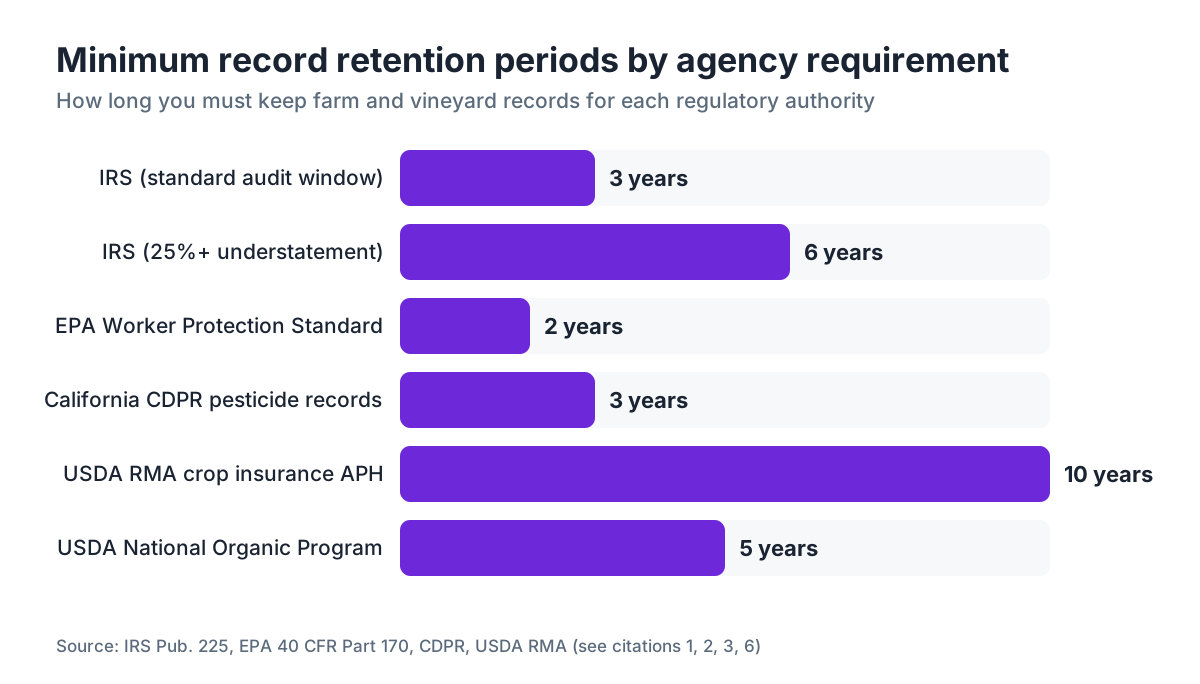
That is the whole document. Five blocks, probably 8 to 15 pages depending on your size. One PDF or binder, kept at least three years for IRS purposes and at least two years for WPS, though many states want three to five years for pesticide records [2][3].
What does the pesticide application table need to look like?
This is the section growers get wrong most often. The raw spray log is not the same as the annual summary table. The spray log is a running field document. The summary table aggregates it for reporting.
For WPS compliance, 40 CFR Part 170 specifies that application records must include the product name, EPA registration number, active ingredient(s), location of the treated area, start and end date of the application, and the applicable REI [2]. California's DPR adds applicator name and license number, site ID, total acres or units treated, and the amount of product applied under the state Pesticide Use Reporting regulations (FAC Section 12979) [3].
Here is a minimal compliant table format:
| Date | Block | Product Name | EPA Reg. No. | Active Ingredient | Rate (oz/acre) | Total Used | Acres Treated | REI (hrs) | Applicator |
|---|---|---|---|---|---|---|---|---|---|
| 04/12 | Block 3 | Pristine WG | 7969-294 | Pyraclostrobin + Boscalid | 8 oz | 24 oz | 3.0 | 12 | J. Smith |
| 05/01 | All | Sulfur 90W | 400-W... | Sulfur | 5 lbs | 40 lbs | 8.0 | 24 | J. Smith |
Keep the EPA registration number exact. That number is how an inspector verifies the product label, which is a federal document. A wrong reg number is not a minor typo in a compliance context.
If you use a pest control adviser (PCA) in California, their written recommendations are also records you must retain [3]. File them with the spray log, not off in a separate folder.
How does the crop record summary connect to IRS Schedule F?
Schedule F is a two-page form, but the real work sits in your supporting records, not on the form itself. The IRS audits farm returns, and when it does, it asks for the documents behind the numbers on each line.
Your Block 3 input cost summary maps almost one to one to Schedule F Part II. The table below shows common vineyard expenses and where they land:
| Expense Category | Schedule F Line |
|---|---|
| Pesticides and herbicides | Line 14 |
| Custom hire (spray contractor, harvest crew) | Line 15 |
| Employee wages | Line 22 |
| Fertilizers and lime | Line 19 |
| Seeds and plants | Line 33 |
| Repairs and maintenance | Line 30 |
| Fuel and oil (farm use) | Line 20 |
| Rent or lease (land, equipment) | Line 24 |
| Crop insurance premiums | Line 16 |
| Depreciation (trellising, equipment) | Line 17 |
The IRS document that matters most here is Publication 225, the Farmer's Tax Guide [1]. It is updated every year and it is genuinely useful, not filler. Read the sections on capital versus deductible expenses closely, because vineyard trellis systems and irrigation infrastructure are usually capital assets depreciated over 7 to 15 years under MACRS, not immediate deductions.
One thing worth flagging: prepaid farm expenses (buying fertilizer or pesticides in December for next year's crop) are deductible in the year paid, up to 50 percent of your other deductible farm expenses, under the rules in Pub. 225 [1]. Prepay more than that and the excess rolls to next year. Your annual summary should note any prepaid inputs with the purchase date and the crop year they apply to.
What are the state-level pesticide reporting requirements you need to hit?
State rules vary enough that you have to look up your own state, but here is the realistic picture for the major wine grape states.
California runs the most demanding system in the country. Growers and applicators must submit pesticide use reports to their county agricultural commissioner monthly, not annually, with reports due by the 10th of the following month [3]. Your annual summary is effectively a roll-up of 12 monthly PURs. The California Department of Pesticide Regulation (CDPR) publishes the forms and data requirements at cdpr.ca.gov. Miss a monthly PUR deadline and you face civil penalties.
Washington requires commercial pesticide applicators to report annually, administered by the WSDA. Washington State University Extension's farm business management program covers how growers there should structure records [4].
Oregon requires licensed commercial applicators to keep records for three years and produce them on ODA request. Growers applying their own pesticides face different rules; check ODA's Pesticide Program section.
New York growers should consult Cornell Cooperative Extension, which publishes state-specific spray record templates and compliance guidance through its viticulture and enology work [5].
The safe baseline: keep every application record for five years. That covers the IRS (three-year audit window, six for substantial understatement), WPS (two years), and the most aggressive state rules.
How do you organize yield and harvest records for both tax and loss documentation?
Harvest records do two jobs. For taxes, they set your gross farm income on Schedule F line 2 (sales of livestock, produce, grains, and other products). For crop insurance and USDA programs, they set your actual production history (APH), which drives your coverage levels under federal crop insurance through USDA's Risk Management Agency [6].
The minimum per block: harvest date, variety, estimated bearing acres, total weight harvested (tons for grapes), price per ton or total revenue, and buyer name. Sold to multiple buyers or at different prices? Record each one separately.
Weight tickets are your primary documents. Do not throw them out. Hand-pick and estimate weight with no tickets, and that estimate is very hard to defend in an audit or an APH dispute. Work with your buyer to get signed intake records even for small loads.
USDA RMA uses up to ten years of production history for APH, or as many years as you have farmed, with a minimum of four years for a base APH [6]. A harvest summary filed consistently builds that history on its own. Growers who skip formal harvest records for a few years end up with a lower insurable yield, because RMA fills the missing years with a transitional yield (T-yield) set at about 65 percent of the county average. That gap costs real money in coverage.
What is the right way to handle labor records in the summary?
Labor is where farm record-keeping fails an audit most often. The IRS watches farm labor closely because cash payments are common in agriculture and the paper trail runs thin.
Your labor block should include total W-2 wages by employee (or a payroll summary from your processor), total 1099-NEC amounts by contractor, any H-2A program costs (visa fees, housing, transportation, the wage differential above AEWR), and employer payroll tax deposits (FUTA, FICA).
For H-2A workers, the Department of Labor sets the Adverse Effect Wage Rate (AEWR) each year by state, and the rate changes every January [7]. Make sure your records capture the actual hourly wage paid against the AEWR for that year. DOL audits compare exactly those two numbers.
One thing a lot of small growers miss: pay any individual $600 or more in a calendar year for services, and if they are not a W-2 employee, you owe them a 1099-NEC. That includes the guy who does your tractor work twice a year and the consultant who visits quarterly. Keep a contractor log all year instead of rebuilding it in January, and you skip a lot of scrambling.
Cornell's farm labor resources and the University of California's farm labor management guides both note that the documentation burden went up meaningfully after DOL revised its H-2A regulations in 2023 [5][8].
How often should you update the crop record summary during the year?
Honest answer: the "annual" summary is built from records you should update weekly through the growing season.
Complete spray records within 24 hours of each application. That is a practical rule, more than a compliance suggestion. The details you remember a week later are not the details you write down the same day.
Input receipts go into a folder, physical or digital, the moment you get them. Categorize at purchase: label each receipt with the Schedule F line it belongs to. Five seconds now saves an hour in January.
Harvest data gets recorded at each pick. Labor records get maintained payroll period by payroll period.
The annual compilation, the act of pulling everything into one document, happens in January for the prior year. Set a hard deadline: January 31. That gives you time to catch gaps before your accountant needs the numbers, and it lines up with W-2 and 1099 filing deadlines so you are already in records mode.
Run a multi-block operation with a dozen or more spray events a season? A tool that captures field records digitally and generates the summary automatically is worth a look. VitiScribe is built for exactly this: spray logs, harvest records, and input costs flow into one exportable annual summary that maps to Schedule F categories and state PUR formats. A well-organized spreadsheet or binder works fine for smaller operations. The system matters less than the habit.
How long do you need to keep the annual crop record summary?
Different agencies run different clocks, and you have to keep records long enough to satisfy the longest one.
The IRS generally has three years from the filing date to audit a return, but that window stretches to six years if the IRS believes income was understated by more than 25 percent [1]. For farm returns with swingy income, six years is the safe call.
WPS requires pesticide application records for two years from the date of application [2]. Most states that require annual pesticide-use reports want records for three to five years. California's CDPR expects records available for inspection for at least three years [3].
USDA RMA crop insurance APH records should stay for ten years or the life of your policy, whichever runs longer [6].
Practical rule: keep everything for seven years. That covers all of these with margin. After seven years you can shred input receipts and labor documents. Keep harvest summaries and spray logs for ten years if you carry crop insurance, because APH disputes can surface late.
Digital storage is fine as long as the files are backed up in at least two places and sit in a format you can still open years later. A PDF outlasts a proprietary database export from software you may not run in eight years.
What are the most common mistakes growers make when building this document?
A few patterns show up again and again.
Mixing personal and farm expenses. Buy a chainsaw and use it 60 percent for farm work, and only 60 percent is deductible. The record needs the business-use percentage, more than the purchase price. IRS Publication 225 covers this directly [1].
Incomplete EPA registration numbers on spray records. Inspectors match the reg number to the label on file. If the number is wrong or missing, the record fails, even when the application itself was done right.
Missing PHI documentation near harvest. Apply anything with a pre-harvest interval in the 30 days before picking, and your spray log should show the application date and the calculated PHI clearance date. This matters for WPS compliance and for liability if a residue issue comes up.
Not separating capital improvements from operating expenses. A new trellis row, a drip irrigation install, or a new block are capital expenditures you depreciate, not expense in the year paid [1]. Expense them wrong and you overstate the deduction and invite an audit.
Lumping all blocks together. Different varieties, organic status, or water sources across your blocks? Keep them separate in the summary. Blending them makes compliance reporting harder and hides block-level profitability from you.
WSU Extension's farm business management guides and the University of California's viticulture resources both point to block-level record-keeping as the base of good vineyard management, more than compliance [4][8]. The compliance benefit is secondary to actually knowing which blocks make you money.
Is there a simple template or checklist you can start with right now?
Yes. Here is a minimal viable annual crop record summary checklist. Print it, tape it inside your spray cabinet, and run it as a year-end audit of your own records before you hand anything to an accountant.
Property header (complete once, update annually):
- Operation name, legal entity, tax ID
- Block map with acres and varieties
- Tax year
Spray log summary table (complete by January 31):
- One row per application: date, block, product, EPA reg. no., rate, total used, acres, REI, applicator
- All applications from January 1 through December 31
- PCA recommendations attached if applicable
Input cost table (complete by January 31):
- Subtotals by Schedule F line category
- All receipts filed and labeled
- Prepaid inputs noted with applicable year
Harvest summary (complete after last pick):
- Tons/lbs per block per variety
- Buyer name and price per ton
- Weight tickets filed
Labor summary (complete by January 31):
- W-2 payroll total
- 1099 contractor total and list of recipients
- H-2A costs itemized if applicable
Retention checklist:
- All documents backed up digitally?
- Backup copy offsite or in cloud?
- Retention calendar updated (shred date for each document type)?
Once your operation runs more than 10 blocks or 40-plus spray events a year, maintaining all this in a spreadsheet or paper binder gets genuinely time-consuming. That is the point where vineyard-specific record-keeping software, like VitiScribe, starts paying for itself in time saved rather than features owned. But start with paper if that is what you have. A complete paper record beats an incomplete digital one every time.
For growers new to the whole framework, the University of California's farm management resources and the extension publications from Cornell's viticulture program are the best free starting points [5][8]. WSU Extension also publishes annual crop enterprise budget templates that double as a record structure guide [4].
Frequently asked questions
Do I need a separate annual crop record summary for each vineyard block?
You do not need a separate document per block, but you do need block-level detail inside your summary. Your spray log table, harvest summary, and input cost records should identify which block each event applies to. A single consolidated document with block-coded rows works fine. Keeping blocks separate inside the document is what lets you produce block-specific reports for state pesticide reporting and crop insurance without rebuilding everything.
What records does the EPA Worker Protection Standard actually require me to keep?
Under 40 CFR Part 170, you must keep pesticide application records that include the product name, EPA registration number, active ingredients, location of the treated area, application dates, and the applicable re-entry interval (REI). Records must be available to workers and handlers within 30 minutes of a request during the application and REI period, and for 30 days after. You must retain the records for at least two years from the date of application.
How do I connect my spray log to California's pesticide use reporting system?
California requires monthly pesticide-use reports submitted to the county agricultural commissioner by the 10th of the following month. Complete spray log entries (product, EPA reg. no., rate, acres, applicator license number, site ID) map directly to the DPR reporting fields. Many growers batch-enter monthly from their spray log. If you use a PCA, they may handle the reporting, but the grower is still responsible for the accuracy of the records on file.
Which IRS form or schedule uses the annual crop record summary as its source?
Schedule F (Profit or Loss From Farming, Form 1040) is the primary tax form. Your input cost table feeds Schedule F Part II expense lines. Your harvest revenue feeds Part I. If you own capital assets like trellis or irrigation systems, Form 4562 (Depreciation and Amortization) uses your equipment and improvement records. IRS Publication 225, the Farmer's Tax Guide, explains all of these connections and is updated each year.
How long do I legally have to keep farm tax records?
The IRS audit window is generally three years from the return filing date, but it extends to six years if the IRS suspects income was understated by more than 25 percent. EPA WPS records require two-year retention. California DPR expects three years for pesticide records. USDA RMA crop insurance APH records should stay for the life of the policy. The practical safe answer: keep everything for seven years, spray logs and harvest records for ten.
Can I deduct prepaid pesticides and fertilizers bought in December for next year's crop?
Yes, with a limit. IRS Publication 225 lets farm cash-basis taxpayers deduct prepaid farm supplies in the year paid, but the prepaid amount cannot exceed 50 percent of all other deductible farm expenses for that year. If your prepayments exceed that threshold, the excess rolls to the next tax year. Your annual summary should flag any December prepayments with the purchase date and the crop year they apply to so your accountant handles them correctly.
What records do I need to support an H-2A labor deduction?
Keep the job order, each worker's I-9, payroll records showing the hourly wage paid against the state AEWR for that year, housing cost receipts, inbound and outbound transportation costs, and visa and border crossing fee receipts. DOL sets the AEWR each year by state; your records should show you met or exceeded it. All of these costs are deductible as ordinary business expenses. Total them in your annual labor summary block.
Does organic certification change what crop records I need to keep?
Yes. Certified organic operations must keep records sufficient to show compliance with the USDA National Organic Program (NOP) for five years, including records of all substances applied to the land, purchase receipts for all organic inputs, and harvest records by field. Your certifier reviews these records every year. The organic farm plan and annual update become extra blocks in your summary, and they must reconcile with your spray log.
What is actual production history (APH) and why does my crop record summary affect it?
APH is your farm's documented yield record, used by USDA RMA to set your federally insured yield level. RMA uses up to ten years of actual yield data, or fewer if you have a shorter history. Your annual harvest summary (tons per acre per block) builds this history year by year. Missing years get filled with a transitional yield set at about 65 percent of the county average, which lowers your insurable yield and costs you coverage. Consistent harvest records protect your APH.
Can a spreadsheet handle the annual crop record summary or do I need software?
A spreadsheet handles it fine for operations with fewer than 10 blocks and under 40 spray events per season. Use one workbook with separate tabs for the spray log, input costs, harvest, and labor. Once you pass that scale, or if you have compliance deadlines in more than one state, purpose-built vineyard record-keeping software starts saving meaningful time on data entry and report generation. The format matters less than consistency.
What happens if a state ag inspector asks for my spray records and they are incomplete?
Consequences vary by state. California's CDPR can issue civil penalties for missing or inaccurate pesticide-use reports; fines range from small amounts for first-time clerical errors to several thousand dollars for willful violations or repeated failures. Most states start with a warning for minor deficiencies on a first inspection. Incomplete REI records or missing EPA registration numbers get treated more seriously because they relate directly to worker safety under WPS.
How do I document block-level costs when some inputs like irrigation or frost protection cover multiple blocks?
Allocate shared costs by acres. If a frost protection event costs $2,000 and covers three blocks totaling 10 acres, allocate $200 per acre to each block based on its acreage. Document the allocation method in your summary so it holds up if questioned. For tax purposes the total deduction is the same whether you allocate or not, but block-level allocation lets you calculate true per-block cost of production, which is genuinely useful for management decisions.
Do I need to include soil test results and tissue tests in my annual crop record summary?
You are not legally required to include them, but it is worth doing. Soil and tissue test results tie directly to your fertilizer application records and support the agronomic rationale for inputs you deduct. In an audit, showing you applied 200 lbs of potassium per acre because a soil test flagged a deficiency is far stronger than a bare receipt. File test results with your input cost block, dated and block-identified.
Sources
- IRS, Publication 225 Farmer's Tax Guide: Schedule F documentation requirements, prepaid farm expense 50% rule, and capital versus deductible farm expense rules
- EPA, Worker Protection Standard 40 CFR Part 170: WPS requires pesticide application records to be retained for two years and available to workers within 30 minutes of request; records must include product name, EPA registration number, active ingredients, location, dates, and REI
- California Department of Pesticide Regulation, Pesticide Use Reporting: California requires monthly pesticide-use reports to the county agricultural commissioner by the 10th of the following month; records must be retained for at least three years
- Washington State University Extension: WSU Extension publishes annual crop enterprise budget templates and farm business management guidance applicable to Washington growers
- Cornell Cooperative Extension: Cornell publishes state-specific spray record templates and pesticide compliance guidance for New York growers, and covers H-2A labor compliance documentation
- USDA Risk Management Agency, Actual Production History: RMA uses up to ten years of actual yield data for APH; missing years are filled with transitional yields set at approximately 65 percent of the county average; minimum of four years required for a base APH
- US Department of Labor, H-2A Adverse Effect Wage Rates: DOL sets the Adverse Effect Wage Rate annually by state each January; H-2A employers must pay the higher of the AEWR or the applicable prevailing wage
- University of California Agriculture and Natural Resources: UC extension emphasizes block-level record-keeping as the foundation of vineyard management and publishes farm labor compliance guides
- IRS, Schedule F (Form 1040) Profit or Loss From Farming: Schedule F Part I captures farm income; Part II captures expense deductions by category including pesticides (line 14), custom hire (line 15), wages (line 22), fertilizers (line 19)
- USDA National Organic Program: Certified organic operations must maintain records of all substances applied to the land and input purchase receipts for five years, reviewed annually by the certifier
Last updated 2026-07-10