How to track neonicotinoid applications to meet state reporting thresholds

TL;DR
- Most states require pesticide application records kept for 2-3 years minimum, with some (California, New York, Oregon) imposing stricter neonicotinoid-specific reporting or use restrictions.
- You need the product name, EPA registration number, active ingredient, rate, acreage, application date, and applicator license number logged at the time of application.
- Missing any one field is the most common audit failure.
What are neonicotinoids and why do regulators pay special attention to them in vineyards?
Neonicotinoids are a class of systemic insecticides. The group includes imidacloprid, clothianidin, thiamethoxam, acetamiprid, dinotefuran, and a handful of others. They work by binding to nicotinic acetylcholine receptors in insects, and because they move through plant tissue, they can show up in pollen and nectar at concentrations that harm bees and other pollinators. That is the regulatory pressure point.
In vineyard settings, neonicotinoids are most commonly used against vine mealybug, leafhoppers, and grape phylloxera. Imidacloprid applied as a soil drench or trunk injection is a standard choice in many regions. The problem is that systemic uptake means residues can persist in guttation droplets and, depending on the product, in soil for months to years. [1]
Regulatory attention to neonicotinoids has grown sharply since the European Union suspended outdoor uses of clothianidin, imidacloprid, and thiamethoxam in 2018 and the EPA began its Interim Registration Review decisions starting in 2023. [2] State-level agencies took note. California's Department of Pesticide Regulation, Oregon's Department of Agriculture, New York's Department of Environmental Conservation, and Washington's Department of Agriculture have all introduced or strengthened reporting or restriction measures in the last several years. If you grow grapes, you need to know which rules apply in your state, because the federal baseline is genuinely the floor.
What does federal law require for pesticide application records?
The federal floor comes from two places: the Federal Insecticide, Fungicide, and Rodenticide Act (FIFRA) and the EPA's Worker Protection Standard (WPS).
FIFRA section 8 gives EPA authority to require record-keeping by certified applicators of restricted-use pesticides (RUPs). Under 40 CFR Part 171, certified private and commercial applicators must keep records of every RUP application for two years. [3] The required fields are: brand name, EPA registration number, total amount applied, location of application, size of area treated, and date applied. For commercial applicators there is also a license number requirement.
Several neonicotinoids are sold as restricted-use products. Imidacloprid formulations for agricultural use, for example, carry RUP designations on certain labels. Always check the current label at the time of purchase because RUP status can change with re-registration.
The EPA Worker Protection Standard (40 CFR Part 170) adds a separate layer. It requires that central posting of pesticide application information be available to agricultural workers and handlers. That posting must include the product name, EPA registration number, active ingredient, location and description of the treated area, and the restricted-entry interval (REI). [4] The posting must stay up for 30 days or the duration of the REI, whichever is longer. This is not the same as your spray record, but the fields overlap almost completely, so a well-designed spray log does both jobs at once.
The WPS was updated in 2015 and those changes took full effect January 2, 2017. WSU's Pesticide Safety Education Program has a clear breakdown of what changed and what it means for vineyards specifically. [5]
Which states have stricter neonicotinoid tracking or reporting rules than the federal minimum?
State rules are a moving target, and you should verify with your state lead agency every season. That said, here is where things stand as of mid-2025 based on published state regulations.
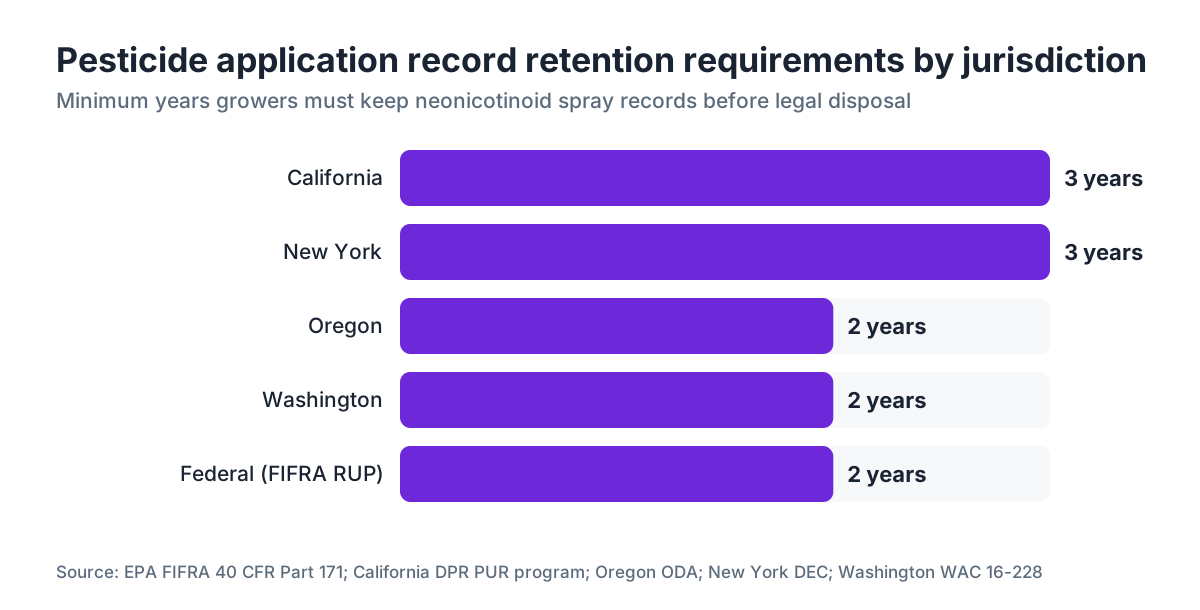
California has the most developed system. The Department of Pesticide Regulation requires every pesticide application by a licensed pest control adviser or applicator to be reported to the county agricultural commissioner (CAC) within the same year, and the reports are aggregated into the publicly searchable Pesticide Use Reporting (PUR) database. This applies to all agricultural pesticide use, more than RUPs and more than neonicotinoids. You file a Pesticide Use Report (DPR-ENF-027 or equivalent county form) covering every application. The deadline is the 10th of the month following the application month. [6] California also has specific mitigation measures for imidacloprid, clothianidin, and thiamethoxam near managed bee yards, codified in county-level bee protection agreements in many counties.
Oregon passed legislation (HB 4129, 2014) requiring a notification registry for beekeepers when pesticides toxic to bees are applied to flowering plants. Neonicotinoids are squarely in scope. The Oregon Department of Agriculture runs the notification program. Vineyards in bloom-adjacent areas need to check whether they're in a notification zone. [7]
New York implemented a 2022 rule requiring a permit to purchase and use most neonicotinoid products for agricultural use, with the permit tied to Integrated Pest Management (IPM) documentation. Cornell Cooperative Extension has guidance on the New York neonicotinoid restriction and how it affects vineyard managers in the Finger Lakes and Hudson Valley regions. [8]
Washington requires pesticide application records under WAC 16-228 for all commercial pesticide applications. For neonicotinoids near blooming crops or bee colonies, the Washington State Department of Agriculture has issued guidance recommending (and in some cases requiring) advance notification to beekeepers registered in the state's system. Washington State University Extension keeps an up-to-date factsheet on applicator obligations. [9]
| State | Record Retention | Reporting Deadline | Neonicotinoid-Specific Rules |
|---|---|---|---|
| Federal (FIFRA) | 2 years | None (records on request) | RUP records only |
| California | 3 years | 10th of following month | PUR required, bee mitigation |
| Oregon | 2 years | None (registry notification) | Beekeeper notification |
| New York | 3 years | None (permit-based) | Purchase permit required |
| Washington | 2 years | None (bee notice) | Bee notification recommended |
If your state isn't listed, check with your state department of agriculture. Most have an online pesticide regulation page. When in doubt, track everything to the California standard. It covers every other state's requirements and will never put you behind.
What specific data fields do you need to record for every neonicotinoid application?
This is where most violations happen: incomplete records, not nonexistent ones. An auditor can't give you credit for an application you logged without the EPA registration number, even if the product name is right there.
At minimum, capture all of these for every application:
- Date of application (day, more than week)
- Product name exactly as printed on the label
- EPA registration number from the label (format: XXXXX-XXXXX)
- Active ingredient(s) and their percentage
- Application rate (oz/acre, fl oz/100 gal, lbs active ingredient/acre, whatever the label expresses it in)
- Total amount of product used
- Total area treated in acres (GPS-derived acreage is becoming the standard for California PUR)
- Site or field identification (your block or APN or field map reference)
- Method of application (ground, air, soil drench, trunk injection, foliar)
- Target pest
- Applicator name and license number (if commercially licensed)
- Pest Control Adviser (PCA) recommendation number (required in California for any product a PCA recommended)
- Restricted-Entry Interval (REI) as stated on the label
- Pre-Harvest Interval (PHI) if the application is during the growing season
For California PUR specifically, you also need the township, range, and section or alternatively the GPS coordinates of the treated area, and the commodity code for winegrapes. [6]
The PHI matters more for grapes than it gets credit for. Imidacloprid has a 30-day PHI on many labels for wine grapes. Thiamethoxam PHIs vary by formulation but can run 7-30 days. Log the application date and the calculated earliest harvest date in the same record. You'll thank yourself at crush.
How do paper spray logs fail and what's a better system?
Paper logs fail in three predictable ways. First, someone fills them out at the end of the week from memory and gets the rate wrong. Second, the binder lives in the spray rig cab and gets wet, torn, or lost. Third, when an auditor asks for records from 28 months ago, you're digging through filing cabinets trying to reconstruct which field was treated on which date.
The good news is that the fix doesn't have to be expensive software. A shared spreadsheet that everyone enters data into on the day of application, stored in cloud backup, solves the first two problems for free. Google Sheets or Excel with a protected template works fine for a 5-10 block operation.
For larger operations or anyone trying to generate California PUR reports automatically, field-specific record-keeping software starts to pay for itself. VitiScribe, for example, is built specifically for vineyard spray records and generates PUR-formatted exports, which saves real time at the monthly deadline. Whatever tool you use, the test is simple: can you produce a complete, audit-ready record within 60 seconds of being asked for any application from the past three years?
WSU Extension recommends logging records at the time of application or, at worst, the same day. [9] "At the time of application" is the language in the federal regulation for RUP records too. The memory decay problem is real. Studies on agricultural record accuracy show meaningful discrepancies when entries are delayed by even two to three days.
For vineyards tracked under block-level records (which is standard practice in most production regions), each block should have its own log section or record identifier. Don't mix blocks in a single row of a spreadsheet. California PUR requires site-level specificity anyway, so building block-level records from day one costs nothing extra and saves reconciliation headaches.
How do you calculate whether you've hit a state-specific reporting threshold?
Most states don't have a tonnage or volume threshold for neonicotinoids specifically, unlike, say, California's air district rules for fumigants. What California has is a mandatory-reporting system where every application is reported, full stop, no threshold. Federal RUP rules kick in per-application for restricted-use products, not at an annual volume threshold.
That said, some state rules and county bee-protection agreements do use thresholds. Certain California county agreements specify that imidacloprid applications within a set distance of a registered bee yard require advance notification when the application rate exceeds a certain lbs/acre figure. You need to read your county's specific agreement.
To know where you stand:
- Identify every neonicotinoid product in your spray program and flag which are RUPs and which are general use.
- Map your blocks against any registered bee yards in your county (the CAC office has these registrations).
- Calculate cumulative active ingredient pounds applied per block per season. This matters for any county mitigation threshold and is useful data for your own resistance management.
- Check whether any of your applications triggered a PHI violation risk by comparing application dates to expected harvest windows.
Nobody has a clean publicly available national database of neonicotinoid-specific thresholds by state. The closest resources are EPA's state lead agency information and each state's department of agriculture website. For California, the DPR's mitigation program documents are the best source for county-level detail. [6]
What records do you need to keep for restricted-use neonicotinoid products specifically?
RUP records have more teeth than general-use records because federal law mandates them under FIFRA. A commercial applicator applying an RUP in a vineyard must keep written records for two years and must make them available to the EPA or state lead agency on request. [3] Failure to maintain these records is a FIFRA violation that can result in civil penalties up to $5,500 per violation per day under 40 CFR Part 22.
Which neonicotinoids are RUPs? The label controls this and it can vary by formulation. Admire Pro (imidacloprid 4F) carries an RUP designation. Many foliar-applied imidacloprid products for agricultural use are also RUPs. Actara (thiamethoxam 25WG) has been listed as an RUP in most states. Always confirm at the point of purchase because EPA label amendments can change this status.
The practical takeaway: treat every neonicotinoid application as an RUP-level record whether or not the current label says RUP. The data fields are almost identical, you're already there with good record-keeping, and if the product gets re-designated mid-season you won't have a gap.
Certified private applicators who buy and apply RUPs themselves must keep their own records. If you hire a licensed pest control business (PCO or PCA), they have independent record obligations but your obligation to maintain records for your own operation doesn't disappear. Get a copy of their application record for your files every time they spray. Don't wait until they're gone to ask.
How should you handle neonicotinoid applications near bloom or when pollinators are present?
This is where good record-keeping overlaps with good practice. Neonicotinoids are highly toxic to bees. The EPA acute contact LC50 for honey bees runs below 0.1 micrograms per bee for imidacloprid, clothianidin, and thiamethoxam. [1] Most neonicotinoid labels for agricultural use prohibit application when bees are foraging and when the target crop is in bloom, unless the label specifically allows it.
The label language from many imidacloprid products reads something close to: "This product is highly toxic to bees exposed to direct treatment or residues on blooming crops or weeds. Do not apply this product or allow it to drift to blooming crops or weeds while bees are foraging." That's a direct label prohibition enforced under FIFRA.
For your spray records in this context, you should log:
- Bloom status of the vineyard block at the time of application (not in bloom, early bloom, full bloom, post-bloom)
- Presence or absence of bee colonies within visible proximity
- Time of application (early morning or evening application reduces direct bee exposure)
- Whether a beekeeper notification was made and when
If California's DPR or an Oregon county program audits a pollinator complaint, your bloom-status log entry is one of the first things they'll want to see. Saying "we checked and it wasn't in bloom" without a written record is not a defense. Writing it down the day of application is.
UC Cooperative Extension has published practical guidance on protecting managed bees from pesticides in wine grape vineyards, including a bloom-monitoring protocol. [10]
What does a compliant annual neonicotinoid application summary look like?
An annual summary does two jobs. It's useful for your own resistance management and cost tracking. And in states like California that require monthly reporting, an annual rollup lets you quickly audit whether you filed every month you were supposed to.
A useful annual summary for each vineyard block includes:
- All neonicotinoid products applied, by date
- Active ingredient, product, and rate per application
- Cumulative lbs of each active ingredient applied per acre
- Total acres treated per product
- Rotation sequence (did you rotate mode of action between applications?)
- Any PCA recommendations filed (California)
- Any beekeeper notifications made (California, Oregon, Washington)
- Harvest dates for the block, cross-checked against PHI compliance
For California PUR filers, the DPR offers guidance on how to reconcile your monthly reports at year end and what to do if you find an error in a past submission. Amendments are allowed, and it's better to amend than to leave a known error.
Cornell Cooperative Extension's integrated pest management guidelines for grapes cover record structure for New York growers and are a reasonable structural template even outside New York. [8] Their IPM framework for the Finger Lakes includes documentation guidance that satisfies the state's neonicotinoid permit requirements.
How long do you have to keep spray records, and what format is acceptable?
Federal law requires two years for RUP records. California requires three years for PUR records. New York's neonicotinoid permit program ties to their general pesticide record requirements, which are also three years. Oregon is two years under state law. Washington is two years under WAC 16-228. [9]
The practical standard: keep everything for three years minimum. If you're farming in California or New York, you're legally at three anyway. For everyone else, matching that standard costs you nothing and protects you against any dispute that drags past the federal two-year window.
Format: federal law doesn't mandate a specific form, it mandates that records be "maintained" and "available" on request. Paper is fine. Digital is fine. A combination is fine. What matters is completeness and retrievability. If an inspector asks for records from a specific block on a specific date and it takes you an hour to find them, that's a problem even if the records technically exist.
If you're storing digital records, use a backup system. A spreadsheet that lives only on a laptop that gets stolen is not a record-keeping system. Cloud backup (even just Google Drive or iCloud) solves this. VitiScribe stores records with redundant cloud backup by default, which satisfies the retrievability requirement without any extra steps from the operator.
For paper records, the filing convention that works best is by calendar year, then by month, then by block. Label the binders clearly and keep them somewhere that won't flood. That sounds obvious until you talk to someone who lost three years of spray logs in a cellar flood.
What happens during a compliance audit, and what should you have ready?
County agricultural commissioners in California conduct routine and complaint-triggered audits. The EPA and state agencies can conduct inspections under FIFRA authority. What they typically ask for first is the pesticide application log for the past 12 months.
Have this ready to produce within minutes, not hours. If you're using paper logs, organize them before the season ends. If you're using software, know how to run and export a date-range report.
An inspector will check:
- That every application has all required fields
- That RUP products were applied by or under the supervision of a certified applicator
- That REI compliance is documented (workers were excluded from treated areas for the required interval)
- That WPS central posting requirements were met
- That California PUR reports were filed on time (if applicable)
- That PHIs were respected (if harvest records are available)
The WPS central posting piece trips up a lot of small operations. Under 40 CFR 170.309, the application information must be posted at a central location on the establishment within 24 hours of application and kept there for 30 days. [4] An inspector can ask to see the current posting and can check whether the dates on the posting align with the records. If you applied last Tuesday and there's no posting, that's a WPS violation separate from any FIFRA record-keeping violation.
Civil penalties under FIFRA for record-keeping violations have ranged widely depending on the nature and history of the violation. EPA's enforcement response policy provides a penalty matrix, but first violations with good-faith remediation typically result in lower penalties than repeat offenses. [12] The bigger risk for small vineyard operations is the practical disruption of an investigation while you're trying to run harvest.
Are there IPM or resistance-management records you should keep alongside your spray logs?
Yes, and they're worth more than most growers realize. Neonicotinoids are IRAC Mode of Action Group 4 (nicotinic acetylcholine receptor agonists). Resistance has been documented in several vineyard pests including glassy-winged sharpshooter biotypes and some aphid populations. [11] An IPM record that shows you rotated away from Group 4 after two applications is a meaningful defense in any regulatory conversation about stewardship, and it's better pest management anyway.
For California, a PCA recommendation is technically an IPM record. The PCA is required to document why the treatment threshold was met before recommending a pesticide application. Get a copy of that recommendation and attach it to your spray record. This is required practice in California and is good practice everywhere.
For New York's neonicotinoid permit program, IPM documentation is a condition of the permit. You need to show that you assessed whether non-chemical alternatives were considered. Cornell's guidelines define what counts as adequate IPM documentation in that context. [8]
Beyond the regulatory angle, tracking your neonicotinoid applications against pest pressure records (monitoring trap counts, vine damage ratings, degree-day models) tells you whether the treatment is actually working. If you're applying on schedule rather than on threshold, you're spending money and generating regulatory exposure without the pest control justification to back it up. UC Cooperative Extension's viticulture guides are the best available resource for what monitoring protocols look like in practice for California vineyards. [10]
For growers thinking about vineyard operations more broadly, the vineyard overview covers the full field-operations context that spray records fit into.
Frequently asked questions
Do all neonicotinoids require a restricted-use pesticide license to apply?
Not all of them. Whether a neonicotinoid is a restricted-use product (RUP) depends on the specific formulation and its current EPA label. Admire Pro and Actara, both common vineyard products, carry RUP designations in most states. Acetamiprid products like Assail are general-use in many states. Always check the current label at purchase. If it says 'Restricted Use Pesticide' on the front panel, you need a certified applicator license or direct supervision by one.
Can I use a smartphone app instead of a paper spray log for neonicotinoid records?
Yes. Federal and state record-keeping requirements specify what data must be captured, not what format. A smartphone app, spreadsheet, or purpose-built field software all satisfy the requirement as long as records are complete, accurate, and retrievable on request. The key is backup: a record stored only on a phone that gets broken or lost doesn't exist in an audit. Use cloud backup or export to a secondary storage location after every application.
What is the pre-harvest interval (PHI) for imidacloprid on wine grapes?
The PHI for imidacloprid on wine grapes is 30 days on most labeled formulations, including Admire Pro. Always confirm on the specific product label in hand because PHI can differ between formulations even with the same active ingredient. Log the application date and the calculated earliest legal harvest date in your spray record at the time of application. PHI violations can result in crop rejection and FIFRA enforcement.
How do I file a Pesticide Use Report (PUR) in California for neonicotinoid applications?
File with your county agricultural commissioner (CAC) by the 10th of the month following each application month. The report requires the product name, EPA registration number, active ingredient, pounds applied, acres treated, site location (township/range/section or GPS coordinates), commodity code for winegrapes, and applicator information. The CAC office in your county provides the current reporting form. California DPR's website has the filing guide and commodity codes.
What's the difference between a spray record and a WPS central posting, and do I need both?
Yes, you need both. A spray record is your internal log kept for compliance and audit purposes. WPS central posting is a physical or electronic notice posted at a central location on the farm within 24 hours of a pesticide application, accessible to all workers and handlers. It must stay posted for 30 days or the length of the REI, whichever is longer. The data fields overlap significantly but the posting is a separate legal obligation under 40 CFR Part 170.
Do I have to notify beekeepers before applying neonicotinoids near my vineyard?
It depends on your state and county. Oregon has a formal notification registry for pesticide applications toxic to bees near flowering plants. California counties with bee-protection agreements may require advance notification when applying imidacloprid or related products near registered bee yards, especially during bloom periods. Washington operates a bee registry that makes notification straightforward. Most neonicotinoid labels also prohibit application while bees are actively foraging, regardless of notification requirements.
How long must I keep neonicotinoid spray records?
Federal law (FIFRA) requires two years for restricted-use pesticide records. California and New York require three years for agricultural pesticide application records. Oregon and Washington require two years under state rules. The practical standard is three years minimum regardless of state, which covers all state requirements and provides a buffer for any late-emerging compliance question or civil dispute involving treated crop.
What pesticide records does a hired pest control operator (PCO) keep, and does that replace my records?
No. A licensed PCO or PCA has their own independent record-keeping obligations, but your obligation to maintain application records for your own operation does not disappear when you hire out. Request a copy of the PCO's application record every time they spray your vineyard and attach it to your own log. In California, the PCO must provide you with a copy of the written pesticide recommendation and the application record.
Can neonicotinoid applications affect my organic certification or wine grape contracts?
Yes. Neonicotinoids are prohibited in certified organic production. If your vineyard holds USDA organic certification, any neonicotinoid application on certified acres will cause you to lose certification for those acres for a minimum of three years from the application date. Some winery contracts for conventional grapes also restrict certain pesticide classes or require advance approval for neonicotinoid use. Review your grape purchase agreement before applying.
What is the EPA's current regulatory status for neonicotinoids as of 2025?
EPA completed Interim Registration Review decisions for imidacloprid, clothianidin, thiamethoxam, and dinotefuran beginning in 2023, with ongoing risk mitigation measures including mandatory label changes restricting use around pollinators. The registration review process is ongoing and label requirements continue to change. Check EPA's pesticide reevaluation page for each specific product before the start of each season to confirm current label status.
Does New York really require a permit to buy neonicotinoids for vineyard use?
New York implemented neonicotinoid restrictions in 2022 that require growers to obtain a permit and document IPM considerations before using most neonicotinoid products for agricultural purposes. The details and which products are covered have evolved through rulemaking. Cornell Cooperative Extension has current guidance for New York vineyard operators and the NYS DEC administers the permit system. This applies to Finger Lakes, Hudson Valley, and Long Island wine grape operations.
What's the best way to track neonicotinoid applications across multiple vineyard blocks?
Use block-level records from day one. Each vineyard block should have its own record section or identifier in whatever system you use. Record the block name or ID, acreage, and GPS reference at the start of the season so they're ready to drop into each application entry. Mixing blocks into a single entry saves a minute up front and costs hours during an audit. California PUR requires site-specific reporting anyway, so block-level records are unavoidable if you farm in California.
What are the civil penalties for neonicotinoid record-keeping violations under FIFRA?
Civil penalties under FIFRA can reach $5,500 per violation per day for commercial entities under EPA's current penalty schedule, adjusted for inflation. First violations with no history and demonstrated good-faith remediation typically result in lower penalties, often significantly lower. State-level penalties vary. The more significant practical risk for small vineyards is the time and disruption of an investigation during a critical production period, not the dollar penalty itself.
Is there a national database where I can look up neonicotinoid application requirements by state?
No single national database exists as of mid-2025. EPA maintains a state lead agency contact list and state-specific information pages, but neonicotinoid-specific rules must be verified directly with each state's department of agriculture. USDA's National Agricultural Library maintains pesticide resource links to state pesticide offices. University extension programs at UC Davis, Cornell, and WSU each maintain region-specific guidance that is more practically useful than any national database.
Sources
- EPA, Pollinator Protection: Neonicotinoids are highly toxic to bees with acute contact LC50 below 0.1 micrograms per bee for imidacloprid, clothianidin, and thiamethoxam; systemic uptake means residues can appear in pollen and nectar
- EPA, Pesticide Reevaluation (Registration Review): EPA began Interim Registration Review decisions for neonicotinoids starting in 2023 with ongoing label changes restricting pollinator exposure
- EPA, Pesticide Worker Safety and Certification (FIFRA Section 8; 40 CFR Part 171): Federal law requires certified applicators to keep restricted-use pesticide application records for two years and make them available to EPA or state lead agencies on request
- EPA, Agricultural Worker Protection Standard (40 CFR Part 170): WPS requires central posting of pesticide application information including product name, EPA registration number, active ingredient, treated area description, and REI within 24 hours of application, kept posted for 30 days or the REI duration, whichever is longer
- Washington State University Extension, Pesticide Safety Education Program: WSU PEP provides WPS compliance guidance for western region vineyard operators; the 2015 WPS update took full effect January 2, 2017
- California Department of Pesticide Regulation, Pesticide Use Reporting: California requires monthly Pesticide Use Reports filed with the county agricultural commissioner by the 10th of the following month, with GPS or township-range-section location data and three-year record retention
- Oregon Department of Agriculture, Pesticides Program: Oregon HB 4129 (2014) requires notification to registered beekeepers when pesticides toxic to bees are applied to flowering plants; ODA administers the notification registry
- Cornell University Integrated Pest Management Program, Grape Guidelines: New York implemented neonicotinoid use restrictions in 2022 requiring purchase permits and IPM documentation; Cornell CCE provides implementation guidance for New York vineyard operators
- Washington State University Extension, Pesticide Safety Education Program: Washington requires pesticide application records under WAC 16-228 for two years; WSU Extension recommends records be logged at the time of application or same day at latest
- University of California Agriculture and Natural Resources (UC Cooperative Extension): UC Cooperative Extension provides practical guidance on protecting managed bees from pesticides in wine grape vineyards, including bloom-monitoring protocols and IPM documentation for California growers
- USDA National Agricultural Library: USDA NAL maintains links to state pesticide regulatory offices; no single national neonicotinoid threshold database exists as of 2025
- EPA, Enforcement: Civil penalties under FIFRA can reach $5,500 per violation per day for commercial entities; penalty amounts vary based on violation history and good-faith remediation
Last updated 2026-07-10