How to track sulfur sensitivity thresholds across grape varieties

TL;DR
- Sulfur phytotoxicity risk changes sharply by variety, temperature, and formulation.
- Chardonnay, Cabernet Franc, and Concord burn easily; Zinfandel and Petite Sirah handle higher rates.
- Track thresholds by logging every application with rate, temperature, and observed damage, then compare block by block across seasons to build a site-specific sensitivity map you can actually trust.
Why does sulfur sensitivity differ so much between grape varieties?
Sulfur kills powdery mildew by volatilizing into sulfur vapor that disrupts fungal respiration. The catch is simple: the same volatilization that kills the fungus also cooks plant tissue when the rate runs high or the day runs hot. Varieties differ in stomatal density, cuticle thickness, and how their leaf surfaces react to sulfur dioxide, and those differences turn into real canopy and yield damage when you push too far [1].
Nobody has one clean dataset ranking every Vitis vinifera and Vitis labrusca variety on a universal scale. What we have is decades of grower experience, trial work from UC Davis, Cornell, and Washington State, and the product label data. The field consensus, backed by extension guidance, holds up well: Chardonnay, Cabernet Franc, Concord, and most hybrids like Chancellor and Baco Noir sit at the high-risk end. Zinfandel, Petite Sirah, and Grenache take sulfur in stride [1][2].
Temperature multiplies everything. Above 90°F (32°C), elemental sulfur volatilizes fast enough to burn even tolerant varieties at label-minimum rates. Cornell's IPM program puts the cutoff at 90°F and tells growers to stop applications at least 24 hours before a forecast high in that range [2]. So the threshold isn't a single number for a variety. It's variety times heat times formulation, and all three have to line up.
Which grape varieties are most sensitive to sulfur, and which are tolerant?
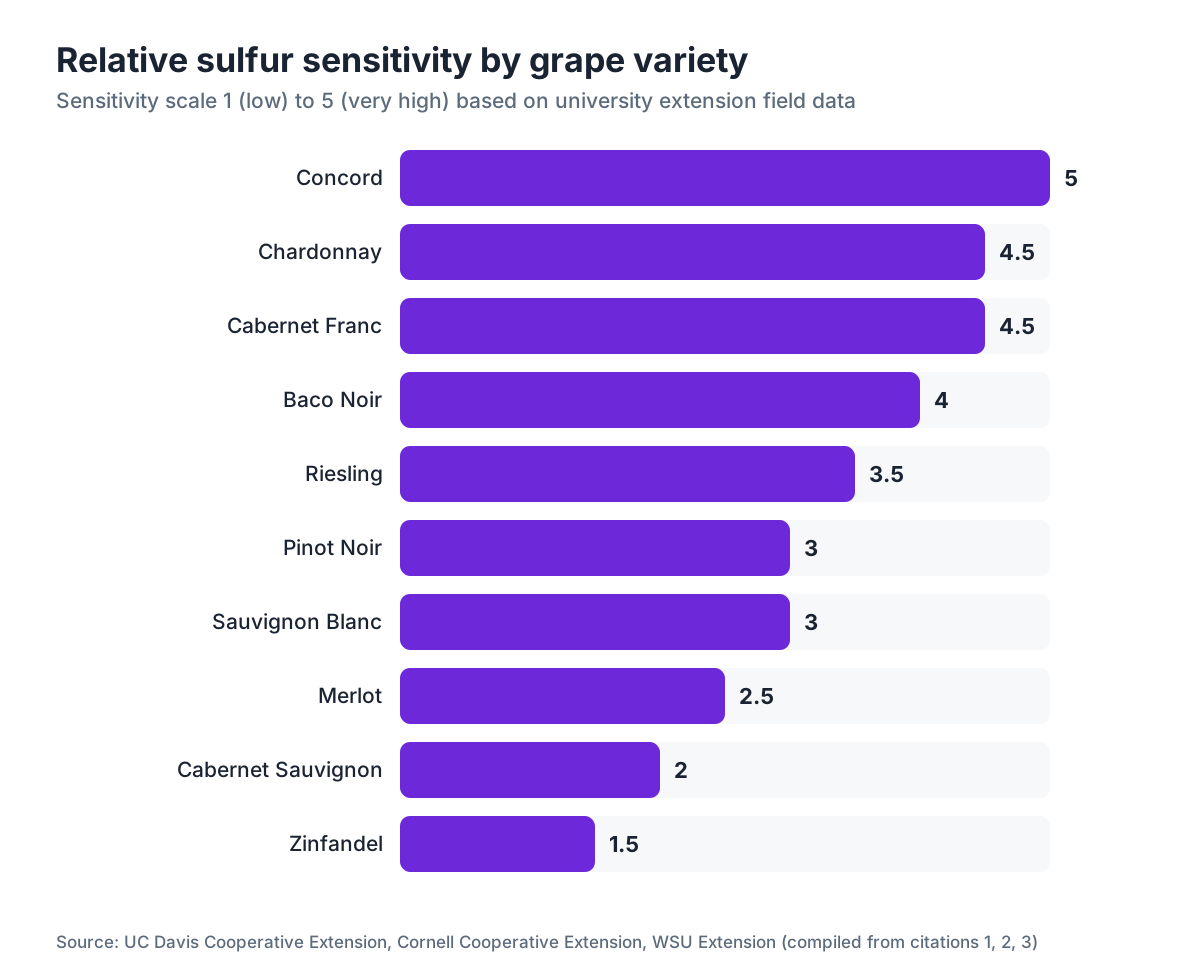
The table below sums up field-reported sensitivity across common varieties, pulled from UC Davis Cooperative Extension, Cornell Cooperative Extension, and WSU extension trial data [1][2][3]. Treat it as a starting grid, not a rulebook. Your blocks will drift from it based on microclimate, timing, and the product in your tank.
| Variety | Relative Sensitivity | Notes |
|---|---|---|
| Concord | Very High | Labrusca; burns at low rates and moderate temps |
| Chardonnay | High | Well-documented; reduce rates on warm days |
| Cabernet Franc | High | Consistent field reports of berry and shoot damage |
| Chancellor | High | Hybrid; treat like Concord |
| Baco Noir | High | Hybrid; high cuticle reactivity reported |
| Riesling | Moderate-High | More sensitive than most reds |
| Pinot Noir | Moderate | Variable by clone and site |
| Merlot | Moderate | Generally tolerates standard rates below 90°F |
| Sauvignon Blanc | Moderate | Watch for berry scarring near veraison |
| Cabernet Sauvignon | Low-Moderate | Tolerates up to 4 lb/acre under typical temps |
| Zinfandel | Low | Historically tolerant; monitor above 88°F |
| Petite Sirah | Low | Similar tolerance to Zinfandel |
| Grenache | Low | Hot-climate adapted; tolerant at standard rates |
Here's the number worth memorizing. UC Davis extension notes that elemental sulfur rates above 3 lb/acre of active ingredient turn phytotoxic on sensitive varieties above 85°F (29°C), even with wettable formulations that volatilize slower than dust [1]. That 3 lb/acre figure is the single most-referenced field threshold in California viticulture.
What data do you actually need to track sulfur sensitivity by block?
Most growers log what they sprayed. Almost nobody logs what happened after in enough detail to build a real sensitivity picture. To track thresholds by variety you need five fields on every application: date and time, product and formulation, rate in pounds of elemental sulfur per acre, the high air temperature at application plus the 48-hour post-spray forecast high, and a damage observation made 5 to 10 days later [4].
The damage observation is the part that gets skipped. It doesn't have to be fancy. A block walk with a 1-to-5 scale (1 = no visible damage, 5 = heavy leaf scorch or berry scarring) takes ten minutes and gives you the comparison point that makes the whole system work. Photograph any block scoring 3 or above. Two or three seasons of that, and you can plot rate against damage for each variety under different temperatures.
Formulation matters more than most growers think. Dust volatilizes faster than wettable sulfur, which volatilizes faster than flowables (liquid suspension concentrates). Switching formulations mid-season or between years? Note it. A block that shrugged off 4 lb/acre of wettable sulfur can show marginal damage at the same rate with a dust during a heat spike [1][3].
The EPA Worker Protection Standard requires that pesticide application records, including rate, date, location, and product, stay on file for two years [5]. That's your legal floor. For a working sensitivity system you want five to seven years. That span is what separates a real variety threshold from a lucky season.
How do you build a block-level sulfur sensitivity map for your vineyard?
Start with a plain spreadsheet, one row per application event. Columns: block ID, variety, acres, product name, elemental sulfur percentage, rate applied (lb product/acre), calculated lb S/acre, application date, application time, temperature at spray, 24-hour post-spray max temp, and your 1-to-5 damage score. That's the whole thing. Nothing clever yet.
After one full season, sort by variety and plot lb S/acre on the X axis against damage score on the Y axis. If you have more than one temperature condition in the mix (some sprays below 80°F, some above 88°F), color-code the dots. The pattern usually jumps out: sensitive varieties pile up damage scores above 2 at lower rates, and the heat relationship shows up plain.
For a vineyard past a dozen blocks, a dedicated record system earns its keep fast. VitiScribe logs spray records with block-level fields and pulls variety comparisons without you rebuilding spreadsheets each season. But a spreadsheet kept consistently beats a software tool used sloppily, every single time.
The physical map comes from your spatial data. Working from a GIS layer or even a hand-drawn block map, shade each block by the damage it has racked up at or below your target rate. Two seasons will tell you whether the sensitivity pattern tracks the variety list, or whether one block is an outlier for reasons of microclimate, timing, or equipment [3].
A vineyard growing multiple varieties across different soils and elevations almost always finds that temperature and aspect move sensitivity as much as variety genetics do. A Chardonnay block on a south-facing slope catching radiated heat off a rock outcrop can burn at rates a block fifty yards away handles fine.
At what temperature does sulfur become dangerous for grapevines, and how do you adjust?
The 90°F rule gets cited most, but the real picture is a gradient [2]. Cornell's IPM guidelines say applications should stop at least 24 hours before temperatures forecast to hit 90°F. UC Davis extension recommends cutting rates by 25 to 50 percent when 85°F to 90°F is expected within 24 hours of application [1]. WSU extension uses a similar threshold and stresses avoiding midday sprays, when canopy temperatures can run 5 to 10 degrees above ambient air [3].
In practice: spray at night or early morning when temps forecast below 80°F, drop your rate by 30 percent when the forecast high is 85 to 89°F, and skip sulfur entirely on days forecast above 90°F no matter the variety. For sensitive varieties like Chardonnay or Concord, slide that whole threshold down 5 degrees.
Wettable sulfur stays phytotoxic longer after application than most growers expect. Rain or heavy dew within 12 hours can re-mobilize residue and concentrate it on leaf tissue. Log your post-spray weather harder than your application conditions. That data explains outlier damage better than any variety guide ever will.
How does sulfur formulation type change the phytotoxicity risk?
Elemental sulfur comes in several formulations, and they differ in volatilization rate and particle size, both of which govern how much vapor reaches plant tissue [1][3]. Dust is the most volatile and carries the highest phytotoxicity risk at equal rates. Wettable sulfur (dry flowable) is the most common commercial form and sits in the middle. Liquid suspension concentrates (flowables) are usually the least volatile and the gentlest on sensitive varieties.
Product labels note the percentage of elemental sulfur and whether the product is a wettable powder, dispersible granule, or liquid. Always convert to pounds of elemental sulfur per acre for cross-product comparison. A 90% wettable sulfur at 4 lb/acre delivers 3.6 lb elemental sulfur. A 52% flowable at 6 lb/acre delivers 3.1 lb. Comparing product rates without adjusting for concentration is the most common tracking error in spray logs, and it makes your whole dataset lie to you.
Micronized sulfur is a newer category with particle sizes below 5 microns. The fine particles improve coverage and may allow lower total rates for the same disease control, but that same fine size increases the surface area available for volatilization. Less is known about their phytotoxicity on sensitive varieties. If you're trialing a micronized product, start at half the label rate on your most sensitive block and document the result before you scale up.
What does EPA's Worker Protection Standard require for sulfur application records?
The EPA Worker Protection Standard (40 CFR Part 170) requires that any pesticide application in an agricultural setting be recorded and kept. The record has to carry the product name and EPA registration number, the application date and location, the rate and amount applied, and a re-entry interval (REI) notation if the label specifies one [5].
For sulfur products used as fungicides, the REI is typically 24 hours under most labels, though you need to verify the specific product. Records must be kept for two years and made accessible to workers on request within 15 days. That two-year mark is the legal floor. In practice, keeping records for seven to ten years gives you the multi-season dataset that real sensitivity analysis needs.
The WPS also requires training workers who enter treated areas during the REI and posting field notices. None of that changes based on whether you're spraying Zinfandel or Chardonnay. But your internal threshold tracking should note the REI for each product, because it drives your re-entry timing after high-heat applications, exactly when you want to be out scouting for damage.
How often should you re-evaluate variety thresholds as conditions change?
Re-evaluate at least once a season, at the end of dormancy and before your first sulfur application. Thresholds from three seasons back may not hold if you've changed your training system, canopy density, or if row orientation shifted how the spray pattern meets sunlight.
Vine stress moves sensitivity too. A block under heavy water stress heading into a heat wave will burn easier than the same block well-watered. If you irrigate, note soil moisture or vine water status at application. The link between pre-dawn leaf water potential and sulfur phytotoxicity hasn't been rigorously studied in published trials (nobody has clean data on that specific interaction), but growers report more damage on blocks that were stressed at spray time, over and over.
Clone and rootstock shift the baseline too. Two Chardonnay blocks grafted to different rootstocks on different soil depths can show meaningfully different sensitivity. Treat them as separate data points, even if the label says the same variety.
Re-evaluate after any season with unexpected damage or unexpected tolerance. Those outliers are the most useful data you own. A burn at a rate you've applied safely before is telling you something changed: temperature, formulation lot, vine stress, or timing. Listen to it.
Can you use historical spray records from another vineyard or extension trials as a starting point?
Yes, and you should. Extension trial data from UC Davis, Cornell, and WSU makes a reasonable prior for your first season, before you have site-specific records. The published rankings (Chardonnay and Concord high, Zinfandel and Petite Sirah low) reflect hundreds of grower observations and replicated plots [1][2][3]. Start there, then treat your first season's records as refinements, not replacements.
The limit of borrowed data is that it doesn't know your microclimate. A trial run in the Willamette Valley on a foggy-morning baseline doesn't map onto a San Joaquin Valley block with 95°F afternoons and low humidity. Use the variety ranking, but apply your local temperature adjustment hard.
For paso robles wineries and other warm-climate operations, the temperature-and-variety interaction is especially sharp. Many published thresholds came out of cooler regions, and warm-climate growers report they need to cut rates and shorten application windows more than the guidelines suggest. After two seasons, your own records beat any borrowed data.
Neighboring vineyards are a legitimate informal source if they grow the same varieties on similar soils. A conversation with a neighbor about what rate burned their Cabernet Franc, and at what temperature, is real observational data. Write it down with the source noted. It's not as good as your own records, but it's a solid cross-check.
How do you handle mixed-block or interplanted varieties when tracking sulfur thresholds?
Mixed blocks are genuinely hard for sulfur, because you can't set the rate for two varieties at once without shortchanging one. The right move is almost always to set the rate for the most sensitive variety in the block.
If the mix pairs a very sensitive variety (Concord, Chardonnay) with a tolerant one (Zinfandel, Petite Sirah), you're leaving efficacy on the table for the tolerant variety to protect the sensitive one. That's the right trade. Phytotoxicity, especially berry scarring near veraison, is harder to recover from than a slightly reduced fungicide effect.
For record-keeping, log mixed blocks under the most sensitive variety. Add a notes field listing the secondary varieties. When you observe damage or no damage, you're seeing the system response, not any one variety in isolation, and your notes should say so. If the block is big enough to justify it, ask whether replanting over time toward a single variety would make management simpler.
For spray log tools, VitiScribe handles multi-variety blocks by allowing multiple variety tags per block record, so your pulled reports can flag blocks with variety mismatches that need a rate adjustment. That saves real time once you're past a dozen blocks with mixed plantings.
What records do organic vineyards need to keep for sulfur applications?
Elemental sulfur is approved for certified organic viticulture under the USDA National Organic Program (NOP). It's one of the few broad-spectrum fungicides organic growers can use, so it's everywhere [6]. The NOP requires that all material inputs be recorded with documentation showing the product is allowed, which means you need the product label and ideally the OMRI listing for the specific formulation [6][7].
Organic certifiers usually ask for the same information as the WPS records (product, rate, date, location) plus proof the product sits on the approved materials list. Some want the OMRI listing number or a letter from the input supplier. Keep those documents filed with your spray records.
The phytotoxicity thresholds are identical for organic and conventional sulfur. Elemental sulfur is elemental sulfur. The organic designation changes your paperwork and your sourcing, not the physiology of your vines. Sensitive varieties are still sensitive, and the 90°F cutoff still applies.
Frequently asked questions
What is the maximum safe sulfur rate for Chardonnay?
UC Davis extension recommends keeping elemental sulfur below 3 lb/acre on sensitive varieties like Chardonnay, especially when temperatures will top 85°F within 24 hours of application. On cooler days (forecast highs below 80°F), some growers apply up to 4 lb/acre without damage, but that's a site-specific call. Start low, watch closely, and adjust from your own block records rather than trusting any published rate as a guarantee.
How do I know if sulfur burned my vines versus some other cause?
Sulfur phytotoxicity usually shows up 5 to 10 days post-application as bleached or brown leaf margins, interveinal chlorosis, or berry russeting and scarring. It follows the spray pattern spatially, so damage runs heavier on sun-exposed sides of the canopy. Tell it apart from nutrient deficiency (which is systemic, not pattern-matched to spray events) and from disease by timing: damage within 10 days of a high-temperature spray points to sulfur.
Does wettable sulfur cause less damage than sulfur dust?
Generally yes. Wettable sulfur and flowable (liquid suspension) formulations volatilize slower than dust, which lowers the peak vapor concentration at the leaf surface. At equal elemental sulfur rates, dust carries higher phytotoxicity risk, especially on sensitive varieties and above 85°F. Working with sensitive varieties, default to wettable or flowable formulations and save dust for tolerant varieties in cooler conditions.
How long do I need to keep spray records for sulfur applications?
The EPA Worker Protection Standard requires pesticide application records for at least two years. For a meaningful sulfur sensitivity dataset, keep them five to seven years minimum. The multi-season pattern is what lets you separate variety sensitivity from a weird weather year. Many state departments of agriculture set their own retention rules that can match or exceed the federal two-year floor, so check your state.
Is Concord really more sensitive to sulfur than most wine grapes?
Yes, consistently. Concord and most Vitis labrusca varieties are among the most sulfur-sensitive grapes grown commercially. Cornell extension, which has the most direct trial experience with labrusca, specifically flags Concord as high-risk even at low rates. Growing Concord or other American varieties, treat the temperature cutoff as 80°F rather than 90°F and keep rates at or below 2 lb elemental sulfur per acre.
Can I spray sulfur the day before a heat wave if I lower the rate?
The guidance from both UC Davis and Cornell is to stop applications at least 24 hours before any forecast high above 90°F. Even at reduced rates, sulfur residue on leaf tissue keeps volatilizing as temperatures climb, and cumulative vapor exposure during a heat event can burn sensitive varieties. The safest practice is to schedule applications at least 48 hours before a heat event and use the lowest effective rate.
Do rootstocks affect a variety's sensitivity to sulfur?
There's no published trial data directly comparing sulfur sensitivity by rootstock. The working assumption in the field is that rootstock affects vine vigor, water uptake, and stress response, all of which can indirectly shape how a scion handles chemical stress. A high-vigor rootstock keeping vines well-watered through a heat event may lower phytotoxicity risk compared to a low-vigor rootstock on shallow soil. Track rootstock in your block records and watch for patterns.
How should I record sulfur sensitivity observations in my spray log?
Add a post-application observation field to every sulfur record. A simple 1-to-5 damage score (1 = no visible damage, 5 = heavy leaf or berry damage) recorded 7 to 10 days after application is enough to build a usable dataset. Include the observation date, the block, and a short note on what you saw. Photograph any block scoring 3 or above. Consistent light scoring beats occasional detailed notes every time.
Are hybrid varieties like Baco Noir and Chancellor treated like Concord for sulfur sensitivity?
They're treated similarly in practice. Most hybrids with significant Vitis labrusca genetics share that species' higher sensitivity to sulfur vapor. Cornell and other northeastern programs recommend treating hybrids conservatively: keep rates low, avoid applications above 80°F, and scout carefully after each spray [9]. The exact sensitivity varies by hybrid, so your own block records matter most when you work with less-commonly-grown varieties.
Does rain after a sulfur application reduce phytotoxicity risk?
Rain washes some sulfur residue off leaf surfaces, which can cut ongoing volatilization risk. But rain within a few hours of application, before the sulfur dries fully, can run off too much and reduce efficacy. Rain followed by high temperatures can mobilize residue into leaf axils and concentrated spots where vapor builds up. Wet-dry-heat cycles are a known risk factor for localized phytotoxicity even at moderate rates.
Can I use the same sulfur rate on Zinfandel as on Cabernet Sauvignon?
Yes. Both sit in the low-to-moderate category and generally tolerate rates up to 4 lb elemental sulfur per acre below 88°F without consistent damage reports. Zinfandel is historically the more tolerant of the two. Still verify with your own block records, because site conditions, canopy density, and timing all move the response. Start at 3 lb/acre on a new block and scale up only after a clean observation season.
What's the difference between elemental sulfur and sulfur dioxide for vine phytotoxicity?
Elemental sulfur (what you spray as a fungicide) and sulfur dioxide (SO2, used in winemaking and as a preservative) are chemically distinct. When elemental sulfur volatilizes on plant tissue, it forms sulfur dioxide vapor at the leaf surface, and that vapor is what burns. The total SO2 exposure at the leaf depends on the elemental sulfur rate, temperature, and formulation. Winemaking SO2 additions are a separate, post-harvest matter and don't affect pre-harvest phytotoxicity.
How many seasons of spray records do I need before my sensitivity thresholds are reliable?
Two seasons gives you a rough picture; three to four gives you enough weather variability to separate temperature effects from variety effects. You need at least one hot season (multiple applications above 85°F) and one cooler season in the dataset to see both sides of the temperature interaction. For less commonly grown varieties with thin published guidance, five seasons of your own records is a fair target before you treat thresholds as reliable for management.
Sources
- UC Davis Cooperative Extension, Grape Pest Management: Elemental sulfur rates above 3 lb/acre active ingredient become phytotoxic to sensitive varieties at temperatures above 85°F, and Chardonnay is identified as a high-sensitivity variety.
- Cornell Cooperative Extension, New York State IPM Program, Pest Management Guidelines for Grapes: Applications should stop at least 24 hours before forecast highs at or above 90°F; Concord and hybrid varieties are flagged as high-risk for sulfur phytotoxicity.
- Washington State University Extension, Pacific Northwest Plant Disease Management Handbook: WSU extension notes that canopy temperatures can exceed ambient air temperature by 5 to 10 degrees and that formulation type affects volatilization rate and phytotoxicity risk.
- EPA, Pesticide Record-Keeping Requirements for Certified Applicators: Federal pesticide applicator record-keeping requires product name, EPA registration number, application date, location, and rate; records must be retained for two years.
- EPA, Worker Protection Standard (40 CFR Part 170): The Worker Protection Standard requires agricultural pesticide application records to be kept for at least two years and made accessible to workers within 15 days of request.
- USDA National Organic Program, Allowed and Prohibited Substances: Elemental sulfur is approved for use in certified organic production under the USDA National Organic Program as a plant disease control material.
- OMRI (Organic Materials Review Institute), Product List: OMRI lists specific elemental sulfur formulations as approved for organic use; certification requires documentation of product approval status.
- Cornell Cooperative Extension, Viticulture and Enology Program: Cornell extension identifies hybrid varieties with Vitis labrusca genetics, including Baco Noir and Chancellor, as high-risk for sulfur phytotoxicity and recommends treating them with conservative rates.
Last updated 2026-07-10