How to track spinosad use restrictions to avoid resistance buildup in vineyards

TL;DR
- Spinosad is an IRAC Group 5 insecticide, and it can lose its punch against western flower thrips and leafhoppers in as few as 3-4 pest generations of repeated use.
- Log every application by mode-of-action group, cap spinosad at 2 applications per target pest per season (labels allow 4), rotate to a different MOA group between treatments, and keep dated records of product, rate, target pest, and running seasonal total.
Why does spinosad resistance happen so fast in vineyards?
Spinosad turns against you fast because its strength is also its weak spot: one narrow site of action, hit over and over. It activates nicotinic acetylcholine receptors and GABA receptors in insects in a way most other chemistry does not, which is why IRAC calls it Group 5. [1]
Spray it repeatedly and you do the selecting for the pest. The few thrips or leafhoppers carrying resistance alleles survive, breed, and pass those alleles on. Warm-climate vineyards can run 10 or more pest generations a season, so the pressure stacks up quickly.
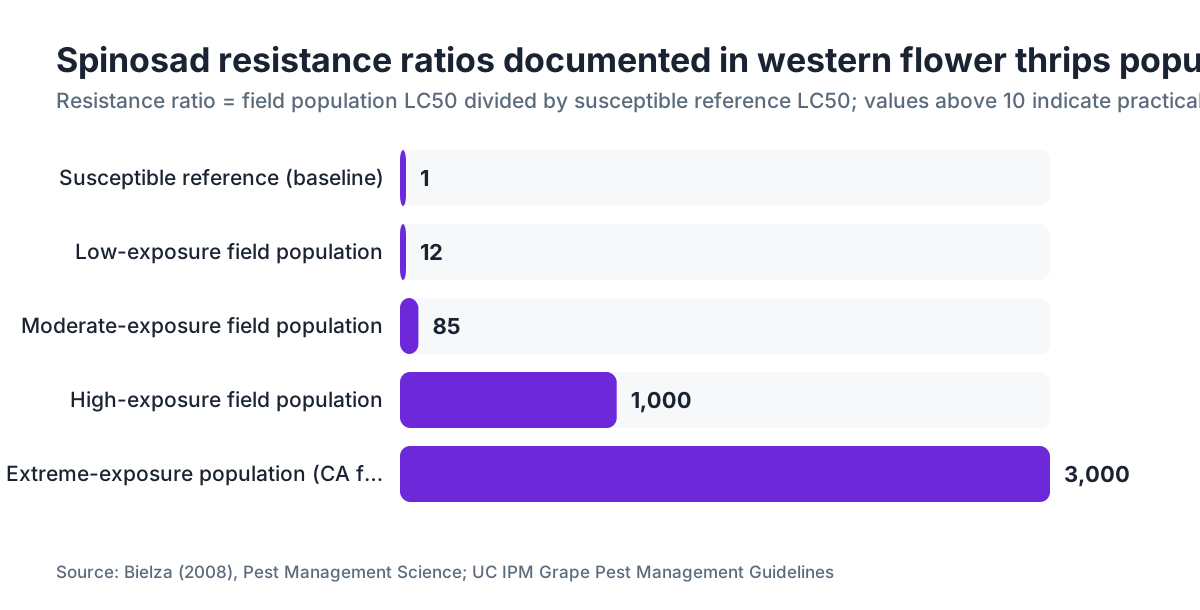
The case California grape growers know best is western flower thrips (Frankliniella occidentalis). UC researchers confirmed field-evolved spinosad resistance in California thrips, with resistance ratios above 1,000-fold in some populations. [2] That is not drift. That is a chemistry going dead.
Leafhoppers are slower. Resistance in grape leafhopper (Erythroneura elegantula) has taken longer to show up, but the logic holds. Any season where spinosad is your only leafhopper tool is a season you spend selecting for tolerance. How fast it happens depends on how many generations finish before harvest, and that swings by region and year.
Growers also underrate carryover selection. If the vineyard next door ran heavy spinosad programs last year, the pests moving into your blocks this spring already carry a higher resistance frequency. You cannot control that. You can control whether you pile on more.
What are the legal use restrictions on spinosad in vineyards?
The two spinosad products you see in vineyards are Entrust SC (OMRI-listed for organic) and Success (conventional). Both carry EPA-mandated label restrictions, and under FIFRA the label is the law. [3] Follow it exactly.
Read your specific lot's label every time, because registrants update them. Here are the core restrictions on current Entrust SC and Success labels:
| Restriction | Entrust SC (organic) | Success (conventional) |
|---|---|---|
| Max apps per season | 4 (but see resistance note) | 4 |
| Minimum interval between apps | 4 days | 4 days |
| Max seasonal rate | 29 fl oz Entrust SC per acre | 10 fl oz Success per acre |
| Restricted Entry Interval (REI) | 4 hours (ventilated); 8 hours | 4 hours (ventilated); 8 hours |
| Pre-harvest interval (PHI) | 7 days | 7 days |
| Bee precaution | Do not apply when bees are foraging | Do not apply when bees are foraging |
The 4-application ceiling is a legal maximum, not a target. Resistance management practice, and the plain guidance from UC IPM and WSU Extension, is to stay well under it. Two applications per season against the same pest is the limit I would hold to if I wanted spinosad still working a decade from now. [4]
EPA's Worker Protection Standard governs your application records too. Under 40 CFR Part 170 you must keep a record of the product name, EPA registration number, application date, location, and REI for each application, and make it available to employees and their designated representatives. [5] That is separate from state pesticide use reporting, and most states pile more on top.
How do you set up a resistance tracking system for spinosad applications?
A spinosad tracking system needs to capture four things: the MOA group, the date, the target pest, and the block. Those four tell you at a glance how much Group 5 pressure a given pest population has taken this season. That is the whole game. Everything else is detail.
Here is the minimum field log that works in practice.
Per-application record (every spray event):
- Date
- Block ID and acreage
- Product name and EPA reg number
- Active ingredient and IRAC MOA group
- Application rate (oz or fl oz per acre)
- Target pest
- Cumulative Group 5 applications to this block this season (running count)
- Applicator name
Season-end summary (per block):
- Total Group 5 applications
- Other MOA groups used, with counts
- Pest pressure notes (were thresholds hit, what did monitoring show)
The running-count column is the one most growers skip. It is also the one that saves you. In the middle of a bad thrips year, when someone wants to spray again, that column tells you instantly whether you are about to walk into a rotation problem.
Track at the block level, not the farm level, because resistance builds in local populations. A block that took three spinosad applications last season and two this season carries a different risk than a neighboring block that has not seen Group 5 in two years. Average them together and you hide the block that is in trouble.
For growers running vineyard blocks across sites, a shared digital log that flags MOA totals by block is worth building. VitiScribe lets you log spray events against block maps and flags when a block's Group 5 count nears your seasonal ceiling, so you are not doing the arithmetic in your head at the tank.
What is the IRAC rotation strategy that actually prevents resistance?
A real rotation means moving to a different IRAC group number between spinosad applications on the same pest. Swapping Entrust SC for Radiant SC is not a rotation. Spinetoram (Radiant SC) is also Group 5, so you are applying the same selection pressure under a different label. [1]
Here is where to go for the main vineyard pests that spinosad targets.
Western flower thrips: After spinosad, rotate to Group 1B (organophosphates, where registered and appropriate) or Group 6 (avermectins such as abamectin). Skip anything else labeled Group 5. Organic programs have fewer moves here. [4]
Grape leafhopper and Virginia creeper leafhopper: Rotate to Group 4 (neonicotinoids, keeping their own resistance history and pollinator concerns in mind), Group 23 (spirotetramat, Movento), or biological controls where pressure allows.
Omnivorous leafroller and other caterpillar pests: Bt products (Group 11) are a clean rotation partner with zero cross-resistance to spinosyns.
WSU's Pacific Northwest handbooks are direct: spinosyns should not run more than two consecutive applications against the same pest, and one intervening generation treated with a different MOA is better. [6] UC IPM's grape guidelines say the same, recommending alternation by MOA group every application. [4]
One practical note. The IRAC group number sits on the label in the resistance management box, usually inside a diamond icon. Train your spray crew to read that box. A 30-second check before filling the tank beats rebuilding your thrips program from scratch.
How many spinosad applications per season is too many?
Two applications per season is the honest upper limit for holding long-term efficacy against a fast-breeding pest like thrips. Nobody has one clean threshold study covering every pest-crop pair, but the evidence lands there.
The label maximum is 4. UC IPM's resistance guidance caps spinosad at 2 applications per season for western flower thrips in grapes, specifically to slow selection. [4] A 2008 review of thrips resistance found resistance ratios above 100-fold in greenhouse and field populations after only a few seasons of heavy spinosad use, with some populations above 3,000-fold. [7]
Leafhoppers and leafrollers have longer generation times and lower per-season risk, but the multi-season math still catches up. Run 3-4 spinosad applications a year for five years in the same blocks and you have accumulated real selection, even with every single season under the label ceiling.
Treat spinosad as a resource you are rationing, not a tool you are spending. Two applications per target pest per season. If you need a third pass, switch MOA groups and come back to spinosad next year.
What records do California, Washington, and Oregon require for spinosad applications?
State rules stack on top of the federal baseline, and the stacking is where compliance gets missed. Here is what each western state wants.
California: The Department of Pesticide Regulation requires a Pesticide Use Report for every agricultural pesticide application, filed monthly with the county agricultural commissioner. The report includes product name, EPA registration number, active ingredient, amount applied, acreage, site, and date. [8] Spinosad is a restricted material in some California counties and may need extra permitting. Check with your local ag commissioner.
Washington: The Washington State Department of Agriculture requires commercial applicators to keep pesticide application records under RCW 17.21 and WAC 16-228. Required fields include date, location, applicator license number, product, and pest treated. Records must be kept for two years. [9]
Oregon: The Oregon Department of Agriculture requires licensed applicators to keep records for two years under ORS 634, and the required data mirrors Washington's broadly.
Federal WPS baseline: Under 40 CFR Part 170, agricultural employers keep application records and make them available within 30 days to employees or their representatives on request. [5] Each record needs the product name, EPA registration number, active ingredient, location and description of the treated area, application date, REI, and early-entry information.
For multi-block operations, the easiest path is one log that captures all of these fields at once. Then a single record covers PUR reporting, WPS documentation, and your resistance tracking together. Cornell's viticulture program recommends integrating pest management records with compliance records for exactly this reason. [10]
How do you detect early signs of spinosad resistance in your vineyard blocks?
Resistance rarely announces itself. What you see is efficacy sliding: you spray at label rate, counts drop less than they used to, and by day 7 the population is back near where it started. That pattern, especially after years of reliable control, is worth taking seriously.
The lab confirmation is a bioassay: collect live insects from the field, run concentration-response assays, and compare to a susceptible reference population. Most vineyard operations cannot do that in-house. Here is what you can do instead.
- Keep consistent pre- and post-spray monitoring with one standardized method (sticky cards, beating-tray counts, or leaf samples) and log the numbers. If percent control is dropping season over season against spinosad but holding against other MOA groups, that is field evidence of resistance drift.
- Track spray intervals. If you are re-treating sooner each season to hold the same suppression, something is shifting.
- Talk to your farm advisor or PCA (Pest Control Adviser). PCAs in California are licensed by CDPR and must write and keep Pest Management Records. [8] A PCA watching a whole region spots resistance trends before any single grower does.
If you suspect resistance, call your county UC Cooperative Extension advisor. They can connect you with UC researchers doing resistance screening or point you to the nearest diagnostic support.
Does organic production change the spinosad resistance risk?
Yes, and usually in the direction growers do not expect: organic raises the risk. In organic vineyards, Entrust SC is often the strongest single tool for thrips and leafhoppers. The NOP-compliant alternatives are thin: pyrethrin, kaolin clay, insecticidal soap, Bt (caterpillars only), and copper and sulfur products that do nothing to insects.
That thin toolbox means organic growers face higher rotation pressure. When your one effective single-application insecticide is Group 5, rotating away from Group 5 means either eating more pest damage or reaching for tools with much lower efficacy. That is exactly the setup where resistance speeds up, and there is no point pretending otherwise.
So organic growers should lean on cultural and biological controls harder than conventional growers do, to cut the number of seasons per decade that need any chemical at all. Cover crops that support beneficials, canopy management that trims thrips habitat, and reflective mulches under the vines all lower how often you hit the spray threshold. [4]
Entrust SC's label maximum is 29 fluid ounces per acre per season, roughly four applications at the 7 fl oz per acre rate. That ceiling exists partly because of resistance. Holding under 2 applications per season on the same pest is the best long-term investment an organic grower can make in keeping Entrust working.
What is the best rotation schedule for alternating spinosad with other vineyard insecticides?
A rotation schedule has to fit your pest pressure, your certification, and the MOA options that are actually registered in your region. No single schedule fits everyone. Here is a working framework built on UC IPM, WSU Extension, and Cornell viticulture guidance.
Conventional, targeting thrips:
- Application 1 (early season, bloom): Group 5 (spinosad)
- Application 2 (if threshold hit, veraison): Group 6 (abamectin) or Group 1B (acephate, where registered)
- Application 3 (if needed, post-veraison): Group 5 only if no Group 5 ran in the prior 4 weeks and the season count is still at 2 or fewer
Organic, targeting thrips:
- Application 1: Group 5 (Entrust SC)
- Application 2: Pyrethrin (Group 3A) with piperonyl butoxide, or insecticidal soap for a softer option
- Application 3 (if needed): Group 5 as a last resort, with full season documentation
Targeting leafhoppers (conventional):
- Application 1: Group 4A (imidacloprid or similar, respecting pollinator restrictions) or Group 23 (spirotetramat)
- Application 2: Group 5 (spinosad) if Group 4 is the primary seasonal tool
- No consecutive Group 5 applications for leafhoppers in the same season
Keep the schedule written down and clipped to your field log. When harvest prep is on and a leafhopper flush hits, having the schedule in front of you beats defaulting to whatever is already in the tank room.
How do digital spray records help you stay ahead of spinosad resistance?
Paper logs work until they do not, and their failure mode is aggregation. You can keep a perfect record for every block and still miss that Block 12 has taken five Group 5 applications across two seasons, because that pattern only shows when you pull the sheets together and do the math by hand.
Digital records fix that. A system that tags every entry with the IRAC MOA group can sum Group 5 applications by block, by season, or by pest, and put that count in front of you before you schedule the next spray. A 10-second check, prompted by the software, beats any policy memo taped to the shop wall.
VitiScribe is built around this workflow: each spray event logs against a block, the MOA group gets captured at entry, and the cumulative seasonal totals are visible before you make the next call. For growers running multiple blocks or reporting to PUR in California, keeping all of it in one place also cuts the compliance paperwork time hard.
Whatever tool you use, capture the same fields: date, block, product, IRAC group, rate, target pest, and the running seasonal count for that pest-MOA pair. A spreadsheet template works if you stay disciplined about updating it. The failure mode is a spreadsheet that lives on one laptop and never gets touched in the field.
What do university extension programs recommend for spinosad resistance management?
Three programs publish the most useful guidance for western US grape growers: UC Davis / UC IPM, Washington State University Extension, and Cornell Cooperative Extension for eastern producers. They land in the same place from different regions.
UC IPM (California): The Grape Pest Management Guidelines list spinosad under resistance management for western flower thrips, recommending no more than 2 applications per season, MOA rotation between applications, and monitoring to confirm efficacy. UC IPM states that "resistance to spinosad has been confirmed in California populations of western flower thrips," as a documented field reality, not a warning. [2]
WSU Extension (Washington/Oregon): WSU's Pacific Northwest Pest Management Handbooks include spinosad in insecticide rotations for leafhoppers and thrips in wine grapes, with explicit MOA rotation tables. WSU treats Group 5 as a limited resource across multi-year programs, more than within any single season. [6]
Cornell Cooperative Extension (New York/Northeast): Cornell's viticulture resources cover grape berry moth and leafhopper management with Group 5 chemistry, recommending a maximum of two spinosad applications per pest complex per season and integration with mating disruption where available for caterpillar pests. [10]
All three share one logic: spinosad is valuable enough that underusing it now is worth it, to keep it for the years you really need it. That is the whole argument for tracking.
What happens if spinosad resistance is already established in your vineyard?
If resistance is confirmed or strongly suspected, you have two jobs: stop adding selection pressure, and rebuild the program around different MOA groups for at least one to two full seasons.
Resistance alleles do not vanish overnight, but their frequency can fall once you pull the pressure. Susceptible individuals migrate in from surrounding areas, and without a selection advantage the resistance alleles slowly lose ground. This is resistance dilution. It is documented in thrips populations, though the timescale varies a lot. The one input you control is giving it room by keeping Group 5 out of the block during the reset.
During that reset period, lean on:
- Biological controls. Minute pirate bugs and predatory mites suppress thrips and leafhoppers without creating resistance.
- Physical exclusion and canopy management where practical.
- Registered conventional alternatives in non-Group 5 MOA categories.
Document the whole stretch carefully. If you come back to spinosad after a two-season break and efficacy is restored, that is real evidence of dilution. If it is not restored, you are looking at a more entrenched problem, and that is the time to call your UC, WSU, or Cornell extension advisor for regional context.
The trap to avoid is cycling back early because it worked last year. One season of apparent recovery does not mean the resistance alleles have cleared the population.
Frequently asked questions
How many times can you apply spinosad to a vineyard per season?
The legal maximum under current Entrust SC and Success labels is 4 applications per season. UC IPM's resistance management guidance recommends a practical limit of 2 applications per season when targeting western flower thrips, given documented field resistance in California populations. Staying under the label maximum is necessary but not enough to preserve long-term efficacy.
Is spinetoram (Radiant SC) a safe rotation partner for spinosad?
No. Spinetoram (Radiant SC) is also IRAC Group 5, the same mode of action as spinosad (Entrust SC, Success). Alternating between them is not a resistance management rotation. Populations resistant to spinosad typically show cross-resistance to spinetoram. A real rotation moves to a different IRAC group number between applications on the same pest.
What IRAC group number is spinosad?
Spinosad is IRAC Group 5 (spinosyn site of action). The number appears in a diamond icon on current labels, in the resistance management section. Group 5 activates insect nicotinic acetylcholine receptors and GABA receptors in a way distinct from neonicotinoids (Group 4) and organophosphates (Group 1B), which gives it its own resistance risk profile.
How long do I need to keep spinosad application records?
Federal WPS requires application records be available to employees on request, with no explicit federal retention period. California requires PUR records be kept 3 years at the county agricultural commissioner. Washington and Oregon both require 2 years under their applicator rules. If you operate in multiple states, keep records at least 3 years to cover the most restrictive requirement.
Does spinosad have a pre-harvest interval (PHI) in vineyards?
Yes. Both Entrust SC and Success carry a 7-day pre-harvest interval for grapes on current labels. The label is the legal document, and PHI can change between label revisions, so confirm against the current label for your specific lot before applying late in the season. The restricted entry interval is 4 hours for adequately ventilated outdoor settings or 8 hours otherwise.
Can I use spinosad in organic vineyards?
Yes. Entrust SC (spinosad) is OMRI-listed and approved for certified organic production. Success is not OMRI-listed and cannot be used in organic programs. Organic growers using Entrust SC face a narrower set of rotation partners, which raises resistance pressure. UC IPM and NOP-compliant programs both recommend keeping Entrust SC applications to 2 or fewer per season for this reason.
What pests in vineyards are most likely to develop spinosad resistance?
Western flower thrips (Frankliniella occidentalis) carries the highest documented risk in California vineyards. UC researchers confirmed field-evolved resistance above 1,000-fold in some California thrips populations. Grape leafhopper and Virginia creeper leafhopper have lower but non-zero risk. Caterpillar pests like grape berry moth and omnivorous leafroller are slower to develop resistance because of longer generation times.
What should a spray record for spinosad include to satisfy WPS requirements?
Under EPA's Worker Protection Standard (40 CFR Part 170), a spinosad record needs the product name, EPA registration number, active ingredient, location and description of the treated area, application date, restricted entry interval, and any early-entry PPE requirements. California PUR reporting adds amount applied per acre and pest targeted. Store records where workers and their designated representatives can reach them.
How do I know if spinosad is failing due to resistance versus a coverage or rate problem?
Poor coverage and under-rate application look like resistance but have different causes. To tell them apart: confirm you applied at full label rate with a calibrated sprayer and enough water volume for canopy penetration, then compare efficacy against a block where spinosad has not run heavily. If control is consistently worse in high-history blocks at the same rate and coverage, resistance is the likelier answer. A PCA or extension advisor can help with field bioassays.
Are there biological controls that can reduce how often I need to use spinosad?
Yes. Minute pirate bugs (Orius tristicolor and related species) are major natural predators of western flower thrips in vineyards. Predatory mites in the Phytoseiidae family suppress both thrips and leafhoppers. UC IPM documents that preserving these beneficials by minimizing broad-spectrum sprays cuts the frequency of chemical intervention. Reducing total spinosad applications through biological suppression is the most durable long-term resistance strategy.
What is the difference between the spinosad application limit on the label and the resistance management recommendation?
The label limit is a legal ceiling you cannot exceed. Resistance management recommendations sit below that ceiling and represent best scientific practice for preserving efficacy. For spinosad in grapes, the label allows up to 4 applications per season. UC IPM's guidance recommends no more than 2 per season targeting western flower thrips. Following only the label maximum is legal but speeds resistance.
Does spraying at a higher rate of spinosad slow resistance development?
No. Higher rates do not slow spinosad resistance in any meaningful way. Rate mainly affects the share of the current population killed. Resistance management depends on cutting the number of selection events, meaning how many generations meet the same MOA, not on raising the dose per event. Rotating MOA groups is what slows resistance. Rate does not substitute for it.
How do I find the IRAC group number for a pesticide before I buy it?
The IRAC group number is printed on the label in the resistance management or directions-for-use section, usually inside a diamond or box icon. IRAC also publishes a free online classification list at irac-online.org where you can search by active ingredient. If an older label is missing it, search the active ingredient on the IRAC site to confirm the group before building your rotation plan.
Do I need a separate resistance tracking log or can it be part of my regular spray record?
It should be the same record. Add two fields to your standard spray log, the IRAC MOA group and a running count of Group 5 applications to that block this season, and you have resistance tracking without a second system. The key is capturing MOA group at the time of application, not reconstructing it later. Integrated records also satisfy WPS documentation and state reporting at once.
Sources
- IRAC (Insecticide Resistance Action Committee), MoA Classification Scheme: Spinosad is classified as IRAC Group 5, activating nicotinic acetylcholine receptors and GABA receptors in a distinct manner from other insecticide groups
- UC IPM, Grape Pest Management Guidelines: Western Flower Thrips: Resistance to spinosad has been confirmed in California field populations of western flower thrips, with resistance ratios exceeding 1,000-fold in some populations
- EPA, Pesticide Registration and FIFRA overview: Under FIFRA, the pesticide label is a legally enforceable document and users must follow all label directions
- UC IPM, Grape Pest Management Guidelines: UC IPM recommends no more than 2 spinosad applications per season targeting western flower thrips in grapes, with rotation to different MOA groups between applications
- EPA, Worker Protection Standard, 40 CFR Part 170: Under 40 CFR Part 170, agricultural employers must maintain pesticide application records including product name, EPA reg number, active ingredient, treated area, date, and REI, available to employees within 30 days
- WSU Extension, Pacific Northwest Pest Management Handbooks: Grapes: WSU Extension recommends treating Group 5 spinosyns as a limited seasonal resource, limiting consecutive applications against the same pest and rotating MOA groups between applications
- Bielza, P. (2008). Insecticide resistance management strategies against the western flower thrips, Frankliniella occidentalis. Pest Management Science, 64(11), 1131-1139: Resistance ratios above 100-fold to spinosad were detected in Frankliniella occidentalis after a few seasons of heavy use, with some populations exceeding 3,000-fold resistance ratios
- California Department of Pesticide Regulation, Pesticide Use Reporting: California requires monthly Pesticide Use Reports filed with the county agricultural commissioner for all agricultural pesticide applications, including product name, EPA registration number, active ingredient, amount, acreage, site, and date
- Washington State Department of Agriculture, Pesticide Application Records, RCW 17.21 and WAC 16-228: Washington State requires commercial pesticide applicators to maintain application records for 2 years under RCW 17.21 and WAC 16-228
- Cornell Cooperative Extension, Integrated Pest Management for New York Vineyards: Cornell's viticulture IPM resources recommend a maximum of two spinosad applications per pest complex per season and integration with mating disruption for lepidopteran pests
- Corteva (Dow AgroSciences), Entrust SC Insecticide label: Entrust SC label specifies a maximum of 29 fl oz per acre per season, 4-day minimum application interval, 7-day PHI for grapes, and 4- or 8-hour REI depending on ventilation
Last updated 2026-07-10