Neonicotinoid use restrictions in vineyards and documentation requirements

TL;DR
- Neonicotinoids like imidacloprid and thiamethoxam are legal in most U.S.
- vineyards, but they carry heavy federal and state strings.
- Labels require pollinator-protection language, re-entry intervals run up to 12 hours, and every application needs a record kept at least two years under FIFRA.
- California, Oregon, and New York stack extra permit and notification rules on top of EPA requirements.
- Miss the paperwork and you lose the chemistry.
What are neonicotinoids and why do they matter in a vineyard context?
Neonicotinoids are systemic insecticides that bind to insect nicotinic acetylcholine receptors and shut the bug's nervous system down. The six you'll see on vineyard labels are imidacloprid (Merit, Admire Pro), thiamethoxam (Actara, Platinum), clothianidin (Belay, Poncho), acetamiprid (Assail), dinotefuran (Safari), and flupyradifurone (Sivanto, technically a butenolide but grouped with neos for regulatory purposes). Growers reach for them against grape leafhopper, vine mealybug, glassy-winged sharpshooter, and phylloxera in certain situations. They work. That's the honest reason they're in the barn.
The trouble is systemic uptake. A neonicotinoid applied as a soil drench or bark spray moves into the vascular tissue of the vine and shows up in pollen and guttation water. A 2009 study in PLOS ONE (Girolami et al.) found imidacloprid in guttation droplets from treated seedlings at concentrations toxic to honeybees [1]. Grapevines don't produce commercial pollen for managed hives, but wild bees forage on cover crops between rows, and drift to neighboring orchards or wildflowers is a documented pathway. That's where regulators have aimed.
Here's the practical takeaway. Neonicotinoids aren't banned federally, but the paperwork and timing restrictions have grown a lot since 2013. State rules in California, Oregon, New York, and a handful of others now sit on top of EPA requirements in ways that will catch you flat if you haven't read a current label lately.
What federal restrictions apply to neonicotinoids in vineyards right now?
EPA has required pollinator-protection language on all neonicotinoid labels since 2013 and has tightened it through later registration reviews. Three hard requirements apply no matter what state you farm in: no application to blooming plants when bees forage, a re-entry interval of up to 12 hours, and application records kept for two years.
Applications to plants in bloom are prohibited when bees are foraging, unless the label specifically allows it. Many imidacloprid labels read: "Do not apply this product to plants that are flowering." Grapevines flower for roughly a 10 to 21 day window in late spring depending on region. If the label says so, timing around bloom isn't optional.
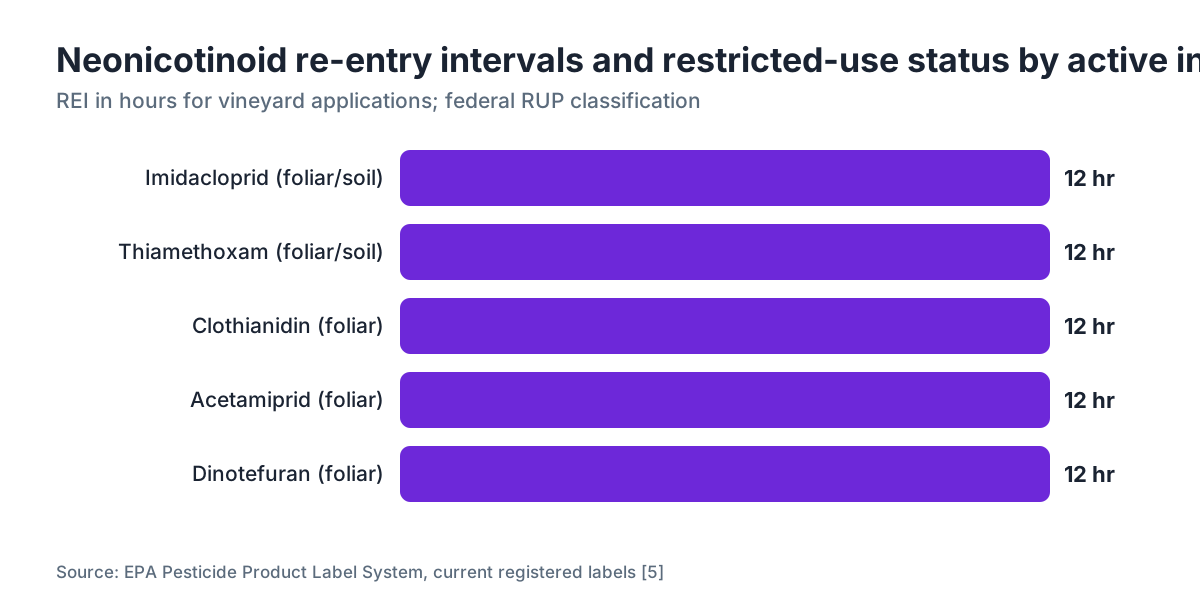
The Worker Protection Standard (WPS), revised in 2015 and run by EPA, sets the re-entry intervals. Imidacloprid soil applications carry a 12-hour REI. Foliar thiamethoxam typically carries 12 hours too. During the REI, workers can't enter the treated area without the personal protective equipment (PPE) named on the label [2]. The WPS also requires that REI information be posted at a central location or told to workers before they go in.
Application records are required under FIFRA (the Federal Insecticide, Fungicide, and Rodenticide Act) for all restricted-use pesticides (RUPs). Several neonicotinoids, including thiamethoxam and some imidacloprid formulations, are RUPs. Certified applicators must keep RUP records for at least two years and produce them for EPA or the state lead agency on request [3]. The minimum fields: product name, EPA registration number, total amount applied, location, size of area treated, month and year, and the applicator's name and certification number.
Soil-applied imidacloprid drew extra scrutiny in EPA's Interim Decision for imidacloprid (January 2020), which flagged risks to aquatic invertebrates and proposed runoff mitigation that could reach vineyard applications near water [4]. That decision is still moving through registration review, so watch for label amendments over the next two to three years.
Which neonicotinoids are approved for vineyard use and at what rates?
The table below covers the neonicotinoids with Section 3 federal registrations that include grapes. Read the current label every time, because rates and permitted uses change between seasons.
| Active Ingredient | Common Trade Name(s) | Registered on Grapes? | Typical Max Rate (per acre) | RUP? | REI |
|---|---|---|---|---|---|
| Imidacloprid | Admire Pro, Merit | Yes | 10.5 fl oz (Admire Pro) soil; 3.75 fl oz foliar | Yes (some formulations) | 12 hr |
| Thiamethoxam | Actara, Platinum | Yes | 5.5 oz (Actara) foliar; 11 oz (Platinum) soil | Yes | 12 hr |
| Clothianidin | Belay | Yes | 9 fl oz foliar | Yes | 12 hr |
| Acetamiprid | Assail 70WP | Yes | 2.5 oz foliar | No | 12 hr |
| Dinotefuran | Safari 20SG | Yes | 5 oz foliar | No | 12 hr |
These rates come from current EPA-registered labels [5]. If your state sets a stricter maximum, that number wins. Never exceed the label rate because a neighbor swears the extra ounce works.
One thing trips growers up: soil applications of imidacloprid get treated as safe because they're "not a spray." They aren't safer on paper. Soil drenches still need REI postings, WPS training for anyone who might re-enter the block, and full application records. Imidacloprid's soil half-life runs 27 to 229 days depending on soil type and moisture, so a spring drench can carry into bloom [6]. If your timing slips, that's a real problem, not a technicality.
How do California's neonicotinoid restrictions differ from federal rules?
California runs well past the federal floor. If you farm here, the California Department of Pesticide Regulation (CDPR) rules are the ones that govern your morning, not the EPA label alone.
CDPR classifies many neonicotinoid formulations as restricted materials, which means you need a county agricultural commissioner (CAC) permit to buy and use them, on top of your federal RUP certification. The permit process requires a Notice of Intent (NOI) filed with the county before you apply. The NOI carries the site address, target pest, product, rate, application date, and acreage. Waiting periods after filing run 24 to 48 hours in most counties, so you can't file at dawn and spray by lunch on a crisis morning [7].
Since 2019, CDPR has attached bee-protection conditions to many neonicotinoid permits in counties with heavy beekeeping. Those conditions can require beekeeper notification 48 to 72 hours ahead and restrict daytime applications when bees are working the field.
California also wants pesticide use reports (PURs) for every agricultural application, not only RUPs. You file with your CAC within one month of application. The PUR system is how CDPR tracks statewide use and decides where to enforce. Miss a filing and you draw fines; stack up enough violations and you lose the restricted materials permit. UC Cooperative Extension publishes county-specific PUR guidance worth reading if you're new to farming in California [8].
For growers around Paso Robles or other Central Coast appellations, CDPR's groundwater rules for nitrate and pesticides can collide with neonicotinoid soil applications near irrigation infrastructure. That's a compliance exposure worth walking through with your CAC before you drench anything.
What records do you actually have to keep, and in what format?
Let's get specific, because "keep records" is useless without the fields.
Federal FIFRA compliance for a restricted-use pesticide record needs, at minimum: product name and EPA registration number, date and location of application, total amount applied, size of area treated, and the name and certification number of the private applicator (or the name of the commercial applicator) [3]. Keep these two years from the application date.
California PURs demand more fields: the site ID from the county parcel system, the commodity (grapes by varietal class is fine), the application method (ground broadcast, soil injection, air blast), total pounds of active ingredient applied, and the section, township, and range of the parcel. File within one month, and expect CDPR to request supporting field records at inspection.
WPS compliance adds its own paper: worker training dates and content, REI durations by product, the application details posted at the central location, and the emergency contact for the treating medical facility. These stay accessible to workers and their representatives during the REI and for 30 days after [2].
What format? Federal law names no specific form. State law varies. California offers optional PUR forms, but the CAC accepts most farm software exports as long as every required field is there. A spiral notebook technically satisfies FIFRA, but it's misery to produce at an inspection. Digital records that export to a clean PDF with all fields have a far better track record when someone official is standing in your office.
This is where a purpose-built tool earns its cost. VitiScribe is built around vineyard spray records and generates application logs with the required fields pre-mapped, so you're not copying numbers from a tank-mix worksheet onto a compliance form after the fact.
WSU Extension publishes a vineyard spray record template that meets federal RUP requirements. It's a solid start if you're building a paper system [9].
What are the re-entry interval and worker protection requirements for neonicotinoids?
The WPS re-entry interval for most neonicotinoid foliar and soil applications is 12 hours. That's the federal floor. Some states set higher REIs, so check your state's WPS version if you're not in a state that simply adopts the federal standard.
During the REI, no worker enters the treated area unless the task can't wait and they wear the label-required PPE. For most neonicotinoid applications, that PPE is chemical-resistant gloves and protective eyewear at minimum; some labels add a long-sleeved shirt and long pants. The handler running the sprayer needs the full label PPE during application, which is usually heavier.
The WPS requires the agricultural employer to post specific information at a central location (often the toolshed or equipment barn) before workers enter treated areas. The posting names the product, EPA registration number, active ingredient, location of the treated block, REI start and end time, and the name and phone number of the nearest emergency medical facility. It stays up for 30 days after the REI expires [2].
Worker training is a separate box to check. Under the 2015 revised WPS, agricultural workers and handlers get WPS safety training before any work in a treated area, and workers need it at least once every 12 months. EPA supplies a training curriculum, and certified trainers at land-grant extension programs like Cornell Cooperative Extension and UC Cooperative Extension can help you build a compliant program [10].
Decontamination supplies, meaning soap, water, and single-use towels, must sit within a quarter-mile of any WPS-covered application, and within 100 feet when a handler is mixing or loading. Small detail, big liability. It's one of the most common WPS violations inspectors write up.
What do Oregon and New York require beyond federal rules?
Oregon and New York both go past federal minimums, and both have leaned into enforcement over the last two years. Oregon focuses on beekeeper notification and blooming crops. New York runs a mandatory beekeeper registry with a half-mile notification radius.
Oregon acted in 2022, restricting the sale and use of clothianidin, imidacloprid, thiamethoxam, and dinotefuran for outdoor agricultural use under Oregon Department of Agriculture (ODA) rules effective January 1, 2023. The restrictions cover outdoor applications to soil or foliage when bees may be present. Growers follow ODA pollinator-protection requirements, including a mandatory 24-hour advance notice to beekeepers registered within one mile of the site. Any neonicotinoid application to a blooming crop, cover crops in the row middles included, is prohibited unless the label allows it and bees aren't foraging. ODA runs the state pesticide registration and the restricted-product list [11].
New York's Department of Environmental Conservation (DEC) has built toward broader restrictions since 2020. As of 2024, DEC classifies imidacloprid, clothianidin, thiamethoxam, dinotefuran, and acetamiprid as pollinator-toxic pesticides subject to enhanced restrictions on certain crops. For grapes, applicators must consult a mandatory beekeeper registry before any outdoor application and give 48-hour notice to registered beekeepers within one-half mile of the treated site. Cornell Cooperative Extension keeps an updated guide to New York's neonicotinoid rules for tree fruit and grapes, and it's the clearest reference I've found for Empire State growers [10].
Both states have stepped up inspections. The documentation isn't just written down somewhere; it's actively getting checked.
Are there restrictions specific to neonicotinoid soil applications in vineyards?
Yes, and this is where growers slip, because a soil drench feels less visible than a sprayer running down the row. It isn't safer on paper, and the residue can outlast your intentions.
Imidacloprid soil drenches and in-furrow applications draw the closest scrutiny right now. EPA's 2020 Interim Decision on imidacloprid identified "risks of concern" to aquatic invertebrates from runoff and leaching and proposed mitigation including setback distances from surface water [4]. The final rule isn't in place yet, but some states have moved ahead. California restricts imidacloprid soil applications within 200 feet of surface water in several high-priority watersheds.
The half-life issue is real. University studies have measured imidacloprid soil half-lives from 27 days in sandy loam to 229 days in some clay soils [6]. A December or January soil drench aimed at soil pests can still sit in vine tissue at bloom in May or June. That creates the label-prohibited "application to blooming plants" exposure even though you never touched the sprayer during bloom. The vine applies it internally for you.
WSU Extension's IPM resources for grapevines address this timing risk head-on and recommend against soil applications of imidacloprid within 90 days of anticipated bloom unless you've exhausted the alternatives [9]. That's guidance, not a regulation, but it reflects the residue reality.
Soil applications carry the same FIFRA records as foliar sprays. Record the method specifically as soil injection, soil drench, or broadcast soil application. If a PCA or licensed commercial applicator does the soil treatment, their license number goes on the record.
How do you handle neonicotinoid documentation during a compliance inspection?
The inspection is a bad time to learn your records have holes. An inspector from the county agricultural commissioner, the state department of agriculture, or an EPA field office will ask for a predictable set of documents, and every one of them should already be filed.
For RUP applications, they want the record within 30 days for commercial applicators or inside the two-year window for private applicators. They'll check that the EPA registration number on your record matches the product label in your storage room. Buy a different formulation midseason and let the numbers drift apart, and that's a flag.
For WPS, they'll ask for your central posting, your decontamination setup, and your worker training records. Training records need names, dates, and a description of the content or the name of the EPA-approved curriculum you used.
For California PUR compliance, they can pull your filings from the CDPR system and lay them next to your spray records. Three neonicotinoid applications in your log and only two PURs filed is a problem you'll spend the afternoon explaining.
A few things that help. Store application records by block and by season in a consistent folder structure. Keep a copy of every product label you use, because the label is the law and having it on hand shows you've read it. Document beekeeper notification attempts even where they aren't strictly required; a timestamped email or text is evidence of good faith.
If you keep digital records, VitiScribe generates exportable spray logs sorted by application date, block, and product, which maps to what inspectors ask for. Whatever system you run, the point is that it's complete before the inspector calls, not scrambled together after.
What are the best alternatives to neonicotinoids for common vineyard pests?
This comes up in every restriction conversation, and the honest answer is that it depends on the pest and your region, and the alternatives mostly aren't as good across the board. Real options exist. None of them is a straight swap.
For vine mealybug, spirotetramat (Movento) is a systemic with a different mode of action (IRAC Group 23), effective and lower in acute bee toxicity in most use scenarios. Buprofezin (Applaud) is another option, an insect growth regulator (IRAC Group 16). Neither hits as fast as imidacloprid, and mealybug control usually takes a season-long IPM program rather than one application.
For glassy-winged sharpshooter, kaolin clay (Surround WP) is a physical barrier that cuts sharpshooter feeding and egg-laying with no bee-toxicity worry. It's more labor to apply and needs repeat coverage, but in high-pressure GWSS zones of Southern California, some growers use it to shave down neonicotinoid load.
For grape leafhopper, the parasitic wasp Anagrus epos lives in most western vineyards and gets knocked back by broad-spectrum insecticides, neonicotinoids included. Cutting spray frequency can improve biological control over several seasons. That's a hard sell in August when you're watching leafhopper numbers climb.
UC Cooperative Extension's Integrated Pest Management guidelines for grapes are the best single reference for alternative chemistries by pest. They're updated regularly and include economic thresholds, which is the most useful number for deciding whether you need to spray at all [8].
If you run a vineyard with agritourism or a tasting room, the optics of insecticide use matter too, and that shapes which tools some growers reach for.
How do you set up a recordkeeping system that actually holds up to scrutiny?
A good spray record system does four things: it captures every required field at the moment of application (not later), it's searchable by block and product, it's backed up somewhere other than the tractor, and it prints a report you'd hand an inspector without editing it first.
Paper works, but it has a failure rate. Logbooks get left in the spray truck. Pencil notes fade. If you go paper, scan or photograph every completed record within 24 hours and drop the image into a cloud folder organized by year and block.
Spreadsheets are a step up, but they need discipline and version control. Let four people edit one master sheet and you'll eventually have a data integrity mess.
Here's the minimum set of fields for every neonicotinoid application: product name, EPA registration number, active ingredient and percentage, application date and time, block ID and acreage, application method, target pest, gallons of water per acre (for foliar), rate per acre, total amount of product used, REI start and end, weather at application (required on many labels), applicator name and license number, and any beekeeper notifications made.
Keep WPS records in the same system or a separate one, but link them to the application record so you can show an inspector the posting went up before workers re-entered the block.
For California growers, PUR data has to match your spray records exactly. If your log says 5.5 ounces of Actara per acre on 12 acres, your PUR should show 66 ounces total, and the pounds of active ingredient (thiamethoxam at 25% AI in Actara) should calculate correctly. Gaps between your internal records and your PUR filings are a common trigger for a follow-up inspection.
Frequently asked questions
Are neonicotinoids banned in vineyards in the United States?
No. There is no federal ban on neonicotinoids in vineyards. Imidacloprid, thiamethoxam, clothianidin, acetamiprid, and dinotefuran all have current EPA registrations for grapes. State restrictions vary. California, Oregon, and New York add significant permit and notification requirements, but as of mid-2025 none of those states have imposed a complete ban on vineyard use.
How long do I have to keep neonicotinoid application records?
Federal law under FIFRA Section 8 requires restricted-use pesticide records for at least two years from the application date. California requires pesticide use reports on file with the county agricultural commissioner for three years. Some state auditing programs look back five years, so keeping records longer than the legal minimum is a reasonable practice when storage isn't a constraint.
Can I apply neonicotinoids during grapevine bloom?
Most neonicotinoid labels prohibit application to plants in bloom when bees are foraging. Grapevines bloom for roughly 10 to 21 days in late spring depending on climate. Applying a neonicotinoid during that window when bees are present is both a label violation and a FIFRA violation. If you have a pest emergency at bloom, call your county farm advisor or PCA before you apply.
What is the re-entry interval for imidacloprid in a vineyard?
The REI for imidacloprid is 12 hours for both foliar and soil applications. Workers can't enter the treated block during that window without the PPE named on the label. Your WPS central posting must show the REI start and end time, and decontamination supplies must be available within a quarter-mile of the treated area during the REI.
Do soil drenches of imidacloprid require the same records as sprays?
Yes. Soil applications of imidacloprid carry the same FIFRA recordkeeping requirements as foliar sprays: product name, EPA registration number, application date, location, acreage, rate, and applicator name and license number. In California, a pesticide use report is required too. Record the method specifically as soil drench or soil injection so the record is accurate at inspection.
Does California require beekeeper notification before applying neonicotinoids?
Many California counties impose beekeeper notification as a condition of restricted materials permits for neonicotinoids, especially in counties with heavy beekeeping. The common requirement is 48 to 72 hours advance notice to beekeepers within a set radius. Check with your county agricultural commissioner for the exact conditions on your permit, since they vary by county and crop.
What is a Notice of Intent and when do I need one in California?
A Notice of Intent (NOI) is a required submission to your county agricultural commissioner before using a California-restricted material. Many neonicotinoids are restricted materials in California, so an NOI must be filed before each application. It includes the product, target pest, site, application date, and acreage. Most counties require at least 24 hours between filing and application.
What does Oregon require for neonicotinoid applications in vineyards?
Oregon's rules effective January 1, 2023 require growers using clothianidin, imidacloprid, thiamethoxam, or dinotefuran outdoors to give 24-hour advance notice to beekeepers registered within one mile of the site. Applications to blooming crops or blooming cover crops are prohibited unless the label allows it and bees aren't foraging. ODA manages the beekeeper registry and enforcement.
Are cover crops in vineyard row middles considered part of the treated area for bloom restrictions?
This one is genuinely messy. If a cover crop in your row middles is blooming and you apply a neonicotinoid to the vines by air blast, drift to the cover crop is likely. Some labels and state rules treat the cover crop as part of the treated area if it's inside the spray pattern. Oregon explicitly prohibits neonicotinoid applications near blooming cover crops. Mowing before bloom is the common workaround.
What happens if I miss a pesticide use report filing in California?
Missing a PUR filing violates California Food and Agricultural Code Section 12999. Fines start at a few hundred dollars per violation and climb with repeat offenses. Enough violations can trigger permit suspension or revocation by the county agricultural commissioner. CDPR cross-checks PUR filings against dealer sales records, so gaps often get flagged without an inspection ever happening.
Which neonicotinoids require a restricted-use pesticide certification to buy and apply?
Federally, imidacloprid (select formulations), thiamethoxam, and clothianidin are restricted-use pesticides requiring a private or commercial applicator certification. Acetamiprid and dinotefuran generally aren't federal RUPs but may be restricted materials under state rules. Always verify RUP status on the current label and with your state department of agriculture, since classifications change.
Does the EPA's Interim Decision on imidacloprid affect current vineyard use?
EPA issued an Interim Decision on imidacloprid in January 2020, identifying risks to aquatic invertebrates from runoff and leaching and proposing mitigation including surface-water setbacks. As of mid-2025 the final registration decision is still pending. Some states, California among them, have set their own surface-water setbacks ahead of the federal rule. Monitor EPA's registration review pages for updates.
How do I find out if my county has additional neonicotinoid restrictions beyond state rules?
Call your county agricultural commissioner directly. In California, county conditions on restricted materials permits vary and aren't always posted online in a usable format. Your local UC Cooperative Extension farm advisor can also tell you what conditions are common in your county. In New York, Cornell Cooperative Extension's county offices track DEC conditions and point you to current guidance.
Can an employee without a pesticide license apply neonicotinoids if a licensed applicator supervises?
Under federal RUP rules, a private applicator must make or directly supervise the application of a restricted-use pesticide. Direct supervision means the licensed person is physically present or immediately available and the application follows their instructions. An employee applying a neonicotinoid RUP while the licensed applicator sits across the farm in another block likely fails the supervision test.
Sources
- PLOS ONE, Girolami et al., 2009, Translocation of Neonicotinoid Insecticides from Coated Seeds to Seedling Guttation Drops: Imidacloprid residues found in guttation droplets at concentrations toxic to honeybees
- EPA, Agricultural Worker Protection Standard (WPS): REI requirements, central posting requirements, decontamination supplies, and worker training intervals under the 2015 revised WPS
- EPA, FIFRA Section 8, Pesticide Records Requirements: Certified applicators must keep RUP application records for at least two years including product name, EPA registration number, amount applied, location, area treated, and applicator certification number
- EPA, Imidacloprid Registration Review Interim Decision (January 2020): EPA identified risks of concern to aquatic invertebrates from imidacloprid runoff and leaching and proposed mitigation measures including surface water setback distances
- EPA, Pesticide Product Label System (PPLS): Current maximum application rates for imidacloprid, thiamethoxam, clothianidin, acetamiprid, and dinotefuran on grapes as listed on registered product labels
- USDA ARS, Pesticide Properties DataBase / Published soil half-life data for imidacloprid: Imidacloprid soil half-life ranges from 27 days in sandy loam to 229 days in some clay soils depending on soil type and moisture
- California Department of Pesticide Regulation, Restricted Materials and Permitting: California requires a county agricultural commissioner permit and Notice of Intent before each restricted material neonicotinoid application; waiting period typically 24-48 hours
- UC Statewide Integrated Pest Management Program, Grape Pest Management Guidelines: UC IPM guidelines for grapes cover alternative chemistries by pest, economic thresholds, and California pesticide use reporting requirements
- Washington State University Extension, Grape Insect Pest Management and Spray Records: WSU Extension recommends against soil applications of imidacloprid within 90 days of anticipated bloom and provides vineyard spray record templates meeting federal RUP requirements
- Cornell Cooperative Extension, New York Neonicotinoid Restrictions for Tree Fruit and Grapes: New York DEC classifies five neonicotinoids as pollinator-toxic pesticides subject to mandatory beekeeper registry consultation and 48-hour notification for vineyard applications
- Oregon Department of Agriculture, Pollinator Protection Requirements for Pesticides: Oregon rules effective January 1, 2023 require 24-hour advance beekeeper notification for outdoor neonicotinoid applications and prohibit applications to blooming crops when bees are foraging
- California Department of Food and Agriculture, Pesticide Use Reporting: California requires pesticide use reports for all agricultural applications within one month of application under California Food and Agricultural Code Section 12999; violations subject to fines
Last updated 2026-07-10