Powdery mildew resistant grape varieties: what actually works in the vineyard
TL;DR
- No grape variety is fully immune to powdery mildew.
- But USDA and Cornell-bred hybrids like Arandell, Traminette, and the Geneva series carry strong partial resistance that cuts fungicide applications 50 to 80 percent versus Vitis vinifera.
- Marquette, Frontenac, and La Crescent perform well in cold, humid climates.
- Resistance ratings shift with local conditions, so cross-check with your state extension program before you replant.
What makes a grape variety resistant to powdery mildew?
Resistance to powdery mildew is genetic, and it's partial, never absolute. The pathogen, Erysiphe necator (once called Uncinula necator), evolved alongside wild North American Vitis for thousands of years. That's why native species like Vitis rotundifolia and Vitis aestivalis carry resistance genes that Vitis vinifera, the European wine grape, never needed to develop [1]. Cross vinifera with a resistant American or Asian species and the offspring can inherit those genes, described in the literature as run1, Ren2, Ren3, or the Rpv loci.
What you get is not immunity. You get a slower disease cycle. Spore germination drops, colonies stall, and the vine's hypersensitive response walls off infections before they spread [2]. Under light to moderate pressure, you may see zero visible mildew all season. Under heavy pressure (a cool cloudy stretch, then warm humidity) you'll see some. It usually stays manageable without the aggressive schedule vinifera demands.
Most breeding programs rate resistance on a 1-to-9 scale, where 1 is highly susceptible and 9 is highly resistant. Cornell uses a similar descriptive scale in its Geneva series trial reports [3]. Ratings above 7 count as commercially useful in the Northeast and upper Midwest, where mildew is a season-long threat. In drier country like eastern Washington or the San Joaquin Valley, even a variety rated 5 may need fewer sprays than a vinifera does through a wet East Coast summer.
Breeders learned one lesson the hard way. Stacking multiple resistance loci matters. Varieties carrying a single major resistance gene have shown that resistance erode under high pressure over years. Varieties with two or more genes, like some of the newer Geneva releases, hold up better across seasons [3].
Which grape varieties have the strongest powdery mildew resistance?
The best performer depends on your region, your market (wine, juice, table), and how much quality tradeoff you'll accept. That said, a handful of varieties earn high marks across trial sites year after year.
Hybrid wine grapes with strong resistance (rated 7-9)
Arandell, released by Cornell in 2013, is a red wine hybrid bred for humid climates [3]. It carries multiple resistance loci for both powdery and downy mildew and has shown very low disease in Geneva, NY plots with no fungicide in most years. Trial notes describe red fruit character. It's still finding its footing commercially.
Marquette, released by the University of Minnesota in 2006, is the most widely planted cold-hardy wine grape in the upper Midwest [4]. Its powdery mildew resistance rates good to very good, and it makes wine some tasters put near mid-range Pinot Noir. Minnesota Extension trial data showed Marquette averaging fewer than two mildew-specific sprays per season in southern Minnesota, against seven or more for vinifera controls [4].
Traminette, a Cornell release with Gewürztraminer character, has grown commercially in the East since the 1990s. Resistance rates moderate to good, enough to cut a spray program well below what vinifera whites need [3].
Norton (Vitis aestivalis) is one of the oldest American wine grapes and carries excellent natural resistance. The wine is distinctive: assertively red-fruited and tannic. Not everyone's cup.
Table and juice grapes
Concord and Niagara, both Vitis labrusca-based, are highly resistant. They aren't wine grapes in the traditional sense, but large juice and table operations in the Lake Erie and Finger Lakes appellations lean on them because disease management costs almost nothing. Some newer table grape selections from the USDA-ARS program show promising resistance, though few are commercially available yet [5].
The Geneva series (Cornell)
GY7, GY8, and the numbered Geneva selections are breeding lines, not named commercial releases yet. Several have advanced to regional trials with powdery mildew ratings of 8 or 9 [3]. Expect named releases within the next few years if the trial results hold.
| Variety | Type | PM Resistance (1-9) | Downy Mildew Resistance | Climate Suitability |
|---|---|---|---|---|
| Marquette | Red wine | 7-8 | 7 | Cold climates, upper Midwest |
| Arandell | Red wine | 8-9 | 8 | Humid East, Northeast |
| Traminette | White wine | 6-7 | 6 | East, Midwest |
| Norton | Red wine | 8 | 7 | Midwest, Mid-Atlantic |
| Crimson Cabernet | Red wine | 7-8 | 7 | Humid South, East |
| Concord | Juice/table | 9 | 8 | Northeast, Midwest |
| Frontenac | Red wine | 7 | 6 | Upper Midwest, Canada |
| La Crescent | White wine | 7 | 7 | Upper Midwest |
Ratings above come from Cornell, University of Minnesota, and USDA trial reports [3][4][6]. Your local extension office may carry ratings calibrated to your specific region, and those beat any national average.
How much can resistant varieties actually reduce your spray program?
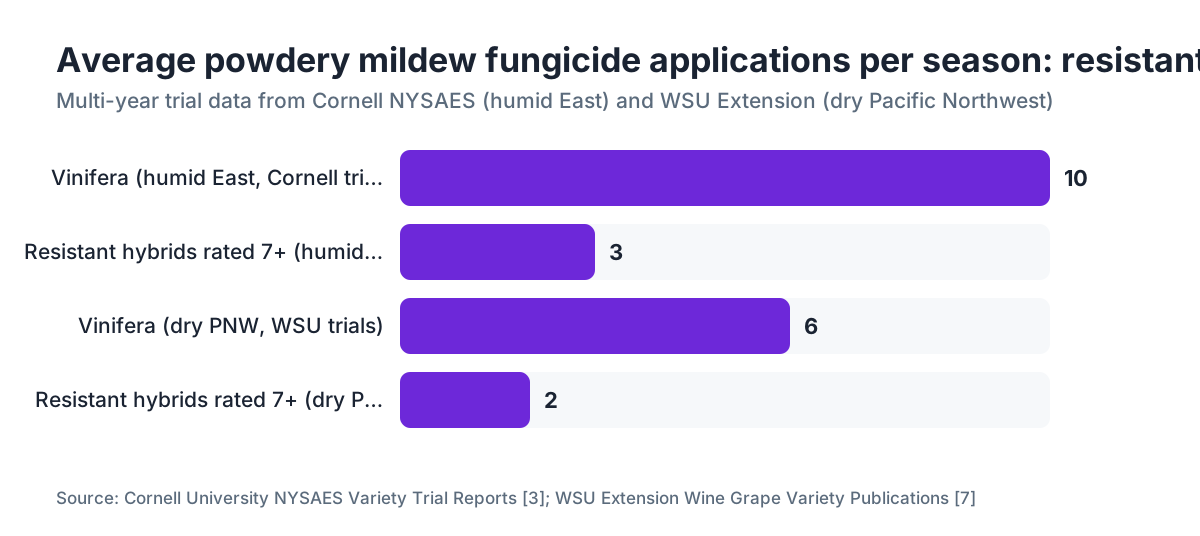
This is the number growers care most about, and the data here is decent. Cornell's research farm in Geneva, NY ran multi-year trials comparing spray programs on resistant hybrids against Vitis vinifera under the same pressure. Resistant varieties rated 7 or above averaged 2 to 4 fungicide applications a season for powdery mildew control. Vinifera blocks in the same trials averaged 8 to 12 [3].
WSU Extension data from Prosser, WA runs more conservative because eastern Washington is dry. Vinifera like Chardonnay averaged 5 to 7 mildew-targeted applications; resistant hybrids needed 1 to 3 in most years, some years none [7].
The economics are simple. A conventional sulfur program for a 10-acre vinifera block in a humid region might run $800 to $1,500 per acre per season once you count product, water, and labor. Cut to two applications and you're at $200 to $400 per acre. Across 50 or 100 acres, that's real money.
Here's the catch. Many resistant hybrids ask for more passes on other problems: black rot, crown gall, or insect pressure specific to the hybrid. Your total program savings can come out smaller than the mildew numbers alone suggest. Model total spray cost, not mildew cost, whenever you weigh a variety switch.
If you track applications per block by disease target, software like VitiScribe makes that comparison across seasons without a homegrown spreadsheet. It matters the day you want to document spray reductions for an organic or low-input certification. You'll need clean per-application records by disease target, more than total gallons out.
Do powdery mildew resistant varieties make good wine?
It's the question every vinifera-trained winemaker asks. The honest answer: it depends on the variety and your market, and the gap has closed a lot since the 1990s.
Marquette wines regularly score in the upper 80s at major competitions. Recent vintages from Upper Midwest producers have earned scores near mid-range Pinot Noir and Merlot in national evaluations. That's not anecdotal. The University of Minnesota tracks commercial adoption and medal outcomes as part of its variety development work [4].
Traminette makes a white with genuine Gewürztraminer character. Growers in the Finger Lakes and Virginia have sold it at $18 to $28 per bottle with little consumer pushback from people who don't know or care about the parentage.
Hybrids still struggle in three spots. Tannin structure in reds runs softer than Cabernet Sauvignon. Vegetative or foxy aromas creep in if you don't manage yields. And distributors in vinifera-dominated markets stay skeptical.
Norton is the real exception. Made well, it gives a deeply colored, structured red that doesn't taste like a hybrid. Missouri built a regional identity on it. It doesn't taste like Cabernet either, so if your market expects recognizable European varieties, Norton means consumer education.
My advice before you commit at scale: plant a quarter-acre trial block, make wine from it, pour it for your best customers. That's a two or three-year experiment. Far cheaper than a full replant you regret.
How does powdery mildew spread in the vineyard, and why does variety choice matter so much?
Erysiphe necator overwinters as chasmothecia (its sexual fruiting bodies) in bark crevices and as dormant mycelium inside infected buds [1][2]. When temperatures hold between 70 and 85°F and humidity climbs, ascospore release and secondary conidia spread move fast. The pathogen doesn't need free water on the leaf the way downy mildew does. It thrives in warm, cloudy, dry conditions, which is how it wrecks a crop even in arid country during a cool, foggy stretch.
On a susceptible vinifera, one infected cluster at bloom can mean 100 percent berry infection if the spray program lapses for 7 to 10 days around fruit set [2]. UC Davis Extension flags the two weeks around bloom and just after as the highest-risk window, when berries are most susceptible [1]. Miss a single spray then on Chardonnay or Cabernet in a high-pressure year and you don't get it back.
On a strongly resistant variety, that window still counts, but the cost of missing one application drops sharply. The pathogen still tries to colonize. The vine's defenses slow sporulation enough that secondary spread stays limited. You still scout, and you still spray if you see disease. You just have more time to respond, and the damage ceiling sits lower.
Variety choice also shapes where trouble starts in the canopy. Some hybrids grow open and upright, ventilating better than sprawling vinifera. More air movement means lower humidity in the fruiting zone, which adds to the genetic resistance.
In humid regions (the Southeast, Midwest, Northeast) variety choice is the single most effective disease decision you'll make. In dry climates it matters less, but it still moves your spray budget and worker exposure.
What do UC Davis, Cornell, and WSU recommend for resistant varieties by region?
Each major grape research university runs its own program, and the recommendations split usefully by climate zone.
Cornell University (Geneva, NY): The New York State Agricultural Experiment Station at Cornell runs the most active disease-resistant wine grape breeding program in the eastern US. It points growers toward Traminette, Arandell, Marquette (Minnesota-bred, but grown widely in New York), and its own Geneva experimental lines for humid northeast conditions [3]. Cornell's variety guidance is blunt: no variety is completely immune, but several show resistance strong enough to cut fungicide programs substantially in commercial production. Check the annually updated IPM guidelines, since new cultivar data lands every season [3].
University of Minnesota (St. Paul): A full breeding program, more than an extension page. Marquette, Frontenac, La Crescent, and Itasca are the flagship releases. All four carry strong powdery mildew resistance and were bred for Zone 4 cold hardiness, so they handle harsh winters and humid summers together in the upper Midwest [4].
UC Davis (Davis, CA): The focus here is vinifera improvement and California conditions. The resistant-variety recommendation is narrower, because in most California wine regions vinifera stays economically viable with good canopy management and a sulfur program. UC Cooperative Extension does publish powdery mildew management guides that cover resistance among table grape varieties and note the rising interest in resistant varieties for organic and reduced-input vineyards in cooler coastal zones [1][5].
WSU Extension (Pullman, WA): Washington's main wine regions run dry enough that mildew pressure on vinifera is moderate against the East. WSU still tracks resistant variety performance. Its publications cover Marquette and other cold-hardy hybrids for the Columbia Basin and note growing interest among eastern Washington growers chasing lower input costs [7].
If your region falls outside these programs, Virginia Cooperative Extension and Michigan State Extension both publish region-specific resistant variety guides. Pull those up before any replant decision.
What are the EPA worker protection standard requirements when spraying for powdery mildew?
This matters even on resistant varieties, because most growers still apply at least one or two fungicides a season regardless of what they planted.
The EPA's Worker Protection Standard (WPS), codified at 40 CFR Part 170, covers all agricultural pesticide applications, sulfur and most powdery mildew fungicides included [8]. Your core obligations as a vineyard operator: post treated areas with WPS-compliant safety information (field signs, or central posting if the restricted-entry interval is 4 hours or less), keep decontamination supplies within one-quarter mile of treated areas, and train workers before they enter treated fields.
Sulfur, the most common powdery mildew fungicide in grapes, carries a restricted-entry interval (REI) of 24 hours for most formulations. Some wettable sulfur products run a 12-hour REI. Read the specific label. Under FIFRA, the label is the law [11].
Organic growers using sulfur face the same WPS obligations. Organic certification doesn't exempt you from pesticide safety rules. Copper fungicides, sometimes used for downy mildew with secondary effect on powdery mildew, carry their own REIs and annual application limits under the National Organic Program [9].
One practical note. The WPS was revised in 2015, and the revised rule requires pesticide application and safety training records to be kept for two years. If a state department of agriculture or OSHA audits you, those records need to be on hand. Growers who drop from 10 applications to 2 sometimes get sloppy on the remaining 2, which is exactly backward. Every application needs a record, and that record needs the applicator name, date, product, rate, REI, and crop [8].
How do you integrate resistant varieties with an existing vineyard's disease management plan?
You can't flip a planted vinifera block to a resistant variety overnight. The real question is how to phase resistant varieties in while you keep managing disease on the blocks you already have.
Start with your highest-pressure blocks. Got a north-facing block that mildews first, or a low, poorly drained spot where you spray 10 to 12 times a season? Those are your first replant candidates. The resistant variety goes where the management cost hurts most.
While new plantings mature, disease management on your vinifera doesn't change. Sulfur stays the backbone of most organic and conventional programs. Systemic fungicides (DMI like myclobutanil, SDHI like fluxapyroxad, QoI like azoxystrobin) work but need rotation by FRAC code to keep the pathogen from developing resistance [2][10]. The Fungicide Resistance Action Committee (FRAC) keeps a current list of powdery mildew fungicide classes, and the UC Davis IPM program mirrors those resistance guidelines for California [1].
Across a mixed vineyard of vinifera and resistant hybrid blocks, keeping spray records by block (not by date) lets you see the per-variety application burden at season's end. VitiScribe is built around that block-level structure, which makes the analysis simple when you're deciding where to replant next.
Scouting cadence shifts too. On resistant varieties, weekly scouting through the bloom window stays necessary, but post-set scouting can often move to every 10 to 14 days instead of weekly. Document what you find either way. Clean scouting records are worth as much as spray records for proving a reduced-input program was intentional, not accidental.
Are resistant varieties suitable for organic vineyard certification?
They're a natural fit, and they're not a free pass.
Organic certification under the USDA National Organic Program (NOP) requires every pesticide used to sit on the National List of Allowed Substances [9]. Sulfur is listed. Most synthetic fungicides (DMI, SDHI, QoI classes) are not. So an organic vinifera vineyard runs its whole mildew program on sulfur and copper, with occasional permitted biologicals like Bacillus subtilis-based products.
A resistant variety cuts how often you apply those allowed materials. That lowers your total sulfur load on the soil (repeated sulfur can acidify soil over time, a real concern for some certified growers), trims labor, and makes the organic program pencil out better per acre.
The catch. Organic certification still demands full documentation of every spray, every input, every scouting observation. Fewer sprays doesn't mean less paperwork. Certifiers often scrutinize reduced-input programs harder, because they want proof the disease was genuinely absent, more than unnoticed.
Some organic growers on resistant varieties find biological programs (Bacillus subtilis, Reynoutria sachalinensis-based products) carry their low-pressure blocks, cutting sulfur to almost nothing some seasons. Cornell's extension program has trial data on biological fungicide efficacy across resistant and susceptible varieties [3]. On susceptible varieties, biologicals alone rarely hold. On varieties rated 7 or above, they sometimes do.
The USDA Agricultural Marketing Service maintains the NOP regulations at the primary source [9]. If you're weighing organic certification, start there, then work with an accredited certifier who knows your state.
What are the cold hardiness and regional adaptation limits of resistant varieties?
Here's where the tradeoffs get real. Most strongly resistant red wine hybrids carry heavy Vitis riparia or Vitis labrusca genetics, which buys cold hardiness down to minus 20°F or lower. Genuinely useful in Minnesota, Wisconsin, the Dakotas, and higher-elevation Northeast sites. It also means some of them won't reach their best quality in warmer regions where vinifera shines.
Marquette, Frontenac, and La Crescent are Zone 4 varieties, built for places where winter kill hits vinifera regularly. Plant them in Virginia or the Willamette Valley and they'll grow fine, but you're leaving quality on the table against a well-managed Pinot Noir or Riesling in those conditions.
Traminette and Norton adapt across a wider range. Traminette does well from Virginia to New York. Norton grows from Missouri to Virginia to Texas, though it wants a longer season than the upper Midwest hybrids.
In the Southeast (hot and humid) resistance to both powdery mildew and Pierce's disease matters. Pierce's is a bacterial disease spread by sharpshooter leafhoppers and lethal to vinifera across most of the South. Blanc du Bois and certain Florida hybrid bunch grapes carry useful powdery mildew resistance while tolerating Pierce's disease pressure [6]. UC Davis's Pierce's disease research group has information on disease-tolerant varieties for warmer regions [5].
Bottom line: match the variety to your hardiness zone and your target market first, then layer resistance ratings on as a secondary filter. A variety rated 9 for mildew that won't ripen in your climate is still a commercial failure.
For growers near established California wine regions, like the vineyards around Paso Robles wineries or South Coast Winery operations, the case for switching to resistant varieties is weaker, because vinifera disease pressure stays manageable with careful spray timing. The case gets much stronger in the Midwest and humid East.
What does the research say about long-term resistance durability?
This one's underappreciated, and the honest answer is that we don't have field histories long enough to be fully confident.
Breeders noticed early. Some of the first disease-resistant varieties, especially those carrying only the run1 locus (which came from Muscadinia rotundifolia), showed partial breakdown of resistance after several years of high pressure in certain locations [2]. The pathogen population evolved. This mirrors resistance breakdown documented in cereal crop breeding and is well established in the plant pathology literature.
The fix has been to pyramid multiple resistance loci in newer releases. Varieties like Arandell pair run1 with other resistance sources, making evolutionary bypass much less likely [3]. The theory is sound. The field evidence across 20-plus years is still coming in.
A 2022 review in the journal Phytopathology examined powdery mildew resistance genetics in Vitis and concluded that "varieties carrying two or more major resistance loci have maintained resistance across a wider range of pathogen populations and environments than single-locus varieties" [2]. That's the clearest statement the literature will support right now.
For growers, the practical read: don't plant one resistant variety across your whole operation on the assumption it stays low-maintenance forever. Spread genetics across blocks. Keep scouting even the most resistant varieties you plant. If mildew shows up unexpectedly on a variety that was clean before, report it to your extension pathologist.
Frequently asked questions
Is any grape variety completely immune to powdery mildew?
No commercially grown grape variety is fully immune. Some Muscadinia rotundifolia selections show very high resistance, but even they can develop infections under extreme pressure. The realistic goal in resistant variety selection is to reduce spray applications by 50 to 80 percent versus Vitis vinifera, not to erase the disease. Scout your resistant blocks during bloom and after, every season.
How is powdery mildew resistance rated in grape varieties?
Most university and USDA breeding programs use a 1-to-9 scale, with 1 highly susceptible and 9 highly resistant. Ratings above 7 count as commercially useful for cutting spray programs in humid regions. Cornell's variety trial reports and the University of Minnesota breeding program publish current ratings for their releases. Ratings vary by location, so check your regional extension office for locally validated data.
Can I grow resistant grape varieties in California?
You can, but the payoff is weaker than in the East. California's drier climate keeps powdery mildew manageable on vinifera with 5 to 8 fungicide applications a season in most regions. Resistant varieties draw interest in cooler, foggier coastal areas like Sonoma or the Santa Cruz Mountains where pressure runs higher, and among organic growers cutting sulfur. UC Davis Cooperative Extension publishes region-specific guidance for California growers.
What fungicides are approved for powdery mildew on grapes?
Sulfur (wettable, micronized, or dust formulations) is the backbone and is approved for both conventional and organic programs. Synthetic options include DMI fungicides (myclobutanil, tebuconazole), SDHI fungicides (fluxapyroxad, penthiopyrad), and QoI fungicides (azoxystrobin, trifloxystrobin). Rotate by FRAC code to keep the pathogen from developing resistance. Always check the current product label; it supersedes any general guideline.
Does Marquette grape make good wine?
Yes, by most measures. Marquette, released by the University of Minnesota in 2006, produces wines that have scored in the upper 80s at major competitions. It shows red cherry and black pepper character, moderate tannins, and good acidity. It's the most widely planted cold-hardy wine grape in the upper Midwest. Quality tracks yield hard; overcropped Marquette loses complexity fast, so keep it under 3 tons per acre.
How many spray applications do resistant varieties need compared to vinifera?
Cornell multi-year trials in Geneva, NY found resistant varieties rated 7 or above averaged 2 to 4 powdery mildew applications per season, versus 8 to 12 for vinifera in the same trials. WSU data from drier eastern Washington shows vinifera at 5 to 7 applications and resistant hybrids at 1 to 3. Results vary by season and site; a wet, cloudy summer can push resistant variety programs higher.
Are resistant grape varieties suitable for organic certification?
Yes, and they fit well. Organic programs are limited to allowed materials like sulfur, copper, and approved biologicals. Resistant varieties cut how often you apply those, lowering labor and input costs. Certification still requires full documentation of every spray and scouting record, no matter how few applications you make. USDA National Organic Program regulations at the Agricultural Marketing Service govern what inputs are permitted.
What are the best white wine grape varieties with powdery mildew resistance?
Traminette (Cornell, Gewürztraminer character, rated 6-7), La Crescent (Minnesota, apricot and citrus, rated 7), and Itasca (Minnesota, neutral white, rated 7-8) are the most commercially established. Frontenac Gris and Frontenac Blanc are also widely planted across the Midwest. All do best in cool to cold climates; in warmer regions they ripen early and can drop acidity.
How does powdery mildew resistant variety selection affect wine labeling?
If the variety meets the TTB minimum 75 percent varietal content threshold (or 85 percent under some AVA and state rules), you can label it by variety name. Marquette, Traminette, and Norton are all TTB-approved variety names for wine labeling. Wines from experimental numbered breeding lines can't use a variety name until the TTB approves it. Check the TTB approved variety list before planting an unnamed release.
What worker protection standard records do I need for vineyard fungicide applications?
The EPA Worker Protection Standard (40 CFR Part 170) requires records including product name, EPA registration number, application date, area treated, applicator name, and restricted-entry interval for each application. Records must be kept for two years and made available to workers or their representatives on request. This applies to all agricultural fungicide applications, sulfur and approved organic materials included.
Can powdery mildew resistant varieties handle the same rootstocks as vinifera?
Most commercially grown resistant hybrids in the US go in on their own roots, since they were bred partly for cold hardiness and own-rooted survival where phylloxera pressure is lower or soils differ from California. In regions with phylloxera pressure, grafting to standard rootstocks like 3309C, SO4, or 101-14 works for most hybrids. Verify with the nursery supplying your material, since graft compatibility varies by cultivar.
Does canopy management affect powdery mildew on resistant varieties?
Yes, a lot. Even on resistant varieties, dense, poorly ventilated canopies create the microclimate Erysiphe necator favors: moderate humidity, low air movement, shade. Vertical shoot positioning, shoot thinning, and leaf pulling in the fruiting zone improve air circulation and cut disease pressure by 30 to 50 percent in some studies, adding to the genetic resistance. Good canopy management is the cheapest disease tool you have on any variety.
How long does it take for a resistant variety to come into full production?
Similar to vinifera: first meaningful crop in year 3, full production by years 5 to 7 depending on training system and vine spacing. No shortcut exists. Cold-hardy hybrids like Marquette and Frontenac establish quickly in their adapted climates, sometimes cropping lightly by year 2, but pushing early cropping compromises vine establishment. Budget the same 5-year timeline you'd use for any new block.
Are there resistant varieties for warmer southern US climates?
Blanc du Bois is the most widely planted resistant white wine grape in the Southeast and Gulf Coast, developed by the Florida Agricultural Experiment Station. It tolerates both powdery mildew and Pierce's disease, making it one of the few viable wine grape options in humid subtropical country. Norton (Vitis aestivalis) also does well in the Mid-South and Missouri. For table grapes in hot climates, Muscadine varieties resist both mildew and Pierce's disease.
Sources
- UC Davis IPM Program, Grape Powdery Mildew Management Guidelines: UC Davis describes the two-week window around bloom and fruit set as the period of highest berry susceptibility to powdery mildew; Erysiphe necator does not require free water on the leaf surface to infect.
- Phytopathology, 2022, Vitis powdery mildew resistance genetics review: A 2022 review concluded that varieties carrying two or more major resistance loci maintained resistance across a wider range of pathogen populations and environments than single-locus varieties; run1 locus resistance showed partial breakdown in some high-pressure field sites.
- Cornell University, New York State Agricultural Experiment Station (NYSAES) grape variety trial reports: Cornell NYSAES trials found resistant hybrids rated 7 or above averaged 2 to 4 powdery mildew applications per season versus 8 to 12 for vinifera; Arandell (2013 release) carries multiple resistance loci and Geneva breeding lines show ratings of 8 to 9.
- University of Minnesota Extension, Cold-Hardy Grape Varieties: Marquette released by University of Minnesota in 2006 is the most widely planted cold-hardy wine grape in the upper Midwest; Minnesota Extension trial data showed Marquette averaging fewer than two mildew-specific spray applications per season in southern Minnesota versus seven or more for vinifera controls.
- UC Davis Pierce's Disease Research and Control Program: UC Davis tracks disease-tolerant variety development for warmer California regions and Pierce's disease pressure; experimental table grape selections in USDA-ARS programs show promising powdery mildew resistance.
- University of Florida IFAS Extension, Bunch Grape Production in Florida: Blanc du Bois developed by the Florida Agricultural Experiment Station tolerates both powdery mildew and Pierce's disease, making it viable in subtropical humid regions where vinifera cannot survive.
- Washington State University Extension, Wine Grape Varieties for Washington: WSU data from eastern Washington shows vinifera averaging 5-7 powdery mildew applications per season while resistant hybrids needed 1-3 in most years; WSU notes growing interest in resistant varieties among Columbia Basin growers seeking to reduce input costs.
- EPA Worker Protection Standard, 40 CFR Part 170: The EPA Worker Protection Standard requires pesticide application records including product name, EPA registration number, application date, area treated, applicator name, and REI; records must be kept for two years. Sulfur carries a 24-hour REI for most formulations.
- USDA Agricultural Marketing Service, National Organic Program: Organic certification under the USDA NOP requires all pesticides to be on the National List of Allowed Substances; sulfur is allowed, most synthetic fungicide classes (DMI, SDHI, QoI) are not.
- FRAC (Fungicide Resistance Action Committee), FRAC Code List: FRAC maintains a current list of fungicide classes for powdery mildew management; rotation by FRAC code is recommended to prevent resistance development in Erysiphe necator populations.
- EPA, Federal Insecticide, Fungicide, and Rodenticide Act (FIFRA): Under FIFRA, the pesticide label is the law; restricted-entry intervals on specific product labels supersede general program guidelines.
Last updated 2026-07-09