How to train a new vineyard foreman on spray record documentation

TL;DR
- A new foreman needs to know which fields federal and state law require on every spray record, when records must be filed or made available, and what an audit-ready file looks like.
- Plan on two to four supervised spray events plus one classroom session covering the EPA Worker Protection Standard, label reading, and your state's reporting deadlines.
Why spray record documentation is the one thing you can't skip training on
Spray records are the most-audited document a vineyard produces. The EPA Worker Protection Standard, codified at 40 CFR Part 170, requires that pesticide application and safety information be available to workers and handlers, and records are what proves you did it [1]. State agriculture departments stack their own rules on top. California county agricultural commissioners require a Pesticide Use Report (PUR) filed within seven days of each application [2]. Washington requires records kept for two years [3]. Miss a filing, lose a record, or hand an auditor a half-filled form, and the fines start at a few hundred dollars and climb.
A foreman who doesn't understand this is a liability. That's not the foreman's fault. Most people who end up running spray crews learned on the job, and nobody sat them down with a statute. Your job as the manager or owner is to close that gap before the first spray of the season, not after the first warning letter.
What federal law actually requires on every spray record
The EPA's Worker Protection Standard doesn't hand you a single record form, but it does require specific information to be on hand whenever a pesticide goes on in an agricultural setting. Under 40 CFR 170.309, application information must be posted at a central location: product name, EPA registration number, active ingredients, location and description of the treated area, date and time of application, and the restricted-entry interval (REI) [1].
Beyond WPS, FIFRA (the Federal Insecticide, Fungicide, and Rodenticide Act) requires that every application follow the label. The label is the law. Apply at a rate not listed on the label, or tank-mix two products in a combination the label prohibits, and no spray record on earth fixes that violation.
Here's the practical training point. Your foreman needs to read labels, more than follow last year's spray program. Labels change. Resistance-management language gets added, buffer zones shift, REIs get revised. Build label reading into the training on purpose. Ask the foreman to find the REI, the application rate, and the pre-harvest interval on three different products before you trust them to document applications solo.
One line worth memorizing: EPA states that a pesticide label "is a legal document," and applying a product in a way inconsistent with that label is a FIFRA violation whether or not it caused any harm [4].
What fields must appear on a vineyard spray record
Here's a complete spray record, combining federal WPS minimums with the fields most state PUR systems require. Train your foreman to treat every field as required even if some are technically state-specific. A record that's complete for California is complete everywhere.
| Field | Required by | Notes |
|---|---|---|
| Date and time of application | EPA WPS, all states | Include start AND end time |
| Applicator name and license number | Most states | Must match licensed applicator on file |
| Product name (as on label) | EPA WPS, all states | Trade name, more than active ingredient |
| EPA registration number | EPA WPS, all states | Found on label, e.g. EPA Reg. No. 62719-XXX |
| Active ingredient(s) | EPA WPS, all states | Full chemical name |
| Amount applied (rate and total) | All states | Per acre AND total volume |
| Acres treated | All states | Actual treated acres, not total block size |
| Block or field location | All states | Use permanent block IDs, not informal names |
| Crop and growth stage | Most states | Required for PUR in CA |
| Method of application | Most states | Air blast, hand gun, drone, etc. |
| REI (restricted-entry interval) | EPA WPS | Copy directly from current label |
| Pre-harvest interval (PHI) | Good practice, some states | Drives harvest planning |
| Weather conditions | Many states | Wind speed/direction, temp, humidity |
| Water source and equipment used | Some states | Relevant for groundwater reporting |
| Supervisor/foreman signature | Good practice | Creates accountability |
Weather fields trip people up most. Wind speed and direction at application time matter for drift liability and for state reporting. Teach your foreman to note them at the start and end of the application, not three hours later from memory [3].
For California-specific training, UC's statewide IPM program publishes pesticide use reporting resources that walk through the PUR form field by field. Print one and keep it in the spray shed [11].
How do state requirements differ from federal minimums?
Federal WPS sets a floor. Every state can go higher, and every state does. The three states with the largest commercial grape acreage show how wide the range gets.
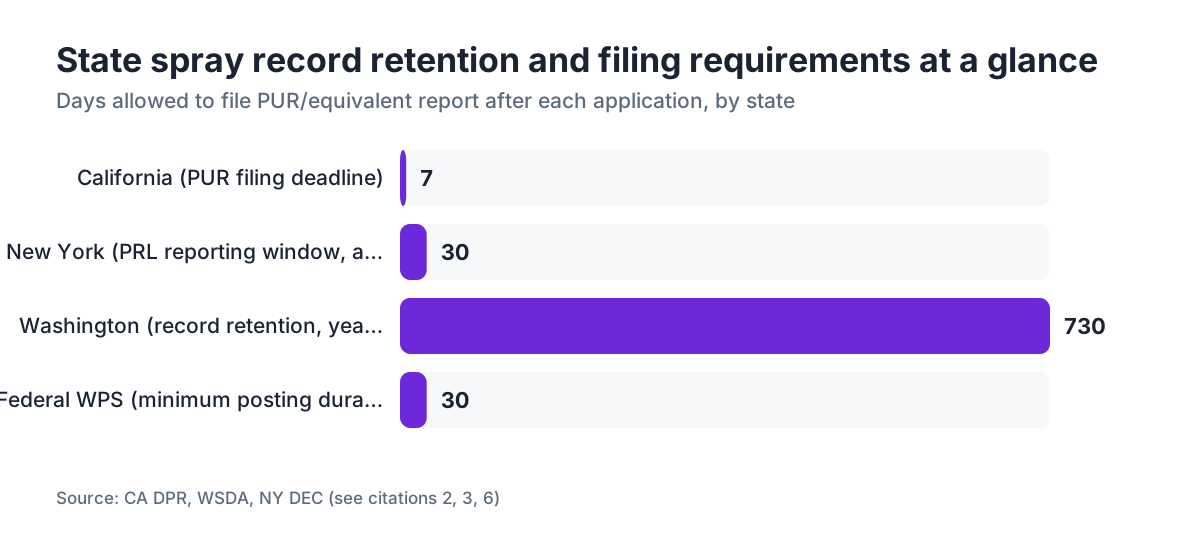
California requires every pesticide application in a commercial agricultural setting to be reported to the county agricultural commissioner within seven days [2]. The report carries fields beyond WPS minimums: county, township and range or GPS coordinates, and the operator's permit number. California also requires a Qualified Applicator License or Certificate for most vineyard pesticides, and that license number goes on the record.
Washington requires pesticide application records to be kept for two years and made available to the Washington State Department of Agriculture within 72 hours of a request [3]. WSU Extension publishes training material for agricultural applicators that covers those record-keeping rules in detail [5].
New York works under the state Pesticide Reporting Law (PRL), which requires commercial applicators to report applications, with annual reporting to the Department of Environmental Conservation [6]. Cornell's statewide IPM program has region-specific guidance for New York grape growers on both the PRL and the federal WPS [7].
Operating in a state not listed here? Pull your state Department of Agriculture's pesticide program page before you write the training plan. Oregon, Michigan, and Virginia each carry their own wrinkles.
How do you structure the actual training sessions?
Two to four supervised spray events, plus one focused session at a desk with real forms, is what actually works. Don't just hand someone a blank form and a stack of regulations. That's how you get a person who can fill out a form but has no idea why any of it matters.
Session one is the classroom piece. Sit down with the foreman, current labels for your top five spray products, a blank spray record form, and your state's PUR or equivalent form. Walk through a completed record for a made-up application. Have them find the EPA registration number on a label. Have them calculate total product needed for a specific block acreage. Have them find the REI and PHI. Budget about 90 minutes. This builds the conceptual base that makes everything else click.
Sessions two through four are supervised applications. The foreman fills out the record in the field, during or right after each application, while you watch. Check every field before the record goes in the file. Circle anything missing or wrong. Explain why each field matters, more than that it's required. By the third supervised event, most people are solid.
After training, spot-check one record a week for the first full spray season. Not punitive auditing, just review. Mistakes caught in week six of solo work are small and easy to fix. Mistakes found at an audit eighteen months later are not.
For structured curricula, UC's statewide IPM and pesticide safety resources include training modules on WPS, label reading, and record-keeping, written for the field rather than for lawyers [8].
What does an audit-ready spray record file look like?
An auditor from your county ag commissioner or state department will ask for records going back at least two years in most states, and further if there's an incident. Here's what audit-ready looks like in practice.
Organization. Records filed by date, each month grouped, each year in its own section or binder. Cross-reference them against your block map so an auditor can pull every application to Block 7 across a full season without hunting.
Completeness. Every field filled in. No blanks, no "see above" shortcuts on multi-application records, no records showing only the foreman's initials instead of a full name and license number.
Consistency. Product names match the label and your purchase records exactly. If you bought "Pristine WG" and the label reads "Pristine WG," the record says "Pristine WG," not "Boscalid/Pyraclostrobin" and not "the fungicide we used in block 3." Active ingredients get their own field.
Retention. Federal WPS requires application information available for 30 days post-application at minimum [1]. Most states require two years. Keep them five. Storage costs almost nothing, and the protection against a future liability claim is real.
Digital or paper, either works for most state reporting, but whatever you use has to be backed up. Paper in a filing cabinet dies in a fire. A spreadsheet on one laptop is one drive failure from gone. Above 50 acres, a purpose-built record system saves real time at audit season. VitiScribe is one option built for vineyard compliance records, with fields mapped to state PUR requirements.
What are the most common spray record mistakes new foremen make?
In rough order of how often they show up in California PUR compliance reviews and WPS inspections:
Missing or wrong REI. The REI on the record doesn't match the current label, usually because someone copied last year's number after the label changed. Train the foreman to pull the REI straight off the label for every application, never from memory.
Blank weather fields. Wind speed at application time is left empty because nobody checked, or checked an hour before spraying started. Require a weather log at spray start and spray end.
Vague location. "West block" instead of a permanent ID. If your vineyard has no consistent block naming and mapping system, fix that before you train anyone on record-keeping. Records are only as good as the location references behind them.
Missed filing deadlines. California's seven-day PUR deadline is the one most often blown. New York's PRL reporting is more forgiving but still slips when records pile up. Build the filing step into the end-of-spray routine, not a separate weekly chore.
Licensed applicator not listed. Where a QAL or QAC is required, that license number has to appear. If the foreman isn't the licensed applicator, the supervising licensee's information goes on the record.
Records filled the next day. A record completed from memory the morning after is less accurate and more error-prone. Require the record done before the sprayer gets cleaned and put away.
How does the EPA Worker Protection Standard training requirement connect to spray records?
WPS training and spray record-keeping are separate obligations, but they connect in ways that matter for your foreman.
Under the 2015 revised WPS (40 CFR Part 170), all agricultural workers and pesticide handlers must receive WPS safety training. Handlers, which includes anyone applying pesticides, have to be trained before they perform handler tasks [12]. Training must cover set topics: pesticide safety, WPS protections, the rights of workers and handlers, and how to reach application and safety information.
Your foreman almost certainly counts as a handler. They need training before their first application, and that training needs documentation. Keep training records next to your spray records. An auditor who finds thorough spray records but no handler training paperwork will flag the hole.
The 2015 revision, effective January 2017, also tightened central posting. Application information must be posted when the application starts and stay up for 30 days or until the REI expires, whichever comes later [12]. Workers have to be able to reach it without asking a supervisor. If your foreman posts a spray record at the shed or main shop, they need to understand that timing.
WSU Extension has a clear explainer on how the 2015 revision changed record-keeping and posting for Washington producers, and most of it carries over to any state [5].
How should you handle records when a licensed applicator isn't the one doing the spraying?
This comes up constantly in smaller operations where the foreman holds a trained handler certification but not a full Qualified Applicator License (QAL) or Qualified Applicator Certificate (QAC). The rules turn on the state and the pesticide type.
In California, restricted-use pesticides (RUPs) must be applied by, or under the direct supervision of, a licensed QAL or QAC holder [2]. "Direct supervision" has a legal definition, and it means more than the licensed person being somewhere on the property. The record for an RUP application has to show the licensee's name and certificate number even if they never touched the sprayer.
Train your foreman on which products in your program are RUPs. The federal RUP list is searchable, and California's DPR keeps its own list that includes some products not on the federal one [2]. For every RUP application, the foreman needs to know whose license number goes on the form, and that person needs to have been available and supervising.
For non-RUP products the rules loosen, but the record still has to name whoever performed the application. If the foreman did it, their name and any applicable certification number goes down.
A clean paper trail here protects the foreman and the operation both. If something goes wrong, an inaccurate record about who applied what under whose supervision is far worse than the underlying incident.
What training resources actually exist for vineyard spray record compliance?
Here's what's genuinely worth pointing a new foreman toward, ranked by usefulness in the vineyard context.
UC Statewide IPM and Pesticide Safety resources. Worker protection training material, label-reading guides, and pesticide use reporting resources built for California. Free, well-written, updated when the law moves. County ag commissioners lean on them constantly [8].
WSU Extension Pesticide Education. Training curricula for handlers and applicators in Washington, including record-keeping. The core manuals cover both federal WPS and Washington-specific rules [5].
Cornell statewide IPM program. Grape-specific IPM and pesticide guides for New York growers, including how to comply with the Pesticide Reporting Law. Written for practitioners, not regulators [7].
EPA WPS page. Current regulation text, the 2015 rule summary, and downloadable training material. Not as field-friendly as the extension stuff, but authoritative and free [1].
State Department of Agriculture pages. Every state has a pesticide program page. They're not always easy to move around in, but they hold the official forms, current deadlines, and RUP list links.
For a vineyard with multiple foremen or high crew turnover, look at a formal pesticide handler training program. Some county farm bureaus and ag commissioner offices run these as day-long sessions with a certificate at the end. The certificate doesn't replace your internal training, but it gives the foreman a credential and gives you proof training happened.
For the record infrastructure itself, VitiScribe is built to match California PUR fields, WPS posting rules, and the common record fields other states use, which cuts setup time for a foreman learning your system.
How do you build spray record habits that stick all season long?
Training in February doesn't guarantee good records in September. The habits that hold all season come from structure, not memory.
The form travels with the sprayer. Not in the office. On a clipboard in the tractor cab or the ATV. If the form is physically present at the point of application, the foreman fills it out at the application. If it lives back at the office, it gets filled out later, from memory, badly.
Make the completed record a prerequisite for the next task. Spray's done. Before the equipment gets washed, the record gets completed and signed. That's a management habit, not a compliance policy. It needs no enforcement if it's simply how your operation runs.
Weekly review during spray season. Fifteen minutes, once a week. Pull the week's records, flip through, flag anything incomplete. Not to punish, just to catch the drift before it hardens into a pattern. Most people fix a small error the second it's pointed out.
For operations on electronic records, a system that blocks saving until every mandatory field is filled kills most blank-field errors by design. The software does the enforcing so the manager doesn't have to.
At season's end, run a full-year review. Confirm every application has a record. Confirm PUR or equivalent filings went in. Confirm the file is organized and backed up. That annual pass is also when you update next year's training based on what actually broke.
Frequently asked questions
How long do I need to keep vineyard spray records?
Federal WPS requires application information posted and available for at least 30 days post-application. Most states require records kept for two years. California PUR records should be kept at least three years given the state audit cycle. As a practical matter, keeping spray records five years costs almost nothing and sharply reduces liability exposure if a neighbor, worker, or regulatory dispute surfaces years later.
Does every pesticide application require a spray record, or just restricted-use products?
Every commercial pesticide application in an agricultural setting requires documentation, more than restricted-use products. The EPA WPS central posting requirement applies to all pesticide applications on agricultural establishments. State PUR systems like California's require reporting of both restricted-use and general-use applications. No category of vineyard pesticide application is entirely exempt from record-keeping.
What happens if a foreman makes an error on a spray record?
Correct it promptly with a single line through the error, the correct information, and the foreman's initials and date. Never white out or delete a field on an official record. If a state PUR or equivalent report was already filed with the error, contact your county ag commissioner or state agency to file an amended report. Most agencies treat corrected reports as routine; they treat missing reports or apparent cover-ups as enforcement matters.
Can a foreman without a pesticide applicator license sign spray records?
It depends on what was applied and which state you're in. For restricted-use pesticides in California, the licensed QAL or QAC holder must be named on the record as the responsible party, even if they didn't operate the equipment. For general-use pesticides, an unlicensed foreman who applied the product can sign the record and should be listed as the applicator. Check your state's specific requirements with your county agricultural commissioner.
What's the fine for a late or missing California Pesticide Use Report?
California's DPR can assess civil penalties up to $5,000 per violation for pesticide law violations, which includes PUR reporting failures. County agricultural commissioners issue the initial citations. Repeat violations carry higher penalties. The seven-day filing deadline after each application is strict, with no grace period written into the statute, though first-time violations sometimes result in a notice of correction rather than an immediate fine for operators with otherwise clean records.
How does the WPS central posting requirement work for spray records?
Under 40 CFR 170.309, after each application you post specific information at a location all workers can reach: product name, EPA registration number, active ingredients, location of treated area, date and time of application, and the REI. The posting goes up before the application starts and stays up 30 days or until the REI ends, whichever is later. Workers cannot be required to ask a supervisor to see it.
Should spray records be kept in paper or digital format?
Both are legally acceptable in most states, but digital records with automatic backups hold up better long-term. Paper records are vulnerable to fire, water, and misplacement. If you go digital, confirm your state accepts electronic format for any required submissions, and keep a backup outside your main location. Some states, including New York under the Pesticide Reporting Law, require electronic filing, which effectively mandates a digital system.
What weather information must be recorded at the time of a spray application?
Requirements vary by state, but best practice, and the standard in California PUR reporting, is to record wind speed, wind direction, temperature, and relative humidity at application time. Some states require noting whether conditions met the label's application restrictions. Record weather at the start and end of the application, since conditions shift during a long spray event, and those changes matter for both compliance and drift liability.
How does a new foreman learn to read a pesticide label correctly?
Start with UC's pesticide safety label-reading material, which walks through label sections in order: product name, EPA registration number, signal word, active ingredients, directions for use, crops and sites, application rates, REI, PHI, and environmental precautions. Have the foreman locate each field on three or four actual labels from your program before you consider them label-literate. Labels are legal documents, so reading them accurately is not optional.
How often should I review my foreman's spray records after training?
Weekly during the active spray season for the first full year. After that, monthly review during spray season is enough if the first year's records were consistently accurate. Always run a full-year review at season's end to confirm completeness and that all required state reports were filed. Spot-checking isn't about distrust; it's about catching format drift before it becomes an enforcement issue.
What's the difference between a spray record and a pesticide use report?
A spray record is your internal documentation of each application, kept on the farm. A Pesticide Use Report (PUR) is the copy filed with your county or state agency, required in California and some other states. The PUR pulls its data from your spray record. In California, the two must be consistent. Your internal record should hold at least every field the PUR requires, plus any extra detail your operation wants for its own management.
Does drone application require any different spray record fields?
Yes, in most states. Drone (UAS) pesticide applications typically require noting the application method as "unmanned aircraft," and some states require additional operator certification. California DPR has issued guidance on UAS pesticide applications requiring both the drone operator's certificate and any applicable FAA Part 107 license to appear in records. Check your state's current UAS pesticide guidance, since this area has moved quickly in the past few years.
What should be included in spray record training for a foreman managing multiple blocks?
Multi-block operations add the challenge of consistent location identification. Train the foreman to use permanent, documented block IDs that match your vineyard map, never informal names. For each application, a separate record line (or a separate record) per block is cleaner than one record covering several locations with different acreages. When an auditor needs to reconstruct all applications to one block, a well-labeled block-by-block system cuts hours off the review.
Sources
- U.S. EPA, Worker Protection Standard (40 CFR Part 170): WPS requires application information including product name, EPA registration number, active ingredients, location, date/time, and REI to be posted at a central location; information must remain posted for 30 days or until REI expires
- California Department of Pesticide Regulation: California requires all commercial pesticide applications to be reported to the county agricultural commissioner within seven days of each application; restricted-use pesticides require a licensed QAL or QAC
- Washington State Department of Agriculture: Washington state requires pesticide application records to be kept for two years and made available to WSDA within 72 hours of a request
- U.S. EPA, Federal Insecticide, Fungicide, and Rodenticide Act (FIFRA): EPA states the pesticide label is a legal document and that applying a pesticide inconsistently with the label is a violation of FIFRA
- Washington State University Extension: WSU Extension publishes training curricula for pesticide handlers and applicators covering Washington-specific record-keeping requirements and the 2015 WPS revision
- New York State Department of Environmental Conservation: New York's Pesticide Reporting Law requires commercial applicators to report pesticide applications, with annual reporting to the DEC
- Cornell University, New York State Integrated Pest Management Program: Cornell's statewide IPM program publishes grape-specific IPM and pesticide application guides for New York grape growers including PRL compliance guidance
- University of California, Statewide Integrated Pest Management Program: UC's statewide IPM and pesticide safety program publishes worker protection training materials, label reading guides, and pesticide use reporting resources used by California county agricultural commissioners
- U.S. EPA, Pesticide Registration: EPA registration numbers appear on all registered pesticide labels and must be recorded in spray records
- California Department of Pesticide Regulation, Enforcement: California DPR can assess civil penalties of up to $5,000 per violation for pesticide law violations including PUR reporting failures
- University of California, Statewide Integrated Pest Management Program, pesticide use reporting resources: UC's statewide IPM program has published pesticide use reporting resources walking through the California PUR form field by field for agricultural operators
- U.S. EPA, Agricultural Worker Protection Standard (2015 revised rule): The 2015 revised WPS, effective January 2017, requires handlers to be trained before performing handler tasks and tightened the central posting requirement
Last updated 2026-07-11