How to transfer handwritten spray logs to digital vineyard software

TL;DR
- Gather every handwritten log, map each field to your software's required columns (product, rate, REI, PHI, applicator, target pest, weather), enter records chronologically by block, and reconcile totals against your pesticide purchase receipts.
- The EPA Worker Protection Standard and most state ag departments require spray records for at least two years, so accuracy matters from the first entry.
Why bother moving paper spray records to digital at all?
Paper works until it doesn't. A coffee stain, a barn fire, a state inspector showing up unannounced, a new hire who can't read your field notes from three seasons ago. Any of those moments makes the case for digital faster than a sales pitch ever could.
The practical upside is real. A searchable record that pulls a worker's exposure history in thirty seconds is much harder to challenge than a folder in a filing cabinet. Once records are digital, the same data does double duty for planning and for compliance.
There's the compliance angle. The EPA Worker Protection Standard (40 CFR Part 170) requires application records be accessible to workers, their designated representatives, and medical personnel on request. Paper in a drawer is technically compliant, but it's slow to produce and easy to dispute [2].
Then there's operational value. Digital data lets you spot patterns: which blocks consume the most sulfur, whether your Botrytis pressure tracks with morning humidity, whether your spray intervals are drifting longer than the label allows. None of that analysis is practical with paper. That's the quiet payoff nobody puts in the brochure.
What data fields do you actually need to capture from a handwritten log?
Here's where most people trip. They transcribe what they wrote down, which is often incomplete, instead of what the record legally has to contain.
For EPA WPS compliance and most state rules, a complete spray record includes the date and time of application, the specific field or block (a defined location, more than "the cab block"), the crop, the pest or disease target, the full pesticide product name and EPA registration number, the application rate per acre, the total amount applied, the total area treated, the application method and equipment, the applicator's name (and certification number if the product requires a licensed applicator), the pre-harvest interval (PHI) in days, the restricted entry interval (REI) in hours, and weather conditions at application (wind speed, temperature, and direction are the minimum) [2].
Plenty of handwritten logs miss the EPA registration number, the weather readings, or both. Before you transcribe, pull your product labels or the EPA's label database to fill those gaps. Missing an EPA reg number in your digital record is the same problem as missing it on paper.
| Required field | Commonly missing on paper logs | Where to find it if missing |
|---|---|---|
| EPA Registration Number | Often | Product label or EPA label database |
| REI (hours) | Sometimes | Product label |
| PHI (days) | Sometimes | Product label |
| Applicator cert. number | Often (for RUPs) | Your own license records |
| Wind speed/direction | Frequently | Weather station records, NOAA archive |
| Total acres treated | Sometimes | Block map or GIS file |
| Application equipment | Often | Equipment log or invoice |
If weather data is genuinely unrecoverable for a past application, say so in a remarks field. An honest "weather data not recorded; not recoverable" beats a blank or an estimate dressed up as fact.
How do you prepare your paper records before you start entering data?
Don't start typing until you've done three things. Sort, audit, and fill gaps.
Sort chronologically by block, not by applicator or product. Most state audit requests and most operational questions come block-first, so organizing around blocks from the start saves you from re-sorting later.
Audit each page for legibility and completeness before you transcribe. Flag every field that's blank, illegible, or ambiguous. If you transcribe a rate you can't read and guess, you've just introduced a compliance error that didn't exist on the paper. Better to flag it now.
Fill gaps from primary sources. Product labels give you REI, PHI, and EPA reg numbers. NOAA's Climate Data Online portal [3] pulls historical weather for your station going back years. Your pesticide dealer or cooperative invoices confirm quantities purchased, which lets you cross-check total-applied figures. WSU Extension's pesticide safety program recommends reconciling application records against purchase records as a quality control step [4].
Then batch by season or crop year. Most software lets you import or enter records year by year, and auditors almost always review by season.
What's the best method for transcribing: manual entry, OCR, or photo capture?
The right answer depends on how many records you have and how consistently they were written.
Manual entry is the most reliable for accuracy. For a small operation with one to three spray events a week across a single season, it's entirely practical. A single season of 40 to 60 records takes one person four to six hours to transcribe accurately if the forms were filled out well. That's a realistic Saturday morning.
OCR (optical character recognition) tools, including apps like Adobe Scan, Microsoft Lens, or specialized agriculture products, work when handwriting is consistent and forms are structured. For scrawled notes on torn field paper, accuracy drops fast. One independent comparison of OCR tools against agricultural handwritten forms found error rates between 8 and 22 percent depending on handwriting quality, which means you'd verify every record anyway [5]. Use OCR to get a draft, not a finished record.
Photo capture with indexing is the middle path. Photograph every page, attach the image to the record in your software, and enter the data by hand from the photo. This gives you an audit trail showing the original document, which some inspectors like. It also protects you if the paper gets damaged later.
For large backlogs (multiple seasons across dozens of blocks), a data entry service familiar with agricultural records can process forms for roughly $0.50 to $2.00 per record depending on complexity. Not cheap. But for a 500-record backlog, it often beats the opportunity cost of your own time.
Whatever method you pick, build in a verification step. Have someone other than the original transcriber spot-check 10 to 15 percent of entries against the source documents.
How do you map your old paper fields to your software's data structure?
Every software product organizes spray records differently. Some treat a "spray event" as the top-level record tied to a specific block. Others use a "product application" as the unit, meaning one spray event across five blocks creates five records. Understand your software's data model before you enter a single record, or you'll end up with duplicate or missing data.
Print or screenshot your software's new-entry form and lay it next to your paper log. For each field on the screen, find the matching field on the paper. Where paper fields don't map cleanly, use the remarks or notes field instead of forcing a square peg into a round hole.
Common mismatches:
Your paper says "rate: 2 lbs/ac" but your software wants a volume rate and total product used. You calculate both from your application records.
Your paper records one row for a tank mix, but your software creates one record per product. Split each tank mix into multiple records, one per active ingredient, all tied to the same spray event date and block.
Your paper uses informal names ("the old Zin block," "the creek road") but your software wants unique block IDs. Build a translation table mapping every informal name to a formal block ID before you start.
UC Davis viticulture record-keeping resources make the point that consistent, unique block identifiers are the single most important structural decision in digitizing vineyard records [6]. Get that right first.
How long do spray records need to be kept, and what format is acceptable?
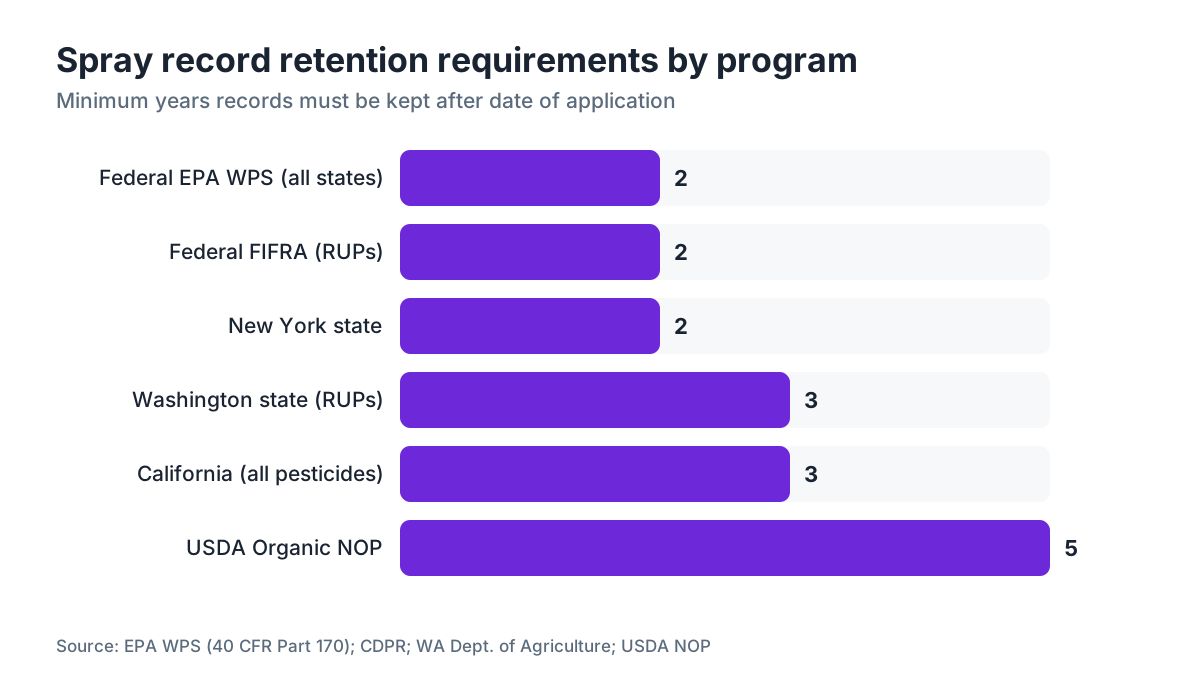
The federal baseline under EPA WPS is two years from the date of application [2]. That's the floor. Several states require longer.
California requires pesticide use records be retained for three years under the California Food and Agricultural Code Section 12980 [7]. New York requires two years. Washington requires two years for most applications but three years for restricted-use pesticides [8]. If you're certified organic, the USDA National Organic Program requires five years of records [9]. Check your specific state ag department, because the federal floor is often not enough.
Format: EPA WPS does not require a specific one. Paper and digital records are both acceptable. What matters is that the record is legible, complete, and accessible within 30 days of an inspector's request (immediately for emergency medical personnel) [2]. Digital records in a cloud system with a backup are arguably faster to produce than paper in a cabinet.
One practical note. Export or print a PDF archive of each season's records after harvest and store it separate from your primary software (local drive, external hard drive, a different cloud service). Software companies go out of business and data migrations corrupt records. Your own archive is your safety net.
What are the most common transcription errors and how do you avoid them?
Rate entry mistakes top the list. Confusing fl oz/acre with oz/acre, or mixing per-gallon rates with per-acre rates, is easy when you're moving fast, and it produces records that look plausible but are flat wrong. Always store the unit alongside the number, never the number alone.
Date errors are more common than people expect. Handwritten logs sometimes swap the spray date and the log date, especially when someone wrote it up the next morning. Cross-reference with field calendars or crew timesheets where you can.
Product name variations wreck searchability downstream. "Rally 40W," "Rally," and "myclobutanil" might all show up in your paper for the same product. Pick one canonical name format (usually the full product name matching the label) and use it every time.
Block boundaries shift over time. A "north block" in 2018 might have been replanted and split in two by 2021. Make sure historical records reference the boundaries as they were at the time, not as they are now. Add a note when a block's boundaries or name changed.
Then rounding. If your paper says "used about half the tank," that's not a recordable quantity. Go back to your tank calibration records or purchase history for an actual number. A rounded estimate beats nothing, but label it as an estimate in remarks.
How do you handle spray records for restricted-use pesticides (RUPs)?
Restricted-use pesticides require certified applicators in every state and carry record-keeping rules beyond the standard WPS fields.
For RUPs, federal rules under FIFRA Section 11 require the certified applicator or their employer keep records for two years that include the product name, EPA registration number, total amount applied, unit treated, location of application, month and year of application, and the name and certification number of the certified applicator [10]. Most state programs demand more than the federal minimum.
When transcribing RUP records from paper to digital, confirm your software has a field for the applicator's certification number, more than their name. If it doesn't, use the remarks field and document it clearly. Some states flag an RUP record as incomplete if the certification number is missing, even when the applicator's name is there.
Keep a separate log of applicator certification expiration dates linked to your spray records. If an RUP was applied by someone whose certification had lapsed, that's a problem you want to catch before an inspector does.
Can you import data in bulk, or does everything need to be typed individually?
Most major vineyard record-keeping platforms accept CSV imports. If yours does, that's the fastest path for a large backlog.
The workflow: build a master spreadsheet in Excel or Google Sheets with column headers matching your software's import template exactly (download that template from your software's help documentation before you build the spreadsheet). Enter all your paper records into the spreadsheet with consistent formatting for dates, rates, and product names. Validate the data in the spreadsheet before you import. Then import and spot-check.
A platform like VitiScribe is one example built for vineyard compliance records that supports CSV import with field-level validation, which catches formatting errors before they reach your database. Whatever platform you use, read the import documentation closely. A misformatted date column often imports silently and lands as a blank, which is worse than an import error because it's hard to spot later.
If your software doesn't support bulk import, you're entering records one at a time. Work in batches of 20 to 30 per session instead of powering through a full season in one sitting. Error rates climb fast after about two hours of data entry.
How do you verify your digital records are complete and accurate after entry?
Run a reconciliation check before you file your paper originals. Compare total product used in your digital records against your pesticide purchase invoices. If you bought 20 gallons of Pristine and your records show 22 gallons applied, either a record is wrong or you borrowed product from another source that wasn't logged. Find the discrepancy before an auditor does.
Run a block coverage check. Every block you sprayed this season should appear in your digital records. Pull a list of blocks from your block map and cross-reference it against your spray event list. Missing blocks usually mean missing records.
Check PHI compliance automatically if your software supports it. Most platforms flag any application where the PHI would run past your expected harvest date for that block. If a flag pops, go back to the paper and confirm whether a late application really happened or whether a date was keyed wrong.
Print or export one complete season and physically compare 10 to 15 random entries against the paper originals. This manual spot-check catches systematic errors that automated validation misses, like a rate column that's consistently off by a factor of ten.
Store verified paper originals separate from your digital system. Some operations scan and attach the original page to the digital record as a PDF. That's good practice and costs almost nothing in storage.
What should your ongoing workflow look like so you never have a paper backlog again?
The answer is disappointingly simple. Enter spray records within 24 hours of application, every time. That one habit eliminates backlogs.
Why 24 hours matters: weather data, applicator recall, and equipment readings are all still fresh. A record filled out a week later is reconstructed history, not a record. WSU Extension's pesticide safety program identifies delayed record entry as the most common source of errors in agricultural spray records [4].
In practice, whoever runs the sprayer fills out a paper field sheet during or right after the application, and someone enters it digitally that evening or the next morning. For a one-person operation doing both jobs, a mobile-friendly entry interface helps. Field apps that sync to your central database once you're back in Wi-Fi range earn their monthly cost just by killing the transcription lag.
When multiple applicators spray the same blocks on the same day with different products (common during powdery mildew pressure peaks in mid-summer), set up a numbering system for spray events so you can link related records. Something as simple as a date-block code (for example, 20240712-N1 for the north block on July 12, 2024) keeps two people from creating duplicate or conflicting records for the same event.
You can read more about general vineyard record-keeping to see how spray records fit the broader operation.
How do California, Washington, and New York spray record requirements differ?
These three states hold the majority of US wine grape acreage, and their rules diverge enough that the specifics are worth knowing.
California is the most demanding. Under California Food and Agricultural Code Section 12980 and the California Department of Pesticide Regulation's rules, all commercial pesticide applications must be reported monthly to the county agricultural commissioner via a Pesticide Use Report (PUR). The application record itself must be created within 24 hours and retained for three years. California also requires licensed pest control advisers (PCAs) for certain recommendation functions other states don't regulate [7].
Washington requires pesticide use records for two years for most applications, three years for restricted-use pesticides. Records must include all WPS-required fields plus the Washington pesticide license number of the applicator if a license is required for the product [8]. The Washington State Department of Agriculture runs one of the more active spray-record inspection programs in the country, so completeness matters.
New York requires two years' retention under state DEC regulations, and commercial applicators must file annual reports with the DEC. Cornell's integrated pest management program publishes a free spray record template that meets New York requirements and works as a starting point even in other states [1].
If you operate across state lines, or if any of your fruit is sold to wineries in a different state, ask your state department of agriculture directly. Requirements for custom-crush arrangements and contract farming get complicated fast.
Frequently asked questions
How far back do I need to digitize my old handwritten spray logs?
At minimum, go back as far as your retention requirement: two years federally under EPA WPS, three years in California, five years for certified organic operations under USDA NOP. For operational value (spotting pest pressure patterns, comparing product performance across seasons), four to five years of history is where the data gets genuinely useful. Anything older than your retention window is optional, but worth digitizing if the paper is deteriorating.
What happens if an inspector finds gaps or errors in my digital spray records?
Consequences depend on the error type and your state. An incomplete record (missing REI, blank applicator name) usually draws a warning on a first inspection. A missing application an inspector can prove occurred through purchase receipts or worker interviews gets treated as falsification, which is far more serious. In California, incomplete pesticide use reports can trigger fines starting at $500 per violation. Consistent gaps read as non-compliance, more than sloppy paperwork.
Do I need to keep the original paper logs after I've digitized everything?
Check with your state ag department, but generally yes, keep the paper originals at least through your retention period. Federal EPA WPS doesn't specify a format, but several states haven't formally accepted digital-only records as equivalent to originals. Scan the originals, attach them to your digital records, and store the paper somewhere dry and organized. Once the retention period expires for a given season, you can safely discard that year's paper.
Can I use a spreadsheet instead of dedicated vineyard software for digital spray records?
Yes. A well-structured spreadsheet is legally compliant in most states, since EPA WPS doesn't require specific software. A spreadsheet works fine for small operations with simple spray programs. The disadvantages show up at scale: no automatic PHI/REI flagging, no block-level reporting, harder to share with consultants or inspectors, and more vulnerable to accidental edits. Past about 25 acres or 50 spray events per season, purpose-built software earns its cost.
What's the fastest way to catch up on a multi-year paper backlog?
Build a master CSV spreadsheet matching your software's import template and enter all records there before importing. Batch by season, work in two-hour sessions to keep error rates low, and prioritize the most recent two years since those are the ones inspectors and auditors are most likely to review. For backlogs over 200 records, a data entry service familiar with agricultural forms can process records for $0.50 to $2.00 each, often faster and cheaper than your own time.
How do I handle tank mixes in digital spray software when the paper shows one entry for multiple products?
Most vineyard software treats each product as a separate record tied to a shared spray event. Split the paper tank mix entry into one digital record per product, keeping the same date, block, applicator, and weather data for each. The software links them by spray event. If yours has no tank-mix linking feature, use a shared event code in remarks. Never combine two active ingredients into one product field; it breaks PHI/REI compliance checking.
What weather data is required in a spray record, and what if I didn't record it at the time?
EPA WPS doesn't specify required weather fields, but most state programs require wind speed and direction at minimum, with temperature also expected. If you didn't record it, NOAA's Climate Data Online tool provides hourly historical weather going back decades for most regional stations. Retrieve the closest station's data for the application date and time, note it as reconstructed from NOAA records in your remarks field, and include the station ID.
Do organic vineyards have different spray record-keeping requirements?
Yes. USDA National Organic Program regulations require certified organic operations keep all records demonstrating compliance with organic standards for five years, longer than the standard two-year EPA WPS requirement. That includes spray records showing only approved inputs were applied. Your certifying agent may have extra format requirements. UC Davis organic viticulture resources cover this in detail and are worth reviewing before your next certification renewal.
Is there a free spray record template I can use before committing to software?
Cornell Cooperative Extension publishes a free spray record template designed to meet New York and federal requirements, available through its IPM program. UC Davis Cooperative Extension and WSU Extension also publish free record-keeping templates for their states. These are solid starting points and cover the required fields for most states. After a season or two using one, you'll have a clear sense of what a paid platform would add.
How do I make spray records accessible to workers and their representatives as required by EPA WPS?
EPA WPS requires that pesticide application and hazard information be available to workers within 30 days of a request, and to medical personnel immediately in an emergency. Digital records make this easy: you can generate a report for a specific worker, date range, or block in seconds. For paper, you'd have to locate and photocopy specific entries. Either format is compliant, but digital records are far easier to produce quickly under pressure.
What's the EPA registration number and where do I find it if it's not on my paper log?
The EPA registration number is a unique identifier on every federally registered pesticide label, formatted as two numbers separated by a hyphen (for example, 62719-396). It's on the front panel of the product container and on every label version in the EPA's label database. If you have the product name and manufacturer, you can look up the number there. It's a required field in most spray records and commonly missing from handwritten logs.
How should I handle spray records for a property I recently purchased with existing vines?
Request all available spray records from the previous owner as part of your purchase due diligence. Digitize whatever you receive, noting that the pre-purchase records came from the prior operator. Your legal retention obligation starts at your date of ownership for new applications, but the prior history matters for organic transition periods (typically three years from last prohibited substance use) and for reading block-level pest pressure history.
What's the difference between a spray record and a pesticide use report in California?
In California, a spray record is the on-site application record you create within 24 hours, kept for three years. A pesticide use report (PUR) is the monthly summary you submit to your county agricultural commissioner by the 10th of the following month, covering all commercial applications made the prior month. Both are required. Your digital spray records are the source data for generating each monthly PUR. The California Department of Pesticide Regulation maintains the PUR database and publishes county-level summaries annually.
Sources
- Cornell Cooperative Extension, New York State Integrated Pest Management Program: Cornell Cooperative Extension publishes free spray record templates meeting New York and federal requirements through its Integrated Pest Management program.
- EPA, Worker Protection Standard for agricultural pesticides (40 CFR Part 170): EPA WPS requires pesticide application records be accessible to workers, their representatives, and medical personnel; records must be retained for two years from date of application.
- NOAA National Centers for Environmental Information, Climate Data Online: NOAA Climate Data Online provides historical hourly weather records for regional stations, usable to reconstruct missing weather data in spray records.
- Washington State University, Pesticide Safety Education Program: WSU Extension recommends reconciling application records against pesticide purchase records as a quality control step, and identifies delayed record entry as the most common source of errors in agricultural spray records.
- Journal of the ASABE (American Society of Agricultural and Biological Engineers), OCR accuracy in agricultural documents: An independent comparison of OCR tools against agricultural handwritten forms found error rates between 8 and 22 percent depending on handwriting quality.
- University of California Agriculture and Natural Resources, Viticulture: UC Davis Cooperative Extension emphasizes that consistent, unique block identifiers are the single most important structural decision in digitizing vineyard records.
- California Department of Pesticide Regulation, Pesticide Use Reporting: California Food and Agricultural Code Section 12980 requires pesticide use records be retained for three years; commercial applications must be reported monthly to county agricultural commissioners via Pesticide Use Reports.
- Washington State Department of Agriculture, Pesticides: Washington state requires pesticide use records retained for two years for most applications and three years for restricted-use pesticides, with applicator license number required on RUP records.
- USDA Agricultural Marketing Service, National Organic Program: USDA National Organic Program regulations require certified organic operations to keep all compliance records, including spray records, for five years.
- EPA, Federal Insecticide, Fungicide, and Rodenticide Act (FIFRA): FIFRA Section 11 requires certified applicators or their employers to keep RUP application records for two years, including product name, EPA registration number, total amount applied, location, and applicator certification number.
- EPA, Pesticide Registration and label database: Every federally registered pesticide carries an EPA registration number on its label; the EPA maintains a searchable label database for looking up registration numbers by product name.
- New York State Department of Environmental Conservation, Pesticides: New York requires commercial pesticide applicators to retain records for two years and file annual reports with the state DEC.
Last updated 2026-07-11