How to transfer spray record obligations when selling a vineyard mid-season

TL;DR
- When a vineyard sells mid-season, spray records don't transfer with the deed.
- The seller must keep all pesticide application records for at least two years under EPA rules and most state laws.
- The buyer needs copies before the first post-sale application.
- A written record transfer clause in the purchase contract is the only reliable way to close that gap and satisfy both parties.
What spray record obligations does a vineyard seller actually carry?
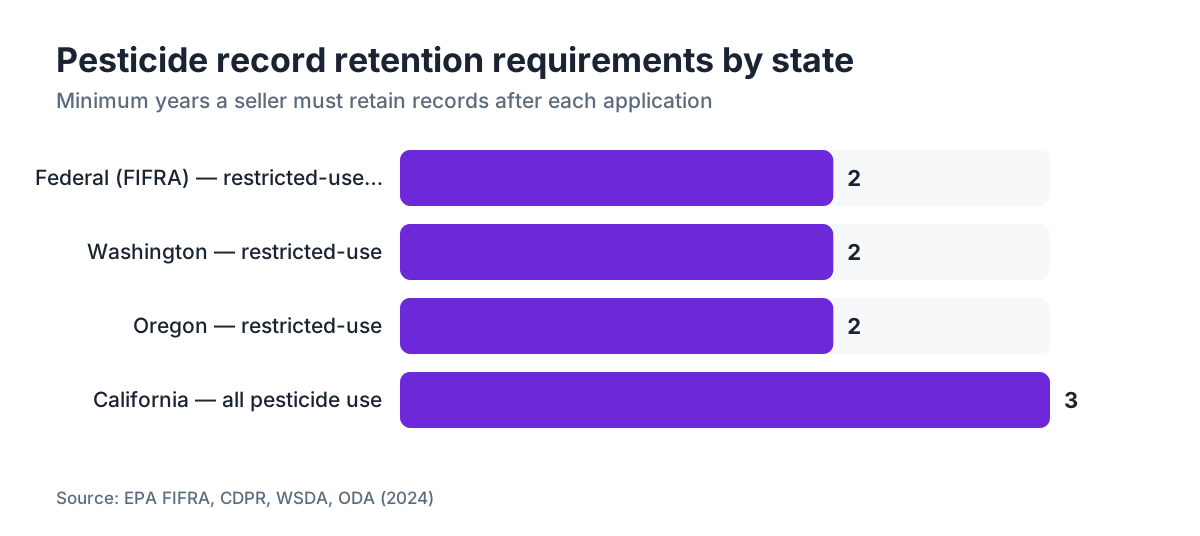
Federal law sets the floor. Under the Federal Insecticide, Fungicide, and Rodenticide Act (FIFRA), any commercial pesticide applicator must keep records of restricted-use pesticide applications for two years from the date of each application [1]. Some states go longer. California requires pesticide use records to be kept for three years and reported monthly to the county agricultural commissioner [2]. That obligation stays with whoever held the Pest Control Business or Qualified Applicator License at the time of application, regardless of who owns the land now.
Spray Mancozeb in June, close escrow in August, and you still own those June records. Selling the property doesn't stop the regulatory clock. You have to produce them if a state inspector shows up, even after the buyer takes possession.
The practical part: organize the whole current season before you enter escrow, not after. Reconstructing application dates, product names, EPA registration numbers, rates, and restricted-entry intervals (REIs) from memory is a bad place to be. In California, penalties for pesticide violations start at $500 and climb, and willful federal violations under FIFRA can reach $25,000 per day [1].
What spray records does the buyer need to receive at closing?
The buyer's exposure is different but just as real. They're taking on a crop with an unknown chemical history unless the seller hands over complete records. Three concrete reasons why that matters.
First, pre-harvest intervals (PHIs). If the seller applied a fungicide with a 14-day PHI on July 15 and the buyer closes July 20, the buyer needs to know harvest can't happen before July 29. Miss that and you're in violation of pesticide label law, a federal offense under FIFRA. The label is the law, full stop [1].
Second, worker protection. The EPA Worker Protection Standard (WPS) under 40 CFR Part 170 requires that workers and handlers have access to application information, including REI dates, before entering treated areas [3]. The buyer's crew cannot legally re-enter a block if an REI from a seller-era application is still running and nobody told them.
Third, residue liability. A buyer who inherits undisclosed spray history and then gets flagged on a residue test at the winery or in an export market faces real commercial and legal trouble. A documented transfer of records is the buyer's first line of defense.
At a minimum, the buyer should receive: all application records for the current season to date, the spray schedule or IPM plan if one exists, a list of materials still under PHI or REI at closing, and copies of any pesticide notices filed with the county or state.
WSU Extension advises that record-transfer terms be written into the purchase and sale agreement rather than handled informally at the closing table [4]. That's good advice. A handshake delivery of a manila folder doesn't create a trail either party can rely on later.
Who is legally liable for spray records after escrow closes?
Liability splits along the application date, not the close date. This is the piece that surprises most first-time vineyard sellers.
The applicator of record on each application is liable for the accuracy of that record and for keeping it. If a licensed pest control adviser (PCA) or a Qualified Applicator made applications while the seller owned the property, those individuals and the seller carry the retention obligation for two to three years, depending on state [2]. The buyer didn't make those applications, so they can't be the applicator of record on them.
The buyer becomes responsible for every application they authorize after close of escrow. That includes anything a PCA or custom applicator does under their direction.
The tricky zone is the period between contract signing and close of escrow, especially if the seller keeps farming under a leaseback or farm management agreement. Spell out in writing who authorizes applications, who maintains the records, and who keeps them. Leave it ambiguous and both parties end up exposed.
Cornell Cooperative Extension notes that in lease situations, pesticide record obligations follow whoever is directing the application, not whoever holds title to the land [5]. That principle fits the pre-close period of a vineyard sale exactly.
What should the purchase agreement say about spray records?
Most standard agricultural purchase agreements say nothing useful about pesticide records. They cover irrigation infrastructure, equipment, and water rights in detail, then drop one generic line about the seller delivering all farm records. Not enough.
Here's what you actually want spelled out:
- A specific delivery deadline for spray records. "Seven days before close of escrow" is practical. "At close" is too late if there are issues to resolve.
- A defined scope. List what's included: application date, product name, EPA registration number, application rate, target pest, method, location (block or APN), and the name and license number of the applicator.
- A seller representation that all applications for the current season are included and that no undocumented restricted-use pesticides have been applied.
- A list of materials still under PHI or REI as of the delivery date, with the calculated clearance dates.
- A seller obligation to keep their copies for the full state-required period, even after delivery to the buyer.
- A contact name for the seller's PCA or farm manager who can answer questions about the records after close.
None of this is exotic. It's the same discipline you'd apply to equipment service records or wine inventory. Spray records are just as material to the value of what's being sold.
How do mid-season spray records affect crop value and winery contracts?
This is where the compliance conversation becomes a money conversation, and buyers often don't see it until they're already in escrow.
Many winery grape purchase agreements require growers to keep and provide, on request, complete pesticide application records for each block [6]. A buyer who closes in August and can't produce records from April through July may be in technical default of the grape contract on day one.
Some wineries, especially those with organic or sustainability certifications, want more. A Certified California Sustainable Winegrowing (CCSW) audit asks for a full season spray record. A gap because records didn't transfer at sale is an audit finding, not an excuse.
For a buyer purchasing a vineyard that supplies grapes under a long-term contract, reading the contract's record-keeping terms before closing is the whole ballgame. If the winery can inspect records back to bud break and the seller won't or can't provide them, that's a negotiating point. Maybe a price adjustment. Maybe a deal issue.
Buyers paying a premium for a vineyard with an established winery relationship should treat spray records as part of the due diligence package alongside the contract itself.
What format do spray records need to be in for a transfer to be valid?
Neither FIFRA nor most state rules prescribe a specific form beyond the data elements required [1]. Records can transfer as paper copies, PDFs, spreadsheets, or exports from a digital system. What matters is that all required fields are present and legible.
FIFRA-required fields for restricted-use pesticide records include: brand name and EPA registration number, total amount applied, location of application, size of area treated, date of application, and the name and certification number of the certified applicator if applicable [1].
California asks for more, including the California registration number (separate from the EPA number), the site ID, the pest(s) treated, and whether the application was under a pest control recommendation (PCR) from a licensed PCA [2]. A full California Pesticide Use Report (PUR) filed with the county is the cleanest thing a California seller can hand over.
For digital records, a PDF or CSV export is fine as long as it captures every required field. If you're using a platform like VitiScribe that logs applications block by block with timestamps and license numbers, a full-season export takes minutes and gives the buyer something clean and auditable.
One practical note: if your records live in a farm management system the buyer won't have access to after close, export before you hand over the keys, not after. Software access doesn't transfer with the property.
What are the state-specific rules sellers should know in California, Washington, and Oregon?
These three states grow most of the wine grapes in the U.S. [7], and each stacks its own requirements on top of the federal baseline.
California: Every pesticide application, restricted-use or not, must be reported to the county agricultural commissioner via a Pesticide Use Report (PUR) within one month of application [2]. The seller must have filed these or be in violation. At sale, the buyer should verify that all monthly reports through the most recent filing deadline are in. The county agricultural commissioner's office can confirm this. Sellers should hand over copies of all filed PURs for the season.
Washington: Washington requires records for restricted-use products to be kept for two years and available for inspection by the Washington State Department of Agriculture [8]. WSDA also enforces the Worker Protection Standard. WSU Extension publishes a record-keeping guide that lists the required data fields and recommends a format you can share with inspectors on short notice [4].
Oregon: The Oregon Department of Agriculture requires restricted-use pesticide records for two years, and commercial applicators must hold an ODA license [9]. Sellers in Oregon should confirm their ODA applicator license is current through the close date and that any custom applicators they hired were licensed at the time of application, because the buyer may be asked to verify this in an audit.
If the vineyard is in a county with extra local pesticide reporting (several California counties have this), the seller should document those separately and flag them for the buyer.
| State | Retention Period | Reporting Frequency | Primary Agency |
|---|---|---|---|
| California | 3 years | Monthly (PUR) | County Ag Commissioner / CDFA |
| Washington | 2 years | On demand / inspection | WSDA |
| Oregon | 2 years | On demand / inspection | ODA |
| Federal (FIFRA) | 2 years | On demand / inspection | EPA / state lead agency |
How does the EPA Worker Protection Standard create obligations during a mid-season transfer?
The EPA Worker Protection Standard (40 CFR Part 170) is one of the most overlooked compliance pieces in a vineyard sale [3]. Under WPS, agricultural employers must post pesticide application information in a central location, train workers annually, provide decontamination supplies, and keep workers and handlers out of areas during restricted-entry intervals.
When a vineyard changes hands mid-season, those WPS obligations pass to the new owner the moment they have workers in the field. No grace period. If a block is still under REI from a seller-era application on the day the buyer's crew walks in to shoot laterals or tie canes, the buyer is the employer of record for WPS purposes and is responsible for making sure that REI was communicated and observed.
That's exactly why the list of active REIs at close of escrow is not optional. It's the document that decides whether the buyer's first week of operations is WPS-compliant.
EPA's central posting requirement states that application information must be posted "before workers or handlers are on the establishment" [3]. That language applies to the new owner's workers just as it did to the seller's.
UC Cooperative Extension publishes WPS compliance materials for California growers that are worth bookmarking for any buyer taking possession of a producing vineyard [10].
What happens if spray records are missing or incomplete at closing?
Missing records at close of escrow create problems on both sides, and the fixes get expensive fast.
For the seller, incomplete records may already be a violation if the application happened and wasn't documented. California fines for pesticide record violations can reach $5,000 per violation for a first offense and go up from there [2]. Finding a gap at closing doesn't erase the underlying violation. It just makes it visible.
For the buyer, the options are limited. You can delay closing until records are produced. You can negotiate a price holdback tied to record delivery. You can accept a seller warranty that the season's applications are as documented, with indemnification in the purchase agreement if that warranty turns out false. None of these feel good if you're already past the normal closing timeline.
The worst outcome is a buyer who closes without records and then gets hit with a winery audit, a state inspection, or a residue violation. Now they're reconstructing what was applied, by whom, and when, with no access to the seller's records and often no cooperation.
Mid-escrow with incomplete seller records? In California, the county agricultural commissioner's office can provide copies of filed Pesticide Use Reports, which at least rebuilds the restricted-use applications. That's a partial fix at best.
The honest answer is that missing records at closing almost always trace back to someone not raising the issue early enough. A well-drafted purchase agreement with a spray record delivery deadline, backed by a real records review, prevents this outright.
How should a vineyard manager document the spray record handoff?
Documenting the handoff matters as much as the records themselves. If there's ever a dispute over what got delivered, or an inspection questions whether the buyer had access to the seller's records, you want a paper trail.
A simple protocol works. Before close of escrow, the seller's PCA or farm manager assembles a complete package: all application records for the season to date, filed PURs (California), a summary sheet listing every material applied by block with PHI clearance dates and remaining REIs, and copies of any product labels for materials still under restriction.
The seller sends this package to the buyer in writing (email with a PDF attachment creates a timestamp). Both parties sign a brief acknowledgment that records for the listed applications were delivered. It doesn't need to be elaborate. A one-page letter listing the date range covered, the number of applications documented, and both names is enough.
The seller keeps their original records separately. Delivery to the buyer doesn't end the seller's retention obligation.
If you're managing records digitally through a platform like VitiScribe, this export and documented delivery is straightforward, because every application already carries a timestamp, a linked product record, and a user log. The audit trail is built in, which is exactly what you want when you hand the file to a new owner.
After close, the buyer's farm manager or PCA should confirm the first new application record is logged under the buyer's name and license. That's the clean line between seller-era and buyer-era records.
What due diligence should buyers do on spray records before making an offer?
Smart buyers look at spray records during due diligence, not at closing. Here's a practical checklist.
Ask for the current season's spray records in the initial information request, alongside the lease, water rights summary, and equipment list. If the seller resists sharing them before an accepted offer, that's information too. It usually means the records are incomplete or were never kept.
Review the records against FIFRA's required fields [1]. Missing application dates, missing EPA registration numbers, or applications with no applicator name are red flags.
Check whether any applied product is under an active cancellation or major restriction. EPA's Pesticide Product Label System lets you look up an EPA registration number and confirm a product's current status [11].
Confirm the applicator named in the records held a valid license at the time of application. In California, look up any licensed pest control operator or PCA through CDPR's license verification [12]. In Washington, WSDA maintains a similar database [8].
If the vineyard supplies a winery under contract, request the spray record provision of that contract and check that the seller's records satisfy it.
Buying property in a new state or AVA you haven't farmed before? UC Cooperative Extension farm advisors in the relevant county can walk you through local requirements and common compliance gaps. That consultation is free and often worth several times what you'd pay a lawyer for the same answer.
Frequently asked questions
Does selling a vineyard mid-season end my obligation to keep spray records?
No. Under FIFRA and most state laws, the obligation to keep pesticide application records stays with the person who authorized or made the applications, no matter who owns the land afterward. California requires three-year retention; federal law requires two years for restricted-use pesticides. Selling the property doesn't start a new clock or move that obligation to the buyer.
Can a buyer refuse to close escrow if spray records aren't delivered?
Yes, if the purchase agreement includes a spray record delivery condition, which it should. Without that language, the buyer's only recourse is general warranties about property condition. Adding a specific spray record delivery requirement with a pre-close deadline and a representation of completeness gives the buyer a clear contractual right to withhold closing if records are missing or deficient.
Who is responsible for WPS compliance during the gap between contract and close?
Whoever is directing workers in the field during that period. If the seller keeps farming under a leaseback or management agreement, they keep WPS obligations for their crew. If the buyer takes possession early, they assume those obligations for their workers. The key document is the list of active restricted-entry intervals at the time of any worker entry, which is why REI disclosure at close is essential.
What federal law governs pesticide record-keeping for vineyard sales?
FIFRA, the Federal Insecticide, Fungicide, and Rodenticide Act (7 U.S.C. 136 et seq.), governs federal requirements. It mandates two-year retention of restricted-use pesticide application records. States can and often do require longer retention or broader reporting. California, Washington, and Oregon each add state-layer requirements on top of the federal baseline.
How far back do spray records need to go for a vineyard sale to satisfy compliance?
For a mid-season sale, the buyer needs all records from the current growing season back to the first application of the year, at minimum. For compliance, the seller must keep records going back two to three years depending on state. The buyer should ask for the full current-season records and confirm filed Pesticide Use Reports (California) or the equivalent cover that period.
Do restricted-entry intervals from the seller's applications bind the buyer's crew?
Yes. REIs are set by the product label, which is federal law under FIFRA. An REI doesn't care who owns the land. If the seller applied a product with a 48-hour REI the day before close, the buyer's crew cannot legally enter that block for 48 hours after the application, regardless of when escrow closed. This is one of the clearest reasons REI disclosure at close is not optional.
What happens if a pre-harvest interval from a seller-era application is violated by the buyer?
The buyer, as the party harvesting, carries primary liability for a PHI violation even if they didn't make the application. FIFRA treats PHI violations as label violations, which are federal offenses. Civil penalties can reach $25,000 per violation per day for commercial applicators. The buyer's recourse is against the seller under whatever representations and indemnification were written into the purchase agreement.
Can a buyer get spray record history from state agencies if the seller won't provide it?
Partially. In California, Pesticide Use Reports filed with the county agricultural commissioner are public records and can be requested, though processing takes time. They cover restricted-use pesticides and report what was applied and where, but may lack block-level detail or applicator notes. This is a backup, not a substitute for direct seller disclosure. Washington and Oregon have thinner public reporting.
What should be included in a spray record transfer checklist at closing?
Application records for the full current season (date, product, EPA registration number, rate, block, applicator name and license number), copies of filed Pesticide Use Reports (California), a summary of materials still under PHI or REI with clearance dates, the name and contact for the seller's PCA, any pesticide-related county notices, and a signed acknowledgment of delivery from both buyer and seller.
Do organic or sustainable certification programs have additional spray record transfer requirements?
Yes, often stricter ones. USDA National Organic Program certified operations must keep records for five years, and organic certification typically requires a complete input record from bud break through harvest for the certification to apply to that year's crop. California Certified Sustainable Winegrowing audits require complete season spray records. Buyers taking over a certified vineyard mid-season should contact the certifying body directly before close to learn what documentation transfers and what needs to be filed.
How do spray records affect grape contract compliance after a vineyard sale?
Many winery purchase agreements require growers to keep complete pesticide records for each block and make them available on request. A buyer who can't produce records from before they owned the vineyard may be in technical default from day one. Review the grape contract's record-keeping requirements during due diligence, not at closing, and make complete spray record delivery a condition of closing if those requirements cover the full growing season.
Is there a standard form for transferring spray records in a vineyard sale?
No federal or state agency publishes a standard transfer form. The transfer usually runs through the purchase agreement's representations and a separate written acknowledgment at closing. UC Cooperative Extension farm advisors can guide you on which fields to include based on your state's requirements. Some agricultural real estate attorneys have developed standard addenda for this purpose.
Who should the buyer contact if they have questions about a seller-era spray record after closing?
The seller's licensed pest control adviser (PCA) or the custom applicator named in the records is the best first contact, since they made the application decisions and hold the underlying documentation. That contact's name and phone number should be part of what transfers at closing. The county agricultural commissioner's office can also answer questions about local requirements and help interpret filed Pesticide Use Reports.
Do spray record obligations apply if the vineyard is sold as part of a larger property or estate?
Yes. Pesticide record obligations attach to the land and the applications made on it, not to how the property is titled or whether it's part of a larger parcel. If vines were treated as part of a commercial farming operation, the records must be kept under FIFRA and applicable state law regardless of how the sale is structured. Buyers of mixed-use or estate properties with vineyard components should specifically address spray records in due diligence.
Sources
- EPA, FIFRA Record-Keeping Requirements for Certified Applicators of Restricted-Use Pesticides: FIFRA requires certified applicators of restricted-use pesticides to retain application records for two years; civil penalties for willful violations can reach $25,000 per day
- California Department of Pesticide Regulation, Pesticide Use Reporting: California requires all pesticide use to be reported monthly to the county agricultural commissioner and records retained for three years
- EPA, Agricultural Worker Protection Standard (40 CFR Part 170): The WPS requires that pesticide application information be posted before workers or handlers enter the agricultural establishment and that REIs be observed
- Washington State University Extension, Pesticide Record-Keeping for Agricultural Producers: WSU Extension recommends pesticide record-transfer terms be written into purchase and sale agreements and records maintained in a format available for inspection on short notice
- Cornell Cooperative Extension, Pesticide Regulations and Record-Keeping for Growers: In lease situations, pesticide record obligations follow whoever is directing the application, not necessarily who holds title to the land
- Wine Institute, California Sustainable Winegrowing Program Guidelines: Many winery purchase agreements and sustainability certification programs require growers to maintain and provide complete pesticide application records for each block upon request
- USDA National Agricultural Statistics Service, Grape Acreage Report: California, Washington, and Oregon account for the vast majority of U.S. wine grape production
- Washington State Department of Agriculture, Pesticide Management Division: Washington requires restricted-use pesticide records to be maintained for two years and available for inspection by WSDA; commercial applicators must be licensed
- Oregon Department of Agriculture, Pesticide Licensing and Compliance: Oregon requires restricted-use pesticide records for two years and commercial applicators must hold a valid ODA license at the time of application
- UC Agriculture and Natural Resources, Worker Protection Standard Resources for California Growers: UC Cooperative Extension publishes WPS compliance guidance for California vineyards including posting requirements and REI protocols
- EPA, Pesticide Product and Label System: EPA's pesticide product database allows lookup of any EPA registration number to verify current product status and registration
- California Department of Pesticide Regulation, License Verification: CDPR maintains a public license lookup for pest control operators and licensed pest control advisers (PCAs) to verify licensure status at time of application
Last updated 2026-07-10