How to use a checklist to verify spray record completeness after each application

TL;DR
- After every pesticide application, run a point-by-point checklist against your spray record before you close out the block.
- The federal Worker Protection Standard and most state ag departments require at least 12 specific data fields per record.
- A checklist built around those fields, checked at the sprayer before you walk away, catches gaps while memory is fresh and keeps you audit-ready year-round.
Why does a post-application checklist matter for spray records?
A spray record is a legal document. Miss a required field and you can face fines, a failed audit, or a suspended license, depending on your state. The EPA Worker Protection Standard (40 CFR Part 170) requires that pesticide application records be kept for two years and be available to inspectors on request [1]. California, Washington, Oregon, and most other wine-grape states layer county-level reporting on top of that federal floor.
Here's the trap. Most missing fields aren't noticed until an auditor asks for them, often months later. By then, nobody remembers the wind speed at 7 a.m. on a Tuesday in April. A checklist, reviewed at the sprayer before you drive back to the shop, fixes this while you still have a thermometer in your hand and the label in the cab.
This isn't about bureaucratic neatness. Incomplete records are the single most common reason vineyards fail compliance inspections in California's county agricultural commissioner system [2]. A two-minute checklist review after each spray run is the cheapest insurance you have.
What fields are legally required on a vineyard pesticide spray record?
The exact list varies by state, but the federal baseline plus California's Department of Pesticide Regulation (DPR) requirements give you a solid working floor. Cornell Cooperative Extension and WSU Extension both publish pesticide record templates that track closely to this list [3][4].
Here are the fields that show up on virtually every state's required list:
| Field | Federal WPS Required | California DPR Required |
|---|---|---|
| Date of application | Yes | Yes |
| Start and end time | No (state varies) | Yes |
| Applicator name and license number | Yes | Yes |
| Pesticide product name | Yes | Yes |
| EPA registration number | Yes | Yes |
| Crop / commodity | Yes | Yes |
| Site / field ID (APN or block name) | Yes | Yes |
| Total acres treated | Yes | Yes |
| Amount of product used | Yes | Yes |
| Dilution / water volume | No | Yes |
| Pest(s) targeted | Yes | Yes |
| Application method / equipment | No | Yes |
| Wind speed and direction | No | Yes |
| Temperature at application | No | Yes |
| REI (re-entry interval) posted | Yes | Yes |
| PHI (pre-harvest interval) noted | No | Recommended |
| Adjuvants used | No | Yes (if any) |
California growers report to their county agricultural commissioner within set deadlines (usually monthly, sometimes within 7 days for restricted materials) [2]. Washington requires commercial applicators to keep pesticide application records for at least 7 years under WAC 16-228 [5]. Know your state's retention window. It runs longer than the federal two-year minimum in several states.
UC Davis IPM notes that applicators must have the product label in their possession or immediately available during application [6]. Build that into your checklist too. A missing label copy is a separate violation from an incomplete record.
How do you build a spray record checklist that actually works in the field?
The best checklist fits on a single page and lives in the sprayer cab. Laminate it. Put a grease pencil on a string next to it. Nobody consults a multi-page document in the rain.
Start with your state's required fields as the backbone. Pull the official form from your state department of agriculture website and map every required field to a checkbox. Then add your own operational fields: equipment calibration date, nozzle type, boom pressure, and tank mix order. Those aren't legally required, but they'll save you the next time a batch fails to perform and you're trying to figure out why.
Format matters. Group fields by when you know them: fields you fill in before the spray run (product, rate, crop, equipment), fields you fill in during (start time, weather, water volume), and fields you confirm after (end time, amount used, applicator sign-off). A three-section layout mirrors how the work actually happens and makes it harder to skip items.
Include a stop-and-check trigger for high-risk conditions. If wind speed is above the label limit (often 10 to 15 mph; check your specific label), the checklist should carry a hard stop line: "Wind > label limit? Do not apply. Record conditions and abort." Building the abort decision into the checklist removes the mental friction that leads to bad-weather applications.
For multi-person crews, add a space for the crew supervisor to counter-sign. A second set of eyes catches more errors, and a signed record carries more weight in a dispute.
When exactly should you run the checklist, before or after the spray?
Both. The checklist has two natural trigger points, and treating them as one is a common mistake.
Before the application, you verify the fields you can know in advance: the product, the EPA reg number, the target pest, the field block, the planned rate. You also confirm the label is in the cab, the REI sign is posted or ready, and you've checked the forecast against the label's environmental conditions.
After the application, you verify the fields that only exist once the spray is done: actual start and end time, actual gallons used, actual wind speed recorded at the field, applicator signature, and any deviations from the planned rate or coverage. This is where most records fall apart. Applicators plan to go back and fill in the actuals later, and then they don't.
The WSU Extension pesticide safety program recommends completing records the same day as the application [4]. If your crew is doing multiple blocks in a day, run the post-application checklist at the end of each block. Not once the whole day is done. Wait that long and the first block's details are already fuzzy.
A laminated card with two columns, "Before" and "After," works well here. Check off the Before column at the tank. Check off the After column when you pull out of the block.
What are the most common spray record errors a checklist catches?
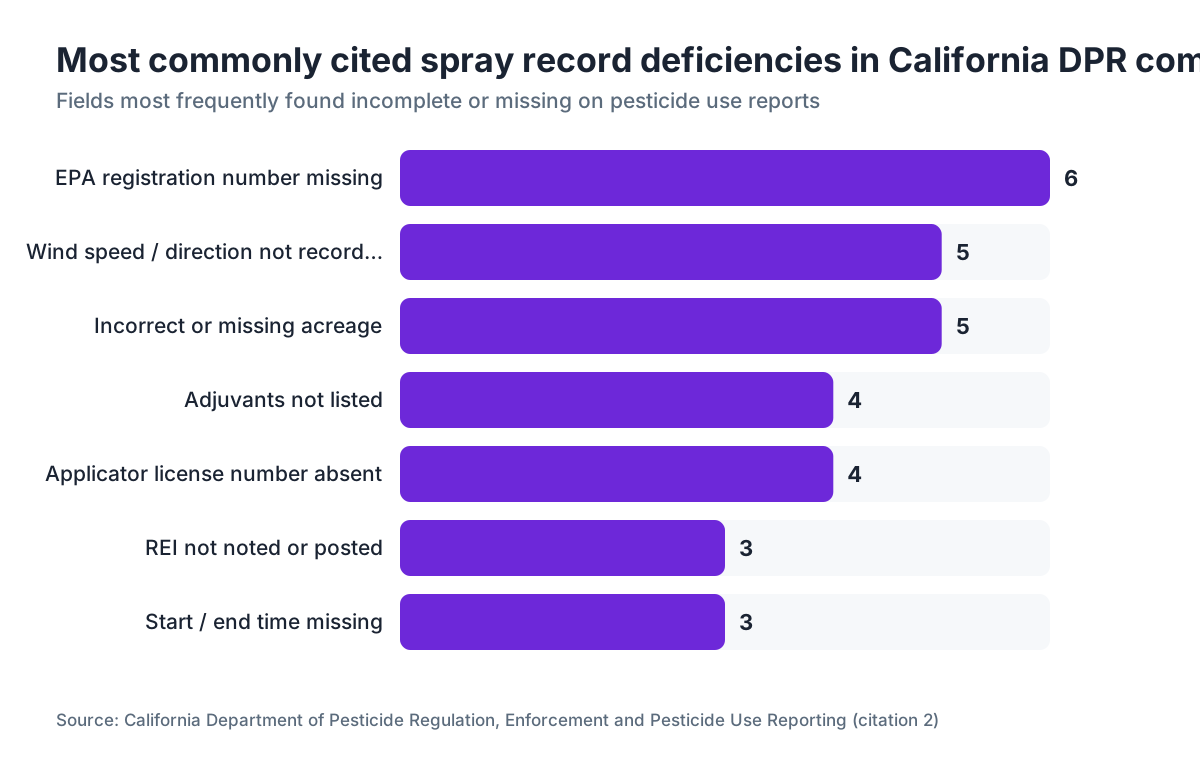
Based on guidance from California DPR compliance summaries and Cornell's pesticide record-keeping training materials, these are the fields most often found blank or wrong [2][3]:
- Missing EPA registration number. Applicators write the product name but not the reg number. These are not interchangeable. Products get reformulated and reg numbers change.
- Wrong acreage. "We did the lower block" is not an acreage. California requires total acres treated, and the number has to match your parcel records or you'll get a mismatch in the commissioner's database.
- No wind speed recorded. Weather data feels optional right up until a drift complaint gets filed. Then it's the first thing an investigator asks for.
- Applicator license number absent. The applicator's name without the license number is incomplete in most states. If a licensed applicator supervised unlicensed workers, that supervision arrangement needs to be documented.
- REI not noted or posted. The WPS requires a specific REI notice (in English and Spanish) be posted at the treated area or at the main entrance to the establishment before the application begins [1]. A checklist item to confirm this is done protects both the grower and the workers.
- Adjuvants omitted. Spreader-stickers and surfactants often get treated as non-events, but California requires them listed on the record if used [2].
- PHI not checked. The pre-harvest interval isn't always required on the record itself, but failing to document that you checked it can create liability if a residue violation shows up at harvest.
How should you handle errors or corrections on a spray record?
Never white out a spray record. Legal document standards apply here: corrections have to preserve the original entry.
The right method is simple. Draw a single line through the error, write the correct information next to it, and initial and date the correction. That's it. It looks messy, but it's legally defensible. A whited-out or digitally deleted entry raises questions about what was changed and why.
If you discover an error days later, the same rule applies. Note in the record when the correction was made. If the error is substantive (wrong field treated, wrong product used), you may need to notify your county agricultural commissioner. California DPR's enforcement guidance addresses late corrections and says voluntary disclosure before an inspection is generally treated more favorably than errors discovered during one [9].
For digital records, your system should keep an audit trail that logs edits with timestamps. If you're using a platform like VitiScribe, check that version history is turned on and that old entries are preserved, not overwritten. An audit log is not optional in most regulatory readings of electronic recordkeeping.
The core principle: the record should tell the story of what actually happened, mistakes and corrections included, not a cleaned-up version.
How do you keep spray records audit-ready all season, more than after inspections?
Audit readiness is a daily habit, not a seasonal scramble. The growers who pass inspections without drama are almost always the ones who treat every application record as if the inspector is coming tomorrow.
A few practices that actually work:
Close out each record within 24 hours of the application. This is the single highest-leverage habit. Memories fade, crew members leave, and weather data gets harder to reconstruct after a day has passed.
Keep your pesticide purchase records filed alongside your application records. County agricultural commissioners often cross-check the two. If you applied 40 gallons of a product but only purchased 35, someone will notice.
Run a monthly completeness audit on your records. Pull every record from the past 30 days and check them against your master checklist. This catches systematic errors, like a crew that's been skipping the wind speed field for six weeks, before they become a compliance problem.
For California growers, the monthly submittal to the county agricultural commissioner is itself a forcing function. You can't submit a record with blank required fields in an electronic system that validates entries. But paper-based counties may still accept incomplete records, which means the validation burden falls on you.
Store records in a location that survives a shed fire. Digital backups in a cloud system matter. The two-year federal retention requirement and the seven-year requirement in Washington both assume the records physically exist [1][5].
If you manage multiple vineyard blocks across different ownership parcels, keep records sorted by APN or parcel ID rather than by block name. Auditors work from county parcel records, and a mismatch in field identification creates confusion you don't need.
Do organic vineyards need spray record checklists too?
Yes, and in some ways the recordkeeping burden runs higher.
Organic certification under the USDA National Organic Program (NOP) requires you to keep detailed records of all inputs applied to certified fields for at least 5 years [7]. Your certifying agent audits these records annually. The list of required data fields looks similar to conventional records: product, rate, date, location, and the National List status of the material.
For OMRI-listed products, you need to be able to show that the specific formulation you used appears on the National List or has been approved by your certifier. The label of the product you actually purchased (not a generic label) is what gets audited. Keep the physical label or a digital photo of it filed with the record.
The checklist for an organic vineyard adds two fields conventional growers don't need: confirmation that the material is allowed under your certification program, and a note on any buffer protocols if you're applying near a conventional neighbor's block. Some certifiers also want the organic certificate number of the supplier.
UC Davis's organic viticulture resources note that drift from conventional neighbors is one of the most common causes of organic decertification incidents, and records documenting your own practices are your primary defense in a dispute [6].
What does a completed spray record checklist look like in practice?
Here's a field-ready checklist structure you can adapt. It covers federal WPS minimums and California DPR requirements; adjust for your state.
BEFORE APPLICATION
[ ] Product label in cab or immediately available
[ ] EPA registration number written on record
[ ] Pesticide product name written exactly as on label
[ ] Target pest(s) listed
[ ] Field block / site ID confirmed (matches parcel records)
[ ] Total acres to be treated entered
[ ] Planned rate (oz or lb per acre) entered
[ ] Water volume (gallons per acre) entered
[ ] Equipment type and nozzle type recorded
[ ] Applicator name and license number on record
[ ] REI posted at block entrance or main gate
[ ] PHI checked against label and harvest date noted
[ ] Pre-application weather checked: temperature, wind speed, wind direction
[ ] Wind speed within label limits? (Stop here if not)
[ ] Adjuvants to be used? If yes, listed on record
DURING / AT COMPLETION
[ ] Actual start time recorded
[ ] Actual end time recorded
[ ] Actual gallons of product used recorded
[ ] Total water volume used recorded
[ ] Weather at time of application: temp, wind speed, wind direction
[ ] Any deviations from planned rate noted with explanation
AFTER APPLICATION
[ ] Applicator signature on record
[ ] Supervisor counter-signature (if required by your program)
[ ] Record filed within 24 hours
[ ] California: record ready for monthly county submittal
That's about 28 checkboxes. Sounds like a lot until you time it. An experienced applicator runs through this in about 90 seconds. The time cost of a failed audit is orders of magnitude larger.
For operations managing multiple blocks and multiple products, a digital system helps enforce completeness before a record can be saved. VitiScribe's spray log module, for example, won't let you save an incomplete record, which catches missing fields at the moment of entry rather than at audit time.
Cornell Cooperative Extension's pesticide record-keeping guide (available through their CALS extension site) includes a printable template that covers New York State requirements and adapts to other states [3].
How do Worker Protection Standard requirements shape what goes on a checklist?
The WPS (40 CFR Part 170) is the federal floor, and it shapes your checklist in specific ways worth understanding rather than just complying with.
The WPS requires agricultural employers to give workers information about pesticide applications in their work area before they enter a treated field during a restricted-entry interval [1]. So your record isn't just a historical document. It's an active safety tool during the REI window. The record has to be accurate enough that a worker or their representative can look at it and know exactly when re-entry is safe.
EPA's WPS rule requires that records include the location and description of the area treated, the product name, EPA registration number, active ingredient, time and date of application, and the restricted-entry interval [1]. That's the federal core. Many states add to it; none subtract from it.
The WPS also requires that a copy of the record (or information from it) be made available to a worker's healthcare provider within 24 hours if there's a possible pesticide exposure incident [1]. This is a concrete reason records need to be complete and findable right away, not buried in a filing cabinet two towns over.
Training your applicators on why these fields matter, more than that they're required, improves compliance more than any enforcement threat. A worker who understands that the REI field protects their colleagues fills it in more reliably than one who sees it as paperwork.
How do digital tools change the checklist process for spray records?
Digital recordkeeping doesn't kill the need for a field checklist. It moves where the checklist lives and how it's enforced.
A well-designed digital system validates required fields before saving a record. That's the core advantage: the software acts as the checklist. But this only works if the system is built around your state's specific required fields, not a generic crop-management template.
The practical question for any digital tool is whether your applicators can use it at the sprayer, in a block with no cell signal. Apps that work offline and sync when you get back to wifi solve this problem. Apps that need a live connection don't survive a full season in most vineyard settings.
Photo-capture of the product label is a feature worth prioritizing. Attaching a phone photo of the specific label lot you used to the spray record satisfies the label-available requirement and creates a permanent record of which formulation was used. This matters when a product gets reformulated mid-season.
WSU Extension's pesticide record training materials note that electronic records are acceptable under federal WPS requirements as long as they can be retrieved and printed within the required 24-hour window for healthcare provider requests [4].
One honest caution: digital systems can create a false sense of completeness. A required field populated with "N/A" or a placeholder just to clear a validation prompt is no better than a blank field. Train your crew that the system is a tool, not a substitute for actually knowing what goes in each field.
Frequently asked questions
How long do I have to complete a spray record after an application?
Federal WPS requirements don't set a time limit within the day, but they do require records to be complete and available on request. California DPR guidance and WSU Extension both recommend completing records the same day as the application. For restricted-use pesticides in California, some county agricultural commissioners require submittal within 7 days. The practical standard across extension programs: fill in all fields before you leave the block, or within 24 hours at the outside.
What happens if an inspector finds an incomplete spray record?
Penalties vary by state. In California, incomplete pesticide use reports can bring notices of violation, civil penalties starting around $1,000 per violation, and in serious cases license suspension. The California DPR enforcement manual describes incomplete records as one of the most frequently cited violations. Federal WPS violations carry civil penalties up to $19,866 per violation as of 2024. Voluntary correction before an inspection is consistently treated more favorably than gaps found during one.
Do I need a separate spray record for each block treated in one day?
Generally yes, if the blocks are separate field sites or parcels. California requires records to identify the specific site treated, including section, township, and range or county parcel number for county submittal. If you spray a contiguous block under a single APN in one continuous run, you may be able to cover it in one record. But if you stop, change rates, or treat separate parcels, each application event needs its own record. Check with your county agricultural commissioner for the rule in your county.
Can I use a photo of the product label instead of writing out the EPA registration number?
A photo of the label is a good backup, and many digital systems support label photo attachments. But it doesn't replace writing the EPA registration number on the record itself. The number needs to appear on the face of the record so it's immediately searchable and cross-referenceable. Attach the photo as supporting documentation, but still write the number. WSU Extension and California DPR both list the EPA reg number as a required standalone field.
What wind speed is too high to spray, and do I have to record it if I abort?
Maximum wind speed limits appear on individual product labels, not in a universal regulation. Many fungicide and herbicide labels specify a 10 mph limit; some go as low as 5 mph for products with drift restrictions. If you abort a planned application because of wind, record what you observed, the time, and your decision to abort. That documentation protects you from a complaint alleging you sprayed under those conditions and is good practice regardless of any legal requirement.
Are adjuvants like spreader-stickers required on the spray record?
In California, yes. California DPR requires all materials added to the tank mix to be listed on the pesticide use report, including adjuvants and spray oils. This is one of the most commonly overlooked fields. Federal WPS requirements focus on the registered pesticide product and don't explicitly require adjuvants, but California's requirements are stricter. Other states vary; check your state ag department's pesticide use reporting instructions to confirm.
How do spray record requirements differ for organic vineyards?
Organic vineyards face dual recordkeeping: they must meet state pesticide use reporting requirements like any other grower, and they must also keep NOP-compliant input records for their certifier. NOP requires a 5-year retention period, longer than the 2-year federal WPS baseline. Organic records must also show that each material used is on the National List or approved by the certifier. Keeping the physical label from each product purchase filed with the application record is strongly recommended.
Can one person both apply pesticides and complete the spray record, or does someone else need to sign off?
In most states, the licensed applicator can complete and sign their own record. California requires the licensed pest control adviser (PCA) who wrote the pest control recommendation to also be documented, but the applicator can complete the use report. Some operations add a supervisor counter-signature as an internal quality control step, which is good practice but not universally required. Check whether your state or county requires second-party validation for restricted-use pesticide records specifically.
How should I store completed spray records so they survive an audit?
Store records in at least two places: a physical copy on site (or accessible binder) and a digital backup off site. Federal WPS requires records to be available within 24 hours for healthcare provider requests, so they need to be findable fast. For California growers, you also need copies of what you submitted to the county agricultural commissioner. Digital cloud storage with a reliable backup satisfies the access-speed requirement and protects against physical loss. Retention periods range from 2 years (federal WPS) to 7 years (Washington state commercial applicators).
What's the difference between a pesticide use report and a spray record?
In California, these are technically the same document, but the terms reflect different uses. The spray record is the field-level document you complete during and after the application. The pesticide use report is what you (or your PCA) submit to the county agricultural commissioner. The submitted report is drawn from the spray record. In other states, the terminology differs but the concept is similar: you keep the detailed record internally and submit a summary or copy to the regulatory agency on the schedule they require.
Does the checklist need to be a formal document, or can it be informal notes?
The checklist itself isn't what regulators audit; the completed spray record is. The checklist is your internal tool to make sure the record is complete. It can be a laminated card, a phone app, or a mental walkthrough, as long as it reliably produces a complete record. A documented, consistent process (like a dated, versioned checklist template) demonstrates good-faith compliance practices and is worth having if your operation is large enough to face routine inspections.
How often should I review and update my spray record checklist?
Review it at the start of each season and any time a regulation changes in your state. California DPR updates its pesticide use reporting instructions periodically, and new label requirements can add fields. Review it again after your first county audit or inspection, because auditors often flag specific fields your current checklist underplays. Sharing the checklist with your PCA or an extension farm advisor annually is a low-cost way to catch gaps before they turn into compliance issues.
What records do I need if I hire a licensed pest control operator to spray instead of doing it myself?
If you hire a licensed pest control operator (PCO) or pest control business (PCB), they are responsible for completing and submitting the pesticide use reports in California. You should still request copies of all records for your own files, because the crop and site are yours and an audit of your operation will include their records. Confirm in your service contract that the PCO will provide you with copies of all pesticide use reports within 30 days of each application.
Sources
- U.S. EPA, Worker Protection Standard (40 CFR Part 170): WPS requires pesticide application records to be kept for two years and available to inspectors on request; records must include location, product name, EPA registration number, active ingredient(s), time and date, and REI; healthcare provider access within 24 hours required.
- California Department of Pesticide Regulation, Pesticide Use Reporting: California DPR requires pesticide use reports submitted to county agricultural commissioners; incomplete records are among the most frequently cited violations; adjuvants must be listed; some restricted materials require submittal within 7 days.
- Cornell Cooperative Extension, CALS Pesticide Safety Education Program: Cornell PSEP publishes pesticide record-keeping training materials and printable templates covering required data fields for New York State; EPA reg number and acres treated identified as commonly missing fields.
- Washington State University Extension, Pesticide Safety Education Program: WSU Extension recommends completing pesticide records the same day as application and confirms electronic records are acceptable under federal WPS if retrievable and printable within the 24-hour healthcare provider window.
- Washington State Department of Agriculture, Pesticide Management Division, WAC 16-228: Washington state requires commercial pesticide applicators to retain pesticide application records for at least 7 years under WAC 16-228.
- UC Davis IPM Program, Pesticide Use and Safety: UC Davis IPM notes applicators must have the product label in possession or immediately available during application; drift from conventional neighbors is a leading cause of organic decertification incidents.
- USDA National Organic Program, Recordkeeping Requirements: NOP requires organic operations to maintain detailed records of all inputs applied to certified fields for at least 5 years, subject to annual certifier audit.
- U.S. EPA, Civil Monetary Penalty Inflation Adjustments (WPS penalties): Federal WPS civil penalties reach up to $19,866 per violation as adjusted for inflation through 2024.
- California DPR, Enforcement and Pesticide Use Reporting Instructions: California DPR enforcement guidance states that voluntary disclosure of record errors before an inspection is treated more favorably than errors discovered during an audit; civil penalties for incomplete use reports start around $1,000 per violation.
Last updated 2026-07-11