Hydrogen peroxide for powdery mildew in grapes: does it work?
TL;DR
- Hydrogen peroxide kills powdery mildew on grapevines by oxidizing fungal cell membranes on contact.
- It works best as a protectant at 0.5 to 1% solution applied every 7 to 10 days during high-pressure stretches.
- Zero pre-harvest interval.
- Fits organic programs.
- No residual activity, so timing and coverage decide everything.
- Use it in a rotation, never as a standalone program.
What does hydrogen peroxide actually do to powdery mildew on grapes?
Hydrogen peroxide (H2O2) kills Erysiphe necator, the fungus behind grape powdery mildew, through oxidative damage. When the solution hits fungal hyphae and conidia, it generates free radicals that rip apart cell membranes and denature proteins. The fungal cells burst. This is a pure contact mechanism. Nothing moves through the plant tissue.
That distinction matters a lot in the field. A fungicide like tebuconazole moves into the leaf and protects tissue the spray never touched. Hydrogen peroxide does none of that. Miss a cluster, a cane junction, or the underside of a leaf, and you missed it. UC IPM plant pathologists put it squarely in the low-residual category and recommend it only when you can get thorough canopy coverage [1].
The oxidation works on the plant too, a little. High concentrations cause phytotoxicity, which is why rate control matters.
Here's the upside. The fungus has no known way to develop resistance to raw oxidative damage, unlike DMI or QoI fungicides where resistance is well documented in California, Washington, and New York populations [2].
What concentration of hydrogen peroxide kills powdery mildew without burning vines?
The working range most extension programs land on is 0.5 to 1.0% active H2O2 in the tank, sprayed to the point of runoff [1][3]. Products like OxiDate 2.0 (BioSafe Systems) come formulated at 27% H2O2 and dilute to roughly 1 to 2 quarts per 100 gallons of water to hit that 0.5 to 1% window.
Go above 1.5% active and you're in phytotoxicity territory, especially on young shoot tissue during the spring growth rush. Bleached or necrotic leaf margins are the first tell that you overdid it. The risk climbs on hot afternoons, when the solution concentrates on leaf surfaces as water evaporates fast.
Temperature drives timing. Most labels and extension guidance say skip application above 90°F (32°C) and spray in early morning or evening [3]. That's about preventing burn, not efficacy. The oxidation happens in minutes at any temperature.
On established vines, properly diluted H2O2 at label rate has a wide safety margin. On young grafted vines in their first or second leaf, where tissue is tender, stay at the low end and scout for any burn in the 48 hours after your first pass.
| Concentration | Use case | Phytotoxicity risk |
|---|---|---|
| 0.25 to 0.5% | Young vines, hot weather | Low |
| 0.5 to 1.0% | Standard application, established vines | Low to moderate |
| 1.0 to 1.5% | Heavy disease pressure, cool conditions only | Moderate |
| >1.5% | Not recommended for foliar use | High |
How does hydrogen peroxide compare to other organic powdery mildew materials?
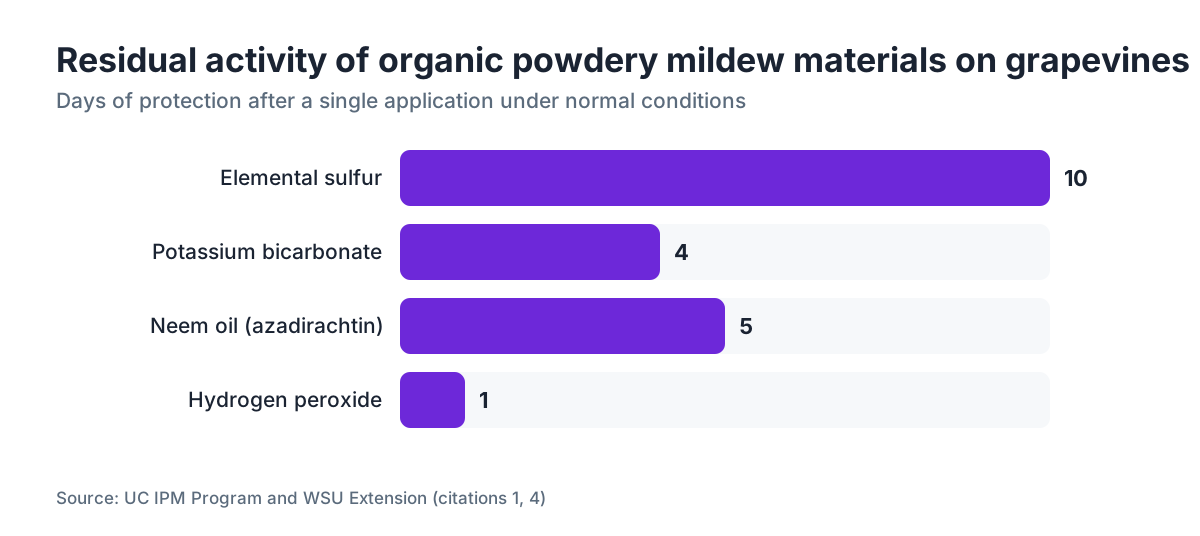
Growers running organic programs have a handful of contact or low-residual options: sulfur, potassium bicarbonate, neem oil (azadirachtin), copper, and hydrogen peroxide. Each does one thing well. Knowing where H2O2 fits against the others saves money and closes program gaps.
Sulfur is still the backbone of organic powdery mildew control. It has real protectant activity, residual action of 7 to 14 days depending on rain and UV, and decades of efficacy data across every wine grape region. Its weakness is phytotoxicity within two weeks of oil sprays or above 95°F. Some jurisdictions also flag sulfur dioxide emission concerns near sensitive neighbors.
Potassium bicarbonate (KHCO3, sold as Kaligreen, MilStop, and others) shifts the leaf surface pH above what E. necator tolerates. It has some eradicant action on top of a protectant effect, and WSU extension lists it among the more effective contact alternatives to sulfur [4]. It's gentler on beneficial insects than copper.
H2O2 wins on three counts against sulfur: no pre-harvest interval, no phytotoxicity near harvest, and fast environmental breakdown. It loses on residual. Zero residual tightens spray intervals to 5 to 7 days under heavy pressure instead of the 10 to 14 days you can sometimes stretch sulfur. That adds labor and fuel fast.
| Material | PHI (days) | Residual activity | Resistance risk | OMRI listed |
|---|---|---|---|---|
| Elemental sulfur | 0 | 7 to 14 days | None known | Yes (most products) |
| Potassium bicarbonate | 0 | 2 to 5 days | None known | Yes |
| Hydrogen peroxide | 0 | <24 hours | None known | Yes (some products) |
| Neem oil (azadirachtin) | 0 | 3 to 7 days | Low | Yes |
| Tebuconazole (DMI) | 7 | 14 to 21 days | Documented | No |
Source: UC IPM Program [1], WSU Extension [4]
When in the season should you apply hydrogen peroxide for grape powdery mildew?
Powdery mildew pressure peaks in three windows: bud swell to bloom (primary inoculum release from chasmothecia), fruit set through veraison (berry infection risk is highest before berries hit about 8% sugar), and post-veraison on leaves that carry inoculum into next season [1].
Hydrogen peroxide earns its slot in the fruit set to veraison window, mostly because it has no pre-harvest interval. You can spray it the day before harvest if pressure demands. Sulfur carries a real risk of throwing off-aromas into fruit when applied within a few weeks of harvest, so growers usually pull sulfur by veraison. That's the gap H2O2 fills.
Early season is different. When you're building protectant coverage during shoot growth, sulfur and potassium bicarbonate do more work per dollar thanks to residual. Running H2O2 as your primary early-season material is expensive in application frequency alone. The smarter play: lean on sulfur and KHCO3 pre-bloom, rotate H2O2 in from fruit set forward, and hold it in reserve for late-season flare-ups near harvest.
The infection window sets the clock. Grape berries stay susceptible to direct powdery mildew infection from fruit set until roughly 3 to 4 weeks after, when sugar accumulation and cuticle hardening make them resistant [1]. Inside that window, a contact material with a 0% PHI is genuinely useful.
Is hydrogen peroxide for grapes EPA-registered and what are the label requirements?
Yes. Multiple H2O2-based products are EPA-registered for grapes, including for powdery mildew. OxiDate 2.0 (EPA Reg. No. 70299-12, BioSafe Systems), StorOx, and ZeroTol are common examples. OMRI lists several hydrogen peroxide products as allowed inputs for certified organic production [5].
The EPA Worker Protection Standard (WPS, 40 CFR Part 170) covers hydrogen peroxide products because they're classified as pesticides under FIFRA, organic status or not [6]. That means:
- The restricted-entry interval (REI) on the label must be followed. Most H2O2 products carry a 4-hour REI, short compared to synthetic fungicides.
- Application exclusion zones apply if you run airblast equipment.
- Workers need annual WPS safety training.
- A copy of the label stays accessible at the central display location.
Apply according to the specific product label, always. FIFRA Section 12(a)(2)(G) makes off-label use a federal violation. "It is unlawful for any person to use any registered pesticide in a manner inconsistent with its labeling," reads the statute [11]. Using a product at a rate, timing, or crop not on the label breaks that rule, no matter how benign the material seems. "The label is the law" is the phrase every applicator trainer repeats, and it's literally correct.
California adds requirements. The California Department of Pesticide Regulation (CDPR) requires a Pest Control Adviser (PCA) recommendation for any pesticide application in a commercial vineyard, including OMRI-listed materials. You also keep records of all pesticide applications for at least two years under California law [7].
How do you build hydrogen peroxide into a powdery mildew spray program rotation?
Rotation usually exists to manage resistance. With H2O2 and other contact oxidants, resistance isn't the concern. Coverage gaps are. So build your rotation around the residual-activity calendar, not a mode-of-action rotation.
Here's a practical rotation for a mixed conventional or organic vineyard through a moderate-to-high pressure season.
Bud swell through bloom: elemental sulfur or potassium bicarbonate on a 10 to 14 day interval. On a conventional program, this is also where you'd place a single DMI fungicide (FRAC group 3) to use its residual.
Fruit set through bunch closure: rotate potassium bicarbonate, H2O2, and sulfur on a 7 to 10 day interval. Peak berry infection risk. Coverage has to be thorough.
Bunch closure through veraison: H2O2 and KHCO3 take over. Sulfur's risk to wine quality climbs. If you used systemic fungicides, pull them at least 14 days before harvest unless the label allows a shorter PHI.
Post-veraison through harvest: H2O2 is your cleanest option for late flare-ups because of zero PHI. Watch leaf infection too. Heavy leaf colonization drains the vine's carbohydrate reserves going into dormancy.
Keeping accurate spray records through a rotation like this matters more than most growers admit, right up until they're sitting across from a CDPR auditor or verifying compliance for an organic renewal. The record has to show date, product, EPA reg number, rate, water volume, target pest, and applicator. Logging that in a vineyard management tool instead of a handwritten field notebook saves real time at audit season. VitiScribe's spray log module auto-populates label data and flags REI conflicts, which is exactly what a program this busy needs.
What application equipment gives the best results with hydrogen peroxide on grapevines?
Because hydrogen peroxide never moves inside the plant, equipment that drives spray deep into the canopy isn't optional. Airblast sprayers with properly aimed nozzles and calibrated output beat hand-gun applications on any block larger than an acre. You want droplets reaching interior surfaces, cluster stems, and the underside of leaves where powdery mildew colonies usually start.
Calibration beats brand every time. A poorly calibrated airblast rig dumps product on the outer canopy and never reaches the interior clusters. Cornell Cooperative Extension's spray guidelines call for annual calibration checks and matching air volume to canopy density [8]. That guidance isn't H2O2-specific, but it applies directly.
Drop nozzle systems help in high-vigor, thick-canopy blocks by pushing spray up into the bunch zone from below. Some Napa and Sonoma growers run dedicated drop-nozzle passes on high-value blocks during fruit set, when berry infection risk is highest.
Electrostatic sprayers keep drawing interest for better coverage at lower water volume. The research on electrostatic application for powdery mildew is mixed. Some trials show coverage gains, others show no real difference in disease control versus conventional airblast at the same rate [3]. The rigs cost a lot. I wouldn't buy one on the strength of H2O2 coverage alone.
Water volume is your other lever. Most extension guidance suggests 50 to 100 gallons per acre for vineyard airblast, pushed higher for dense canopy. With H2O2, the urge to cut water to save money works against you. The solution has to wet every surface you want protected.
Can hydrogen peroxide eradicate an active powdery mildew infection or only prevent one?
This one trips people up, so let's be direct. Hydrogen peroxide has limited eradicant activity. It kills surface hyphae and conidia it contacts, but it won't penetrate infected tissue to reach mycelium already inside the leaf epidermis [1]. It can knock back a light surface infection and slow sporulation. It won't cure a block already showing heavy colony formation.
For genuine eradicant action, you need a DMI fungicide (propiconazole, myclobutanil, tebuconazole) at early infection stages, or potassium bicarbonate, which has better documented eradicant activity than H2O2 in the extension literature [4]. DMI fungicides carry documented resistance issues in California, New York, and Washington E. necator populations, so rotate modes even on a conventional program [2].
Walking a block and seeing active white sporulating colonies on leaves or clusters? H2O2 alone is the wrong call. Reach for a material with eradicant activity, get thorough coverage, then bring H2O2 back into the next scheduled pass as a protectant. Treating H2O2 as a rescue material for established infections is where most spray programs using it fall apart.
What does hydrogen peroxide cost compared to other powdery mildew fungicides?
Product cost per acre for H2O2-based fungicides runs roughly $15 to 40 per application depending on product, rate, and water volume, based on commercial pricing for products like OxiDate 2.0 in the mid-2020s. Elemental sulfur costs far less, often $5 to 15 per application. Potassium bicarbonate products (MilStop and similar) run $10 to 25 per acre. Synthetic DMI or QoI fungicides land at $20 to 80 per application but buy you 14 to 21 days of residual, which cuts your application count.
The real cost of H2O2 isn't the product. It's the frequency. A 7-day interval through peak pressure means roughly 8 to 10 applications between bud swell and harvest in a high-pressure region like the Willamette Valley or Finger Lakes. At 10 applications and $25 average product cost, that's $250 per acre in product alone, before labor and fuel. A sulfur-based program at the same frequency runs closer to $75 to 125 per acre in product.
The math works best when you slot-place H2O2: two to four applications during the late-season window when sulfur is out and nothing else zero-PHI is in the program. That's a $50 to 150 per acre bet for meaningful harvest-period protection, easy to justify against a powdery mildew loss in wine grapes worth $2,000 to 6,000 per ton in premium regions.
For vineyards tracking input costs by block, recording product cost alongside application date is how you actually see where the season's money went.
Does hydrogen peroxide harm beneficial insects, vineyard soil biology, or bees?
Hydrogen peroxide breaks down fast into water and oxygen, which is its main environmental edge over many conventional fungicides. Soil half-life is generally under a day, and sunlight speeds it up further [5]. Residue on fruit at harvest is effectively zero.
For beneficial insects, acute contact toxicity is moderate while wet and low once dry. Spraying away from peak pollinator activity (morning or evening, avoiding bloom when you can) cuts exposure. H2O2 isn't listed as a restricted material under any state bee protection registry I'm aware of, but check your county agriculture department requirements anyway.
Soil biology impact is minimal at foliar concentrations. Some research suggests dilute H2O2 applied to soil can briefly suppress microbial populations, but the fast breakdown means quick recovery [9]. The amount reaching soil from foliar overspray sits far below soil-treatment concentrations.
Leaf-dwelling beneficial arthropods (predatory mites, parasitic wasps) face short-term mortality from direct contact during application. That's true of most pesticide applications. The short residual window means predators recolonize faster than after persistent insecticides or fungicides. For IPM programs tracking beneficials, a 48 to 72 hour observation window after application gives you a realistic read on impact.
How should you keep records for hydrogen peroxide applications in a vineyard?
Every commercial pesticide application in the United States requires a record under state law, and every major wine grape state has its own version. California requires records within 30 days of application, retained for two years, available to the county agricultural commissioner on request [7]. Washington requires records kept for at least seven years under WAC 16-228 [10]. New York's rules under 6 NYCRR Part 325 are similar in spirit.
The minimum record for an H2O2 application: date and time, product name and EPA registration number, amount used, total acres treated, target pest, applicator name and (if required) license number. California also wants the county, section, township, and range or GPS coordinates of the treated site.
For organic certification, these records feed your Organic System Plan audit trail. The National Organic Program (NOP) requires documentation of every material used with evidence of its allowed status, and H2O2 products must appear on the OMRI list or carry your certifier's approval [9].
Keeping records in a digital system indexed by block, product, and date saves real time during certification audits and compliance checks. VitiScribe's spray log is built around these exact field requirements, so records come out audit-ready without reformatting. Whatever system you run, record at application, not from memory later. Reconstruction errors are the most common way growers end up with compliance gaps they never knew they had.
Frequently asked questions
What percentage hydrogen peroxide should I use on grapevines for powdery mildew?
Use 0.5 to 1.0% active hydrogen peroxide in the spray tank. For a product like OxiDate 2.0 (27% H2O2), that's roughly 1 to 2 quarts per 100 gallons of water. Stay at the lower end in hot weather or on young vines. Above 1.5% active concentration you risk bleaching and necrosis on leaf margins, especially during rapid spring growth when tissue is most tender.
Is hydrogen peroxide OMRI listed for organic grape production?
Several hydrogen peroxide-based products are OMRI listed for organic production, including OxiDate 2.0 and ZeroTol. OMRI listing means the product has been reviewed against National Organic Program standards. You still need to confirm the specific product is on your certifier's approved list before use. Using an unlisted product can jeopardize your organic certification for the season.
What is the pre-harvest interval for hydrogen peroxide on grapes?
The pre-harvest interval for most H2O2-based products registered for grapes is 0 days. You can apply the day before harvest. That's its primary advantage over sulfur and many synthetic fungicides in the final weeks before picking. Always verify the specific label for your product, since PHI is set per product registration, not by chemistry class alone.
Can hydrogen peroxide be tank-mixed with sulfur or copper for grape powdery mildew?
Avoid tank-mixing hydrogen peroxide with sulfur. H2O2 is a strong oxidizer that reacts with sulfur and degrades both materials. Evaluate copper-based products for compatibility before mixing too; most labels advise against mixing H2O2 with other pesticides unless the manufacturer confirms compatibility. Run them as separate applications or on alternating days.
How often should hydrogen peroxide be sprayed for powdery mildew on grapes?
Every 5 to 7 days during high disease pressure, or every 7 to 10 days when pressure is moderate. Because H2O2 has less than 24 hours of residual activity, interval management is everything. Rain, heavy dew, or fast shoot growth all break protective coverage sooner. Tighten intervals in warm humid conditions; stretch them slightly in dry weather with slow canopy development.
Does hydrogen peroxide work on botrytis as well as powdery mildew in grapes?
Some H2O2 products carry a botrytis suppression claim for grapes. The same contact oxidation that kills powdery mildew conidia also damages Botrytis cinerea spores. Still, the evidence for consistent botrytis suppression from H2O2 alone is weaker than for powdery mildew. For serious botrytis pressure, reach for materials with better documented activity, like Bacillus subtilis products or cyprodinil/fludioxonil.
What are the worker safety requirements for applying hydrogen peroxide in vineyards?
Under EPA's Worker Protection Standard (40 CFR Part 170), hydrogen peroxide products are regulated pesticides. The REI for most H2O2 products is 4 hours. Workers need annual WPS safety training, access to the product label and SDS, and a way to reach emergency assistance information. Applicators follow all PPE listed on the specific product label, typically at minimum chemical-resistant gloves and eye protection.
Will hydrogen peroxide cause phytotoxicity on Cabernet Sauvignon or other wine grape varieties?
At label rates (0.5 to 1% active H2O2), phytotoxicity is unlikely on established vines of any major wine grape variety in normal weather. Risk climbs when you apply above 1.0% active concentration, spray above 90°F, or hit very young spring tissue. Varieties with thinner cuticles or high-vigor growth may show more sensitivity. Scout 48 hours after your first application of any new product or rate.
How does hydrogen peroxide compare to potassium bicarbonate for grape powdery mildew?
Potassium bicarbonate has slightly better documented eradicant activity than H2O2 and the same zero-PHI status. H2O2 acts faster on contact but breaks down quicker. KHCO3 shifts surface pH and may hold 2 to 5 days of residual versus less than 24 hours for H2O2. WSU extension rates potassium bicarbonate highly for organic programs. Rotating between them makes sense since they work by different mechanisms.
Can I use hydrogen peroxide for powdery mildew without a pest control adviser recommendation in California?
No. California requires a licensed Pest Control Adviser (PCA) recommendation for any pesticide application in a commercial vineyard, including OMRI-listed materials like hydrogen peroxide products. This applies even to low-risk materials. The recommendation must be in writing before application. Growers who skip it are out of compliance with the California Food and Agricultural Code, whatever product they're using.
Does hydrogen peroxide lose efficacy in the spray tank over time?
Yes. H2O2 is unstable in solution and starts breaking down once diluted, especially in alkaline water or when contaminated with metals or organic matter. Mix only what you'll use in a single session and don't leave diluted product in the tank overnight. Acidic to neutral water (pH 5 to 7) slows degradation. Test your water pH before mixing if tank stability has been a problem.
What records do I need to keep for hydrogen peroxide spray applications in my vineyard?
At minimum: date and time, product name and EPA registration number, amount used per acre, total acres treated, target pest, applicator name, and (in California) the GPS or legal location of the treated block. California requires records within 30 days and retention for two years. Organic growers need records for their NOP audit trail. Digital spray logs cut errors and audit prep time.
Sources
- UC Statewide IPM Program (UC IPM), Grape Pest Management Guidelines: Hydrogen peroxide classified as low-residual-activity material; berry infection window from fruit set to roughly 3 to 4 weeks after; application timing and concentration guidance
- UC Statewide IPM Program (UC IPM), fungicide resistance guidance for Erysiphe necator: DMI and QoI fungicide resistance documented in California, Washington, and New York populations of Erysiphe necator
- UC Agriculture and Natural Resources (UC ANR), grape fungicide efficacy and application guidance: Application temperature guidance (avoid above 90°F), electrostatic sprayer efficacy comparisons, water volume recommendations for airblast
- Washington State University Extension, organic powdery mildew management in wine grapes: Potassium bicarbonate rated as effective alternative to sulfur with documented eradicant activity; residual activity comparison with hydrogen peroxide
- Organic Materials Review Institute (OMRI), Products List: Multiple hydrogen peroxide-based products OMRI listed for organic production; environmental breakdown to water and oxygen
- EPA, Agricultural Worker Protection Standard (40 CFR Part 170): WPS applies to all pesticides including OMRI-listed materials; REI requirements, worker training, and label access rules
- California Department of Pesticide Regulation (CDPR): California requires pesticide application records within 30 days, retained for two years; PCA recommendation required for all commercial vineyard pesticide applications
- Cornell Cooperative Extension, vineyard spray application guidelines: Annual airblast sprayer calibration recommendations; air volume matching to canopy density guidance
- USDA Agricultural Marketing Service, National Organic Program (NOP): NOP documentation requirements for all materials used in certified organic production; hydrogen peroxide allowance under NOP
- Washington State Department of Agriculture, pesticide record-keeping requirements (WAC 16-228): Washington state requires pesticide application records retained for at least seven years
- EPA, Federal Insecticide, Fungicide, and Rodenticide Act (FIFRA) Section 12(a)(2)(G): Using a registered pesticide in a manner inconsistent with its labeling is a federal violation under FIFRA
- BioSafe Systems, OxiDate 2.0 product information: 27% H2O2 formulation; dilution rates for grape powdery mildew; 0-day PHI; 4-hour REI; OMRI listed
Last updated 2026-07-09