Why soil microbes matter more than fertilizer in your vineyard
TL;DR
- Vineyard soil microbes, including bacteria, fungi, archaea, and nematodes, cycle nutrients, hold back pathogens, and shape berry chemistry.
- One gram of healthy vineyard soil can hold over a billion bacteria and thousands of fungal species.
- Tillage, synthetic inputs, and cover crops shift that community fast, often within a single growing season.
What do soil microbes actually do in a vineyard?
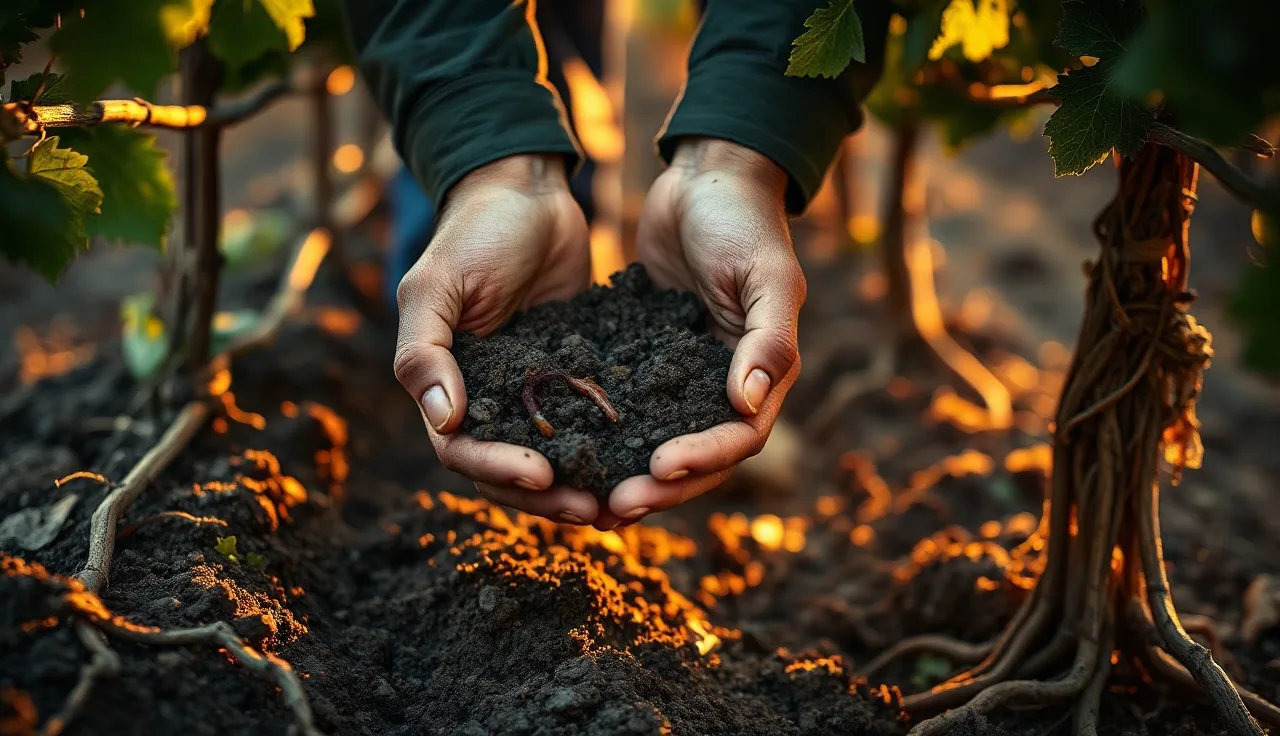
Soil microbes are the engine under your vine rows. They break down organic matter and release nitrogen, phosphorus, and sulfur in forms the vine can actually take up. They produce compounds that regulate vine hormone signaling. Some attach directly to root cells and move water and phosphorus into the vine in trade for sugars the vine exudes. Without that exchange, fertilizer just sits there.
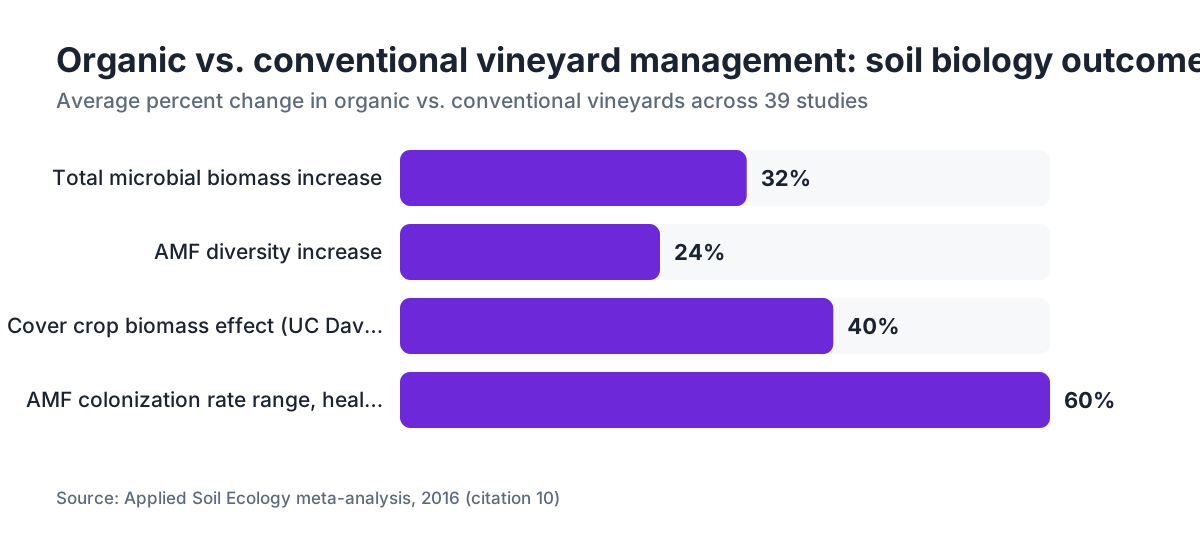
Four groups matter most: bacteria, fungi (especially mycorrhizal fungi), archaea, and protists. Bacteria handle most of the nutrient cycling. Arbuscular mycorrhizal fungi (AMF) colonize vine roots and extend the root's effective reach by orders of magnitude. A UC Davis study on Napa and Sonoma vineyard soils found AMF colonization rates from 40 to 80 percent of sampled root tips, depending on tillage intensity and fungicide history [1].
Pathogen suppression is the benefit nobody talks about enough. When microbial diversity in vineyard soil is high, beneficial organisms outcompete and physically crowd out pathogens like Armillaria, Phytophthora, and Pythium. Suppressive soils are a real, studied thing: soils where this competition keeps disease pressure low without any chemical help. USDA's Agricultural Research Service has documented suppressive soil developing in perennial systems where cover cropping and reduced tillage ran for at least three straight years [2].
Then there's the wine quality angle. Some volatile compounds in wine, including certain esters and thiol precursors, trace partly to how the soil microbiome handles sulfur and amino acids. This is still an open research area, but the data points one direction.
How many microbes are in vineyard soil, and why does the number matter?
Healthy vineyard sites consistently run between 100 million and 1 billion bacteria per gram of dry soil. Fungal biomass is lower by count but much higher by volume, and in perennial systems like vineyards, fungi tend to drive more carbon cycling than bacteria do [3].
The count matters less than the diversity. A soil with a billion cells of one species is fragile. A soil with a million cells each from a thousand species has backup. When drought, frost, or a spray knocks out one function, another organism picks it up. Cornell's Soil Health Lab calls this "functional redundancy," and it's one big reason diverse communities beat species-poor ones in long-term field trials [4].
Microbiome diversity in vineyard soil also tracks with vine age. Young vines planted in disturbed, fumigated ground start out with thin communities. Older vines, especially in blocks that haven't been fumigated in years, build richer ones, particularly in AMF. A 2019 PLOS ONE paper analyzing 197 vineyard plots across California found vine age and distance from the last fumigation event were the two strongest predictors of AMF species richness [5].
Here's a number you can bank on. Vineyards with AMF colonization above 50 percent of root tips show measurably lower phosphorus fertilizer needs across multiple university trials. That's real money staying in your pocket.
Which vineyard practices harm soil microbial communities the most?
Soil fumigation tops the list. Pre-plant fumigants like metam sodium and 1,3-dichloropropene sterilize the top 18 to 24 inches of soil, hitting target and non-target organisms nearly alike. Recovery takes three to seven years even under good conditions, and some AMF species never climb back to pre-fumigation levels without a local inoculum source nearby [5]. That doesn't make fumigation always wrong. Phylloxera and nematode pressure sometimes leave no real alternative. But the cost to the microbial community is real and it lasts.
Synthetic herbicides sprayed on the soil surface, especially simazine and diuron, cut bacterial biomass and shift the community toward tolerant taxa that tend to be less functionally diverse. Research from WSU's viticulture and enology program has documented measurable shifts in under-vine communities within one season of herbicide use compared to cultivated or mulched controls [6].
Tillage kills fungal hyphae mechanically. AMF networks take months to rebuild after a disruptive pass with a disc or rototiller. Under-row ripping does the most damage because it hits the zone of highest root and hyphal density. Clean cultivation, keeping all soil bare and tilled, produces the lowest microbial biomass of any vineyard management system studied.
Heavy synthetic nitrogen pushes soil communities toward fast-cycling bacterial dominance and away from the fungal-dominated networks that suit perennial plants. The fungal-to-bacterial (F:B) ratio tends to run higher in soils supporting long-lived perennials in their natural state. Chronic heavy nitrogen flips that ratio.
Fungicides count too. Broad-spectrum soil-applied products hit non-target fungi, mycorrhizal species included. Systemic foliar fungicides that move through the plant into root exudates can also suppress AMF. This isn't a case for letting Botrytis or powdery mildew run. It's a reason to remember your spray timing and product choice reach further than the disease you're aiming at.
What practices build and protect vineyard soil microbe diversity?
Cover crops are the most accessible tool most growers underuse. A diverse seed mix in the drive rows, and under the vine where you can manage it, feeds microbes with root exudates and organic matter and gives a range of taxa physical habitat. UC Davis cover crop research in vineyards shows diverse grass-and-legume mixes raising total microbial biomass by 20 to 60 percent over clean-cultivated controls within two growing seasons [7].
Compost adds organic carbon and living inocula. Rate and quality make the difference. A mature, hot-composted product is safer on pathogens but carries lower live microbial counts than a vermicompost or a shorter-cycle compost. Some growers run compost teas or aerated compost extracts through drip lines, though the field-scale evidence is genuinely mixed. Nobody has good data on durable colonization from liquid extracts. The closest studies find short-term bumps that fade within four to eight weeks unless the soil itself supports the introduced organisms.
Reduced tillage keeps fungal networks intact. In drive rows that can mean going from annual cultivation to permanent sod or managed mowing. Under the vine, your options are deep mulch, shallow cultivation only, or targeted micro-cultivation that stays above 4 to 6 inches.
Irrigation drives microbial activity directly. Soil moisture powers microbial metabolism, and swinging between soaked and bone-dry, common with infrequent heavy irrigation, suppresses diversity worse than steady moderate moisture does. Deficit irrigation timed to skip the most active root-zone windows helps.
Biological inoculants, the commercial AMF and bacterial products, have a real but narrow role. They work best in fumigated or otherwise species-poor soils where they give the soil a local starting population to build on. In a diverse, healthy soil, introduced organisms rarely establish at meaningful levels because resident populations outcompete them. These products aren't a substitute for habitat. They're a starting point.
If you want to track which inputs and sprays are moving your soil program, VitiScribe gives vineyard managers one field-operations log for spray records, cover crop dates, and amendment applications. That makes it far easier to trace a management change back to a yield or soil-test result.
How does the vine's own root zone shape the microbial community?
The rhizosphere, the thin band of soil hugging the roots, is the most microbially active spot in the vineyard. Root exudates (sugars, amino acids, organic acids) feed a community often ten to a hundred times denser than bulk soil a few centimeters away. Vines actively pick their microbes through the chemistry of what they release, and different grape varieties release different exudate profiles.
A 2020 study in mBio analyzed the rhizosphere microbiomes of twelve Vitis vinifera cultivars grown in the same Napa Valley field soil and found statistically significant differences in bacterial community composition driven by variety, independent of soil type or management [8]. Cabernet Sauvignon and Chardonnay carried measurably different rhizosphere communities in the same block. The authors concluded that "plant genotype is a significant driver of rhizosphere microbiome assembly" in grapevine, matching earlier work in other perennial crops.
There's a practical read here. If you're replanting, your variety choice shapes what community assembles over the next several years, which feeds back into nutrient cycling and disease dynamics. It's not yet a reason to pick one variety over another. It is a reason to treat soil as living rather than inert when you plan a replant.
Do soil microbes affect wine flavor and terroir?
This is the question with the most money riding on it and the least settled science behind it. Parts of the connection are solid. Parts are speculation.
What's well established: the soil microbiome shapes vine nutrient status, particularly the availability of sulfur, potassium, and trace minerals, which feed into berry chemistry. AMF colonization raises uptake of zinc and copper, both of which affect how fermentation behaves. Nitrogen availability, largely microbe-mediated, sets yeast-assimilable nitrogen (YAN) in the must, which shapes fermentation aromatics directly.
What's still speculative but actively studied: whether specific soil microbes produce volatile precursors that end up in the fruit. A 2021 review in Frontiers in Microbiology examined sixteen studies on soil-to-fruit microbial influence and found the evidence for direct chemical transfer thin, while the evidence for indirect influence through vine physiology is strong [9].
Terroir is even messier. Soil type, microclimate, vine age, and winemaking all feed terroir expression. Soil microbes are one variable among many, and pulling their contribution apart in the field is hard. Organic and biodynamic vineyards tend to show higher microbial diversity than conventional ones. They also tend to sit on better sites and get more attention. Untangling those effects without controlled trials is close to impossible.
The honest position: soil microbial diversity correlates with plenty of outcomes winemakers want, but proving it causes better wine specifically is still a work in progress.
How does organic or biodynamic management change vineyard soil microbes?
Consistently and measurably. A 2016 meta-analysis of 39 studies comparing organic and conventional vineyard management found organic management raised total microbial biomass by an average of 32 percent and AMF diversity by an average of 24 percent [10]. The effect grew in soils with longer conversion histories.
Biodynamic management shows even higher diversity in some studies, but the evidence base is smaller and the confounds are bigger. Biodynamic farms often carry more diverse cover crops, more composting, and lower pesticide loads than conventional organics, so pinning effects on biodynamic practice specifically rather than the whole management picture is tough.
What drives the organic difference is mostly what's missing rather than what's added. No synthetic herbicides. No synthetic nitrogen. Reduced or eliminated fumigation. The additions (compost, inoculants, cover crops) help, but probably matter less than stopping the inputs that suppress the community in the first place.
Organic certification typically takes three years to earn. Microbial recovery starts in the first season but settles into its new equilibrium more slowly, often four to six years, depending on how hard the previous program pushed.
How can you measure the microbial health of your vineyard soil?
You have several options, from nearly free to several hundred dollars per sample, and they measure different things.
The cheapest useful test is a Solvita CO2 respiration test or a similar jar incubation, which reads microbial activity rather than diversity. Active respiration tells you something is alive and working. These kits run roughly $20 to $40 per sample and you can do them yourself.
Standard commercial soil biology tests from labs like Haney Soil Health (a USDA-developed protocol), Soil Food Web School-affiliated labs, or Ward Laboratories quantify bacterial and fungal biomass, active and total counts, and sometimes nematode populations. Costs run $50 to $150 per sample depending on the panel.
DNA-based metagenomic or 16S/ITS amplicon sequencing gives you actual species composition and relative abundance. These run $150 to $400 per sample depending on sequencing depth and whether interpretation is included. Services like Biome Makers' Bx platform are built for vineyards and return agronomic interpretation alongside raw taxonomy. Worth it if you're making a management change and want baseline-plus-followup data. Overkill if you just want to know whether your cover crop is doing anything.
Whatever you pick, consistency beats any single result. Sample the same spots, the same time of year (most growers go early spring before bud break and again at fruit set), and the same depth. Trends over time tell you more than any absolute number.
| Test Type | Cost per Sample | What It Measures | Best Use |
|---|---|---|---|
| CO2 jar respiration | $20-$40 | Microbial activity | Quick annual check |
| Haney Soil Health | $50-$80 | Biomass, active/total counts | Routine monitoring |
| Full biology panel | $100-$150 | Biomass + nematodes | Management evaluation |
| DNA metagenomic | $150-$400 | Species composition | Pre/post management change |
What does worker safety law say about protecting workers during soil management?
The EPA Worker Protection Standard (WPS), codified at 40 CFR Part 170, covers agricultural pesticides including soil fumigants and many soil-applied herbicides and fungicides. Under WPS, employers must provide pesticide safety training, post restricted-entry intervals (REIs), supply personal protective equipment, and make pesticide labeling available to workers [11].
Soil fumigants like metam sodium carry REIs from 24 to 72 hours depending on the product and application method, and they require buffers to protect bystanders during application. Some fumigants require field posting with WPS signs through the REI.
Under-vine herbicide applications, among the most common practices that touch soil microbes, usually carry REIs of 12 to 24 hours. Workers re-entering treated ground before the REI expires without required PPE is one of the most frequently cited WPS violations in vineyard inspections.
State rules often stack on top of federal WPS. California requires a County Agricultural Commissioner permit for most fumigant applications and adds buffer zone requirements beyond the federal floor. Oregon and Washington run similar permit layers for restricted-use fumigants.
Accurate spray records that include REI documentation are both a legal requirement and your practical protection if a worker exposure incident happens. If you're juggling spray logs across multiple blocks and multiple workers, this is exactly where a field operations platform earns its keep. VitiScribe builds compliant spray records with the REI as a required field, so it never gets skipped.
How does soil microbe diversity in vineyards compare to other agricultural systems?
Perennial crops like vineyards consistently show higher microbial diversity than annual row crops when managed comparably. The root system stays put, the soil goes untilled (in well-managed vineyards), and organic inputs from cover crops and vine tissue keep coming, so the habitat holds steady.
A 2017 comparison in Applied Soil Ecology found well-managed vineyard soils carried 18 to 35 percent higher AMF species richness than adjacent grain fields under conventional tillage, even after controlling for soil type [12]. Grain fields that switched to no-till for at least five years closed most of that gap.
Conventional vineyards with frequent tillage and heavy herbicide use can end up with communities as thin as intensively managed annual crops. The crop type sets the ceiling. Management decides where you land under it.
Olive orchards and fruit tree orchards follow patterns close to vineyards. Perennial grasslands and native shrublands hold the highest diversity of all, which is useful context for picturing what your soil could look like under ideal conditions.
What do university extension programs recommend for vineyard soil biology?
UC Davis's Viticulture and Enology program, publishing through University of California Agriculture and Natural Resources, points to cover crop diversity as the main lever for improving soil biology. Their research backs mixes of at least five to eight species over monoculture cereal rye or oat covers, specifically because diverse root architectures feed more diverse microbial communities [7].
Cornell Cooperative Extension's soil health program recommends combining reduced tillage, cover cropping, and compost, with soil biology testing every two to three years to track progress. Cornell's work has run mostly in New York's Finger Lakes and Hudson Valley, where cool, humid conditions bring different pathogen pressure than California, but the soil biology principles carry over [4].
WSU Extension's vineyard floor management publications, particularly their Columbia Valley work, take on the tension between weed control and soil biology in a region where clean cultivation has long been standard. WSU researchers have documented that permanent sod in drive rows plus targeted mechanical under-vine cultivation holds acceptable weed control while keeping more microbial activity alive than clean cultivation everywhere [6].
The National Sustainable Agriculture Information Service (ATTRA) also keeps free resources on soil biology in perennial systems that are worth a bookmark.
Frequently asked questions
How do soil microbes help grapevines absorb nutrients?
Mycorrhizal fungi connect to vine roots and reach into soil pores too small for roots, delivering phosphorus, zinc, and water into root cells in trade for plant sugars. Bacteria cycle organic nitrogen into ammonium and nitrate that roots can absorb. Without these functions, a vine depends entirely on what you apply as fertilizer, which is both more expensive and less efficient.
Can soil microbes suppress grapevine diseases?
Yes, in well-documented ways. High microbial diversity in vineyard soil creates competition that limits pathogens like Pythium, Phytophthora, and Armillaria. Bacterial genera like Bacillus and Trichoderma-type fungi produce compounds that directly inhibit plant pathogens. USDA has studied suppressive soil development in perennial systems and found it needs at least three consecutive years of favorable management to establish.
Does tillage really hurt vineyard soil microbes that much?
Mechanical tillage physically destroys fungal hyphae networks that took months to build. Arbuscular mycorrhizal fungi are especially vulnerable because their networks are fragile and far-reaching. Under-vine ripping hits the highest-density root zone. WSU research shows measurable drops in microbial biomass and AMF colonization in tilled versus non-tilled vineyard soils within a single season. Recovery takes several months to a full season.
What cover crops are best for building vineyard soil microbe diversity?
Diverse mixes beat monocultures. UC Davis research backs mixes of at least five to eight species including grasses, legumes, and brassicas. Different root chemistries and shapes support different microbes. Legumes bring nitrogen-fixing bacteria. Deep-rooted species like daikon radish open pore space and deposit organic matter deeper in the profile. Avoid mixes dominated by one species, which narrows the microbial community they feed.
How long does it take to recover soil microbes after fumigation?
Three to seven years is the range most research points to, depending on whether local inoculum sources exist, how often cover crops go in, and whether tillage continues afterward. AMF species richness is the slowest to return. A 2019 PLOS ONE study of 197 California vineyard plots found fumigation history was one of the two strongest predictors of AMF diversity, with full recovery taking six or more years at some sites.
Do soil microbes differ between wine regions and affect regional wine character?
Different wine regions carry measurably different soil microbial communities, driven by soil parent material, climate, management history, and native vegetation. Whether those differences translate into flavor differences is genuinely uncertain. The strongest evidence is for indirect effects through nutrient cycling and vine physiology. Direct transfer of soil microbial metabolites into fruit is possible but not consistently demonstrated. It's a live research area, not settled science.
Are commercial mycorrhizal inoculant products worth the money in vineyards?
In fumigated or otherwise species-poor soils, yes, they give the soil a starting population to build on. In diverse, healthy soils, introduced AMF strains rarely establish at meaningful levels because resident communities outcompete them. University trials show the products work best as a starting point when planting into disturbed soil, not as a routine annual treatment. Build habitat through cover crops before spending on inoculants.
What soil microbe tests should a vineyard manager run?
For most operations, an annual or biennial Haney Soil Health test ($50 to $80 per sample) covering microbial biomass and activity gives you actionable numbers. If you're making a significant management change, pre- and post-DNA metagenomic sequencing ($150 to $400 per sample) tracks the actual community shift. Sample consistently: same location, same time of year (early spring or fruit set), same depth. Year-over-year trends beat any single result.
How do herbicides applied under the vine affect soil biology?
Soil-residual herbicides including simazine and diuron cut bacterial biomass and shift community composition toward tolerant taxa within one season of application, per WSU research. Even contact herbicides with no soil residual affect the cover and root exudate inputs that feed microbes. Alternatives like mechanical cultivation or deep mulch reduce weed pressure without the microbial cost, though they carry their own management tradeoffs.
Does organic viticulture actually produce healthier soil microbial communities?
The meta-analytic evidence says yes. A 2016 analysis of 39 studies found organic vineyard management raised total microbial biomass by an average of 32 percent and AMF diversity by 24 percent over conventional management. The effect was stronger in longer-term organic operations. Much of the benefit comes from what organic management avoids, specifically synthetic herbicides, fumigants, and heavy synthetic nitrogen, rather than what it adds.
What EPA Worker Protection Standard rules apply when applying soil fumigants or herbicides in vineyards?
Under 40 CFR Part 170, employers must train workers on pesticide safety, post restricted-entry intervals at field entry points, provide required PPE, and make labeling available before re-entry. Soil fumigants like metam sodium carry REIs of 24 to 72 hours and require bystander buffers during application. State rules, especially in California, add permit requirements for fumigant use. Accurate spray records including REI documentation are a legal requirement, not optional.
Can the grape variety affect which soil microbes live in the rhizosphere?
Yes. A 2020 mBio study of twelve Vitis vinifera cultivars grown in the same Napa Valley field soil found statistically significant differences in bacterial rhizosphere community composition by variety. The researchers concluded that plant genotype is a significant driver of rhizosphere microbiome assembly in grapevine. Cabernet Sauvignon and Chardonnay carried measurably different rhizosphere communities in the same block and soil, independent of management.
How does irrigation management affect vineyard soil microbes?
Soil moisture directly powers microbial metabolism. Extreme wet-dry cycling from infrequent heavy irrigation suppresses diversity more than steady moderate moisture does. Deficit irrigation timed to skip the most active root-zone windows helps preserve microbial activity. Drip systems that hold relatively stable moisture in the root zone generally support more diverse communities than flood or furrow irrigation, which swings moisture hard between applications.
What is the relationship between vine age and soil microbial diversity?
Older vines build richer soil microbial communities over time, particularly in AMF species richness, assuming they haven't been recently fumigated or heavily tilled. The 2019 PLOS ONE analysis of 197 California vineyard plots found vine age and years since last fumigation were the two strongest predictors of AMF diversity. This is one reason old-vine fruit often comes from blocks with genuinely different soil biology than young replants, regardless of variety or clone.
Sources
- UC Davis, Agriculture and Natural Resources: Vineyard Mycorrhizal Research: AMF colonization rates in Napa and Sonoma vineyard soils ranging from 40 to 80 percent of sampled root tips depending on tillage intensity and fungicide history
- USDA Agricultural Research Service: Suppressive Soils and Plant Disease: Suppressive soil development in perennial cropping systems documented after at least three consecutive years of cover cropping and reduced tillage
- Cornell Cooperative Extension: Soil Health Lab, Functional Redundancy in Soil Communities: Functional redundancy in diverse microbial communities allows one organism to substitute for another when functions are disrupted by stress
- PLOS ONE: Vine age and fumigation history as predictors of AMF diversity in California vineyards (2019): Vine age and distance from last fumigation event were the strongest predictors of AMF species richness across 197 California vineyard plots; full recovery from fumigation can require six or more years
- Washington State University Extension: Vineyard Floor Management and Soil Biology: Measurable shifts in under-vine microbial communities within one season of herbicide application; permanent sod plus mechanical under-vine cultivation preserves more microbial activity than clean cultivation
- UC Agriculture and Natural Resources: Cover Crops and Soil Microbiology in Vineyards: Diverse mixes of grasses and legumes increase total microbial biomass by 20 to 60 percent compared to clean-cultivated vineyard controls within two growing seasons
- mBio: Plant genotype drives rhizosphere microbiome assembly in Vitis vinifera (2020): "Plant genotype is a significant driver of rhizosphere microbiome assembly" in grapevine; twelve cultivars in the same soil showed statistically different bacterial communities by variety
- Frontiers in Microbiology: Soil microbiome influence on grape and wine quality, review (2021): Evidence for direct soil-to-fruit chemical transfer from microbes is thin; indirect influence through vine physiology and nutrient cycling is well supported across sixteen reviewed studies
- Meta-analysis: Organic vs. conventional vineyard management and soil microbial communities (2016), published in soil ecology literature: Organic management increased total microbial biomass by an average of 32 percent and AMF diversity by 24 percent compared to conventional management across 39 studies
- EPA: Agricultural Worker Protection Standard, 40 CFR Part 170: WPS requires pesticide safety training, posting of restricted-entry intervals, provision of PPE, and access to labeling; soil fumigant REIs run 24 to 72 hours with bystander buffers required during application
- Applied Soil Ecology: AMF species richness in vineyards vs. grain fields comparison (2017): Well-managed vineyard soils had 18 to 35 percent higher AMF species richness than adjacent conventionally tilled grain fields after controlling for soil type
Last updated 2026-07-09