When does bud break occur for grapes in Virginia?
TL;DR
- In Virginia, grape bud break generally happens between late March and late April, depending on variety and location.
- Vinifera varieties like Chardonnay often break around late March to early April in the Piedmont and Northern Shenandoah, while cold-hardy hybrids may push a week or two later.
- The trigger is roughly 50 growing degree days (base 50°F) accumulated after March 1.
What is bud break and why does timing matter so much?
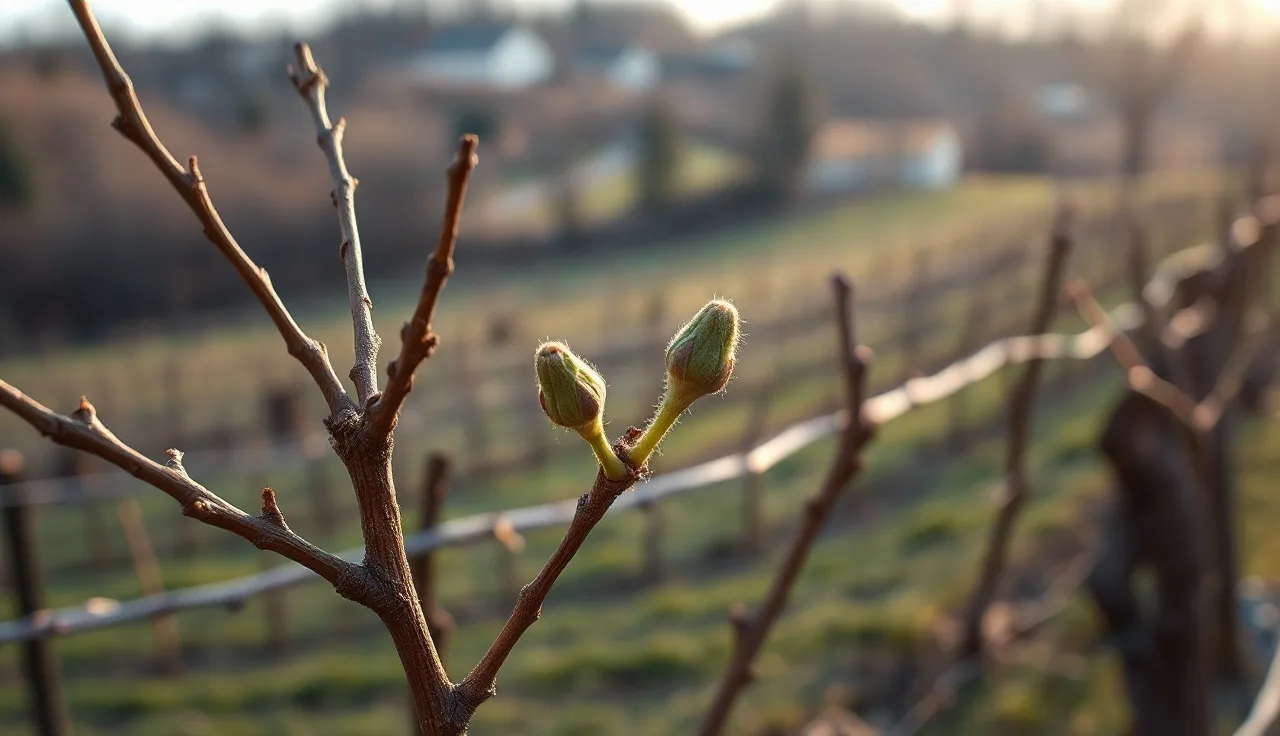
Bud break is the moment when dormant buds on grapevine canes swell, crack their scales, and show the first green tissue, what viticulturists call 'wool' or 'bud swell' through to 'green tip.' It marks the official end of dormancy and the start of the growing season. From that day forward, the vine is committing energy to shoot growth, and the nascent flower clusters inside those buds are now exposed to the world.
Timing matters because Virginia's biggest single-season risk arrives immediately after bud break: spring frost. A vine that has broken dormancy has no way to pull back. Frost events at or below 28°F for more than 30 minutes can kill primary buds, and if temperatures hit the low 20s, secondary buds go too. According to Virginia Cooperative Extension, frost damage to primary buds is the leading cause of crop loss in Virginia vineyards in most years [1].
Get the timing right and you can make intelligent decisions: whether to delay pruning to protect late-breaking secondary buds, whether to budget for frost protection equipment, and when to schedule your first fungicide application. Get it wrong and you chase the season all year.
When does bud break typically happen across Virginia's wine regions?
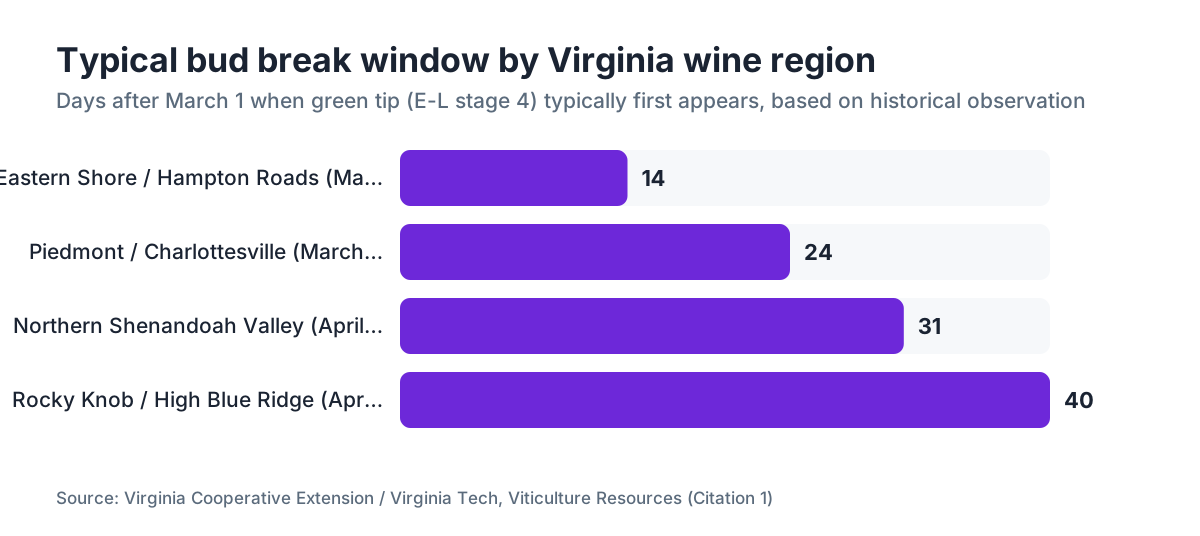
Bud break in Virginia runs from mid-March on the milder Eastern Shore to late April on high Blue Ridge sites. The state's wine regions span elevations from near sea level to over 2,000 feet, and that spread matters more than most people expect.
The Piedmont AVA and areas around Charlottesville sit at 400 to 700 feet, have moderate springs, and often see Chardonnay and Merlot buds break anywhere from late March to the first week of April in a typical year [1]. The Northern Shenandoah Valley AVA, which includes the area around Front Royal and Woodstock, tends to run about one to two weeks behind the Piedmont because of cold air drainage into the valley floor.
The Eastern Shore and Hampton Roads region is a different animal entirely. Maritime influence keeps winters milder, and bud break on some sites there can happen in mid-to-late March, sometimes earlier than growers inland would expect. Rocky Knob and the higher Blue Ridge sites (above 2,000 feet) are typically the latest, sometimes not breaking until late April on cold-hardy varieties.
Think of it as a rough calendar:
| Region | Typical Bud Break Window | Key Risk Period |
|---|---|---|
| Eastern Shore / Hampton Roads | March 15 to April 1 | Late March through mid-April |
| Piedmont / Charlottesville | March 25 to April 10 | Late March through late April |
| Northern Shenandoah Valley | April 1 to April 15 | Early to late April |
| Rocky Knob / High Blue Ridge | April 10 to April 25 | Mid-April through early May |
These windows are approximations built from historical observation, not guarantees. Any given year can push the whole range two weeks earlier or later [1][2].
How do growing degree days predict bud break more reliably than calendar dates?
Growing degree days (GDD) beat calendar dates because they respond to actual weather, not the number on the wall. The formula is simple: GDD = ((daily high + daily low) / 2) - base temperature. For grapevines the base is typically 50°F (10°C), meaning any day where the mean temperature falls at or below 50°F contributes zero heat units. You start accumulating from a fixed date, usually January 1 or March 1.
Research from Cornell's New York State Integrated Pest Management program and supporting data from Virginia Cooperative Extension both point to roughly 50 GDD base 50 (accumulated from March 1) as the threshold at which most Vitis vinifera varieties show green tip [2][3]. Early-breaking varieties like Chardonnay and Pinot Noir can push at 30 to 40 GDD. Cabernet Franc and Merlot tend to be closer to 50 to 70 GDD. Cold-hardy interspecific hybrids like Vidal Blanc and Traminette often require 70 to 100 GDD because they were bred to hold dormancy longer.
You can pull daily temperature data from the nearest NOAA weather station or, better yet, from an on-site data logger. The Virginia Vineyard Degree Day calculator maintained through Virginia Cooperative Extension lets you input your station data and get running GDD totals by week [1]. If you're tracking multiple blocks with different varieties, keeping that log by block is worth the fifteen minutes a week it takes.
Here's why the math matters. A warm February followed by a cold March can delay bud break past its historical average. A February cold snap followed by a warm early March can accelerate it. The calendar sees neither of those. GDD captures both.
Which Virginia grape varieties break bud earliest and which are latest?
Within the common Virginia variety mix, early bud break varieties carry the highest frost risk because they're exposed sooner. Late-breaking varieties buy you time, but some of them give up quality potential in shorter-season sites.
Early breakers (tend to break first, highest frost risk):
- Chardonnay
- Pinot Noir
- Pinot Gris
- Albariño
Mid-season breakers:
- Cabernet Franc
- Merlot
- Petit Verdot
- Viognier
- Sauvignon Blanc
Late breakers (more inherent frost protection from delayed phenology):
- Cabernet Sauvignon
- Tannat
- Vidal Blanc
- Traminette
- Norton (Cynthiana)
Norton is worth calling out specifically. It's Virginia's signature native variety and one of the latest to break bud among commonly grown cultivars, sometimes two to three weeks behind Chardonnay at the same site. That's one practical reason it performs well across so many Virginia soils and elevations: it simply dodges more frost events by sleeping later [1].
One thing growers often miss: the same variety can vary by up to seven to ten days between clones. Some Chardonnay clones (particularly Dijon 96 and 277) break notably earlier than older California heat-clone selections. If you're managing a mixed-clone block, the first clone to break is the one that sets your frost-protection schedule.
What spring frost risk follows bud break in Virginia, and how bad is it?
Virginia's average last frost date (at 32°F) ranges from around March 25 in the far southeast to May 5 or later at higher elevations in the Blue Ridge and Allegheny mountains [4]. That overlap between bud break timing and likely frost events is not occasional. It's the defining tension of Virginia viticulture.
At bud break (green tip through woolly bud stages), primary buds can tolerate temperatures down to about 28°F for short durations. Once shoots are 1 to 3 inches long, damage begins at 30°F. Full shoot development (6-plus inches) can sustain injury at 32°F [1]. The Virginia Cooperative Extension publication 'Frost and Freeze Protection for Vineyards' has a detailed table by phenological stage and temperature threshold.
Active frost protection options used in Virginia include wind machines (effective to about minus 5°F of inversion lift, most useful on sites with strong inversions), overhead irrigation (works by releasing latent heat as water freezes, typically requires 0.1 inches per hour flow rate or more), heaters and smudge pots (largely phased out due to cost and smoke), and passive site selection. Of these, wind machines are the most common capital investment in Virginia's mid-size commercial vineyard sector, though nobody has good published data on exactly what percentage of Virginia acreage is protected by them.
Passive strategies matter too. Delaying dormant pruning until just before, or even slightly after, bud break forces the vine's energy into the outermost buds last, slowing the effective break of the buds you want to protect. Some growers in the Shenandoah call this 'late-pruning for frost avoidance' and report anecdotally that it can delay vulnerable shoot emergence by three to five days.
How do I track and record bud break for my vineyard records?
A bud break log isn't just good practice. In Virginia, if you're applying pesticides commercially, your spray records must include application timing relative to crop growth stages, a requirement that flows from the EPA Worker Protection Standard (WPS) and Virginia Department of Agriculture and Consumer Services (VDACS) pesticide record-keeping rules [5][6]. Growth stage at application (green tip, half-inch green, etc.) needs to be documented for any restricted-use pesticide application, and some state compliance audits will ask for it.
A minimal bud break record should capture: the date of first observation, the variety and block, the phenological stage at observation (using the standard Eichhorn-Lorenz scale, E-L stage 4 is green tip, E-L stage 5 is woolly bud, E-L stage 7 is first leaf unfolding), and the GDD accumulated as of that date. Take a photo, stamp it with metadata, and attach it to the block record. That photo alone has resolved more than one compliance question.
For vineyards managing multiple blocks with different varieties, a tracking spreadsheet by block makes this much easier to keep up consistently. Tools like VitiScribe are built specifically to log phenology events, link them to spray records, and keep everything organized by block in a format that holds up to a compliance review. Dedicated software or a well-organized spreadsheet, either works, but the record needs to be legible, dated, and retained for the required period (at least two years for pesticide records under VDACS rules, and some federal programs require longer).
If you're in any Virginia Department of Agriculture cost-share programs or USDA EQIP conservation practices, bud break and phenology records may also support your documentation requirements for those programs.
How does climate variability affect bud break timing year to year?
The year-to-year swing in Virginia is real. Looking at historical weather data from NOAA stations around Charlottesville and the Piedmont, mean spring temperatures in March and April can vary by four to six degrees Fahrenheit between a cool year and a warm one. That translates to bud break swings of one to three weeks in the same vineyard from one season to the next [7].
The 2012 season is the cautionary example. A warm spring pushed bud break across much of Virginia's Piedmont into mid-to-late March, and the April 6 to 7 freeze that followed caused widespread primary bud loss for early-breaking varieties. Wineries across the state reported yield reductions of 40 to 80 percent in Chardonnay and Merlot that year. It was not a freak accident. It was the predictable consequence of early bud break coinciding with a late frost, a combination that historical records show happening roughly every four to seven years across the Piedmont [1].
Long-term, there's evidence that bud break in the eastern United States is trending earlier. A 2017 study published in Nature Climate Change found that spring phenology across North American wine regions advanced by an average of six days per decade between 1981 and 2009 [8]. That's a direction, not a rule, and year-to-year variability still dominates any single season's planning. But it does mean that planting decisions made today for cold-hardy or later-breaking varieties may look smarter in thirty years than they do now.
El Niño years tend to bring warmer, drier springs to the Mid-Atlantic, often speeding up bud break. La Niña years lean cooler and wetter in March and April, sometimes delaying it. These patterns are real but imperfect predictors. The three-month NOAA outlook is worth checking in January as you plan your frost-protection readiness.
What should I do immediately after bud break to protect the crop?
The week or two after bud break is one of the busiest stretches of the year. Several things need to happen in close sequence.
First, finalize pruning if you haven't already. Unpruned vines hold dormancy slightly longer, but once bud break is visible across the block, finish pruning fast. Leaving too many buds on a vine that has already broken wastes vine energy on shoots you'll remove anyway.
Second, get your frost monitoring in place. Check weather stations daily, subscribe to a frost alert service (Virginia Cooperative Extension's CSES department and some private services offer text alerts), and know your specific site's cold-air drainage patterns. Valley floor blocks can run five to seven degrees colder than a mid-slope block at the same elevation on a still, clear night.
Third, schedule your first fungicide application. Powdery mildew (Erysiphe necator) and downy mildew (Plasmopara viticola) both become active within a few weeks of bud break once temperatures are consistently above 50°F and rainfall begins. The recommendation from Virginia Cooperative Extension and the integrated pest management guides from Virginia Tech is to begin protectant fungicide applications at half-inch green (E-L stage 5) or at least by one-inch green [9]. The EPA WPS requires that restricted-use pesticide applicators hold current certification and that workers stay out of treated areas during the restricted entry interval (REI), which for many fungicides is four to 24 hours [5].
Fourth, document everything. Date, stage, GDD, what you applied and at what rate. That record protects you legally and agronomically.
How does elevation change bud break timing within a single Virginia vineyard?
A single Virginia vineyard with 300 feet of elevation change from its lowest block to its highest can have a five to ten day spread in bud break timing across the property [1]. Flat-ground growers don't always think about it, but Virginia's terrain makes it genuinely relevant.
Cold air is denser than warm air and flows downhill like water on a still night. Valley floors and low-lying blocks accumulate cold air, which keeps vine temperatures lower, slows heat accumulation, and delays bud break. Mid-slope blocks warm faster, break earlier, and, ironically, also benefit from cold air draining past them on frost nights. Top-of-ridge blocks can be windier (which causes desiccation and can slow spring green-up) but often have better frost drainage.
Practically, this means you should track GDD by block, more than from a single on-site weather station, if your vineyard has meaningful topographic variation. A weather station at one corner of the property can misrepresent conditions in a frost pocket fifty yards away by three to five degrees on a clear, calm night. If you've had unexplained frost damage in specific blocks, a second inexpensive data logger in that block for one season will often explain everything.
Site selection for future plantings should account for this. The vineyard planning literature from both Virginia Cooperative Extension and Washington State University Extension consistently treats cold air drainage as a site selection criterion at least as important as soil type [1][10].
Are there online tools and resources to forecast bud break in Virginia?
Yes, and a few of them are genuinely good.
Virginia Cooperative Extension's viticulture team, based primarily at Virginia Tech, publishes growing degree day tracking tools and regular updates during the growing season through their online resources and county extension offices [1]. The Pest Management Guide for Grapes, updated annually and available through the Virginia Tech publication system, includes GDD-based spray timing that references bud break as a starting anchor.
NOAA's National Centers for Environmental Information and Climate Services portal provide historical climate normals and real-time weather station data for stations across Virginia. You can pull daily high/low data for any active NOAA cooperative observer station near your vineyard and calculate GDD yourself in a spreadsheet [7].
Cornell's Network for Environment and Weather Applications (NEWA) covers parts of the Mid-Atlantic and has disease models keyed to phenological stages [3]. It was built primarily for New York and the Northeast, but several Virginia growers use it for their mildew and black rot timing models.
The National Phenology Network (USA-NPN) publishes lilac and grape bud break maps each spring that update in near-real-time based on observer reports and satellite indices. These are useful for seeing where bud break is happening regionally and whether your block is on schedule [11].
For your own records, set up a simple GDD tracker in a spreadsheet or use purpose-built vineyard management software to keep running totals by block. Consistency matters more than the specific tool.
What do other wine regions' experiences teach Virginia growers about managing bud break risk?
Virginia growers can learn a lot from programs in regions with similar climates. The Finger Lakes in New York has a long history of managing early bud break risk on steep lake-slope sites where cold air drainage is aggressive and spring frosts are regular [3]. Cornell's IPM program there has produced practical guides on delayed pruning and frost-protection economics that apply directly to Virginia conditions.
Washington State University's wine grape research program, focused mainly on Eastern Washington, deals with a different kind of frost risk (fall frosts on late-ripening varieties), but their phenology tracking methods and GDD-based prediction tools transfer well and are documented in detail [10]. WSU's ViticultureWiki is one of the cleaner free resources for understanding bud development stages with photographic references.
France's Bordeaux region has perhaps the most developed long-term phenology database in the world, and studies from INRAE using that data have documented the relationship between winter chilling hours, spring heat accumulation, and bud break date going back to the 1950s. That research underpins much of what we understand about bud break timing in V. vinifera varieties, including the ones Virginia grows most [8].
The practical takeaway from all of these programs is the same. Growers who track their own site-specific data for five or more years end up with better predictions for their microclimate than any regional average can give them. Your own five years of block-level bud break dates and concurrent weather data is worth more than any published table.
For Virginia-specific compliance and recordkeeping as you build that multi-year dataset, a tool like VitiScribe keeps phenology logs, spray records, and GDD tallies in one place without rebuilding spreadsheets each season.
Frequently asked questions
What temperature triggers bud break in Virginia grapevines?
There's no single temperature that flips a switch. Bud break is driven by accumulated heat units above a 50°F base temperature, not one warm day. Most Virginia vinifera varieties break at roughly 50 growing degree days (base 50°F) accumulated from March 1. Sustained daily mean temperatures in the high 50s and 60s over one to two weeks are typically what gets you there.
Can I delay bud break to reduce frost risk in Virginia?
You can't fully delay it, but you can slow it modestly. Delaying dormant pruning until just before or at green tip forces the vine to push energy into all potential buds before concentrating on the remaining ones, slowing visible bud break by three to seven days. Evaporative cooling via overhead sprinklers on warm late-winter days has been tested but is not widely proven at commercial scale in Virginia.
How early can bud break happen in a warm Virginia winter?
In extreme warm years, isolated early bud break on south-facing slopes in the Piedmont or Eastern Shore has been observed in early to mid-March. The 2012 season was a notable example where Chardonnay in some Piedmont blocks broke in mid-to-late March, well ahead of the historical average, and was then hammered by a late frost on April 6 to 7.
What's the difference between bud swell and bud break, and which stage is most frost sensitive?
Bud swell (E-L stage 1 to 3) is when the bud enlarges but no green tissue is visible. Bud break (green tip, E-L stage 4) is when green tissue first shows. Woolly bud (E-L stage 5) and first leaf unfolding (E-L stage 7) follow quickly. Damage potential increases with each stage: green tissue is more frost sensitive than swollen but still-closed buds, and the vulnerability rises sharply once shoots are 1 to 3 inches long.
Do hybrid grape varieties break bud later than vinifera in Virginia?
Generally yes. Cold-hardy hybrids like Norton, Vidal Blanc, and Traminette tend to break one to two weeks later than early vinifera varieties like Chardonnay or Pinot Noir at the same site. This is partly a product of their breeding: they were selected for winter hardiness, which often correlates with later spring phenology. It's one reason Norton performs consistently well across Virginia's variable spring climate.
How does elevation affect bud break timing in Virginia vineyards?
Higher elevation generally means cooler temperatures and later bud break, but it's more complicated than a straight altitude relationship. Cold air drainage on clear, still nights pools in valleys and low spots, keeping those blocks colder and sometimes delaying bud break there compared to mid-slope blocks. A single vineyard with 300 feet of elevation change can have a five to ten day spread in bud break timing between blocks.
What growing degree day total marks bud break for Cabernet Franc in Virginia?
Cabernet Franc is a mid-season breaker and typically shows green tip in the range of 50 to 70 GDD (base 50°F, accumulated from March 1) in Virginia. That's a week or so behind Chardonnay in most years. It's one reason Cabernet Franc has become Virginia's signature red variety: it breaks late enough to dodge many early frosts but early enough to ripen fully in most seasons.
What spray applications should I make right at bud break in Virginia?
Protectant fungicide applications for powdery mildew and downy mildew should begin at half-inch green (E-L stage 5) or no later than one-inch green. Sulfur-based fungicides are common at this early stage. If botrytis has been a problem in the vineyard, a protectant at early shoot growth is also warranted. Always record the growth stage at application for pesticide compliance records required under VDACS and the EPA Worker Protection Standard.
How do I find the last frost date for my specific Virginia vineyard location?
NOAA's Climate Services portal and the nearest cooperative weather observer station are the best starting points for historical last frost probability data by date. Virginia's last frost date at 32°F ranges from around March 25 near the coast to May 5 or later at high elevations. Your specific site may differ from the nearest station, especially if you're in a frost pocket or on a well-drained slope.
Does Virginia Cooperative Extension have resources specifically on grape bud break and spring frost?
Yes. Virginia Cooperative Extension, through Virginia Tech's Department of Horticulture, publishes viticulture resources including the annual Pest Management Guide, variety-specific phenology references, and frost protection guidance. Their viticulture agents in wine-grape-producing counties (Augusta, Nelson, Rappahannock, and others) can also provide site-specific advice and on-farm consultations.
How many days does Virginia typically have between bud break and the last frost date?
This is the core problem. In the Piedmont, average bud break for Chardonnay falls around late March to early April, while the average last frost date at 32°F is around April 10 to April 20 at most Piedmont sites. That leaves a two to four week window of overlap. In some years the gap is zero; frost arrives right at bud break. In good years, the last frost precedes bud break entirely.
Should I keep bud break records for vineyard compliance purposes in Virginia?
Yes, and it's practical for more than compliance. Pesticide record-keeping under VDACS rules requires documentation of application timing, and growth stage at application is a standard field for restricted-use pesticide records. The EPA Worker Protection Standard also requires that spray records be maintained. Linking your phenology log to your spray log by block date makes audits straightforward and helps you refine timing decisions in future seasons.
How does the Shenandoah Valley's bud break timing compare to the Piedmont in Virginia?
The Northern Shenandoah Valley AVA typically runs about one to two weeks behind the Piedmont for vinifera bud break, mainly because of cold air drainage into the valley floor on clear spring nights. Sites on the valley's slopes and ridgelines can break closer to Piedmont timing. The Southern Shenandoah (around Staunton and south) has characteristics somewhere between the two, varying considerably by site elevation and aspect.
Sources
- Virginia Cooperative Extension / Virginia Tech, Viticulture Resources: Frost damage to primary buds is the leading cause of crop loss in Virginia vineyards; bud break timing by region and variety; cold air drainage as a site selection criterion.
- Virginia Cooperative Extension, Pest Management Guide for Grapes: Approximately 50 GDD (base 50°F from March 1) as threshold for green tip in most V. vinifera varieties grown in Virginia.
- Cornell University, New York State Integrated Pest Management Program: GDD-based bud break prediction thresholds for vinifera varieties; delayed pruning for frost avoidance; disease model timing keyed to phenological stages.
- NOAA National Centers for Environmental Information, Climate Normals: Virginia average last frost dates (32°F) ranging from approximately March 25 in the southeast to May 5 or later at high elevations.
- U.S. EPA, Worker Protection Standard for Agricultural Pesticides: Restricted-use pesticide applicators must have current certification; workers must be excluded during restricted entry intervals; spray records must be maintained.
- Virginia Department of Agriculture and Consumer Services, Pesticide Regulation: Virginia pesticide record-keeping requirements include application timing and growth stage for restricted-use pesticides; records must be retained at least two years.
- NOAA Climate.gov, Historical Weather Data: Mean spring temperatures in March and April around Charlottesville vary by four to six degrees Fahrenheit between cool and warm years, translating to bud break swings of one to three weeks.
- Nature Climate Change, spring phenology advancement literature (Wolkovich et al. and related, 2017 era): Spring phenology across North American wine regions advanced by an average of six days per decade between 1981 and 2009.
- Virginia Tech, Integrated Pest Management for Grapes in Virginia: Recommendation to begin protectant fungicide applications at half-inch green (E-L stage 5) or by one-inch green for powdery and downy mildew management.
- Washington State University Extension, Wine Grape Viticulture: Cold air drainage as a key site selection criterion; phenology tracking methods and GDD-based prediction tools for wine grape production.
- USA National Phenology Network (USA-NPN): Near-real-time bud break maps for grape and indicator plant species updated each spring based on observer reports and satellite indices.
Last updated 2026-07-09