When do grapes have bud break in zone 5? A grower's guide
TL;DR
- In USDA hardiness zone 5, most grape varieties reach bud break between late April and mid-May, depending on the cultivar and the year's accumulated heat.
- Cold-hardy varieties like Somerset Seedless break a few days to a week ahead of Vitis vinifera types.
- A late frost after bud break is the main risk, and your management should start before the buds even swell.
What is bud break in grapes and why does it matter?
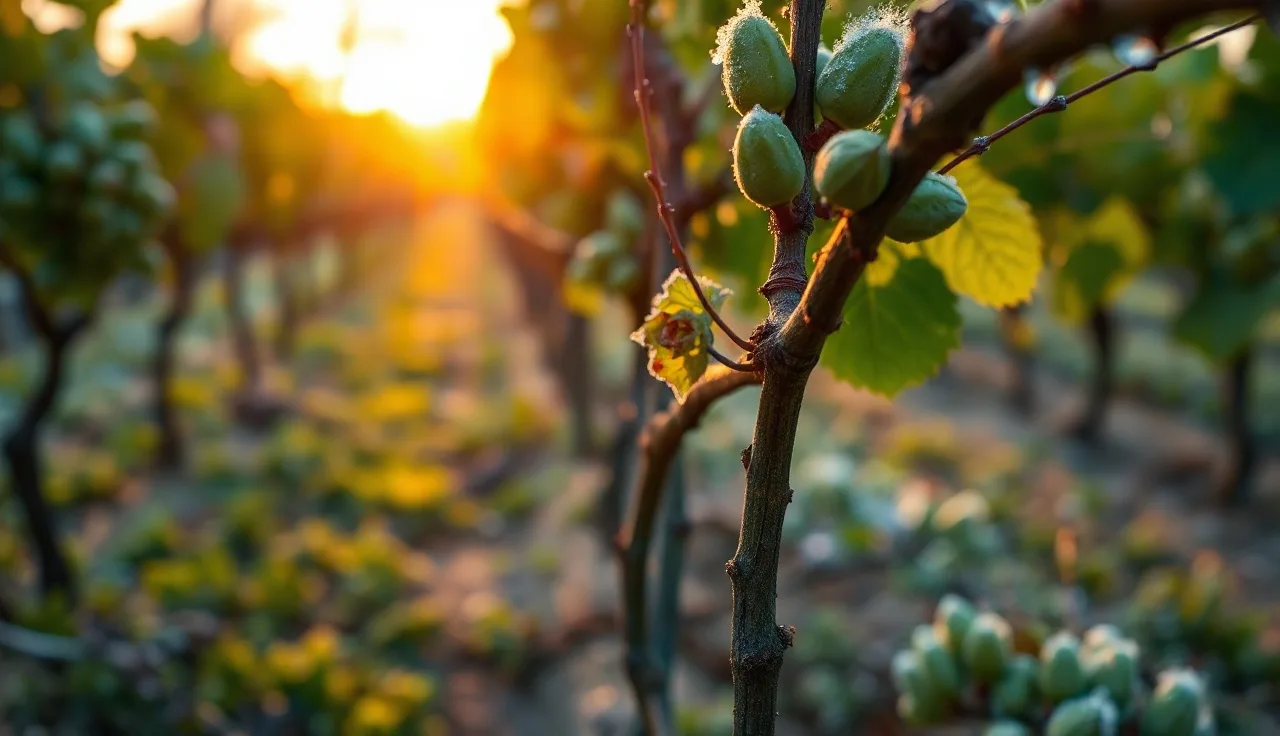
Bud break is the moment a dormant grape bud swells, splits its brown scales, and shows the first green tissue. It's more than a phenology milestone to admire. It's the point where your vine goes frost-vulnerable again after winter, and your whole early-season spray program, frost plan, and canopy calendar pivots from that one date.
Before bud break, dormant canes can survive temperatures well below zero, depending on the variety. Once the bud pushes green tissue, that same shoot can die at 28°F, or even at 32°F if it's developed far enough. Cornell University's viticulture program puts the critical damage threshold for newly emerged shoots at around 28°F for less than 30 minutes, and notes that brief exposure to 30°F can cause partial shoot kill once the green tip is out [1].
For a zone 5 vineyard manager, this transition is the highest-stakes week or two of the season. Get it right and you have a crop. Get surprised by a forecast that turned colder than predicted, and you're looking at partial or total crop loss for the year.
When exactly does bud break happen in zone 5?
Bud break in zone 5 usually lands between April 20 and May 15, with a median around May 1 to May 7 for most hybrid varieties. The exact date rides on accumulated heat, not on winter cold, so a warm March pulls it early and a cold April shoves it late.
Zone 5 covers a broad stretch of the US, roughly the northern Midwest, interior New England, and parts of the mid-Atlantic highlands, where average annual minimum temperatures fall between -20°F and -10°F [2]. That zone boundary tells you about winter survival. It tells you nothing about spring timing.
The standard metric is growing degree days (GDD), usually base 50°F. Grape bud break in the northern US typically begins when vines accumulate roughly 50 to 100 GDD (base 50°F) after March 1 [3]. Historical data from Cornell's mesonet and extension observation networks puts the median bud break date for most hybrids in zone 5 at around May 1 to May 7 [1].
Vitis vinifera varieties planted in zone 5 microclimates tend to break a little later, partly because growers bury or heavily mulch them and slow the soil warming, and partly because the varieties respond to heat at slightly different rates.
Here's the practical line: have your frost protection ready by April 15, and don't assume you're clear until May 20. The years when everything goes perfectly aren't the years you'll remember. The May 10 frost after an early bud break is the one that costs you the crop.
When do Somerset grapes have bud break in zone 5?
Somerset Seedless reaches green tip around April 22 to May 5 in zone 5, which makes it one of the earliest-breaking cold-hardy grapes you can plant. It's a pink-fruited table grape from Elmer Swenson's breeding work, released through the University of Minnesota program, and it survives without burial at -20°F or below on a good site [4].
That early break is the double edge of this variety. Its cold hardiness protects the cane through winter, but the early green tip raises frost exposure at exactly the moment the tissue is most fragile. In a warm spring it can go even sooner.
Growers in Minnesota and Wisconsin report Somerset at green tip by April 25 in warmer vintages, with Marquette, LaCrescent, and other University of Minnesota varieties following within a week [4]. If you grow Somerset next to wine grapes like Marquette or Frontenac, treat the Somerset rows as your early-warning gauge. When those buds show color, pull up your 10-day forecast and turn on your frost plan.
The University of Minnesota Extension recommends checking soil temperature at 4-inch depth alongside air temperature, because bud break timing tracks soil warming past 50°F closely across varieties [4]. A soil thermometer you read every morning during this window costs almost nothing and tells you more than a calendar date ever will.
What triggers bud break and how do growing degree days work?
Two things have to happen before bud break. The vine has to finish its chilling requirement (endodormancy), and then it has to bank enough warmth to trigger active growth. Zone 5 winters satisfy the chilling requirement for basically every commercial variety, usually by late December or early January. After that it's purely a heat question.
Growing degree days (base 50°F) get calculated daily. Take the average of the day's high and low, subtract 50, and count any positive result. A day averaging below 50°F contributes zero. You start the running total on March 1, the most common start date for viticulture GDD tracking in the northern US, and watch the number climb.
Washington State University's extension viticulture team has published GDD benchmarks for key stages. Bud break typically falls between 50 and 150 GDD (base 50°F) accumulated from March 1, with flowering around 300 to 400 GDD and veraison near 1,000 GDD [3]. These are population averages across varieties, so a single cultivar can shift the numbers 20 to 30 GDD either way.
To put this to work, pull the nearest NOAA weather station data or use a state mesonet (Cornell's is very good for New York and reads across to similar climates) and track your own site's GDD from March 1. After two or three seasons you'll know whether your site runs warm or cold against the regional average, and you can set your frost alert calendar off that instead of a generic date.
One warning: GDD from March 1 is not the Winkler index, which runs April 1 to October 31. Both use base 50°F, so it's easy to mix them up when reading extension bulletins, but the threshold numbers are completely different between the two.
How does zone 5 compare to other zones for bud break timing?
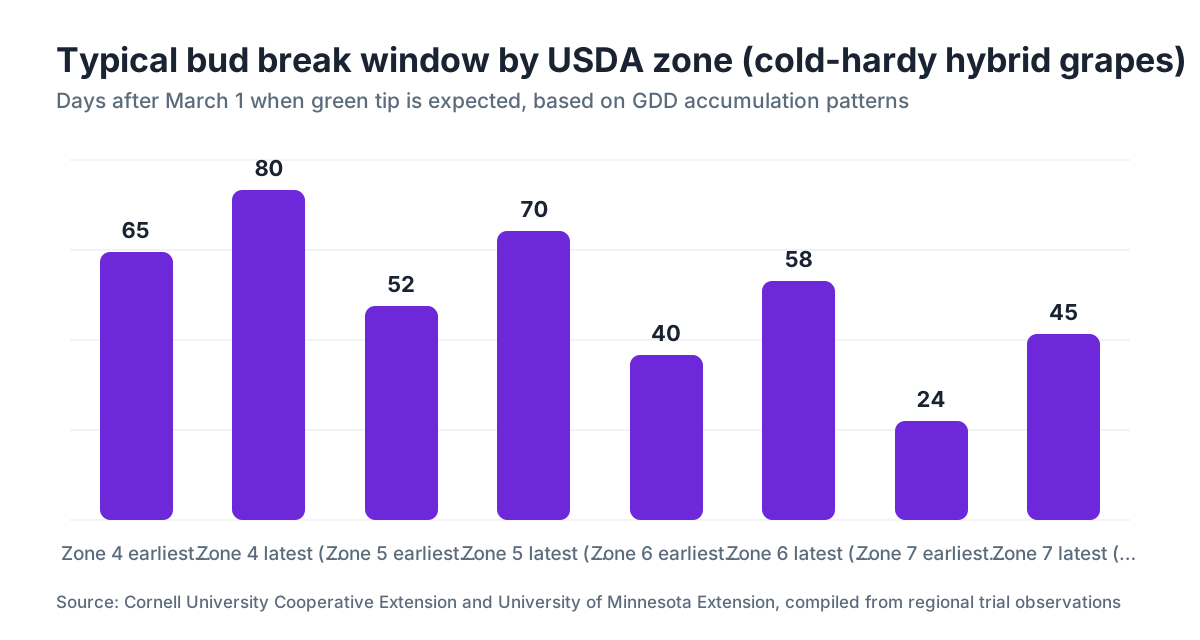
Bud break moves about two weeks per zone. Zone 5 hybrids break around April 22 to May 10; zone 6 runs roughly two weeks earlier; zone 4 runs about two weeks later. Here's how the timing shifts across zones for common cold-hardy hybrids, drawn from Cornell [1], University of Minnesota [4], and WSU [3] observation data.
| USDA Zone | Typical Winter Min °F | Avg Bud Break (hybrid varieties) | Frost Risk Window |
|---|---|---|---|
| Zone 4 | -30 to -20°F | May 5 to May 20 | May 5 to June 1 |
| Zone 5 | -20 to -10°F | April 22 to May 10 | April 15 to May 20 |
| Zone 6 | -10 to 0°F | April 10 to April 28 | April 1 to May 10 |
| Zone 7 | 0 to 10°F | March 25 to April 15 | March 15 to April 25 |
The frost risk window runs two to three weeks past expected bud break, because late frosts in these zones aren't rare. NOAA historical frost probability data for zone 5 cities like Chicago, Columbus, and Albany shows a 10% chance of frost at or below 32°F as late as May 10 to May 20, depending on the exact location [5].
Moving from zone 5 to zone 6 buys you about two weeks of earlier bud break, but it drags your frost risk window earlier by roughly the same amount. Crop safety comes out similar between the two, which is why frost management matters just as much in zone 6 as it does in zone 5.
What cold-hardy grape varieties break bud earliest in zone 5?
Somerset Seedless and Edelweiss break earliest in zone 5, both around late April. Frontenac follows around May 1 to May 8, Marquette and LaCrescent around May 3 to May 10, and Vidal Blanc trails at May 8 to May 15. This ordering matters because earlier bud break means more frost exposure, and later bud break can mean the fruit runs out of season before it ripens in zone 5's short summer.
There's a real tension there, and growers work it every year.
The University of Minnesota grape breeding program has published phenology data on its varieties from trials in Minnesota and Wisconsin [4]. Somerset is among the earliest. Edelweiss (another Swenson introduction) breaks very early too, often a day or two behind Somerset. Frontenac comes slightly later, La Crosse and St. Croix sit mid-range, and Vidal Blanc, grown in zone 5 with protection, breaks late.
If you want to spread your frost risk, plant a mix of early- and late-breaking varieties. If a late frost hammers the early buds, the later-breaking blocks may come through. That's not a guarantee. It's a real risk-reduction move that plenty of zone 5 commercial growers make on purpose.
Nobody has clean large-scale data comparing bud break dates across every cold-hardy variety under identical conditions. The closest thing is the University of Minnesota's trial data from its Horticultural Research Center at Excelsior, MN, which is the most rigorous published source out there [9].
How do you protect grape buds from frost in zone 5?
Once bud break is close, your frost options are: do nothing and accept the risk, run overhead irrigation, run wind machines, burn smudge pots or propane heaters, or drape row covers on young or low-trained vines. Overhead irrigation is the most effective at commercial scale, and wind machines are the most practical for most zone 5 late frosts.
Overhead irrigation works because water releases latent heat as it freezes, holding the ice-coated tissue at 32°F. As long as you keep applying enough water to maintain continuous ice formation, the tissue underneath stays alive. Cornell's extension team documents the required application rate at roughly 0.1 inches per hour minimum for drops to 25°F, with higher rates for colder events [1]. The catch is real: you have to start before the temperature hits 32°F, run continuously until it climbs back above freezing, and hold your water pressure and coverage the whole time. If the system quits mid-event, partially ice-coated tissue can end up worse off than if you'd done nothing.
Wind machines pull warmer air from the inversion layer down onto the canopy. They shine in radiation frost events (calm, clear nights) and do almost nothing in advective frost (cold front wind events). Most zone 5 late spring frosts are radiation frosts, so wind machines earn their keep here. A single machine protects 10 to 30 acres depending on terrain, and installed pricing runs roughly $15,000 to $40,000, a real number for a small operation [1].
Row covers (floating fabric draped over the trellis) give you 2°F to 4°F. That's enough to save a borderline frost and useless in a hard freeze. On young vines or low-spur systems they're practical. On a high-wire system across 200 acres, forget it.
If you track spray timing and frost events together, a decent field records system saves real time. VitiScribe lets you log frost events, bud break dates, and protection activities in the same place as your spray records, which matters when you're trying to reconstruct two years later what actually happened on May 3rd.
How do you time your first spray application to bud break in zone 5?
Your first fungicide goes on at green tip if wet weather is in the forecast, targeting phomopsis cane and leaf spot. Too early and you spray with no target tissue. Too late and you miss the preventive window for early-season disease. Both mistakes cost you.
Phomopsis is the main worry at and just after bud break. The pathogen overwinters in infected wood and starts releasing spores at green tip, with peak infection during wet stretches from green tip through 1-inch shoot growth. UC Davis plant pathology guidance, which reads across to cool northern climates, recommends the first protectant fungicide at green tip when wet weather is forecast [6]. So you're watching the calendar and the forecast at the same time, starting about two weeks before expected bud break.
The EPA Worker Protection Standard (WPS) applies to every pesticide application on agricultural land, including small commercial vineyards. Under the current rule (revised, effective January 2, 2017), workers must get safety training before they enter treated areas, and the restricted-entry intervals (REIs) on the label have to be observed [7]. The REI depends on the product, not the crop, so check the label of everything you plan to use at bud break. Captan, mancozeb, and copper fungicides are common at this timing and carry REIs from 24 to 48 hours [10].
Dormant oil for scale insects and grape berry moth egg masses is a different story. That goes on before bud swell, not after. Dormant oil applied at or after green tip burns the tissue. If you missed the dormant oil window, skip it for the year rather than risk the opening buds [10].
How does site selection affect bud break timing in zone 5?
Same zone, two different sites, and bud break can vary by 10 to 14 days. Cold air is dense and pools in low spots, so a ridge or slope vineyard in zone 5 can act phenologically more like zone 6 on warm spring days, while a low-lying site at the same latitude stays cold and breaks later. Sometimes that delay is a gift, because it drops your frost exposure after the buds open.
South-facing slopes bank heat faster and break bud earlier. North-facing slopes do the reverse. Proximity to large water bodies (the Great Lakes are the big ones in zone 5) moderates temperature, slows spring warming, and delays bud break by one to two weeks against inland sites at the same latitude [1]. That's the Lake Effect working for you in spring, even though it's better known for winter snow.
Soil matters too. Dark, well-drained soils soak up heat fast. Heavy clay stays cold longer. Sand warms quickly. If you're weighing two potential sites, the one with darker, better-drained soil on a gentle south-facing slope with good cold air drainage will generally reach bud break earlier and hand you a longer effective season, which counts for a lot in zone 5 where season length already pinches.
For a wider look at what goes into a well-run vineyard operation, see our vineyard overview.
How do you track and record bud break dates for future planning?
One bud break record is mildly useful. Five years from the same site is genuinely valuable. Ten years and you can see your site's normal range, spot the outlier seasons, and set a realistic risk calendar instead of guessing.
Record the date of first green tip on each variety, the GDD accumulated from March 1 to that date, the date of 50% bud break (half the buds on a representative vine showing green tissue), and every frost event with its minimum temperature and duration. Note whether you had crop injury, and if so, roughly what percent of shoots got hit.
That data does several jobs. It tells you whether your site runs early or late against the regional average. It lets you calibrate spray timing to your actual phenology instead of a generic calendar. And it gives you documentation if you work with a crop insurance program, because most federal grape policies want production records and some want phenology documentation for frost loss claims [8].
USDA Risk Management Agency (RMA) covers grapes under the Actual Production History (APH) program in many zone 5 states. Clean records of bud break dates and frost events make any claim you file stronger [8]. VitiScribe was built for exactly this kind of field record keeping, holding phenology events, spray applications, and weather notes in a form you can pull up fast when you need it.
For an example of what organized vineyard recordkeeping looks like on the ground, the Gervasi Vineyard operation in Ohio, solidly in zone 6a but close to the zone 5 boundary, comes up often in regional viticulture discussions for its documented approach to seasonal operations.
What are the biggest mistakes zone 5 growers make at bud break?
The most common mistake is not watching the 10-day forecast starting April 15. Growers know bud break is coming but treat it as one event instead of a multi-week vulnerability window. The risk doesn't end when the buds pop. It runs until shoots are several inches long and the secondary buds (the ones that can rescue partial crop after a primary bud kill) have cleared their most fragile stage.
Pruning too late is the opposite error, and it's more interesting. Delayed pruning can actually push bud break slightly later on the pruned canes because you remove the apical dominance that drives early growth. Some growers on frost-prone zone 5 sites leave extra canes unpruned until after the last frost date, then make a second pass. This is double pruning, and WSU extension has documented it delaying bud break by 7 to 14 days in some trial conditions [3].
Undervaluing variety selection is the long game mistake. If you're planting new vines, think hard about whether an early breaker like Somerset fits a frost-prone low-lying site. The cane's cold hardiness won't save you if the buds freeze every other May. Match the variety's bud break timing to your site's frost probability window before you worry about its cane hardiness rating.
Ignoring secondary buds after a frost is a planning mistake too. If primary shoots die, secondary and tertiary buds often push within 7 to 10 days. They're less fruitful, usually 50% to 70% of normal crop potential, but they're partial recovery. Cornell extension recommends waiting 10 days after a frost event before you assess final damage, because that secondary push changes the picture a lot [1].
Frequently asked questions
What is the average bud break date for grapes in USDA zone 5?
In most zone 5 locations, hybrid grape varieties reach bud break (green tip stage) between April 22 and May 10. The date depends on accumulated growing degree days (base 50°F) from March 1, not a fixed calendar day. A warm spring pulls it a week early; a cold one pushes it a week or more late. Track GDD from March 1 and expect bud break around 50 to 100 GDD accumulated.
When do Somerset Seedless grapes have bud break in zone 5?
Somerset Seedless usually reaches green tip between April 22 and May 5 in zone 5, one of the earliest breaks among cold-hardy varieties. Because it breaks early, frost exposure is a real risk even though the canes survive winter well. Use your Somerset rows as an early-warning gauge: when those buds show green, turn on your frost monitoring and protection plan right away.
What temperature kills grape buds after bud break?
Newly emerged grape shoots (green tip through half-inch stage) can suffer damage at 28°F held for 30 minutes or less. At the 1-inch shoot stage the threshold is similar but stretches to 29°F or 30°F depending on variety. Cornell University extension puts the critical damage temperature for young shoots around 28°F, with complete shoot kill possible at 25°F or below. Secondary buds generally survive to lower temperatures.
How do growing degree days predict grape bud break?
Calculate GDD daily by averaging the day's high and low and subtracting 50. Positive values accumulate from March 1. Most northern hybrid grapes reach bud break between 50 and 150 GDD (base 50°F) from March 1. After two or three seasons of tracking, you'll know whether your site runs warm or cold against the regional average, which beats any calendar-based estimate for planning.
Does late pruning delay bud break in zone 5?
Yes, on purpose. Double pruning (leaving extra canes through early spring, then finishing pruning after frost risk drops) can delay bud break by 7 to 14 days on the pruned canes. Washington State University extension has documented the practice. It cuts frost risk on your final crop canes but takes a second pass through the vineyard, and it pays off best where late frost is an annual problem rather than an occasional one.
What frost protection methods work best in zone 5 vineyards?
Overhead irrigation is the most effective at commercial scale, protecting tissue as freezing water releases latent heat. You need at least 0.1 inch per hour and must start before temperatures hit 32°F. Wind machines work well in radiation frost (calm, clear nights), the most common late-spring frost type in zone 5. Row covers give 2°F to 4°F, useful for small plantings but impractical across large high-wire systems.
What grape varieties survive zone 5 winters and still produce well?
University of Minnesota releases dominate zone 5 commercial planting: Marquette, Frontenac, LaCrescent, La Crosse, and Itasca are the most common wine varieties. For table grapes, Somerset Seedless and Edelweiss are widely grown. Vidal Blanc can survive zone 5 with careful site selection. Vitis vinifera varieties like Chardonnay and Cabernet Sauvignon generally need burial or heavy winter protection and stay high-risk without it.
When should I apply the first fungicide spray in zone 5?
The first fungicide for phomopsis cane and leaf spot goes on at green tip if wet weather (rain or long leaf wetness) is forecast. It's variety-specific: early breakers like Somerset can hit green tip in late April, while later varieties need it later. Don't spray on a fixed date. Watch the buds directly and apply a protectant fungicide from green tip through early shoot growth when infection-period weather is expected.
How does proximity to the Great Lakes affect bud break timing in zone 5?
Large water bodies like the Great Lakes slow spring warming in their immediate influence zone, often pushing bud break 1 to 2 weeks later than inland sites at the same latitude. That delay helps: by the time the buds open, the odds of a hard frost are lower. Lake-influenced sites in Michigan, Wisconsin, and New York often post better frost safety records than inland zone 5 sites at the same USDA classification.
Do I need to worry about EPA Worker Protection Standard rules during early-season spraying?
Yes. The EPA Worker Protection Standard applies to all pesticide applications on agricultural land, including small commercial vineyards. Workers must be trained before entering treated areas, and restricted-entry intervals (REIs) on product labels must be observed regardless of application size. REIs for common bud-break fungicides like captan and mancozeb run 24 to 48 hours. Check the label for every product, because REIs vary by product, not by crop stage.
How long after a frost event should I wait before assessing bud kill?
Wait at least 7 to 10 days before a final damage assessment. Primary bud kill can look total right after a frost, but secondary and tertiary buds often push within that window. Cornell University extension recommends the waiting period specifically because secondary recovery can deliver 50% to 70% of a normal crop even after complete primary shoot kill. Cutting canes to check internal tissue color helps, but don't write off the block until secondary push is confirmed.
Can I grow Vitis vinifera grapes in zone 5?
With serious effort, yes, but it's high-risk without burial or mounding. Vitis vinifera canes typically die at -15°F to -20°F, which falls inside zone 5's expected minimum range in any given decade. Most commercial zone 5 growers who run vinifera either bury the whole vine every fall (common in the northern Midwest) or accept periodic vine loss as a cost. The University of Minnesota recommends cold-hardy hybrids as the more reliable path for zone 5 commercial production.
What records should I keep about bud break for crop insurance purposes?
Record the date of green tip and 50% bud break by variety, GDD accumulated from March 1, any frost events with minimum temperature and duration, and observed crop damage percentage. USDA Risk Management Agency's Actual Production History program covers grapes in many zone 5 states, and documentation of frost events and phenology timing strengthens any claim. Date-stamped photos are useful supplemental documentation alongside written field records.
Sources
- Cornell University College of Agriculture and Life Sciences, Grapes and Viticulture Program: Critical damage threshold for newly emerged shoots is around 28°F for less than 30 minutes; median bud break for zone 5 hybrids around May 1 to May 7; overhead irrigation requires roughly 0.1 inches per hour minimum for drops to 25°F; wind machines protect 10 to 30 acres at roughly $15,000 to $40,000 installed; wait 10 days after frost before final damage assessment; Great Lakes proximity delays bud break 1 to 2 weeks.
- USDA Agricultural Research Service, USDA Plant Hardiness Zone Map: USDA zone 5 is defined by average annual extreme minimum temperatures of -20°F to -10°F.
- Washington State University Extension, Viticulture and Enology: Grape bud break typically occurs at 50 to 150 GDD base 50°F accumulated from March 1; flowering around 300 to 400 GDD; double pruning can delay bud break by 7 to 14 days in trial conditions.
- University of Minnesota Extension, Cold-Hardy Grape Varieties: Somerset Seedless, bred from Elmer Swenson's program, survives to -20°F without burial; monitoring soil temperature at 4-inch depth alongside air temperature correlates with bud break timing; cold-hardy hybrids are recommended over vinifera for zone 5 commercial production; Somerset among earliest to break, Marquette and LaCrescent within a week.
- NOAA National Centers for Environmental Information, Frost/Freeze Probability Data: Historical frost probability data shows 10% probability of frost at or below 32°F as late as May 10 to May 20 in zone 5 cities including Chicago, Columbus, and Albany.
- UC Agriculture and Natural Resources, Grape Pest Management: Phomopsis releases spores starting at green tip with peak infection during wet weather from green tip through 1-inch shoot growth; first protectant fungicide application recommended at green tip when wet weather is forecast.
- US EPA, Worker Protection Standard for Agricultural Pesticides: EPA WPS revised rule effective January 2, 2017 requires worker safety training before entering treated areas and observance of restricted-entry intervals stated on pesticide labels.
- USDA Risk Management Agency, Grape Crop Insurance (APH Program): USDA RMA covers grapes under the Actual Production History program in many zone 5 states; production records and phenology documentation support frost loss claims.
- University of Minnesota Landscape Arboretum, Horticultural Research Center, Excelsior MN: Phenology observations for Frontenac, Marquette, LaCrescent, and Somerset Seedless in Minnesota trials; Frontenac bud break around May 1 to May 8 in zone 5 conditions; Edelweiss among earliest to break.
- Cornell University, New York State Integrated Pest Management Program, Grape IPM Guidelines: Captan and mancozeb have 24 to 48 hour restricted-entry intervals; phomopsis management begins at green tip; dormant oil causes phytotoxicity when applied at or after green tip.
Last updated 2026-07-09