What temperature do grapes break bud in northern Nevada?
TL;DR
- Grapevines in northern Nevada start moving when average daily temperatures hold at 50°F (10°C), the base temperature for grapevine growing degree days.
- Bud break lands between late March and late April depending on elevation and variety.
- Frost risk runs into mid-May above 4,000 feet, which makes site selection and frost protection the two decisions that decide your crop.
What temperature triggers bud break in grapevines?
Grapevines start their biological clock when average daily air temperatures consistently exceed 50°F (10°C). That number is the base temperature for grapevine growing degree days (GDD), and it's the same threshold UC Davis, Washington State University Extension, and Cornell's viticulture program use to model vine phenology across North American wine regions. [1][2][3]
Bud swell, the first visible stage, can begin a little below that line on warm afternoons. True bud break, when green tissue is exposed and the season is genuinely underway, needs sustained warmth. You want several days running where the daily mean (high plus low, divided by two) clears 50°F before vines commit. One warm week in February followed by a cold snap won't push vines into full break. They stall and wait.
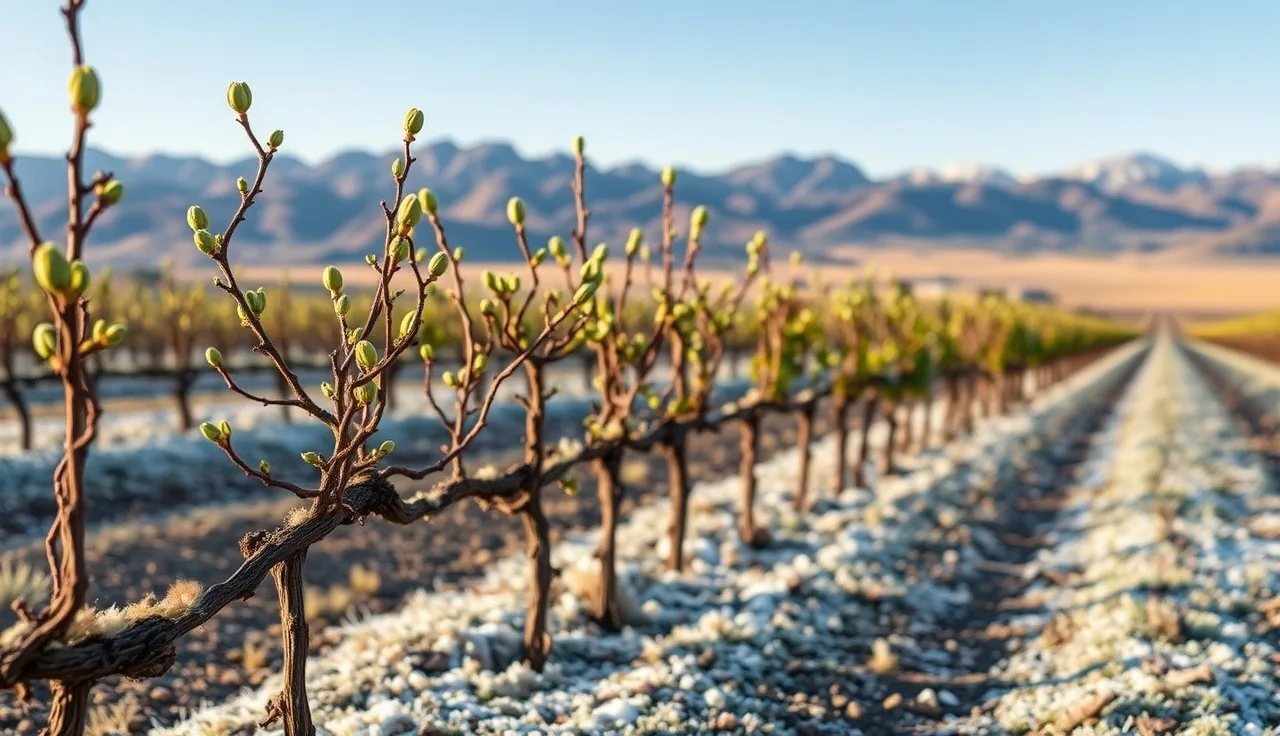
The literature breaks the process into named stages. The "woolly bud" stage (Eichhorn-Lorenz stage 4) is first visible swelling. "Green tip" (EL stage 5) is when green tissue pushes out from the bud scales. Most frost damage research measures injury starting at EL stage 5.
Once you're at green tip in northern Nevada, you have real money on the table every cold night until mid-May.
When does bud break happen in northern Nevada specifically?
Bud break in northern Nevada runs from the second half of March through late April at vineyard elevations, and elevation drives almost all of that spread. Reno sits at roughly 4,500 feet. The Carson Valley floor near Minden runs about 4,700 feet. The Tahoe-area foothills climb higher. A 500-foot rise can shift bud break by 10 days or more.
For vineyards between 4,200 and 5,000 feet in Washoe, Douglas, and Lyon counties, plan on green tip somewhere in that late-March-to-late-April window. The University of Nevada Cooperative Extension has documented that the Reno-Sparks corridor accumulates GDD slowly next to California's Central Valley, with the season effectively running May through October at higher sites. [4] A Cabernet Franc planted at 4,500 feet near Carson City usually hits green tip 3 to 4 weeks later than the same variety in Napa Valley.
South-facing slopes with good air drainage break earliest. North-facing blocks, frost pockets near the valley floor, and sites where cold air pools off surrounding terrain can lag by two weeks. If you're siting a new vineyard here, the single most useful data source is the Western Regional Climate Center's station data for Reno, Minden, and Yerington, which gives you daily min/max going back decades. [5]
Variety matters too. Early-ripening varieties like Gewurztraminer and Pinot Gris break ahead of mid-season Merlot or late Cabernet Sauvignon. That's partly a feature and partly a trap. Earlier break means more frost exposure in a region where the last killing frost can arrive in mid-May.
How do growing degree days work for northern Nevada vineyards?
Growing degree days get calculated daily: average the high and low, subtract 50°F, and add any positive result to your running total. A day with a high of 80°F and a low of 50°F gives you (80+50)/2 minus 50, which is 15 GDD. Negative results count as zero.
Northern Nevada wine regions accumulate roughly 2,000 to 2,800 base-50 GDD in a typical season at valley-floor elevations, which puts them in Winkler Region II to low Region III. [1] That's enough heat to ripen early and mid-season varieties, but marginal for late Cabernet Sauvignon most years. Higher sites above 5,000 feet may only reach 1,500 to 1,800 GDD, landing in Region I, better suited to Riesling and Pinot Noir than Cabernet.
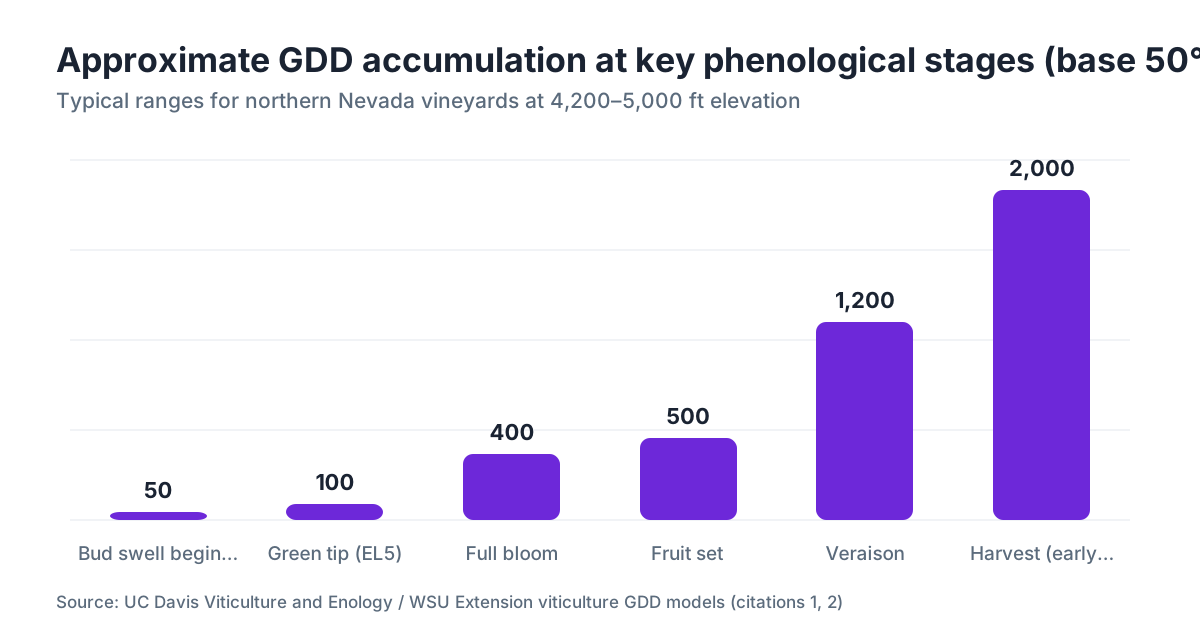
WSU's viticulture team published a widely used GDD accumulation model showing that the 50°F base gives the best correlation with phenological stages across western North American wine regions. [2] The table below shows approximate GDD targets for key stages based on that research and extension guidance.
| Phenological Stage | Approximate GDD (base 50°F) | Typical Northern NV Timing |
|---|---|---|
| Bud swell begins | 20-50 | Mid-March to mid-April |
| Green tip (EL5) | 50-100 | Late March to late April |
| Full bloom | 300-400 | Late May to mid-June |
| Fruit set | 400-500 | June |
| Veraison | 1,000-1,200 | Late July to mid-August |
| Harvest (early vars) | 1,800-2,200 | September to October |
These ranges are wide on purpose. Nobody has precise multi-year phenology data from a large sample of northern Nevada commercial vineyards. The closest published records come from University of Nevada Cooperative Extension trial plots and scattered grower reports. Treat the timing column as a planning scaffold, not a promise.
What frost temperatures actually kill grapevine buds after break?
The damage threshold shifts as the bud moves through its stages, and this is where northern Nevada growers need to watch closely. At bud swell (EL stage 4), grapevine tissue survives down to about 23°F (-5°C) for short spells. At green tip (EL stage 5), damage starts at 28°F (-2.2°C) and gets severe below 26°F (-3.3°C).
By the "2-inch shoot" stage, a single night at 28°F can wipe out 90% of the primary buds. Cornell's viticulture extension notes that secondary buds are less cold-hardy than primary buds and generally produce lower yields when the primary bud is killed. [3]
Northern Nevada's frost calendar is genuinely scary. NOAA climate normals for Reno show a 50% probability of frost (32°F or below) extending to May 14 at the airport station (4,415 feet), and a 10% probability as late as June 1. [10] If your vineyard sits in a cold air drainage basin 200 feet below a ridge, your actual last frost can run a week later than the airport records suggest.
The rule most high-desert growers live by: budget for frost protection through May 15, and keep sprinklers or wind machines ready through Memorial Day. That's not pessimism. That's arithmetic from the record.
A single hard frost at 26°F after green tip can eliminate 80 to 100% of primary buds, turning a potential 4-ton crop into half a ton of secondary bud production. Run that scenario once and the frost equipment usually pays for itself.
Which grape varieties handle northern Nevada's late frosts best?
Variety selection is your first line of frost defense, and it's cheaper than a wind machine. Late-breaking varieties buy you the most buffer. Cabernet Sauvignon, Cabernet Franc, and Merlot break bud 1 to 3 weeks later than Chardonnay or Gewurztraminer most years, which in northern Nevada can decide whether you break into frost season or break just after the worst of it. The catch: those same late-breaking varieties ripen late too, which can be a problem at high elevation.
Varieties with documented cold hardiness through dormancy (surviving winter lows, a separate matter from spring frost at bud break) include Marquette, Frontenac, and other University of Minnesota hybrids bred for cold climates. [6] These rarely go in the ground in Nevada for wine quality reasons, but they're worth a look for experimental high-elevation plantings above 5,500 feet.
For a workable middle ground between 4,200 and 4,800 feet, the varieties that show up in successful local vineyards are Tempranillo (moderate break timing, good heat tolerance), Barbera (relatively late break, handles diurnal swing well), and Sangiovese (mid-season). Riesling and Gruner Veltliner have done well at higher elevations in neighboring high-desert regions and deserve more trial plantings than Nevada gives them.
Any variety on a north-facing slope or in a frost pocket takes more damage regardless of its break timing. Site trumps variety when the site is bad.
How does northern Nevada's elevation and desert climate affect bud break timing?
Northern Nevada's high desert throws a specific mix at your vines: strong solar radiation (the state averages over 300 sunny days a year), low humidity, big diurnal temperature swings (often 35 to 45°F between daily high and low), and late spring frosts riding cold continental air masses. It's different from both coastal California and the inland Pacific Northwest.
The large diurnal swing works against GDD accumulation in a way that fools people. Because your overnight low is so cold, your daily average (which drives GDD) sits well below what the afternoon high suggests. A day that hits 75°F in Reno but drops to 28°F overnight averages only 51.5°F, giving you 1.5 GDD. That same afternoon high in Sacramento with a 55°F low gives you 15 GDD. Northern Nevada vines see plenty of warm afternoons that barely move the ledger.
Soil temperature at 4-inch depth is another useful signal, and small operators underuse it. Vine roots respond to soil warming as much as air temperature, and high-elevation soil warms slower than air in spring. A soil thermometer is a $15 tool that tells you more about where your vines actually are than any app. When the 4-inch soil temp holds at 50°F, bud break is imminent or already happening.
The Western Regional Climate Center's Great Basin data shows northern Nevada's spring temperature trend running roughly 2 to 4 weeks behind Napa at comparable air temperatures. That regional average hides enormous site-to-site swings driven by aspect, elevation, and how close you sit to a valley cold-air pool. [5]
What frost protection methods work in high-desert vineyards?
Wind machines are the go-to for sites with temperature inversions, where cold air pools near the surface and warmer air sits 20 to 50 feet up. The machine mixes those layers and can raise vineyard temperature 3 to 5°F. They cost roughly $15,000 to $35,000 per unit installed, cover 15 to 25 acres each, and do nothing on advective frost nights when cold wind is blowing across the whole region. At northern Nevada elevations, advective frosts are common in April and May, so a wind machine is not a complete answer here.
Over-vine sprinkler irrigation releases latent heat as water freezes on vine tissue. The ice coating holds at 32°F while it forms, protecting tissue that would otherwise drop lower. It works, but it demands continuous water through the whole frost event, plus enough pressure and coverage to ice the tissue evenly. Under-applied sprinklers (running low, or stopping early) can make damage worse than doing nothing. UC Davis extension has published irrigation-based frost protection guidelines that carry over well to Nevada conditions. [1]
Heaters (orchard heaters or smudge pots) are mostly history now because of air quality rules and cost, though small electric or propane heaters in tight frost pockets still make sense for very small blocks.
Row covers and fabric frost blankets give you 2 to 4°F, often enough for the typical 29 to 31°F events in northern Nevada's late spring. They're labor-heavy on any block over an acre. For a small high-value block of Pinot Gris or Gewurztraminer that breaks early, the labor still beats the crop loss math most years.
The cheapest protection of all is site selection. A block planted 50 feet upslope from the valley floor, on a gentle south-facing slope with cold air draining to lower land, runs 3 to 5°F warmer minimums than a block in the flat valley. That difference is free and permanent.
How do I track bud break dates and frost events for vineyard compliance records?
Accurate phenology records earn their keep two ways: agronomic decisions (calibrating spray timing, irrigation start, and frost readiness) and regulatory compliance (restricted-use pesticide applications need recorded windows that often reference phenological stage). Bud break date, written down in your field notes, anchors the timeline your spray records lean on.
The EPA's Worker Protection Standard (WPS) requires that application records include the date of application, and that re-entry intervals (REIs) get posted and tracked. [7] In Nevada, the Nevada Department of Agriculture's pesticide use reporting rules add state-level spray record obligations on top of that. [8]
A paper log works legally, but it's easy to lose and hard to audit. Recording bud break observations in a dated field notebook, with block ID, variety, and Eichhorn-Lorenz stage noted, gives you a defensible record if anyone ever questions your spray timing. Photograph the block with your phone's timestamp visible for a quick, free backup.
If you want something more structured, VitiScribe was built for exactly this: logging phenological observations, attaching spray records to growth stages, and keeping a compliance-ready timeline for each block. A field operations platform won't replace good judgment about when to spray. It keeps the paper trail clean.
Whatever system you run, record bud break stage, date, and temperature at the time of observation for each block. That takes five minutes and saves hours of reconstruction if you get audited or file a crop insurance claim after a frost.
What should northern Nevada growers watch in the weeks before bud break?
The two weeks before bud break are your window for a short checklist that actually matters. Start it in late February.
First, finish dormant pruning before green tip if you haven't already. Pruning after green tip opens wounds and can cost you fruitful buds. In a region with unpredictably early warm spells, check bud swell stage weekly from late February on.
Second, test your frost protection equipment. If you have wind machines, run them. If you have over-vine sprinklers, check pressure, coverage, and whether freeze cracked any lines over winter. A frost event on April 20th at 27°F is a bad time to learn your pump won't start.
Third, calibrate your thermometers and confirm the weather station works. A $200 wireless station with a min/max function, placed within 100 feet of your most frost-prone block, beats the Reno airport ASOS as an early-warning tool.
Fourth, review your spray program. The first sprays of the season (usually dormant oils or early sulfur) need to go on before significant bud swell in many programs, and that window shuts fast once vines move. Check your state pesticide license renewal status with the Nevada Department of Agriculture. Restricted-use pesticide licenses renew on a three-year cycle, and letting one lapse mid-season creates a compliance mess. [8]
Fifth, verify your crop insurance policy's documentation requirements. The USDA Risk Management Agency's Whole-Farm Revenue Protection and specialty crop programs have specific record requirements that phenology data supports. [9]
Are there resources and data tools for northern Nevada vineyard temperature monitoring?
A handful of genuinely useful, free resources cover this region.
The Western Regional Climate Center at the Desert Research Institute in Reno keeps historical climate data for Nevada weather stations. Their online tool pulls daily min/max temperatures for stations across the Great Basin going back decades. It's the best free source for building a baseline expectation of when 50°F average temperatures arrive at your elevation. [5]
NOAA Climate Data Online gives you frost probability statistics (10%, 50%, and 90% probability dates for last spring frost at 32°F and 28°F) for stations near your vineyard. The nearest to most northern Nevada vineyards are Reno/Tahoe International Airport, Minden-Tahoe Airport, and Yerington. These are airport stations, so apply judgment when your site differs in elevation or cold air drainage. [10]
UC Davis's viticulture extension resources include GDD calculators and phenology models you can run with your own local temperature data. [1] UC ANR Publication 3343, "Wine Grape Varieties in California," includes phenological timing by variety that translates reasonably well to high-desert Nevada once you adjust for the GDD difference.
WSU's viticulture extension covers the Columbia Valley and eastern Washington, which shares more with northern Nevada than California's coastal models do. Their frost protection publications apply almost directly. [2]
For managing records across multiple blocks, a personal weather station, a simple spreadsheet or purpose-built vineyard tool, and those free climate databases cover most of what a commercial grower needs. You don't need expensive proprietary weather services unless you're running 50 or more acres with multiple frost-risk microclimates.
What do northern Nevada growers actually experience at bud break: real conditions
A few honest observations about what the numbers look like on the ground.
March in Reno routinely delivers afternoon temperatures in the 60s and 70s while overnight lows still drop below 28°F. Your vines respond to those warm afternoons. A single week of 65°F highs can push susceptible early varieties into green tip faster than you expect. Then a cold front drops lows to 26°F for two nights and you lose a big share of primary buds. This pattern shows up in the historical record roughly one year in three.
The late frosts growers fear most arrive after a warm early spring has pushed vines well past green tip. A late-April cold front dropping to 27°F on fully expanded two-inch shoots can eliminate your primary buds for the season. Secondary buds still produce some fruit, but cluster count and berry size both suffer. Figure a 40 to 70% crop reduction depending on variety and stage at the time of the freeze.
Soil moisture going into bud break matters more than many growers realize. Dry soils warm faster and lose heat faster overnight, which sharpens the temperature drop near ground level. Irrigating to field capacity before the frost season starts (and before soils warm enough to lose much to evaporation) is a simple, low-cost step that nudges your worst-case scenario in the right direction.
Talk to your neighbors. The viticultural community in northern Nevada is small enough that a neighbor's weather station data from last year is a real resource. The Nevada Farm Bureau and the University of Nevada Cooperative Extension's Reno office are both good places to find those connections. [4]
For a wider look at how western mountain vineyards compare, the mountain winery community has documented similar frost management challenges in high-elevation sites, and the approaches transfer well.
Frequently asked questions
What is the base temperature for calculating grapevine growing degree days?
The accepted base temperature for grapevine GDD calculation is 50°F (10°C). Below it, vine growth essentially stops. You calculate each day's contribution by averaging the high and low, subtracting 50, and discarding any negative result. Northern Nevada vineyards at 4,200 to 5,000 feet typically accumulate 2,000 to 2,800 GDD (base 50) over a full growing season.
What is the last frost date in northern Nevada for vineyards?
Per NOAA climate normals, the 50% probability last frost date (32°F) for the Reno area is around May 14 at airport elevation (4,415 feet). The 10% probability date runs to early June. Higher-elevation sites and cold-air drainage basins see killing frosts even later. Budget frost protection readiness through Memorial Day across most northern Nevada growing areas.
How cold does it have to get to kill grapevine buds after bud break?
At green tip (Eichhorn-Lorenz stage 5), damage begins at 28°F (-2.2°C) and gets severe below 26°F (-3.3°C). Earlier bud swell stages survive down to about 23°F for short spells. As the shoot elongates past two inches, cold hardiness drops further. A single night at 26°F after full green tip can kill 90% or more of primary buds.
Which grape varieties are best for northern Nevada's short growing season?
Tempranillo, Barbera, Sangiovese, and Cabernet Franc have shown reasonable success at valley-floor elevations (4,200 to 4,700 feet) in northern Nevada. At higher elevations, Riesling, Gruner Veltliner, and cool-climate Italian varieties merit more experimentation. Cold-hardy hybrids like Marquette work at extreme elevations but are less established commercially. Variety selection has to account for both spring frost timing and season-end heat accumulation.
How does elevation affect bud break timing in Nevada vineyards?
Every 1,000 feet of elevation typically delays bud break by 10 to 14 days in Great Basin conditions. A vineyard at 5,000 feet near the Sierra foothills may not reach green tip until late April, while a valley-floor block at 4,200 feet could break in late March. South-facing slope and cold-air drainage quality can shift timing by another 1 to 2 weeks independent of elevation.
Do I need to keep records of bud break dates for pesticide compliance in Nevada?
Nevada's pesticide use reporting requirements (run by the Nevada Department of Agriculture) require dated application records tied to specific fields or blocks. Bud break date isn't always explicitly required, but it anchors your phenological timeline and justifies spray timing. The EPA Worker Protection Standard requires application records and posted re-entry intervals. Phenology notes make those records defensible and support crop insurance claims after frost events.
How many growing degree days do northern Nevada vineyards accumulate?
Valley-floor vineyards at 4,200 to 5,000 feet in Washoe, Douglas, and Lyon counties typically accumulate roughly 2,000 to 2,800 base-50°F GDD in a normal season, placing them in Winkler Regions II to low III. Higher sites above 5,000 feet may reach only 1,500 to 1,800 GDD. Season length runs approximately May through October at most commercial sites.
What frost protection methods work best in high-desert Nevada vineyards?
Wind machines work on inversion frost nights (cold air pooling below a warmer layer), giving 3 to 5°F of protection over 15 to 25 acres. Over-vine sprinklers protect tissue through latent heat release but need continuous application through the event. Row covers give 2 to 4°F for small blocks. The most cost-effective long-term protection is site selection: a slope with cold-air drainage consistently beats a valley-floor frost pocket.
How do I read a soil thermometer to predict bud break timing?
Check soil temperature at 4-inch depth with a basic probe thermometer. When the daily reading holds at 50°F, bud break is imminent or already underway. Soil at northern Nevada elevations warms slowly in spring because of cold nights. Check it every few days from late February on. It's a $15 tool that gives you ground-truth data specific to your block, not a weather station miles away.
Can a late-season freeze after bud break destroy an entire northern Nevada harvest?
Yes. A night at 26°F when shoots are at the two-inch stage can eliminate 80 to 100% of primary buds. Secondary buds produce fruit, but typically only 30 to 60% of the normal crop at reduced cluster size. In northern Nevada's historical record, late freezes after significant bud break have hit roughly one year in three at some point in the spring window. This is the region's primary crop-loss risk.
Where can I find historical temperature data for planning a Nevada vineyard?
The Western Regional Climate Center (wrcc.dri.edu), based at the Desert Research Institute in Reno, has daily min/max temperature records for dozens of Nevada stations going back decades. NOAA Climate Data Online (ncdc.noaa.gov) provides frost probability statistics. Both are free. For vineyard-specific modeling, UC Davis and WSU extension both offer GDD accumulation tools you can run with local station data.
How does northern Nevada's diurnal temperature swing affect vine heat accumulation?
Northern Nevada's diurnal swings of 35 to 45°F between daily high and low sharply reduce effective GDD accumulation compared to what afternoon temperatures alone suggest. A day with a 75°F high and a 28°F low averages only 51.5°F, generating just 1.5 GDD. The same high with a 55°F low gives 15 GDD. Growers judging heat by afternoon temperatures will consistently overestimate their vines' progress.
Does irrigation before frost events help protect northern Nevada vines?
Yes, to a modest but real degree. Bringing soils to field capacity before the spring frost window improves thermal mass and softens the overnight temperature drop near the soil surface. Dry soils lose heat faster at night. Pre-frost irrigation won't replace wind machines or sprinkler protection for severe events, but it's a low-cost step that slightly lifts your worst-case temperature floor on marginal frost nights.
What university extension programs have resources for Nevada wine grape growers?
The University of Nevada Cooperative Extension (extension.unr.edu) has regional offices in Reno and Minden with publications and staff covering Great Basin viticulture. UC Davis Viticulture and Enology extension has free online resources applicable to Nevada's climate, especially at lower elevations. Washington State University Extension covers high-desert and cold-climate viticulture topics more directly relevant to northern Nevada's temperature profile than most California sources.
Sources
- UC Davis Viticulture and Enology, extension resources: 50°F (10°C) is the accepted base temperature for grapevine growing degree day accumulation; UC Davis uses this threshold for phenological modeling
- Washington State University Extension, Viticulture: WSU viticulture extension documents 50°F base GDD accumulation as the standard for western North American wine regions and publishes frost protection guidance applicable to high-desert conditions
- Cornell University, College of Agriculture and Life Sciences, Viticulture and Enology: Cornell viticulture extension notes that damage to grapevine tissue begins at 28°F at green tip stage and that secondary buds are less cold-hardy than primary buds
- University of Nevada Cooperative Extension: University of Nevada Cooperative Extension documents that the Reno-Sparks corridor accumulates GDD slowly compared to California wine regions, with the growing season running effectively May through October at high-elevation sites
- Western Regional Climate Center, Desert Research Institute: WRCC historical station data shows spring temperature trends for the Great Basin, including daily min/max records for Reno, Minden, and Yerington stations
- University of Minnesota Extension, Cold Hardy Grape Varieties: University of Minnesota bred cold-hardy hybrid varieties including Marquette and Frontenac for cold-climate viticulture; these varieties have improved dormancy cold hardiness compared to vinifera
- U.S. EPA, Worker Protection Standard for Agricultural Pesticides: The EPA Worker Protection Standard requires application records including date of application and that re-entry intervals are posted and tracked for agricultural pesticide use
- Nevada Department of Agriculture, Pesticides: Nevada Department of Agriculture administers restricted-use pesticide licensing and use reporting requirements for Nevada growers; licenses renew on a three-year cycle
- USDA Risk Management Agency, Whole-Farm Revenue Protection: USDA RMA Whole-Farm Revenue Protection and specialty crop programs have specific record-keeping requirements that phenological observation data supports in the event of a frost loss claim
- NOAA National Centers for Environmental Information, Climate Data Online: NOAA Climate Data Online provides frost probability statistics including 10%, 50%, and 90% probability dates for last spring frost at 32°F and 28°F for Nevada weather stations
Last updated 2026-07-09