Integrated viticulture: a practical guide for vineyard managers

TL;DR
- Integrated viticulture combines biological controls, cultural practices, careful monitoring, and targeted pesticide use to manage vine health with fewer inputs.
- Applied consistently, it cuts pesticide applications by 30 to 50 percent without costing you crop quality.
- The system runs on scouting-based decision thresholds instead of calendar sprays, and it satisfies EPA Worker Protection Standard recordkeeping along the way.
What is integrated viticulture, exactly?
Integrated viticulture is Integrated Pest Management (IPM) applied to wine grape production. The goal is never zero pesticide use. The goal is spraying only when monitoring shows a pest population has crossed a threshold that will actually hurt yield or fruit quality, and reaching for the least harmful option that still works. [1]
The concept has four tiers, stacked in order of preference. First, prevention through vineyard design and cultural practices. Second, biological and mechanical controls. Third, targeted low-risk pesticides. Fourth, broad-spectrum conventional chemistry when nothing else does the job. You don't jump to tier four because you spotted a few leafhoppers. That's the whole point.
The USDA and most land-grant universities have written this up as a formal decision framework. UC Davis, Cornell, and Washington State University each publish region-specific IPM guidelines for Vitis vinifera and hybrid cultivars, and those documents are the closest thing the industry has to a consensus standard. [2][3][4]
Where integrated viticulture goes past basic IPM is scope. It folds soil health, irrigation management, cover crops, and canopy architecture in as active tools, not background conditions. A well-trellised, well-thinned canopy dries faster after rain, and that cuts Botrytis pressure in a way no fungicide fully matches.
How does integrated viticulture differ from organic or conventional growing?
Organic certification bans synthetic pesticides outright and limits you to approved materials on the National Organic Program list. Conventional farming sprays on a calendar schedule, often no matter what the actual pest pressure is. Integrated viticulture sits between them. It lets you use synthetic chemistry when the situation warrants it, but it makes you justify the decision with evidence before you spray. [5]
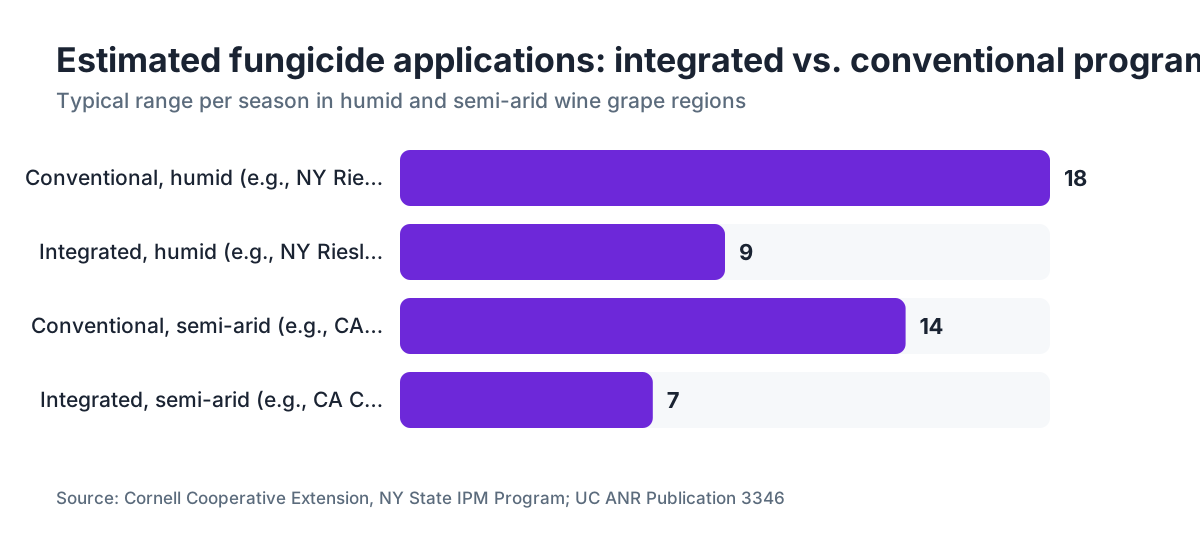
The difference shows up in your spray log. A conventional grower on a 10-day sulfur and copper program may run 15 to 20 fungicide sprays in a wet year. An integrated grower using disease models and canopy management might run 6 to 10, and several of those are low-risk biofungicides. Cornell's New York State IPM Program has documented 50 percent cuts in fungicide inputs among growers who adopted degree-day models and scored their vineyard blocks for Botrytis risk. [3]
Here's the honest read for most small to mid-size operations. Full organic certification is a market decision, not an agronomic one. The price premium can pay for the added costs and yield risk in the right market. Integrated viticulture usually saves you money outright, because you're buying fewer inputs. That argument works almost everywhere.
Both systems share one thing: documentation. Organic certification demands input records for USDA NOP. EPA's Worker Protection Standard demands pesticide application records for anyone using restricted-use or agricultural-use pesticides with workers present. [6] Integrated viticulture doesn't pile on more paperwork. It just rewards growers who already keep good records, because your threshold calls get sharper when you can hold this season up against last.
What are the core IPM components growers actually implement in vineyards?
Monitoring and scouting. You pick a sampling protocol and you stick to it. For leafhoppers, that usually means counting adults on 25 to 50 leaves per block, sampled weekly from late June through veraison. For mites (Pacific spider mite, Willamette mite), you count mites per leaf. Economic thresholds vary by region, but UC Davis guidance puts the action threshold for western grape leafhopper at roughly 20 adults per leaf in the first generation and 15 in the second, when natural enemies are absent. [2]
Biological control. Encouraging parasitoid wasps (Anagrus spp.) that attack leafhopper eggs is one of the better-documented success stories in California viticulture. Planting French prune or other rosaceous plants near vineyard edges gives Anagrus overwintering habitat. WSU research in Washington shows similar habitat manipulation cuts the need for leafhopper interventions in many years. [4]
Cultural practices. Canopy management is your most powerful disease tool. Removing leaves in the fruit zone after fruit set improves air movement, drops humidity, and cuts Botrytis bunch rot pressure you can measure. Cornell trials in Riesling showed that single-sided fruit zone leaf removal reduced Botrytis incidence by 30 to 60 percent, depending on how humid the season ran. [3]
Cover crops and soil health. A well-chosen midrow cover crop slows erosion, adds beneficial insect habitat, and can improve water infiltration. The tradeoff is water competition in dry years, so most arid-region advisors recommend alternating row covers or shallow-rooted annuals that terminate by June.
Targeted pesticide applications. When you do spray, the material matters as much as the timing. Sulfur still works against powdery mildew but turns phytotoxic above 90°F. Copper is the backbone of organic and low-input programs, but it builds up in soil over decades. Biopesticides (Bacillus subtilis, Trichoderma, kaolin clay) earn their place in low-pressure windows. Conventional FRAC Group 3 or Group 11 fungicides are legitimate tools under heavy disease pressure, with resistance-management rotation as a hard rule.
| Control Category | Example Tool | Primary Target | Relative Cost |
|---|---|---|---|
| Cultural | Fruit zone leaf removal | Botrytis, powdery mildew | Low |
| Biological | Anagrus habitat plantings | Grape leafhopper | Low |
| Biofungicide | Bacillus subtilis (e.g., Serenade) | Powdery mildew, Botrytis | Moderate |
| Low-risk chemical | Sulfur, kaolin clay | Powdery mildew, mites | Low-Moderate |
| Conventional fungicide | FRAC Group 3 (DMI) | Powdery mildew, bunch rots | Moderate-High |
| Conventional insecticide | Organophosphate, pyrethroid | Leafhoppers, mealybug | High (resistance risk) |
How do you set up an economic threshold for vine pest decisions?
An economic threshold (ET) is the pest population level where the cost of doing nothing, in lost crop, tops the cost of the control you'd apply. It's not the same as the economic injury level (EIL), which is the actual damage point. You set the ET below the EIL so you have time to act before the damage lands. [1]
For grape growers, the math runs like this. If a leafhopper population causes cosmetic stippling that doesn't touch berry sugar or skin integrity, the EIL might be sky-high or beside the point for your buyers. If you're selling to a winery with strict cosmetic standards or growing for a premium label, your working threshold sits below the academic recommendation.
Setting a threshold takes three inputs: a scouting protocol you actually follow, regional damage coefficients (your local extension office has these), and an honest number for your control costs. UC Cooperative Extension's Grape Pest Management (UC ANR Publication 3346) is the most complete reference for California. Cornell's Guide to Integrated Crop Management in Vineyards covers the Northeast. WSU Extension covers Pacific Northwest conditions. [2][3][4]
Nobody has perfect economic-threshold data for every pest in every region. That's a real limit of the system, and it's worth saying out loud. The closest thing to a universal claim is this: most growers who follow UC Davis or Cornell threshold recommendations report crop outcomes equal to or better than calendar spray programs, at lower input cost. It's not a guarantee. It's a finding that keeps showing up across extension trials.
What does EPA Worker Protection Standard compliance look like for integrated viticulture programs?
The EPA Worker Protection Standard (WPS), revised in 2015 and updated in 2017, sets the rules for agricultural employers using pesticides around workers and handlers. It covers training, posting of application information, personal protective equipment, and recordkeeping. [6]
For an integrated program, WPS compliance isn't harder than conventional. It's often easier, because you spray less, which means fewer restricted entry intervals (REIs) to track. The standard requires employers to "provide workers and handlers with information about pesticide safety, pesticide application, and emergency assistance" (40 CFR Part 170). That includes posting application records at a central spot workers can reach.
WPS wants these records for each application: product name and EPA registration number, active ingredient, location of application, date and time, REI, and the name or identifier of each handler who applied it. Many states require two-year retention. Some require longer. California, through the county agricultural commissioner system, requires pesticide use reports (PURs) filed monthly for all agricultural pesticide applications. [7]
Where integrated growers slip is the posting requirement. REI notices go up at the application site and at a central location before application begins, and they stay up until the REI expires. Missing that step is one of the more common WPS violations turned up in Cal/OSHA and EPA inspections.
Run multiple blocks with different spray dates and materials, and keeping WPS-compliant records by hand gets tedious fast. Tools like VitiScribe help here, pulling block-level spray records, REI tracking, and posting documentation into one place without the paper shuffle.
How do disease forecast models fit into an integrated program?
Disease forecast models take temperature, relative humidity, and leaf wetness data and turn it into an infection-risk estimate for a specific pathogen. Powdery mildew (Erysiphe necator) and downy mildew (Plasmopara viticola) are the two pathogens where these models have the most practical validation in wine grapes. [2]
The UC Davis powdery mildew risk index uses nighttime temperatures to predict ascospore release and early-season infection risk. When the index sits low for a 10-day window, you can stretch your spray interval without taking on more pathogen pressure. Cornell's NEWA (Network for Environment and Weather Applications) platform runs real-time disease models for Northeast growers and links to local weather stations. [3]
Growers who've moved to weather-based disease management report stretching spray intervals two to four days per event, which adds up to two to four fewer applications across a season. That helps the checkbook and the resistance-management plan, since every spray pushes selection toward fungicide-resistant pathogen populations.
The catch is infrastructure. A model only runs well on a well-sited weather station, ideally within a quarter mile of your blocks. Generic regional weather data carries enough error to make the model outputs shaky. A good on-site station runs roughly $800 to $3,000 depending on the sensor package, and it pays back through reduced spray costs for most operations of 10 acres or more. That's an honest estimate built on typical fungicide program costs, not a promised ROI.
What cover crops and habitat plantings actually reduce pest pressure in vineyards?
It depends on your main pest and your climate. There's no single cover crop recipe that works everywhere.
For California growers fighting leafhoppers, French prune (Prunus domestica) planted as edge hedgerows is well-documented Anagrus habitat. UC Cooperative Extension trials in Napa Valley and the North Coast showed measurable jumps in Anagrus egg parasitism in blocks near prune hedgerows versus blocks without them. [2] The mechanism is simple. Anagrus overwinters on prunus species, so having them nearby shortens the trip beneficial insects make in spring.
For general beneficial insect habitat, composite-family plants (yarrow, buckwheat, phacelia) and umbellifers (fennel, sweet alyssum) supply nectar and pollen for predatory and parasitoid insects. WSU research on insectary plantings in Washington wine country came back mixed: habitat plantings help most in landscapes that otherwise lack diversity, so the marginal benefit drops in regions with varied natural vegetation nearby. [4]
Cover crop choice for disease management is trickier. Tall, dense covers can raise humidity at the vine base if you mow them rarely. Low-growing covers (cereal rye, crimson clover, or shallow-rooted annuals) that terminate early are the safer pick for disease-prone varieties.
For erosion control and soil organic matter, any cover crop beats bare dirt. The tradeoff with perennial covers in drip-irrigated arid regions is real water competition. Alternating row management, where every other row is cover-cropped and the rest get mowed or tilled, is a common compromise.
How do you build an integrated viticulture plan for a new vineyard block?
Start before you plant. Block layout, variety, rootstock, and trellis system all have downstream effects on pest and disease pressure. Tight-cluster varieties in humid climates need canopy architectures that put airflow ahead of maximum yield. Phylloxera-resistant rootstocks are non-negotiable in most California soils. Those choices set the baseline difficulty for everything that comes after.
Once the block goes in, the first year's IPM plan is really just a monitoring plan. You don't have the site history yet to know which pests will be your headaches. Scout weekly through the growing season and log every pest and beneficial you see, with a rough density number. By year three you have a baseline that tells you which problems are chronic and which were weather-driven flukes.
Write your action thresholds down before the season starts, not after you find a pest population. Write them after the fact and you'll rationalize the decision you already made.
A workable starting structure for a California integrated viticulture plan covers: (1) a scouting calendar with a named responsible party, (2) action thresholds for your top three to five pests by region and variety, (3) a preferred materials list ordered from lowest to highest impact on beneficials, (4) a canopy management calendar, and (5) your WPS compliance checklist. UC ANR Publication 3346 gives you a template framework to adapt. [2]
Growers in Oregon, Washington, or New York should start from WSU Extension's Grape IPM guidance and Cornell's Guide to Integrated Crop Management in Vineyards. [3][4] The principles are identical. The pest lists and disease windows are what change.
What are the certification and audit options for integrated viticulture?
There's no single federal certification for integrated viticulture or IPM. What you get instead is a patchwork of state, regional, and third-party programs.
California's SIP (Sustainability in Practice) certification, run by SIP Certified, asks you to demonstrate IPM practices, water management, and labor standards, and a third party audits it. The Lodi Rules program uses a similar peer-reviewed sustainability code with scored metrics. [8] A growing number of buyers and restaurant chains accept both as evidence of environmental stewardship.
Cornell Cooperative Extension backs the New York Sustainable Winegrowing program, which runs on a self-assessed scorecard across more than 200 management practices. It's not a formal certification, but it produces documented records that answer buyer questions and, increasingly, crop insurance requirements. [3]
For operations chasing organic certification, USDA National Organic Program (NOP) certification through an accredited certifier is the only legally recognized path. NOP standards prohibit synthetic pesticides, require an organic system plan (OSP), and require three years of transitional management before certification. [5] Organic premium pricing in wine grapes swings widely: certified organic juice grapes in California have traded $100 to $400 per ton above conventional in recent years, but that premium is volatile and market-dependent.
Most growers I'd talk to are better off implementing integrated viticulture thoroughly and documenting it well than chasing a certification whose market value is uncertain. The practices pay regardless of what label lands on the wine.
What does a compliant spray record look like under integrated viticulture?
A spray record that satisfies both EPA WPS and most state PUR requirements needs to capture: the date and start/end time, the block or field identifier, the pesticide product name and EPA registration number, the active ingredient(s), the application method (airblast, backpack, drip), the total volume applied, the target pest, the REI, and the applicator's name. In California, add the applicator's county license number, and the Pesticide Use Report (PUR) goes to the county agricultural commissioner monthly. [7]
In an integrated program you're also logging scouting observations and the threshold-based reason for each spray call. WPS and most state PUR systems don't require that. But it's good practice, and it's what makes your program defensible in an audit or a pest control adviser review.
Paper logs work until end of season, when you're trying to review your program or answer a buyer's sustainability audit and the notebook is a mess. A block-level digital system that links spray records to GPS-referenced blocks, tracks REI expiration, and spits out PUR-ready reports cuts the administrative time a lot. VitiScribe is one tool built for exactly this workflow, made for vineyard managers rather than general farm software users.
Whatever system you run, the record has to be legible, complete, and accessible to workers on request under WPS. "Accessible" means at the central location (usually the farm office or equipment shed) and available within 30 days to a worker or their designated representative who asks.
How do water and irrigation management fit into an integrated approach?
Irrigation is an indirect but heavy lever on pest and disease pressure. Moderate vine water stress (predawn leaf water potential around -0.4 to -0.6 MPa through berry set) actually helps wine quality in many varieties. Chronic overwatering drives runaway shoot growth, and that builds the dense, humid canopy powdery mildew and Botrytis love.
ET-based irrigation scheduling, built on Penman-Monteith evapotranspiration estimates from CIMIS (California Irrigation Management Information System) or an equivalent state network, is the backbone of precision water management in California vineyards. [9] You apply a crop coefficient (Kc) to reference ET, usually 0.3 to 0.5 for grapevines depending on growth stage and how much stress you're after.
Timing matters for pests too. Drip systems keep leaves drier than overhead systems, which directly shortens infection periods for foliar pathogens. If you run overhead for frost protection, you're accepting that tradeoff, and it's a real one to watch.
Soil moisture monitoring (capacitance sensors, tensiometers, or pressure bombs) gives you data instead of a guess. The UC Davis Viticulture and Enology department publishes solid guidance on pressure bomb use for vine water status. [10] For most small operations, the practical move is to own one pressure bomb and use it religiously all season rather than sinking money into a full network of soil sensors.
What are the biggest mistakes growers make when starting an integrated viticulture program?
The most common mistake is treating integrated viticulture as a spray-reduction program without changing how you make decisions. Growers drop two applications off the calendar, call it IPM, and then wonder why it fell apart. The spray calendar is the thing you're replacing, not trimming.
Second most common: scouting that exists on paper but not in the field. A monitoring program with spotty or missing data is worse than none, because it hands you a false sense of information. If you won't scout weekly during the critical windows, you're better off with a simple calendar-based low-input program and good material selection than an IPM program built on gaps.
Third: ignoring beneficials when you pick a spray. An organophosphate or pyrethroid aimed at one pest can wipe out the beneficial population holding a secondary pest in check. Grape mealybug outbreaks that follow broad-spectrum insecticide sprays for other pests are a documented pattern in California. [2]
Fourth: not tuning thresholds to your actual market. If your winery buyer rejects any leafhopper stippling, your working threshold sits below the UC recommendation, and your program has to account for it. The economic threshold framework was built to bend to local economics.
Fifth, and this one is pure operations: losing spray records mid-season. A waterlogged field notebook, a spreadsheet stranded on someone's personal laptop, whatever the cause, record loss opens WPS compliance exposure and kills the season-over-season learning that makes integrated programs sharper every year.
Frequently asked questions
Is integrated viticulture the same as organic viticulture?
No. Organic viticulture prohibits synthetic pesticides and requires USDA NOP certification. Integrated viticulture allows synthetic chemistry when monitoring shows pest pressure exceeds an economic threshold. Most integrated programs use far fewer pesticides than conventional operations, but they aren't bound by the same material restrictions as certified organic. The two can coexist: some growers use integrated decision-making while choosing only approved organic materials.
How many pesticide applications does integrated viticulture typically eliminate?
Studies from Cornell and UC Cooperative Extension consistently show 30 to 50 percent cuts in pesticide applications compared to calendar-based conventional programs. The exact number depends on your region, pest pressure, and variety. In low-disease years with good canopy management, some integrated growers in drier climates report dropping fungicide applications from 14 to 16 down to 6 to 8 without yield or quality loss.
What scouting frequency does an integrated viticulture program require?
Weekly scouting during the active growing season is the standard recommendation from UC Davis, Cornell, and WSU extension IPM programs. That means budbreak through harvest for most pests and diseases. Some pest windows are shorter: leafhopper scouting matters most from late spring through late summer. You can ease off in low-pressure periods, but not during critical windows like bloom through fruit set for powdery mildew.
What records do I need to keep under EPA Worker Protection Standard for pesticide applications?
Under EPA WPS (40 CFR Part 170), required records for each application include the product name, EPA registration number, active ingredient, application location, date and time, restricted entry interval (REI), and handler information. Most states require two-year retention. California adds monthly Pesticide Use Reports filed with the county agricultural commissioner. Records must be accessible to workers within 30 days of a request.
Can integrated viticulture work for small vineyards under 10 acres?
Yes, and in some ways it's easier on small operations because you can scout all your blocks thoroughly yourself. The overhead is lower: one person with a hand lens, a field notebook, and a copy of your regional extension IPM guide can run a credible program. The disease forecast models and on-site weather stations that optimize large programs are harder to justify at tiny acreage, but the cultural and biological controls cost nothing extra.
What are economic thresholds for grape leafhopper in California?
UC Davis and UC Cooperative Extension put the action threshold for western grape leafhopper (Erythroneura elegantula) at roughly 20 adults per leaf for the first generation and 15 per leaf for the second, when natural enemy populations are low. These are guidelines, not fixed numbers: if your winery buyer objects to any stippling, your working threshold may be lower. Always check current UC ANR Publication 3346 for regional guidance.
How does canopy management reduce disease pressure without fungicides?
Leaf removal in the fruit zone after fruit set increases airflow, drops humidity, and improves spray penetration. Cornell trials in Riesling showed 30 to 60 percent reductions in Botrytis bunch rot incidence from single-sided fruit zone leaf removal, depending on season humidity. The mechanism is physical: drier fruit surfaces give Botrytis and powdery mildew less favorable infection conditions. Shoot positioning and hedging matter too, especially in high-vigor varieties.
What cover crops work best for beneficial insect habitat in vineyards?
Composite and umbellifer family plants (yarrow, buckwheat, phacelia, sweet alyssum) give parasitoid wasps and predatory insects the best nectar and pollen. In California, French prune hedgerows near vineyard edges are well-documented habitat for Anagrus spp., which parasitize leafhopper eggs. Low-growing, early-terminating annuals (crimson clover, cereal rye) are the safer pick in arid climates where tall perennial covers compete for water.
Are there certifications for integrated viticulture programs?
There's no federal IPM certification for vineyards. California's SIP Certified and Lodi Rules programs provide third-party verified sustainability certifications that include IPM requirements. New York has the NY Sustainable Winegrowing program. Oregon has LIVE certification. None carry USDA federal recognition the way organic certification does, but many buyers and restaurant buyers accept them as documented evidence of responsible growing.
How do disease forecast models help reduce fungicide sprays?
Models like the UC Davis powdery mildew risk index or Cornell's NEWA platform use temperature, humidity, and leaf wetness data to estimate infection-risk windows. When the model shows low risk for an extended stretch, you can safely stretch spray intervals two to four days per event. Over a season, integrated growers using these models report two to four fewer fungicide applications without more disease, according to Cornell extension documentation.
What is the difference between an economic threshold and an economic injury level?
The economic injury level (EIL) is the pest population density where damage costs equal control costs. It's the break-even point. The economic threshold (ET) sits below the EIL, typically at 70 to 80 percent of it, so you have time to apply a control before damage reaches the injury level. In practice, most published vineyard thresholds already build in this margin, so you apply at the published ET without calculating the EIL yourself.
Does integrated viticulture affect wine quality or grape pricing?
No credible controlled study shows integrated viticulture reduces wine quality compared to conventional management at equivalent yield. In many cases, canopy management and lower fungicide residues improve fruit quality. Premium buyers increasingly prefer documented IPM or sustainability programs. Certified sustainable wines (SIP, Lodi Rules, LIVE) can command modest premiums, and organic-equivalent programs command more, though organic premiums are volatile and market-dependent.
How do I handle a grape mealybug outbreak under an integrated program?
First confirm the identification and estimate population density across blocks. Mealybug populations often spike after broad-spectrum insecticide sprays kill the Anagyrus and Coccophagus parasitoids that naturally suppress them. Before applying anything, check for parasitoid activity. UC ANR Publication 3346 covers biological and chemical options. If chemical control is warranted, spirotetramat (a group 23 insecticide) has lower impact on beneficials than organophosphates. Document your decision and the evidence that triggered it.
What is the role of rootstock in integrated viticulture?
Rootstock choice is a preventive control, the first tier of the IPM pyramid. Phylloxera-resistant rootstocks (110R, 5BB, 3309, and others) eliminate one of the most damaging vine pests with no spray input. Nematode-resistant rootstocks (Freedom, Harmony) reduce root damage in sandy soils with root-knot or dagger nematode pressure. Choosing the right rootstock at planting is one of the highest-leverage decisions in an integrated program because it lowers baseline pest pressure for the life of the vineyard.
Sources
- UC ANR, Statewide IPM Program, What is IPM?: IPM definition, economic threshold and economic injury level framework
- UC ANR Publication 3346, Grape Pest Management: Leafhopper action thresholds, Anagrus habitat plantings, pressure bomb use, mealybug management, and integrated grape pest management framework for California
- Cornell Cooperative Extension, New York State IPM Program, Vineyard IPM: 50 percent fungicide reduction from degree-day models, 30 to 60 percent Botrytis reduction from fruit zone leaf removal in Riesling, Cornell NEWA disease forecasting platform
- Washington State University Extension, Grape IPM in the Pacific Northwest: Anagrus habitat in Washington vineyards, insectary planting research, WSU-specific leafhopper and mite management guidance
- USDA Agricultural Marketing Service, National Organic Program: NOP organic certification requirements, prohibited synthetic pesticide list, three-year transition requirement
- EPA, Worker Protection Standard (40 CFR Part 170): WPS recordkeeping requirements for pesticide applications, REI posting obligations, worker and handler training requirements; statute text on employer obligation to provide pesticide safety information
- California Department of Pesticide Regulation, Pesticide Use Reporting: California monthly Pesticide Use Report (PUR) requirement filed with county agricultural commissioner
- SIP Certified, Sustainability in Practice Certification Standards: California SIP certification requirements including IPM practices and third-party audit process
- California Department of Water Resources, CIMIS (California Irrigation Management Information System): ET-based irrigation scheduling using Penman-Monteith reference evapotranspiration for California vineyards
- UC Davis Viticulture and Enology: Pressure bomb use for predawn leaf water potential measurement, recommended stress levels for wine grape quality
Last updated 2026-07-09