Interpreting petiole nitrate results at bloom for wine grapes

TL;DR
- At full bloom (50 to 80% cap fall), petiole nitrate between 350 and 500 ppm NO3 is adequate for most wine grape varieties.
- Below 350 ppm points to nitrogen deficiency.
- Above 500 to 600 ppm risks excess vigor and delayed ripening.
- Variety, rootstock, and soil type all shift those thresholds, so no single number fits every vineyard.
Why do we sample petioles at bloom specifically?
Bloom is the single most diagnostic window for vine nitrogen status. By the time cap fall starts, the vine has already committed resources to shoot growth and inflorescence development, so the petiole reading at that moment reflects how much nitrogen was actually available through budbreak and early shoot elongation. Sample earlier or later and you get a different story.
The petiole is the leaf stem, not the leaf blade. That distinction matters. Blades accumulate oxalate and other compounds that interfere with nitrate colorimetry in some labs. Most university extension programs in California, Washington, and New York specify petioles opposite basal cluster leaves at bloom, not blades [1].
Wait too long and the reading loses its predictive value for the current season. Vigorous shoots dilute nitrogen concentration fast, so a vine that looks fine at pea-size berry may have already corrected an early deficiency on its own, or it may be masking a deeper problem. Sample at 50 to 80% cap fall and you catch the vine mid-sentence, so to speak.
Petiole nitrate is reported as ppm NO3 (parts per million nitrate-nitrogen) in the dried petiole tissue. Some labs report total N percent instead. If yours does, confirm which number you're looking at before comparing to any published sufficiency range. Those two metrics are not interchangeable.
What are the sufficiency ranges for petiole nitrate at bloom?
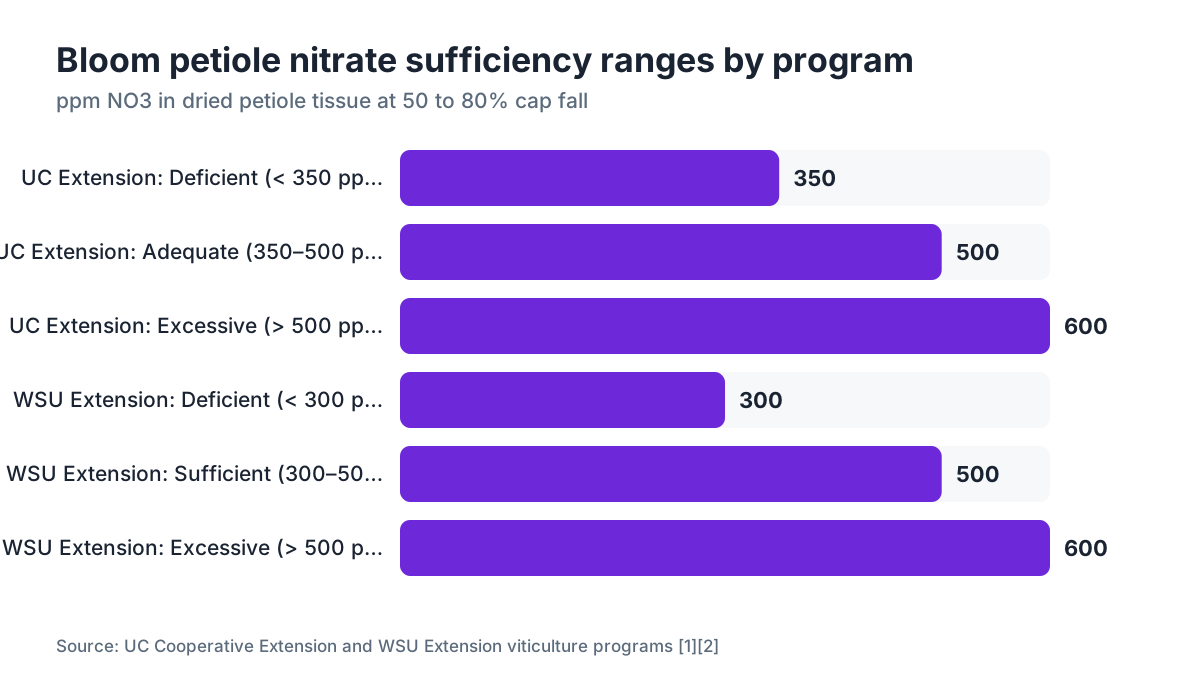
The most widely cited sufficiency range in California comes from UC Cooperative Extension work: 350 to 500 ppm NO3 in the dried petiole at bloom is adequate for most Vitis vinifera wine grapes [1]. Below 350 ppm signals deficiency. Above 500 ppm, and especially above 600 ppm, points to excess nitrogen that pushes vegetative growth at the expense of berry quality.
Washington State University Extension uses a similar framework. Their guidance lists bloom petiole nitrate below 300 ppm as deficient, 300 to 500 ppm as sufficient, and above 500 ppm as excessive [2]. The gap between UC and WSU thresholds is small enough that you'd treat them the same way in the field, but it's a reminder that these numbers came from specific regional datasets and rootstock populations.
Cornell's viticulture program has published Finger Lakes and North Fork data suggesting some cooler-climate varieties tolerate or even prefer the lower end of the 300 to 500 ppm range, because high vine nitrogen in short seasons extends shoot growth past the point where the canopy can ripen fruit before frost [3].
Here's how the ranges stack up across programs:
| Status | UC Cooperative Extension (ppm NO3) | WSU Extension (ppm NO3) |
|---|---|---|
| Deficient | < 350 | < 300 |
| Adequate / Sufficient | 350 to 500 | 300 to 500 |
| Excessive | > 500 to 600 | > 500 |
Treat these as starting points, not verdicts. A Cabernet Sauvignon on deep, high-vigor soil may read 480 ppm and still carry too much vegetative growth. A Pinot Noir on shallow, low-fertility soil at 380 ppm may be performing exactly right. The number is one input.
How do variety and rootstock affect what a "normal" reading looks like?
Rootstock moves petiole nitrate more than most growers expect. High-vigor rootstocks like 110R and 1103P take up more nitrogen per unit of soil nitrate than moderate-vigor options like 101-14 Mgt or 3309C. Two blocks with identical soil nitrogen can show petiole readings that differ by 50 to 80 ppm on rootstock choice alone [8].
Varietal differences exist too, though they're milder than rootstock effects. White varieties, particularly Chardonnay and Sauvignon Blanc, are often managed at the lower end of the adequate range because excess nitrogen in white grapes correlates with higher yeast assimilable nitrogen (YAN) in juice. High YAN can push fermentation faster than some winemakers want and may shift the aromatic profile. Red varieties like Cabernet Sauvignon and Syrah are sometimes managed a touch higher because their canopy management (leaf pulling, hedging) tolerates moderate vigor.
Nobody has clean variety-specific bloom petiole sufficiency tables with sample sizes big enough to be definitive. The extension ranges are mostly built on mixed-variety California trial work. If you're growing something unusual, like Grüner Veltliner or Tannat in a warm climate, your best reference is your own multi-year trend data, not a published number from a different variety in a different state.
What does a low petiole nitrate reading actually mean for the vine?
Below 350 ppm NO3 at bloom, the vine is short on nitrogen during one of its highest-demand periods. Shoot growth may be slow or already stalled. Leaves often look pale yellow-green rather than deep green, and the internodes come in shorter than normal.
Low nitrogen at bloom is linked to reduced fruit set in some studies, because the vine lacks the amino acid pool it needs to fully develop pollen and set berries. The closest data comes from UC Davis trials showing nitrogen-deficient vines at bloom produced measurably lower crop loads at the following harvest [7].
Here's the honest caveat. A single low reading doesn't tell you whether nitrogen is actually missing from the soil, or whether it's sitting in the soil and something is blocking uptake. Cold, saturated soils in spring slow nitrate mobility and root uptake sharply. After an unusually wet spring, a sample pulled right after irrigation or rain can read deficient when there's plenty of nitrogen in the profile. Timing and soil temperature both matter.
Cross-reference a low reading with your soil organic matter data, your irrigation log, and how the shoots looked when you sampled. A reading below 350 ppm in a vine that looks actively deficient (pale leaves, short internodes, small tendrils) is a real call to action. A reading of 320 ppm in a vine that looks fine after a cold, wet April is worth watching, not worth fertilizing on the spot.
What does a high petiole nitrate reading mean, and should you be worried?
Readings above 500 ppm at bloom, and especially above 600 ppm, flag excess nitrogen. How much it matters depends on how high the number is and whether it repeats across years.
High nitrogen at bloom drives vegetative growth. The vine spends that nitrogen extending shoots rather than ripening the cluster. You get dense canopies, shading in the fruit zone, delayed color development in reds, and higher berry potassium, which raises wine pH. In white varieties, excess nitrogen lifts juice YAN, which sounds like a win but can make fermentation management harder if YAN is already high from other sources.
Above 700 ppm, most agronomists would hold all nitrogen inputs for the rest of the season without argument. Between 500 and 600 ppm, it's contextual. If the block already shows excessive vigor and a dense canopy, hold inputs. If the block looks balanced and the reading is 520 ppm, note it and skip the fertilizer rather than doing anything dramatic.
One mistake shows up regularly. Growers sample, get a high reading, and assume the problem will self-correct. Excess soil nitrogen doesn't vanish. Skip the inputs review and next year's bloom sample will likely run high again. The time to recalibrate your fertilizer program is the fall after a high reading, not mid-season.
How do you collect a petiole sample correctly so the result is actually valid?
Lab results are only as good as the sample. A poorly collected sample gives you a number that's technically precise and agronomically meaningless.
Collect at 50 to 80% cap fall. That's when roughly half the flower caps have dropped and the inflorescences look like small exposed berries just starting to form. This window runs 5 to 10 days wide depending on weather.
Take the petiole from the leaf directly opposite a basal cluster on a healthy, fully expanded shoot. Skip stressed leaves, symptomatic leaves, and shoot-tip leaves. The basal cluster leaf sits at nodes 4 to 6 from the base depending on variety. Pull 50 to 100 petioles per sample block, usually a defined vineyard unit of no more than 10 to 15 acres under similar soil and rootstock [1].
Strip the leaf blade off cleanly so you have just the stem. Put petioles in a paper bag, not plastic. Moisture buildup in plastic starts enzymatic changes that alter nitrate readings. Get the sample to the lab within 24 to 48 hours, or dry it at low heat (around 60°C) if you can't ship it right away.
Label the bag with block ID, date, and variety. Label it precisely enough that you can compare results year over year. This is where a good record-keeping system pays for itself. If you can't match this year's sample to last year's from the same block under the same conditions, the trend data is useless. Tools like VitiScribe let you attach sample results directly to block records so the history stays in one place.
Avoid sampling right after heavy rainfall or overhead irrigation if you can. Soil or spray residue on the tissue can inflate or suppress readings depending on what's in the water.
How does petiole nitrate at bloom compare to other timing windows and other nutrients?
Bloom is the most important window for nitrogen diagnosis, but some programs also run a veraison sample, typically 4 to 6 weeks after bloom. By veraison, petiole nitrogen sits much lower (100 to 200 ppm is common) as the vine shifts resources to berry fill. Veraison samples read better for micronutrients like zinc, manganese, and boron than for nitrogen.
Pre-bloom or budbreak petiole sampling exists but rarely gets used for nitrogen. The tissue is too young and concentrations run naturally high regardless of vine status. The UC Davis program specifically cautions against interpreting nitrogen readings from samples taken before 30% cap fall [7].
For nutrients other than nitrogen, the petiole blade (not the stem) is sometimes preferred at certain timings. Zinc, for example, is often measured in blades at bloom. But for NO3 specifically, use the petiole stem at bloom. If your lab reports multiple nutrients from one bloom sample, confirm which tissue type they used for each analyte.
Soil tests and tissue tests together tell a fuller story than either alone. A soil test showing adequate total nitrogen paired with a deficient petiole reading points toward an uptake problem (compaction, cold soil, poor root health). A high soil test with a sufficient petiole reading tells you to stop adding. The two data sources check each other.
When should you apply nitrogen after getting bloom results, and what rates are appropriate?
If bloom petioles come back deficient (below 350 ppm), the most effective correction window has already started closing. Nitrogen applied at or just after bloom can still move into the vine in time to support fruit set, but you're racing the calendar.
For a deficient reading, a modest 10 to 20 lbs actual N per acre via fertigation or foliar spray is the standard approach from UC extension guidance [1]. Foliar urea at 5 to 10 lbs urea per acre in 50 to 100 gallons of water per acre gets nitrogen into the vine within days and helps when soil application would be too slow [9]. Don't chase a deficient reading with heavy rates. You're more likely to overcorrect and cause the excess-nitrogen problems above.
For an excessive reading, the answer is simple: add nothing. Skip fertilizer entirely this season for that block. Review your cover crop species too. Legume-based cover crops contribute meaningful N through fixation and decomposition. On blocks running consistently above 500 ppm at bloom, switching to a grass-only or low-N cover crop is often part of the long-term fix.
For a sufficient reading in the 350 to 500 ppm range, most programs recommend no mid-season nitrogen correction. Any nitrogen planned for fall application (to rebuild vine reserves for next year's budbreak) can proceed on the normal schedule.
One note on fertigation. Nitrogen applied through drip moves fast, but only to where your emitters wet the soil. If root distribution sits mostly outside the wetted zone, fertigated N won't work regardless of rate.
How do organic nitrogen sources and cover crops affect how you read petiole results?
Organic programs complicate interpretation because organic nitrogen sources (compost, fish emulsion, cover crop decomposition) release N slowly and unevenly. Soil nitrate from these sources peaks weeks or months after application, not on the schedule you'd expect from a synthetic fertilizer.
A vine on certified organic nutrition reading 320 ppm at bloom in early May may read 420 ppm at a second sampling two weeks later if a warm spell has sped up cover crop breakdown and nitrification. That's one reason some organic growers take two bloom samples two weeks apart rather than one. It costs more and gives a clearer picture.
The practical advice: if you manage organically, calibrate your normal range against your own historical data harder than conventional growers need to. Your soil's organic matter levels, the species mix in your cover crop, and how aggressively you mow and incorporate it interact in ways that published sufficiency ranges from conventional trials don't fully capture.
For conventional programs, the main confounders are fall fertilizer timing and carryover from the previous year's excess. Apply heavy nitrogen in late summer or early fall, get good late-season rains, and soil nitrate can stay elevated into the new growing season even if you meant to pull back.
What records do you need to keep, and are there any regulatory requirements around nitrogen?
Most states don't require growers to keep petiole test results specifically, but several regulatory frameworks touch nitrogen management in ways that make good records smart practice beyond agronomy.
California's Irrigated Lands Regulatory Program, run through the Regional Water Quality Control Boards, requires many agricultural operations to report nitrogen management practices and, in some regions, to document nitrogen application rates against crop uptake [4]. Keeping bloom petiole results inside a documented nitrogen management plan directly supports showing that your application decisions were evidence-based.
EPA's Worker Protection Standard (WPS) applies when any pesticide is applied alongside a foliar nutrition program, including urea or other foliar nutrient products registered as pesticides in some formulations [5]. Check whether your foliar nitrogen product carries a pesticide label and apply WPS recordkeeping accordingly. Many pure urea products carry no pesticide label and fall outside WPS scope, but some formulated products with added micronutrients do.
Some wine grape contracts, particularly those tied to sustainability certification programs like the California Sustainable Winegrowing Alliance (CSWA), ask growers to document tissue testing as part of their fertilization decision process. The test result plus the fertilizer application record (or the record of no application) tells the compliance story [6].
Keep petiole results, the lab report, the block map, the sampling date, and the fertilizer application or non-application decision in one file. VitiScribe links spray and fertilizer records directly to block-level tissue test results, which keeps that documentation chain easy to maintain and share with a winery auditor or regulator. A three-ring binder works too. The point is that the chain of decisions stays traceable.
How reliable is petiole nitrate compared to other diagnostic methods for vine nitrogen?
Petiole nitrate is the most widely used and most practically reliable single diagnostic for in-season vine nitrogen. It's not perfect.
Chlorophyll meters (SPAD meters) and canopy reflectance tools like NDVI flag nitrogen deficiency in real time without shipping a sample to a lab, but they respond to anything that changes leaf greenness, including water stress, magnesium deficiency, and disease. A SPAD reading alone can't separate low nitrogen from low magnesium.
Petiole total N (percent nitrogen in the tissue) is sometimes used alongside or instead of petiole nitrate. Total N captures both nitrate and the organic forms already built into amino acids and proteins. Some researchers argue total N is a better integrated measure of vine nitrogen than the snapshot nitrate gives [10]. In practice, most California growers use nitrate because their labs report it reliably and the sufficiency database is larger.
Soil mineral nitrogen testing (extractable NO3 and NH4 from soil cores) identifies supply potential, but the link between soil NO3 and vine uptake runs through too many variables (rooting depth, soil moisture, temperature, organic matter) to replace direct tissue testing.
No single method is definitive. A grower who combines bloom petiole nitrate, a visual read on canopy vigor, knowledge of the soil, and a multi-year trend record will make better calls than anyone leaning on a single number from a single year.
Frequently asked questions
What ppm is considered deficient for petiole nitrate at bloom?
UC Cooperative Extension considers bloom petiole nitrate below 350 ppm NO3 deficient for most wine grape varieties. WSU Extension sets the threshold at 300 ppm. Both programs agree the vine is likely short on nitrogen during fruit set at these levels. Visual symptoms like pale internodes and slow shoot growth usually accompany readings in this range, but don't wait for symptoms to confirm the test result.
Can petiole nitrate results be used to calculate how much nitrogen to apply?
Not directly. The reading tells you the vine's current status, not a precise application rate. A deficient result (under 350 ppm) generally calls for 10 to 20 lbs actual N per acre via fertigation or foliar application per UC extension guidance. An excessive result means adding nothing. The reading starts the decision, but soil type, rootstock, crop load, and organic matter all factor into how you respond.
Does petiole nitrate differ between Chardonnay and Cabernet Sauvignon at bloom?
There's no large-sample, variety-specific sufficiency table published with high confidence. In practice, white varieties like Chardonnay get managed at the lower end of the 350 to 500 ppm adequate range to control YAN in juice, while reds like Cabernet Sauvignon tolerate slightly higher readings given their canopy management. Your own multi-year trend data for each variety-block combination is more reliable than a general rule.
When exactly during bloom should I pull petiole samples?
Sample at 50 to 80% cap fall. That's roughly when half the tiny flower caps have dropped from the inflorescence and you can see the small berry primordia forming. The window runs 5 to 10 days wide. Sampling earlier gives inflated readings from immature tissue; sampling after berry set loses the diagnostic connection to fruit set nitrogen demand. Most California vineyards hit this window in May to early June.
How many petioles should I collect per sample?
Collect 50 to 100 petioles per sample unit. One sample should represent a homogenous block, generally 10 to 15 acres or less with the same variety, rootstock, soil type, and management history. Take petioles from the leaf opposite a basal cluster on healthy, mid-shoot nodes (roughly nodes 4 to 6 from the base). More subsamples reduce variability from individual vine differences.
How does rootstock affect bloom petiole nitrate readings?
High-vigor rootstocks like 110R and 1103P take up more nitrogen than moderate-vigor stocks like 101-14 Mgt or 3309C even in identical soil. Two blocks with the same soil nitrate can show petiole readings that differ by 50 to 80 ppm on rootstock alone. Know your rootstock before comparing your results to published ranges or to a neighboring block on a different rootstock.
Does rain or irrigation just before sampling affect petiole nitrate results?
Yes, and it's a real source of error. Heavy rain or irrigation just before sampling can temporarily dilute soil nitrate at the rooting zone and slow uptake. Cold soil temperatures do something similar. If you sample right after a significant weather event, note it in your records. If the reading looks unexpectedly low and conditions were cold and wet, a retest 7 to 10 days later after the soil warms can confirm whether the deficiency is real.
What's the difference between petiole nitrate and petiole total nitrogen?
Petiole nitrate (ppm NO3) measures only the inorganic nitrate present at the moment of sampling. Petiole total nitrogen (% N) captures all nitrogen forms, including amino acids and proteins already built into tissue. Nitrate is a faster-changing snapshot; total N is a more integrated measure. Most California extension sufficiency ranges are calibrated to NO3 because it's the primary form vines absorb and it's what most regional labs report. Confirm with your lab which value they provide.
Should organic growers use the same petiole nitrate thresholds as conventional growers?
The published thresholds (350 to 500 ppm for UC extension) came mostly from conventional trial blocks. They're a reasonable starting point for organic programs, but organic N sources release unevenly and can cause timing mismatches between soil availability and plant uptake. Organic growers often benefit from a second sampling 10 to 14 days after the first bloom sample to catch delayed mineralization from cover crop decomposition. Build your own multi-year reference data for your organic system.
How does petiole nitrate at bloom relate to juice YAN at harvest?
High petiole nitrate at bloom correlates with higher YAN in the resulting juice, because the vine's amino acid pool at bloom feeds berry nitrogen accumulation through the season. Chardonnay and Sauvignon Blanc growers targeting moderate YAN (150 to 250 mg/L) often manage bloom petiole nitrate at the lower end of the adequate range (350 to 400 ppm) as one lever. The relationship is directional, not a precise formula; canopy management and harvest timing also move final YAN.
Can I use NDVI or a SPAD meter instead of sending petioles to a lab?
These tools flag potential nitrogen deficiency in real time, but they can't confirm it's nitrogen rather than water stress, magnesium deficiency, or disease driving the signal. SPAD meters and NDVI work as screening tools to flag blocks worth testing, not as replacements for tissue analysis. If a field reading looks off, send a petiole sample to confirm before making a fertilizer decision.
Are there legal or compliance reasons to keep petiole test records?
In California, the Irrigated Lands Regulatory Program requires many growers to document nitrogen management decisions, and petiole results help show applications were agronomically justified. Some winery sustainability certification programs (like CSWA) also ask for tissue testing documentation. If your foliar nitrogen product carries a pesticide label, EPA's Worker Protection Standard requires additional application records regardless of nitrogen content.
How many years of bloom petiole data do I need before the trend is useful?
Three years of data from the same block, sampled at the same timing and from the same location within the block, starts to be genuinely useful. One year is a snapshot; two years shows direction; three years lets you see whether a trend holds or an unusual season threw it off. Five or more years, paired with your fertilizer application records, gives you a real basis for adjusting your nitrogen program with confidence.
What happens if I miss the bloom window for petiole sampling?
If you miss 50 to 80% cap fall, petiole nitrate drops fast as the vine metabolizes available nitrogen into growing tissue. A sample taken even two weeks after full bloom may read 150 to 200 ppm in a perfectly adequate vine. You lose the calibrated bloom reference. Your options are to wait for a veraison sample (useful for micronutrients but not nitrogen) or lean on visual assessment and prior years' data to make a management call for the current season.
Sources
- UC Cooperative Extension, Nutrient Management for Vineyards: Bloom petiole nitrate 350 to 500 ppm is adequate for most Vitis vinifera wine grapes; collect the petiole opposite the basal cluster at 50 to 80% cap fall; 50 to 100 petioles per sample unit
- Washington State University Extension, Viticulture and Enology: WSU bloom petiole nitrate sufficiency range: below 300 ppm deficient, 300 to 500 ppm sufficient, above 500 ppm excessive
- Cornell Cooperative Extension, Viticulture Program: Cooler-climate varieties may perform better at the lower end of the nitrogen sufficiency range; petiole total N as an alternative integrated measure of vine nitrogen status
- California State Water Resources Control Board, Irrigated Lands Regulatory Program: California agricultural operations in regulated regions must document nitrogen management practices and application rates relative to crop uptake
- US EPA, Worker Protection Standard for Agricultural Pesticides: EPA Worker Protection Standard applies to pesticide applications including some foliar nutrient products that carry a pesticide label
- California Sustainable Winegrowing Alliance, Sustainability in Practice: CSWA sustainability certification asks growers to document tissue testing as part of their fertilization decision process
- UC Davis Department of Viticulture and Enology: Nitrogen-deficient vines at bloom produced measurably lower crop loads; petiole nitrate from samples before 30% cap fall should not be used for nitrogen diagnosis
- WSU Viticulture and Enology, Grapevine Nutrition: High-vigor rootstocks like 110R and 1103P take up more nitrogen than moderate-vigor rootstocks under identical soil conditions
- UC Cooperative Extension, Pest Management Guidelines for Grapes: Foliar urea applications at 5 to 10 lbs urea per acre in 50 to 100 gallons water per acre used for correction of bloom-period nitrogen deficiency
- Cornell University, Department of Horticulture, Grape Research: Petiole total nitrogen captures organic nitrogen forms already incorporated into amino acids, providing a more integrated measure than nitrate alone
Last updated 2026-07-11