When to apply potassium to wine grapes based on petiole results

TL;DR
- Apply potassium before bloom if petiole K is below 1.0% at bloom sampling, or before next season if veraison petioles fall below 1.2%.
- Mid-season corrections rarely move fast enough to matter.
- Tissue thresholds come from UC Davis and WSU extension research.
- Timing, form, and rate all depend on your soil CEC and how bad the leaf symptoms already are.
What do petiole potassium results actually tell you?
Petiole testing is the standard diagnostic tool for grapevine nutrition across every major wine grape region in the U.S. A petiole is the small stem that attaches the leaf blade to the cane. It pulls nutrients from the xylem sap and gives you a cleaner signal than leaf blade analysis for most macronutrients, potassium especially. [1]
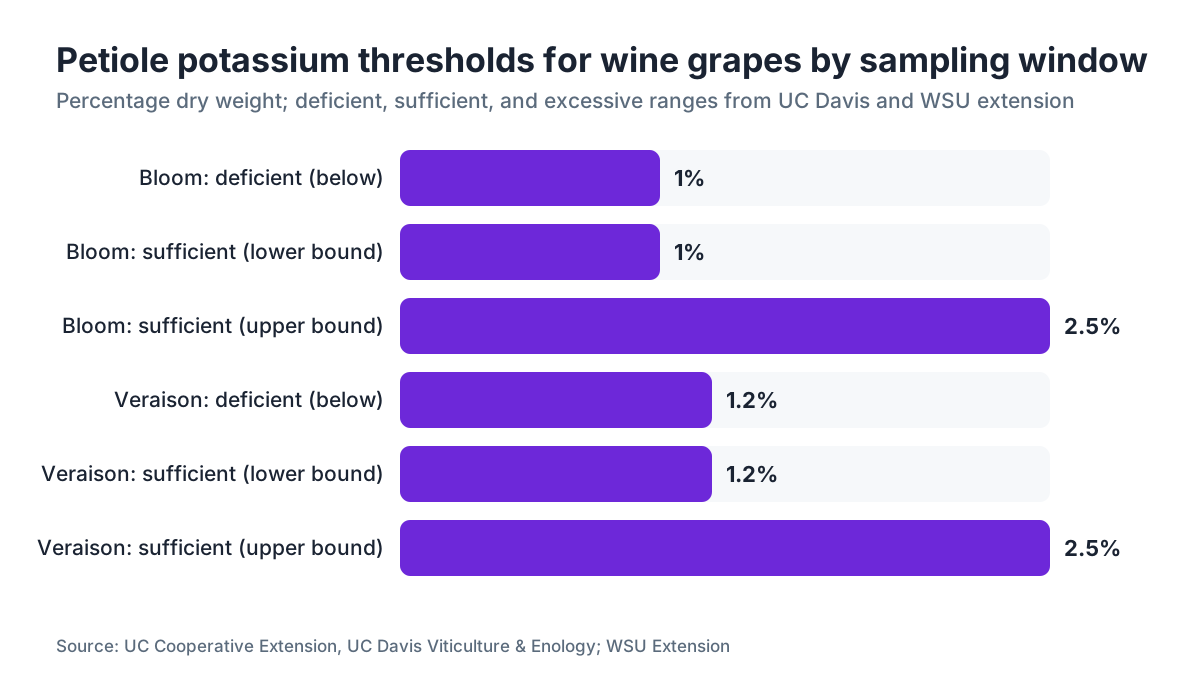
The numbers you get back from the lab are a percentage of dry weight. UC Davis extension pegs the sufficiency range for K in bloom-timed petioles (sampled opposite the first cluster at 50% bloom) at 1.0% to 2.5% dry weight. [1] WSU's viticulture program uses a similar range for the Inland Northwest and sets the deficient threshold at below 1.0% for bloom samples and below 1.2% for veraison samples. [2]
Here's what the result does NOT tell you. It won't tell you how your soil K relates to the plant signal. It won't predict wine pH by itself. And it won't catch mid-season swings that happened after you sampled. Treat it as a snapshot with a two-week lag on what the vine was actually experiencing when those leaves were expanding.
One caveat nobody talks about enough: potassium is highly mobile in the phloem, so late-season petiole samples can overstate deficiency if the vine has already started moving K to the fruit. Pair your results with a harvest berry analysis if you're trying to understand the wine pH picture.
What are the correct petiole K thresholds for wine grapes?
The two standard sampling windows each carry their own threshold, and mixing them up is the most common mistake in the field.
| Sampling window | Timing | Deficient below | Sufficient range | Excessive above |
|---|---|---|---|---|
| Bloom | 50% bloom, opposite basal cluster | 1.0% | 1.0 to 2.5% | 2.5% |
| Veraison | Onset of color change, same leaf position | 1.2% | 1.2 to 2.5% | 2.5% |
Source: UC Cooperative Extension, UC Davis Viticulture & Enology [1]
Bloom samples are the gold standard for diagnosing K status. The vine is in rapid vegetative growth, and the petiole K signal is least muddied by fruit loading or water stress. One sampling window per year, and you can only afford one? Do bloom. [1]
Veraison samples still earn their keep, especially if you missed bloom or suspect a mid-season problem. But veraison K numbers run lower as the vine ships potassium to the berries, so the threshold nudges up to 1.2% to compensate. [2]
A result in the 0.6% to 0.9% range at bloom is a real deficiency. A result at 0.4% or below, with visible interveinal chlorosis on older basal leaves and marginal leaf scorch, means the vine has been short on K for more than one season. That's a multi-year correction program, not a single application.
When is the right time to apply potassium based on your petiole results?
The answer shifts with which sampling window caught the deficiency, what your soil type is, and whether you're feeding the soil or the leaf.
Bloom petioles below 1.0% give you two realistic options. The first is a foliar potassium spray during the current season, ideally between bloom and fruit set when leaves are still expanding and uptake runs efficient. Foliar K won't fully fix a soil-level deficiency, but it can rescue berry set and early fruit development when you're running low. The second is a soil application the following dormant season or very early spring before budbreak, which has time to move into the root zone before the next bloom window. [3]
If veraison petioles come back low but bloom samples were fine, the vine likely had enough K during vegetative growth but couldn't keep up with the demand spike at berry fill. That's a timing problem as much as a supply problem. Adjust the pre-bloom soil application rate for next season.
If both windows come back deficient over two or more years, you have a structural soil problem: the soil's CEC is too low to hold K, the pH is out of range and limiting uptake, high magnesium is competing at the root surface, or root distribution is poor from compaction or phylloxera. Throwing more K at a vine that can't take it up is money wasted. Get a soil profile analysis done before you raise rates. [4]
For the current season, a foliar spray at the 6-8 leaf stage or shortly after bloom (not during bloom itself, to avoid interference with pollination) is the most responsive move. Potassium sulfate (0-0-50 or 0-0-52) dissolves cleanly and carries low phytotoxicity risk at 2 to 4 lb per 100 gallons of water, applied in the cool morning. Potassium thiosulfate (KTS) works well through drip fertigation at bloom and again at veraison if you have the system for it. [5]
How much potassium should you apply per acre to correct a deficiency?
There's no universal rate. The correct amount depends on your soil's existing K level, CEC, and how bad the deficiency is. Extension programs still give you practical starting points.
UC Cooperative Extension guidelines for corrective K applications on deficient soils start at 50 to 100 lb K2O per acre for mild deficiencies (petiole K in the 0.7% to 1.0% range at bloom) and go up to 200 lb K2O per acre for severe deficiencies. [3] WSU extension suggests similar ranges for eastern Washington soils and notes that soils with a CEC below 10 meq/100g may not hold a large single application efficiently. [2]
Foliar correction runs much lower. A typical potassium sulfate foliar application is 2 to 4 lb actual K2O per acre per pass, and two to three applications per season is a reasonable ceiling before you hit diminishing returns or salt burn on the leaves.
One thing worth saying plainly: the rate math trips people up. Potassium sulfate (SOP) runs about 50% K2O by weight. Potassium chloride (MOP) runs about 60% K2O. Buy a product listed as 0-0-50 and you need 200 lb of product to deliver 100 lb of K2O per acre. Confusing product weight with nutrient weight is a very common over- or under-application error. Read the guaranteed analysis on the bag.
Split applications generally beat single large applications on light soils. Put half down in late winter or early spring (February to March in California, March to April in Washington) and the rest at or just before bloom.
Does the form of potassium fertilizer matter for wine grapes?
It does, more than most growers expect. The choice is partly agronomic and partly winemaking.
Potassium sulfate (0-0-50 or 0-0-52, also labeled SOP) is the go-to for wine grapes. It adds sulfate alongside K, which carries some incidental fungal-suppression benefit at very low rates, and it doesn't raise soil salinity as aggressively as chloride-based products. Most certified organic programs allow SOP. It's also the only soluble form you should run through drip fertigation without checking line compatibility first.
Potassium chloride (0-0-60, MOP) is cheaper per unit K2O, but the chloride load on already stressed vines can be a problem, especially in dry or saline soils. Some winemakers believe repeated MOP applications shift juice chemistry in ways that affect fermentation, though the research on this isn't conclusive at typical agronomic rates. Tight budget, non-saline soils? MOP isn't a disaster. Just watch your EC after a few seasons.
Potassium thiosulfate (0-0-25-17S, KTS) is liquid, drops into drip fertigation programs easily, and works well as a low-rate foliar. Keep it out of tank mixes with calcium-containing products because it will precipitate.
Langbeinite (0-0-22 with 11% Mg and 22% S) is a specialty product worth a look if you have a combined deficiency of K, magnesium, and sulfur. It shows up in older organic programs in California.
For soil applications broadcast before budbreak, any of these forms work. Delivery method, incorporation depth, and timing matter as much as the specific product.
Can you apply potassium mid-season if you miss the bloom window?
You can, but your options narrow fast after fruit set.
Foliar potassium stays effective through fruit set and early bunch closure, roughly 6 to 10 weeks post-bloom depending on your variety and region. After bunch closure, getting product onto leaf surfaces without hitting clusters becomes physically harder, and the risk of residue on fruit skin climbs. Some winemakers care about that; others don't.
Soil applications after bloom do reach the vine, but translocation to the fruit is slower than you'd like during berry fill. A late-summer soil drench with potassium through your drip system can hold K supply to the canopy through veraison, but don't expect it to reverse a real deficiency that showed up at bloom.
For foliar applications, check your pesticide applicator license requirements and re-entry intervals even for fertilizer products. Under the EPA Worker Protection Standard, any product applied in a treated area may carry re-entry restrictions for field workers, even if it's not a pesticide. Your product label is the governing document. [6]
The honest answer: if your bloom petioles came back deficient, the most cost-effective mid-season move is a foliar bridge application, then aim your real correction at the soil before next year's bloom. Mid-season soil applications beat doing nothing, but they won't fully fix the problem.
How does potassium deficiency affect wine quality, more than vine health?
This is where viticulture and winemaking collide, and the relationship is genuinely complicated.
Known effect: moderate potassium deficiency in the vine tends to produce berries with lower juice pH and higher titratable acidity, which many cool-climate winemakers actually prefer. Some Zinfandel and Chardonnay growers in coastal California manage K deliberately low to keep pH in check. [7]
The other end: vines with high K status, or sandy soils heavily over-fertilized with potassium, produce berries where K competes with H+ ions in the juice, driving juice pH up into the 3.7 to 3.9 range. High juice pH shortens wine shelf life, demands more SO2 for stability, and can flatten aromatic expression. For red wines especially, that's a real winemaking problem.
Deficient vines don't just hand you nicely acidic fruit, though. Potassium shortage slows sugar translocation (K is the primary driver of phloem loading for sucrose), which means uneven ripening, lower Brix at harvest, and in severe cases, delayed color development in red varieties. The vine also loses drought tolerance, a growing concern in warming regions.
A 2002 paper in the American Journal of Enology and Viticulture noted that "potassium is the most abundant cation in grape juice and has the strongest influence on must pH," which captures why both deficiency and excess are problems depending on your wine style and climate. [7] The goal is sufficiency, not maximization.
What else should you check before deciding to apply potassium?
A low petiole K result on its own is not automatically a prescription to add fertilizer. A few other checks belong in your decision before you open the barn.
Soil K and CEC. If your soil test shows adequate exchangeable potassium (typically above 200 ppm in most Western U.S. guidelines) but your petioles are still low, the problem is likely uptake, not supply. Check soil pH first. K availability drops sharply below pH 5.5 and above pH 8.0. [4]
Magnesium to potassium ratio. High soil magnesium, particularly in serpentine or heavily lime-amended soils, antagonizes K uptake. A Mg:K ratio above 5:1 in the soil is worth flagging. If that's your situation, adding more K without addressing the ratio may give you only marginal improvement.
Rootstock. Some rootstocks accumulate K far more efficiently than others. 5BB Kober, 5C Teleki, and 110 Richter are known high-K accumulators. [8] If your vines on high-accumulating rootstocks are showing elevated juice pH rather than deficiency, be conservative with additions.
Your irrigation and fertigation history. Excess water flushes K from the root zone faster than almost any other factor on sandy or loamy soils. Unusually high irrigation from a wet spring or an overly generous drip program can leach K before the vine takes it up.
Once you've worked through these four factors, you'll know whether you're dealing with a supply problem (soil K too low), an uptake problem (chemistry or rootstock blocking absorption), or a sampling artifact (timing or water stress skewing the petiole result).
Tracking all of this across multiple blocks and multiple seasons is where vineyard record-keeping software pays for itself. VitiScribe keeps tissue test results, application records, and soil data together in one place so you can see the multi-year pattern instead of treating every season as a standalone puzzle.
How should you sample petioles correctly to get reliable results?
A bad sample produces a number that's confidently wrong. Sampling protocol matters as much as the lab analysis.
The standard protocol from UC Davis and Cornell: collect 60 to 80 petioles per block, each from a different vine, always from the leaf opposite the basal cluster (at bloom) or the same position (at veraison). Use only healthy-looking leaves. Don't sample water-stressed vines within 48 hours of irrigation or rain. Don't sample from vines that had a foliar spray in the last 14 days, since residue contamination will push K results upward. [1] [9]
Sample all blocks the same day if you can, or at least within the same three-day window. Variation in sampling date is one of the leading causes of block-to-block comparison errors.
Once collected, put petioles in a paper bag. Not plastic, which traps moisture and degrades the sample. Ship overnight to the lab. If you're sending multiple blocks, label bags clearly with block ID, date, and the specific vine rows sampled. Labs like A&L Western and Waypoint Analytical run petiole samples regularly and publish their own protocol sheets aligned with UC and WSU guidelines.
Sample the same block in the same week each year. Year-to-year comparisons only hold if the timing holds. A result from week 12 of the season is not comparable to a result from week 9 of the prior year in any useful way.
For vineyard blocks with known variability (different soil series, rootstocks, or irrigation zones within the same block), split them into separate sampling units. A single composite from a mixed block averages out real variation that you need to see.
What do WSU and UC Davis recommend differently, and does it matter for your region?
The core thresholds are similar between UC Davis and WSU, but the context around application recommendations reflects real regional differences.
UC Davis extension materials, particularly the Soil and Foliar Nutrient Management guide, lean heavily on California conditions: diverse soil types from marine sediments in Napa to granitic decomposed rock in Paso Robles, irrigation water quality issues (high bicarbonate is common), and high baseline K in many coastal valley soils. Their default guidance stays conservative on application rates because over-application has been a documented problem in some high-potassium California soils. [3]
WSU extension materials, particularly the PNW Nutrient Management Handbooks (co-authored with Oregon State and the University of Idaho), calibrate for eastern Washington's volcanic ash soils, which can have lower natural K reserves and lower CEC. WSU also gives more specific guidance on fertigation timing through drip and micro-sprinkler systems, which are nearly universal in Columbia Valley and Yakima Valley. [2]
Cornell Cooperative Extension, covering New York's Finger Lakes and Hudson Valley, deals with humid climate complications that neither UC nor WSU addresses much: higher disease pressure increases defoliation risk, which disrupts the normal nutrient cycling assumptions, and some eastern soil types have high K-fixing capacity that needs higher application rates than California equivalents. [9]
The practical takeaway for most growers: use the extension program for your state as your baseline, not a general internet chart. The thresholds are close enough to be broadly useful, but the rate recommendations diverge on local soil chemistry.
How do you track petiole results and K application records for compliance?
In most U.S. wine grape states, keeping fertilizer application records is not optional. California's Fertilizer Inspection Advisory Board regulations require a record of any fertilizer applied to agricultural land, and many California counties require submittal of nutrient management plans for operations above certain acreages under the State Water Board's Irrigated Lands Regulatory Program. [10]
At minimum, your records should include the date of application, the product name and guaranteed analysis, the application method (broadcast, drip, foliar), the rate per acre, the total acres treated, and the block or field ID. Keep these records for at least three years. Some permit conditions require five.
Pairing your application records with the matching petiole results makes agronomic sense and gives you documentation that your applications were justified by tissue testing rather than a hunch. That matters if you're in a region under scrutiny for nitrate or potassium loading into groundwater or drainage.
Managing multiple blocks and trying to keep petiole data, soil test data, and spray and fertigation records in one place? VitiScribe was built for this workflow. You can log tissue results alongside application decisions and generate the record summaries your PCA or compliance consultant will ask for at year end.
Under the EPA Worker Protection Standard, any fieldwork in areas where pesticides or certain fertilizer products have been applied must respect re-entry interval requirements. Even if your K application isn't a pesticide, mixing it with a fungicide in the same tank means WPS re-entry rules apply to the whole application. Documenting application dates and products protects you if there's ever a question about worker exposure. [6]
What are the signs of potassium deficiency in the vineyard you can see without a lab?
Don't wait for visual symptoms before sampling. By the time symptoms show up, the deficiency is already cutting into yield and berry composition. Knowing what to look for helps you prioritize which blocks to sample first.
Classic K deficiency symptoms in grapevines start on the older, basal leaves. Marginal leaf scorch is the first sign: a dry, brown or tan edge on the leaf margin that begins at the tips and works inward. Magnesium deficiency shows interveinal chlorosis in the interior of the leaf. Potassium deficiency causes marginal scorch on basal leaves first. [1]
In severe cases, the scorched margins curl upward, and the leaf eventually dries and drops. That premature defoliation exposes clusters to sunburn and strips photosynthetic capacity right when the vine needs it most for berry fill.
Shoot tips may show abnormal curvature in acute deficiency. Berries on severely deficient vines ripen unevenly and tend to show poor color development in red varieties. Seeing Brix laggers in the same blocks year after year? K status is worth checking.
One visual trap to avoid: leaf scorch from potassium deficiency looks a lot like wind damage, herbicide drift, and certain mite damage. Confirm with a petiole sample before you apply anything. Visual diagnosis alone carries a meaningful false positive rate, and an unnecessary K application on a vine already at adequate K will push your juice pH up.
Frequently asked questions
What is the deficient threshold for petiole potassium in wine grapes?
UC Davis puts the deficiency threshold at below 1.0% K dry weight for bloom-timed petiole samples and below 1.2% for veraison samples. WSU extension uses the same thresholds for Pacific Northwest wine grapes. The sufficient range at both windows is roughly 1.0% to 2.5%. Results above 2.5% count as excessive and can contribute to elevated juice pH at harvest.
Is bloom or veraison the better time to collect petiole samples?
Bloom is better for diagnosing whether the vine needs a K correction that season. Sample at 50% bloom, taking petioles from the leaf opposite the basal cluster. Veraison samples still help if you missed bloom, but K naturally moves toward the fruit at veraison, so petiole values run lower and the threshold adjusts to 1.2%. If you can only do one sampling window per year, do bloom.
Can you apply potassium after bloom if petiole results come back low?
Yes, but your window is short. Foliar potassium sulfate works reasonably well from fruit set through early bunch closure, roughly 6 to 10 weeks post-bloom. After bunch closure, leaf surface access gets difficult and residue on fruit becomes a concern. Soil applications after bloom reach the vine but are slower to move into the fruit. The better fix is a pre-bloom soil application before next season.
How much potassium per acre do I need to apply to correct a deficiency?
UC Cooperative Extension recommends 50 to 100 lb K2O per acre for mild deficiencies (petiole K 0.7% to 1.0% at bloom) and up to 200 lb K2O per acre for severe cases. For foliar correction, 2 to 4 lb K2O per acre per application is typical. Always convert from product weight to actual nutrient weight: potassium sulfate (0-0-50) contains 50% K2O, so 200 lb of product delivers 100 lb K2O per acre.
What is the best form of potassium fertilizer for wine grapes?
Potassium sulfate (SOP, 0-0-50) is the standard recommendation for wine grapes. It has low phytotoxicity risk, works as a foliar or soil application, and fits most organic programs. Potassium chloride (MOP) is cheaper but the chloride load can be a problem on saline soils. Potassium thiosulfate (KTS) is ideal for drip fertigation. Avoid mixing KTS with calcium products in the tank.
Why is my petiole potassium low when soil tests show adequate K?
Low petiole K alongside adequate soil K usually points to an uptake problem rather than a supply problem. Check soil pH first, since K availability drops below 5.5 and above 8.0. High soil magnesium (Mg:K ratio above 5:1) antagonizes K uptake. Rootstock matters too: some rootstocks accumulate less K regardless of soil levels. Heavy irrigation that leaches K below the root zone is another common cause on sandy soils.
Does potassium deficiency raise or lower wine pH?
Deficiency tends to lower juice pH and raise titratable acidity because the vine ships less K to the fruit. High K status does the opposite: potassium is the dominant cation in grape juice and directly displaces H+ ions, raising pH. Juice pH in the 3.7 to 3.9 range, often linked to K excess, shortens wine shelf life and requires more SO2 for stability. The goal is sufficiency, not the highest K level possible.
How do I collect petioles correctly so the sample is valid?
Collect 60 to 80 petioles per block from different vines, always from the leaf opposite the basal cluster at 50% bloom or the equivalent position at veraison. Use only healthy leaves. Don't sample within 48 hours of irrigation or rain, and not within 14 days of a foliar application (residue contamination skews K values upward). Ship overnight in paper bags, labeled with block ID and sampling date.
Does rootstock affect potassium uptake in wine grapes?
Yes, significantly. Rootstocks like 5BB Kober, 5C Teleki, and 110 Richter accumulate more potassium than rootstocks like 101-14 Mgt or 3309C. If your vines are on a high-K-accumulating rootstock and you're seeing elevated juice pH, be conservative with K fertilization. On a low-accumulator rootstock in a low-K soil, you'll need higher application rates to reach sufficiency.
What records do I need to keep for potassium fertilizer applications?
At minimum: application date, product name and guaranteed analysis, application method, rate per acre, total acres treated, and block ID. California's Fertilizer Inspection Advisory Board and the State Water Board's Irrigated Lands Regulatory Program may require more depending on your acreage and region. Retain records for at least three years, or five years if your permit requires it. Pairing applications with petiole results documents that the application was need-based.
Can too much potassium hurt my wine grapes?
Yes. Petiole K above 2.5% at bloom, or soil potassium well above 200 ppm with no deficiency symptoms, can push juice pH into problem ranges, often 3.7 to 3.9 in red varieties. That makes wine more prone to oxidation and microbial instability, and demands higher SO2 additions. Sandy soils with long fertilization histories in the same blocks are most at risk. A full soil profile test every three to four years helps prevent it.
When should I split my potassium application rather than applying all at once?
Split applications pay off on soils with CEC below 10 meq/100g (sandy or light loams), because a large single K application will partially leach before the vine can use it. Apply half in late winter or very early spring before budbreak, and the rest at or just before bloom. On high-CEC clay or clay-loam soils, a single pre-budbreak application is usually fine and cuts an equipment pass.
Do I need to adjust potassium management differently for certified organic vineyards?
Potassium sulfate (SOP) is permitted under the USDA National Organic Program when derived from a nonsynthetic source, but check your certifier's approved materials list before buying. Potassium chloride (MOP) is generally not allowed in organic programs. Langbeinite (0-0-22) and greensand are allowed. Application rates and timing logic match conventional, but your product choices are narrower. Always document the product's source and certifier approval.
How often should I be doing petiole testing for potassium?
Annually is the standard for blocks with any history of deficiency, imbalance, or unusual juice pH. For stable, well-managed blocks with consistent petiole results year over year, every two years may be enough, though most PCAs and extension advisors recommend annual sampling to catch drift early. At minimum, always sample after a year with unusual weather, a heavy crop, or a rootstock problem that could have altered uptake patterns.
Sources
- Washington State University Extension, Viticulture and Enology, Pacific Northwest Nutrient Management Handbook: WSU deficiency threshold for petiole K is below 1.0% at bloom and below 1.2% at veraison; recommendations for low-CEC volcanic ash soils in eastern Washington
- UC Cooperative Extension, Soil and Foliar Nutrient Management for Vineyards: Corrective K application rates of 50 to 100 lb K2O per acre for mild deficiencies and up to 200 lb K2O per acre for severe deficiencies on California soils
- Oregon State University Extension Service, Fertilizing Wine Grapes in Oregon: Potassium sulfate at 2 to 4 lb per 100 gallons as a foliar; potassium thiosulfate (KTS) for drip fertigation at bloom and veraison; avoid KTS in tank mixes with calcium products
- U.S. EPA, Worker Protection Standard for Agricultural Pesticides: WPS re-entry interval requirements apply to any product applied in a treated area; when a fertilizer is tank-mixed with a pesticide, WPS rules govern the combined application
- American Journal of Enology and Viticulture, Vol. 53, No. 4 (2002), Potassium in the Grape Berry: Potassium is the most abundant cation in grape juice and has the strongest influence on must pH; both deficiency and excess create distinct winemaking challenges
- Cornell Cooperative Extension, Grape Petiole Sampling and Analysis for New York Vineyards: Recommended to collect 60 to 80 petioles per block; do not sample within 14 days of a foliar spray; ship overnight in paper bags with block ID labeled
- California State Water Resources Control Board, Irrigated Lands Regulatory Program: California operations under the Irrigated Lands Regulatory Program must maintain fertilizer application records and in some regions submit nutrient management plans; records retained for at least 3 years
- USDA National Organic Program, Allowed and Prohibited Substances: Potassium sulfate from nonsynthetic sources is permitted under NOP; potassium chloride is generally not allowed; langbeinite and greensand are approved
- Washington State University Extension, Grapevine Rootstock Selection for the Pacific Northwest: WSU guidance on rootstock-by-soil K interaction for Columbia Valley and Yakima Valley viticulture; CEC below 10 meq/100g cited as threshold for recommending split K applications
Last updated 2026-07-11