Interpreting soil test boron levels in wine grape production
TL;DR
- Soil boron tests for wine grapes flag deficiency below roughly 0.5 ppm (hot-water extractable) and toxicity risk above 1 to 2 ppm, though the safe window varies by soil texture, pH, and rootstock.
- The number alone doesn't tell the whole story.
- Petiole analysis at bloom confirms whether vines are actually taking up what's there, and that combination is what drives a reliable management decision.
Why does boron matter so much for wine grapes?
Boron is the micronutrient that controls cell wall formation and pollen tube growth. When it's short, flowers fail to set, berries don't fill, and you get a condition called "shot berries" or millerandage, where clusters look patchy with a mix of tiny seedless berries and normal ones. WSU Extension describes boron deficiency as one of the more common causes of poor fruit set in Pacific Northwest vineyards, particularly on sandy, low-organic-matter soils [1].
The tricky part is that the window between "not enough" and "way too much" is narrow. Boron is one of the few essential plant nutrients where the toxic threshold sits close to the deficient threshold. Most other nutrients give you a wide safe zone. Boron does not. That's why reading the test number correctly matters more than it does for, say, potassium.
Vine demand for boron peaks at bloom. Adequate supply during that two-week window directly determines how many berries you'll have at harvest. Miss it and you can't make up the yield loss later in the season.
What extraction method does your soil test use, and why does it change everything?
Before you interpret any boron number, you have to know the extraction method the lab used. This is where growers get burned.
The hot-water extraction (Berger-Truog or hot-water soluble boron) is the standard method for agricultural soils and the one almost all university extension recommendations are built on [2]. It pulls the fraction of boron that's most available to plants. The DTPA method used for other micronutrients is not reliable for boron. Mehlich-3, which many general soil labs run as a package, does not extract boron well either.
If your lab report just says "boron" without specifying extraction method, call the lab before acting on the number. A result from an unsuitable extraction method is not interpretable against extension thresholds, full stop.
UC Davis Plant Sciences recommends hot-water soluble boron for vineyard soil testing specifically, noting that the method most accurately reflects the plant-available pool [3]. Cornell's viticulture program makes the same point for New York wine regions [4].
What soil boron levels indicate deficiency in wine grapes?
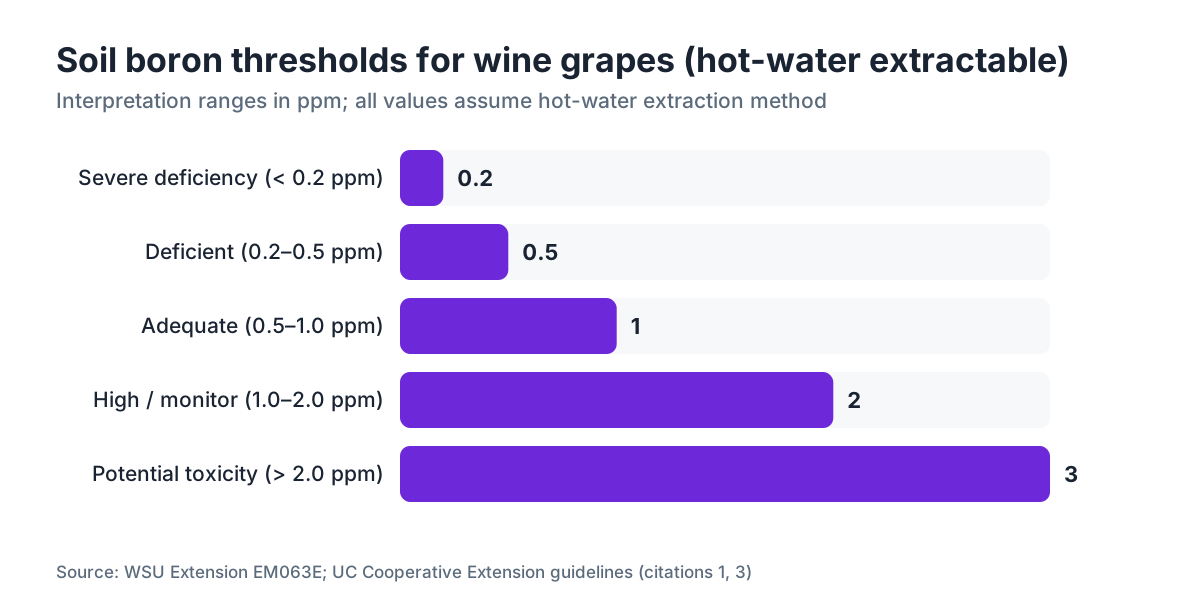
Using hot-water extractable boron, the general deficiency threshold for wine grapes is below 0.5 ppm. WSU Extension lists less than 0.5 ppm as deficient and 0.5 to 1.0 ppm as adequate for Vitis vinifera [1]. UC Cooperative Extension uses similar thresholds for California wine regions, though some researchers place the lower critical value as low as 0.2 to 0.3 ppm in very sandy soils with high leaching [3].
Soil texture is a real modifier here. Sandy soils with low organic matter hold almost no boron and leach it quickly. If you're farming a light sandy loam in a high-rainfall or heavily irrigated block and your hot-water boron comes back at 0.4 ppm, that's genuinely risky. The same 0.4 ppm reading in a clay loam with 3% organic matter is less alarming because the soil's buffering capacity means actual delivery to the vine is more consistent.
Soil pH also changes availability sharply. Boron availability is highest in the pH range of 5.5 to 7.0 and drops off above 7.5 [2]. Alkaline soils in arid growing regions can show adequate total boron on a test but still leave vines short because the pH is locking it up. That's exactly why growers in places like parts of the Central Valley or some Paso Robles blocks need to think about both the number and the pH before concluding everything is fine. If you're curious how producers in those areas manage soil nutrition, know that the Paso Robles wineries region sits largely on calcareous soils where pH-driven lockout is a real management challenge.
| Soil boron level (hot-water extractable) | Interpretation for wine grapes |
|---|---|
| < 0.2 ppm | Severely deficient; fruit set likely affected |
| 0.2 to 0.5 ppm | Deficient; foliar correction at bloom recommended |
| 0.5 to 1.0 ppm | Adequate; monitor with petiole test at bloom |
| 1.0 to 2.0 ppm | High; confirm with petiole; no addition needed |
| > 2.0 ppm | Potentially toxic; further testing required before any irrigation or amendment |
Source: WSU Extension EM063E, UC Cooperative Extension guidelines [1][3]
What boron levels are toxic to grapevines?
Toxicity is the other side of the problem and it gets less attention, probably because deficiency is more common in most wine regions. But in arid zones with boron-rich irrigation water, or after repeated foliar or soil applications without testing, toxicity creeps in faster than people expect.
Generally, hot-water extractable boron above 2 ppm in soil starts raising flags for grapevines. At levels above 5 ppm, phytotoxicity symptoms are likely: leaf margins yellow and scorch, often starting on older leaves, and shoot growth slows [5]. The plant essentially can't keep up with the intake. There is no good way to rapidly fix a boron-toxic soil. It doesn't flush out the way excess nitrogen does. Leaching with large water volumes helps over seasons but doesn't solve the problem in one year.
Irrigation water is the most common route to soil boron accumulation in California wine country. Water boron above 0.5 ppm is worth watching; above 1.0 ppm it will cause problems over time in poorly drained soils [5]. The UC Agriculture and Natural Resources program recommends testing irrigation water for boron annually if you're drawing from groundwater in regions with naturally elevated boron geology, which includes parts of the San Joaquin Valley and some North Coast watersheds [3].
Should you rely on soil tests alone or pair them with petiole analysis?
Soil tests tell you what's there. Petiole tests tell you what the vine is actually getting. For boron specifically, you need both because the correlation between soil boron and vine boron uptake is noisier than for most other nutrients.
The standard timing for boron petiole sampling is bloom (when roughly 50% of flowers are open), taking the petiole from the leaf directly opposite a flower cluster. That sample reflects nutrient status during the highest-demand period [4].
Cornell's viticulture program lists adequate petiole boron at bloom as 25 to 75 ppm dry weight for Vitis vinifera, with deficiency below 20 to 25 ppm and potential toxicity concern above 100 ppm [4]. If your soil test reads adequate (0.5 to 1.0 ppm) but your petiole boron comes back at 18 ppm, you have a real uptake problem, possibly from high pH, dry soil conditions during bloom, or rootstock incompatibility. That's actionable. A soil test alone wouldn't have caught it.
Flip the situation. If a grower sees a soil test below 0.5 ppm but the petiole comes back at 40 ppm, the vines are finding boron somewhere (organic matter mineralization, subsoil reserves) and a foliar application would be wasted money.
Keeping those paired records organized by block and year is where a system like VitiScribe helps, since you can track the soil/petiole relationship over multiple vintages and see whether a correction actually moved the needle.
How do you correct boron deficiency in a wine grape vineyard?
Foliar application is the fastest and most reliable correction for deficient or borderline vines. Soil applications work but they're slower and easier to over-apply.
For foliar boron, the standard rate is 0.1 to 0.2 lbs actual boron per acre, applied at early bloom. Solubor (disodium octaborate tetrahydrate, 20.5% B) is the most commonly used formulation in commercial vineyards. A typical rate is about 0.5 to 1.0 lb Solubor per acre mixed in 30 to 50 gallons of water [1]. Some programs split the application: one spray at early pre-bloom, one at full bloom.
Do not exceed recommended label rates. The margin between corrective and phytotoxic foliar rates is tight. Leaf burn shows up fast at over-application, and it's not reversible for that growing season.
Soil application with borax (10 to 11% B) is sometimes used for long-term building of boron reserves in severely deficient, high-organic blocks. Rates run 1 to 5 lbs actual boron per acre depending on soil texture, applied in fall or early spring [2]. Sandy soils should always get split or lower rates because boron leaches before vines can use it. Heavy rates on sandy soils are money straight down into the water table.
Always retest the following year after any soil boron application. There's no reliable way to predict exactly how much the soil level will move from a given application rate without site-specific data.
How does rootstock affect boron uptake from the soil?
This is where the conversation gets more nuanced and where a lot of growers don't have good data yet. Different Vitis rootstocks vary in how efficiently they pull boron from soil, and those differences are big enough to matter in borderline situations.
Research from UC Davis found that rootstock choice affected boron concentration in both petioles and berries in field trials, with some rootstocks showing markedly higher uptake at the same soil boron level [6]. 110R and 140Ru, both known for drought adaptation and deep rooting, appear to be more efficient boron foragers than shallower-rooting stocks like 101-14 Mgt or Riparia Gloire. Nobody has a complete table of rootstock boron efficiency rankings that's been validated across regions, so use that generalization carefully.
The practical implication: if you have two blocks with identical soil boron at 0.45 ppm, the one on 110R may be fine while the one on 101-14 might show deficiency symptoms. This is why the petiole test always has to be your confirmation step before spending money on a correction program.
What are the visible symptoms of boron deficiency and toxicity in grapevines?
Knowing what to look for in the canopy is how you catch a problem before the test cycle catches up.
Boron deficiency symptoms in grapevines: irregular or stunted shoot tips, zigzag or distorted internodes, small and misshapen leaves with chlorotic margins on young growth, and most distinctively, poor fruit set with the millerandage (shot berry) pattern on clusters. Shoots may die back from the tip in severe cases. Symptoms show primarily on new growth because boron is not mobile in the phloem, so it can't move from old tissue to new [1].
Boron toxicity symptoms: marginal leaf scorch beginning on mature leaves (not new growth), a yellow-to-brown leaf margin that progresses inward, and overall reduced vigor. Toxicity symptoms tend to show on older tissue because boron accumulates there over time. This is the opposite pattern from deficiency, which is useful for diagnosis.
Confusing the two is easy if you only look at one or two leaves. Always walk the block and look at tissue age distribution before concluding which direction the problem runs. Then test.
Does organic matter or compost application affect soil boron?
Yes, and it matters practically. Organic matter is the primary reservoir of boron in most agricultural soils. As organic matter mineralizes, it releases boron into the plant-available pool. Soils with higher organic matter typically have higher total boron, but they also have more stable and gradual boron delivery, which buffers both deficiency and toxicity [2].
Compost additions do raise soil boron over time, but slowly. A single compost application at typical vineyard rates (4 to 8 tons per acre) is unlikely to cause a measurable change in hot-water extractable boron within one season. Over five to ten years of consistent applications, it can meaningfully increase the available pool in originally deficient sandy soils.
One thing worth knowing: some municipal biosolids and certain livestock manures carry elevated boron from detergents and cleaning products. If you're using non-traditional organic amendments, test them for boron content before applying at scale. This isn't common knowledge and labs can test amendment boron easily and cheaply.
What records do you need to keep for boron applications under pesticide and worker safety rules?
Foliar boron products like Solubor are not pesticides under the Federal Insecticide, Fungicide, and Rodenticide Act (FIFRA), so they don't trigger pesticide application records the way fungicides or insecticides do. But you still need to document nutrient applications for several reasons.
First, any product mixed with a pesticide carrier, or applied in a tank mix with a registered pesticide, takes on the record-keeping requirements of that pesticide. If you're adding Solubor to a fungicide spray at bloom, that application needs a full pesticide application record under your state's requirements [7].
Second, if you're farming to a certification standard (organic, sustainable, LODI, SIP, or others), boron source and rate matter. Solubor is OMRI-listed for organic use; borax in its commercial form may or may not qualify depending on the certifier. Check before applying.
Third, under the EPA Worker Protection Standard (WPS), any product with labeling that restricts entry intervals or requires PPE triggers those protections regardless of whether it's a pesticide in the narrow FIFRA sense [8]. Some boron product labels do carry PPE language. Read them.
Good block-level records of what you applied, when, at what rate, and with what equipment are worth keeping even when not strictly required. When a problem shows up three years later, you'll want that history. Keeping those records organized by block in a tool like VitiScribe means you can pull a block's full nutrient history in seconds when your agronomist asks.
For vineyards also running estate or tasting room operations, clean field records matter for everything from certification audits to SIP or sustainability program renewals. The vineyard management context shapes how detailed those records need to be.
How often should you test soil boron in a wine grape vineyard?
Soil boron doesn't need annual testing unless you've made a correction or you're in a high-risk situation (sandy soil, high-pH, boron-rich irrigation water, or a history of deficiency). A baseline test every two to three years is reasonable for most established vineyards running a stable nutrition program [3].
After any soil boron application, test the following season. After starting a new irrigation water source, test both the water and soil in the first year. When establishing a new block on sandy soil, test before planting and again after the first full season.
Sample depth matters. The standard for available boron is the top 12 inches (0 to 12"), but in high-clay or high-pH subsoils you might also want a 12 to 24" sample if you suspect subsoil accumulation from years of boron-containing irrigation water. Most labs charge separately for the second depth increment but it's worth it if there's a reason to suspect accumulation.
Take a minimum of 20 to 25 subsamples per block to form a composite, following a zigzag pattern across the block. One or two grab samples give you noise, not signal.
Are there regional differences in baseline soil boron levels across U.S. wine regions?
Yes, and they're large enough to matter for interpreting your results.
Pacific Northwest wine regions (Walla Walla, Yakima Valley, Columbia Valley) tend to have low native soil boron, particularly on the aeolian (wind-deposited) sandy loam soils that dominate much of the AVA landscape. WSU Extension identifies boron deficiency as a recurring issue in these regions and recommends routine monitoring at bloom [1].
California's coastal regions (Napa, Sonoma, Santa Barbara) vary widely. Soils derived from sedimentary marine parent material sometimes have naturally higher boron, while soils derived from granitic parent material tend to be lower. Central Valley floor soils can have elevated boron from both geologic and irrigation water sources [3].
Eastern U.S. wine regions (New York Finger Lakes, Virginia, North Carolina) generally have acidic soils where boron availability is adequate to moderately available, but leaching on steep vineyard slopes in high-rainfall years can deplete reserves faster than in western arid regions [4].
Knowing your region's baseline isn't a substitute for testing your blocks, but it shapes how you interpret a borderline result. A reading of 0.45 ppm in eastern Washington is more urgent than the same number in a well-buffered North Fork of Long Island clay loam.
Frequently asked questions
What is the normal range for boron in a wine grape vineyard soil test?
Using hot-water extractable boron, the adequate range for wine grapes is roughly 0.5 to 1.0 ppm. Below 0.5 ppm is considered deficient and above 2.0 ppm starts moving toward toxicity risk. These thresholds come from WSU Extension and UC Cooperative Extension guidelines and assume standard hot-water extraction. Different extraction methods produce different numbers that aren't directly comparable.
Can I apply boron as a foliar spray instead of a soil amendment?
Yes, and for correcting a deficiency quickly, foliar application is almost always the better choice. It's faster-acting, easier to calibrate, and harder to over-apply to the point of soil toxicity. The standard rate is 0.1 to 0.2 lbs actual boron per acre as Solubor at early bloom. Soil applications make more sense for long-term building in severely deficient, low-organic-matter soils.
What happens to berry quality if boron deficiency goes uncorrected?
Poor fruit set is the primary economic injury. Vines produce clusters with a mix of normally sized berries and tiny, seedless shot berries, which is called millerandage. Yields drop, and the surviving normal berries may show elevated sugar concentration from the reduced crop load, which can push alcohol higher than desired. In severe cases, shoots die back from tips and overall vine development is stunted for the season.
How do I know if my irrigation water is contributing to soil boron buildup?
Test your irrigation water for boron directly. Water boron above 0.5 ppm is worth monitoring; above 1.0 ppm, accumulation in soil is likely over time, especially in poorly drained blocks or where water use is high. UC Agriculture and Natural Resources recommends annual water testing if you're drawing from groundwater in regions with boron-enriched geology. Many commercial water testing labs include boron in a standard ag water panel.
What is the best time to collect soil samples for boron testing?
Fall after harvest or early spring before bud break are both acceptable windows for vineyard soil boron sampling. Avoid sampling within a few weeks of any amendment application. Collect at least 20 to 25 subsamples per block to 12-inch depth, composite them, and request hot-water extractable boron specifically on the test submission form so the lab uses the correct method.
Is Solubor approved for organic viticulture?
Solubor (disodium octaborate tetrahydrate) is OMRI-listed and is generally accepted for use in certified organic vineyards, but you should verify with your specific certifying agency before applying. Some certifiers keep their own approved materials lists that may differ from the OMRI list. Borax and other boron sources may or may not qualify depending on purity and source documentation requirements of your certification program.
Does soil pH affect how much boron my vines can take up?
Significantly. Boron availability drops as pH rises above 7.0 and falls sharply above 7.5. This means a soil with 0.6 ppm hot-water boron at pH 6.5 will deliver meaningfully more boron to vines than the same soil at pH 8.0. In alkaline soils common to arid wine regions, you can have apparently adequate soil boron but still see deficiency symptoms and low petiole values because the pH is restricting uptake.
How do I interpret a petiole boron test at bloom?
Cornell's viticulture program lists adequate petiole boron at bloom as 25 to 75 ppm dry weight for Vitis vinifera. Below 20 to 25 ppm is deficient; above 100 ppm raises concern for excess. Petiole sampling must be done correctly: collect the petiole (not the leaf blade) from the leaf directly opposite a flower cluster, at roughly 50% bloom, from at least 20 to 25 representative vines per block.
Can too much boron from a previous grower's applications cause problems for a new vineyard?
Yes. Soil boron above 2 ppm in a newly acquired block is worth investigating before planting. Boron doesn't flush quickly from soil, particularly from heavier-textured soils. If you're buying or leasing ground with a history of intensive micronutrient programs, get a full micronutrient soil test before setting a nutrition plan. There's no fast fix for a boron-toxic soil; leaching over multiple seasons is the only practical option.
Do different grape varieties have different boron requirements?
There's not strong published data separating boron requirements cleanly by variety across Vitis vinifera. The bigger variable is rootstock, which affects uptake efficiency more than the scion variety. That said, thin-skinned, high-cluster-count varieties may show fruit set problems from mild deficiency more visibly than low-cluster cultivars simply because they're producing more flowers demanding boron at bloom. Rely on petiole testing at bloom rather than adjusting targets by variety.
What PPE do I need when applying boron products in the vineyard?
Read the specific product label; PPE requirements vary. Solubor labels typically require gloves, safety glasses, and a dust mask during mixing because the powder is an eye and respiratory irritant. Under the EPA Worker Protection Standard, any label PPE language must be followed and the label is treated as law. If you're applying in a tank mix with a registered pesticide, the most protective PPE listed among all products in the mix governs.
How much does a soil boron test cost?
A standalone hot-water extractable boron test runs about $10 to $20 per sample at most commercial ag labs, though this varies by lab and region. As part of a full soil micronutrient panel, the per-element cost is often lower. The petiole boron test runs a similar range. Neither test is expensive relative to the cost of a yield-reducing deficiency or a phytotoxic over-application, so there's no sensible argument for skipping it in an established vineyard program.
What should I do if my soil boron test comes back above 2 ppm but I haven't applied any boron?
First, check your irrigation water. Elevated irrigation water boron is the most common unintended accumulation pathway. Second, check for boron-bearing amendments (some composts, certain biosolids) in the field history. Third, confirm the extraction method the lab used. If the elevated reading is confirmed with hot-water extraction and you have elevated irrigation water boron, switch to the lowest-boron water source available and monitor soil levels annually. Do not apply any foliar or soil boron product.
Sources
- Washington State University Extension, EM063E Nutrient Management for Wine Grapes: Boron deficiency threshold below 0.5 ppm hot-water extractable; adequate range 0.5 to 1.0 ppm for Vitis vinifera; foliar Solubor rates at bloom for Pacific Northwest vineyards
- UC Cooperative Extension, Nutrient Management in Vineyards: Hot-water soluble boron recommended extraction for California vineyard soil; deficiency thresholds; irrigation water boron above 0.5 ppm flagged for monitoring
- Cornell University Cooperative Extension, Viticulture and Enology Program: Petiole boron at bloom 25 to 75 ppm dry weight adequate; deficiency below 20 to 25 ppm; hot-water boron extraction recommended for New York wine regions
- UC Agriculture and Natural Resources, Irrigation Water Quality for California Agriculture: Irrigation water boron above 1.0 ppm causes long-term soil accumulation and phytotoxicity in poorly drained soils; toxicity symptoms on mature leaves
- University of California Davis, Department of Viticulture and Enology, rootstock nutrition research: Rootstock choice affects boron concentration in petioles and berries; deep-rooting rootstocks including 110R show higher boron uptake efficiency in field trials
- California Department of Pesticide Regulation, Pesticide Application Record Requirements: Tank-mix applications of non-pesticide nutrients with registered pesticides carry the record-keeping requirements of the registered pesticide
- U.S. EPA, Worker Protection Standard for Agricultural Pesticides (40 CFR Part 170): Products with label PPE requirements trigger Worker Protection Standard protections; labels with restricted entry intervals must be followed regardless of pesticide classification
- OMRI (Organic Materials Review Institute), Listed Materials Database: Solubor (disodium octaborate tetrahydrate) is OMRI-listed for use in certified organic production
- WSU Extension, Columbia Valley Viticulture soil fertility bulletins: Low native soil boron in aeolian sandy loam soils of Washington wine regions; routine monitoring at bloom recommended
Last updated 2026-07-11