Pre-harvest interval tracking spreadsheet for wine grape pesticides

TL;DR
- A pre-harvest interval (PHI) tracking spreadsheet logs every pesticide application date against that product's legally required days-before-harvest window.
- For wine grapes, PHIs run from 0 to 66 days depending on the product.
- Miss one and you risk quarantine of your fruit or an EPA Worker Protection Standard violation.
- A properly built sheet calculates your earliest legal harvest date for you.
What is a pre-harvest interval and why does it matter for wine grapes?
A pre-harvest interval (PHI) is the minimum number of days between your last pesticide application and the day you pick fruit. It's printed on every registered pesticide label, and under federal law the label is the law. Harvest before that window closes and you've broken it. No gray area.
Wine grapes raise the stakes. You're growing a processing crop, residues concentrate through fermentation, and buyers, distributors, and state regulators can pull juice or wine at any point in the chain and test it. California's Department of Pesticide Regulation runs a market basket monitoring program that samples commercial product off the shelf. A violation caught after harvest costs you far more than one caught in the vineyard.
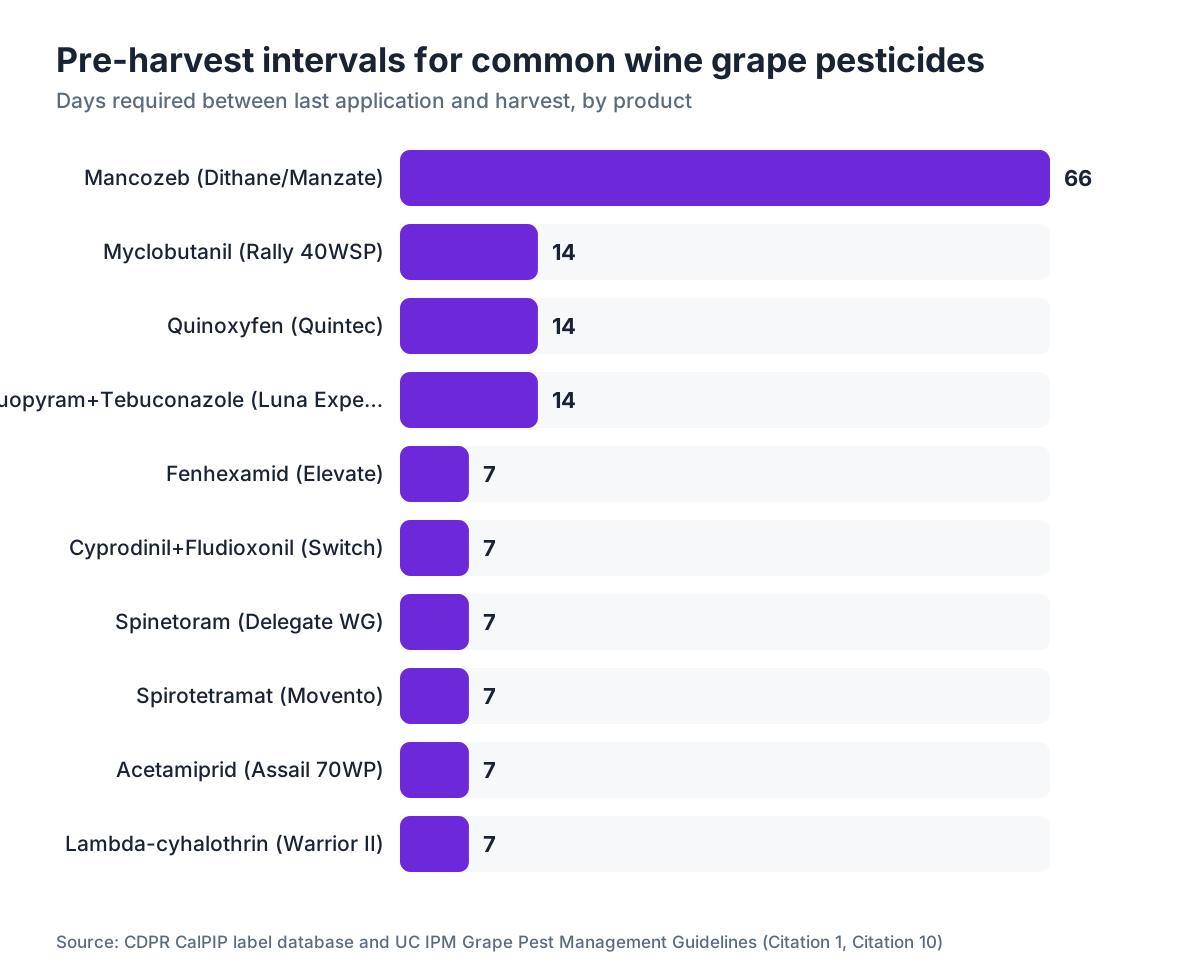
PHIs on common wine grape pesticides run all over the map. Sulfur is 0 days on most registrations. Mancozeb, a broad-spectrum fungicide plenty of growers keep on hand, is 66 days. Captan is 4 days. Luna Experience (fluopyram plus tebuconazole) is 14. None of that is intuitive, and the numbers shift with formulation and registration, so trusting your memory is exactly how violations happen. [1]
The EPA's Worker Protection Standard (WPS) stacks a second clock on top: the restricted-entry interval (REI), which governs when workers can re-enter a treated block. REI and PHI are different numbers on the same label, and you track both. Some products carry an REI longer than the PHI, so your crew can't legally walk the rows even after the harvest window opens. [2]
What columns does a PHI tracking spreadsheet actually need?
Keep the columns that do real work and drop the rest. Here's the set that earns its place:
| Column | What to enter | Why it's there |
|---|---|---|
| Application date | MM/DD/YYYY | Starting point for every calculation |
| Block / APN | Field identifier | Ties the record to a specific parcel |
| Pesticide product name | Full label name | Must match the registered label exactly |
| Active ingredient(s) | e.g., myclobutanil | Needed for MRL and residue lookups |
| EPA Reg. Number | Found on label | Confirms which label version governs |
| PHI (days) | From label | The core legal threshold |
| REI (hours) | From label | Worker safety compliance |
| Earliest legal harvest date | Auto-calculated | Application date plus PHI days |
| Actual harvest date | MM/DD/YYYY | Filled in at harvest |
| PHI met? (Y/N) | Formula-driven | Quick compliance flag |
| Applicator name | Person or PCA | Ties to license for WPS records |
| Notes | Any label restrictions | Tank mix limits, max applications |
The "Earliest legal harvest date" column is where the spreadsheet earns its keep. In Google Sheets or Excel it's just =A2+F2, where A2 is the application date and F2 is the PHI in days. Format the result as a date and it reads instantly. [3]
One column people skip and shouldn't: the EPA Reg. Number. Labels get amended. A product's PHI can change between registration cycles. Log the reg number and you can prove which exact label governed your application if anyone asks two years later. UC Cooperative Extension recommends keeping a scanned copy of every label version you use. [4]
What are the PHI lengths for the most common wine grape pesticides?
Here are real, label-sourced PHIs for products commonly used on Vitis vinifera wine grapes in California, Washington, and Oregon. Verify against your current label, because state registrations can differ from federal.
| Product (common name) | Active ingredient | PHI (days) | Notes |
|---|---|---|---|
| Sulfur (elemental) | Sulfur | 0 | Most registrations; check label |
| Captan 50 WP | Captan | 4 | Do not apply within 7 days of an oil |
| Quintec | Quinoxyfen | 14 | Max 2 apps/season |
| Luna Experience | Fluopyram + Tebuconazole | 14 | Max 2 apps/season |
| Pristine | Boscalid + Pyraclostrobin | 0 | Some state registrations vary |
| Rally 40WSP | Myclobutanil | 14 | 5-day REI |
| Elevate | Fenhexamid | 7 | Botrytis use |
| Switch 62.5WG | Cyprodinil + Fludioxonil | 7 | Common Botrytis tool near harvest |
| Mancozeb (Dithane, Manzate) | Mancozeb | 66 | One of the longest PHIs; plan early |
| Movento | Spirotetramat | 7 | Mealybug, phylloxera |
| Delegate WG | Spinetoram | 7 | Leafhopper, mealybug |
| Assail 70WP | Acetamiprid | 7 | Check REI: 12 hours |
| Warrior II | Lambda-cyhalothrin | 7 | REI 24 hours |
| Kaolin clay (Surround) | Kaolin | 0 | Particle film; no PHI |
The 66-day window on mancozeb is the one that bites people. In a high-pressure powdery mildew year the temptation is to spray whatever's in the barn. Put mancozeb down in late July on a Napa or Sonoma block aimed at late-September harvest and you're still inside the PHI on pick day. [1]
WSU Extension publishes a Washington Pest Management Guide for Grapes and updates it every year. It lists PHIs next to efficacy ratings, which makes it a solid two-for-one when you're building a spray program. [5]
How do you build the spreadsheet formula to auto-calculate the earliest harvest date?
The core formula is dead simple. If column A holds application dates and column F holds PHI days:
=A2+F2
Format that cell as a date. Done. Every row in your spray log now shows the earliest calendar day you can legally harvest that block.
The compliance flag column takes one more step:
=IF(I2>=H2,"YES","NEEDS REVIEW")
Here I2 is the actual harvest date and H2 is the earliest legal harvest date. Set conditional formatting to turn "NEEDS REVIEW" red and nothing slips through a 40-row season log.
For multi-block operations, add a summary tab that pulls the latest earliest-harvest date per block with a MAXIFS function:
=MAXIFS(H:H,B:B,"Block 12")
That returns a single cell per block showing the most restrictive PHI in play, no matter how many products you sprayed. That's the number your harvest crew needs. [3]
Still on paper? It happens. The math is identical, just done by hand with a pocket calendar. The risk lives in that manual date arithmetic. One transposed digit on a spray date turns a compliant application into an apparent violation, or worse, hides a real one. Cornell's record-keeping guidance recommends a verification step where someone other than the applicator checks the dates before harvest sign-off. [6]
What do state regulators actually require you to keep in your spray records?
Start with the federal floor. The EPA WPS requires certain application information be kept and available to workers and their representatives, for 30 years on fumigants and 2 years on everything else. Under 40 CFR Part 170 the required fields include product name, EPA registration number, active ingredient, date and time of application, location, and applicator information. [2]
California goes further. Under California Food and Agricultural Code Section 12981, licensed pest control operators and growers using restricted-use pesticides file a Pesticide Use Report (PUR) with their county agricultural commissioner within 30 days of application. That PUR lists the crop, site, product, amount used, acreage treated, and application method. CDPR makes those PURs public. [7]
Washington requires pesticide application records under WAC 16-228-1250 and asks that you keep them for 7 years, longer than the federal minimum. [8]
Oregon tracks federal WPS minimums for most uses but adds record-keeping for restricted-use pesticides under state pesticide law administered by the Oregon Department of Agriculture. [9]
Here's the practical rule: build your PHI spreadsheet to satisfy the most demanding jurisdiction you operate in. In California, that's your floor. If you sell into export markets, your importer may add documentation tied to the destination country's maximum residue limits (MRLs), which can sit well below US tolerances. The EU sets MRLs for some compounds that function as import tolerances far below what's legal domestically. [10]
How do you handle multiple sprays on the same block in the same season?
This is the complication a basic log handles badly. Say you spray sulfur on May 15, mancozeb on June 1, Quintec on August 10. Each product carries its own PHI. The block's real "do not harvest before" date is the latest of all those calculated harvest dates.
In a spreadsheet, the MAXIFS approach from earlier handles it cleanly. On paper you have to scan every spray event for that block by hand and find the most restrictive one. Doable, but error-prone across 20 blocks and a 50-row log.
The structure that works: one tab per season titled "Spray Log," with block as a filterable column. A second tab titled "Block PHI Summary" that auto-pulls the maximum earliest-harvest date per block. Your field crew only ever reads the summary tab on the morning of harvest.
For tank mixes, give each active ingredient its own row when the PHIs differ. Some managers log a tank mix as one row with the most restrictive PHI filled in. That works for the harvest date calculation, but it buries the individual active ingredient record you might need for an MRL question later. Two rows is more typing. It's also more defensible. [4]
Can a spreadsheet replace dedicated vineyard compliance software?
For a small single-site operation with one person doing all the spraying, a well-built spreadsheet does the job. The formulas are simple, the data volume is small, and there's no subscription cost. Don't overbuy.
The cracks show around 50 to 80 acres with several people entering records. Version control turns into a headache: who has the current file, did someone log last Tuesday's spray, did the block names shift when you replanted Block 3A? These aren't hypotheticals.
Software built for vineyard compliance, like VitiScribe, handles concurrent access, block mapping, and PHI calculation in the background, so a record entered on a phone in the field updates the harvest-date view for the harvest manager right away. Worth a monthly fee? That depends on your acreage and what a single compliance error would cost you.
For most small wineries and independent growers, the honest answer is to start with a solid spreadsheet. The template structure in this article, or the data tables linked from UC Cooperative Extension, costs nothing and covers you legally. Move to software when the spreadsheet's admin overhead becomes the bottleneck, not before. [4]
Where can you get a free PHI tracking template built for wine grapes?
Several university extension programs publish working templates, or at least the data tables you need to build one.
UC Cooperative Extension and the UC IPM program keep a Pest Management Guidelines for Grapes page that lists registered products, rates, PHIs, and REIs in table form. It isn't a spreadsheet template, but pasting that table into your spray log gives you a lookup reference. [10]
WSU Extension's Washington Pest Management Guide for Grapes, updated annually, includes PHI tables and downloads free as a PDF. It covers the major fungicides, insecticides, and miticides used across Pacific Northwest wine grape production. [5]
Cornell Cooperative Extension's viticulture resources include record-keeping guidance for New York growers, with spray log templates that satisfy New York DEC requirements. [6]
The EPA's own pesticide registration and label resources give you the authoritative PHI numbers straight from federal registrations. [12]
None of these hands you a finished, formula-driven spreadsheet you can run out of the box. They're the data sources. You or someone on your team builds the MAXIFS formulas above, or you find a working Google Sheets template shared by a farm bureau or PCA in your region. Farm bureaus in Sonoma, Napa, and Paso Robles counties have posted basic spray record templates over the years, though those URLs move around.
If you'd rather run a ready-made field operations framework than build one, that's a fair case for dedicated vineyard software. But the underlying data is public and free.
What mistakes do growers most commonly make with PHI records?
Using the wrong label version. Amendments happen. A product you've sprayed for ten years may have had its PHI changed in a re-registration. Pull the number from memory or an old label copy and you may be working off a dead figure. Verify against the label on the container you're opening, every time.
Logging the date but not the actual product. "Sprayed fungicide" is not a record. Regulators and buyers want the full product name and EPA reg number.
Confusing PHI with REI. Two different clocks. A 7-day PHI with a 24-hour REI means workers re-enter after one day but fruit stays on the vine for a week. Some products flip it: short REI, longer PHI.
Ignoring multiple applications on the same block. Spray mancozeb twice in a season and the 66-day clock restarts from the second application, not the first.
Recording the block loosely. "North vineyard" is not a block. When a violation question surfaces three years later, you need GPS coordinates or a documented block map tied to the record. California's PUR system requires a legal description or field location. [7]
Letting the log fall behind. Records entered a week late from memory breed error. WPS requires application records be available to workers, but same-day or next-day entry is the practice that actually protects you. [2]
How does the EPA Worker Protection Standard interact with your spray log?
The WPS, codified in 40 CFR Part 170 and last overhauled in 2015 with some provisions phased in through 2018, requires agricultural employers to keep application records for pesticides used to produce agricultural plants. [2]
The EPA's WPS guidance directs employers to keep pesticide application records for two years and make them available to workers and their designated representatives on request within 15 days. For fumigants, the retention period is 30 years.
Your PHI tracking spreadsheet is your WPS application record. The fields WPS demands overlap almost entirely with what you'd track for PHI purposes anyway: product name, EPA registration number, active ingredient, application date, location, and applicator.
WPS also requires application information at a central posting location in the field. That posting shows the product name, EPA reg number, REI, and the date and time the REI expires. Some growers run a laminated card at the block entrance and update it after each spray. Others print a daily field summary from the spray log. Either works as long as it's current and reachable. [2]
State WPS plans can add requirements. California's implementation through CDPR calls for additional training records and emergency medical care information. Oregon and Washington run their own state plan modifications. Know which state plan applies before you finalize your record-keeping system.
How do you use your PHI spreadsheet to plan a spray program that doesn't conflict with harvest?
Work backward from your target harvest date. Aiming for September 20 on a Cabernet Sauvignon block? Count back 66 days. That's July 16. Any mancozeb application after July 16 leaves you inside the PHI at your target pick.
A 14-day product like Quintec cuts off September 6. Seven-day products like Switch cut off September 13.
Build those cutoff dates into your spray planning sheet, separate from your spray log, and you make the call before you mix the tank. A short lookup table with your estimated harvest date in one cell and formulas subtracting each product's PHI gives you a spray-by date for every registered product.
This matters most when Botrytis pressure hits late. The reflex is to reach for the strongest material you have, but Switch 62.5WG at 7 days buys you a much longer window near harvest than some alternatives. Knowing that before the pressure arrives, not during it, is the line between a reactive program and a planned one. [5]
The same view flags blocks where a spray already went down. If your mancozeb application landed August 1 and harvest slips to October 10, you're clear, and you can see it in the sheet without running the math in your head on a chaotic harvest morning.
For growers juggling multiple blocks with different harvest dates, the planning view becomes a grid: blocks across the top, products down the side, each cell showing the latest permissible application date. That's a 30-minute build in Excel and it heads off real problems. [3]
Frequently asked questions
What is the PHI for sulfur on wine grapes?
Elemental sulfur has a 0-day PHI on most wine grape registrations, so you can harvest the same day you apply it. Verify the specific label you're using, because formulations differ and some state registrations restrict application timing near harvest. Sulfur can also throw off-flavors in wine if applied too close to pick, but that's an enological concern separate from the legal PHI.
How long do I have to keep pesticide application records for my vineyard?
The federal EPA Worker Protection Standard requires 2 years for most agricultural pesticides and 30 years for fumigants. California requires Pesticide Use Reports within 30 days of application, with records available to county commissioners. Washington requires 7-year retention under WAC 16-228-1250. Build your record-keeping for the longest requirement that touches your operation.
What's the difference between a PHI and a REI on a pesticide label?
PHI (pre-harvest interval) is the minimum days between last application and harvest. REI (restricted-entry interval) is the minimum hours or days before workers can re-enter the treated area for field tasks. Both appear on every label. A product can have a 7-day PHI and a 24-hour REI, so workers return after one day but fruit can't be picked for a week. Track them separately.
Can I use a Google Sheet instead of Excel for my PHI tracking?
Yes, and for multi-staff operations Google Sheets has a real edge: everyone edits one live document with no version-control mess. The date formulas are identical. The catch is that Google Sheets wants internet access in the field, which rural vineyards often lack. A common fix is entering records in a phone notes app offline, then moving them into the sheet at end of day.
What happens if I accidentally harvest before a PHI expires?
Harvesting before a PHI closes violates federal pesticide law under FIFRA. Consequences include quarantine or rejection of the fruit by your buyer, civil penalties from state regulators, and residue violations if the wine or juice is later tested. In California, county agricultural commissioners can impose fines. Document the error immediately, call your PCA, and don't blend the affected fruit until you have guidance.
Does mancozeb really have a 66-day PHI for grapes?
Yes. Mancozeb carries a 66-day pre-harvest interval on wine grapes per its federal label registration, one of the longest PHIs of any common wine grape fungicide. In regions aiming at September or October harvest, that effectively limits mancozeb to applications before mid-July. Check your specific formulation label, because some mancozeb products carry state-specific registration differences.
How do I handle a tank mix with two products that have different PHIs?
Use the longer PHI of the two to calculate your earliest legal harvest date. The more restrictive label governs. Log each active ingredient on its own row so you keep a complete residue trail if questioned later. Enter both rows on the same application date and mark them as a tank mix in the notes column.
Do organic vineyards still need to track PHIs?
Yes. OMRI-listed and organically approved materials still carry PHIs when they're registered pesticides. Sulfur, copper-based products, and spinosad all carry label requirements including PHIs and REIs. Your organic certification audit will also review these records. The same spreadsheet structure applies; only the product list changes from a conventional program.
Where can I find the current PHI for a specific pesticide product?
The authoritative source is the product label on the container in your hand. For a fast lookup, the UC IPM Pest Management Guidelines for Grapes list PHIs for registered materials, and Purdue's National Pesticide Information Retrieval System offers label database access. Always cross-check the physical label, because online databases can lag behind label amendments.
What block identification format works best in a PHI spreadsheet?
Use a consistent alphanumeric code tied to a block map, not descriptive names like 'upper north' that shift depending on who's talking. Something like V-12A (vineyard, block 12, sub-block A) works. California's PUR system requires a legal description or field location tied to your records, so your block codes should map to GPS coordinates or APN parcels you can pull if audited.
How do I adjust my PHI calculations if harvest gets pushed back by rain or low brix?
If harvest slips later than planned, your spray options widen because more time has passed since your last application. Your spreadsheet already shows the earliest legal date, and any actual harvest date after that is fine. The risk runs the other way: if you planned September 30 and need to pull forward to September 15, check every spray record to confirm all PHIs close before the earlier date.
Is there a free PHI tracking spreadsheet template I can download today?
UC IPM and WSU Extension publish PHI data tables for grapes in free PDFs, but finished formula-driven templates aren't widely published by extension services. Cornell Cooperative Extension has spray log templates for New York growers. Your county farm bureau or PCA may have a working file. The column structure and formulas in this article are enough to build a functional sheet in under an hour.
Do I need to track PHIs for materials applied by a contract spray operator?
Yes. As the agricultural employer and grower of record, you're responsible for compliance no matter who pulls the trigger. Your contract should require the applicator to hand over complete records: product name, EPA registration number, date, rate, and PHI. Add them to your spray log the day you receive them. WPS puts the record-keeping obligation on the agricultural employer, not the applicator.
Can I export my PHI spreadsheet to satisfy a winery's third-party audit?
Most third-party audits (SCS, Lodi Rules, CCOF, Stellar) accept spray records in spreadsheet format as long as the required fields are present: product name, EPA reg number, active ingredient, application date, PHI, and earliest legal harvest date. Some auditors also want the applicator's license number. Export as PDF before submission so formatting holds. Ask your auditor for their record format before the audit, not the week of.
Sources
- CDPR - California Pesticide Information Portal (CalPIP), label database: PHI values for mancozeb (66 days), Quintec (14 days), sulfur (0 days), and other wine grape pesticides sourced from registered California labels
- EPA - Worker Protection Standard, 40 CFR Part 170: WPS requires employers to retain pesticide application records for 2 years (30 years for fumigants) and make them available to workers within 15 days of request
- University of California Agriculture and Natural Resources - Record Keeping for Pesticide Applications: Recommended spreadsheet structure for pesticide application records including date arithmetic for PHI compliance
- UC Cooperative Extension - Integrated Pest Management Program, Grapes Pest Management Guidelines: UC IPM recommends keeping scanned label copies with application records; PHI tables for wine grapes updated annually
- WSU Extension - Washington Pest Management Guide for Grapes: WSU Extension publishes an annually updated Pest Management Guide for Grapes listing PHIs alongside efficacy ratings for Pacific Northwest wine grape production
- Cornell Cooperative Extension - Viticulture and Enology Program, spray record templates: Cornell recommends a verification step where someone other than the applicator checks dates before harvest sign-off; provides spray log templates for NY DEC compliance
- California Department of Pesticide Regulation - Pesticide Use Reporting: California Food and Agricultural Code Section 12981 requires Pesticide Use Reports filed with county agricultural commissioner within 30 days; requires crop, site, product, amount, and acreage
- Washington State Department of Agriculture - Pesticide Application Records, WAC 16-228-1250: Washington requires pesticide application records to be kept for 7 years under WAC 16-228-1250
- Oregon Department of Agriculture - Pesticides Program: Oregon follows federal WPS minimums for most uses and adds record-keeping requirements for restricted-use pesticides under state pesticide law
- UC IPM - Pest Management Guidelines: Grape, registered fungicide and insecticide table: UC IPM Grape Pest Management Guidelines list registered products, application rates, PHIs, and REIs for California wine grape production
- European Commission - EU Pesticide MRL Database: EU maximum residue limits for some compounds used on wine grapes differ substantially from US tolerances, creating additional documentation requirements for export
- EPA - Pesticide Registration and FIFRA label-as-law requirement: Under FIFRA, the pesticide label is the law; harvesting before a PHI closes constitutes a federal pesticide law violation
Last updated 2026-07-11