Introduction to viticulture: what grape growing actually involves
TL;DR
- Viticulture is the science and practice of growing grapes, covering site selection, variety choice, vine training systems, canopy and water management, pest and disease control, and harvest timing.
- A commercial vineyard typically costs $15,000 to $35,000 per acre to establish in California, takes three to four years to reach first production, and requires detailed spray and field records to meet state and federal compliance standards.
What is viticulture and how is it different from enology?
Viticulture is the branch of horticulture focused on growing grapevines. Enology is the science of winemaking. The two are tied together, but the vineyard manager and the winemaker are solving completely different problems. The viticulturist asks: what does this vine need today to produce healthy, consistent fruit? The enologist asks: what do I do with that fruit now that it's in the tank?
The word comes from the Latin "vitis" (vine) and "cultura" (tending). Grapes are perennial crops, which means the decisions you make in year one (rootstock choice, trellis design, row orientation) shape what the block produces for the next 30 to 50 years. That permanence is what makes viticulture genuinely hard. A mistake in a row crop hurts for one season. A mistake in a vineyard can cost you a decade.
The U.S. had roughly 1.05 million bearing acres of grapes in 2022, according to the USDA National Agricultural Statistics Service [1]. California grows about 80 percent of that. Real production also spans Washington, Oregon, New York, Texas, and Virginia. The principles are the same across all of them. The specific pressures (frost, humidity, drought, pest spectrum) shift hard by region.
For a closer look at how individual vineyard operations run day to day, including staffing and equipment decisions, that companion piece covers the operational side.
What are the main stages of the grapevine's annual growth cycle?
The vine runs through roughly eight recognizable stages every year, and your entire spray calendar, irrigation schedule, and labor plan revolves around them.
Budbreak happens when soil temperatures at 8-inch depth warm to around 50°F (10°C). This is also the moment of maximum frost risk. A two-hour frost at 28°F right after budbreak can wipe out your whole crop for the year.
Shoot growth follows fast. Shoots can grow two to three inches per day in warm weather. This is when you're doing shoot thinning, positioning, and early hedging.
Flowering and fruit set is the stage where the season's yield is decided. Poor fruit set from cold, wet weather during bloom is one of the most common causes of low-tonnage years. The cluster is essentially locked in during this window.
Veraison is when berries change color and start piling on sugar. For red varieties, green turns to red or purple over about two weeks. Brix climbs fast. This is when you're making decisions about crop thinning if you haven't already.
Harvest follows, anywhere from 30 to 70 days after veraison depending on variety and target style. Then the vine goes through post-harvest recovery, leaf drop, and dormancy. Winter dormancy is when you do your pruning, which sets the framework for next year's crop.
University of California Cooperative Extension has published phenology guides keyed to degree-day accumulations for California's major varieties [2]. Washington State University Extension has parallel resources for the Columbia Valley and Yakima regions [3]. Both are worth having on your desk.
How do you choose a vineyard site and which grape varieties fit it?
Site selection is the single decision with the longest consequences in all of viticulture. Get it wrong and no amount of later skill closes the gap.
The core factors are climate (heat accumulation, frost risk, rainfall pattern), soil (drainage above all else, then texture, pH, and depth), topography (slope, aspect, air drainage), and water availability where irrigation is needed. Vines prefer well-drained soils because waterlogged roots are a disease vector and stress the vine chronically. Grapevines are famously productive on poor soils precisely because good drainage and low fertility push them to put energy into fruit rather than leafy growth.
Climate classification matters here. The Winkler scale, developed at UC Davis, divides regions into five heat-summation zones based on growing-degree-days between April 1 and October 31 [4]. A Region I site (below 2,500 GDD, like coastal Sonoma) suits Pinot Noir and Chardonnay. A Region IV or V (over 3,501 GDD, like parts of the San Joaquin Valley) suits Thompson Seedless and other table or raisin varieties. Plant a heat-loving variety on a cool site, or the reverse, and you get chronically poor fruit.
Variety selection follows site selection. Rootstock selection follows variety selection. The rootstock decides how the vine handles your soil's pH, nematode pressure, phylloxera risk, and drought. UC Davis Cooperative Extension maintains current rootstock comparison trial data [2]. WSU publishes variety trial results for Pacific Northwest conditions [3]. Cornell's New York State Agricultural Experiment Station covers cold-hardy varieties and humid-climate disease management [5].
One honest caveat: nobody has perfect data on long-term climate change impacts at the micro-site level. The closest systematic work suggests many classic California winegrowing regions will see harvests two to three weeks earlier by mid-century (Jones et al., various publications), but planning a 30-year vineyard around projections that uncertain is genuinely uncomfortable. Most experienced growers I've watched do this pick varieties with a wider climate tolerance than their current site strictly requires.
What trellis systems and vine training methods do growers actually use?
The training system decides how the vine's canopy sits in space, which affects light interception, air circulation, spray penetration, and mechanical harvest compatibility. There is no universal best system. There are tradeoffs.
The most common systems in U.S. commercial viticulture:
| System | Description | Common Use Case |
|---|---|---|
| Vertical Shoot Positioning (VSP) | Shoots trained vertically upward between foliage wires | Premium wine production, hand harvest, most California Coast AVAs |
| Scott Henry | Divided canopy, shoots trained both up and down | High-vigor sites needing canopy management |
| Geneva Double Curtain (GDC) | Two canopy planes dropped from a high wire | High-vigor sites, mechanical harvest |
| Guyot (single or double) | One or two canes retained at pruning | Common in Burgundy-style production, also New York and Oregon |
| Cordon/spur | Permanent arms along a wire with short spurs | Broad commercial use, machine pruning compatible |
| Head training | Free-standing vines, no trellis | Dry-farmed old vines, traditional regions |
VSP dominates California Coast wine production because it works with most mechanical operations (hedging, leaf removal), gives good fruit exposure, and is straightforward to manage. On high-vigor sites, VSP can produce a dangerously dense canopy that traps moisture and blocks spray. That's when divided-canopy systems earn their cost.
Trellis installation is real money. Posts, wire, anchors, and labor run $3,000 to $6,000 per acre in most California regions as of recent estimates, more if you're using Gripple wire tensioning or high-end end assemblies. That cost is baked into establishment before the vines go in the ground.
How do you manage vine canopy through the growing season?
Canopy management is where viticulture becomes a weekly, sometimes daily, field discipline. The goal is to get enough sunlight into the fruit zone, enough airflow through the canopy to cut disease pressure, and the right leaf-to-fruit ratio for the ripeness and style you're after.
The main operations are shoot thinning (done early, removing excess or poorly positioned shoots), shoot positioning (tucking shoots into foliage wires so they grow upward rather than sprawling), hedging (mechanical topping of shoot tips to control growth, sometimes two or three passes a season), leaf removal in the fruit zone (better sun exposure, airflow, and spray penetration around clusters), and cluster thinning (dropping fruit to concentrate resources).
Leaf removal timing has gotten serious research attention. Early leaf removal on the morning-sun side of the canopy, done near bloom, can reduce bunch compactness and cut Botrytis risk later. UC Davis work has documented this effect for Pinot Gris and other compact-clustered varieties. Too much leaf removal on the afternoon-sun side in hot climates causes sunburn. It's a real tradeoff.
The right vine-to-fruit balance is expressed as a ratio. The Ravaz Index, which is simply yield (in pounds) divided by pruning weight (in pounds), gives you a number. Below 3 suggests the vine is over-cropped relative to its vigor. Above 10 suggests it might be over-vegetative. Most quality-focused producers aim for something between 4 and 8. This number costs you nothing to calculate, and it's one of the more honest diagnostic tools in viticulture.
What are the biggest disease and pest threats in a vineyard?
Disease and pest pressure vary hugely by region, but a few threats show up nearly everywhere in U.S. wine grape production.
Powdery mildew (Erysiphe necator) is the dominant fungal threat in most California regions. It's a dry-weather pathogen that thrives exactly in the mild, slightly humid conditions common on the coast. Uncontrolled, it colonizes berries before veraison, leading to cracked, off-flavored fruit. The spray program against powdery mildew starts at budbreak and runs through 30 days post-bloom at minimum.
Botrytis cinerea (gray mold) is the humid-climate and harvest-time problem. It attacks damaged or compact clusters when moisture is present. In some sweet wine styles it's managed on purpose as "noble rot," but for most table wine producers it's a yield and quality loss.
Phylloxera (Daktulosphaira vitifoliae) is a root-feeding louse native to North America. It devastated European vineyards in the late 19th century and triggered a replanting crisis in California in the 1980s when AXR#1 rootstock failed. The fix is planting on resistant rootstock. There's no spray that solves phylloxera once it's in your soil.
Pierce's Disease, caused by the bacterium Xylella fastidiosa and spread by the glassy-winged sharpshooter, is an existential threat to vineyards in warm, humid southern California regions and parts of the South. There's no cure. Affected vines die within one to five years. Management is vector control at the landscape level.
Leafhoppers, mites, mealybugs, and grapeleaf skeletonizer fill out the pest spectrum depending on your region. Integrated Pest Management (IPM) approaches, which put monitoring thresholds and biological controls ahead of synthetic chemistry, are now the standard recommendation from UC Cooperative Extension [2][12] and WSU [3].
Every pesticide application needs a written record under most state regulations, and EPA's Worker Protection Standard sets training and posting requirements for agricultural workers handling pesticides [6]. That paperwork burden is real. Tools like VitiScribe exist to make spray record compliance less painful, with field-level logs that capture product, rate, PHI, and REI automatically.
What does irrigation and water management look like in a working vineyard?
Not all vineyards irrigate. Old-world tradition and many California coastal regions rely on dry farming, where vine roots reach deep for residual soil moisture. Dry-farmed vines often show better drought adaptation over time and some growers argue for flavor concentration benefits, though the research on that last claim is genuinely mixed.
Where irrigation is used, which is most of the Central Valley, eastern Washington, and any new planting in hotter California regions, the dominant system is drip. Surface or buried drip emitters send water straight to the root zone, cutting evaporative loss and keeping canopy and fruit dry (which matters for disease). Drip systems typically apply 6 to 24 acre-inches per season depending on climate, soil type, and vine vigor.
Water stress management is the real skill. Vines need some mild water stress during certain growth stages, particularly post fruit-set through veraison, to slow leafy growth and push the vine toward ripening. Too much stress at the wrong time causes berry shrivel, brown stems, and quality problems. The tool most growers use to manage this is the pressure bomb (pressure chamber), measuring predawn or midday stem water potential. Vine water status is read in MPa. UC Cooperative Extension has published threshold guidelines by growth stage for California conditions [2].
In water-limited regions, water rights and the legal right to use groundwater are separate from land ownership. This is a place where getting agricultural water law wrong can shut down your operation. Check your state's water agency and a water rights attorney before planting.
How do you know when to harvest, and what happens at harvest?
Harvest timing is the decision that ties together everything the growing season built. Pick too early, and you get thin, tart wine with green characters. Pick too late, and you lose acidity, gain excessive alcohol, and risk overripe or raisin-flavored fruit. The window is sometimes a week. Sometimes less.
The main measurements viticulturists track as harvest approaches:
Brix is the sugar concentration of the juice, measured with a refractometer or hydrometer. Most California red wine grapes are harvested between 23 and 27 Brix, though premium producers targeting specific alcohol levels may pick earlier (21 to 24). Every degree Brix converts to roughly 0.55 percent potential alcohol after fermentation.
pH and titratable acidity (TA) tell you about acid balance. As grapes ripen, pH rises and TA falls. A red wine grape at 3.4 to 3.6 pH sits in a typical range. Much above 3.7 and you're looking at microbial stability problems in the winery.
Seed color and taste are qualitative indicators experienced tasters use alongside the numbers. Green seeds with astringent tannins suggest physiological immaturity even when Brix is high. Brown seeds with round tannins suggest readiness.
Harvest itself is either hand-picked or machine harvested. Hand harvesting costs $200 to $800 per ton in most California regions depending on labor availability and terrain. Machine harvesting costs $80 to $200 per ton for contract harvest, amortized differently if you own the harvester. Machine harvesters don't suit every trellis system or every terrain.
Post-harvest care matters more than many new growers realize. The vine still needs to finish photosynthesis through leaf fall to replenish carbohydrate reserves in the wood and roots. Strip the canopy early or let disease defoliate the vine before natural leaf fall, and you'll pay for it in next year's vine performance.
What does vineyard establishment actually cost, and how long until you break even?
There's no honest universal answer here, but there are real ranges.
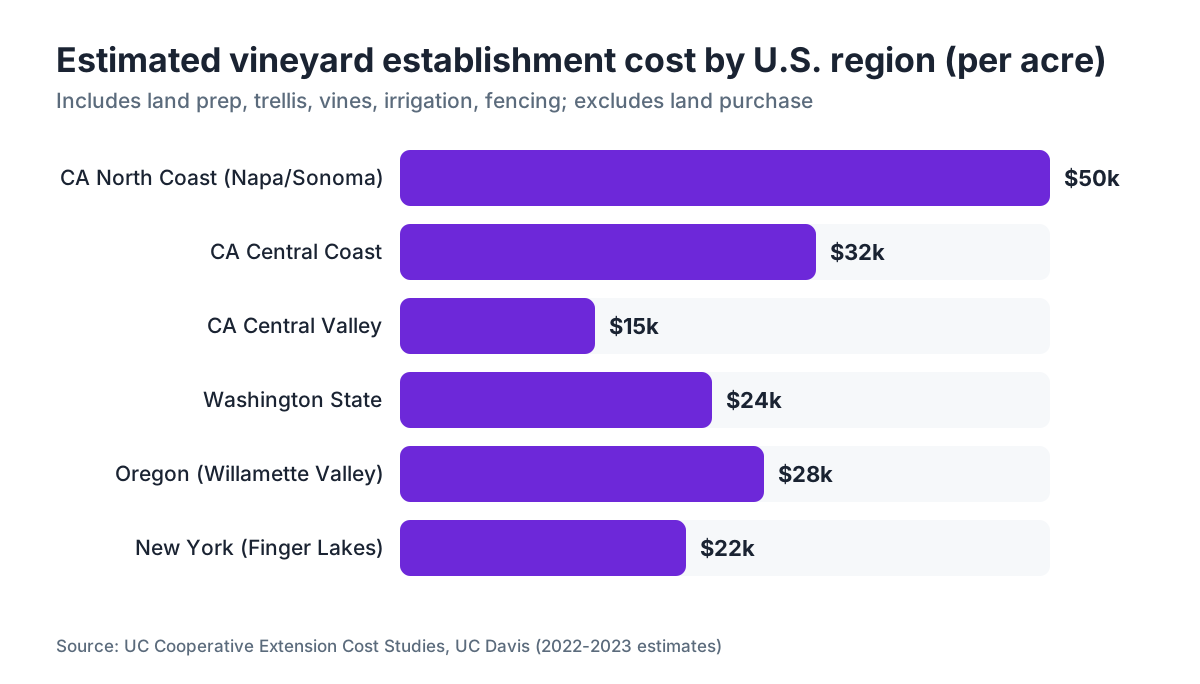
California North Coast (Napa, Sonoma) establishment costs are the highest in the U.S. Land clearing, soil prep, cover crop, trellis installation, vine purchase and planting, deer fencing, and irrigation infrastructure run $35,000 to $60,000 per acre or more before the vineyard produces a commercial crop [7]. Napa Valley land itself is a separate cost entirely, often $200,000 to $400,000 per acre for planted ground.
Central Valley and lower-cost California regions see establishment costs of $10,000 to $20,000 per acre for table or raisin grapes, somewhat higher for premium wine grape trellising.
Washington and Oregon run $15,000 to $30,000 per acre for wine grape establishment depending on irrigation infrastructure needs.
New York and mid-Atlantic regions vary widely depending on frost protection requirements and trellis system complexity.
The timeline to revenue is the punishing part. Vines planted in year one produce minimal crop in year two, a light commercial crop in year three, and approach full production by years four through six. You're carrying establishment debt and operational costs for at least three years before meaningful revenue.
Break-even on a new vineyard investment, depending on your cost structure and sale price, commonly takes 10 to 15 years. That's not a reason to skip it. It's a reason to go in with eyes open and enough capital to survive the establishment period.
For growers at the paso robles wineries scale or planning operations like what you'd see at gervasi vineyard, the business model usually includes agritourism or an estate winery to improve economics during the establishment period.
What record-keeping and compliance requirements does a vineyard operation face?
This is where a lot of small growers get surprised. The regulatory burden is real and it scales up faster than expected once you're applying pesticides and employing workers.
Pesticide records are required in every state for restricted-use pesticides, and many states require records for general-use products applied commercially too. California, under the County Agricultural Commissioner system, requires pesticide use reports within 30 days of application [8]. Records must include applicator name, license number, product name, EPA registration number, application rate, acreage treated, and method of application at minimum.
Pre-harvest intervals (PHI) are the legally mandated days between last application and harvest for every registered pesticide. Violating PHI can result in crop rejection or regulatory action. Restricted Entry Intervals (REI) set when workers can safely re-enter a treated field after application.
EPA Worker Protection Standard (WPS) applies to any agricultural operation with workers or handlers who handle pesticides or enter pesticide-treated fields and crops. The 2015 revised WPS (40 CFR Part 170) requires annual pesticide safety training for all agricultural workers, posting of application information at a central location, and access to emergency medical care information. As the EPA states in its WPS guidance, "agricultural employers must provide workers and handlers with pesticide safety training" before they handle pesticides or enter treated areas [6].
Water quality compliance comes into play under the Clean Water Act if your operation has irrigation tailwater discharge or falls under state general permit requirements for agricultural stormwater. California, specifically, has been tightening requirements under the State Water Board's agricultural order process.
Tracking all of this on paper or in spreadsheets works until it doesn't. The volume of inputs across a spray season on even a 20-acre operation makes manual record-keeping error-prone. VitiScribe is built for this: spray logs, PHI tracking, and field records that satisfy state reporting requirements without making you re-enter data across multiple systems.
Field scouting records, even when not legally required, are worth keeping. A documented threshold-based IPM approach is your best defense in a regulatory audit and your best tool for year-over-year spray program improvement.
What's the best way to learn viticulture if you're starting from scratch?
Formal education and hands-on work are both required, and neither substitutes for the other.
On the formal side, UC Davis offers undergraduate and graduate programs in viticulture and enology that are the most widely recognized in North America [4]. Cornell's College of Agriculture and Life Sciences runs viticulture programs focused on cool-climate and humid-region production [5]. WSU has a viticulture program centered on Pacific Northwest conditions [3]. For working growers who can't do a full degree, all three schools offer extension courses, online programs, and workshops.
Certifications worth knowing: the Society of Wine Educators offers a Certified Specialist of Wine; the Wine Scholar Guild runs regional programs. For vineyard-specific technical work, the American Society for Enology and Viticulture (ASEV) is the primary professional body. None of these replace time in the vines.
Time in the vines means working harvests, internships, or assistant vineyard manager positions before running your own block. The growing season is six months of compressed learning that no classroom replicates. There's a reason the standard path in the industry runs through two or three seasons as someone else's assistant before managing independently.
Read the literature. Vines, Grapes, and Wine by Jancis Robinson (the original 1986 edition is dated but foundational), the UC Davis publication series on viticultural practices, and the peer-reviewed journal American Journal of Enology and Viticulture are the primary references serious growers use. The AJEV is the closest thing to a Bible for evidence-based viticulture in North America [9].
Local industry groups matter too. The wine grape growers associations in most major regions run field days, technical workshops, and spray trials that apply directly to your specific pest and disease pressure. The California Association of Winegrape Growers (CAWG) and Washington Wine Growers Association both run active technical programs.
How does sustainable, organic, and biodynamic viticulture differ in practice?
These three terms describe different things, and the distinctions matter in practice.
Sustainable viticulture generally means a documented, third-party-verified approach to reducing environmental impact while staying economically viable. It doesn't mean no synthetic inputs. California's Certified California Sustainable Winegrowing (CCSW) program, run by the California Sustainable Winegrowing Alliance, is a self-assessment and audit program covering vineyard, winery, and business practices [10]. Many programs under this umbrella still permit registered synthetic fungicides and insecticides.
Organic viticulture means compliance with the USDA National Organic Program (NOP) [11]. Synthetic pesticides and fertilizers are prohibited. Allowed materials include elemental sulfur (the primary powdery mildew control), copper-based fungicides, certain biological pesticides, and other NOP-approved inputs. The three-year transition period before certification is a heavy financial burden, since you're farming to organic standards without the premium price point.
Biodynamic viticulture adds a layer of spiritual and ecological philosophy on top of organic practices, following the principles developed by Rudolf Steiner in the 1920s. Demeter certification is the primary standard. Biodynamic practice includes specific planting and application calendars tied to lunar and cosmic cycles, preparation of fermented herbal and mineral materials applied to soil and compost, and a closed-farm-system ideal. The research evidence for the specific mechanisms of biodynamic preparations is weak. The evidence that biodynamic farms often produce healthy soils and low-input systems is more credible, though this may reflect the management attention the approach demands rather than the preparations themselves.
None of these systems is automatically better economically. Organic certification costs vary ($500 to $3,000 per year depending on certifier and acreage), and premium price realization for organic wine grapes is real in some markets and nonexistent in others.
Frequently asked questions
How long does it take a newly planted vineyard to produce commercial-quality fruit?
Most vineyards produce a light commercial crop in year three and reach full production by years four to six after planting. Quality fruit, meaning fruit that justifies a premium price, often takes longer as the vine's root system matures and the block settles into its site. The first two years after planting are typically all cost and no revenue.
What is the difference between Brix, pH, and TA in harvest decisions?
Brix measures dissolved sugar in juice, which predicts potential alcohol after fermentation. One degree Brix converts to roughly 0.55 percent alcohol. pH measures acidity on a logarithmic scale; wine grapes are typically harvested at pH 3.2 to 3.7. Titratable acidity (TA) measures total acid concentration in grams per liter. Winemakers want all three in balance, more than they want high sugar.
Do I need a pesticide applicator license to spray my own vineyard?
It depends on your state and the pesticide category. Restricted-use pesticides require a licensed private or commercial applicator in every state. In California, even some general-use products applied commercially generate reporting requirements through the County Agricultural Commissioner. If you hire someone to apply pesticides, they need a commercial applicator license. Check your state department of agriculture for specific requirements.
What rootstocks are best for preventing phylloxera?
No rootstock is perfectly immune, but the widely used resistant rootstocks in California include 110R, 140Ru, 1103P, St. George (Rupestris du Lot), and several AxR hybrids. AXR#1 proved susceptible to biotype B phylloxera in the 1980s and caused widespread replanting in Napa and Sonoma. UC Davis maintains current rootstock trial data and recommends selection based on soil type, nematode pressure, and vigor needs alongside phylloxera resistance.
What is the Winkler scale and how do I use it to choose grape varieties?
The Winkler scale groups winegrowing regions into five heat zones based on growing degree days (GDD) accumulated between April 1 and October 31, using a 50°F base temperature. Region I is below 2,500 GDD (suitable for Pinot Noir, Chardonnay); Region V is above 4,000 GDD (suitable for Grenache, Thompson Seedless). Match your variety's heat requirement to your site's zone for consistent ripening. UC Davis developed the system in the 1940s.
How much water does a wine grape vineyard need per season?
It varies a lot by climate and soil. In arid California Central Valley conditions, drip-irrigated vineyards typically apply 18 to 30 acre-inches per season. In cooler coastal regions or dry-farmed situations, water use is much lower or zero. Predawn stem water potential, measured with a pressure chamber, is the most reliable guide to vine water status. UC Cooperative Extension publishes growth-stage thresholds for California conditions.
What is the EPA Worker Protection Standard and does it apply to my small vineyard?
The WPS (40 CFR Part 170) applies to any agricultural operation that hires workers who enter pesticide-treated areas or handle pesticides. It requires annual pesticide safety training for all workers and handlers, posting of application information at a central location, and access to emergency assistance. The 2015 revised standard expanded some training requirements. Family members working the operation without pay may be exempt, but hired workers are not. Check EPA's WPS page for the current exemption thresholds.
Can I grow wine grapes profitably on a small plot, say under 10 acres?
Profitability at small scale usually requires selling to an estate winery you own or control, direct-to-consumer agritourism, or a long-term contract with a premium producer paying above-average prices per ton. Bulk grape prices in most California regions for general wine grapes ($300 to $900 per ton) rarely cover establishment costs on small plots without premium positioning. Under 10 acres is absolutely viable; it just needs a clear business model beyond commodity grape growing.
What is canopy management and why does it matter so much?
Canopy management covers all the operations that shape how the vine's leaves and shoots are arranged: shoot thinning, shoot positioning, hedging, leaf removal, and cluster thinning. A well-managed canopy lets sunlight reach fruit (improving color, flavor, and ripening), lets air circulate (cutting disease pressure), and lets spray penetrate to the target. A dense, unmanaged canopy creates a humid microclimate that's essentially a Botrytis incubator.
What university extension programs are best for learning viticulture?
UC Davis Cooperative Extension covers California conditions most thoroughly, from rootstock trials to IPM and water management. Washington State University Extension covers Pacific Northwest and Columbia Valley specifics well. Cornell Cooperative Extension, through the New York State Agricultural Experiment Station at Geneva, leads on cold-hardy varieties and humid-climate disease management. All three publish free technical bulletins and run grower workshops.
What are the pre-harvest interval (PHI) and restricted entry interval (REI) and why do they matter?
PHI is the minimum number of days that must pass between the last pesticide application and harvest. Violating PHI can result in illegal residue levels, crop rejection, and regulatory action. REI is the time after application before workers can safely re-enter the treated area without full protective equipment. Both are listed on every registered pesticide label. The label is a federal legal document; ignoring it is a federal violation under FIFRA.
How does organic grape growing differ from conventional in terms of disease management?
Organic grape growers rely on elemental sulfur as the primary powdery mildew control, copper-based fungicides for downy mildew and some bacterial issues, kaolin clay for some pest management, and biological controls like Bacillus subtilis-based products. They cannot use synthetic DMI (sterol inhibitor) fungicides or synthetic insecticides. The restrictions often require more frequent applications and better canopy management to make up for lower material efficacy in heavy pressure years.
Sources
- USDA National Agricultural Statistics Service, Grape Bearing Acreage: U.S. had roughly 1.05 million bearing acres of grapes in 2022; California accounts for approximately 80 percent of U.S. wine grape production
- University of California Cooperative Extension, Viticulture and Enology: UC Davis CE publishes phenology guides, rootstock trial data, water stress thresholds, and IPM recommendations for California viticulture
- Washington State University Extension, Viticulture: WSU Extension publishes variety trial results, canopy management guidelines, and pest management recommendations for Pacific Northwest viticulture
- UC Davis Department of Viticulture and Enology: UC Davis developed the Winkler heat-summation scale dividing regions into five GDD zones; offers undergraduate and graduate programs in viticulture and enology
- Cornell University College of Agriculture and Life Sciences, Viticulture Extension: Cornell CALS and the NY State Agricultural Experiment Station lead research on cold-hardy varieties and humid-climate disease management
- U.S. EPA, Agricultural Worker Protection Standard (WPS): The 2015 revised WPS (40 CFR Part 170) requires annual pesticide safety training, posting of application information, and emergency medical access for agricultural workers and handlers
- UC Cooperative Extension, Sample Costs to Establish a Vineyard and Produce Wine Grapes, North Coast: California North Coast vineyard establishment costs range from approximately $35,000 to $60,000 per acre including land clearing, trellis, vines, fencing, and irrigation
- California Department of Pesticide Regulation, Pesticide Use Reporting: California requires pesticide use reports to the County Agricultural Commissioner within 30 days of application for all commercially applied pesticides
- American Journal of Enology and Viticulture (AJEV), American Society for Enology and Viticulture: AJEV is the primary peer-reviewed journal for evidence-based viticulture and enology research in North America
- California Sustainable Winegrowing Alliance, Certified California Sustainable Winegrowing Program: The CCSW program is a self-assessment and audit program covering vineyard and winery practices; it permits some registered synthetic inputs unlike certified organic programs
- USDA National Organic Program: USDA NOP prohibits synthetic pesticides and fertilizers in certified organic production; requires a three-year transition period before certification
- UC Statewide Integrated Pest Management Program: UC IPM program publishes monitoring thresholds and biological control recommendations for California vineyard pests including leafhoppers, mites, and mealybugs
Last updated 2026-07-09