How to irrigate grapes at veraison without wrecking your fruit
TL;DR
- At veraison the vine splits its energy between ripening berries and pushing new shoots.
- Research puts the safe window at deficit irrigation of 50 to 80 percent ETc replacement, applied once stem water potential drops past -12 to -14 bar.
- Too much water restarts shoot growth and dilutes sugar.
- Too little stalls ripening.
- Timing and soil type matter as much as volume.
What actually happens in the vine at veraison?
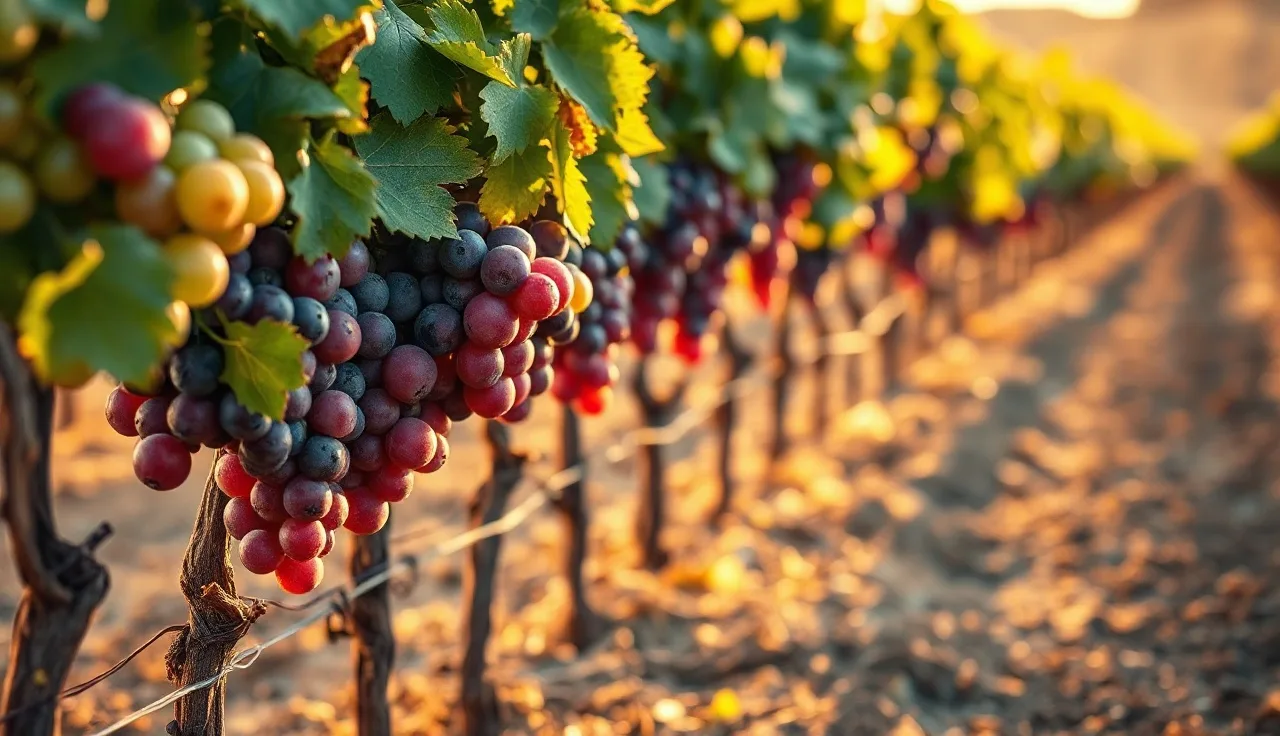
Veraison is the moment berries turn from hard, green, and acid-loaded into soft, colored, and sugar-hungry. In reds it's the color change. In whites it's the softening you feel when you roll a berry between two fingers. The shift takes two to three weeks, and the vine is doing two jobs at once that pull against each other.
Berries start importing sugars and potassium through the phloem. Meanwhile, if any spring soil moisture is left in the tank, shoots keep growing. That competition is the whole problem. Water feeds both, but late vegetative growth is the enemy of quality. You want photosynthate going into fruit, not into the next lateral node.
WSU Extension describes veraison as the signal that flips the berry from a growth phase to a ripening phase. [1] Once that switch flips, cell division in the berry is done. What's left is cell expansion and the loading of solutes. That's why water stress at exactly this moment moves final berry size, and with it the skin-to-juice ratio, more than stress at any other point in the year.
Cell expansion runs on water. A berry under severe deficit at veraison stops expanding. Smaller berries can be an asset, especially for reds where you want concentrated phenolics. They can also be a wreck if the stress goes so deep that ripening stalls and sugars flatline three weeks out from harvest. The vine won't tell you which one you're getting until it's too late to change course. That ambiguity is why veraison irrigation is the hardest single call of the season.
What does the research say about veraison irrigation timing?
The short version: timing precision beats volume. A moderate amount of water applied at the right soil moisture deficit does far less damage than the same volume applied three days early or dumped onto soil already at field capacity.
Much of the foundational work comes out of UC Davis and the Kearney Agricultural Research and Extension Center. Regulated deficit irrigation (RDI) strategies that tighten the deficit at veraison consistently improve color and phenolic concentration in reds without the yield hit you'd expect, as long as the deficit stays inside a narrow range. [2]
UC Cooperative Extension guidelines for the San Joaquin Valley set the veraison threshold at stem water potential (SWP) between -12 and -16 bar, depending on variety and target style. [2] Push a sensitive variety like Pinot Noir past -16 to -18 bar and you risk berry shrivel and stuck ripening. Sit above -10 bar at veraison and you're almost certainly overwatering and inviting regrowth.
Cornell's viticulture program works the humid eastern side of the country, and the problem flips. In the Finger Lakes and Hudson Valley the worry is excess soil moisture from summer rain, not supplemental water. Cornell notes that vines taking more than 1.5 inches of rain in the two weeks around veraison often show reduced anthocyanin in reds. [3] That's not an irrigation problem, but it points to the same biology: water excess at veraison dilutes color, no matter where it comes from.
What irrigation thresholds and targets should you use at veraison?
Set your trigger with either stem water potential or soil moisture sensors, and pick the target from your style goal. SWP measured at midday with a pressure chamber is the most reliable read on vine water status you can get. [2] Irrigate when the vine crosses the threshold, not when the calendar says so.
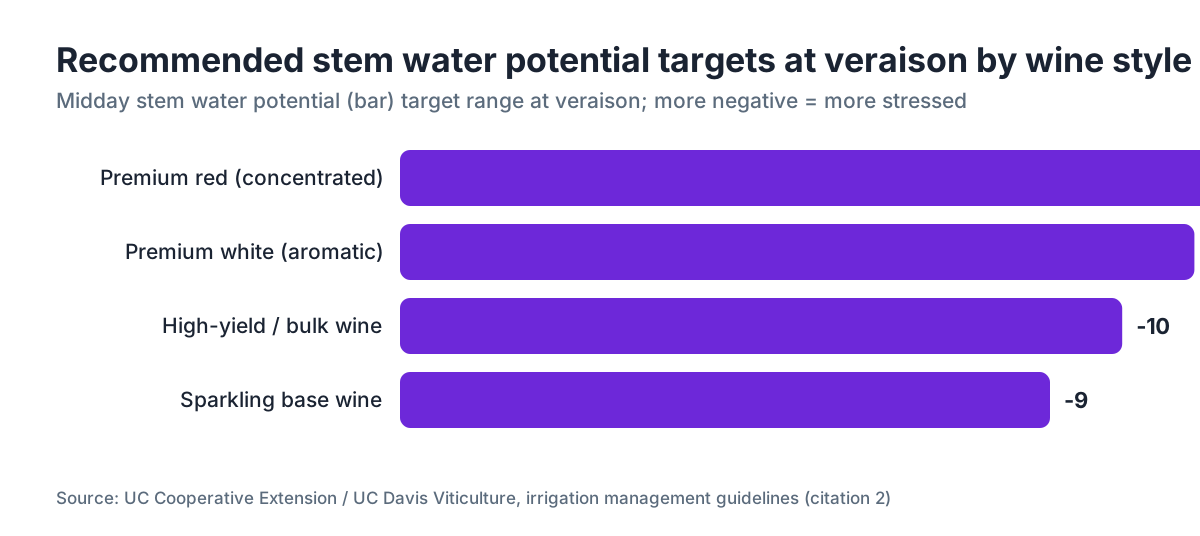
Here's how the general targets break down by style goal:
| Style target | Pre-veraison SWP | Veraison SWP | Post-veraison SWP |
|---|---|---|---|
| Premium red (small berry, concentrated) | -10 to -12 bar | -12 to -14 bar | -14 to -16 bar |
| Premium white (aromatic, moderate alcohol) | -8 to -10 bar | -10 to -12 bar | -10 to -12 bar |
| High-yield table or bulk wine | -8 bar | -10 bar | -10 to -12 bar |
| Sparkling (high acid, lower sugar) | -6 to -8 bar | -8 to -10 bar | -8 to -10 bar |
These are rough industry benchmarks. The exact numbers move with rootstock, soil texture, and climate. Heavy clay holds more plant-available water at a given soil moisture percentage than sandy loam, so a clay block reading 40 centibars might sit at mild deficit while the same reading in sand is severe stress.
Running soil moisture sensors? Tensiometers or capacitance probes at 12 and 24 inches give you a two-depth picture. The upper sensor reports recent wetting. The lower one tells you whether roots are pulling from depth. When both sensors trend dry and SWP confirms -12 to -14 bar, that's your signal. Not before.
The irrigation calendar is not your friend at veraison. A fixed weekly schedule set back in June ignores the fact that ET demand swings 30 to 40 percent week to week with temperature and cloud cover. [4] At veraison a heat spike can push daily vine ET from 0.18 inches to 0.28 inches. That extra draw-down can move a vine from mild to severe stress in 48 hours if you're not watching.
How much water should you apply when you do irrigate at veraison?
Apply enough to bring the root zone back to about 50 to 60 percent of field capacity, not all the way full. That's the regulated part of regulated deficit irrigation. You're refilling the tank partway, on purpose.
Here's a simple method. Estimate the soil water deficit in the root zone from your sensor readings, then replace 50 to 70 percent of it. For a vine row with an 8-inch deficit in a 2-foot root zone, that's roughly 0.4 to 0.6 inches of water. With drip at 0.5 gallons per emitter per hour, emitters 24 inches apart on 10-foot rows, you're looking at about 2 to 3 hours of run time. Do this math for your own system, because emitter flow and spacing vary wildly across operations.
WSU Extension's irrigation guide for Washington wine grapes recommends ET replacement of 50 to 80 percent through the post-veraison ripening phase, down from full replacement early in the season. [5] That covers veraison through the last few weeks before harvest, when most operations tighten further to 30 to 50 percent ETc to concentrate flavor.
Split the application when you can. Two shorter runs with a 12-hour gap wet the profile more evenly than one long soak, especially in layered soils or ground with low infiltration. Splitting also cuts deep percolation waste.
How do you read vine water stress before you irrigate?
The pressure chamber is the most reliable single tool you own. Measure four to six mature, sun-exposed leaves from representative vines mid-block, at midday, on a clear day above 85 degrees F. Average the readings. SWP more negative than -12 bar in a variety like Cabernet Sauvignon means mild to moderate stress. Below -16 bar is severe and calls for water now. [2]
Visual cues exist, but they lag. Tendrils curling or losing turgor, slight morning leaf roll (the real kind, not afternoon heat wilt), and shoot tip necrosis all mean stress has been building for days. By the time you spot them at veraison, berry shrivel may already have started.
Leaf color helps in some varieties. Slight yellowing of older basal leaves at veraison can flag nitrogen remobilization plus water stress, though disease and virus can mimic it. Don't diagnose from color alone.
If you're tracking data across blocks and vintages, a spray and irrigation record system lets you cross-reference sensor readings against the weather and actual application volumes you logged. VitiScribe's field record tools attach SWP readings and soil moisture logs straight to block records alongside your other seasonal inputs, which makes year-over-year comparison easy. Not mandatory. But past three or four blocks it beats a spreadsheet that lives on one person's laptop.
Does variety change how much water to apply at veraison?
Yes, a lot. Small-berried varieties with thick skins (Syrah, Petit Verdot, Tannat) take more deficit before berry expansion suffers. Thin-skinned, large-berried varieties (Grenache, Viognier, Muscat) react hard to both excess and deficit. Grenache is famous for shrivel and raisining if the deficit drops below -16 bar at or just after veraison in hot climates.
Pinot Noir is the most-discussed case in the literature. UC Davis trial work at Oakville and Lodi shows Pinot Noir handles moderate pre-veraison deficit well but turns sensitive to severe post-veraison stress. Color and anthocyanin improve with controlled deficit, but the line between helpful and harmful stress is narrow next to thicker-skinned reds. [2]
Rootstock matters too. 110R and 140Ru, common on hot dry sites, tolerate higher stress than SO4 or 101-14, which want wetter feet. A vine on 110R holding at -15 bar at veraison might be running fine. The same SWP on 101-14 in shallow soil could mean real root dysfunction.
Finger Lakes Riesling and other aromatic whites need a gentler hand. Cornell work suggests those varieties do better with SWP held in the -8 to -10 bar range through veraison to protect terpene accumulation and aromatic precursors. [3] Push aromatic whites too hard and the flavor drifts toward fat and low acid instead of the taut, high-acid style the variety is prized for.
What happens if you over-irrigate at veraison?
The damage is concrete, and for that vintage it's usually permanent.
Shoot growth restarts first. Latent buds and laterals that had hardened off push new tissue that competes with ripening berries for photosynthate. You'll see it inside a week: soft green shoot tips where you expected dormancy.
Berry size climbs next. More cell expansion means more juice relative to skin, so the skin-to-juice ratio drops. For reds that's diluted anthocyanins, lower tannin concentration, a thinner wine. For whites it's more juice volume but flatter aromatics. Neither one sells at a premium price.
Botrytis risk spikes third. Bigger berries pack tighter in the cluster. Wet soil raises canopy humidity. At veraison the berry skin is at its thinnest and most permeable as it leaves the green phase. That combination is exactly what Botrytis cinerea wants. [6]
Fourth, you burn water and electricity. Drip systems on pumped well or canal water run on real energy. Over-application that percolates below the root zone is money and resource thrown straight into the ground.
Fifth, harvest slips. Post-veraison sugar loading depends partly on leaf-to-fruit ratio and partly on berry water status. Excess water dilutes sugar and can stretch ripening by one to two weeks, squeezing your harvest window against fall rain.
What happens if you under-irrigate or completely withhold water at veraison?
Full withholding is a real strategy in the right place. On high-quality, low-yielding Mediterranean-climate sites with deep soils, dry farming through and past veraison is intentional. The vine draws on deep reserves, berries shrink naturally, and everything concentrates.
The catch is that dry farming only works when soil depth, water holding capacity, and vine age all cooperate. Young vines (under eight years in most soils) don't have roots deep enough to carry themselves through severe veraison stress without harm. A three-year-old vine on sandy soil, no water, a 95-degree week at veraison, will likely drop leaves, stall ripening, and set back next year's bud fruitfulness.
For mature vines on deep soils, moderate to firm deficit at veraison carries real but manageable risk. The research backs SWP in the -12 to -14 bar range for reds as a productive target, not a panic signal. Below -16 to -18 bar in most commercial varieties you're in damage territory: berry shrivel, sugar stall, and lost bud viability for next year. [2]
The University of California Farm Advisor network has documented San Joaquin Valley cases where late-summer restriction below -18 bar SWP in Thompson Seedless cut the following season's yield by 15 to 25 percent, driven by poor bud fruitfulness. [10] Wine grape data is thinner, but the mechanism is the same.
How does soil type change the irrigation approach at veraison?
Sandy soils drain fast and hold little at field capacity. A drip event that fills a sandy root zone can be gone to uptake and evaporation in three to five days during a hot August week. So you go smaller and more often. Run a once-a-week schedule on sand at veraison and you almost guarantee severe stress between irrigations.
Clay holds more water but hands it to roots slowly once soil moisture drops below about 40 percent of field capacity. Clay also cracks as it dries, and those cracks can tear fine feeder roots right at veraison. An SWP of -10 bar on a clay loam may reflect a much smaller real deficit than the same reading on a plain loam.
Loam and silt loam are the easy case: decent water holding, good delivery to roots, predictable sensor-to-stress relationships. Most of the published thresholds, including the -12 to -14 bar targets, come off loam-type soils in California's North Coast and Central Valley. Adjust for your own texture.
Caliche, hardpan, and other restrictive layers complicate all of it by capping effective rooting depth. If a hardpan at 20 inches limits your roots to 18, field capacity in that shallow zone empties far faster than a textbook calculation predicts. A soil pit dug before you plant, or dug now on an existing block, is the only reliable way to know what's down there. [5]
See also this overview of vineyard management fundamentals, which covers site assessment and soil profiling in more detail.
How do you build a veraison irrigation record that satisfies compliance requirements?
Good irrigation records at veraison tie your water-use documentation to your pesticide applications, your nutrient program, and your general field log. In states with agricultural water-use reporting (California's SGMA rules, for example, require groundwater users in adjudicated basins to track volumes), you need more than "irrigated block A." You need date, duration, flow rate, and estimated volume. [7]
For worker safety, the EPA Worker Protection Standard (WPS) requires records of pesticide applications, and irrigation timing after certain applications feeds into re-entry intervals. Applying water to move a soil-applied herbicide into the root zone counts as an application-related activity for record-keeping. [8]
A minimal veraison log entry has: date and start/stop time, block or zone ID, emitter flow rate and number of active emitters (or the flow meter reading), total estimated volume, soil moisture readings before and after from at least two depths, an SWP reading if you took one, weather notes (temperature, wind), and the initials of whoever made the call.
Keep it in a spreadsheet and the usual failure mode shows up: the log lives on one person's phone and never reaches the master record. VitiScribe's block-level field records give the whole team one shared place to enter irrigation events in real time from the field, so the data is there when your PCA, auditor, or certifier asks. That's a genuine pain point a purpose-built tool handles better than a general spreadsheet.
Organic or sustainability-certified operations also need water volume documentation for third-party standards. CCOF and Lodi Rules both require irrigation records as part of the annual audit trail. [9][11]
What does a good veraison irrigation schedule actually look like week by week?
Here's a practical framework built from WSU and UC Davis extension guidance, set for a Northern Hemisphere wine grape block in a semi-arid climate on drip. [2][5]
Two weeks before veraison (berry still hard and green): hold deficit irrigation at 70 to 80 percent ETc replacement. Take two to three SWP readings a week. Target -10 to -12 bar for premium reds. You're setting up a mild deficit to tighten into veraison, not going dry yet.
Veraison onset (first 10 percent of berries showing color or softening): drop to 50 to 60 percent ETc. Check SWP every two to three days. If temperatures stay under 90 degrees F and SWP holds at -12 to -14 bar, hold the schedule. If a heat spike drives SWP to -15 bar or beyond, apply a small deficit refill (50 percent of calculated deficit) right away.
Mid-veraison (50 percent color change): stay at 50 to 60 percent ETc, nudging up only if sustained heat pushes stress past -14 bar. Watch softening uniformity. Uneven softening (lag phase variation) can flag uneven water distribution. Check your emitters.
End of veraison through three weeks post-veraison: begin tightening to 30 to 50 percent ETc depending on style. This is the concentration phase. If your winemaker wants small, concentrated berries, let SWP ride at -14 to -16 bar for reds. For a higher-yield program or aromatic whites, stay at -10 to -12 bar.
Three weeks before harvest: many operations cut irrigation entirely here to force final maturation. On shallow or sandy soils, one small event in the last two weeks may be needed to prevent shrivel. That's a judgment call on SWP and how the berries look.
Are there regional differences in veraison irrigation practice?
Yes, and they're big enough to matter.
Napa and Sonoma: most operations run RDI on drip, targeting the literature SWP ranges. Harvest calls hinge on SWP trend, Brix gain per day, and the weather forecast together. A typical North Coast block might apply 6 to 10 inches of water across the whole season, with the veraison window taking 1 to 2 inches of that. [4]
Central Valley (San Joaquin): hotter days, higher ET demand, more total water. Holding a tight deficit is harder because potential ETc on a 105-degree day is enormous. Many operations here settle at 70 percent replacement during veraison, because full deficit management drops yield below what the high-volume programs need to pencil out at lower price points.
Washington's Columbia Valley: arid, warm days, cool nights, irrigation mandatory for every commercial block. WSU research shows veraison deficit management in Columbia Valley Cabernet and Merlot lifts anthocyanin concentration and color density measurably, and the cool nights hold aromatic complexity even under moderate stress. [5]
Eastern US (Finger Lakes, Virginia, North Carolina): the question is usually too much water, not too little. Summer rain can saturate soils clean through veraison, and drainage management (cover crop choice, tile drainage in valley sites) matters as much as irrigation. Cornell's work stresses that canopy management, not irrigation, is the main quality lever in wet-summer regions. [3]
Mediterranean Spain, southern France, and similar climates lean on dry farming at premium sites, keeping irrigation as an emergency move below about -16 bar SWP rather than a regular schedule. Paso Robles offers a useful domestic parallel, where many estate vineyards are testing dry farming and ultra-deficit programs. If warm-climate dry-farmed viticulture interests you, Paso Robles wineries include several operations that publish their approach.
Frequently asked questions
When exactly during veraison should I start irrigating?
Start monitoring SWP daily from about two weeks before the first berries change color. Apply water when SWP crosses your target threshold, typically -12 to -14 bar for premium reds, not on a fixed date. The trigger is vine water status, not the calendar. In most California wine regions that crossing happens one to two weeks after the first color change is visible.
Can I skip irrigation entirely at veraison to concentrate flavors?
On mature vines in deep soils with high water holding capacity, yes. That's dry farming logic and it works on the right site. On vines under eight years, shallow soils, or sandy textures, withholding all water through veraison risks SWP dropping past -16 to -18 bar, which causes berry shrivel and can cut next year's bud fruitfulness. Check your SWP before committing to full withholding.
How does veraison irrigation affect Brix at harvest?
Over-irrigation at veraison dilutes sugar by expanding berry size and raising juice volume relative to solutes. Under-irrigation below about -16 bar can stall sugar loading and flatten Brix early. Moderate deficit in the -12 to -14 bar range usually gives the fastest Brix gain after veraison, because photosynthate goes into berries instead of shoots. UC Davis research supports this across several red varieties.
Does the rootstock change how I should irrigate at veraison?
Yes. Drought-tolerant rootstocks like 110R and 140Ru buffer the vine against deficit better than 101-14 or SO4. A vine on 110R can hold SWP at -14 to -16 bar at veraison without meaningful harm. A vine on 101-14, especially in shallow soil, may show stress at -12 bar. Set your target thresholds against the rootstock's known drought tolerance rating.
How do I use a pressure chamber to time veraison irrigation?
Take readings at midday on a clear day above 85 degrees F. Sample four to six mature, fully expanded, sun-exposed leaves from mid-canopy on representative vines across the block. Bag each leaf in plastic for two to five minutes before measuring to equilibrate. Average the readings. If average SWP is more negative than your target, irrigate. Repeat two to three times a week during the veraison window.
What is regulated deficit irrigation and how does it apply at veraison?
Regulated deficit irrigation (RDI) means intentionally replacing only part of vine ET demand, usually 40 to 80 percent, during specific phenological windows to manage vigor and berry composition. At veraison, RDI means watering to prevent severe stress but not to refill the soil. UC Davis and WSU research shows RDI at veraison improves color, phenolic concentration, and skin-to-juice ratio in reds compared to full replacement.
How does heat during veraison change my irrigation decisions?
A sustained event above 100 degrees F can move SWP from -10 to -16 bar in 48 to 72 hours on sandy or shallow soils. During heat spikes at veraison, check SWP daily instead of weekly and be ready to apply a small deficit refill the moment stress nears or passes -15 bar. Heat also speeds softening and color change, compressing the window and leaving less time to correct water status before flavor is fixed.
Is there a risk of disease from irrigating at veraison?
Yes. Excess irrigation at veraison raises soil and canopy humidity, which lifts Botrytis cinerea risk, especially in tight-clustered varieties. Berry skin permeability peaks during the softening phase. Drip cuts foliar wetting risk compared to overhead systems, but overwatering that raises canopy humidity still creates favorable conditions. Keep the canopy open and avoid evening irrigation during veraison.
What records should I keep for veraison irrigation for certification audits?
At minimum: date and time of each event, block or zone ID, flow rate and run time (or direct volume from a meter), soil moisture readings at two depths before and after, an SWP reading if taken, temperature and weather notes, and the name of whoever authorized it. Organic and sustainability certifications (CCOF, Lodi Rules) require this. California's SGMA groundwater rules add total volume tracking for users in affected basins.
How does veraison irrigation differ for white varieties versus reds?
White aromatic varieties (Riesling, Viognier, Muscat) generally need less deficit at veraison than reds. Cornell and UC Davis work suggests holding SWP in the -8 to -12 bar range for aromatics to protect terpene and acid development. Reds tolerate and often benefit from tighter deficit in the -12 to -16 bar range. For sparkling base varieties, keep the mildest deficit of all to preserve acid and hold off premature sugar loading.
Can over-irrigating at veraison cause problems in the following vintage?
Indirectly, yes. Over-irrigation that triggers late-season regrowth sends carbohydrates into shoot tissue instead of storage reserves in trunk and roots. Those reserves, mostly starch, power budbreak and early shoot growth the next spring. Vines entering dormancy with depleted reserves show weaker budbreak, lower fruitfulness, and more frost vulnerability. Moderate deficit at veraison protects next year's crop even more than this one's.
What is the relationship between veraison irrigation and berry skin tannin?
Berry size at harvest ties directly to skin-to-juice ratio, which drives tannin extraction potential. Moderate deficit at veraison limits cell expansion, giving smaller berries with higher skin-to-juice ratios and more extractable tannin per volume of wine. UC Davis phenolic research finds deficit-irrigated California Cabernet Sauvignon blocks show 15 to 30 percent higher anthocyanin concentration than fully irrigated controls, though exact numbers vary by site and vintage.
Do cover crops in vine rows affect how much irrigation I need at veraison?
Yes, quite a bit. A permanent cover crop in the vine row competes directly with vines for soil moisture. In a drought year or on a tight veraison deficit, that competition can pull you past your target threshold faster than expected. Many California operations mow or desiccate the undervine strip before veraison to cut this competition. In wet years or humid eastern regions, cover crop water use can help manage excess moisture and lower disease pressure.
Sources
- WSU Extension, Wine Grape Production in Washington State: Veraison is the physiological signal that triggers the switch from the growth phase to the ripening phase of berry development.
- UC Cooperative Extension, Irrigation Management for California Vineyards (Williams, Peacock et al.): Stem water potential thresholds for premium red wine grapes at veraison range from -12 to -16 bar depending on variety and style target.
- Cornell Cooperative Extension, Viticulture Resources: Vines receiving more than 1.5 inches of rain in the two weeks bracketing veraison often show reduced anthocyanin concentration in red varieties; aromatic white varieties benefit from SWP held at -8 to -10 bar through veraison.
- UC Davis Department of Viticulture and Enology, Irrigation and Vine Water Status: Daily vine ET at veraison can swing from 0.18 to 0.28 inches depending on temperature; North Coast operations typically apply 6 to 10 inches total per season.
- WSU Extension, Irrigation Management for Washington Wine Grapes: WSU recommends ETc replacement rates of 50 to 80 percent during the post-veraison ripening phase; caliche and hardpan layers limit effective rooting depth and accelerate soil moisture depletion.
- US Department of Agriculture, Agricultural Research Service (Botrytis cinerea in grapes): Botrytis cinerea infection risk rises with tight cluster architecture, high canopy humidity, and thin berry skin permeability at veraison.
- California Department of Water Resources, Sustainable Groundwater Management Act (SGMA): Groundwater users in basins subject to SGMA adjudication are required to track and report water application volumes.
- US EPA, Worker Protection Standard for Agricultural Pesticides: The EPA Worker Protection Standard requires records of pesticide applications; irrigation activities that move soil-applied pesticides count as application-related events for record-keeping purposes.
- CCOF Certification Services, Organic Certification Requirements: CCOF organic certification requires irrigation volume documentation as part of the annual audit trail.
- UC Cooperative Extension, San Joaquin Valley Irrigation and Yield Studies: Late-summer water restriction below -18 bar SWP in San Joaquin Valley vineyards resulted in 15 to 25 percent yield reductions the following season due to impaired bud fruitfulness.
- Lodi Winegrape Commission, Lodi Rules for Sustainable Winegrowing: Lodi Rules sustainability certification requires irrigation records as part of annual audit documentation.
Last updated 2026-07-09