Veraison stage in grapes: what it is and why it matters
TL;DR
- Veraison is the moment grapes shift from hard, green, and acidic to soft, colored, and sugar-accumulating.
- It typically lasts 2 to 6 weeks depending on variety and climate.
- Once it starts, the berry's entire physiology changes.
- Managing irrigation, canopy, and pests at this window directly shapes final wine quality.
What exactly is veraison and what happens inside the berry?
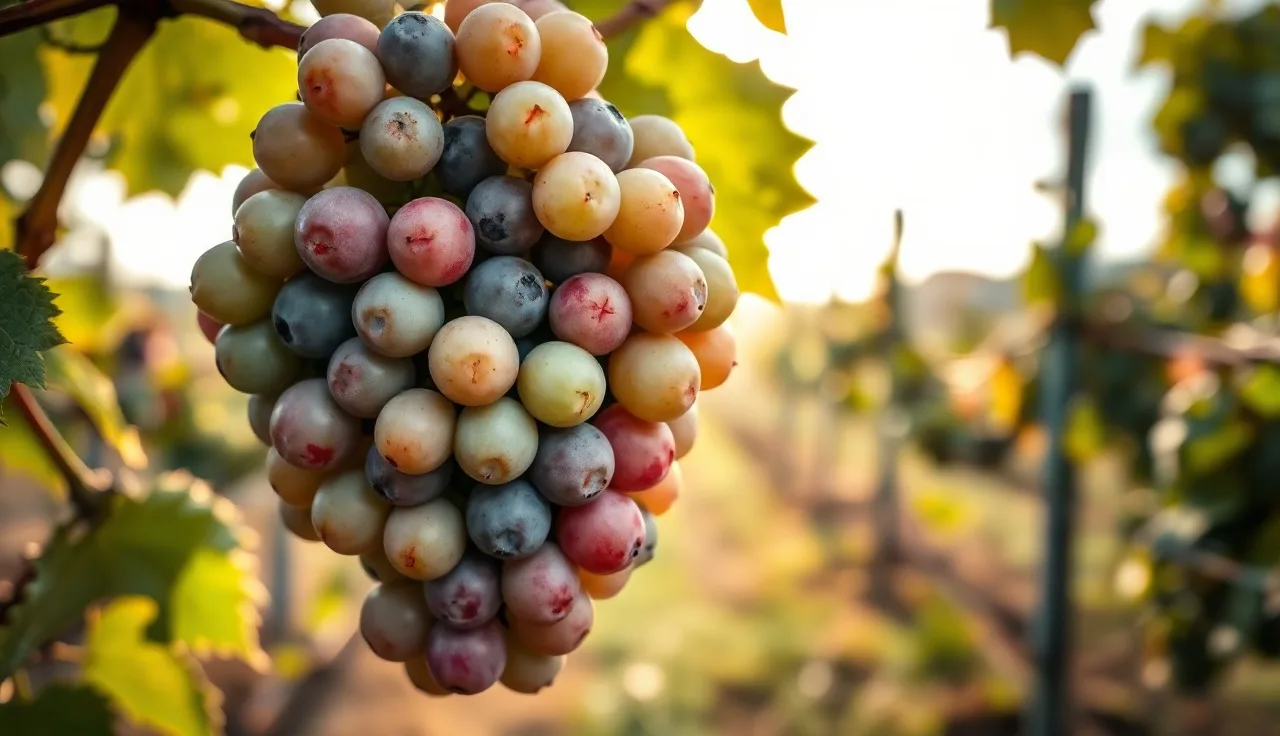
Veraison (from the French véraison, meaning the change of color) is the most visible physiological turning point in the grapevine's year. Before it, berries are hard, green, chlorophyll-rich, and loaded with tartaric and malic acid. Sugar is barely present. Then something shifts.
At the cellular level, veraison is a two-part event. Color change comes first as chlorophyll breaks down and, in red varieties, anthocyanin pigments begin accumulating in the skin. At the same time the berry's relationship with its own vascular system changes: phloem (the sugar-carrying tissue) reconnects to the fruit in earnest, while xylem flow slows sharply. The berry starts pulling sugar from the vine instead of water from the soil. [1]
Softening happens fast. The cell walls of the berry flesh break down under enzymes like pectin methylesterase and polygalacturonase. A berry that squeezed firm a week ago will now give under light thumb pressure. This is the easiest field check you have.
Flavor precursors, aroma compounds, and phenolic maturity all accelerate in the weeks after veraison. Malic acid drops through respiration while tartaric acid stays more stable. Brix climbs, pH rises, and the berry swells as it takes on water along with sugar. Your entire harvest window rides on how cleanly this transition runs. [2]
When does veraison happen, and how long does it last?
Veraison runs from mid-July through late August in most Northern Hemisphere wine regions, though timing varies by variety, rootstock, climate, and vine load. Early varieties like Pinot Noir and Chardonnay often hit it in late July in California's coastal valleys. Late varieties like Cabernet Sauvignon can run into August in warm inland zones.
The process inside a single block is not instantaneous. Individual berries within a cluster enter veraison on different days, and clusters on different canes of the same vine follow each other over one to three weeks. Full block-level completion, where 95 percent or more of berries have changed color and softened, commonly takes 2 to 6 weeks from when the first berries turn. [3]
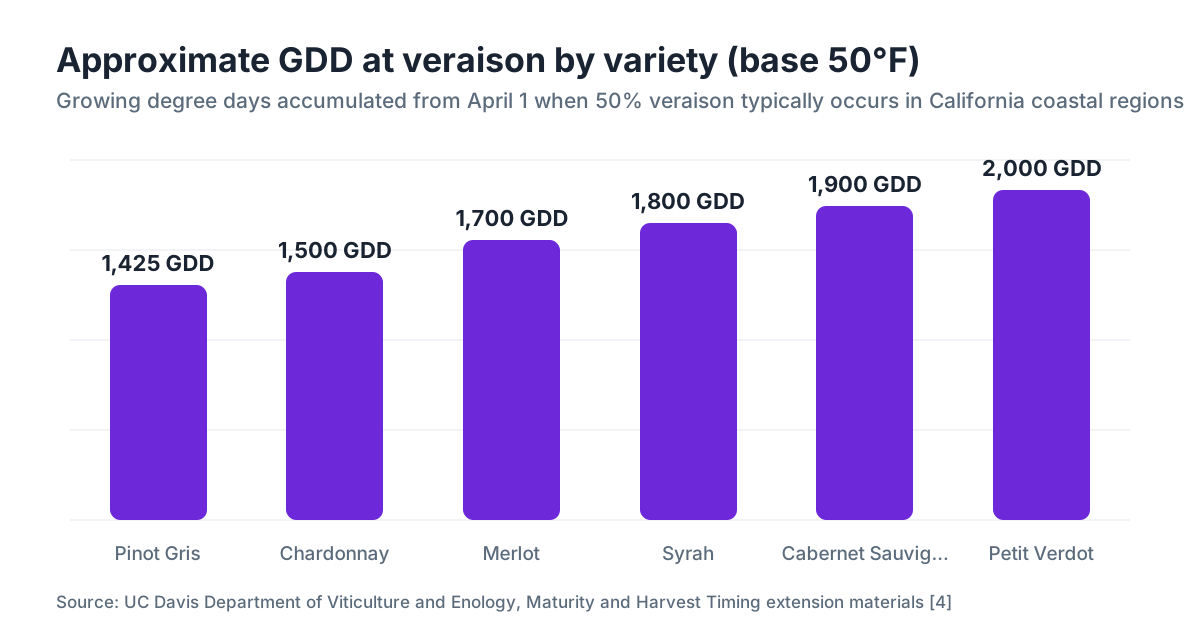
Growing degree days (GDD) give you the best predictive lens. UC Davis research on variety heat requirements puts Pinot Noir veraison around 1,400 to 1,600 GDD (base 50°F), while Cabernet Sauvignon typically needs 1,800 to 2,000 GDD. Track GDD from April 1, map those thresholds against your historical weather data, and you'll land within a week of the actual date most years. [4]
Cool years stretch veraison out. Hot years compress it. A slow, even transition generally correlates with better phenolic and aroma development than a rapid heat-forced one, though nobody has strong replicated trial data to put hard numbers on that relationship.
How do you identify veraison in the vineyard?
The visual check is obvious for red varieties: berries shift from solid green to pink, then red or blue-black. For white varieties it's subtler. Chardonnay, Sauvignon Blanc, and Riesling don't show anthocyanin, so you're watching for the shift from opaque, waxy green to a translucent yellow-green, and more than that you're feeling for softness.
The squeeze test works on any color. Walk a representative row, pick 20 to 30 berries from different parts of the canopy (not only the sun-exposed side), and roll each one between thumb and forefinger. Before veraison, it resists. At veraison, it gives. That tactile difference is unmistakable once you've felt it once.
Percent veraison is the standard field metric. Count the number of colored or softened berries out of 100 total berries sampled from multiple clusters and vines across the block. Record this number every three to five days once you see the first turning berries. Aim to document the 10%, 50%, and 90% thresholds, because different management decisions key off different points in that range. [5]
A few practical pitfalls: sunburned berries on the east or west face of clusters can show color before true veraison. Check the cluster interior. Second-crop clusters lag primary clusters by one to three weeks and will distort your block average if you don't sample consistently.
Why does veraison timing matter for vineyard management decisions?
Every major post-set management decision keys off veraison. Get the timing wrong and you're either acting too early (wasting money, stressing the vine) or too late (locking in problems you can't fix).
Irrigation is the biggest one. Before veraison, regulated deficit irrigation (RDI) is a common tool for controlling shoot growth and vine vigor. After veraison, the calculus changes: the vine is now filling berries, and severe water stress in this period can shrink berry size and concentrate phenolics in ways that may or may not match your style target. WSU Extension recommends monitoring stem water potential through veraison and keeping it above roughly -1.2 to -1.4 MPa (megapascals) for most varieties if you want to avoid stress-induced flavor defects. [6]
Green harvest (crop thinning) loses most of its effect after 50% veraison. Remove clusters before that point and you trigger a compensatory response where the remaining clusters fill larger. After that point the vine's resources are already committed and you get less size response per cluster removed. If you haven't thinned by full veraison, the honest answer is to leave the clusters on and manage at harvest.
Canopy management, specifically leaf removal to improve air circulation around clusters, matters most in the window around veraison. Early leaf pull in the fruit zone happens well before veraison in many programs, but a second pass to strip leaves shading clusters as they begin to ripen is common practice, especially in humid regions prone to Botrytis. Cornell's viticulture extension program has repeatedly found that fruit-zone leaf removal timed near veraison improves spray penetration and reduces bunch rot pressure measurably. [7]
Spray program timing hinges on veraison too. Powdery mildew risk shifts at this stage: once berries reach about 8 Brix, they become resistant to infection, so your spray intensity can taper off for mildew, though Botrytis pressure often climbs. Knowing exactly when your block crosses veraison lets you rotate to the right materials at the right time.
What is the berry chemistry doing between veraison and harvest?
The 6 to 10 weeks between veraison and harvest are where wine is actually made, in a literal sense. The composition you set during this period is what you put in the tank.
Sugar accumulates fast. In a warm climate, Brix can climb 0.3 to 0.5 per day in the two weeks after veraison, then slow as the berry approaches its physiological ceiling. Malic acid breaks down through respiration, particularly on warm nights when the vine keeps respiring heat-stored carbon. Tartaric acid stays relatively stable. The ratio of the two acids shifts, and that shift is what creates the softer palate in warm-climate fruit versus the sharper, greener profile from cool-climate late harvests. [2]
Anthocyanins in red varieties peak and then can actually decline late in ripening if temperatures stay high, a phenomenon called anthocyanin degradation at high temperatures. Harvest timing relative to color peak matters for red wines chasing deep pigmentation. Tannin polymerization also continues after veraison. Unripe tannins are harsh and grippy; polymerized, ripe tannins feel rounder. Sensory and chemical maturity often don't align with sugar maturity, which is exactly why harvest decisions require more than a refractometer reading.
Flavor compounds, especially methoxypyrazines in Cabernet Sauvignon and Sauvignon Blanc, degrade after veraison when exposed to light. Heavy canopy shade at and after veraison preserves green, pyrazine-driven character. If you want riper, fruit-driven profiles, you need light in the fruit zone from veraison onward. [1]
How does veraison timing differ by variety and region?
Variety is the dominant driver. In any given vineyard in any given year, the spread between early and late varieties can top eight weeks. The table below shows approximate GDD requirements and typical California coastal veraison windows for major varieties, based on UC Davis and USDA data. [4]
| Variety | Ripening class | Approx. GDD at veraison (base 50°F) | Typical coastal CA window |
|---|---|---|---|
| Pinot Gris | Early | 1,350 to 1,500 | mid-July |
| Chardonnay | Early-mid | 1,400 to 1,600 | mid to late July |
| Merlot | Mid | 1,600 to 1,800 | late July to early August |
| Syrah | Mid-late | 1,700 to 1,900 | early August |
| Cabernet Sauvignon | Late | 1,800 to 2,000 | mid to late August |
| Petit Verdot | Very late | 1,900 to 2,100 | late August |
Region adds another layer. The same Cabernet Sauvignon clone on the same rootstock will hit veraison two to three weeks earlier in Paso Robles's warmer inland valleys than in Napa Valley's cooler appellations. Elevation and aspect compound this: a hillside block with a southwest exposure and good airflow can run a week ahead of a valley-floor block of the same variety a half-mile away.
Climate change has been pushing veraison earlier across most regions. A 2017 study in Nature Climate Change found that harvest dates in Burgundy have advanced by roughly two weeks over the past 30 years, with veraison following a parallel trend. The driver is longer, warmer springs accumulating more GDD earlier in the season. [8]
What pests and diseases are most threatening at veraison?
Veraison makes berries vulnerable in ways they weren't before. Softening skin is easier for insects and fungi to penetrate. Rising sugar draws pests that ignored unripe fruit. This window demands vigilance.
Botrytis cinerea is the main fungal threat at and after veraison. The pathogen infects through flower parts left in the cluster, through wounds, and through direct skin penetration in humid conditions. Tight-clustered varieties like Pinot Noir and Riesling are the most susceptible. Your last effective fungicide application for Botrytis is typically just before or at 50% veraison. After that, spray penetration into tight clusters is poor and residue timing relative to harvest becomes a concern. [7]
Powdery mildew (Erysiphe necator) is the opposite case. Berries become resistant to new infection at roughly 8 Brix. Your post-veraison spray program for mildew can be reduced or eliminated if the block was well-protected through that threshold. Over-spraying mildewicides post-veraison is a common and expensive mistake.
Spotted wing drosophila (SWD, Drosophila suzukii) is a serious post-veraison threat in many regions. Unlike common vinegar flies that only attack damaged fruit, SWD females have a serrated ovipositor that cuts into intact, softening berries at veraison. Cornell's IPM program documents infestation beginning within days of color change in susceptible blocks. Monitor with sticky traps from veraison onward, and remember that EPA Worker Protection Standard (WPS) restrictions under 40 CFR Part 170 govern re-entry intervals for any insecticides you spray near harvest. [9][10]
Leafhopper and mite populations that were manageable earlier can spike after veraison as the canopy microclimate changes. These rarely cause direct berry damage, but heavy defoliation stress at this stage does drag on sugar accumulation and flavor development.
How should you log and document veraison observations for compliance?
If you keep spray records under CDFA regulations, USDA organic certification, or GAP (Good Agricultural Practice) certification, your veraison observations feed straight into your pre-harvest intervals (PHI) and restricted-entry interval (REI) documentation under the EPA Worker Protection Standard. The WPS, codified at 40 CFR Part 170, requires that workers who enter a treated area receive specific information about the products applied and the applicable REIs. Harvest is the hard deadline that makes PHI compliance non-negotiable. PHI countdown starts from the application date, not from veraison, but knowing your veraison date helps you backplan your last application windows accurately. [10]
Organic certification under USDA NOP (7 CFR Part 205) requires that spray materials used near harvest are NOP-compliant and that records show application dates, materials, and rates. Your certifier will want to see that your pest management actions from veraison onward used allowed materials only. [11]
For any third-party wine quality audit (SQF, BRC, or similar), field records of phenological events including veraison dates and percent-veraison observations are increasingly requested as evidence of monitoring rigor. Keeping dated field notes with block ID, percent veraison, and the method used to estimate it (berry count, visual assessment) takes 10 minutes per block and protects you in an audit.
VitiScribe's field records module is built around exactly this kind of phenological observation logging, letting you attach GPS-tagged percent-veraison readings to specific blocks and automatically flag spray record entries that fall within PHI windows. If you're managing more than 20 acres across multiple varieties, the manual version of this becomes a real time drain.
A simple paper log works fine for small operations. The habit that matters is consistency: same method, same sample size, same time of day. Refractometer readings taken at 8am when berries are cool read differently than readings at 2pm after sun exposure, so pick one and stick with it through harvest.
What vineyard practices should you skip or avoid after veraison?
Some practices that make sense earlier in the season turn counterproductive or actively harmful after veraison. Knowing what to stop doing matters as much as knowing what to start.
Heavy nitrogen applications after veraison are a mistake. Nitrogen drives shoot growth and pulls the vine's energy away from berry filling. It also raises fruit nitrogen levels in ways that can create fermentation and wine stability problems. Most nitrogen programs should wrap up well before veraison, and post-veraison cover crop fertilization should be timed carefully if the vine roots are likely to intercept it. [2]
Aggressive shoot positioning or hedging very late in the season strips leaf area the vine needs for sugar translocation. A light cleanup pass is fine. Removing a big chunk of the canopy after veraison cuts the vine's photosynthetic capacity at the moment it needs it most. I'd skip the late-season mechanical hedging pass entirely if the canopy is reasonably open.
Dramatic soil disturbance, including deep tillage, can damage feeder roots that are actively supplying the ripening clusters. Shallow cultivation for weed management is generally fine. The deeper the implement, the more you're gambling with root systems that are working hard.
Over-irrigation after veraison is a persistent problem. The vine is now pulling more sugar than water, and excess soil moisture can dilute berry sugar, thin flavors, and encourage Botrytis by driving late-season vegetative growth. Unless your stem water potential readings show severe stress, err toward less water once you're past 50% veraison.
How does veraison connect to harvest timing decisions?
Veraison doesn't tell you when to harvest. It tells you the clock has started. Harvest timing is a separate and messier call, but veraison is the zero point for almost every ripening metric you'll use.
Brix accumulation rate from veraison gives you a trajectory. If you know your target harvest Brix (say, 24.5 for a Napa Cabernet) and your historical accumulation rate of 0.3 to 0.4 Brix per day, you can project a rough harvest window from the date you reach 50% veraison. The projection breaks down in weird weather years, but it's a useful anchor for scheduling labor and equipment.
The relationship between veraison date and harvest date is reasonably consistent within a variety and site across years, which makes multi-year phenological records worth their weight. If your block's Cabernet historically runs 50 to 60 days from 50% veraison to harvest at target Brix, a late veraison year (say, two weeks late) should translate to a late harvest, and you can plan accordingly.
Flavor and phenolic ripeness assessments, including seed color, seed taste, skin tannin texture, and aroma profile, only make sense starting after veraison. Some wineries taste-check clusters weekly from 50% veraison onward. UC Davis's extension materials on maturity assessment describe this kind of systematic sensory protocol as the best complement to Brix measurements. [4]
For blocks you're selling to a winery on a contract that specifies Brix and pH targets, the veraison date is the first real input to conversations with your winemaking buyer. A late veraison year with a heat event on the horizon means both of you need to be thinking about that harvest window earlier rather than later. Track it and share the data.
Does cluster thinning at veraison actually improve quality?
This is one of the most debated management questions in viticulture, and the honest answer is: it depends, and the window matters a lot.
Green harvest before veraison (closer to 30 to 50 days after fruit set) does trigger compensatory fruit growth in remaining clusters and can meaningfully reduce yield while holding vine balance. After 50% veraison, the berry growth response is mostly gone. You're left with a yield cut but without the size compensation. Whether that's worth it depends on your crop load.
WSU Extension's research found that post-veraison cluster thinning in overcropped Riesling blocks did improve Brix at harvest and shortened time to target maturity, but the effect was smaller than equivalent pre-veraison thinning. [6] If you're genuinely overcropped at veraison, some thinning still beats nothing. But if you're doing it mainly for size uniformity or because it's on your calendar, you've missed the best window.
A field rule many experienced managers use: if the block is at 1.5x to 2x your target yield at veraison, thin. If you're within 20 to 25% of target, leave it alone and manage at harvest. The labor cost of post-veraison thinning is real, and the quality return at that stage is diminishing.
VitiScribe users tracking crop estimates from fruit set through veraison have a real advantage here, because you can model your yield trajectory before the thinning window closes rather than scrambling for a count at 80% veraison when most of the decision power is already gone.
Frequently asked questions
What triggers veraison in grapevines?
The precise trigger isn't fully understood. Current research points to hormonal shifts, particularly a drop in abscisic acid inhibitors and a rise in ethylene and abscisic acid itself, that signal the berry to switch from cell division and acid accumulation to sugar accumulation and ripening. Vine stress, crop load, and temperature all influence when that hormonal shift occurs, but no single environmental trigger has been pinned as the cause.
Can you speed up or delay veraison?
Within limits. Deficit irrigation and crop load reduction before fruit set can advance veraison slightly by reducing the vine's overall workload. Heavy crop loads and excessive nitrogen push veraison later. Temperature is the dominant factor and largely outside your control. Canopy manipulation that changes fruit zone temperature can produce small timing shifts, but attempting to significantly advance or delay veraison through cultural practices alone rarely works as intended.
Why do some berries in a cluster turn color before others?
Berries within a cluster sit on slightly different developmental timelines because they flowered and set at slightly different times. Berries closer to the cluster stem (proximal) often lag berries at the tip. Sun-exposed berries on the outer face tend to show color earlier because direct UV exposure drives anthocyanin synthesis. This within-cluster asynchrony is normal, but extreme asynchrony can signal uneven fertilization at fruit set or localized disease.
How do I record veraison dates for multiple varieties across a vineyard?
Use a consistent method: count 100 berries per block from at least 10 clusters across representative vines, note the percent that are softened or colored, and record the date. Do this every three to five days from when you spot the first turning berries until the block hits 95% or more. Log block ID, variety, count, method, and assessor name. For operations with multiple blocks and varieties, a digital field record system makes the comparison and trend analysis much more manageable.
Does veraison timing predict harvest date?
It's the best single predictor you have at that point in the season. The days-from-veraison-to-harvest span is reasonably consistent for a given variety on a given site, typically 45 to 75 days depending on variety and climate. Warm weather after veraison compresses the timeline; cool weather extends it. Tracking your veraison dates against harvest dates over multiple years builds the site-specific model that matters most for your operation.
What Brix level do grapes reach at veraison?
Most varieties enter veraison at roughly 4 to 8 Brix. Accumulation then accelerates fast, sometimes reaching 14 to 18 Brix within three to four weeks of 50% veraison. The starting Brix at veraison varies by variety and vintage conditions but is too low to be a useful maturity metric on its own. It's more useful as confirmation that veraison has begun and sugar loading is underway.
Is veraison the same for table grapes and wine grapes?
The physiological process is identical. The management response differs. Table grape growers often apply gibberellic acid (GA3) before veraison to stretch berry size and loosen clusters. Timing those GA applications precisely relative to veraison is critical and well-documented in UC Davis table grape extension materials. Wine grape growers generally avoid GA applications because they reduce anthocyanin and flavor compound concentration.
Why do white wine grapes look different at veraison than red varieties?
White varieties lack the genetic machinery to produce anthocyanins in their berry skins. Veraison in white grapes shows as a shift from opaque, waxy green to a translucent, softer yellow-green as chlorophyll breaks down. The softening of the berry, the shift in sugar-to-acid balance, and the change in vascular supply all happen identically to red varieties. You just have to rely on the squeeze test and translucency check rather than color change.
How does water stress during veraison affect berry size and wine quality?
Moderate stress at veraison can reduce berry size, which concentrates solutes including sugars, pigments, and phenolics. Many premium wine programs target a stem water potential of around -1.1 to -1.3 MPa through veraison to achieve this effect. Severe stress, below -1.5 MPa, risks stopping berry development entirely, causing shriveling, and producing astringent, unbalanced tannin profiles. The target window is narrow enough that pressure chamber readings every five to seven days are worth the effort.
What spray materials are safe to use at veraison?
It depends on the product's pre-harvest interval (PHI) and your target harvest date. From veraison onward, your spray program must be planned backward from harvest. Any material with a 30-day PHI should be applied before the point where your harvest date minus 30 days falls. Sulfur for powdery mildew has a PHI of 0 to 7 days on most labels but can affect fermentation at high residues. Always consult the specific label and your certifier if you're organic. EPA's WPS requirements apply regardless of material.
How does climate change affect veraison timing?
Veraison is arriving earlier across most wine regions. A widely cited 2017 study in Nature Climate Change documented that harvest dates in Burgundy have advanced roughly two weeks over 30 years, with parallel shifts in veraison. The mechanism is warmer springs accumulating growing degree days faster. Earlier veraison means harvest can now fall in hotter late-summer windows rather than cooler early-fall windows, which pressures regions that relied on cool harvest conditions for acidity and aroma retention.
Does high temperature during veraison cause problems?
Yes. Temperatures above about 95°F (35°C) during and shortly after veraison inhibit anthocyanin synthesis in red varieties, giving lighter-colored fruit even when Brix is fully ripe. High temperatures also accelerate malic acid respiration, which can push pH higher than desired. Prolonged heat events right at veraison can desynchronize the ripening process, producing uneven clusters. There's not much you can do except manage irrigation carefully and harvest earlier if pH is rising ahead of flavor development.
Should I be checking for Botrytis specifically at veraison?
Yes. Walk tight-clustered varieties like Pinot Noir, Riesling, and Gewurztraminer every three to five days starting at veraison. You're looking for gray sporulating mold on berries or any brown, water-soaked skin lesions. Your last effective fungicide window for Botrytis is at or just before 50% veraison because spray penetration into the tight, swelling cluster becomes very poor after that. If you see active Botrytis at veraison, your best tools are often cluster thinning and aggressive leaf removal to dry the canopy.
Sources
- UC Davis Viticulture and Enology, 'Berry Development and Ripening': At veraison, phloem reconnects to the berry in earnest and xylem flow slows; methoxypyrazines degrade when exposed to light after veraison.
- Boulton, Singleton, Bisson, Kunkee, 'Principles and Practices of Winemaking', Springer: Malic acid breaks down through respiration post-veraison while tartaric acid stays more stable; heavy nitrogen post-veraison can raise fruit nitrogen and create fermentation issues.
- UC Agriculture and Natural Resources, UC Cooperative Extension, Grape Phenology: Full block-level veraison completion from first turning berries typically takes 2 to 6 weeks; within-cluster asynchrony is normal.
- UC Davis Department of Viticulture and Enology, Maturity and Harvest Timing extension materials: Pinot Noir veraison occurs around 1,400 to 1,600 GDD base 50°F; Cabernet Sauvignon needs roughly 1,800 to 2,000 GDD; sensory and chemical maturity often diverge from sugar maturity.
- Cornell Cooperative Extension, Viticulture Program, Phenological Monitoring: Percent veraison is assessed by counting softened or colored berries per 100 sampled; documentation of 10%, 50%, and 90% thresholds supports spray and canopy management timing.
- Washington State University Extension, Viticulture, Irrigation and Crop Load Management: WSU recommends stem water potential above -1.2 to -1.4 MPa through veraison; post-veraison cluster thinning in overcropped Riesling improved Brix but with smaller effect size than pre-veraison thinning.
- Cornell Cooperative Extension, Fruit Zone Leaf Removal Research, Botrytis Management: Fruit-zone leaf removal timed near veraison improves spray penetration and measurably reduces bunch rot; last effective Botrytis fungicide application is at or before 50% veraison.
- Wolkovich et al., Nature Climate Change, 2017, 'Progressing phenology in wine grapes': Harvest dates in Burgundy have advanced roughly two weeks over 30 years, with veraison following a parallel trend driven by warmer spring GDD accumulation.
- Cornell Integrated Pest Management Program, Spotted Wing Drosophila in Vineyards: SWD females can oviposit into intact softening berries beginning at veraison using a serrated ovipositor; monitoring with sticky traps from veraison onward is recommended.
- EPA Worker Protection Standard, 40 CFR Part 170: WPS under 40 CFR Part 170 governs re-entry intervals and worker information requirements for all pesticide applications in agricultural settings including vineyards near harvest.
- USDA National Organic Program, 7 CFR Part 205: USDA NOP requires that spray materials used near harvest are NOP-compliant and that records showing application dates, materials, and rates are maintained for organic certification.
- UC Cooperative Extension, Table Grape Production, Gibberellic Acid Timing: GA3 application timing relative to veraison is critical for table grape berry size and cluster looseness; wine grape growers generally avoid GA applications because they reduce anthocyanin and flavor compound concentration.
Last updated 2026-07-09