Soil consulting for vineyards: what it costs, what you get, and when it's worth it
TL;DR
- A vineyard soil consultant reads the physical, chemical, and biological properties of your ground and turns them into decisions: rootstock, drainage, irrigation, and annual fertility.
- A one-time pre-plant assessment runs roughly $500 to $2,500.
- Ongoing annual programs run $2,000 to $5,000 or more.
- For new plantings and struggling blocks, the payback is obvious.
- For established blocks with steady yields, the math gets harder.
What does a vineyard soil consultant actually do?
A soil consultant translates what's in the ground into decisions you can act on. Sounds obvious. It isn't, because a lot of growers expect a consultant to hand over a fertilizer recipe and call it a day. The good ones do far more.
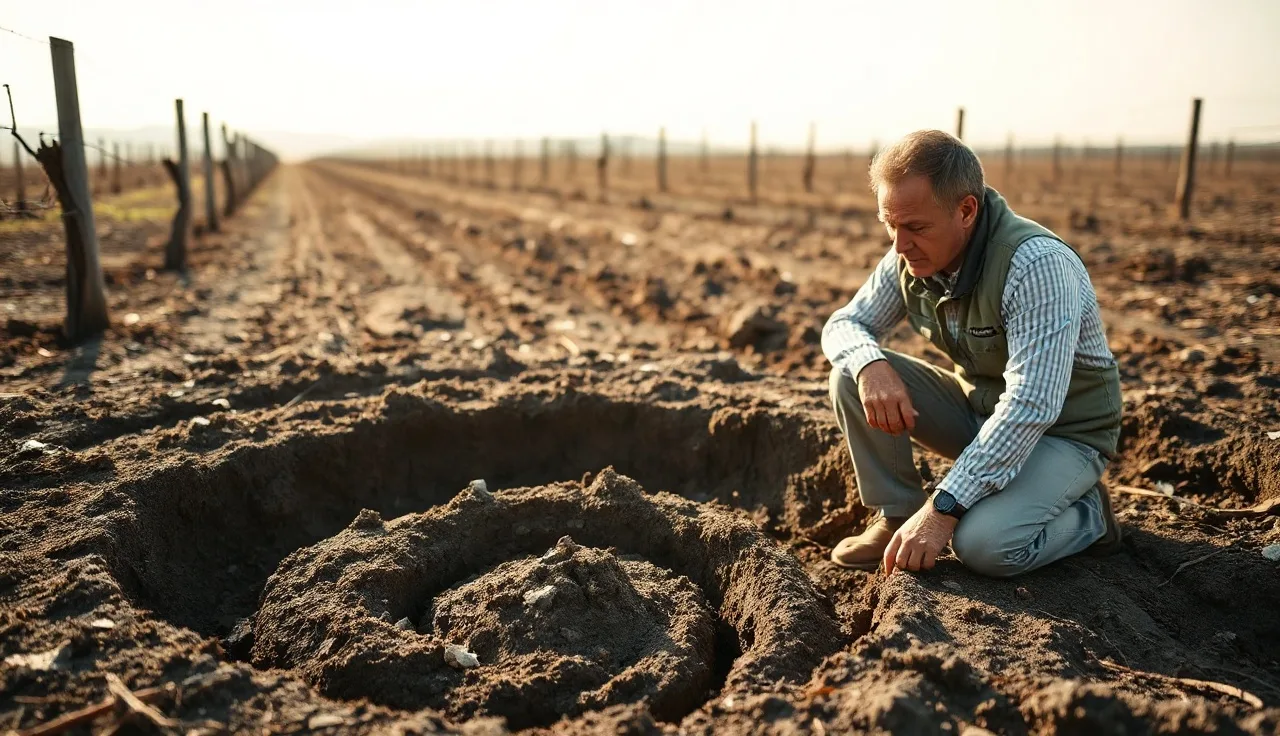
Before planting, the work is site characterization: mapping soil series across the property, finding the depth to restrictive layers (hardpan, caliche, heavy clay), reading drainage, and flagging spots likely to cause rootstock trouble or uneven vine growth. That usually means hand-digging or machine-auguring profile pits at one pit per 2 to 5 acres, tighter where the site is more variable [1].
After planting, the job flips. A good consultant reads annual soil and petiole samples together, never in isolation, and ties fertility trends back to the canopy and yield numbers you're already tracking. Most of the time they're telling you when to back off nitrogen, not when to pile it on.
In Washington wine country, soil consulting has grown right alongside the planted acreage in the Columbia Valley AVA. Plenty of Walla Walla and Yakima Valley growers work with people who know the region's loess soils and irrigation-driven salinity risks [2]. Those conditions are different enough from California's north coast that regional experience earns its keep.
What soil tests do vineyards actually need?
There's no universal panel. But a few tests show up in every well-designed program, and a few more depend on your site.
The baseline is a standard agronomic soil test: pH, buffer pH, organic matter, CEC (cation exchange capacity), and extractable macro and micronutrients (P, K, Ca, Mg, S, Zn, Mn, Fe, Cu, B). California labs run Mehlich-3 or Olsen-P extraction depending on soil pH. Expect $25 to $75 per sample at commercial ag labs like A&L Western or Waypoint Analytical [3].
Beyond the baseline, consultants often add:
- Soil texture by particle size analysis (sand, silt, clay percentages), mostly for pre-plant work or irrigation design
- Electrical conductivity (EC) to catch salinity, especially in arid irrigated ground
- Nematode assays before planting, since rootstock choice hinges on dagger nematode (Xiphinema index) pressure and fanleaf virus risk
- Biological activity indicators like active carbon or the Haney test, though the interpretive frameworks for vineyards are still thin
Petiole sampling sits separate from soil sampling but you can't run a real fertility program without it. Standard timing for grapevines is full bloom (50% cap fall) and again at veraison. WSU Extension's viticulture publications lay out the petiole protocols and sufficiency ranges by nutrient and variety [4]. A consultant who never asks for petiole data is working with half the picture.
One note on nematodes. Pre-plant assays cost roughly $50 to $150 per composite sample and can keep you from planting a susceptible rootstock in infested ground. If your site had a vineyard or stone fruit on it before, skipping this is a mistake you'll pay for later.
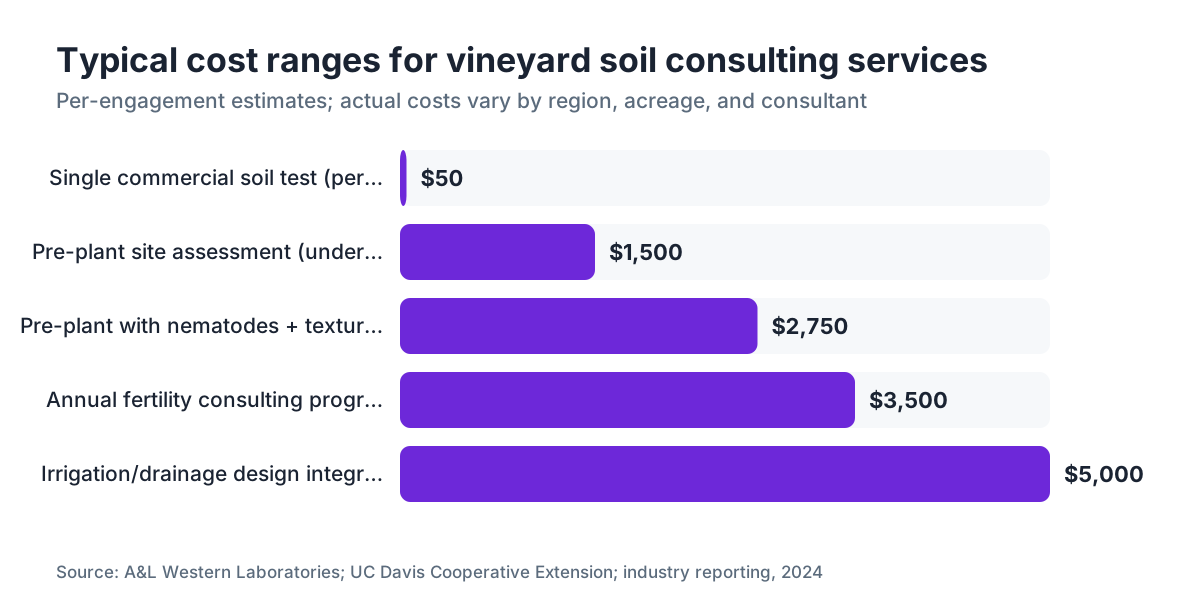
How much does vineyard soil consulting cost?
Prices swing with scope, region, and whether you hire an independent agronomist or someone tied to a product line. That last one matters more than most growers realize.
| Service type | Typical cost range | What you're getting |
|---|---|---|
| Single soil test (commercial lab) | $25 to $75/sample | Chemistry report, no interpretation |
| One-time pre-plant site assessment | $500 to $2,500 | Profile pits, drainage eval, soil map, report |
| Annual fertility consulting (per block) | $1,500 to $5,000+ | Soil + petiole sampling, interpretation, recommendations |
| Full pre-plant study with nematodes + texture | $1,500 to $4,000 | All of the above plus rootstock/site matching |
| Irrigation/drainage design integration | $2,000 to $8,000 | Soil hydraulic data, drip spec, drainage layout |
These ranges come from public extension guidance and industry discussion. Real quotes move with the consultant, travel, and acreage. A 5-acre block prices differently than a 200-acre estate.
The hidden cost is product-tied consulting. Some fertilizer retailers offer "free" or cheap soil testing as part of the sales relationship. Not inherently bad. But the recommendations tend to drift toward what they sell. If you want independence, pay for it on purpose: hire an independent Certified Crop Adviser (CCA) or Professional Soil Scientist (PSS) and expect full consulting rates.
Washington growers have a head start. WSU Extension offers limited support through county offices, and several WSU viticulture faculty publish regional nutrient management guides free online [4]. That won't replace a site visit. It does give you a solid interpretive base before you spend a dollar on consulting.
When is soil consulting worth the money for a vineyard?
Honest answer: it hangs almost entirely on the decision you're trying to make.
Pre-plant is the highest-value moment there is. Fix a drainage problem later, pick the wrong rootstock, or miss a nematode infestation, and you're looking at replanting costs of $15,000 to $40,000 per acre by most industry estimates, plus 3 to 5 years of lost production [5]. A $2,000 site assessment against those stakes is easy math.
Established blocks with steady yields and no obvious trouble are harder to call. If your fruit quality sits where you want it, your vines are balanced, and your own sampling gives you consistent data, a full consulting engagement may not move much. Run your own annual soil and petiole samples through a lab, cross-reference them against UC Davis or WSU sufficiency tables, and you get maybe 80% of the way there for a fraction of the cost.
Here's where consulting earns its rate in established ground: problems you can't explain. Patchy vigor. Leaf symptoms that don't match your program. pH drift. A block that keeps underperforming no matter what you do with irrigation and canopy. A fresh set of expert eyes and a fuller diagnostic workup often finds what routine sampling walked right past.
New blocks in Washington's Columbia Valley, Oregon's Willamette Valley, or California's Central Coast justify soil consulting almost by default, given the capital at risk and the site variability common in those regions. Paso Robles is a good example. Soils shift hard between the east and west sides of the AVA, where calcareous ground and active limestone on the west demand a different fertility approach than the sandy loams to the east [6].
How do you find and vet a good vineyard soil consultant?
Start with credentials. Don't stop there. The designations worth looking for:
- Certified Crop Adviser (CCA), run by the American Society of Agronomy. CCAs pass exams in soil fertility, pest management, and crop management, and they carry continuing education requirements [7].
- Professional Soil Scientist (PSS), certified through the Soil Science Society of America. More relevant for pre-plant characterization and soil mapping than for ongoing fertility work [12].
- Certified Viticulture Adviser (CVA), a newer credential from the American Society for Enology and Viticulture. Not widely held yet, but growing.
Regional experience beats a stacked resume. A CCA with 10 years on California's north coast who's now advising your Washington vineyard is starting cold on regional soil behavior, irrigation, and disease pressure. Ask flat out about their work in your AVA.
Ask for references and actually call them. Ask three things: did the recommendations turn into measurable outcomes, did the consultant explain the reasoning or just hand over a product list, and did they over-promise.
Red flags. Consultants who skip petiole samples. Consultants who hand every client the same fertility program regardless of site data. Anyone who leads with a product line instead of a diagnostic process.
University extension is an underused resource. UC Davis Cooperative Extension [8], Cornell's viticulture and enology program [9], and WSU's wine and viticulture extension [4] all publish regionally calibrated nutrient guides, sampling protocols, and sometimes referral networks. They don't replace a site visit. They give you a baseline to judge whatever a consultant tells you.
What soil factors matter most for wine grape quality?
This is where viticulture gets interesting and a little humbling, because a lot of the science is genuinely incomplete.
The factors with real evidence behind them:
Drainage. Well-drained soils moderate vigor and push roots deeper, which lines up with steadier ripening and lower berry water content. That's a consensus position across UC Davis, Cornell, and WSU extension literature [8][9][4]. Waterlogged soils bring Phytophthora root rot, vigor swings, and inconsistent cropping.
pH. Wine grapes want roughly 5.5 to 7.0. Outside that band, nutrient availability distorts no matter what you apply. Potassium uptake in particular runs excessive in high-pH soils, which pushes tartaric and malic acid balance around and drags on wine pH and stability.
Organic matter. Below 1%, water-holding capacity and biology both suffer. Above 3% in warm climates, you can drive too much nitrogen mineralization and shove vines into over-vigor. For most California wine regions the sweet spot sits at 1 to 2%.
Texture and depth. Sandy soils drain fast, warm quickly, and lean toward low yields with concentrated fruit. Heavy clay can grow excellent wine grapes when drainage is handled, but it compacts and goes anaerobic at the roots if you get careless with tillage and water. Depth to a restrictive layer below 3 feet is generally considered adequate for grapevines [1].
The factors people talk about but nobody has quantified well: specific mineral profiles (calcium-to-magnesium ratios, micronutrient cocktails) and their supposed link to fruit character and terroir. There's a lot of romance about limestone and granite in wine writing. The peer-reviewed evidence connecting specific soil mineralogy to sensory outcomes is thin. A good consultant says so.
How does soil consulting connect to spray records and worker protection compliance?
Growers don't always see this link, but soil decisions touch pesticide and worker protection compliance in real ways.
Soil pH and organic matter change how many pesticides persist and move. Systemic fungicides and some pre-emergent herbicides bind differently in high-clay ground than in sand, which affects label re-entry intervals and application rates. If your consultant is recommending amendments that shift soil structure, your pesticide program may need another look.
Under the EPA Worker Protection Standard (WPS), handlers and early-entry workers follow the PPE and re-entry rules tied to the pesticide label, not to what you figure is fine given your soil [10]. Organic matter never overrides a label. It does inform how you calibrate rates and think about runoff and leaching in your records.
For anyone keeping spray records, tying soil data to application decisions builds a much more defensible file. When a state ag auditor asks why you applied potassium silicate at a given rate, a soil test showing low Si plus a consultant's recommendation in the file is a clean answer. VitiScribe lets you attach soil test records and consultant notes straight to block-level records, so the line from soil program to spray decision sits documented in one place.
Organic and biodynamic programs add a layer. Approved materials under USDA National Organic Program certification depend partly on how you manage soil biology. A consultant who knows NOP rules can build a fertility program that keeps your certification safe [11].
What's the soil consulting process from first call to final report?
Here's what a well-run pre-plant engagement looks like, step by step.
Initial scoping call (free to $200). You describe the site, acreage, intended varieties, and what you already know. A good consultant asks about previous land use, existing irrigation, and your target wine style, because rootstock and row orientation downstream depend on all of it.
Site visit and profile pits (usually the main billing event). The consultant walks the property, marks zones of variability by topography, vegetation, and color, and picks pit locations. A backhoe or tractor auger is typically needed for pits deeper than 4 feet. Budget half a day to a full day per 20 to 40 acres. They're reading horizon depth, texture by feel, structure, color (Munsell notation), coarse fragment content, mottling (a sign of seasonal saturation), and anything that might stop roots.
Sampling. Soil samples come out by depth increment from representative zones and go to the lab. Turnaround at most commercial labs is 5 to 10 business days for standard tests, longer for specialty assays. Nematodes can take 2 to 3 weeks.
Report and recommendations. A written report should map the soil variability, summarize lab results by management zone, flag concerns, and give specific calls on pre-plant amendments, drainage work, rootstock by zone, and the first-year fertility structure. The verbal debrief matters as much as the paper. If a consultant can't explain the reasoning without jargon, that's a problem.
Year-one follow-up. The best consultants build in a check-in after your first growing season, when petiole data gives you a first read on how the vines are handling the site and the program.
What are the common mistakes vineyards make without soil consulting?
Planting without nematode assays on previously farmed ground is probably the single most expensive mistake there is. Fanleaf degeneration, caused by GFLV moved by Xiphinema index nematodes, is incurable once a vineyard is in. Choose a susceptible rootstock like 3309 or plant own-rooted vines in infested ground and you've shortened the economic life of the whole block. UC Davis lists nematode assays as a standard pre-plant recommendation for any site with prior agricultural history [8].
Over-correcting pH without knowing the cause. Growers see a low pH and reach for lime. If aluminum saturation is driving that low pH (common in some coastal California soils), the lime rate and type matter enormously. Over-lime and you push pH too high, crash manganese and zinc availability, and spend years walking it back.
Ignoring soil-to-soil variability inside a block. One fertility rate across a block with two distinct soil types gives you two different response curves. You over-fertilize one zone and starve the other. A simple soil EC map, or even a walk-through with a consultant before sampling, tells you whether you should be running two management zones instead of one.
Mistaking organic matter for biological activity. Compost raises your organic matter number. It doesn't automatically fix soil biology or undo compaction from heavy equipment. A consultant worth the rate will tell you cover crop management and reduced tillage often do more for long-term soil health than compost, and they'll have data instead of an amendment invoice.
How often should a vineyard update its soil testing and consulting program?
For soil tests, most extension programs recommend every 2 to 3 years for established vineyards in stable programs, and annual testing for new blocks or blocks under active amendment [4][8]. pH and CEC move slowly, so annual soil testing in a stable system just piles up redundant data. Petiole sampling at bloom is annual and non-negotiable, because in-season nutrient status reflects current vine physiology in ways a winter soil test can't touch.
For consulting, the frequency tracks what you're managing. A new planting wants a consultant in year one (pre-plant), year two (first-season review), and year three (once you have yield and quality data to judge). After that, a biennial or triennial check-in usually beats annual fees if things are going well.
Blocks that see a big management change, like a new cover crop program, a shift in irrigation scheduling, or replanting after disease removal, deserve a fresh look. Same for any block throwing unexplained symptoms or yield trends.
The pattern I see among experienced growers: heavy consulting upfront around new plantings or problem blocks, then build up their own interpretive skills using extension resources, then pull the consultant back in selectively for specific diagnostic jobs instead of running it as a standing subscription.
How does VitiScribe help you get more from your soil consulting investment?
A soil consultant generates a pile of data: lab reports, profile pit notes, amendment recommendations, petiole results, irrigation maps. All of it is only as useful as your ability to connect it to what's actually happening block by block, season by season.
VitiScribe lets you attach soil test records, consultant reports, and amendment notes straight to block-level records, right alongside your spray applications, harvest data, and irrigation logs. When you're staring at a patchy block mid-season or weighing a replant, having three years of soil data, petiole reports, and yield history in one place changes the quality of the conversation you can have with a consultant. You're not reconstructing history from memory or a filing cabinet. It's already there.
Compliance is where this pays off hardest. Under a third-party sustainability certification or a state audit, pulling a complete block history that includes soil management decisions is faster and cleaner than stitching it together from scattered spreadsheets and lab emails.
For growers in Washington, California, or Oregon, where water management complexity and regulatory scrutiny both run high, the record-keeping discipline good soil consulting demands fits right into what a field operations platform already has to do.
Frequently asked questions
What's the difference between a soil test and soil consulting?
A soil test is lab analysis of a sample: it gives you numbers for pH, nutrients, and organic matter. Soil consulting is the interpretation and decision layer on top. A consultant tells you what those numbers mean for your specific site, variety, and goals, and gives you actionable recommendations instead of raw data you have to decode yourself.
How much does a pre-plant vineyard soil assessment cost?
A one-time pre-plant assessment runs $500 to $2,500 for sites under 20 acres, depending on how much variability exists and how many profile pits the consultant digs. Larger sites, or ones needing nematode assays, texture analysis, and drainage evaluation, can push $3,000 to $4,000. That's small against replanting costs of $15,000 to $40,000 per acre if a site problem slips through.
What credentials should a vineyard soil consultant have?
Look for a Certified Crop Adviser (CCA) through the American Society of Agronomy, a Professional Soil Scientist (PSS) through the Soil Science Society of America, or both. Regional vineyard experience matters as much as the letters. Ask directly about experience with your AVA or soil type, and request references from growers on similar sites.
Is soil consulting different for Washington state vineyards compared to California?
Yes, meaningfully. Washington's Columbia Valley has loess-derived soils with different pH profiles, lower organic matter, and salinity risks from irrigation that you don't see across most California coastal ground. WSU Extension publishes Washington-specific fertility guides calibrated to those soils. A consultant without Pacific Northwest experience takes time to get up to speed on regional soil behavior.
Can I just send samples to a lab myself without hiring a consultant?
Yes, and for established vineyards on stable programs, that's often the right call. Labs like A&L Western or Waypoint Analytical provide basic interpretation with their reports. Cross-reference against UC Davis or WSU sufficiency tables and you get most of the way there. A consultant earns their fee on site-specific interpretation, diagnostic problem-solving, and calls like rootstock selection that a lab report alone can't make.
How do I know if my vineyard has a soil problem vs. a pest or disease problem?
Symptoms overlap a lot. Boron and potassium deficiencies can look like disease. Nematode pressure produces decline patterns that mimic virus. A good workup runs soil and petiole samples together, maps where symptoms show up in the block, and rules out pests and disease before landing on soil. Don't spend money on a fertility program until the cause is nailed down.
What is petiole sampling and why do vineyards need it?
Petiole sampling analyzes the leaf stem opposite a flower or fruit cluster, collected at bloom or veraison. It measures the vine's actual in-season nutrient uptake, which reflects both soil supply and vine physiology. WSU and UC Davis publish sufficiency ranges by growth stage. A soil test tells you what's available in the ground. A petiole test tells you what the vine is actually taking up.
Does soil consulting help with water and irrigation management?
Yes. Soil texture data (sand, silt, clay percentages) directly informs irrigation scheduling. Sandy soils have low water-holding capacity and want shorter, more frequent cycles, while clay holds more water but compacts and goes anaerobic. A consultant who pairs soil hydraulic assessment with irrigation design can head off over-watering that feeds Botrytis pressure and excess vigor.
What soil factors affect grapevine rootstock selection?
The big ones: nematode species and pressure (some rootstocks resist Xiphinema index, others don't), soil pH and lime content (high-lime soils want rootstocks with good iron uptake like 140 Ruggeri or 1103 Paulsen), drainage, and vigor expectations. Pre-plant nematode assays and a full soil profile review are the standard basis for the decision. Getting it wrong is expensive to fix.
Are there free resources for vineyard soil management I can use before hiring a consultant?
Yes. UC Davis Cooperative Extension, WSU Extension's viticulture program, and Cornell's viticulture and enology program all publish free nutrient management guides, sampling protocols, and sufficiency tables. These are legitimate agronomic references calibrated to regional soils. They won't replace a site visit, but they'll help you ask sharper questions of any consultant you hire.
How does soil consulting relate to organic or biodynamic certification?
Under USDA National Organic Program rules, fertility inputs must come from the approved materials list, and synthetic fertilizers are prohibited. A consultant who knows NOP certification can build a fertility program from permitted amendments (compost, mined minerals, approved biostimulants) that meets both agronomic and certification requirements. An unapproved input on bad advice can put your certification at risk.
Can soil consulting help with replanting decisions in an existing vineyard?
It's one of the best uses of consulting dollars. Before replanting, a full soil workup can tell you whether disease pressure (GFLV, Armillaria), soil chemistry, or drainage drove the original block's decline. Replant into the same conditions without fixing the cause and you get the same result. A pre-replant diagnostic runs $1,000 to $3,000 and is money well spent ahead of a $20,000-per-acre replanting commitment.
How do I keep track of soil test results and consultant recommendations across multiple blocks?
Block-level record-keeping is essential once you're managing multiple soil zones and separate fertility programs. Many growers start with spreadsheets and lab email archives, which works until you hit 10-plus blocks or need historical data for a certification audit. Vineyard management software that ties lab reports and consultant notes to block records keeps the data useful across seasons instead of filed away and forgotten.
Sources
- UC Davis Cooperative Extension, Soil Profile Characterization for Vineyards: Pre-plant site characterization involves profile pits at a density of at least one pit per 2 to 5 acres to evaluate soil depth, drainage, and restrictive layers.
- Washington State University Extension, Columbia Valley Viticulture: Washington's Columbia Valley vineyards are established on volcanic loess-derived soils with salinity risks from irrigation and unique pH profiles compared to California coastal regions.
- A&L Western Laboratories, Agricultural Soil Testing Services: Standard agronomic soil tests at commercial ag labs run roughly $25, $75 per sample and report pH, organic matter, CEC, and macro and micronutrients.
- Washington State University Extension, Viticulture Nutrient Management and Petiole Sampling: WSU Extension viticulture publications specify petiole sampling timing at bloom and veraison and give nutrient sufficiency ranges by variety.
- UC Davis Cooperative Extension, Vineyard Economics and Establishment Costs: Vineyard replanting costs range from approximately $15,000, $40,000 per acre depending on region, site preparation, and vine spacing.
- Paso Robles Wine Country Alliance, Terroir and Soil Diversity: Paso Robles AVA has significant soil variability between east and west sides, with calcareous soils and active limestone on the west side requiring different fertility approaches.
- American Society of Agronomy, Certified Crop Adviser Program: The Certified Crop Adviser (CCA) designation requires passing competency exams in soil fertility, pest management, and crop management and meeting ongoing continuing education requirements.
- UC Davis Cooperative Extension, Vineyard Nutrition and Soil Health: UC Davis lists pre-plant nematode assays as a standard recommendation for any site with prior agricultural history, given the risk of Xiphinema index and fanleaf degeneration virus.
- Cornell University Cooperative Extension, Viticulture and Enology: Cornell Extension publishes regionally calibrated nutrient management guides and petiole sufficiency tables for northeastern U.S. wine grape production.
- U.S. EPA, Worker Protection Standard for Agricultural Pesticides: Under the EPA Worker Protection Standard, re-entry intervals and PPE requirements are determined by pesticide labels, not by on-site soil conditions or grower judgment.
- USDA National Organic Program, Allowed and Prohibited Substances: USDA NOP certification requires that all fertility inputs be drawn from the approved materials list; synthetic fertilizers are prohibited in certified organic vineyard programs.
- Soil Science Society of America, Professional Soil Scientist Certification: The Professional Soil Scientist (PSS) credential is administered by the Soil Science Society of America and is the primary designation for practitioners conducting soil profile characterization and mapping.
Last updated 2026-07-09