Soil amendments for vineyards: what actually works and when
TL;DR
- The right soil amendment for your vineyard comes from a current soil test, not a general recommendation.
- Lime raises pH, gypsum fixes compaction and sodium, compost builds biology, and sulfur drops pH.
- Most vineyards need 2-4 tons of amendment per acre at establishment; annual rates run far lower.
- Test first, amend second.
Why do vineyard soils need amendments at all?
Grapevines tolerate poor soils better than almost any crop you can name. They'll grow on rocky hillsides and gravelly loams that would starve corn or lettuce. But tolerant is not the same as indifferent. Vines still need the right pH range, adequate calcium and magnesium, functional soil biology, and enough organic matter to hold water through a dry summer. When those conditions are off, you see it in slow establishment, chlorotic leaves, uneven ripening, and roots that never reach the subsoil.
The bigger issue is that vineyard soils stay the same for decades. You're not tilling every year like a vegetable grower. Whatever you put into the soil at planting sets the foundation for the life of the block, which could run 30-plus years. Get that foundation wrong and you live with the mistake a long time.
One more thing worth saying plainly: most soil problems in vineyards are site-specific. There's no universal amendment prescription. A Sonoma hillside Zinfandel block on volcanic clay-loam has almost nothing in common with a flat, sandy Coachella Valley plot or a North Fork of Long Island site sitting on marine sediment. The amendment question is always answered by a soil test, not by what worked for your neighbor. [1][2]
What should a vineyard soil test include before you amend?
A basic agronomic test covers pH, organic matter percentage, and the major macronutrients: phosphorus, potassium, calcium, magnesium, and sodium. That gets you most of the way there. For a vineyard, especially at establishment, add cation exchange capacity (CEC), percent base saturation for each major cation, and boron. Boron deficiency causes poor fruit set and is one of the more common micronutrient problems in vineyards west of the Cascades. [3]
For a new site, get a deep-profile test down to at least 36 inches, more than the top 12. Vines root deep. If your subsoil hides a compaction layer, a pH problem, or a sodium buildup that your surface sample misses, you find out the hard way three years after planting. Subsoil correction is nearly impossible post-establishment without expensive deep tillage.
For established vineyards, test every 2-3 years at minimum. Sample in the same season each time (most growers do late fall after harvest) so year-to-year comparisons hold up. UC Davis Cooperative Extension recommends sampling at 0-12 inches and 12-24 inches separately, and publishes a sampling protocol worth following. [1]
Send samples to a lab that knows wine grape nutrition, more than row-crop nutrition. Optimal ranges differ. Most labs charge $30 to $80 per standard panel; adding a full micronutrient screen runs another $20 to $40. It's a small budget line for the information it buys you.
How does soil pH affect grapevines and when do you need to correct it?
Grapevines do best in a pH range of roughly 5.5 to 7.0, with most references clustering the sweet spot at 6.0 to 6.5. [2] Outside that window, nutrient availability collapses even when the nutrients are physically present. Below pH 5.5, aluminum and manganese turn soluble enough to poison roots. Above pH 7.5, iron and zinc lock up, and you get interveinal chlorosis that looks like a deficiency even when your soil test shows plenty of both.
If your pH runs too low, you lime. If it runs too high on a calcareous soil, you have a harder problem: acidifying a naturally alkaline soil is slow and takes large sulfur inputs over several years.
Cornell Cooperative Extension notes that grapevines are more sensitive to pH-related nutrient imbalances than many other fruit crops, partly because their deep roots meet subsoil layers that can run far more acidic or alkaline than the surface. [3] That's why the deep-profile sample matters so much before you plant.
One practical point: pH correction is slow. Lime takes 6 to 12 months to fully react, sometimes longer in dry climates. Planting in spring means liming the previous fall at the absolute latest, and two years ahead if your pH problem is severe.
What is the right rate and type of lime to use in a vineyard?
Limestone comes in two main forms: calcitic (calcium carbonate, CaCO3) and dolomitic (calcium-magnesium carbonate). Use dolomitic lime when your soil magnesium is also low, which it often is in high-rainfall eastern and Pacific Northwest sites. Use calcitic lime when magnesium is adequate or high, because piling on magnesium you don't need throws off the calcium-to-magnesium ratio in your cation base saturation.
The amount you need depends on your current pH, your target pH, and your soil's buffering capacity, which rides heavily on texture and organic matter. The lime requirement test (also called a buffer pH test) is what labs use to calculate the rate, and it beats guessing from pH alone. As a rough guide, a loam soil at CEC 10 meq/100g might need 1 to 2 tons per acre to move pH from 5.5 to 6.5. A higher-CEC clay could need 3 to 5 tons per acre for the same move. [4]
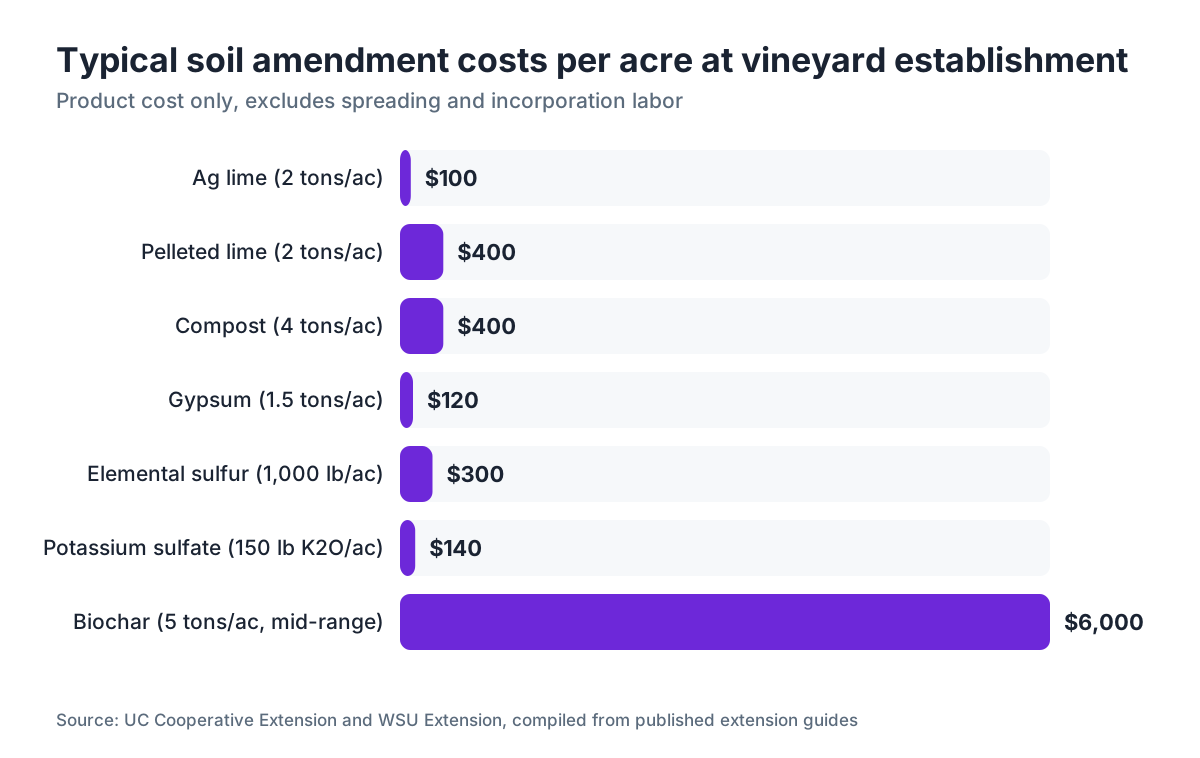
Efficiency is measured by Effective Calcium Carbonate Equivalent (ECCE), which combines purity and fineness of grind. A finer grind reacts faster but often costs more. Most commercial ag lime runs 85 to 95% ECCE. Budget $30 to $60 per ton for ag lime, plus spreading. Pelleted lime costs more ($150 to $250 per ton) but spreads cleaner through a spinner and lands more accurately in established rows.
Pelargonic-acid products sold as rapid pH correction aren't worth the money at vineyard scale. The effect is real but short-lived.
When does a vineyard need gypsum and what does it actually do?
Gypsum is calcium sulfate (CaSO4). It does not change soil pH. That's the most common misconception about it. What it does: supply calcium and sulfur without raising pH, improve flocculation of clay particles in high-sodium or high-magnesium soils, and sometimes loosen compacted subsoils enough to help drainage and root penetration.
Gypsum earns its cost on soils with a high exchangeable sodium percentage (ESP above 5 to 10%) or a sodium adsorption ratio (SAR) problem from irrigation water. Sodic soils have clay particles that disperse instead of aggregating, which kills drainage and builds a hard, dense layer. Calcium from gypsum displaces sodium on the exchange sites, and that displaced sodium leaches out with irrigation water. WSU Extension covers this in detail for the Columbia Valley, where irrigation water quality is a real and ongoing issue. [5]
On well-drained, non-sodic soils, gypsum offers little and is generally a waste of money. Some studies show marginal gains in calcium uptake on low-CEC sandy soils, but the effect is small and inconsistent.
Where it's warranted, a typical rate is 1 to 2 tons per acre, broadcast and incorporated before planting. In established vineyards, surface applications run 0.5 to 1 ton per acre on a 2-3 year cycle. Ag-grade gypsum runs $50 to $100 per ton delivered, depending on region.
How much does compost help, and what kind should you use?
Compost is the amendment with the widest benefits and the hardest-to-predict results. Done right, it raises organic matter, feeds soil biology, adds slow-release nutrients, holds water in sandy soils, and improves drainage in clay soils. Done wrong, it brings weed pressure, excess nitrogen that delays fruit maturity, high potassium that competes with magnesium uptake, or pathogens if it wasn't finished properly.
The research on compost in vineyards is genuinely positive, but the soil OM benefit often takes 3 to 5 years to show up on a test. A short-term panel won't tell you much. The longer payoff is real. [10]
Ask these questions before you buy. What's the feedstock? Grape pomace, green waste, and biosolids all behave differently. What's the C:N ratio? For vineyards you generally want a finished compost between 15:1 and 25:1. Has it been tested for heavy metals, especially if it's biosolids or recycled municipal material? California requires compost sold commercially to meet specific standards under CDFA; other states vary. [6]
Potassium is a real concern. Many composts, grape pomace especially, run high in potassium. Adding potassium-heavy compost to a vineyard already high in K makes the imbalance worse. Ask your supplier for a full nutrient analysis, more than a certificate of conformance.
Rates at establishment: 3 to 5 tons per acre worked into the planting row is typical in California coastal regions. Annual maintenance on established vineyards: 1 to 2 tons per acre, usually surface-applied in the undervine strip. Some high-OM blocks need no compost at all after establishment. Test, then decide. [10]
Does sulfur lower soil pH in vineyards and how long does it take?
Yes. Elemental sulfur (S) is the main tool for lowering soil pH. Soil bacteria, mainly Thiobacillus species, oxidize elemental sulfur into sulfuric acid, which acidifies the soil. The reaction needs warm, moist soil and an active microbial community, so it stalls in cold or dry conditions. In a warm California summer you might see pH movement in 3 to 4 months. In a cold, dry climate the same application can take a full year to register.
Rates depend heavily on your starting pH, buffering capacity, and how far you want to move. Shifting pH from 7.5 to 6.5 in a loam might take 1,000 to 2,000 lb per acre of elemental sulfur. Moving pH down from 8.5 is functionally impossible with sulfur alone on a calcareous soil, because the calcium carbonate in the parent material keeps regenerating alkalinity. [4]
Finely ground sulfur (sulfur flour or dusting sulfur) reacts faster than granular. Prilled or granular forms spread more easily by machine. Most growers use granular for broadcast application before tillage and save the fine grind for foliar uses (a separate topic, for fungal pressure).
Cost is modest: elemental sulfur runs $0.20 to $0.40 per pound in bulk, so a 1,000 lb per acre application costs $200 to $400 per acre in product alone. The real cost is patience. Acidification takes time and repeated applications.
Sulfur applications count as pesticide applications in some states and under the EPA Worker Protection Standard [7], so make sure your spray records reflect any broadcast applications. If you run a digital field log, this is exactly the kind of entry that belongs alongside your pesticide sprays.
What about biochar: is it worth using in vineyards?
Biochar is charcoal made by heating organic material in low-oxygen conditions (pyrolysis). It's highly porous, which in theory holds water and shelters soil microbes. It's also alkaline, so it acts as a liming agent. And unlike compost, it barely breaks down, so its effects persist for decades.
The honest answer on vineyard-specific biochar research: promising but thin. Nobody has good long-term vineyard data at commercial scale. The closest published work comes from grape trials in Australia and pilot work in California, which show gains in vine water use efficiency on sandy soils and modest yield bumps, but with wide variability between sites. UC Davis has noted the potential but warns that biochar quality swings enormously with feedstock and pyrolysis temperature, so two products both sold as "biochar" can behave nothing alike in soil. [8]
Cost is the wall. Quality biochar runs $500 to $2,000-plus per ton, and effective field rates land at 2 to 10 tons per acre at establishment. That math is hard to justify without a clear return, especially when compost at $50 to $150 per ton does something similar for soil biology (if less persistent).
My take: consider biochar on extremely sandy, low-retention soils where everything else has underperformed, or if you have a local, low-cost source (like vineyard prunings run through a kiln). For most operations, it's not the first place to put your dollars.
How do cover crops function as a soil amendment in vineyards?
Cover crops aren't an amendment you buy and spread, but they do the same work over time. Legumes fix atmospheric nitrogen; grasses build organic matter when mowed and incorporated; deep-rooted species like tillage radish and chicory break up hardpans and open channels for vine roots to follow. Washington State University Extension has well-documented research on cover crop mixes for the Columbia Valley that balance erosion control, water competition, and soil building, and the recommendations carry over reasonably well to other semi-arid wine regions. [5]
Water competition is the main reason some growers resist cover crops in dry climates. In drought years or on shallow soils, a vigorous rye or fescue mix in the vine row can steal enough moisture to stress the vines. There, mowing timing matters more than species choice: mow before soil moisture drops in late spring, and keep the undervine strip clean.
In wetter climates (Pacific Northwest, northeastern US, western Europe), cover crops are nearly universal and the water competition worry fades. The soil biology benefits are real and stack up over a decade.
The cheapest way to build organic matter over time in an established vineyard is a cover crop mix seeded every fall. It takes years, not months. But the cost runs $20 to $60 per acre in seed, against hundreds of dollars per ton for finished compost. Most experienced managers use both: cover crops for the long game, compost for specific blocks with acute deficits.
What amendments address specific nutrient deficiencies in grapevines?
Not every deficiency needs a soil amendment. Some are fixed faster by foliar application, some by adjusting irrigation pH, some by picking a better rootstock at the next replant. But for deficiencies driven by soil chemistry, amendments are the long-term fix.
| Deficiency | Soil Amendment | Notes |
|---|---|---|
| Calcium low | Calcitic lime or gypsum | Lime if pH also low; gypsum if pH is fine |
| Magnesium low | Dolomitic lime or sul-po-mag | Lime if pH also low; sul-po-mag if pH is fine |
| Phosphorus low | Rock phosphate or superphosphate | Incorporate deeply before planting; low mobility in soil |
| Potassium low | Potassium sulfate (SOP) | Avoid KCl on soils where chloride is a concern |
| Boron low | Borax or solubor | Very low rates; toxicity margin is narrow, max 1-2 lb/acre B |
| Zinc low | Zinc sulfate | Soil or foliar; foliar often faster |
| Iron low (high pH soil) | Soil acidification (sulfur) or chelated Fe | Soil iron rarely deficient; availability is the problem |
| Sodium high | Gypsum + leaching | Requires adequate drainage |
Boron deserves special mention because the gap between deficient and toxic is narrow. Below 0.5 ppm in a hot-water extract, vines set fruit poorly. Above 2 to 3 ppm, you get toxicity symptoms. Do not apply boron without a soil test or tissue test to confirm the need. [3]
For phosphorus, grapevines on most established vineyard soils rarely need supplemental P. The exception is brand-new sites broken out of native vegetation or ground with very low native P. Apply at planting, work it in deep, and you likely won't touch it again for years.
Keep good records of every amendment application, rate, and date. A digital field log like VitiScribe makes it easier to tie amendment history to block-level yield and quality data over time, which is the only way to actually learn what's working on your specific soils.
What are the regulatory and worker safety considerations for soil amendments?
Most lime, compost, and gypsum applications sit outside pesticide regulation entirely, which keeps them simple from a compliance standpoint. Elemental sulfur is where it gets complicated. Sulfur is registered as both a fertilizer and a fungicide, and when it's applied for pest or disease control, it triggers EPA Worker Protection Standard requirements. [7] Even a broadcast soil sulfur application can carry a 24-hour restricted entry interval (REI) and an entry into your pesticide application records, depending on the product label.
Read the label of any sulfur product before you apply it. If it carries a pesticide registration number (EPA Reg. No.), it's a pesticide for record-keeping purposes regardless of why you're applying it.
For organic operations, USDA National Organic Program rules govern which amendments are allowed. Synthetic fertilizers are prohibited; many mined minerals (lime, gypsum, rock phosphate) are allowed; biosolids (municipal sewage sludge) are prohibited; compost is allowed with restrictions on feedstock and composting temperature. [9] Check the current NOP materials list before sourcing anything new for a certified operation.
California operations carry extra requirements: all pesticide applications, including some sulfur uses, must be reported to the county agricultural commissioner. CDFA also regulates commercial compost quality under a separate program. [6] Oregon and Washington run their own programs that differ in the details. If you operate across multiple states, the patchwork is real and worth knowing cold.
By the end of each block's amendment history, you want records that show what you applied, at what rate, on what date, and who applied it. That documentation protects you at audit time and is required for organic certification.
How should you sequence soil amendments at vineyard establishment?
Establishment is when you hold the most power over the block. Once vines are in the ground and a trellis is up, getting amendments into the subsoil is expensive or impossible. The sequence below is a practical default that most vineyard consultants on new sites follow, though your site conditions will shift the details.
Year 1 before planting (ideally 12 to 18 months out): Take a full deep-profile soil test. Apply lime if pH needs correcting. Let it react. Apply sulfur if you're on an alkaline site that needs it. Run a cover crop to start building organic matter if the ground has been fallowed.
Fall before a spring planting: Rip to 30 to 36 inches if there's a hardpan or compaction layer. Incorporate compost (3 to 5 tons per acre in the planting row area) with final tillage. Apply gypsum now if sodium or calcium is a concern. Apply phosphorus if the soil test calls for it, and work it in deep since P barely moves on its own.
At planting: Use mycorrhizal inoculant on bare roots or in the planting hole if you're on a fumigated or heavily disturbed site. This isn't a soil amendment in the classic sense, but fungal inoculation matters when native soil biology has been knocked back.
Years 1 to 3 post-planting: Light annual compost (0.5 to 1 ton per acre) in the undervine strip. Establish a permanent cover crop mix in the midrows. Foliar nutrients as tissue tests dictate; don't assume the soil is limiting just because growth looks slow. Shallow-rooted young vines respond to foliar nutrition faster than to soil-applied amendments.
After year 3: Retest soil. Compare to baseline. Adjust the program based on real movement in OM, pH, and cation balance. This is also when you start getting meaningful yield and quality data to correlate against your amendment history.
How should you keep amendment records for compliance and future planning?
Amendment record-keeping has two jobs. The first is compliance: organic certifiers, state ag departments, and buyers on sustainability programs all want to see what went into the ground and when. The second is agronomic learning: if you don't record what you applied and when, you can't figure out what changed between your 2018 soil test and your 2024 soil test.
At a minimum, each amendment record should capture block ID, date, product name and source, application rate (tons or pounds per acre), method of application, and the person who did the work. If the product carries a pesticide registration (like some sulfur products), add the EPA Reg. No., wind speed, and target area per the label. [7]
Paper logs work, but they're hard to search and easy to lose in a truck. A simple spreadsheet keyed to your block map is better. VitiScribe has a field operations module that connects amendment records directly to the block's soil test history and harvest logs, which is the kind of longitudinal view that actually helps you decide. Either way, the discipline matters more than the tool.
For operations pursuing certification (Certified California Sustainable Winegrowing, LIVE, SIP, Salmon-Safe, or similar), amendment inputs are audited inputs. Keep purchase receipts, product specs, and application records together. Don't assume your memory will serve you at a third-party audit two years later. It won't.
Frequently asked questions
How often should I amend vineyard soil?
There's no universal schedule. Lime corrections go on as needed based on soil tests, typically every 3 to 7 years once the initial correction is made. Compost in established vineyards usually goes on annually or every other year at 1 to 2 tons per acre. Test your soil every 2 to 3 years, compare to your amendment history, and let the data drive the timing.
Can I over-apply lime in a vineyard?
Yes. Excess lime pushes pH above 7.0, which locks up iron, zinc, and manganese. It also loads calcium at the expense of magnesium if you use calcitic lime exclusively over many years, creating a cation imbalance. Always base lime rates on a lab-calculated lime requirement test, more than a target pH, and retest before each subsequent application.
What is the best soil pH for grapevines?
Most research and extension guidance places the optimal range at 6.0 to 6.5. Some variety and rootstock combinations do fine up to 7.0. Below 5.5, aluminum toxicity and manganese solubility become real problems. Above 7.5, micronutrient availability, iron and zinc especially, drops sharply. Cornell, UC Davis, and WSU Extension all target 6.0 to 6.5 for establishment.
Is compost better than synthetic fertilizer for vineyards?
They do different jobs. Compost builds soil biology, organic matter, and long-term nutrient cycling but releases nutrients slowly and unpredictably. Synthetic fertilizers deliver specific nutrients on a precise schedule. Most experienced growers use compost for soil building and targeted synthetic applications for in-season corrections. Neither is universally better; they're different tools.
How do I fix a high-pH vineyard soil without replanting?
On calcareous (limestone-parent) soils, pH correction is genuinely hard because the soil regenerates alkalinity continuously. Acidified irrigation water, elemental sulfur, and acidifying nitrogen sources (ammonium sulfate rather than calcium nitrate) all help, but you're managing against the system rather than fixing it. If pH is above 8.0 on calcareous soil, rootstock selection (SO4, 1103P, or similar high-lime-tolerant stocks) is often more practical than chasing the chemistry.
Do vineyards need nitrogen amendments?
Grapevines generally need less nitrogen than other fruit crops, and excess N causes excessive vigor, shading, and delayed ripening. Compost, cover crop legumes, and organic mulches supply enough in most established vineyards. If a soil or petiole test shows genuine deficiency, small applications of ammonium sulfate (20 to 40 lb N per acre) pre-bloom are typical. More than that usually causes quality problems.
What amendments help with vineyard soil compaction?
Mechanical ripping is faster and more effective than any amendment for breaking up existing compaction layers. Once you've ripped, deep-incorporated compost (3 to 5 tons per acre) and aggressive cover crops with deep taproots (radish, chicory, cowpea) help prevent recompaction. Gypsum helps on sodic soils where clay dispersion causes the compaction, but it does little on mechanically compacted, non-sodic soils.
Are biosolids safe to use as a vineyard amendment?
Conventional operations in some states can use Class A biosolids (treated municipal sewage sludge) as a nutrient source; rates and setback rules vary by state. Certified organic operations cannot use biosolids at all under USDA NOP rules. The practical concern for many growers is customer perception: some buyers and retailers require no-biosolids declarations even for conventional fruit. Check your sales contracts before applying.
How do soil amendments affect wine quality?
Indirectly and over the long term, yes. Nutrient-balanced, biologically active soil supports more even ripening and better vine health, which affects fruit composition. There's no credible direct path from a single lime application to a flavor compound in the wine. The effect works through vine balance: properly amended soils support roots that forage deeper, which correlates with lower yield variability and more consistent brix and acid at harvest.
What's the difference between potassium chloride and potassium sulfate for vineyards?
Potassium sulfate (SOP) is the standard choice for vineyards. Potassium chloride (muriate of potash, MOP) is cheaper but adds chloride, which at high rates inhibits chlorophyll development and can injure vines on sensitive rootstocks. Some soils already carry excess chloride from irrigation water. Unless cost is a major constraint and your soil test shows very low chloride, use SOP at 50 to 150 lb per acre of actual K2O as needed.
Do I need a permit to apply soil amendments in a vineyard?
Most lime, compost, and gypsum applications need no permit. Elemental sulfur and any product with a pesticide EPA registration number must be applied according to the label and recorded in your pesticide application records under the EPA Worker Protection Standard. In California, all pesticide applications get reported to the county ag commissioner. Check your state's specific requirements for products that carry dual fertilizer and pest-control roles.
How do I know if my vineyard soil has a drainage problem that amendments can fix?
Dig a hole 24 to 30 inches deep, fill it with water, and watch how fast it drains. If it's still holding water after 6 to 8 hours, you have a drainage problem. Gypsum can help if sodium dispersion is the cause (check the SAR on your soil test). If it's a physical hardpan or just slow-draining clay, mechanical ripping plus organic matter incorporation is the fix. Some sites need tile drainage, and no amendment will substitute.
Sources
- UC Davis Cooperative Extension, Soil Sampling and Analysis for Vineyards: UC Davis Cooperative Extension recommends sampling at 0-12 inches and 12-24 inches separately for vineyard soil analysis
- UC Agriculture and Natural Resources, Grape Nutrition: Grapevines perform best in a soil pH range of 6.0-6.5 for optimal nutrient availability
- Cornell Cooperative Extension, Viticulture and Enology, Nutrient Management for Vineyards: Grapevines are sensitive to pH-related nutrient imbalances and boron deficiency is a common micronutrient problem; boron tissue and soil levels must be monitored closely due to narrow toxicity margin
- Penn State Extension, Soil Acidity and Liming: Lime requirement and sulfur rates to change soil pH depend on soil texture and buffering capacity; calcareous soils cannot be permanently acidified with elemental sulfur alone
- Washington State University Extension, Vineyard Floor Management and Cover Crops: WSU Extension documents cover crop mixes for Columbia Valley vineyards and addresses gypsum use for sodic irrigation-water soils
- California Department of Food and Agriculture, Fertilizing Materials Program: CDFA requires commercial compost sold in California to meet specific quality standards including heavy metals limits
- U.S. EPA, Worker Protection Standard for Agricultural Pesticides: EPA Worker Protection Standard requires REI compliance and pesticide application records for products with a pesticide EPA registration number, including some sulfur formulations
- UC Davis, Department of Viticulture and Enology, Biochar Research: UC Davis has noted biochar potential for vineyards but cautions that product quality varies significantly by feedstock and pyrolysis temperature
- USDA Agricultural Marketing Service, National Organic Program Regulations: USDA NOP prohibits synthetic fertilizers, biosolids, and requires compost meet temperature standards in certified organic operations
- UC Cooperative Extension, Soil Organic Matter in Vineyards: Compost effects on soil organic matter in vineyards often take 3-5 years to become measurable; typical pre-plant application rates are 3-5 tons per acre in California coastal regions
- WSU Extension, Irrigation Water Quality for Vineyards: Sodium adsorption ratio (SAR) from irrigation water is an ongoing issue in Columbia Valley; gypsum at 1-2 tons/acre is used to manage sodic soil conditions
Last updated 2026-07-09