Is ferrous sulfate used in vineyards as a foliar spray?
TL;DR
- Yes.
- Vineyard managers spray ferrous sulfate on grapevine leaves to correct iron-deficiency chlorosis, mostly on high-pH or calcareous soils where soil applications fail.
- Foliar rates run 1 to 3 lb of ferrous sulfate per 100 gallons of water.
- It is a fertilizer, not a pesticide, so EPA Worker Protection Standard rules do not apply, though state fertilizer and organic-record rules often do.
What is ferrous sulfate and why do vineyards use it?
Ferrous sulfate (FeSO4, also called iron(II) sulfate or copperas) is a water-soluble iron salt that puts ferrous iron straight onto plant tissue when you spray it on leaves. In vineyards, one problem drives its use: iron-deficiency chlorosis. Young leaves turn yellow between the veins while the veins stay green. Growers call it lime-induced chlorosis because it hits hardest on high-pH or calcareous soils.
Calcareous soils lock iron into forms roots cannot touch. Total soil iron can be high and the vine still starves, because most of it sits in the oxidized, unavailable fraction. Soil iron applications, chelates included, often move too slowly or bind up before roots reach them. Foliar delivery skips the soil chemistry problem. You put soluble iron on the leaf, where it enters through stomata and moves in the apoplast.
Foliar ferrous sulfate is a fertilizer. It is not a crop protection product and is not regulated like one [1]. That line matters for your spray records, your re-entry timing, and your annual pesticide-use reports. Get it wrong and you either under-report (a compliance risk) or over-report (an audit headache).
For how soil management and spray programs fit into field operations, the VitiScribe vineyard section covers the full picture.
How common is foliar iron spray in commercial vineyards?
Foliar iron is common but situational. You see it on three kinds of blocks: coastal and Central Coast California sites planted on shallow soils over limestone or marine clay, Paso Robles and Temecula operations where alkaline well water keeps pushing soil pH up, and Pacific Northwest sites where a wet spring leaches nitrogen and suppresses iron uptake at the same time [2].
University of California Cooperative Extension ranks iron chlorosis among the top nutritional problems on the state's high-pH vineyard soils, especially Napa hillside sites and Central Valley blocks irrigated with bicarbonate-heavy water [3]. Washington State University Extension reports iron deficiency is far less common on the wet west side of the Cascades than on the irrigated east side, where calcareous subsoils spread out under many vineyards [4].
Nobody has a clean national count of foliar-iron acreage. The nearest proxy is fertilizer sales data, which USDA's National Agricultural Statistics Service tracks by state but not by product or crop [5]. Here is the honest read: foliar iron is a targeted tool, and most vineyards on acidic or loam soils never need it.
Does foliar ferrous sulfate actually fix iron chlorosis in grapevines?
Yes, with real limits. Foliar iron reliably clears the visible symptoms and can restore chlorophyll in affected leaves within two to three weeks [6]. What it cannot do is fix the soil chemistry that started the problem. So you repeat it most seasons, sometimes more than once in a season on badly hit vines.
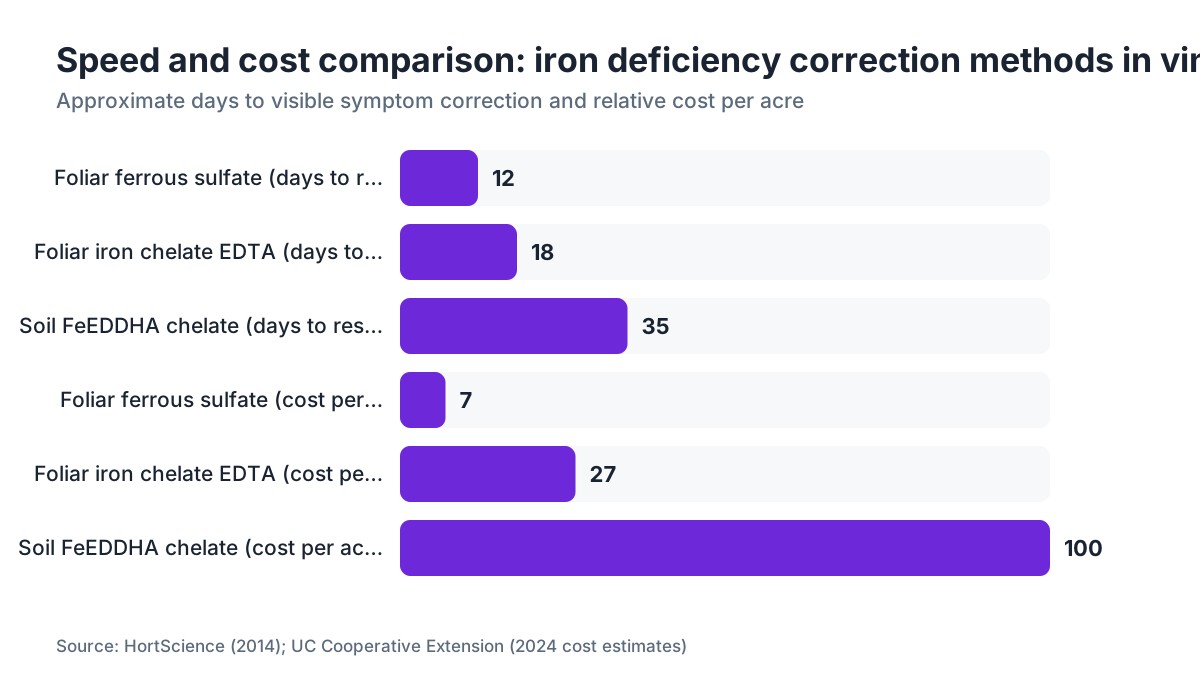
A 2014 study in the journal HortScience compared foliar iron sulfate, iron chelates (EDTA, EDDHA), and soil drenches on chlorotic grapevines in calcareous soil. Foliar ferrous sulfate greened leaves fastest, inside 10 to 14 days. Soil EDDHA chelate worked slower but held correction through the season. The authors framed foliar iron sulfate as a rapid rescue treatment for mid-season chlorosis and chelate soil applications as the better prevention tool [6].
Cornell's viticulture extension team warns that Northeast growers often misdiagnose iron chlorosis. Manganese deficiency, magnesium deficiency, and even virus symptoms all mimic it. Test the tissue before you spray [7]. Ferrous sulfate on a manganese-deficient vine wastes money and changes nothing.
The take here is blunt. If you have not run a petiole analysis confirming low iron, you are guessing. Bloom-stage petiole tests cost roughly $20 to $40 per sample through most UC Cooperative Extension labs. That is cheap next to a season of pointless spray passes.
What are the correct rates and timing for foliar ferrous sulfate on grapevines?
The rate that shows up again and again in university and industry guidance is 1 to 3 lb of ferrous sulfate heptahydrate per 100 gallons of spray solution, applied at full-cover volume to runoff [3][4]. Some growers push to 4 lb per 100 gallons on severe cases, but phytotoxicity risk climbs above 3 lb, especially on young shoot tissue in hot weather.
Timing carries a lot of weight. The workable windows:
| Growth stage | Why it works | Risk |
|---|---|---|
| 2-4 leaf (budbreak through early shoot) | Young tissue absorbs iron well; symptoms show early | Low if temps below 85°F |
| Bloom (flower cluster stage) | Fast correction before fruit set locks in vine load | Moderate; avoid direct flower contact |
| Post-bloom (lag phase) | Rescue spray after confirmed chlorosis | Low phytotoxicity risk |
| Veraison or later | Little benefit; leaves are aging | Not recommended |
Skip spraying above 90°F, and skip it when foliage is wet from rain or dew. Hot, dry air concentrates the solution on the leaf surface and burns tissue. In warm inland regions, growers spray early, before 9 a.m., as standard practice.
WSU Extension recommends a pH-buffered carrier when you tank-mix ferrous sulfate with other foliar nutrients, because iron precipitates fast above pH 6.5 and the whole batch goes dead [4]. A little citric acid to bring tank water to pH 5.5 to 6.0 keeps iron in solution and improves uptake. Check your water pH before you mix. Well water in these regions is often the problem in the first place.
What does ferrous sulfate cost and where do you buy it for vineyard use?
Agricultural-grade ferrous sulfate heptahydrate runs roughly $15 to $30 per 50-lb bag through farm supply retailers and ag co-ops, on 2024 pricing [8]. Technical and greenhouse grades from specialty suppliers cost more. Take a 100-acre vineyard needing two passes at 2 lb per 100 gallons and 100 gallons per acre: that is about 400 lb per pass, 800 lb for the season. At $25 a bag, material cost lands near $400 for two passes. Cheap, compared with soil chelate applications at $50 to $150 per acre depending on the chelate.
There is no single ag brand name for it. You will see it labeled iron sulfate, iron vitriol, green vitriol, or copperas. Read the iron percentage on the label every time. Heptahydrate is about 20% iron by weight; anhydrous forms sit closer to 36%. Grab the wrong form without recalculating and you either starve the vine or scorch it.
Most states let you buy and apply it without a pesticide applicator license, because it is classified as a fertilizer [1]. Confirm with your state department of agriculture anyway. California, Washington, and New York each set their own fertilizer registration rules, and some states require iron fertilizers to be registered before sale.
Is ferrous sulfate organic or allowed under organic certification?
This trips up a lot of growers. Ferrous sulfate sits on the USDA National Organic Program (NOP) National List as an allowed substance for crop production, but only when a soil or tissue test documents the need [9]. The NOP rule (7 CFR Part 205) lists iron sulfate among the synthetic substances allowed in organic crop production, tied to documented deficiency.
In practice that means your organic system plan has to note the deficiency, your records need a soil or petiole test behind it, and your certifier has to see that paper at audit. Spraying ferrous sulfate because the vines look a little pale is not compliant.
The NOP also splits ferrous sulfate as a foliar nutrient from ferrous sulfate as an herbicide, which is a separate and common use (it kills moss and broadleaf weeds in orchards and turf). The herbicide use carries different restrictions. Know which one you are doing and write it down clearly.
Plenty of certified organic vineyards in California and Oregon lean on foliar iron sulfate as their main fix for lime-induced chlorosis, because chelated products like FeEDDHA are synthetic chelating agents and off-limits under NOP. For those operations, ferrous sulfate is basically the only affordable foliar iron on the table.
What are the worker safety and re-entry rules for ferrous sulfate foliar sprays?
Ferrous sulfate is a fertilizer, so the EPA Agricultural Worker Protection Standard (WPS) does not cover it the way it covers registered pesticides [10]. The WPS applies to pesticides registered under FIFRA (Federal Insecticide, Fungicide, and Rodenticide Act), and ferrous sulfate fertilizer is not a FIFRA-registered crop protection product.
That does not make it harmless. The compound is mildly corrosive and irritates eyes. OSHA's Hazard Communication Standard (29 CFR 1910.1200) applies to anyone who handles it [11]. You need a Safety Data Sheet (SDS) on file, basic hazard training for handlers, and PPE on hand: splash goggles, chemical-resistant gloves, and a long-sleeved shirt at minimum.
There is no EPA-mandated restricted-entry interval (REI), because there is no pesticide label to set one. Many states and certifiers still suggest a practical re-entry window of four hours or until the spray dries, a sensible guard against wet solution on skin and in eyes.
Organic-certified operations keep re-entry and spray records anyway, as part of the organic system plan, even though ferrous sulfate is no pesticide. Log product name, rate, date, block, operator, and weather on every pass. Tracking several passes across several blocks by hand eats time. VitiScribe is built for this spray-log compliance work, and a free trial is at vitiscribe.com.
Can ferrous sulfate damage grapevines or cause phytotoxicity?
Yes, at high rates or in the wrong conditions. Phytotoxicity from ferrous sulfate shows as marginal leaf scorch or small necrotic spots, usually within 48 to 72 hours of application [3]. Four things make it worse: high concentration (above 3 lb per 100 gallons), high temperature at application (above 85 to 90°F), low humidity that dries the solution fast on the leaf, and very young tissue right after budbreak.
Varietal sensitivity is real but thin on hard data. Some Central Coast growers say Pinot Noir burns easier than Cabernet Sauvignon at the same rate, but no published trial confirms it cleanly. First time on a variety, spray 1 lb per 100 gallons on a small test block and watch it for 72 hours before you treat everything.
Ferrous sulfate also fights with a lot of tank-mix partners. It is generally incompatible with phosphate-based fertilizers, forming insoluble iron phosphate, and with some fungicides. Run a jar test before you combine it with anything.
How does foliar ferrous sulfate compare to chelated iron or soil applications?
Each method does a different job. Here is the lineup:
| Method | Speed of response | Season-long protection | Cost per acre | Works on calcareous soils? |
|---|---|---|---|---|
| Foliar ferrous sulfate | 10-14 days | No; needs repeat apps | $4-$10 | Yes |
| Foliar iron chelate (EDTA) | 10-21 days | No; needs repeat apps | $15-$40 | Partial |
| Soil chelate (FeEDDHA) | 3-6 weeks | Yes, often season-long | $50-$150 | Yes |
| Grafting to resistant rootstock | 1-3 seasons (transition) | Permanent | $2,000+ per acre | Yes |
Rootstock is the only permanent fix. High iron-efficiency rootstocks, like 140 Ruggeri and 1103 Paulsen, get planted in calcareous regions for exactly this reason [2][3]. But if you are already established on an inefficient rootstock and cannot replant, foliar ferrous sulfate buys you productive seasons while you plan the real move.
For a soil fix on calcareous ground, FeEDDHA chelate wins, because EDDHA holds together across a wide pH range. EDTA chelates fall apart above pH 7 and dump iron that goes unavailable the moment it hits alkaline soil. That mistake is common and expensive: buy FeEDTA for calcareous soil, get zero response [6].
What records do you need to keep for ferrous sulfate vineyard sprays?
Ferrous sulfate is not a FIFRA-registered pesticide, so it does not trigger mandatory pesticide-use reporting in most state frameworks. California's pesticide-use reporting system, required under California Food and Agricultural Code Section 12161, covers pesticides registered with the California Department of Pesticide Regulation, and ferrous sulfate fertilizer is not one of them [12]. Washington's pesticide recordkeeping rules likewise apply to registered pesticides [4].
Several other record requirements can still land on you.
Hold an organic certification and your certifier wants records of every material applied to certified blocks, pesticide or not. Operate under a winegrape purchase contract that specifies documentation of all spray materials and you keep records no matter what the regulators require. And your input-cost accounting needs field activity logs that match, for any cost-of-goods work.
The practical minimum for a foliar ferrous sulfate record: date, block or row IDs treated, product name and EPA registration number if it has one, amount mixed, total spray volume, operator name, and weather (temperature, wind speed, relative humidity). Sell to a winery running a sustainability program like the California Sustainable Winegrowing Alliance (CSWA) or Lodi Rules and you may owe extra reporting tied to nutritional input tracking [13].
For growers in the south coast winery and ponte winery parts of Southern California, iron chlorosis on calcareous Temecula soils shows up often enough that a clean spray-record system earns its keep less for compliance than for year-over-year comparison of how well your iron program is actually working.
Are there alternatives to ferrous sulfate for correcting vine iron deficiency?
Several alternatives exist, and the right one turns on your soil, your certification, and your budget.
FeSO4 soil drenches or banding put the same compound in the root zone. This works on lower-pH soils, where iron stays soluble long enough for roots to grab it. On calcareous soil it oxidizes before roots reach it, so as a soil treatment it mostly fails.
Iron chelates (FeEDTA, FeEDDHA, FeDTPA) are synthetic agents that hold iron plant-available across a wider pH range. FeEDDHA is the most pH-stable and the best performer on calcareous vineyard soils, but it is not NOP-approved for organic operations [9]. It costs more than ferrous sulfate.
Root-zone acidification, through drip-applied sulfuric acid or slow-release elemental sulfur, can drop soil pH enough over time to free up native iron. This is a multi-season play, not a rescue [3].
Rootstock at planting or replanting is the strongest long-term fix. UC Davis viticulture extension recommends high iron-efficiency rootstocks for calcareous sites and names 140 Ruggeri, 1103 Paulsen, and 41 B Millardet among the moderate-to-high uptake options [3]. Get on the right rootstock and iron chlorosis mostly stops being your problem.
For growers in paso robles wineries and allegretto vineyard resort country, where calcareous subsoil spreads wide, rootstock choice at replanting comes up far more than it does in cooler, acidic-soil regions.
How do you diagnose iron deficiency before spraying?
Visual symptoms are a starting point, never a diagnosis. Iron-deficiency chlorosis shows as interveinal yellowing on young leaves at shoot tips, veins staying green. Most university literature calls it lime-induced chlorosis, and the same pattern turns up with manganese and zinc deficiency, which is exactly why the eye alone is not enough [7].
Petiole analysis at bloom is the standard diagnostic in viticulture. California Cooperative Extension treats bloom-stage petiole iron below 30 ppm dry weight as a sign of deficiency, though the threshold shifts a little by variety and lab [3]. Cornell Extension recommends pairing petiole analysis with soil analysis and visual observation before you commit to a nutritional spray [7].
Soil pH often tells you more than soil iron does. Soil pH above 7.5 plus interveinal chlorosis on young leaves is strong circumstantial evidence for iron deficiency before the lab results even land. A handheld pH meter and a soil sample are cheap diagnostics.
Chlorophyll meters (SPAD meters) put a number on leaf greenness and catch chlorosis before your eye does, which helps you time early intervention. They will not name the deficient nutrient, but they confirm you are losing photosynthetic capacity and that action is warranted. Field trials have used SPAD readings to track iron-treatment response over time [6].
Frequently asked questions
Is ferrous sulfate the same as iron sulfate for vineyards?
Yes, ferrous sulfate and iron sulfate are the same compound: FeSO4. You will see it sold under both names plus older terms like green vitriol or copperas. The key variable is hydration state: ferrous sulfate heptahydrate (FeSO4 7H2O) is about 20% iron, while anhydrous iron sulfate is about 36% iron. Confirm which form you are buying before you calculate your spray rate.
Will foliar ferrous sulfate affect wine flavor or residue levels?
There is no evidence that foliar ferrous sulfate applied at normal agronomic rates leaves problematic iron residues in wine grapes. Iron occurs naturally in grapes and wine. Very high iron in must can contribute to iron-induced wine instability (casse), so timing and rate matter: most growers stop foliar iron well before veraison to avoid any accumulation.
Can you mix ferrous sulfate with other foliar sprays in the same tank?
Sometimes, but jar test first. Ferrous sulfate is incompatible with phosphate fertilizers (forms insoluble iron phosphate) and with some fungicides. It is generally compatible with calcium or magnesium foliar sprays at low pH. Acidify tank water to pH 5.5 to 6.0 before mixing to keep iron in solution. If the mix turns cloudy or drops sediment in the jar test, do not spray it.
How many times per season should you apply foliar ferrous sulfate?
One to three applications per season is typical for moderate to severe chlorosis. A common program starts with one spray at 2 to 4 leaf stage, then a second two to three weeks later if symptoms persist. On badly calcareous soils without rootstock improvement, some growers apply three times: early shoot, pre-bloom, and post-fruit set. Beyond three, added economic benefit is rare.
Does ferrous sulfate also control weeds or pests in vineyards?
Ferrous sulfate is herbicidal at high concentrations and is used to kill moss and some broadleaf weeds on orchard floors and turf. At the low rates used for foliar iron nutrition on grapevines, it does not act as an herbicide. These are two separate uses with different rates, methods, and regulatory classifications. Do not confuse them in your records.
Is foliar ferrous sulfate allowed under California sustainable winegrowing programs?
Ferrous sulfate is generally consistent with the California Sustainable Winegrowing Alliance (CSWA) principles and the Lodi Rules for Sustainable Winegrowing. Both require documentation of nutritional inputs and a rationale based on observed deficiency or soil/tissue testing. The material itself is not restricted, but you have to show you applied it against a diagnosed need, not as a routine prophylactic spray.
What personal protective equipment do workers need when spraying ferrous sulfate?
Ferrous sulfate is mildly corrosive and irritates eyes and skin. OSHA Hazard Communication rules require an SDS on file and basic hazard training. Practical PPE: splash-proof safety goggles, chemical-resistant gloves (nitrile or neoprene), a long-sleeved shirt, and waterproof boots when mixing concentrate. The EPA Worker Protection Standard does not apply because it is not a registered pesticide, but OSHA rules do.
How do you know if the foliar iron spray worked?
New leaf color is the clearest signal. Within 10 to 14 days of a successful application, new growth from the shoot tip should look noticeably greener than the chlorotic leaves present at spray time. Already-chlorotic mature leaves rarely fully recover. A SPAD chlorophyll reading before and 14 days after gives you a number. Petiole resampling 3 to 4 weeks out confirms tissue iron has risen.
Does ferrous sulfate foliar spray work better than drip-applied chelated iron?
Foliar ferrous sulfate corrects faster, usually 10 to 14 days versus three to six weeks for drip-applied chelates. But drip-applied FeEDDHA at budbreak often gives better season-long coverage with fewer passes. On severely calcareous soils, many growers use foliar ferrous sulfate as a mid-season rescue while relying on fall or early-season FeEDDHA drenches for background protection.
Does iron deficiency in grapevines reduce yield or wine quality?
Yes, noticeably. Severe chlorosis cuts photosynthetic capacity, which limits carbohydrate production, shrinks berries, and can drop yield by 30% or more in badly affected blocks. Iron deficiency also weakens shoot maturation before dormancy, raising cold-injury risk. Fruit quality suffers too, through reduced sugar accumulation and flavor development problems in chlorotic vines.
What soil pH triggers iron deficiency in vineyards?
Iron becomes less available to grapevines as soil pH climbs above 7.0. At pH 7.5 and up, the ferric (Fe3+) form dominates and is largely insoluble. Vineyards on soils consistently above pH 7.5, especially those with free calcium carbonate, run the highest chlorosis risk. Below pH 6.5, iron deficiency is rare; very low pH can cause iron toxicity in some crops, though that is unusual in vineyards.
Can ferrous sulfate be applied through a drip irrigation system instead of as a foliar spray?
You can inject it through drip, but performance on calcareous or high-pH soils is poor, because the iron oxidizes and precipitates before roots intercept it. It is also acidic enough at high concentration to damage drip emitters over time. For soil delivery on alkaline sites, FeEDDHA chelate is a far better drip choice, though it costs significantly more per acre.
Do you need a pesticide license to buy or apply ferrous sulfate in California?
No. Ferrous sulfate used as a fertilizer is not a registered pesticide and needs no applicator license to buy or apply in California. But California's fertilizing materials law (California Food and Agricultural Code Section 14501 et seq.) requires fertilizer products sold in the state to be registered with the California Department of Food and Agriculture. Confirm your product is registered for sale; you still do not need a license to use it.
Sources
- U.S. EPA, Pesticide Registration (FIFRA): Ferrous sulfate used as a fertilizer is not regulated as a pesticide under FIFRA and does not require pesticide registration for fertilizer applications.
- Oregon State University Extension, viticulture and vineyard nutrition: Wet Pacific Northwest springs can leach nitrogen and suppress iron uptake; high iron-efficiency rootstocks such as 140 Ruggeri and 1103 Paulsen are used on calcareous sites.
- UC Cooperative Extension / UC ANR, grape nutrition and iron chlorosis guidance: UC Cooperative Extension documents iron chlorosis as a top nutritional problem on high-pH California vineyard soils; bloom-stage petiole iron below 30 ppm indicates deficiency; recommends high iron-efficiency rootstocks including 140 Ruggeri, 1103 Paulsen, and 41 B Millardet.
- Washington State University Extension, viticulture and vineyard nutrient management: Iron deficiency is less common west of the Cascades than on the irrigated east side with calcareous subsoils; iron precipitates above pH 6.5, so a pH-buffered carrier is recommended for foliar iron tank mixes.
- USDA National Agricultural Statistics Service, Chemical Use Survey: USDA NASS tracks fertilizer sales data at state level but not by specific product or crop, making precise ferrous sulfate usage data unavailable nationally.
- HortScience (American Society for Horticultural Science), grapevine iron deficiency foliar vs. soil chelate comparison: Foliar ferrous sulfate corrected chlorosis symptoms within 10-14 days; soil FeEDDHA provided slower but longer-lasting correction; authors recommended foliar iron sulfate as a mid-season rescue treatment.
- Cornell Cooperative Extension, grape nutrition and tissue testing: Iron chlorosis is often confused with manganese, magnesium, and virus symptoms; tissue testing plus soil analysis is recommended before nutritional spray decisions.
- USDA Agricultural Marketing Service, agricultural input market data: Agricultural-grade ferrous sulfate heptahydrate retails in the range of $15-$30 per 50-lb bag through farm supply and ag co-op channels, based on 2024 pricing.
- USDA National Organic Program, National List of Allowed and Prohibited Substances (7 CFR Part 205): Iron sulfate is listed as an allowed synthetic substance for organic crop production under the NOP National List, provided use is documented by a soil or tissue test showing deficiency.
- U.S. EPA, Agricultural Worker Protection Standard: The EPA Agricultural Worker Protection Standard applies to pesticides registered under FIFRA; fertilizer products including ferrous sulfate are not covered by WPS requirements.
- OSHA Hazard Communication Standard, 29 CFR 1910.1200: OSHA HazCom requires Safety Data Sheets and worker hazard training for handling corrosive or irritant substances including ferrous sulfate, regardless of pesticide classification.
- California Department of Pesticide Regulation, Pesticide Use Reporting: California's pesticide-use reporting requirement under California Food and Agricultural Code Section 12161 applies to DPR-registered pesticides; fertilizer materials such as ferrous sulfate do not trigger mandatory pesticide-use reports.
- California Sustainable Winegrowing Alliance, program overview: CSWA and Lodi Rules sustainability programs require documentation of all nutritional inputs and a deficiency rationale; ferrous sulfate is not a restricted material but documentation is required.
Last updated 2026-07-09