John Bean vineyard sprayer: history, parts, and still-running machines

TL;DR
- John Bean Manufacturing built high-pressure hydraulic sprayers from the 1880s into the mid-20th century that became a standard tool in California and Eastern vineyards.
- The brand was absorbed into FMC Corporation by 1928.
- Rebuilt machines still work rows today, parts are scarce but findable, and a used unit in decent shape costs roughly $500 to $4,000 depending on configuration.
What is a John Bean vineyard sprayer?
John Bean Manufacturing Company built hydraulic pump spray equipment starting in the 1880s in San Jose, California. The name got so tied to orchard and vineyard spraying in the American West that growers well into the 1970s called any high-pressure rig a "Bean sprayer," no matter who actually made it. That's brand permanence most companies never reach.
The machines are piston-pump sprayers driven by a tractor PTO or a dedicated gasoline engine. A crankshaft-driven pump builds pressure, typically 200 to 600 PSI depending on the model, pushes liquid through hardened brass distribution blocks, and delivers it to adjustable nozzle heads aimed at the canopy. The mechanical simplicity is exactly why these rigs outlasted the company that made them. There's very little on one that can't be rebuilt with basic machining.
Bean's early units were horse-drawn and worked by hand crank. By the 1920s, tractor-mount and power-takeoff designs took over. California wine country, especially the vine rows of Napa and Sonoma, ran heavily on Bean equipment through mid-century. The company merged into what became FMC Corporation by 1928, and Bean-branded farm equipment kept coming off the line for decades under that umbrella. [1]
Inherited one with a vineyard, or buying an old property with equipment attached? What you've got is a pre-emissions, pre-computer spray platform that still does the job if the pump seals hold.
How does a John Bean sprayer pump work?
The heart of any Bean sprayer is a triplex or duplex plunger pump. Plungers reciprocate inside brass or bronze-lined cylinders, drawing liquid in through a ball-check valve on the intake stroke and pushing it out through a second ball-check on the pressure stroke. A bypass valve regulates pressure by bleeding excess flow back to the tank once you pass your set point.
These pumps rebuild with off-the-shelf materials. Plunger packing is leather or synthetic cup-seal stock. Valves are small brass balls sitting on machined seats. A correct rebuild takes a few hours, some patience, and cup-seal packing you can buy through agricultural pump suppliers. The cylinder blocks are thick enough that they rarely crack unless the machine froze with water in it, and even a cracked block can sometimes be sleeved.
Pressure ratings matter for vineyard work. Low-pressure weed control runs 15 to 50 PSI. Canopy penetration for fungicide coverage in a dense row wants 150 to 400 PSI at the nozzle. Bean's vineyard models were built for that higher end, which is why growers picked them over simpler diaphragm units for disease programs. [2]
Here's the catch. The older Bean models were designed for petroleum-based or arsenical spray materials that are long gone from the legal market. If your machine was originally calibrated for lead arsenate, its nozzle orifice sizes and pump output volumes were set for chemistry that no longer applies. Recalibrate output. Check gallons per minute against current label rates. Confirm your application volume matches what your pesticide label specifies. The label is a federal legal document under FIFRA, and applying off-label rates, even with an antique machine, is a violation. The statute makes it "unlawful for any person to use any registered pesticide in a manner inconsistent with its labeling." [3]
When did John Bean stop making sprayers?
John Bean Manufacturing merged with Anderson-Barngrover and Sprague-Sells in 1928 to form the entity that became FMC Corporation (Food Machinery and Chemical Corporation). [1] The Bean name stayed on equipment tags through at least the 1950s and, in some cases, the early 1960s. By the mid-1960s, FMC had moved its farm equipment lines off the Bean name entirely.
So the last new John Bean vineyard sprayers were probably built somewhere between 1955 and 1965. Any machine you find today is at minimum 60 years old. That's not a reason to walk away. Well-maintained hydraulic pump equipment from that era still moves fluid reliably. The issue is wear. Machined clearances that were fine at 0.002 inches when new may have drifted to 0.010 inches, and pump efficiency drops right along with them.
FMC's farm equipment division later spun off, but none of the successor companies ever built John Bean-branded vineyard sprayers again. Genuine new-old-stock parts essentially don't exist through normal dealer channels anymore.
What are John Bean sprayer parts and where can you find them?
This is the hard part. No national dealer network stocks John Bean vineyard sprayer parts today. What exists is old-equipment dealers, online auction platforms, and machining to spec.
Pump internals are what you'll need most: the balls, seats, plunger packing, and bypass valve components. Many of these cross-reference to current pump makers. Companies like Giant Industries, CAT Pumps, and Hypro sell plunger packing and ball-check assemblies in standard sizes, and a machinist can measure your cylinder bore and match a modern seal to it. Hypro catalogs plunger packing in common fractional-inch sizes that fit many Bean pump cylinders. [2]
Hardware specific to the Bean distribution blocks, pressure gauges, and nozzle heads is tougher. Cast iron and brass fittings from that era often used pipe-thread sizes still common now (NPT fittings), so plumbing connections usually work out. Nozzles have been standardized by the spray industry, and TeeJet nozzle bodies, in production since 1950, often thread straight into older brass nozzle holders. [4]
For mechanical parts like pump crankshafts, connecting rods, or engine components on engine-driven units, you're down to machine shops or agricultural salvage yards. Search "antique orchard sprayer parts" and "John Bean FMC sprayer" on eBay and TractorHouse. Pricing bounces all over. A used pressure gauge might run $15. A replacement pump crankshaft assembly might run $300 to $800, if you find one at all.
One honest option. If the pump block is damaged past a simple rebuild, a modern triplex pump from Hypro or CAT Pumps can often bolt to the existing Bean frame with minor fabrication. You lose the originality. You gain a machine with available parts for the next 30 years.
What is a used John Bean sprayer worth today?
Pricing is genuinely inconsistent, and I won't pretend there's good market data on this category. Nobody tracks John Bean sprayer auction results as a formal market segment.
What you actually see: simple tow-behind or skid-mount units with a working pump and tank sell for $500 to $1,500 when the seller knows what they have. Estate finds where nobody knows the brand go for $200 or get donated. A complete tractor-mount unit with all its original distribution hardware, a working pump, and a clean tank can hit $2,500 to $4,000 at an agricultural auction in wine country where someone actually wants to run it.
The functional value lives in the pump. If the pump is dead and unrepairable, the scrap value of the iron and brass is your realistic floor. If it runs and holds pressure, you have a usable sprayer.
Before buying anything, run the pump with water and check PSI at the nozzle heads. Watch for bypassing around the pressure valve, which means worn pump bores. Check for calcium buildup in the distribution block from hard water, which blocks orifices. Inspect the tank for rust pitting on steel, or UV degradation on any fiberglass tank someone added later.
For comparison, a new small tractor-mounted vineyard airblast sprayer costs $8,000 to $25,000 depending on tank size and features. [5] A working Bean unit at $1,500 that you keep running on $200 a year in parts is genuinely economical for a small vineyard that only sprays 5 to 15 acres.
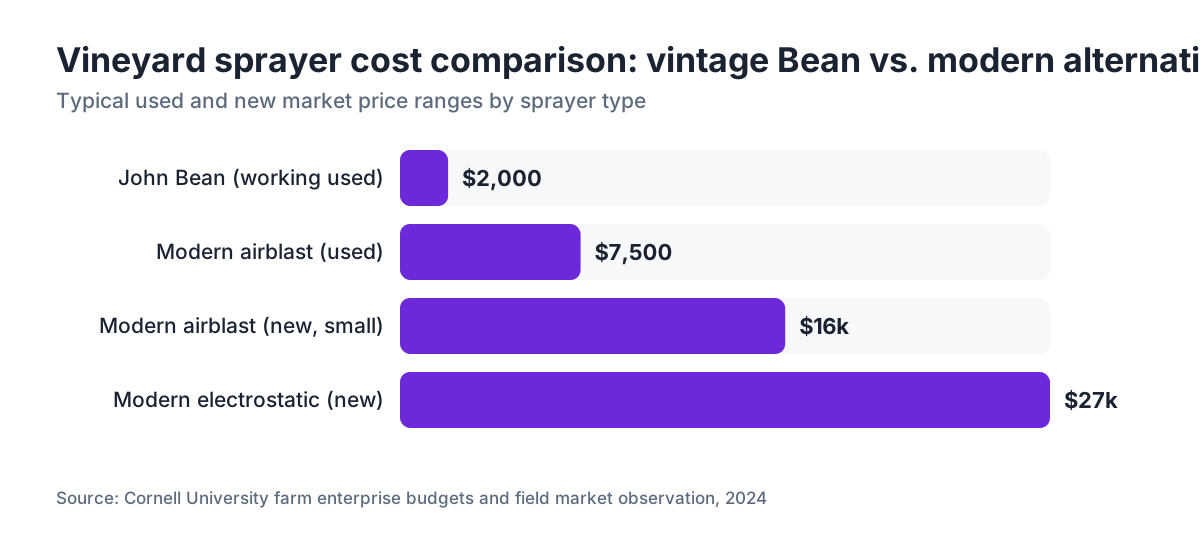
How do John Bean sprayers compare to modern vineyard sprayers?
The honest comparison is a tradeoff between simplicity and coverage.
| Feature | John Bean (vintage) | Modern airblast sprayer | Modern electrostatic |
|---|---|---|---|
| Operating pressure | 200-600 PSI | 50-150 PSI + air assist | 10-100 PSI + charge |
| Canopy penetration | Moderate (pressure-only) | Good (air carrier) | Good (particle attraction) |
| Spray drift potential | High at 400+ PSI | Moderate | Lower |
| Parts availability | Very limited | Good to excellent | Manufacturer-dependent |
| New cost | N/A (used only) | $8,000-$25,000 | $15,000-$40,000+ |
| Used cost | $500-$4,000 | $3,000-$12,000 | Rare used market |
| Operator skill needed | High | Moderate | Moderate-high |
| Record-keeping complexity | Same as any sprayer | Same | Same |
Modern airblast sprayers push a large volume of air through the canopy while delivering low-pressure droplets. That air carrier moves spray into a dense vine canopy far better than pressure alone. UC Davis research on sprayer coverage found that air-assisted delivery improves deposition on interior leaf surfaces compared to hydraulic-only application in dense canopies, though the size of the gain shifts with canopy architecture and machine calibration. [6]
Still, plenty of small vineyards under 10 acres with open-canopy training like VSP (vertical shoot positioning) get acceptable disease coverage from a properly calibrated hydraulic sprayer. The machine matters less than calibration and timing. Spraying at the right phenological stage, with the right product, at the right interval, beats whatever brand is on the tank.
Drift is the real concern with high-pressure hydraulic units. Small droplets thrown at 400+ PSI wander off-target easily, which sours neighbor relations and can violate label directions if the label calls for drift-reduction measures. Modern air-induction flat-fan tips cut drift a lot compared to old solid-cone tips. You can retrofit modern TeeJet AI nozzles to a Bean distribution head, which helps considerably. [4]
What spray records do you need to keep when running an older sprayer?
The sprayer's age changes nothing about your recordkeeping. Federal and state pesticide rules apply to the application, not the equipment.
Under EPA's Worker Protection Standard (WPS), agricultural employers must keep pesticide application records for at least two years and make them available to workers and state agencies on request. The data points: product name and EPA registration number, active ingredient, date and time of application, location, amount applied, and the operator's name. [7]
California growers face the strictest state rules in the country. California's Department of Pesticide Regulation requires licensed Pest Control Advisors (PCAs) for many restricted-use pesticide applications, and growers file pesticide use reports monthly. [12] Washington State requires pesticide application records kept for two years under WAC 16-228. [8]
Running a John Bean on a small vineyard and doing your own applications? You still track every spray event. Notebook records are legal, but they fall apart when you're trying to reconstruct a season for an audit, a buyer's due diligence review, or a neighbor's drift complaint.
This is where a tool like VitiScribe earns its keep. The platform is built for vineyard spray records: it logs application events in the field from your phone, attaches pesticide label information, and generates the formatted reports state agencies actually want. Nobody should be transcribing field notebooks into compliance reports at midnight before a DPR inspection.
For calibration records, which are separate from application records but matter just as much, document your gallons-per-acre output at least once a season, or any time you change nozzles or pressure. WSU Extension has a plain calibration protocol for hydraulic sprayers that works for vintage equipment as well as new. [9]
How do you calibrate a John Bean sprayer for modern pesticide labels?
Calibration works the same for a vintage Bean as for any hydraulic sprayer. You need your output volume per acre to confirm you're inside the label's rate range. Most fungicide and insecticide labels give rates in ounces or pounds of product per 100 gallons of mix, or in product per acre, so you have to know your gallons per acre to mix right.
The catch method. Mark a known distance in your rows, usually 100 feet. Run the sprayer at your working pressure and tractor speed through that distance. Catch the output from each nozzle separately in calibrated containers for the time it takes to cover 100 feet. Calculate gallons per minute, then convert to gallons per acre using your row spacing and ground speed. [9]
On a Bean, also run a pump output test separate from the nozzle catch. Run the pump at operating pressure and measure total bypass flow plus nozzle flow to see whether the pump still delivers its rated output. A worn pump may show 70% of rated output, which means your pressure gauge reads correctly but your total volume per acre is low. You're under-applying without knowing it.
Pressure gauge accuracy matters too. Old Bourdon-tube gauges on vintage equipment drift badly. A $15 check against a known-accurate gauge is worth doing before you trust the reading for any regulated application.
WSU Extension's Bulletin EM067E covers sprayer calibration in detail and is free. UC Davis and Cornell also publish calibration resources for vineyard equipment. [6][9][10]
Is a John Bean sprayer safe for workers under EPA regulations?
The sprayer equipment itself isn't directly regulated by EPA's Worker Protection Standard. WPS governs training, PPE, restricted-entry intervals, and emergency assistance, not the mechanical design of the equipment. But how you use a hydraulic sprayer touches WPS all over. [7]
High-pressure hydraulic sprayers throw more fine-droplet drift than low-pressure systems, which raises the risk of exposing other workers in adjacent rows during application. WPS prohibits entry into a treated area during application. Running a Bean in a narrow-row vineyard with workers present nearby means you have to think through the operation to keep them out of the spray.
The operator needs PPE matched to the pesticide being applied. That information is on the label under the PPE section. Many common vineyard fungicides call for chemical-resistant gloves, protective eyewear, and long sleeves. Restricted-use pesticides push the requirements higher. The vintage machine exempts you from none of it.
Mixing and loading is a specific WPS focus. Bean-era rigs used gravity-fill tanks with wide openings, which makes direct splash exposure a real risk during filling. A closed-system transfer setup, or at minimum a pump-and-hose fill, cuts that exposure a lot. EPA's WPS final rule, updated in 2015, requires handlers to be trained before they handle pesticides. [7]
For a small family operation these requirements feel like bureaucracy. They exist because organophosphate and other pesticide exposures have done real harm to farm workers. Take them seriously with an older machine.
Should you buy a John Bean sprayer for your vineyard today?
My honest take: it depends on your acreage, your mechanical ability, and whether the specific machine in front of you actually runs.
For a vineyard under 5 acres with open-canopy training and mild disease pressure, a working John Bean is a legitimate tool. You get simplicity, repairability with basic tools, and very low capital cost. If you already keep old tractors alive and you're comfortable diagnosing pump problems, this path works.
For 10 acres and up, or vineyards with dense canopies or serious powdery mildew or Botrytis pressure, I'd put the money toward at least a used modern airblast unit. The coverage gain in a dense canopy is real, and a disease control failure in a 10-acre block costs far more than the price gap between a $1,500 Bean and a $6,000 used airblast. Cornell's integrated pest management resources for vineyards are clear that canopy penetration drives fungicide efficacy. [10]
Buying property that comes with a John Bean sprayer? Treat it as a bonus, not a substitute for deciding whether you need better equipment. Run it, calibrate it, see if it holds pressure, and make the call on what it does rather than what it is.
One more honest note. Finding a Bean in genuine working order gets harder every year. Machines that were borderline operable in 2010 are often dead by now. Parts you could source a decade ago are rarer. If you find one that runs well, that's increasingly the exception.
For anyone managing records across a spray program, vintage Bean or modern airblast, VitiScribe's spray log is built for the calibration data, application records, and compliance reports a vineyard has to keep straight season after season.
How did John Bean sprayers shape California vineyard history?
San Jose was John Bean's home base, which put the company in the middle of Northern California agriculture right as commercial viticulture expanded in the late 19th and early 20th century. Bean's closeness to Napa, Sonoma, and the Santa Clara Valley orchards and vineyards made his equipment the default choice by geography as much as by quality.
The early California wine industry had serious disease pressure. Powdery mildew (Erysiphe necator) had wrecked European vineyards in the 1850s, and sulfur dusting, then liquid sulfur spraying, became standard practice in California to head off the same disaster. Bean's high-pressure pumps handled sulfur suspensions well, since those materials need agitation and pressure to stay mixed and reach the leaf. [11]
Through Prohibition (1920-1933), many California vineyards grew table and juice grapes legally rather than wine, and sprayer demand held up. Fungicide and insecticide programs didn't stop just because winemaking did.
After Prohibition, the California wine industry rebuilt fast, and John Bean equipment, by then under FMC, was already standard on most established properties. The name was so locked in that growers who bought other brands still called their machines "Bean sprayers" as a category term. You still hear it from older growers in Napa and Sonoma.
For a look at how vineyards at different scales operate now, the range from small estate properties like Gervasi Vineyard to the larger California regions around Paso Robles wineries and South Coast Winery shows how much the industry has changed since those early Bean days, even though the basic disease management challenge in the vineyard hasn't changed much at all.
Frequently asked questions
Are John Bean sprayer parts still manufactured new?
No manufacturer makes new John Bean-branded parts today. The brand was absorbed into FMC Corporation by 1928 and no longer exists as an independent company. Many pump internals, though, such as plunger packing, ball-check valves, and common pipe fittings, cross-reference to current agricultural pump suppliers like Hypro or CAT Pumps. A machinist can measure original components and source or fabricate replacements in most cases.
What PSI does a John Bean vineyard sprayer operate at?
John Bean vineyard models ran between 200 and 600 PSI, with most vineyard applications in the 200 to 400 PSI range. That's well above modern airblast sprayers, which rely on air volume rather than liquid pressure for canopy penetration. Higher PSI raises drift risk and fine-droplet generation, which matters for both worker safety and staying compliant with pesticide label directions.
Can a John Bean sprayer apply modern pesticides and fungicides?
Yes, with calibration. The machine delivers liquid at pressure, and modern fungicides and insecticides are compatible with the brass and iron hardware in Bean sprayers. The key is recalibrating output to match the gallons-per-acre rate on your pesticide label. Original nozzle orifice sizes may not match current label requirements, and modern TeeJet nozzle bodies often retrofit directly to existing Bean distribution hardware.
What records do I need to keep when spraying with a vintage sprayer?
The same records as any other sprayer. EPA's Worker Protection Standard requires at least two years of application records including product name, EPA registration number, active ingredient, date, time, location, amount applied, and operator name. California requires monthly pesticide use reports through DPR. Washington State requires two-year records under WAC 16-228. The sprayer's age has no effect on these requirements.
How do I find out what model my John Bean sprayer is?
Look for a cast or stamped model plate on the pump body or main frame. Common spots are the pump crankcase casting or a tag riveted to the tank frame. Bean model numbers from the FMC era usually appear as a letter-number combination. If the tag is gone, UC Davis library archives and the California State Library hold some historical FMC and Bean equipment documentation that can help with identification.
Is a John Bean sprayer good for organic vineyard programs?
It can work. Organic vineyard programs lean on sulfur and copper-based fungicides, which are compatible with Bean pump hardware. Sulfur suspensions need good agitation to stay mixed, and high-pressure Bean pumps with bypass agitation handle that. The concern is output calibration: confirm your gallons per acre matches the label rate for your organic materials, and clean the tank thoroughly between sulfur and copper applications since the two react with each other.
What is the difference between a John Bean sprayer and an airblast sprayer?
A John Bean sprayer is a hydraulic pressure-only unit: liquid pressure alone drives droplets through nozzles toward the target. An airblast sprayer uses a fan to generate a high-velocity air stream that carries relatively low-pressure droplets into the canopy. Airblast machines generally reach interior canopy surfaces better in dense vine canopies, produce larger droplets with less drift, and are now the dominant vineyard spray technology.
How much does it cost to rebuild a John Bean pump?
A basic rebuild, replacing plunger packing, ball-check valves, and valve seats, runs roughly $50 to $200 in materials if you source modern equivalents from agricultural pump suppliers. If machining is needed to restore cylinder bores or valve seats, shop labor adds $100 to $400 depending on local rates. A full rebuild with all-new components and machined seats is typically under $600 if the cylinder block itself is sound.
Where can I buy a used John Bean vineyard sprayer?
Check TractorHouse, eBay, Craigslist farm equipment sections, and local agricultural auction houses, especially in California wine country and the Finger Lakes region of New York. Estate sales on older vineyard properties are another source. Prices run from roughly $500 for a non-running unit to $4,000 for a complete, functional rig. Always confirm the pump runs and holds pressure before buying, and insist on a water-test demonstration if you can.
What training do workers need to operate a vineyard sprayer under WPS?
EPA's Worker Protection Standard requires that pesticide handlers, meaning those who apply pesticides or handle treated areas during the restricted-entry interval, get WPS handler training before working with pesticides. Training must come from a trained trainer using EPA-approved materials and must repeat every year. WPS also requires operators to have access to the pesticide label and safety data sheet at the time of application.
How do I calibrate a John Bean sprayer for gallons per acre?
Use the catch method. Mark 100 feet of row, run the sprayer at operating pressure and working speed, and catch output from each nozzle for the time it takes to travel 100 feet. Calculate gallons per minute from the catch volume, then convert to gallons per acre using your row spacing and ground speed. WSU Extension Bulletin EM067E gives a step-by-step calculation worksheet that works for any hydraulic sprayer, vintage units included.
Can John Bean sprayers be used in narrow vineyard rows?
Yes, and they were used constantly in close-spaced California vineyard rows through the mid-20th century. The limiting factor is the tractor or mule pulling the unit, not the sprayer. For very narrow rows under 5 feet, you need a narrow-track tractor or specialized carrier. Modern airblast units come in narrow-row configurations too, so if you're replacing a Bean in tight rows, look at compact orchard airblast sprayers from makers like Gregoire or Empas.
Does FMC Corporation still support old John Bean sprayer equipment?
No. FMC Corporation left farm equipment manufacturing and today runs as a crop science and chemical company. It holds no parts inventory or technical support for John Bean sprayer equipment. FMC's current agricultural business is pesticide products, not equipment. For old Bean support, your best resources are antique equipment clubs, machine shops, and cross-referencing parts to current pump manufacturers.
Sources
- FMC Corporation, company website (corporate history): John Bean Manufacturing merged with other companies in 1928 to form what became FMC Corporation
- Hypro (Pentair), agricultural pump technical resources: Plunger packing and ball-check assemblies in standard fractional-inch sizes compatible with vintage pump cylinders are available from current pump manufacturers
- U.S. EPA, Federal Insecticide, Fungicide, and Rodenticide Act (FIFRA), pesticide registration section: Applying a registered pesticide inconsistent with its labeling is unlawful under FIFRA
- TeeJet Technologies, spray nozzle catalog: TeeJet air-induction flat-fan nozzles have been manufactured since 1950 and thread into standard NPT fittings common to vintage spray equipment
- Cornell University College of Agriculture and Life Sciences, farm enterprise budgets: New small tractor-mounted vineyard airblast sprayers range from approximately $8,000 to $25,000 depending on tank size and configuration
- University of California Agriculture and Natural Resources, sprayer calibration and coverage resources: Air-assisted sprayer coverage on interior leaf surfaces is better than hydraulic-only application in dense canopy situations
- U.S. EPA, Agricultural Worker Protection Standard: EPA's WPS requires pesticide application records to be maintained for at least two years and handlers to be trained annually before working with pesticides
- Washington State Department of Agriculture, pesticide records (WAC 16-228): Washington State requires pesticide application records to be kept for two years under WAC 16-228
- Washington State University Extension, Sprayer Calibration EM067E: WSU Extension Bulletin EM067E provides a step-by-step calibration protocol for hydraulic sprayers including the catch method for calculating gallons per acre
- Cornell University, New York State Integrated Pest Management Program, vineyard IPM: Cornell's integrated pest management resources indicate that canopy penetration is a primary factor in fungicide efficacy in vineyard applications
- UC Davis, Department of Viticulture and Enology: Powdery mildew (Erysiphe necator) required sulfur-based spray programs in California vineyards from the mid-19th century onward, driving demand for high-pressure spray equipment
- California Department of Pesticide Regulation, pesticide use reporting: California requires growers to file pesticide use reports monthly through the Department of Pesticide Regulation
Last updated 2026-07-09