Kniffin trellis system: how it works and when to use it
TL;DR
- The Kniffin trellis trains grapevines on two to four horizontal wires, with canes or cordons draped downward from each wire.
- It's one of the oldest American training systems, built for native and hybrid varieties in the Northeast.
- It suits vigorous vines, humid sites, and growers who want a cheap trellis.
- It does poorly for mechanical harvest and tight canopy control.
What is the Kniffin trellis system and where did it come from?
The Kniffin system is a cane-pruned or cordon-trained trellis where vines grow on two or more horizontal wires, with fruiting wood draped downward from each wire. The classic four-cane Kniffin uses two wires, one at roughly 3 feet and one at 5 to 5.5 feet above the ground, with two canes tied in opposite directions along each wire. That gives you four fruiting canes per vine. Hence the name.
William Kniffin, a Hudson Valley grape grower, described the system in the mid-1800s. It caught on fast in New York and the broader Northeast because it matched the vigor of Concord, Niagara, Catawba, and other Labrusca and hybrid varieties that were the backbone of American commercial viticulture before vinifera took hold on the West Coast [1]. Cornell Cooperative Extension still lists it as a baseline system when discussing Northeast training for those varieties [1].
There are several variants. The two-cane Kniffin uses one wire and is sometimes called the Hudson River Umbrella when canes are tied at the top and left to hang. The six-cane Kniffin adds a third wire. The umbrella Kniffin is probably the most common version in the field: the trunk goes to the top wire, two canes are tied at the top and bend outward and downward, and two renewal spurs sit near the base wire. Every variant shares one idea. Position shoots so they hang down, and you get a curtain of foliage.
How does Kniffin differ from VSP, Scott Henry, and GDC?
Understanding Kniffin means understanding what it is not. It trains shoots downward in a drooping curtain, while the other three big systems either send shoots up or split the canopy.
Vertical Shoot Positioning (VSP) trains shoots upward into a narrow, vertical wall. Kniffin drapes them down. VSP puts more direct light on the fruit and is the standard for premium vinifera in most regions. Kniffin shade at the cluster zone runs much higher, which hurts color and sugar in vinifera but matters less for juice grapes like Concord where brix targets are lower.
Scott Henry is a divided canopy where half the shoots go up and half go down, roughly doubling the fruiting surface on the same land footprint. It was developed at Scott Henry Winery in Oregon in the 1980s [2]. Kniffin gets some of the same downward shoot effect but never divides the canopy vertically, so it misses the fruit exposure Scott Henry delivers.
Geneva Double Curtain (GDC), developed at Cornell's Geneva station, splits the canopy into two parallel downward curtains on a wide T-bar. It was designed for high-vigor American varieties and can nearly double yield per acre versus single-curtain systems on the right sites [1]. Kniffin is simpler and cheaper to install than GDC but leaves more vigor problems unsolved on very high-vigor ground.
The table below lays out the practical differences.
| System | Shoot direction | Wire height | Best variety type | Mechanized harvest | Relative install cost |
|---|---|---|---|---|---|
| Kniffin (4-cane) | Downward | 3 ft + 5 ft | Labrusca, hybrids | Poor | Low |
| VSP | Upward | 3 ft + 4.5 ft + 6 ft | Vinifera | Possible | Medium |
| Scott Henry | Up and down | 4 ft divided | Vinifera, hybrids | Difficult | Medium-high |
| GDC | Downward, 2 curtains | 5.5 ft T-bar | High-vigor Labrusca | Good | Medium-high |
| Umbrella Kniffin | Downward arc | 5-5.5 ft top | Labrusca, hybrids | Poor | Low |
Sources: Cornell Cooperative Extension [1], Oregon State University Extension [2].
What wire setup and trellis hardware does a Kniffin system require?
A standard four-cane Kniffin uses two wires. The lower wire sits at 2.5 to 3.5 feet, the upper wire at 5 to 5.5 feet. End posts need to be heavy: 4-inch round or 4x4 square treated wood, set 2.5 to 3 feet deep, with a brace or anchor to hold against the wire tension. Line posts can be lighter, 2.5 to 3-inch round, spaced 20 to 24 feet apart.
Wire gauge is typically 9 to 11 gauge high-tensile galvanized for the fruiting wires. Some growers run a lighter catch wire at the base to tie renewal spurs, but that's optional. You skip the elaborate wire-tensioning hardware a VSP system wants, because you're running just two wires and a downward canopy puts less lateral pressure on the trellis than a shoot-positioned system fighting gravity.
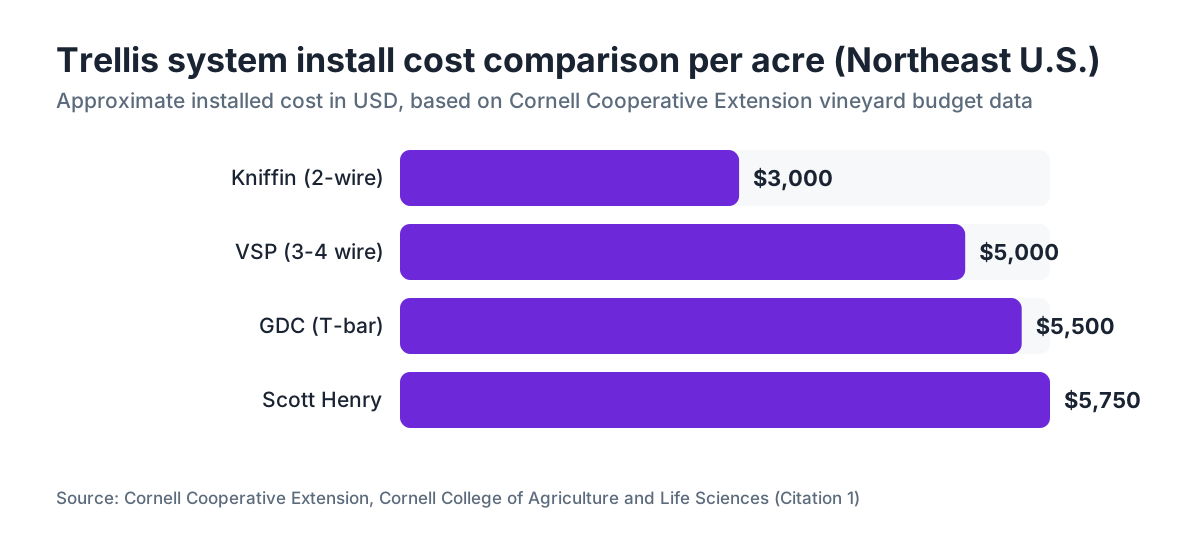
Installed cost for a basic Kniffin trellis in the Northeast runs roughly $2,000 to $4,000 per acre depending on terrain and post spacing, based on typical New York vineyard budgets from Cornell Cooperative Extension [1]. VSP with three to four wires plus shoot-positioning wires typically runs $4,000 to $6,000 per acre in the same region [10]. Those are 2020s figures from extension budgets. Your actual bids will move with lumber and wire prices, which have been all over the place lately.
Post longevity matters. Treated wood posts, with a service life of about 20 to 30 years in vineyard use, are the standard choice for permanent blocks [3]. Steel T-posts work as line posts and cost less upfront but are harder to staple wire to securely. Fiberglass posts are gaining ground in organic operations trying to steer clear of chromated copper arsenate-treated wood.
How do you prune a Kniffin-trained vine?
Pruning a Kniffin vine is straightforward once the trunk is set. In winter you cut off the previous year's fruiting canes entirely and select new canes from renewal spurs near each wire. The goal is two canes per wire, each carrying 8 to 12 buds depending on variety vigor, tied in opposite directions along the wire.
Bud count is where most growers get Kniffin wrong. Vigorous Concord vines in good soil can carry 50 to 80 buds per vine. Leave too few, and the vine throws even more vegetative growth and pushes the canopy into a tangled mess. Cornell's Vitis research and extension work has pushed balanced pruning for decades: use the previous season's cane weight to estimate the right bud load [1]. A common rule of thumb is 20 to 30 buds per pound of dormant prunings, up to about 60 buds for most Labrusca varieties.
Renewal spur management is the other half of the job. You want two to four short spurs near each wire, each cut back to two buds. These spurs make the canes you'll select next winter. Without good renewal spurs, the fruiting zone walks away from the head of the vine over a few seasons and you lose the ability to keep clean, well-placed canes.
Green work during the season is light by design. You might tuck shoots that are flopping badly onto the wire and pull water shoots off the trunk, but Kniffin skips the repeated shoot positioning VSP demands. That's a real labor savings, especially for small operations short on crew time.
What grapevine varieties work best in a Kniffin system?
Kniffin was built for American Labrusca and Labrusca-hybrid varieties. Concord is the textbook case. Niagara, Catawba, Delaware, and Fredonia all do well under Kniffin. These varieties share a few traits that make Kniffin sensible: high natural vigor, good shade tolerance in the cluster zone, and tip-heavy shoot growth that actually likes the downward orientation.
French-American hybrids like Marquette, Frontenac, and Chambourcin can grow on Kniffin, especially in high-vigor situations, but you'll get better fruit quality and easier disease control if you move to a divided canopy or VSP. Hybrids tend to make better wine when the clusters get more light and air, and Kniffin's downward curtain is a shading machine.
Vinifera, as a general rule, doesn't belong on Kniffin. Chardonnay, Cabernet Sauvignon, Pinot Noir, and their kin want the shoot-positioned, light-exposed wall that VSP builds. Put vinifera on Kniffin and you usually get higher disease pressure, especially Botrytis and powdery mildew, plus weaker fruit quality because the cluster zone sits too shaded. Washington State University's viticulture extension makes this point clearly when comparing training systems for Pacific Northwest conditions [4].
If you're planting for the first time and your site has high vigor (deep fertile soils, plenty of water), Kniffin or GDC are worth a look even for hybrids. On moderate-vigor sites, VSP or a simple two-wire cordon gives you tighter control.
What row spacing and vine spacing work with Kniffin?
Traditional Kniffin vineyards in the Northeast used 8-foot vine spacing in the row and 10 to 12-foot row spacing, which puts roughly 363 to 544 vines per acre. That wide layout came partly from the varieties (high vigor needs room) and partly from the era of horse-drawn cultivation.
Modern Kniffin plantings for juice grapes, mostly Concord in New York and Pennsylvania, still lean toward 8x10 or 8x12 spacing. The Welch's grower base in New York is largely planted this way, and the Finger Lakes and Lake Erie production zones treat these numbers as defaults [1][7].
For wine hybrids on Kniffin you can tighten spacing some, but going below 8 feet in-row with a vigorous variety and a downward-shooting canopy risks bad crowding. Shoots from neighboring vines overlap by midsummer, which piles on disease pressure and turns spray penetration into a real problem.
Row orientation matters too. North-south rows catch the most light for a Kniffin canopy, same as any other system. On a slope, you'll often trade orientation for erosion control by running rows across the grade. Neither choice is wrong. Just know the tradeoff you're making.
How does canopy management and disease pressure differ in a Kniffin system?
Canopy density is the central disease problem with Kniffin. The downward curtain of shoots builds a humid, low-airflow pocket at the cluster zone, worst at full leaf area in July and August. That's exactly the environment Botrytis cinerea, powdery mildew (Erysiphe necator), and downy mildew (Plasmopara viticola) want.
For Concord and other thick-skinned Labrusca varieties, it's manageable. They carry decent resistance to bunch rots and tolerate humid canopies better than vinifera. For wine hybrids or any thin-skinned variety, you need a more aggressive spray program to make up for what the trellis can't fix.
Spray penetration into a Kniffin canopy comes down to nozzle setup and tractor speed. A dense downward curtain shadows its own interior from a standard airblast sprayer if you move too fast. Slow down, angle the nozzles down a touch, and calibrate output to the canopy volume. WSU Extension's IPM resources cover canopy-volume-based calibration that applies to Kniffin canopies as much as VSP [4].
Worker protection during spray applications in Kniffin vineyards follows the same federal rules as any other system. The EPA Agricultural Worker Protection Standard (40 CFR Part 170) sets restricted-entry intervals, personal protective equipment, and decontamination duties for all pesticide applications on farms [5]. A downward canopy means workers doing green work or harvest can brush more foliage carrying spray residue than they would in a VSP block, so documenting REI compliance is worth the effort.
If you're tracking spray records across a Kniffin block, tools like VitiScribe log application rates, canopy volume estimates, REI windows, and worker entry records in one place, which makes end-of-season compliance reviews far less painful.
What does a Kniffin vineyard cost to establish and what yield can you expect?
Establishment cost breaks into trellis hardware, planting material, and the lost-revenue years before the block pays. For a standard Kniffin setup in the Northeast on a juice grape block:
Trellis hardware (posts, wire, anchors): $2,000 to $4,000 per acre [1]
Vines (Concord on own roots or 101-14 rootstock, certified): $1.50 to $3.50 per vine, so roughly $650 to $1,900 per acre at 8x10 spacing [1]
Site prep, planting labor, irrigation if installed: varies enormously
Years one and two produce no commercial crop. Year three gives a partial crop. Full production on Concord under Kniffin usually lands by year four or five.
Yield for Concord on Kniffin in a well-managed New York block runs 6 to 10 tons per acre. High-fertility sites push 12 to 14 tons with aggressive fertilization, though that can drag down juice quality and brix. Welch's and other juice processors typically set brix minimums around 14 to 15, and they apply premiums or penalties on soluble solids [9].
For wine hybrids on Kniffin, target yields run lower, roughly 3 to 6 tons per acre for quality fruit, because heavy crops thin the flavor. These are rough figures. Nobody has published a clean multi-site yield comparison for Kniffin versus GDC on hybrids in the Northeast. The closest numbers come from Cornell extension budget worksheets, which are the most credible public source out there [1].
Can you mechanically harvest a Kniffin trellis?
For most standard Kniffin setups, that's a hard no. Over-the-row mechanical harvesters need a defined fruiting zone at a consistent height and a clear path for the harvest head. The two-wire Kniffin, with canes draped in multiple downward directions and clusters scattered through the hanging curtain, doesn't give the machine what it needs.
GDC was engineered as the machine-harvestable replacement for Kniffin on Concord blocks. Its two parallel curtains on a T-bar give a harvester a consistent curtain to beat, and the open center keeps clusters accessible. If mechanical harvest is anywhere on your horizon, build GDC from the start. Retrofitting a Kniffin block to GDC is possible but pricey: you replace every trellis post, reconfigure wire, and re-train every vine over two to three seasons.
Hand harvest on Kniffin is easy. Clusters hang at reachable heights throughout the two-wire system and pickers move fast. For farm wineries and small juice operations where hand harvest is the plan and always will be, this isn't a drawback at all.
Is Kniffin a good system for cold-climate and winter-hardy grape varieties?
Yes, with some caveats worth reading. In the four-cane version the trunk and head sit at middle wire height, which keeps the permanent wood above the worst cold-air pooling at ground level. In the umbrella Kniffin the trunk runs all the way to the top wire, which actually raises winter injury risk for the trunk itself in a severe freeze.
For the University of Minnesota-bred cold-hardy varieties like Marquette, La Crescent, and Frontenac, now widely planted across the Upper Midwest and Great Lakes, Kniffin sees some use but isn't the preferred system. University of Minnesota Extension points growers toward modified Kniffin or low-cordon systems that let you hill soil over the graft union in fall for extra protection, especially on vinifera and sensitive hybrids [6]. Cold-hardy varieties on their own roots can sometimes ride out winter on Kniffin without hilling, but that depends on your winter minimums.
The Midwest Grape Production Guide, a multi-state extension publication, covers training system choice for cold climates in detail and generally steers growers toward systems that allow trunk protection, or toward genetically hardy varieties whose trunks survive without it [8]. Kniffin fits that second category reasonably well when paired with the right varieties.
How do you establish a Kniffin trellis from scratch, step by step?
Year one. Plant rooted cuttings or dormant bench grafts in spring after last frost risk. Drive a temporary stake at each vine for the first season. Let the vine grow freely. Your only job is to pick the strongest shoot, remove the rest, and train it up with loose ties to the stake. No fruit in year one.
Year two. Install permanent posts if they're not in yet. Set end posts before growth starts in spring, because driving posts near established vines tears up roots. String the lower wire at 3 feet. As the vine grows, select the best trunk shoot and train it to the lower wire. Pinch laterals that break below the wire. When the trunk reaches the lower wire, let two shoots run in opposite directions along it. Cut or pinch the trunk shoot above the wire to stop upward growth for now.
Year three. Install the upper wire at 5 to 5.5 feet. Let one of the lower-wire canes keep climbing to the upper wire, or select a fresh shoot from the head of the vine and train it up. Tie canes gently. A partial crop is fine in year three on vigorous vines. Prune conservatively: 30 to 40 buds maximum.
Year four onward. Full cane pruning every winter. Select two new canes per wire, each 8 to 12 buds, plus two renewal spurs per wire. Remove all other wood. Weigh your pruning against last year's cane weights if you're running balanced pruning.
Write down what you do each season: which blocks got pruned on which dates, bud counts, training notes. A simple field log works. If you want that data searchable and tied to your spray and harvest records, VitiScribe was built for exactly this kind of ongoing vineyard record-keeping.
The whole establishment sequence takes patience. Rush to full crop in year three by leaving too many buds and you undercut root development and shorten the vine's productive life.
What are the real advantages and limitations of the Kniffin system?
Advantages first. The system is cheap to build. Two wires and basic posts are about the simplest permanent trellis you can put up, and for a small farm that capital difference matters. It suits high-vigor varieties that would swamp a VSP wall. Green work labor during the season is low next to shoot-positioned systems. Hand harvest is easy. And for juice grapes, where the quality metrics are forgiving (brix, absence of disease, not tannin structure or phenolic extraction), it does the job.
The limitations are real, and honest growers state them plainly. Canopy shade drops fruit quality on varieties that need light for color, flavor, and brix. Disease management is harder and spray costs run higher than in an open-canopy system. Mechanical harvest isn't practical on a standard two-wire Kniffin. The system doesn't scale for premium wine. And on high-vigor ground without disciplined balanced pruning, Kniffin blocks turn into a jungle within a few seasons.
For anyone planting vinifera, or planting with machine harvest in mind, Kniffin is the wrong call from day one. For small, hand-harvested operations growing Concord or Niagara for juice or table grapes, or cold-hardy hybrids in hobby and small commercial vineyards, it's still a sensible, low-cost option.
One common mistake: treating Kniffin as a beginner system you'll upgrade later. Converting an established Kniffin block to VSP or GDC means resetting every vine's training and replacing most of the trellis. If you think you'll want VSP in five years, build VSP now.
Frequently asked questions
What is the difference between a four-cane Kniffin and an umbrella Kniffin?
A four-cane Kniffin has the trunk ending at or between the two wires, with two canes tied along each wire in opposite directions. An umbrella Kniffin runs the trunk all the way to the top wire, then drapes two canes downward from the top in an arc, plus two shorter canes or spurs near the lower wire. The umbrella version is common in New York Concord production and is slightly easier to prune once established.
Can I use a Kniffin trellis for Concord grapes?
Yes. Concord is the variety the Kniffin system was essentially built for. Its high vigor, shade tolerance, and thick-skinned clusters match the downward curtain canopy. Commercial Concord production in New York and Pennsylvania, the two largest Concord-producing states, has relied on Kniffin and umbrella Kniffin for over a century. Target 50 to 70 buds per vine at full production on most sites.
How far apart should posts be in a Kniffin trellis?
Line posts typically sit 20 to 24 feet apart, plus a post at every row end with end-post bracing. End posts need heavier gauge wood or steel, set at least 2.5 to 3 feet deep with diagonal bracing. Closer post spacing (16 to 18 feet) stiffens the wire but adds cost. On flat ground with firm soil, 24-foot spacing is fine for a standard two-wire Kniffin.
Is the Kniffin system suitable for small backyard vineyards?
It's one of the best choices for a backyard or hobby vineyard with Concord, Niagara, or similar American varieties. The hardware is cheap, installation is simple, and it skips the ongoing shoot-positioning labor VSP demands. For a four-vine backyard planting, you can build a working Kniffin trellis for well under $200 in materials using treated 4x4 posts and two runs of 9-gauge wire.
What wire gauge should I use for a Kniffin trellis?
9-gauge high-tensile galvanized wire is the standard for fruiting wires on a two-wire Kniffin. Some growers use 10 or 11 gauge on shorter row runs where tension loads are lower. Avoid smooth wire below 12 gauge for fruiting wires. It stretches and sags under cane weight by midsummer. Crimp connectors and a wire tensioner make mid-season tightening easier than re-stapling.
How many buds per vine should I leave when pruning a Kniffin system?
For Concord at full production, 50 to 70 buds per vine is a common target, split across four canes of 12 to 18 buds each plus renewal spurs. Balanced pruning adjusts bud load to last winter's cane weight: roughly 20 to 30 buds per pound of prunings, with a ceiling around 80 buds for very vigorous vines. Under-pruning is the more common mistake on high-vigor sites.
Does the Kniffin system work in hot climates like California or Texas?
Rarely the best choice. Hot, dry climates tend to make moderate-vigor vines that don't gain from the high-bud-load, downward-curtain approach. VSP or low-cordon systems suit vinifera in California and Texas much better. Some high-vigor hybrid plantings in East Texas or the humid Gulf Coast might work on a modified Kniffin, but for disease-prone humid climates a divided canopy like GDC that improves airflow is usually the smarter move.
What rootstocks are commonly used with Kniffin-trained Concord vines?
Many commercial Concord Kniffin blocks in New York are own-rooted, because Concord has good natural vigor and phylloxera resistance from its Labrusca genetics. Where phylloxera or nematodes are a concern, 3309 Couderc and 101-14 Millardet are common Northeast rootstocks for their moderate vigor and Labrusca compatibility. Very high-vigor rootstocks like SO4 or 5BB are rarely used with Kniffin because they compound canopy problems.
How does Kniffin affect labor costs compared to VSP?
Kniffin usually cuts in-season labor next to VSP because it skips repeated shoot tucking and positioning. Winter pruning is comparable or slightly faster, since you're selecting canes on two wires instead of positioning shoots on three or four. Green work savings can run $100 to $300 per acre per season on a well-established Kniffin block, though it varies widely with crew wages and canopy standards.
Can I convert an existing Kniffin vineyard to VSP?
Yes, but it's a multi-year job and far from trivial. You'd add wires, lower or remove existing fruiting wires, and re-train trunks to a new height. Most vines trained for years on Kniffin have trunks set at wire height, which may or may not suit VSP. On a productive, economically sound block, conversion is worth pricing out. On an aging block near the end of its life, replanting to VSP from scratch usually makes more sense.
What are typical spray intervals and fungicide needs on a Kniffin block?
In humid climates like the Northeast, Kniffin blocks typically need a 7 to 14-day spray interval from pre-bloom through post-harvest for powdery mildew, downy mildew, and Botrytis. The dense canopy shortens effective intervals versus more open systems. In dry years or arid regions, intervals can stretch to 14 to 21 days. Always check the specific pesticide label for REI, PHI, and application rate before any application.
Are there any Cornell or university extension resources on the Kniffin system specifically?
Cornell Cooperative Extension has published Concord and hybrid training guidance for decades, including Kniffin descriptions in its Northeast vineyard management guides. The Midwest Grape Production Guide, a collaborative extension publication, covers training system selection including modified Kniffin variants. WSU Extension covers training comparisons for Pacific Northwest conditions. Links to these resources are in the citations section of this article.
Sources
- Cornell Cooperative Extension, Cornell College of Agriculture and Life Sciences: Kniffin and umbrella Kniffin system descriptions, bud load guidance for Concord, and trellis establishment cost estimates for Northeast vineyards
- Oregon State University Extension Service: Scott Henry training system origin and comparison with other downward-shoot systems
- UC Davis Department of Viticulture and Enology: Treated wood post service life of 20 to 30 years in vineyard applications
- Washington State University Extension: Training system comparisons for Pacific Northwest conditions and spray calibration for canopy volume in different trellis systems
- U.S. EPA, Agricultural Worker Protection Standard, 40 CFR Part 170: Federal restricted-entry intervals, PPE requirements, and decontamination obligations for pesticide applications in agricultural settings
- University of Minnesota Extension: Training system recommendations for cold-climate and cold-hardy varieties including modified Kniffin and trunk protection practices
- Penn State Extension: Concord Kniffin vine spacing, yield expectations, and trellis hardware guidelines for Pennsylvania producers
- Midwest Grape Production Guide, University of Missouri Extension: Training system selection for cold climates including Kniffin variants and trunk protection practices
- USDA National Agricultural Statistics Service, Noncitrus Fruits and Nuts Summary: New York and Pennsylvania Concord grape production volumes and acreage supporting Kniffin system prevalence in the Northeast
- UC Cooperative Extension, Sample Costs to Establish a Vineyard and Produce Wine Grapes: Comparative trellis establishment cost ranges for VSP and other systems used as baseline for regional cost comparisons
Last updated 2026-07-09