Large-scale vineyard soil aeration: methods, timing, and real costs
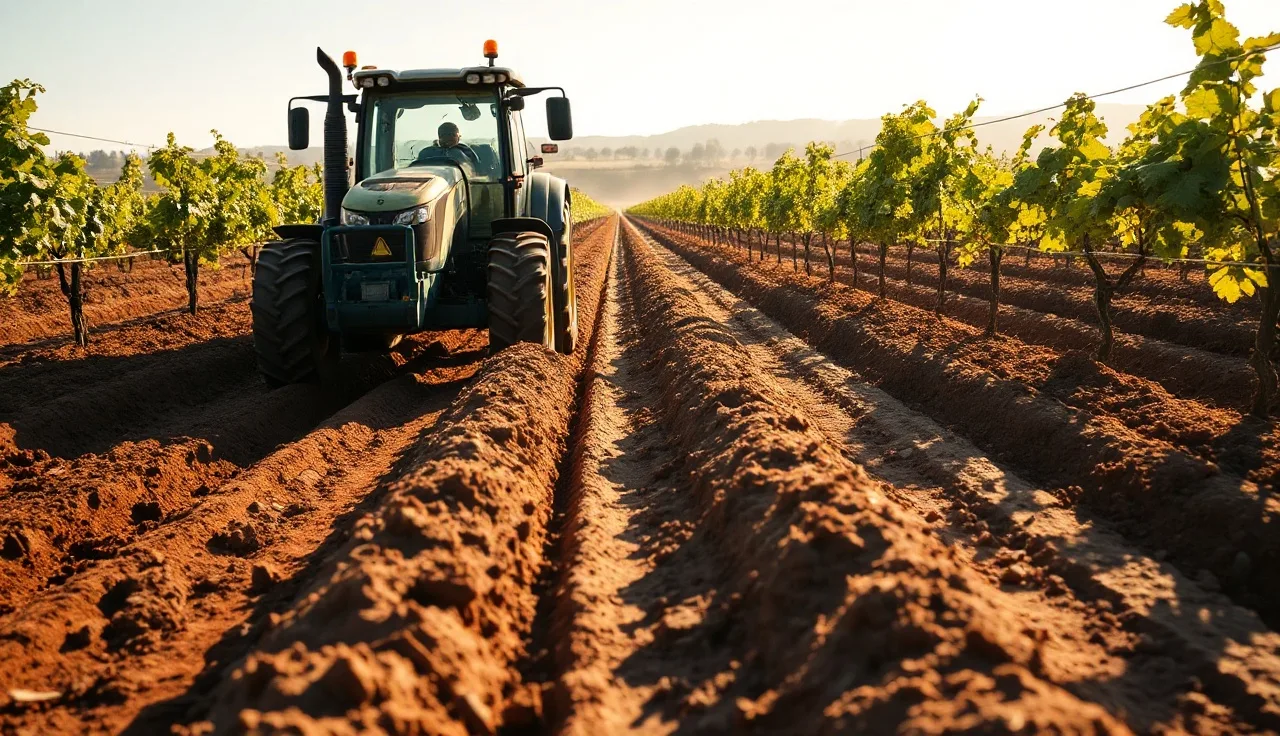
TL;DR
- Large-scale vineyard soil aeration breaks up compaction and restores gas exchange in the root zone.
- The main tools are subsoil rippers, zone tillage machines, and taproot cover crops.
- On blocks over 20 acres, a single pass runs roughly $40 to $120 per acre depending on method.
- Rip in early fall after harvest so soils settle over winter before bud break.
What is soil aeration in a vineyard and why does it matter at scale?
Soil aeration restores oxygen exchange and water movement in a root zone that has been squeezed tight by traffic, layered with a hard pan, or degraded by years of rain hammering bare ground. On a one-acre trial block you fix it with a single tractor pass. On a 500-acre planting it becomes a capital decision with a real dollar figure attached.
Vine roots need oxygen. Anaerobic soils produce ethylene gas and toxic compounds that shut down fine root growth and choke off water uptake [1]. UC viticulture researchers have tied poorly aerated soils to weaker vines, more disease pressure in the canopy (stressed roots limit the vine's defense capacity), and a shorter productive life for the whole block [2].
At scale, the enemy is machinery. A loaded harvester, a tractor towing a full spray rig, a water truck, a forklift shuttling bins: every wheel load presses soil tight below 10 to 14 inches, deeper than any cultivator reaches. Once a compaction layer sits at 18 to 24 inches, standard tillage skips right over it. Breaking that takes either deep ripping or a patient biological program.
Consistency is the other headache. One block shows severe compaction in the tractor rows and almost none under the vines. Another has a clay pan at depth that machinery never touched. Figure out which problem you actually have. It changes every decision that follows.
How do you diagnose soil compaction before choosing an aeration method?
Before you spend a dollar on iron, run a penetrometer survey. A recording cone penetrometer reads soil resistance in pounds per square inch (psi) or megapascals (MPa) as you push it down. Root growth slows hard above 300 psi and fine roots essentially stop above 400 psi [3]. Walk a grid, take readings every 20 to 30 feet in both directions, and log them in 6-inch depth steps down to 36 inches.
This costs almost nothing. A basic manual recording penetrometer runs $200 to $400. For blocks over 50 acres, a GPS-integrated unit that logs straight to a tablet earns its $1,500 to $3,000 price because it hands you a compaction map you can act on, not an average that hides the spots that actually matter.
Read your data for three things: the depth where readings climb past 250 psi (the top of your compaction layer), the peak reading (how bad it is), and the spatial pattern (row versus inter-row, headland versus mid-block). Headlands almost always read worst. That is where equipment turns. The mid-row under the canopy usually reads loosest because wheels rarely go there.
Texture changes the meaning. A sandy loam at 300 psi is a different animal from a clay loam at 300 psi. Dry clay reads high on its own, so re-check after rain or an irrigation set before you call it compaction. WSU Extension recommends taking penetrometer readings at a consistent soil moisture, ideally field capacity, so numbers compare across a season and year to year [4].
Dig pits too. At least two per block, one in the tractor alley and one under the vine row. You want to see a distinct color or texture change that marks a clay pan, orange mottling that flags periodic saturation (poor drainage, which people constantly mistake for compaction), and where the roots actually stop. If roots quit at 12 inches, that is your real story, no matter what the penetrometer says about 24.
What aeration equipment works at large-scale vineyard operations?
Four equipment categories cover almost every large-scale job. Each moves soil to a different depth, costs a different amount, and recovers on a different clock.
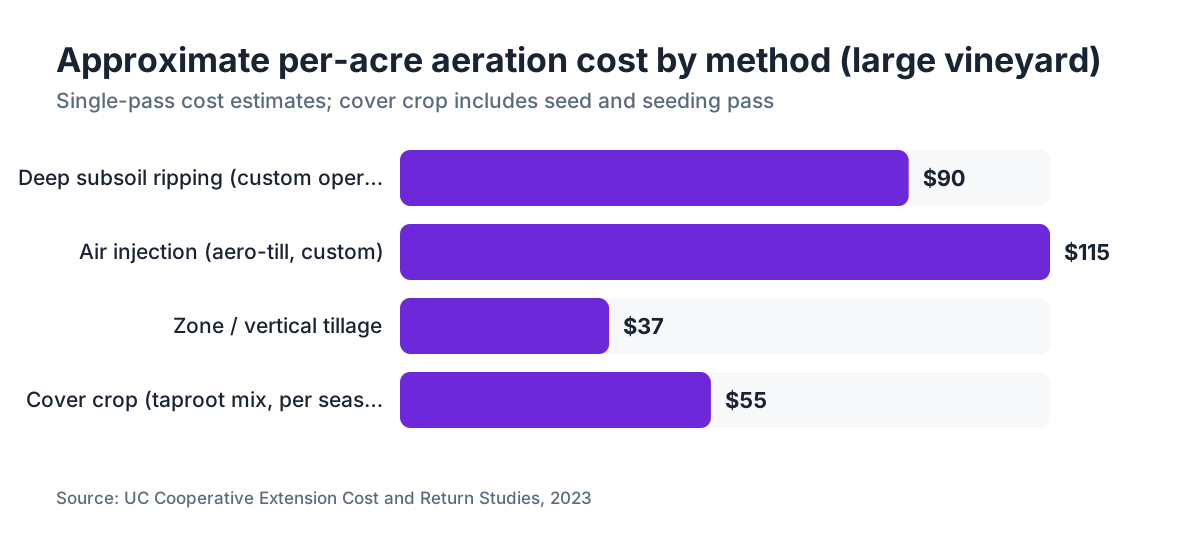
Subsoil ripper (deep shanks). The workhorse for serious compaction. Usually 3 to 7 shanks set at 18 to 36 inches, pulled by a 150 to 300 hp tractor. One inter-row pass fractures the compaction layer and opens channels for water. On a 100-acre block you cover 15 to 25 acres a day depending on soil and row spacing. Custom rates run $60 to $120 per acre, or $35 to $65 if you own the tractor and rent just the implement [5]. It works well and it works rough: it lifts soil and tears surface feeder roots, so timing carries real weight.
Zone tillage or vertical tillage machines. These work 8 to 14 inches deep in a single inter-row pass. Gentler than a ripper and faster. They will not touch a deep compaction layer, but they handle surface sealing, traffic pan, and cover crop residue well. Operating cost runs $25 to $50 per acre.
Aero-till or air-spade injection. Compressed air fires through hollow tines and fractures soil without cutting or pulling it. Low surface disturbance, slow throughput. At scale you reach for it on problem spots, headlands, or ground near trunks where you cannot gamble on root damage. Rental or custom work runs $80 to $150 per acre because of the speed penalty.
Biological aeration via cover crops. Taproot species like tillage radish (Raphanus sativus), turnips, and some clovers punch through compaction and leave open channels when they die and rot. It is the cheapest option at $30 to $80 per acre per season including seed and the seeding pass [6], but it runs on a 2 to 4 year clock, not a single season. On a big operation, a cover crop program is usually the smartest long-term money once you have done an initial mechanical rip.
| Method | Working depth | Cost/acre (approx.) | Recovery time | Best for |
|---|---|---|---|---|
| Deep subsoil ripper | 18 to 36 in | $60 to $120 | 1 season | Hard pans, severe compaction |
| Zone/vertical tillage | 8 to 14 in | $25 to $50 | Immediate | Traffic pan, surface sealing |
| Air injection (aero-till) | 12 to 18 in | $80 to $150 | 1 season | Near trunks, spot treatment |
| Cover crop (taproot) | 12 to 24 in (roots) | $30 to $80/yr | 2 to 4 seasons | Long-term structure building |
For a vineyard running at true commercial scale, a hybrid plan usually wins: one deep rip on the worst blocks, zone tillage where compaction is moderate, and a cover crop seeding program across everything right after.
When is the best time to aerate vineyard soils without damaging vines?
Timing is where most managers blow it. The instinct is to rip in spring, when the vines are bare and you can see the soil surface after pruning. That is one of the riskier windows.
The best time to deep rip in most regions is 4 to 8 weeks after harvest, before the first hard frost. The logic holds up: carbohydrate reserves are moving back into the trunk and roots, the vine is sliding into dormancy and fine root activity is slowing, and the soil still holds enough warmth and moisture that the fractures start to consolidate before winter. Then the rains work down into those channels for months.
Rip in early spring, right at bud break, and you tear feeder roots exactly when they are expanding fastest. The vine spends stored carbohydrates to push bud break. Force it to reroute that energy into repairing roots and you get uneven or late budbreak, weak shoots, and canopy problems that follow you through the whole season.
In Mediterranean climates (California's Central Coast, Paso Robles, the Lodi AVA), late October through mid-December works well. In the Pacific Northwest, aim for the narrow gap between September harvest and the first soaking fall rains. WSU Extension notes that ripping waterlogged or near-saturated soil smears it rather than fracturing it, which makes compaction worse [4].
Soil moisture at ripping matters more than almost anything else. Shoot for roughly 50 to 60 percent of field capacity. Too wet and you smear a fresh plow-pan at the base of the shank. Too dry and the soil shatters in big useless blocks while vibration shock snaps feeder roots. If you irrigate, shut it off 10 to 14 days before you rip.
How deep should you rip vineyard soils?
Rip to just below the compaction layer, not as deep as the machine can reach. Going deeper than you need wrecks structure that is already doing its job, drags up subsoil with different texture or chemistry, and costs more for nothing.
If your penetrometer shows a compaction layer from 14 to 22 inches, set your shanks at 24 to 26 inches. That buys you 2 to 4 inches of clearance under the hard pan. Dropping to 36 inches on that same soil would be expensive and backwards.
On old plantings sitting over a clay pan, the pan may be geological rather than traffic-made. Break through it with a ripper and you can create a bathtub: water moves through your worked soil, hits the clay, pools, and has nowhere to go. Sort that out with French drains or a real drainage assessment before you rip.
Cornell Cooperative Extension notes that root zone depth in northeastern vineyards is often capped by shallow bedrock or a fragipan layer, and that aggressive deep tillage in those soils can expose rock or build perched water tables that are harder to manage than the compaction you started with [7]. Know your profile before you set shank depth.
What are the real costs of large-scale vineyard aeration?
Here is honest math for a 200-acre vineyard with moderate to severe compaction across 60 percent of its blocks.
Hire a custom operator to deep rip 120 acres at $80 per acre and you are out $9,600 for the mechanical pass. Add a cover crop seeding pass on those same 120 acres at $55 per acre (seed plus seeding) and year one hits $16,200. The other 80 acres with lighter compaction get zone tillage at $35 per acre ($2,800) plus cover crop seeding ($4,400), another $7,200. Total year-one cost: about $23,400 across 200 acres, or $117 per acre.
That looks like a lot. Now compare it to replanting a block that dies young from chronic root zone problems. Replanting in California currently runs $15,000 to $25,000 per acre once you count land prep, plants, trellis, irrigation, and 3 to 5 years of non-bearing establishment [5]. Push productive block life out even five years and aeration pays for itself many times over. It is an operating expense, not a luxury.
Own a suitable ripper and tractor and your per-acre cost drops to $20 to $40 in fuel, labor, and implement wear. At that number, rotating annual or biennial aeration across your blocks becomes routine.
One cost people always miss: the traffic the aeration work itself creates. Custom equipment means extra tractor passes, harvest access for post-harvest work, and maybe a water truck to dial in soil moisture before ripping. Budget 2 to 3 extra passes per acre and lay out your traffic pattern with care, or you re-compact the headlands you just spent money loosening.
How does cover crop selection affect soil aeration outcomes?
Not every cover crop aerates soil. Grasses with fibrous roots build organic matter and firm up surface structure, but they do not punch through a compaction layer. For biological aeration you need species with big, stiff taproots.
Tillage radish is the most studied and the most used. A 2019 review of cover crop effects on soil bulk density found that taproot species cut bulk density in the 6 to 18 inch zone by 5 to 15 percent after two growing seasons, with the biggest gains in sandy loams and silt loams [6]. That is no substitute for a mechanical rip on severe compaction, but it is real structural improvement.
Turnips and sugar beets work the same way but take winter cold harder. Austrian winter peas and bell beans add nitrogen and skip the deep aeration. A blend of tillage radish at 4 to 6 lb/acre plus a winter cereal like oats or triticale at 30 to 40 lb/acre gives you taproot action along with surface residue and erosion cover.
The seeding window is tight. In California, aim for mid-September through mid-October to get radish established before the soil cools. In Oregon and Washington, late August through September. Seed into moisture. Dry-seeding into cracked summer soil and praying for early rain is a gamble that usually loses. If you irrigate, run a light set right after seeding.
Termination timing matters just as much. Let the taproots die in place instead of mowing or tilling them in. That decomposing root channel is the whole point. In wet winter climates, a standing dead cover crop also slows runoff and holds soil between the rows.
What do soil health metrics tell you about aeration progress?
Penetrometer readings before and after are the most direct measure you have. Take post-rip readings 90 days out, then again the following spring. Expect a sharp drop right after ripping (readings may cut in half), then some re-consolidation over winter. If spring readings are already creeping back toward pre-rip levels within one season, something is still driving compaction: traffic patterns, drainage, or a structural pan you never fully broke.
Three other metrics track progress well over time.
- Bulk density (grams per cubic centimeter). Core-sample at 6, 12, and 24 inches before your program and once a year after. Well-aerated vineyard soils read below 1.4 g/cc in the top 24 inches. Anything above 1.6 g/cc points to severe structural compaction [3].
- Infiltration rate (inches per hour). A simple double-ring infiltrometer test before and after shows how fast water moves in. Compacted inter-rows in established vineyards often read below 0.2 inches per hour. After ripping, the same spots commonly jump to 1 to 3 inches per hour.
- Earthworm counts. Dig a 12-by-12-inch block 12 inches deep and count the worms. It sounds like a backyard experiment, but it is a real proxy for biological activity and pore structure. USDA NRCS treats 10 or more earthworms per block as a sign of healthy structure [8]. Compacted soils often turn up zero to two.
For record-keeping at scale, a platform like VitiScribe logs these field measurements block by block across seasons, so you can tie an aeration event to a measurable outcome instead of chasing spreadsheets that drift apart across a multi-block operation.
The same data matters for compliance and cost-share documentation if you pursue soil health programs through USDA NRCS, which funds cover crop and conservation tillage practices under the Environmental Quality Incentives Program (EQIP) [9].
What are the worker safety and regulatory requirements for vineyard aeration operations?
Aeration on its own does not trigger pesticide rules, but it runs right alongside spray and fertility programs that do. The EPA Worker Protection Standard (WPS) applies when agricultural workers are in or near recently treated ground. If your aeration schedule drops a tractor operator into a block that got a recent application, the re-entry interval (REI) on that product controls access [10].
The WPS, codified at 40 CFR Part 170, requires that "agricultural employers must protect workers and handlers from pesticide exposures on agricultural establishments where pesticides are produced." Your ripping crew is covered under WPS if they enter a field inside an REI, even though they are not spraying anything. Train third-party ripping operators before they set foot on the block. The WPS requires that they be told of any current REIs before entry.
Fuel storage for a multi-week ripping campaign can trigger Spill Prevention, Control, and Countermeasure (SPCC) plan requirements once you keep more than 1,320 gallons of petroleum products on-site [11]. Check that before you stage a big fuel supply.
State rules vary. California's Cal/OSHA runs a heat illness prevention standard covering outdoor agricultural workers, and a multi-week September ripping program in the San Joaquin Valley or Central Coast falls squarely under it [12]. Water, shade, and rest are not negotiable.
How do you prevent re-compaction after a large-scale aeration program?
Aeration without traffic management is renting, not owning. You can spend $20,000 ripping a 200-acre block and undo half of it in three seasons if you never address what compacted the soil in the first place.
The biggest single change is controlled traffic farming (CTF): permanent tractor lanes that nothing ever strays from. Tractors, harvesters, spray rigs, all of it runs on the same wheel tracks every year. The vine rows and the ground between the tracks never see a tire. CTF can cut compaction-affected area by 50 to 80 percent versus random-path operations, according to a review in the Australian Journal of Soil Research [13].
CTF needs matching or harmonized wheel spacings across your fleet, which a mixed collection of equipment rarely has out of the box. Row spacing has to fit your narrowest machine too. Designing a new block or replanting? Build it in from the start.
Tire pressure management is badly underused. Drop rear tire pressure from 35 psi to 15 to 18 psi during field work and you spread the footprint and cut contact pressure on the surface sharply. On-the-go inflation systems now let you air down for the field and air back up for the road. The payback in soil structure is real, though the $8,000 to $15,000 per tractor up-front cost keeps smaller operations out.
Cover crops in the inter-row buy ongoing protection too. The root mat and surface organic matter absorb wheel-load energy. A permanent sod in every row or every other inter-row is one of the simplest long-term defenses against re-compaction, and it holds down erosion and dust on the vineyard floor besides.
What do university extension programs say about aeration for specific wine regions?
Extension guidance is not one-size-fits-all, and the regional differences are real.
UC Cooperative Extension has done detailed work on Napa and Sonoma soils, where volcanic and alluvial parent materials build very different compaction profiles. The guidance holds that Napa Valley red volcanic soils (Aiken, Josephine series) tend to run naturally lower in bulk density and may not need annual ripping, while the alluvial clay loams on the valley floor compact hard under traffic and may need deep ripping every 3 to 5 years backed by annual biological aeration [2].
WSU Extension's Columbia Valley work covers the odd problem of irrigated desert soils that crust over fast after rain or irrigation, cutting infiltration even where deep compaction is mild. Their answer is light vertical tillage or zone cultivation 2 to 3 times a season to break the crust, paired with every-other-row cover cropping [4].
Cornell Cooperative Extension focuses on the Finger Lakes, Lake Erie, and Hudson Valley, where glacial soils, fragipan layers, and wet springs leave a very short workability window. Their guidance warns against any tillage on wet soil, favors cover crop programs over mechanical aeration in most cases, and treats drainage correction as a prerequisite before aeration can help at all [7].
In Paso Robles wineries and other warm Central Coast ground, shrink-swell clay plus dry summers leads managers to confuse drought-cracked surface soil with real aeration. Cracking does open the surface, but the cracks slam shut when soils rewet, and the deep layers can stay severely compacted through it all.
Run a mountain winery or a hillside vineyard and slope adds another variable. Aggressive deep ripping on steep ground can destabilize the profile and speed up erosion. On slopes above 15 percent, biological aeration and minimal tillage almost always win.
Can USDA cost-share programs fund large-scale vineyard aeration?
Yes, and hardly anyone uses it. USDA's Natural Resources Conservation Service (NRCS) pays through EQIP for several practices that map directly onto vineyard soil aeration [9].
Practice 340 (Cover Crop) pays per acre to establish cover crops that improve soil health, and taproot species qualify. Rates vary by state and county; in California they have run $60 to $150 per acre depending on the species mix and equipment.
Practice 345 (Residue and Tillage Management, Reduced Till) covers the move toward conservation tillage, which can include the controlled traffic and zone tillage approaches above. Practice 329 (Residue and Tillage Management, No-Till/Strip Till) fits if you are shifting to a strip-till system in your inter-rows.
The application runs through your local NRCS service center. EQIP is competitive, and vineyard applicants may go head to head against row crop operations for the same county pool. The usual cycle is applying in September or October for the following fiscal year. Show up with your soil data already documented (penetrometer maps, bulk density, infiltration rates) and your application gets stronger, because NRCS field offices score by resource concern and documented soil compaction is a qualifying concern.
For record-keeping across a multi-block operation during an EQIP enrollment period, VitiScribe's field operations log documents practice dates, equipment, and seed lot information in the format NRCS wants for practice verification and payment.
Frequently asked questions
How often should you aerate vineyard soils at large scale?
Most commercial vineyards benefit from deep mechanical ripping every 3 to 5 years on the inter-rows, paired with annual or biennial cover cropping. High-traffic blocks, especially headlands and blocks with annual harvest machine access, may need ripping more often. Let penetrometer readings above 300 psi at any depth trigger a mechanical pass, rather than following a fixed calendar.
Can you aerate vineyard soils without disrupting drip irrigation lines?
Yes, but map your lateral lines precisely before any deep ripping. Shanks at 18 to 24 inches will cut buried drip laterals if the lines went in shallow. Most vineyard drip runs 12 to 18 inches deep, so mark the rows carrying lateral lines, set shank spacing to miss them, and run a single shank down each tractor alley instead of multi-shank passes that can drift. Air injection tools carry lower line-damage risk than mechanical shanks.
What is the best cover crop for vineyard soil aeration in dry climates?
Tillage radish seeded in September to early October is the most reliable choice in dry-summer climates like California and the Columbia Valley. It germinates fast, drives a thick taproot to 18 to 24 inches in most soils, and winter-kills in most regions, leaving the channel intact. Seed at 4 to 6 lb/acre. A companion oat or triticale at 30 lb/acre adds erosion control in wet winters and organic matter at termination.
Does aerating compacted vineyard soils improve vine water use efficiency?
Evidence says yes. Compacted soil limits root volume, forcing vines to pull from a smaller water reservoir per unit of leaf area. Breaking the compaction layer lets roots reach deeper, cooler, steadier moisture. Field work cited by UC Cooperative Extension found irrigation efficiency improved measurably after deep ripping in clay loam soils, with vines holding similar midday stem water potential on lower applied water.
What tractor horsepower do you need to pull a subsoil ripper in a vineyard?
A 3-shank ripper working at 24 inches in typical clay loam vineyard soil needs 150 to 200 PTO horsepower minimum. In sandier soils or at shallower depth, 120 hp can do it. Move to 5 to 7 shanks or 30 to 36 inches and the requirement climbs to 250 to 300 hp. Many vineyards run a single-shank or twin-shank pass at row width to stay inside their existing 100 to 130 hp fleet, even if that means more passes.
Is deep ripping safe near established grapevine trunks?
Ripping within 18 to 24 inches of a trunk risks cutting primary structural roots and can introduce Armillaria and other soil pathogens through the wounds. Keep the shank in the mid-inter-row, at least 24 inches of clearance from the nearest vine. For the vine-row zone itself, air spade injection or deep cover crop roots are safer. Never run a mechanical shank down the vine row in an established planting.
How do you measure whether soil aeration actually improved vine performance?
Track soil metrics (penetrometer readings, bulk density, infiltration rate) alongside vine metrics (shoot length at set, berry weight at harvest, yield per vine on a consistent-canopy basis) across treated and untreated blocks. You need at least two seasons of post-treatment data to separate aeration effects from annual climate swings. Earthworm counts and cover crop biomass work as supplementary biological indicators.
Can I use a Yeomans plow or keyline plow for vineyard soil aeration?
Yes, and it is gaining ground in regenerative viticulture. A Keyline plow (single-shank, winged) works at 12 to 18 inches and cuts lateral fissures that move water across the slope instead of straight downhill. It is gentler than a straight-shank ripper and can run closer to vine rows. The tradeoff: it does not reach compaction layers below 18 inches as well as a deeper straight shank. Best for moderate compaction and water distribution on hillside sites.
Does USDA NRCS fund vineyard soil aeration programs?
NRCS funds related practices through EQIP, mainly Practice 340 (Cover Crop) and Practice 345 (Reduced Tillage Management). Direct payment for mechanical ripping is not a standard stand-alone practice code, but it may qualify under a site-specific conservation plan. Contact your county NRCS service center in September or October to apply for the following fiscal year. Documented soil compaction data, including penetrometer maps, strengthens the application.
What is controlled traffic farming and can it work in existing vineyards?
Controlled traffic farming (CTF) assigns permanent tractor lanes so all equipment follows the same wheel tracks every year, sparing the rest of the inter-row. Retrofitting CTF into an existing vineyard means confirming wheel spacings match across your tractor, harvester, and spray rig. It is easiest at replanting, when row spacing can match your widest machine. In existing plantings, even informal discipline (always turning in set headland zones, never short-cutting) cuts the compaction rate.
How do wet soil conditions change the risk of aeration work?
A ripper or zone tool in wet soil smears the structure at the shank face instead of fracturing it. That glazes a plow pan at working depth that can restrict roots worse than the original compaction. WSU Extension recommends checking soil moisture to at least 6 inches before ripping; the soil should crumble, not smear, when you squeeze it in your fist. If the vineyard caught significant rain in the past 10 to 14 days, wait.
Are there organic or biologically based alternatives to mechanical aeration for large vineyards?
Taproot cover crops (tillage radish, turnips, daikon) are the main biological tool. Compost at 4 to 6 tons per acre improves aggregate stability over time, which lowers the tendency to compact even if it does not break an existing hard pan. Biochar at 1 to 3 tons per acre per application improves long-term porosity in lighter soils, though it is costly and slow. Earthworms respond to organic matter and hold pore structure once established, but they cannot break into severe compaction to colonize it.
How does soil aeration interact with disease pressure in the vineyard?
Poor aeration stresses vine roots, which weakens the vine's defenses and can raise its susceptibility to Botrytis and powdery mildew in the canopy. More directly, wet anaerobic soils favor root pathogens like Phytophthora species and Armillaria. Better drainage and aeration will not wipe out these pathogens, but they shift the soil away from the conditions those pathogens like. Ripping can expose Armillaria-infected wood, so clean equipment between infected and clean blocks.
Sources
- UC Agriculture and Natural Resources, Soil Aeration and Root Health: Anaerobic soils produce ethylene and toxic compounds that suppress fine root growth and limit water uptake in grapevines
- UC Cooperative Extension, Napa County, Vineyard Soil Management: Alluvial clay loam soils on the Napa Valley floor compact severely under traffic and may need deep ripping every 3 to 5 years; volcanic red soils compact less readily
- Washington State University Extension, Soil Management for Pacific Northwest Vineyards: WSU recommends penetrometer readings at field capacity for comparability; ripping waterlogged soils smears rather than fractures them, worsening compaction
- UC Cooperative Extension, Cost and Return Studies for Wine Grapes: Replanting costs in California range from $15,000 to $25,000 per acre including establishment; custom subsoil ripping runs $60 to $120 per acre
- Journal of Soil and Water Conservation, Cover crop effects on soil bulk density (2019 review): Taproot cover crop species reduced bulk density in the 6 to 18 inch zone by 5 to 15% after two growing seasons, with largest effects in sandy loams and silt loams
- Cornell Cooperative Extension, Viticulture Northeast, Soil Tillage and Drainage Guidelines: Cornell Extension cautions against tillage when soils are wet in northeastern vineyards; recommends drainage correction before mechanical aeration on fragipan soils
- EPA, Agricultural Worker Protection Standard, 40 CFR Part 170: EPA WPS requires agricultural employers to inform workers of current pesticide re-entry intervals before they enter treated fields, including during aeration operations
- EPA, Spill Prevention, Control, and Countermeasure (SPCC) Rule: SPCC plan requirements apply when agricultural operations store more than 1,320 gallons of petroleum products on-site
- California Department of Industrial Relations, Cal/OSHA Heat Illness Prevention Standard: Cal/OSHA heat illness prevention standard requires water, shade, and rest provisions for outdoor agricultural workers in California
- Australian Journal of Soil Research, Controlled Traffic Farming and Compaction Reduction: Controlled traffic farming can reduce compaction-affected area by 50 to 80% compared to random-path equipment operations
Last updated 2026-07-09