Large sprayer selection and operation for vineyards: a field guide
TL;DR
- Large vineyard sprayers (500 gallons and up) come in three main types: tower airblast, tunnel/recycling, and self-propelled high-clearance rigs.
- The right one depends on your row spacing, canopy density, block size, and state pesticide reporting rules.
- A calibration error of just 10-15% causes either poor coverage or illegal overapplication.
- Budget $30,000 to $250,000 depending on type and features.
What counts as a 'large' vineyard sprayer, and why does the distinction matter?
A large vineyard sprayer means a unit with a tank of 500 gallons or more, built to cover several acres per fill. That's the practical line where your equipment options, licensing, and calibration math all change compared to the compact 100-200 gallon rigs a small hobby block runs.
The distinction matters for money and for compliance. Bigger tanks mean longer runs between fills, which raises productivity and raises the stakes on getting your numbers right. A 2% output error on a 100-gallon tank costs you two gallons of product. On a 1,000-gallon tank covering a few hundred acres a season, that same 2% error turns into real dollars and a possible application-rate violation [1].
Size also decides who has to be trained and what you have to keep on file under the EPA Worker Protection Standard. Any operation using pesticides on agricultural land is covered by the full WPS, and large sprayer operations clear that bar easily [2].
For a wider look at how vineyard scale shapes your operational decisions, see our overview of vineyard fundamentals.
What types of large sprayers are used in commercial vineyards?
Four sprayer architectures show up in commercial vineyards. Each has a real niche. Picking the wrong one for your row spacing or canopy is a costly mistake, common enough that WSU Extension wrote a whole publication on the subject [3].
Tower airblast sprayers are the most common large-scale option in California, Washington, and Oregon wine country. A central fan drives a high-velocity air column, and nozzles along a vertical tower push that air and product into the canopy from both sides at once. Tanks run 500 to 1,000 gallons and up. They're fast, they work in upright canopy systems, and they're the benchmark everything else gets measured against for cost and simplicity.
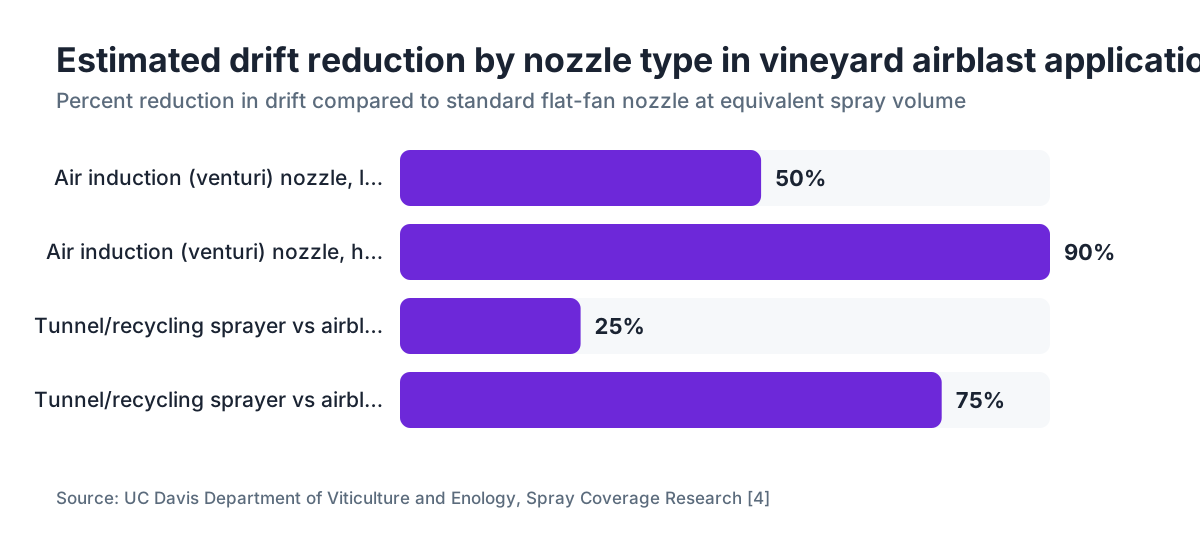
Tunnel (recycling) sprayers wrap the vine row in a shroud that catches spray passing through the canopy and pumps it back into the tank. UC Davis trials in California wine grapes found recycling sprayers cut chemical use by 25-75% versus conventional airblast, depending on canopy density and growth stage [4]. The tradeoff is a higher price, slower ground speed, and more maintenance.
Self-propelled high-clearance sprayers are the big rigs, sometimes adapted from row-crop equipment. You see them in very large flat blocks in the San Joaquin Valley or Washington's Horse Heaven Hills. Tanks can top 1,500 gallons. They earn their keep when you're covering 500-plus acres and can't afford to stop for refills.
Vineyard boom sprayers with downward-directed nozzles work in some high-density or lyre/Scott Henry systems where precise placement beats raw canopy penetration. Less common, but worth knowing if your trellis is unusual.
| Sprayer Type | Typical Tank Size | Best For | Relative Cost (new) |
|---|---|---|---|
| Tower airblast | 500-1,000 gal | Standard upright canopies, most row spacings | $30,000-$80,000 |
| Tunnel/recycling | 500-800 gal | Dense canopies, spray-sensitive neighbors | $80,000-$150,000 |
| Self-propelled high-clearance | 1,000-2,000+ gal | Large flat blocks, 500+ ac | $120,000-$250,000+ |
| Vineyard boom | 300-800 gal | Lyre, Scott Henry, high-density | $25,000-$60,000 |
How do you calibrate a large airblast sprayer for vineyards?
Calibration is where you win or lose on spray efficiency. A sprayer off by 15% is either wasting money on product or, worse, laying down an overapplication that shows up in your use records and flags a compliance problem.
The standard method for airblast sprayers has three steps: measure output per nozzle, measure ground speed, and calculate gallons per acre. Cornell's vineyard spray guidance says collect output from each nozzle individually with a catch cup for 30 seconds, then compare against the manufacturer's rated output at your pressure [5]. Replace any nozzle more than 10% off from the rest.
Ground speed counts as much as nozzle output. A 1 mph change in travel speed shifts your GPA by roughly 10-15%, depending on row spacing. Cornell's formula:
GPA = (GPM x 5,940) / (MPH x row width in feet)
GPM is the total output of all nozzles on one side of the sprayer.
Run the math. A 1,000-gallon sprayer covering 200 acres at 50 GPA empties its tank four times before you finish, and each fill is a fresh chance for operator variation to creep in. Keep a logbook of actual ground speeds and pressure readings for each block, because you'll need to show what GPA you applied if a state inspector asks. VitiScribe's field log templates are built around this per-block spray data, which cuts the end-of-season reporting slog.
WSU Extension publishes a calibration worksheet for airblast sprayers that walks the math in a print-and-take-to-the-field format [3].
What tank size do you actually need for your vineyard acreage?
The honest answer: tank size is less about total acreage than about refill logistics. Where's your water source relative to your blocks? How far is the drive to your mix pad? How many acres can you spray before your product window closes (usually 4-6 hours for most fungicides, though the label sets it)?
A rough working estimate. At 50 GPA and 3 mph with 8-foot rows, a 500-gallon tank covers about 10 acres per fill. A 1,000-gallon tank covers roughly 20. Those numbers move with your GPA target, which ranges from 25 to 100 GPA depending on canopy stage and product.
If your blocks are spread across the property with multiple refill points, a 500-gallon sprayer on a tractor you already own beats a 1,500-gallon self-propelled unit on practicality. If you're running one continuous 300-acre block on flat ground, the big self-propelled rig pays for itself in labor savings inside a few seasons.
Here's what gets overlooked. Large tanks add serious weight. A 1,000-gallon tank of water weighs about 8,300 lbs, before you count the tractor. Spring soil compaction is a real yield problem in many wine regions. Some growers pick smaller tanks on purpose and accept more refill stops to protect soil structure.
How does row spacing and trellis type affect sprayer choice?
Row spacing is the first constraint you work from, not the last. A sprayer that's mechanically perfect for 10-foot rows underperforms badly in 6-foot rows, because the airblast pattern is designed around a set distance from vine to vine.
Most California and Pacific Northwest commercial vineyards run 6 to 12 feet between rows [4]. Tower airblast sprayers are generally engineered for 7 to 12 foot spacings. In tighter plantings you risk overspraying the row center and undertreating the canopy, because the air column has no room to expand and redirect.
Trellis height matters too. VSP (vertical shoot positioning) systems usually run 4 to 6 feet of canopy height, which pairs well with a standard tower airblast. GDC (Geneva Double Curtain) and lyre systems present a wider, lower canopy that may need a custom nozzle setup or a boom rig to get even coverage.
Run a mix of trellis systems across blocks and you'll need either adjustable tower geometry or the discipline to recalibrate between blocks. Plenty of operations skip that recalibration, and it turns up as uneven disease pressure across the property by midseason.
Regions like paso robles wineries tend to run a mix of row spacings across estates, which is exactly why equipment flexibility earns its price in diverse wine regions.
What does EPA's Worker Protection Standard require for large vineyard spray operations?
The EPA Worker Protection Standard (WPS), last revised in 2015 and effective January 2017, sets minimum rules for agricultural workers and pesticide handlers on farms using EPA-registered pesticides [2]. For vineyard spray work, the relevant pieces are training, decontamination supplies, emergency assistance, and application exclusion zones.
Pesticide handlers (the people mixing, loading, or running the sprayer) must complete WPS handler training before they touch pesticides. The training uses EPA-approved materials and repeats every year. You keep records of it: the handler's name, the date, and the trainer's credentials.
The WPS also makes you post pesticide safety information at a central spot, provide decontamination supplies at or near the spray site, and set an Application Exclusion Zone (AEZ) around the sprayer during application. The AEZ rules introduced in 2015 keep anyone other than trained, equipped handlers 25 to 100 feet away during application, depending on the method [8].
EPA describes the standard's aim directly: it requires employers to "provide information about pesticide hazards, safety training, and access to labeling and specific information about pesticides used."
For large operations running multi-person crews, the recordkeeping is a real load. You need handler training records, application records, and product safety data on hand for inspection. State agriculture departments (California's DPR, Washington's WSDA) stack their own requirements on the federal baseline [6].
What pesticide application records do you need to keep for a large vineyard sprayer?
Federal law requires records of restricted-use pesticide (RUP) applications for two years [10]. Many states require records for general-use products too, and several go further. California's Pesticide Use Reporting (PUR) system requires reporting of every agricultural pesticide application, RUP or not, within a month of application [6].
A complete spray record for each pass should carry: date and time, applicator name and license number (if RUPs), field or block ID, product name and EPA registration number, rate per acre, total acres treated, total product used, target pest, crop growth stage, equipment used, and weather (wind speed and direction, temperature, relative humidity) at application.
Washington keeps a three-year window on applicator license records, and Oregon's rules run close [7]. Selling into a certified organic or sustainability program (LIVE, Salmon Safe, CCOF) adds documentation that often exceeds state minimums.
Here's the practical problem. A 300-acre estate might run 12 to 18 spray applications a season across 6 to 10 blocks. That's up to 180 individual application records a year. Paper logs work, but they're slow to add up at season's end and easy to lose. A field platform like VitiScribe builds those per-application records live from the field, which takes most of the pain out of the annual audit.
Keep your mixing records too. Tank mixes with multiple products get tracked individually, and if someone files a drift complaint, your mixing records are the first thing a state inspector asks to see.
How do you manage spray drift from a large airblast sprayer in a vineyard?
Drift is the biggest complaint trigger and the most common reason vineyard operators end up in front of a county agricultural commissioner. Large airblast sprayers are powerful by design, and that power is what makes them good at canopy penetration. It's also what makes them a drift risk.
The drift levers are nozzle type and size, operating pressure, air volume and velocity, ground speed, and timing against the wind. Lower pressure means coarser droplets and less drift, but it also softens coverage uniformity. That's a genuine tradeoff, not a free fix.
Wind speed is the clearest lever. Most labels require application below 10 mph. In practice, seasoned operators set a personal limit of 5 to 7 mph and stop well before noon in summer, when valley winds pick up. UC Davis extension recommends early-morning applications in regions with diurnal wind patterns, which covers most of California wine country [9].
Tunnel sprayers largely erase drift by holding the spray inside the shroud. If you have sensitive neighbors (organic operations, homes, apiaries), that drift argument can justify a tunnel sprayer's price premium even at moderate acreage.
Nozzle choice moves the needle hard. Air induction nozzles (also called venturi nozzles) make larger droplets that resist drift far better than standard flat-fan tips at the same pressure. They cost more per tip, but the coverage tradeoff in dense canopies is usually fine. UC Davis published trials showing air induction nozzles cut drift by 50-90% versus standard flat-fan nozzles at equivalent spray volumes [4].
What does a large vineyard sprayer actually cost, and what's the total cost of ownership?
Purchase price is the easy number to find. Operating cost over a 10 to 15 year life is the one most buyers lowball.
New tower airblast sprayers from makers like Gregoire, Berthoud, Munckhof, or Durand-Wayland run $30,000 to $80,000 depending on tank size and nozzle count. Tunnel recycling sprayers from the same tier start around $80,000 and push past $150,000 for large-tank builds. Self-propelled high-clearance units sit in another category, often $150,000 to $250,000 or more once you count the sprayer head [3].
Used equipment can pencil out, but the risks are real. Worn pumps, cracked tank seams, and uneven nozzle wear all hide better on a used unit. Have any used sprayer independently inspected and calibrated before you buy.
Season operating costs for a 500-gallon airblast sprayer:
- Fuel: tractor fuel for spray runs, roughly 1 to 2 gallons an hour at field load
- Nozzle replacement: swap tips when output drifts more than 10% off rated, typically every 15,000 to 25,000 gallons of solution through the tip [5]
- Pump maintenance: diaphragm pumps need valve and diaphragm replacement every 500 to 1,000 hours, piston pumps less often
- Filter cleaning: at every fill, more in heavy-residue conditions
- Tank agitation maintenance: annually at minimum
The biggest hidden cost is downtime. A large sprayer that dies during peak fungal pressure (bloom through veraison in most regions) can cost you more in disease losses than the sprayer is worth. Keep a parts kit with common wear items in the shop before spray season: diaphragm rebuild kits, nozzle tips, pressure gauges, and filter screens.
How do you set fan speed and air volume for different canopy growth stages?
This is where a lot of managers leave coverage on the table. Most operators set fan speed once at the start of the season and leave it. Trouble is, a vine at bud break has almost no leaf to catch spray, while the same vine 8 to 10 weeks later has a full, dense canopy that needs much more air volume to penetrate.
WSU Extension's orchard and vineyard spray guide recommends adjusting air volume and nozzle setup at three canopy stages: pre-bloom (small, open canopy), bloom through fruit set (rapidly developing canopy), and post-fruit set through veraison (full dense canopy) [3]. Each stage wants its own GPA target and nozzle arrangement.
At pre-bloom with a sparse canopy, high air volume just blows through the vines and makes drift. Drop the fan speed and cut output. At full canopy, you need maximum air to push spray into the interior shoot zone where botrytis starts in tight-cluster varieties.
A practical schedule for a tower airblast sprayer. Run the fan at 70-75% of rated RPM at bud break, step up to 85-90% at bloom when the canopy is half-built, and run 95-100% from fruit set through harvest depending on density. Move nozzle positions to concentrate spray in the fruiting zone once shoot growth passes the fruiting wire.
This matters most for botrytis in tight-cluster varieties like Pinot Noir, Gewurztraminer, and Riesling, where interior coverage during the window from bloom to 3 or 4 weeks after sets your infection rate.
What are the best practices for maintaining a large vineyard sprayer between seasons?
Off-season maintenance is where you either protect the investment or plan your next big purchase. Large vineyard sprayers have long replacement cycles (10 to 20 years if maintained), and the work between November and January mostly decides whether that 20-year life is real.
Flush the system with clean water after the last application. Then flush again with a tank cleaner matched to the residue left behind. Triple-rinse per label. Copper products, sulfur, and synthetic fungicides each want their own cleanup, and mixing incompatible residues can cause gelling or corrosion.
After flushing, drain the pump and spray lines fully, especially in freeze country. Water left in a diaphragm pump that freezes cracks the head. Run RV antifreeze (not automotive) through the pump and lines if storage temperatures might drop below 28 degrees F.
Nozzle inspection is the most skipped and highest-return step. Pull every nozzle, check the tip for wear (a worn orifice throws an irregular pattern you can see by spraying water over white paper), clean the screens, and replace any tip more than 10% off rated output [5]. Cap nozzles individually if you store in a frost-prone spot.
Inspect hoses for cracks at the fitting connections (the highest-stress point), check tank walls for UV damage or cracks, grease every fitting per the manufacturer's schedule, and swap worn boom seals. Calibrate again at the start of next season, before your first application, not during it.
How do self-propelled vineyard sprayers compare to tractor-mounted units for large operations?
Self-propelled sprayers free your tractors for other work during the spray window, which matters more than it sounds during the compressed bloom-to-fruit-set stretch when you might need to mow, cultivate, and spray at once. That's the strongest practical argument for going self-propelled in a large operation.
Speed is the second argument. A purpose-built self-propelled vineyard sprayer sized to your row width with a 1,500-gallon tank covers ground faster than a tractor rig, because it skips the weight and drag of a general-purpose tractor. Some operators in large Washington and California blocks report 20-25% throughput gains over their old tractor-mounted setups, though nobody has published a controlled trial on this exact comparison.
The case against. They're expensive to service because they're specialized. Any tractor dealer can work on your tractor. A self-propelled sprayer from a European maker can carry a 2 to 4 week parts lead time when something odd fails. In a region like south coast winery country, where weather windows run short, that parts gap hurts.
Under 300 acres with a modern 100-plus hp tractor already in the fleet, a tractor-mounted tower airblast sprayer is almost certainly the smarter buy. Above 500 acres with the terrain and infrastructure to support it, the self-propelled math starts to favor the bigger check. The 300 to 500 acre middle is genuinely a toss-up, and the right call depends on your labor costs, spray-timing pressure, and block layout.
Frequently asked questions
How many acres can a 500-gallon vineyard sprayer cover per hour?
At typical settings (50 GPA, 3 mph, 8-foot rows), a 500-gallon tank covers about 10 acres per fill. At 3 mph you cover roughly 1.5 to 2 acres per hour of actual spray time, so a full tank takes 5 to 7 hours of continuous spraying to empty. In practice, refills, row-end turns, and equipment checks pull real-world throughput below what the math suggests.
What is the difference between GPA and rate in vineyard spraying?
GPA (gallons per acre) is total spray volume per acre, water and all products together. Rate is the amount of a specific active ingredient per acre, in ounces, pounds, or fluid ounces. The pesticide label sets your product rate. You set GPA by diluting that rate into enough water to reach the coverage your canopy needs. You can move GPA a lot while holding product rate constant by changing concentration.
Do I need a pesticide applicator license to operate a large vineyard sprayer?
It depends on what you spray. Apply any Restricted Use Pesticide (RUP) and you or a licensed applicator must hold a valid state applicator certificate. General-use products don't require a license in most states, but the EPA Worker Protection Standard still requires handler training for anyone mixing, loading, or operating the sprayer on a commercial farm, license or not.
How often should I replace nozzle tips on a large vineyard sprayer?
Cornell extension says replace tips when output deviates more than 10% from the manufacturer's rated flow at your operating pressure. That often lands after 15,000 to 25,000 gallons of solution through the tip, but abrasive products like wettable sulfur or copper speed up wear a lot. Catch-cup test each nozzle at the start of every season, and again midseason if you run abrasive materials.
Can you use a standard row-crop sprayer in a vineyard?
A standard flat-boom row-crop sprayer doesn't work in most vineyard setups. It's built for low crops and can't drive spray into an upright trellis canopy. Vineyards need airblast equipment for penetration or a specially configured vertical boom. Some operators adapt row-crop high-clearance sprayers with drop nozzles for certain trellis types, but that takes careful engineering and calibration.
What wind speed is safe for airblast spraying in vineyards?
Most labels prohibit application above 10 mph. In practice, experienced operators set a working limit of 5 to 7 mph and spray early morning before winds build. Airblast sprayers generate their own air velocity that can amplify ambient wind. UC Davis extension recommends pre-dawn to mid-morning applications in California regions with a predictable afternoon wind increase.
What records does the EPA Worker Protection Standard require for vineyard spray applications?
Under 40 CFR Part 170, agricultural employers must keep WPS handler training records (name, date, trainer), post pesticide safety information centrally, and maintain application-specific information including the product applied, the field treated, and the re-entry interval. These records must be available to workers and handlers on request, and training records are kept for two years after the training date.
How does a tunnel sprayer reduce pesticide use in vineyards?
A tunnel sprayer wraps the vine row in a shroud that catches droplets passing through the canopy instead of letting them escape into the air. Collectors on the far side recover that spray and pump it back into the tank for reuse. UC Davis trials found this recycling effect cuts total chemical use by 25-75% versus conventional airblast, with the higher savings in open canopies early in the season.
How do I calculate gallons per acre for my vineyard sprayer?
Use this formula: GPA = (GPM x 5,940) / (MPH x row width in feet). GPM is total output from all nozzles on one side, measured by catch-cup timing. MPH is your actual field travel speed, measured by GPS or timed over a known distance. Row width is your between-row spacing in feet. Rerun the math every time you change nozzle size, pressure, or ground speed.
What tank size large sprayer makes sense for a 100-acre vineyard?
For 100 acres, a 500 to 800 gallon tractor-mounted tower airblast sprayer is generally the fit. At 50 GPA and 3 mph, you'll make 10 to 20 fills per application depending on GPA target and block layout, which is manageable with water in or near the blocks. A 1,000-gallon tank gives longer runs but adds real weight, which matters if your soils are compaction-sensitive in the spring window.
How long does it take to spray a vineyard with a large airblast sprayer?
Rough estimate: at 2 acres per hour of actual spray time (3 mph, 8-foot rows), a 100-acre vineyard takes about 50 hours of spraying. Add 20-30% for row-end turns, refills, and equipment checks. That puts a full 100-acre application at 2 to 3 full days for a single operator and sprayer. Block layout matters enormously. Long straight rows beat short irregular blocks with lots of row-end stops.
Is it worth buying a used large vineyard sprayer?
Used equipment can save 30-50% of purchase price, but the risks are real: pump wear, tank integrity, and uneven nozzle wear are hard to spot without a thorough inspection. Have any used sprayer independently calibrated before you buy. Ask for service records. Nozzle replacement on a large tower sprayer can run $500 to $1,500 if every tip needs swapping, worth factoring into your offer.
What is the re-entry interval (REI) and how does it apply to vineyard spray crews?
The REI is the time that must pass after application before workers can re-enter the treated area without personal protective equipment. REIs range from 4 hours for many fungicides to 48 hours or more for some insecticides. The REI prints on every pesticide label. Under the EPA WPS, vineyard employers must post REI information centrally and tell all workers before they enter treated areas.
Sources
- UC Statewide Integrated Pest Management Program, Pesticide Application and Safety: Calibration errors affect both coverage uniformity and application rate compliance in commercial vineyard spray operations
- EPA, Agricultural Worker Protection Standard (40 CFR Part 170): WPS requires annual handler training, decontamination supplies, central information posting, and Application Exclusion Zones during pesticide applications on agricultural operations
- Washington State University Extension, spray technology and calibration guidance for Pacific Northwest vineyards and orchards: WSU Extension recommends adjusting air volume and nozzle configuration at three key canopy growth stages and provides calibration worksheets for airblast sprayers
- UC Davis Department of Viticulture and Enology, canopy management and spray coverage research: UC Davis trials found recycling tunnel sprayers reduce chemical use 25-75% compared to conventional airblast; air induction nozzles reduced drift 50-90% vs standard flat-fan nozzles at equivalent volumes
- Cornell University College of Agriculture and Life Sciences, vineyard spray application and calibration guidance: Cornell recommends catch-cup measurement of each nozzle for 30 seconds and replacing tips that deviate more than 10% from rated output; typical tip life is 15,000-25,000 gallons of solution
- California Department of Pesticide Regulation, Pesticide Use Reporting program: California requires reporting of all agricultural pesticide applications (not just RUPs) within one month of application under the Pesticide Use Reporting program
- Washington State Department of Agriculture, pesticide applicator licensing and recordkeeping: Washington requires pesticide applicator license records to be maintained for three years; Oregon requirements are comparable
- EPA, Agricultural Worker Protection Standard revision (2015): The 2015 WPS revision introduced Application Exclusion Zone requirements prohibiting untrained persons within 25-100 feet of active pesticide applications depending on application method; the standard became effective January 2017
- UC Agriculture and Natural Resources Cooperative Extension, spray drift management guidance: UC Davis recommends early morning applications in regions with diurnal wind patterns and notes that most product labels require application when wind is below 10 mph
- National Pesticide Information Center (Oregon State University and EPA), pesticide recordkeeping: Federal law requires pesticide application records for restricted-use pesticides to be kept for two years; state requirements often exceed this baseline
Last updated 2026-07-10