Leveling soil for a vineyard: what to grade, when, and how
TL;DR
- Vineyard soil leveling removes high spots, improves drainage, and lets equipment move safely between rows.
- Most sites need laser grading to within 0.1-foot tolerance before planting.
- Topsoil depth is the main risk: strip and stockpile it first.
- Budget $500, $4,000 per acre depending on slope severity, equipment, and whether you're doing a rough cut or finish grade.
Why does leveling soil matter before planting a vineyard?
Vines don't need flat ground. What they can't tolerate is uneven ground that ponds water in some rows while leaving the next row bone dry, or slopes so irregular that a tractor tilts past a safe operating angle. Those two problems, poor drainage and equipment hazard, drive almost every vineyard grading project.
Water pooling in low spots kills vine roots fast. Even a short saturation during dormancy can thin a stand within one season. The flip side is a high crown in a row that drains so aggressively the vine hits drought stress two weeks before everything around it. Both are preventable with a properly graded surface before you set a single post.
Equipment safety gets ignored until somebody rolls a tractor. OSHA and most state farm safety programs flag side-slope operation above 15 to 20 degrees as high-risk for overturn [1]. A vineyard with irregular micro-terrain can hit those angles on short stretches that a paper survey never flags. Laser grading smooths those lurking spots out.
A level pad also gives you accurate row spacing. Stake rows across a bumpy surface and the lines that look parallel on paper will converge slightly where the ground rises. That makes end-of-row maneuvering harder for the life of the block, which could be 30 years or more.
What's the difference between rough grading and finish grading for a vineyard?
Rough grading is the bulldozer pass. You're moving real volumes of earth, cutting high spots down and filling hollows, working to maybe a 6-inch tolerance. This is where you set the gross drainage slope you want, usually 1 to 3% across the row direction and 0.5 to 2% along rows [2]. It's fast and cheap per hour. It also leaves a surface you cannot plant into.
Finish grading, usually done with a laser-guided land plane or box blade, brings you to the 0.1-foot tolerance that vineyard consultants typically specify. That precision matters because irrigation emitters are designed around a pressure-uniformity assumption. A surface that wanders by 6 inches across a 600-foot row produces meaningfully different emitter output at the low end versus the high end, even on drip.
Some sites need a third pass, tillage and soil conditioning, before the ground can actually hold vine roots. That's not grading in the earthmoving sense. It's breaking up the compaction the heavy equipment just created. Plan for it. A deep ripper or subsoiler run at 18 to 24 inches after grading is almost always money well spent on a site that's been bulldozed.
One thing worth separating out. If you're cutting terraces into a hillside, that's terrace construction, not grading in the flatland sense. The equipment overlaps, but the drainage design is completely different and usually needs a licensed engineer or an experienced vineyard designer on sites above 10% average slope.
How do you protect topsoil when grading vineyard land?
This is the step most first-time developers get wrong, and it's the one you can't fix cheaply after the fact. Topsoil in most agricultural areas is 6 to 18 inches deep [3]. The subsoil under it is often low in organic matter, poorly structured, and sometimes high in clay or calcium carbonate. Vines planted into scraped subsoil grow slowly, produce poorly, and may never fully recover.
The protocol is simple but demands planning. Before any heavy equipment moves, strip the topsoil from the entire project area and stockpile it outside the grading zone. Take what's there, even if it's only 4 inches. Mark the pile clearly so equipment doesn't track over it.
Once the rough grade is complete, and before you finish grade, spread that topsoil back across the surface at a consistent depth. Many vineyard consultants recommend at least 12 inches of topsoil going into planting. If your native topsoil doesn't get you there, this is the moment to bring in certified agricultural-grade topsoil or compost, not after the vines are in the ground.
UC Davis Cooperative Extension has documented repeatedly that vine yield and quality correlate strongly with the depth of the effective rooting zone in the first several years [4]. Destroying that zone with a dozer blade is a long-term economic mistake that no amount of fertilizer fully corrects.
What slope and drainage design should a vineyard have?
The textbook answer from most extension programs is 1 to 3% cross-slope (perpendicular to rows) for surface drainage and a minimum 0.5% along-row slope to carry water toward the end of each row [2]. Those numbers work on most sites and are easy for a laser grader operator to hit.
They're starting points, not rules. On heavy clay in a high-rainfall region, you might push the cross-slope to 3 to 5% to shed water faster. On a sandy, drip-irrigated site in a dry region like parts of the Paso Robles appellation, surface drainage matters less and subsurface flow patterns matter more.
Aspect matters too. In cool-climate regions, south-facing slopes (in the Northern Hemisphere) capture more heat units and can shift ripening dates by weeks. If your grading choices wipe out a favorable aspect across part of the block, that's a yield and quality decision more than an engineering one. A good vineyard designer will model heat accumulation across proposed grades before you commit.
Drainage swales at the end of rows are often cheaper than engineering the entire block surface to carry water. A collection swale at the toe of each row, graded at 0.2 to 0.5% toward a detention basin or waterway, handles rainfall events that would overwhelm even a 3% cross-slope. If your county requires a stormwater plan for agricultural development above a certain acreage, those swales belong in the design documents from day one.
What equipment is used to level vineyard soil?
The sequence runs like this: dozer or scraper for rough cut, laser-guided land plane for finish grade, subsoiler for compaction relief, then disk or chisel plow for seedbed prep.
A D6 or D7 bulldozer handles moderate cut-and-fill work. For larger volumes, a self-propelled scraper (a Caterpillar 623 or equivalent) is faster because it cuts, carries, and dumps in one machine, which cuts the number of passes. Scrapers pay off when you're hauling earth more than about 300 feet. Inside that distance, a dozer with a box blade is often cheaper.
The laser land plane is the finish tool. It carries a GPS or rotating laser receiver on a float behind a tractor and adjusts blade angle automatically to hold a pre-programmed grade. Rental rates in most regions run $150, $300 per hour for the tractor-and-implement combination, and contractor pricing varies by region. A 10-acre block typically takes 4 to 8 hours of finish grading depending on how rough the dozer left it.
Subsoiler shanks should run at least 18 inches deep after grading, ideally 24 inches if your soil profile allows. Shank spacing matters too: 18 to 24 inches apart is standard. Run the subsoiler in the direction your rows will run so you're fracturing the compaction pan right where vine roots need to go.
One note on tracks versus wheels. Track machines beat wheeled machines on soft or wet soil because they spread weight over a larger footprint and compact less. Send a rubber-tired scraper onto a wet, high-clay site in spring and you can build a compaction layer so severe it defeats the whole point of grading.
How much does it cost to grade vineyard land per acre?
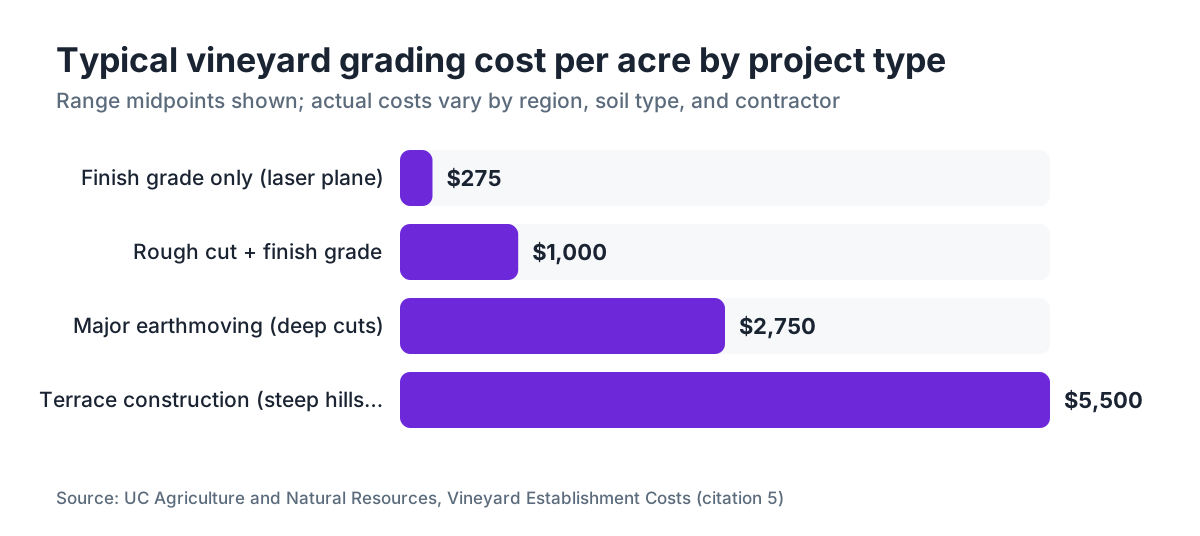
Honest range: $500 to $4,000 per acre, with most straightforward projects landing between $800 and $2,000 per acre [5]. The spread is real and driven by a handful of factors.
Cut depth is the biggest variable. A site that needs 12-inch cuts across 40% of its area is a completely different project than one needing a 2-inch finish grade. Equipment mobilization is a fixed cost that spreads better over larger jobs, so 50-acre developments often see lower per-acre costs than 5-acre ones.
Soil type drives speed and wear. Rocky soils cost more because you're either grinding through rock or blasting, and both add time and money. High clay soils force you into narrow weather windows to avoid compaction, which means more scheduled mobilizations.
Below is a rough cost comparison by project type.
| Project type | Typical cost per acre | Notes |
|---|---|---|
| Finish grade only (laser plane) | $150, $400 | Surface already roughly even |
| Rough cut + finish grade | $500, $1,500 | Moderate cut-and-fill |
| Major earth moving (deep cuts) | $1,500, $4,000 | Large volume, rocky or wet soil |
| Terrace construction (steep hillside) | $3,000, $8,000+ | Requires engineering, retaining structures |
These numbers reflect contractor pricing in California and the Pacific Northwest as of 2024 to 2025. Costs in lower-wage regions may run 20 to 30% lower. Always get three bids and ask each contractor to specify the cut volume they're pricing. Two bids "per acre" can be pricing entirely different scopes of work.
When is the best time of year to grade a vineyard site?
Late summer through early fall is the window most experienced developers prefer across the continental U.S. The soil is dry enough to carry heavy equipment without compacting badly, conditions are stable enough for the laser grade to stick, and you have time to subsoil and get a cover crop established before winter rains.
Spring grading is tempting because the planting date looms, but spring soil in most wine regions is wet. Wet soil compacts under equipment weight, and the pan you create in April can persist for years. WSU Extension recommends waiting until the soil is at or below field capacity before running heavy equipment, which in Washington's Columbia Valley often means August or September [6].
Don't grade into rainstorms. A freshly graded surface with disturbed soil and no cover erodes fast. California's Regional Water Quality Control Boards require stormwater erosion control best management practices (BMPs) on graded agricultural land over certain acreages [7]. Even where it isn't legally required, a 2-inch rain on a freshly graded site can undo days of finish work and cut gullies you'll be chasing for years.
If you have to grade in late fall or winter, the minimum response is a cover crop seeded right after the finish grade. Cereal rye or a mustard mix at standard seeding rates germinates fast and holds the surface through the wet season. You'll disk it down in spring before planting, but it buys you the winter without erosion damage.
Do you need permits to grade land for a vineyard?
Probably yes, depending on where you are and how much you're moving. The honest answer means checking at three levels: federal, state, and county.
Federal: if your project involves grading within or adjacent to waters of the United States, including seasonal wetlands, you may need a Section 404 permit from the Army Corps of Engineers [8]. That's not uncommon for vineyard sites in California, Oregon, and Washington where seasonal drainages cross farmland. The definition of "waters of the U.S." has shifted through multiple administrations, so get a wetland delineation from a qualified biologist before you grade any site with drainage features.
State: many states require grading permits for projects over a certain acreage of disturbance. California's Construction General Permit (CGP) under the State Water Resources Control Board applies to sites with one acre or more of soil disturbance [7]. Oregon and Washington have similar provisions.
County: most counties require a grading permit for projects moving more than a set volume of earth, commonly 50 to 200 cubic yards. The permit typically requires a grading plan stamped by a licensed engineer or land surveyor.
Agricultural exemptions exist in many states and can cut the permitting burden a lot. California has an agricultural exemption to the CGP for some farm operations, but it carries conditions and doesn't apply to all grading work. Your local Resource Conservation District (RCD) is usually the fastest path to figuring out what applies to your site, and it can sometimes provide low-cost technical help.
How do you survey and plan a vineyard grading project?
Start with a topographic survey. A drone-based photogrammetry survey of a 20-acre site typically costs $500, $2,000 and produces a 1-foot or better contour map within a few days. That map becomes the basis for your cut-and-fill analysis, which tells you how much earth moves and whether the site is roughly balanced (cuts equal fills) or needs material imported or exported.
A balanced site is far cheaper than one that needs fill hauled in. If your analysis shows a real deficit, factor in fill costs: agricultural-grade fill in most wine regions runs $15, $40 per cubic yard delivered, and a 10-acre site needing 6 inches of fill across a third of its area can swallow thousands of cubic yards. That's a budget-blowing surprise if you didn't see it coming.
GPS-guided grade design software is now within reach of vineyard managers without an engineering background. Programs like Trimble's business software or AutoCAD Civil 3D let you model proposed grade planes and see the resulting cut-and-fill volumes before a single machine moves. Many grading contractors already run these tools and can provide a preliminary design as part of their bid.
For row orientation, the grading plan and the row layout plan have to develop together. Running rows up-and-down slope (in the direction of maximum gradient) controls erosion better than running them across slope in some situations, but it fights the preference in many cool climates to orient rows for maximum sun exposure. Those tradeoffs belong in the design phase, not after the contractor has staked the work.
What soil compaction risks come with vineyard grading, and how do you fix them?
Heavy equipment compacts soil. That's not a risk, it's a certainty. The only question is how deep and how severe.
A loaded dozer or scraper compacts soil to roughly the depth of the wheel or track sinkage plus another 6 to 12 inches of pressure wave below that. On soft soil, that can mean a pan at 12 to 18 inches that restricts vine roots for years. Cornell viticulture research on New York sites has documented rooting depth correlating directly with pre-plant soil preparation, including compaction relief [9].
The standard fix is a deep-shanked subsoiler run after all heavy grading is done. Two passes at 90 degrees to each other (a cross-rip pattern) break up pans in every direction. One pass in the row direction, then one across rows, takes more time and fuel but leaves a more uniformly fractured subsoil layer.
Soil health after grading is worth a soil test. A standard test that includes bulk density tells you how compacted you actually are. Bulk density above 1.6 g/cm³ in most loam and sandy loam soils indicates significant restriction to root growth [10]. Below 1.4 g/cm³ is generally fine for most grapevine rootstocks.
Gypsum applied after subsoiling helps flocculate clay soils and improve structure in the months before planting. Rates of 1 to 2 tons per acre are common on California's Central Coast, where clay soils are widespread. It's no substitute for physical compaction relief, but it improves water infiltration and speeds the natural recovery of soil structure.
If you're tracking pre-plant soil prep records and tying them to later block performance, a tool like VitiScribe makes it easy to log equipment passes, soil test results, and amendment applications in one place, so you can trace a problem back to site prep years down the line.
How does grading affect erosion and water quality compliance?
A freshly graded vineyard site is an erosion machine until you get ground cover established. Bare disturbed soil erodes at rates 10 to 100 times higher than established cover, and that sediment ends up in local waterways.
California's Irrigated Lands Regulatory Program (ILRP) under the State Water Resources Control Board requires growers in many regions to run erosion control practices and, in some cases, keep monitoring records [7]. Similar programs run in Oregon and Washington. The EPA's National Pollution Discharge Elimination System (NPDES) permit program sets the federal floor, and state agricultural water quality programs often layer more requirements on top.
Best management practices for post-grading erosion control include permanent cover crops in row middles established right after finish grade, straw wattles or silt fences at the toe of slopes until vegetation takes hold, and slope breaks every 200 to 300 feet on grades above 3%. The Natural Resources Conservation Service (NRCS) publishes technical standards for each of these and can provide cost-share funding under the Environmental Quality Incentives Program (EQIP) for practices that qualify [11].
The EPA's Worker Protection Standard (WPS) doesn't cover earthmoving directly, but once a site moves from construction to agricultural operation, WPS requirements apply to pesticide work crews may encounter [12]. If you're doing any pre-plant fumigation or herbicide work on a graded site, WPS posting and notification requirements are in effect.
For most small sites under 10 acres, the practical approach is straightforward: seed a cover crop within two weeks of finish grading, install a silt fence at the downslope boundary, and keep records of what you planted and when. That demonstrates good faith under most state programs and cuts actual erosion risk substantially.
What mistakes do first-time vineyard developers make when grading?
The topsoil mistake comes first. I covered it above, but it bears repeating: stripping and stockpiling topsoil before grading is the single most important prep step, and it's the one most often skipped when developers are rushing toward a planting date.
The second most common mistake is grading too flat. Some developers see "drainage slope" in the plan and figure flatter is safer, but a 0.1% slope on clay soil in a 30-inch rainfall zone is a recipe for ponding. The 1% minimum guideline exists for a reason.
Grading without a post-grade soil test is the third mistake. You've moved earth, mixed horizons, maybe exposed subsoil over part of your site, and you have no idea what the nutrient and pH picture is across the block before you plant. A grid soil sample at one sample per 2.5 acres costs maybe $300, $600 for the whole block and tells you exactly where amendments are needed.
Fourth: not accounting for settle. Fill areas compact and settle after grading, sometimes several inches over the first one to two winters. If you finish-grade in fall and plant in spring, recheck grades before post installation. What measured 1.5% in October might read 0.8% in March after settlement and frost heave.
Fifth, and this one is expensive: over-grading a site that had natural drainage working for it. If a site already has a consistent 2% natural slope in roughly the right direction, sometimes a single light pass with a laser plane is all you need. Bringing in a full grading crew for a site that only needed finish work burns $1,000, $2,000 per acre you didn't need to spend.
Frequently asked questions
How flat does a vineyard need to be?
Vineyards don't need to be flat; they need to drain predictably. A cross-slope of 1 to 3% perpendicular to vine rows is the standard target for most sites, with a minimum 0.5% slope along rows to move water toward row ends. Perfectly flat ground (0%) causes standing water problems on most soil types. Slopes above about 15 to 20% typically require terracing rather than general grading.
Can I grade a vineyard site myself, or do I need a contractor?
You can rent a tractor-mounted laser land plane and do finish grading yourself if you have equipment experience, but rough cut work with a bulldozer or scraper almost always needs a licensed earthmoving contractor with the right insurance and equipment. Mistakes on rough cut, especially burying topsoil or cutting too deep, are expensive to correct. For sites over 5 acres, professional grading usually pays for itself in avoided errors.
How long after grading should I wait before planting vines?
Most vineyard consultants recommend waiting at least one full growing season after rough grading before planting. This lets fill areas settle, lets a cover crop cycle improve soil biology, and gives you time to do post-grade soil testing and amendment. Emergency timelines can compress this, but planting immediately after grading into disturbed, un-amended soil consistently produces slower vine establishment and uneven first-leaf growth.
How do I grade a sloped or hillside vineyard site?
Hillside sites above about 10% average slope typically need terrace construction rather than general grading. Terraces cut benches into the slope with a flat or slightly back-sloped pad for the vine row and a compacted berm or cut face below. Above 15 to 20% slope, engineering review is usually required and in many counties mandatory. Hillside grading on steep sites without proper terrace design causes serious erosion and soil loss.
What cover crop should I plant immediately after grading a vineyard?
Cereal rye is the most reliable quick-cover option after grading because it germinates in cool, dry conditions and establishes fast. A mix of cereal rye at 50 to 75 lbs per acre with a winter legume like crimson clover or hairy vetch adds nitrogen benefit. Avoid aggressive perennials like tall fescue as a post-grade seeding; they establish too slowly to prevent erosion in the first winter and become hard to manage later.
How deep should I subsoil after grading for a vineyard?
Standard practice is 18 to 24 inches with shanks spaced 18 to 24 inches apart, run in the direction of the vine rows. Where equipment compaction is suspected to be deeper (from heavy scrapers on soft soil), going to 30 inches is reasonable if your subsoiler has the reach and your tractor the horsepower. Two passes at 90 degrees to each other, a cross-rip pattern, does a better job than one pass alone.
Will grading affect my vineyard's water rights or drainage permits?
It can. Changing surface drainage patterns can affect downstream water flow, which in western states with prior appropriation water law may have legal implications if you're redirecting water off your property in a new direction or volume. Section 404 of the Clean Water Act also applies if grading affects seasonal wetlands or streams. Check with your county planning department and your local NRCS office before committing to a grade design that significantly changes where water exits the property.
How do I get a topographic survey done before vineyard grading?
Drone photogrammetry is the fastest and most affordable option for most vineyard sites. A licensed surveyor or agricultural drone operator can survey a 20-acre site and deliver a contour map to 1-foot or better accuracy within a few days, typically for $500, $2,000. Traditional ground-based survey is more accurate for small critical areas but much slower for full-site mapping. Your grading contractor may include a basic topo survey as part of their bid; ask.
Does vineyard grading require an engineering permit?
It depends on location and project size. Most counties require a grading permit for projects moving more than 50 to 200 cubic yards of soil, and many require a plan stamped by a licensed engineer or land surveyor. California, Oregon, and Washington also have stormwater permit requirements for soil disturbance over one acre. Agricultural exemptions can reduce the burden but don't eliminate all requirements. Always check with your county planning and your state's water quality board before starting.
How much topsoil depth do I need to leave after grading a vineyard?
A minimum of 12 inches of topsoil above subsoil is the commonly cited standard from UC Davis and other extension programs. Where native topsoil is only 6 to 8 inches deep, the grading plan needs to be conservative about how much cutting happens in those areas, or you need to plan to amend with compost or imported topsoil after grading to bring effective depth back up. Anything under 8 inches over a significant portion of a block will show up in yield data within the first few crop years.
What is laser grading and is it worth it for a vineyard?
Laser grading uses a rotating laser emitter and a receiver mounted on a land plane float, which automatically adjusts the blade angle to maintain a pre-programmed slope. It gets finish grades to within 0.1 feet across a field. For vineyards, it's almost always worth the cost because the uniformity it produces directly affects irrigation efficiency and drainage. Rental rates typically run $150, $300 per hour; most 10-acre blocks take 4 to 8 hours for finish grading.
How does grading affect soil pH and nutrient levels in a vineyard block?
Grading mixes soil horizons and can expose subsoil with very different pH and nutrient content than your native topsoil. Areas with deep cuts may surface calcareous subsoil with high pH (7.8 to 8.5), which locks up iron and zinc and causes chlorosis in young vines. Always do a post-grade grid soil sample at one sample per 2.5 acres or finer before you plant, and address pH and nutrient issues with amendments before vines go in. Correcting pH under established vines is slow and expensive.
Can grading fix waterlogging in an existing vineyard, or does the vineyard need to be replanted?
In most cases you can't laser-grade between established vine rows; the equipment clearance isn't there and root disturbance would be severe. For existing vineyards with chronic waterlogging, the practical options are subsurface tile drainage installed with a vibratory plow or trencher, raised berms built in vine rows, or in severe cases, replanting after grading the block. Subsurface tile drainage is often the least disruptive fix and can be installed without removing vines if drainage depths allow.
Sources
- OSHA, Agricultural Operations Safety and Health Topics: Tractor operation on slopes above 15 to 20 degrees is flagged as high-risk for overturn in farm safety guidance
- UC Davis Cooperative Extension, Vineyard Design and Layout: Recommended cross-slope of 1 to 3% perpendicular to rows and minimum 0.5% along rows for vineyard drainage
- UC Davis Cooperative Extension, Viticulture Research Publications: Vine yield and quality correlate with rooting zone depth in early years of establishment
- University of California Agriculture and Natural Resources, Vineyard Establishment Costs: Vineyard land leveling and grading costs typically range from $500 to $4,000 per acre depending on cut depth and site conditions
- Washington State University Extension, Vineyard Site Preparation: WSU Extension recommends waiting until soil is at or below field capacity before running heavy equipment, often August, September in the Columbia Valley
- California State Water Resources Control Board, Construction General Permit: California's CGP applies to sites with one acre or more of soil disturbance and requires stormwater erosion control BMPs
- US Army Corps of Engineers, Section 404 Permit Program: Section 404 of the Clean Water Act requires permits for grading or fill activities in or adjacent to waters of the United States, including seasonal wetlands
- Cornell University College of Agriculture and Life Sciences: Cornell viticulture research documents rooting depth correlating directly with pre-plant soil preparation including compaction relief
- US EPA, Worker Protection Standard for Agricultural Pesticides: EPA Worker Protection Standard applies to pesticide applications on agricultural establishments, requiring posting and notification once a site moves from construction to agricultural operation
Last updated 2026-07-09