Lime sulfur for powdery mildew on grapes: rates, timing, and safety
TL;DR
- Lime sulfur (calcium polysulfide) is a century-old, OMRI-listed fungicide that kills powdery mildew on grapes by contact and vapor action.
- Apply at 1 to 3 gallons per 100 gallons dilute when shoot tips are 1 to 6 inches.
- It burns foliage if applied above 90°F or within 2 weeks of oil.
- PHI is 0 days on most labels, but re-entry interval is 48 hours under EPA WPS.
What is lime sulfur and how does it work against powdery mildew?
Lime sulfur is a liquid calcium polysulfide solution, usually sold at 29 to 32% active ingredient. It's one of the oldest fungicides in commercial viticulture, older than the whole synthetic era, and it still earns its place in a modern spray program. Especially an organic one.
The mode of action is multi-site. When the solution hits a powdery mildew colony (Erysiphe necator, formerly Uncinula necator), polysulfide ions tear up cell membranes, denature proteins, and throw off hydrogen sulfide gas that poisons fungal spores on its own [1]. Because it attacks several biochemical targets at once, powdery mildew has a very hard time evolving around it. That matters right now, given documented resistance to DMI (Group 3) and SDHI (Group 7) fungicides in E. necator populations across California and Washington [2].
Lime sulfur is protective, and it has some eradicant kick at higher rates. It can knock back an early colony rather than only preventing germination. Don't treat it as a rescue spray for a bad infection. But a well-timed application after a disease event does cut inoculum load in a way you can measure.
When should you apply lime sulfur to grapevines for powdery mildew?
Timing is everything with lime sulfur. Two windows actually move the needle: dormant or delayed-dormant, before budbreak, and early-season after budbreak up to roughly 12-inch shoot tips.
Dormant applications at 1:9 dilution (about 1 gallon concentrate per 9 gallons water, or roughly 10 gallons per 100 gal) clean up bark-overwintering cleistothecia and flag shoots. UC Davis Cooperative Extension recommends this timing to cut the primary inoculum that fuels the first pressure wave in spring [1]. Hit every surface: cordon, spurs, trunk.
Post-budbreak timing follows E. necator biology. Ascospore discharge starts around bloom in most California regions, and infection risk peaks when temperatures run 70 to 85°F and the canopy is dense enough to hold humidity overnight [1]. Your practical trigger is shoot tip length. Apply when new growth is 1 to 6 inches. Past 6 inches, phytotoxicity risk on tender tissue climbs fast, and by 12 inches you really want a curative material or a rotation to a sterol inhibitor.
Cornell's extension guidance for the Northeast recommends 7 to 10 day spray intervals during high-pressure periods, tightening to 5 to 7 days after a rain event or when temperatures hit the infection sweet spot [3]. That cadence is realistic in a region like the Finger Lakes or Willamette Valley where cool moisture lingers. In drier climates, 10 to 14 day intervals often hold early season.
Don't spray after bloom on wine grapes if you can help it. Lime sulfur near or after bloom can drive sulfur dioxide buildup in the berry skin under some conditions, and there's real concern about residue effects on fermentation. The published data is inconsistent and depends heavily on rate and timing.
What rate of lime sulfur should you use on grapes?
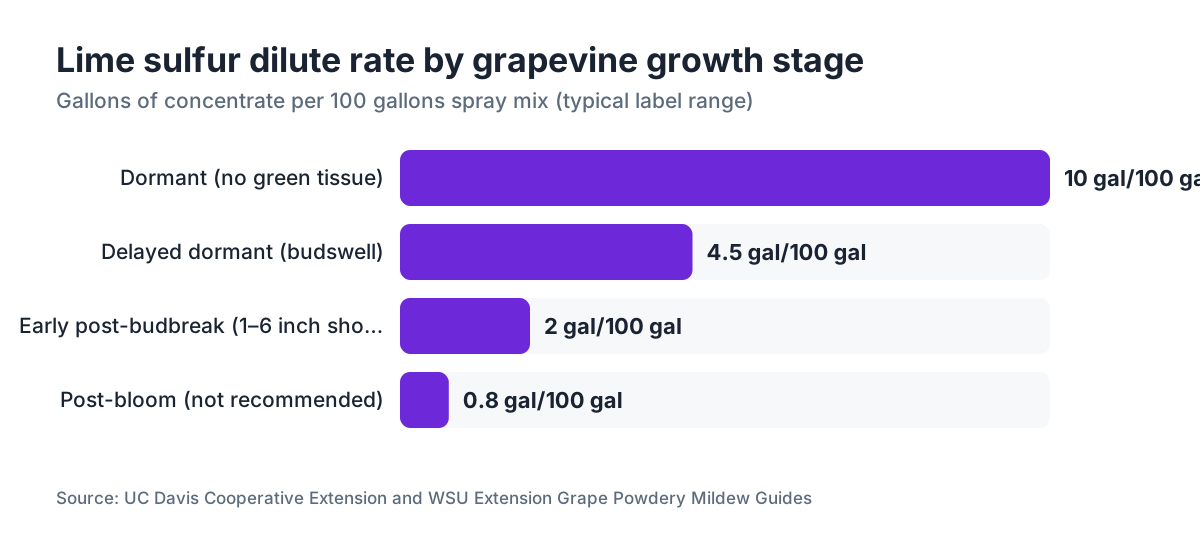
Rate tracks application timing. Use the wrong rate for the growth stage and you'll burn tissue, full stop.
| Timing | Typical dilute rate | Notes |
|---|---|---|
| Dormant (no green tissue) | 8 to 12 gal/100 gal | Full-strength cleansing application |
| Delayed dormant (budswell, no green) | 3 to 6 gal/100 gal | Back off before any green shows |
| Early post-budbreak (1 to 6 inch shoots) | 1 to 3 gal/100 gal | Standard season program rate |
| Post-bloom (not recommended) | 0.5 to 1 gal/100 gal | High phytotoxicity risk; avoid |
These ranges come from WSU Extension and UC Davis extension recommendations and match most registered label directions [1][4]. The label on your specific product is what controls, and labels do vary between manufacturers, so read yours before mixing.
Calibration matters more than most growers admit. A mist blower delivering 50 GPA needs a very different concentrate-to-water ratio than an airblast at 100 GPA to lay down the same pounds of active ingredient per acre. Calibrate the equipment first, then back-calculate your mix rate. Skipping that step is probably the single most common reason lime sulfur applications either underperform or burn.
What temperatures are safe for spraying lime sulfur on vines?
Phytotoxicity is the main limit on lime sulfur use, and temperature is the main driver. The safe working window is 40 to 85°F.
Don't apply lime sulfur when air temperatures will top 90°F within 24 hours. The polysulfide chemistry volatilizes faster above that line, which drives more tissue absorption and the classic brown burn on leaf margins and shoot tips [4]. Spray early, before the day heats up, when you're in a warm region.
Cold below 40°F slows the chemistry too much for good control and lets the solution settle unevenly. So you're boxed in on both ends.
Relative humidity matters too. High humidity, above 85%, slows drying and stretches contact time on leaf tissue, which raises burn risk at the top of the rate range. Some growers in coastal California and the Pacific Northwest drop their rates 25% on days with morning fog or persistent overnight RH.
Wind is a problem for a different reason. Lime sulfur reeks of rotten eggs and it's a skin and eye irritant. Don't spray into wind blowing toward neighbors or homes. Past the neighborly angle, drift onto non-target crops or structures is a real liability.
Can lime sulfur be mixed with other fungicides or pesticides?
Two compatibility rules are absolute: never mix lime sulfur with oil-based products, and mind the interval between oil and lime sulfur applications.
Combine lime sulfur with any petroleum or plant-based horticultural oil (dormant oil, neem oil, stylet oil) and you get a phytotoxic reaction that burns leaves and, at worst, strips a vine bare. The reaction is chemical, not a concentration issue. There's no safe rate for that combination on green tissue. Most labels and extension guidance require a minimum 2-week gap between oil and lime sulfur in either direction [4].
Mixing lime sulfur with other fungicides calls for a jar test before you scale up. Lime sulfur is highly alkaline (concentrate pH runs 11 to 12), and many synthetic fungicides fall apart at that pH. Captan is a clear incompatible: it breaks down fast and can generate toxic hydrogen sulfide in the tank. The WSU Spray Guide lists several known incompatibles [4].
For organic programs, growers often tank-mix lime sulfur with copper hydroxide or copper octanoate at reduced rates of both to cover powdery mildew and downy mildew in one pass. That can work. Watch the total sulfur load per application, though. Copper and sulfur together at full rates push phytotoxicity risk up on sensitive varieties.
One note on variety sensitivity: Concord and other labrusca types tolerate sulfur worse than most vinifera. Some vinifera, including Thompson Seedless and Perlette, are also known as sulfur-sensitive. Check WSU or UC Davis variety sensitivity tables before you set your rate [1][4].
What are the re-entry interval and worker safety requirements for lime sulfur?
This is where growers get caught short in a compliance audit, so pay attention. Most registered lime sulfur products carry a 48-hour re-entry interval under the EPA Worker Protection Standard.
Under the Worker Protection Standard (40 CFR Part 170), the pesticide label sets the re-entry interval (REI). A 48-hour REI means no worker enters treated areas for 48 hours without full personal protective equipment [5]. That's longer than most people expect for a "natural" or OMRI-listed product.
The WPS requires you to post the REI at the establishment's central posting location before the application happens. It also requires that workers be told about the application. If you use a custom applicator, they have to give you the application information within 30 days, and you keep those records.
Mixing and loading PPE includes chemical-resistant gloves (heavier than nitrile), protective eyewear or a face shield, a chemical-resistant apron, and a long-sleeved shirt with long pants. Lime sulfur concentrate is corrosive to eyes and skin. NIOSH's pesticide illness surveillance work has identified calcium polysulfide and lime sulfur products in reported skin and eye exposure incidents, a reminder that "organic" is not the same as "low risk" to workers [6].
An enclosed cab with air filtration cuts exposure a lot, but check your cab's filter rating against the product label. Open-cab spraying usually requires the same PPE as hand application.
For your spray records, most state programs (California DPR, Oregon ODA, Washington WSDA, and others) want the product name, EPA registration number, rate applied, acres treated, date and time, applicator name, REI, and PHI. The pre-harvest interval for lime sulfur is 0 days on most registered labels, which is one of its real advantages when harvest is bearing down on you.
Is lime sulfur approved for certified organic grape production?
Yes. Lime sulfur is on the National List of Allowed and Prohibited Substances under the USDA National Organic Program (7 CFR 205.601) as an allowed plant disease control material [7]. It's also OMRI-listed, which means the Organic Materials Review Institute has reviewed commercial formulations and confirmed they meet NOP standards [10].
The NOP still expects documentation. Your certifier needs to see that your lime sulfur product is an approved formulation (OMRI listing or equivalent), that you use it consistent with good farming practice, and that your spray records prove compliance. No records, no certification, no matter what you actually sprayed.
One nuance: the NOP caps copper-based materials by cumulative annual load, but sulfur has no equivalent annual load cap in the NOP rule itself. Some certifiers apply their own guidelines, so ask your certifier directly if you run a heavy sulfur program.
For California organic growers, both the California Department of Food and Agriculture and the California Department of Pesticide Regulation require active certification behind any organic claim, and DPR requires pesticide use reporting whether you're organic or not [8].
How does lime sulfur compare to other powdery mildew fungicides for grapes?
Lime sulfur sits in a specific niche: multisite, cheap, OMRI-listed, and strong at specific timings. It isn't the best pick at every growth stage.
| Product class | Mode of action (FRAC group) | Resistance risk | OMRI organic? | PHI (typical) | Best timing |
|---|---|---|---|---|---|
| Lime sulfur | Multisite (M02) | Very low | Yes | 0 days | Dormant, early season |
| Sulfur (wettable/dry) | Multisite (M02) | Very low | Yes | 0 days | Season-long |
| Copper | Multisite (M01) | Very low | Yes | 0 to 7 days | Varies |
| DMI fungicides (myclobutanil, etc.) | Sterol inhibitor (G3) | High (documented) | No | 7 to 14 days | Pre/post-infection |
| SDHI (fluxapyroxad, etc.) | Succinate dehydrogenase (G7) | Moderate-high | No | 7 days | Season-long program |
| QoI/strobilurin (azoxystrobin) | Respiration (G11) | High | No | 0 to 14 days | Avoid solo use |
| Potassium bicarbonate | Multisite | Very low | Yes | 0 days | Light-moderate pressure |
Cost per acre runs roughly $5 to $25 for lime sulfur depending on rate, timing, and application volume, against $15 to $60 or more per acre for single-site synthetics at full label rates. That price gap is real in a season where you make 10 to 15 applications.
The honest limitation: lime sulfur has no systemic activity. It doesn't move through the plant. If your canopy has filled in and you've got dense interior shoots the spray can't reach, lime sulfur won't touch that tissue. Past about 6-inch shoots, a systemic material usually makes more sense as the primary fungicide, with lime sulfur kept in rotation for resistance management.
Resistance management is probably the strongest reason to keep lime sulfur in any program, organic or conventional. Cornell's integrated crop and pest management program recommends multisite materials like sulfur in rotation with at-risk single-site fungicides to slow resistance [3].
How do you build a full-season lime sulfur spray program for grapes?
A workable season looks like this. It isn't one-size-fits-all, but it gives you a frame to adapt.
Dormant, before budbreak: one application at 8 to 12 gal/100 gal to clean bark-overwintering inoculum. Do it while temperatures are still cool and before any green tissue shows. This single spray can cut primary inoculum a lot, and it's especially worth doing after a high-mildew year.
Delayed dormant to budbreak (1/4-inch green): drop to 3 to 6 gal/100 gal if any green shows. Some growers skip this timing and jump straight to the post-budbreak rate, which is fine if the dormant application was thorough.
Early post-budbreak through 6-inch shoots: 1 to 3 gal/100 gal on a 7 to 14 day interval by pressure. Cool, humid region, or disease pressure last year? Go to 7 days. This is the window where lime sulfur genuinely earns its money.
Pre-bloom through bloom: switch to a systemic or curative material. Lime sulfur alone isn't enough during the highest-risk window in most wine regions. A DMI or SDHI (conventional) or potassium bicarbonate plus sulfur (organic) fills that gap better. This is also where your resistance rotation needs real thought.
Post-bloom: most growers drop lime sulfur entirely and lean on wettable sulfur, systemics, or biorationals by program type. Lime sulfur post-bloom at meaningful rates carries real phytotoxicity and residue risk, which makes it a poor pick for most situations.
Track every application in a dedicated spray record: product, EPA reg number, rate, timing, REI posted date, and field block. If you're managing records across multiple blocks or multiple seasons, a purpose-built field records tool saves time and keeps you audit-ready. VitiScribe is built for vineyard spray records and compliance documentation, and it generates the reports most state ag departments accept directly.
See our vineyard hub for more on full-season spray record compliance.
What are the phytotoxicity signs and how do you avoid them?
Lime sulfur phytotoxicity shows as a brown or necrotic leaf margin burn, sometimes with a bleached or silvered look on young tissue. Shoot tips can die back when exposure is severe. In mild cases you see speckled bronzing that looks a lot like mite damage at a glance. Fruit can russet or crack if sprayed at high rates near berry formation.
Four main causes of phytotoxicity:
- Rate too high for the growth stage (see the rate table above).
- Application when temperatures top 90°F within 24 hours, or are already above 85°F at spray time.
- Application too close in time to an oil product.
- Application during high humidity when drying is slow.
Once you've sprayed and conditions turn against you, there's not much to do but watch. A light water rinse within a few hours can cut severity in theory, but it's rarely practical at scale. Damage is usually cosmetic in mild cases and doesn't hurt fruit quality much. Severe burn during rapid shoot growth can set a vine back for real.
Sensitive varieties (Concord, Thompson Seedless, Perlette, and some table grapes) get the low end of the rate range as the default, not the high end. With a variety that's new to you, test a small block the first season before you commit to a field-wide rate.
How do you store and dispose of lime sulfur safely?
Lime sulfur is corrosive and carries a strong hydrogen sulfide odor. Storage rules are simple and non-negotiable.
Store it in original containers, sealed tight, out of direct sun and away from heat and incompatible chemicals (acids and oxidizers in particular). Most labels require storage above 32°F to prevent crystallization that clogs equipment and shifts concentration. A garage or barn is fine as long as it doesn't freeze or bake.
Shelf life is usually 2 to 3 years sealed, but concentration drifts over time. Test older product for actual sulfur content or replace it before you lean on it for an early-season application that has to work.
Disposal: never pour lime sulfur into storm drains, waterways, or onto soil where it can run off. It's acutely toxic to aquatic life. Contact your county agricultural commissioner or state extension service for disposal options. Many states run periodic household and agricultural pesticide collection events at no cost [9].
Rinse water from application equipment is regulated too. Apply rinsate to a labeled use area or follow your state's guidance on equipment rinsate disposal. California DPR, for one, has explicit guidance on this [8].
What does the current research say about lime sulfur resistance management?
The practical takeaway from the resistance literature is blunt: lime sulfur and wettable sulfur belong in every powdery mildew program, organic or conventional, because E. necator can't easily evolve around multisite oxidant chemistry.
A 2019 survey of E. necator populations across California wine regions found DMI resistance in populations from Sonoma, Napa, and San Joaquin counties, with some populations showing reduced sensitivity to multiple fungicide classes [2]. The same survey found no evidence of resistance to elemental sulfur or lime sulfur. That fits the biochemistry: evolving resistance to a compound that disrupts many cellular targets at once is orders of magnitude harder than evolving past a single enzyme target.
Cornell's disease forecasting and management program, which produced the NEWA weather-based powdery mildew risk model, builds sulfur-group materials in as the low-resistance-risk anchor of an integrated program [3]. Washington State University's grape powdery mildew guide states that "Sulfur is the most widely used fungicide for powdery mildew management in Pacific Northwest vineyards" and recommends it as the backbone of both conventional and organic rotations [4].
One caveat. There's some evidence that long, exclusive use of sulfur in high-pressure sites selects for E. necator populations with slightly higher sulfur tolerance, though not outright resistance the way QoI resistance works. The point is that even sulfur shouldn't carry every application by itself, especially under heavy pressure. Rotating with potassium bicarbonate, copper, or (in conventional programs) a different FRAC group every few sprays is still good practice.
Frequently asked questions
Can you spray lime sulfur on grapes after bloom?
Technically yes, but rates have to stay very low (0.5 to 1 gal/100 gal) and the risk of berry russeting, skin cracking, and fermentation interference climbs sharply. Most extension programs recommend switching to wettable sulfur, potassium bicarbonate, or systemic fungicides after bloom. Lime sulfur post-bloom is generally not worth the phytotoxicity risk unless pressure is extreme and no alternatives exist.
What is the pre-harvest interval for lime sulfur on grapes?
Most registered lime sulfur products carry a 0-day PHI, meaning no mandated wait between application and harvest. That said, late-season applications at any meaningful rate can affect fermentation chemistry (sulfur residues on skins) and aren't recommended regardless of the PHI. Always confirm the PHI on your specific product label, since formulations vary.
How long after applying lime sulfur can workers re-enter the vineyard?
The re-entry interval on most registered lime sulfur labels is 48 hours under the EPA Worker Protection Standard. Workers entering before the REI expires must wear full chemical-resistant PPE. The REI must be posted before application under WPS requirements. 48 hours is longer than many growers expect for an OMRI-listed product, so plan field operations around it.
Does lime sulfur kill powdery mildew colonies that are already established?
Lime sulfur has limited eradicant activity at higher rates, so it can reduce an early-stage colony, but it's mainly a protectant. It won't rescue a vine with heavy established mildew. For genuine eradicant activity, a DMI fungicide (myclobutanil, tebuconazole) or a QoI material in a conventional program works better. In organic programs, potassium bicarbonate has slightly better knockback against established colonies.
Can lime sulfur be used in conventional (non-organic) vineyards?
Yes. Lime sulfur isn't restricted to organic use. It's registered for conventional viticulture too, and it's a smart rotation partner in any resistance management program because its multisite mode of action (FRAC group M02) helps slow resistance to the synthetic single-site fungicides used alongside it.
Why does lime sulfur smell so bad and is that a health hazard?
The odor is hydrogen sulfide gas, a byproduct of polysulfide chemistry. At the concentrations present during normal outdoor spraying, it's unpleasant but not acutely dangerous for brief exposures. Mixing and loading in enclosed spaces, or working continuously in drift without respiratory protection, is a legitimate concern. NIOSH classifies hydrogen sulfide as a hazardous substance at higher concentrations, so use the label-specified PPE during mixing.
What varieties of grapes are most sensitive to lime sulfur phytotoxicity?
Concord and other Vitis labrusca varieties are well-documented as sulfur-sensitive and should get the low end of the rate range or be avoided entirely in warm weather. Among vinifera, Thompson Seedless and Perlette are known as sensitive. Some table grapes react more too. WSU Extension and UC Davis publish variety sensitivity tables. When in doubt, test a small block at your intended rate before applying field-wide.
How do I calibrate my sprayer for lime sulfur applications?
Calibrate actual output (gallons per acre) first, independent of the product. Run a water-only calibration for your airblast or mist blower at your normal operating speed and fan setting. Once you know GPA, calculate the concentrate volume per tank to hit the target rate (2 gal/100 gal dilute means 2 gallons of lime sulfur concentrate per 100 gallons of spray mix). Recalibrate any time you change speed, nozzles, or canopy density.
Is there a minimum temperature required for lime sulfur to be effective?
Lime sulfur works best between 40°F and 85°F. Below 40°F the chemistry slows and you may not get adequate surface coverage, since the solution behaves differently in cold. Above 85°F the phytotoxicity risk climbs sharply. Early morning applications in warm regions are standard practice to stay inside the effective and safe temperature range.
How does powdery mildew overwintering affect my spring lime sulfur timing?
Erysiphe necator overwinters as cleistothecia in vine bark and as mycelium in dormant buds. A thorough dormant application of lime sulfur at 8 to 12 gal/100 gal directly on the cordon and spurs kills surface-level cleistothecia and cuts primary inoculum for the coming season. This spray is especially valuable after a high-disease year or when infection rates ran high at harvest the prior fall.
Do I need a pesticide applicator license to spray lime sulfur on my own vineyard?
In most U.S. states, a private applicator certification is required to buy and apply any federally restricted-use pesticide. Most lime sulfur formulations are general-use, not restricted-use, so no license is required for a grower applying to their own land. Regulations vary by state, though. California, Oregon, and Washington all have separate state registration and use reporting rules. Check with your state department of agriculture for current requirements.
What records do I need to keep for lime sulfur applications in my vineyard?
At minimum: product name, EPA registration number, application date and time, field or block identifier, rate applied (gal/acre or oz/acre), total volume, applicator name, REI posted date, and PHI. California requires pesticide use reports filed with the county agricultural commissioner within 7 days of application. Most other states require records kept at least 2 years. A vineyard spray log tool keeps this organized and audit-ready. VitiScribe can generate compliant application records directly from your field entries.
How does the FRAC code for lime sulfur affect my resistance management plan?
Lime sulfur is FRAC group M02 (multisite inorganic sulfur), the same group as wettable and dry sulfur. Multisite materials carry very low resistance risk because inhibiting multiple cellular targets at once requires many simultaneous mutations in the pathogen. Use M02 materials as the backbone of your rotation, alternating with single-site FRAC groups (G3, G7, G11) in conventional programs to ease selection pressure on those higher-risk chemistries.
Can I use lime sulfur to manage both powdery mildew and Botrytis in grapes?
Lime sulfur isn't reliably effective against Botrytis cinerea (gray mold). Its main strength is powdery mildew and some other fungal pathogens. For Botrytis, you need different chemistry: FRAC group 17 (fenhexamid), FRAC group 9 (cyprodinil), or, in organic programs, Bacillus subtilis-based biocontrol products. Don't stretch lime sulfur into the Botrytis window expecting it to do double duty.
Sources
- UC Davis Cooperative Extension, Grape Powdery Mildew Management: Dormant applications of lime sulfur at 1:9 dilution reduce primary inoculum (cleistothecia); post-budbreak rate 1 to 3 gal/100 gal; infection risk highest 70 to 85°F
- Wilcox, W.F. et al. / Phytopathology: Survey of DMI resistance in E. necator in California wine regions (2019): DMI resistance documented in E. necator populations in Sonoma, Napa, and San Joaquin counties; no resistance detected to elemental sulfur or lime sulfur
- Cornell University Cooperative Extension, Integrated Crop and Pest Management Program for Grapes: 7 to 10 day spray intervals recommended during high-pressure periods; sulfur-group materials recommended as low-resistance-risk anchor of integrated program
- Washington State University Extension, Grape Powdery Mildew Management Guide: Sulfur is the most widely used fungicide for powdery mildew in Pacific Northwest vineyards; oil/lime sulfur incompatibility noted; variety sensitivity table included
- EPA, Worker Protection Standard (40 CFR Part 170): Re-entry intervals must be posted before application; most lime sulfur labels carry 48-hour REI; workers must be notified of applications
- NIOSH, Pesticide Illness and Injury Surveillance Program: Calcium polysulfide and lime sulfur products identified in reported farm pesticide skin and eye exposure incidents; 'organic' classification does not equate to low worker risk
- USDA National Organic Program, 7 CFR 205.601 National List of Allowed and Prohibited Substances: Lime sulfur is listed as an allowed plant disease control material under the National Organic Program
- California Department of Pesticide Regulation, Pesticide Use Reporting: California requires pesticide use reports filed with county agricultural commissioner; organic growers must report regardless of certification status
- OMRI (Organic Materials Review Institute), Listed Products Database: Commercial lime sulfur formulations are OMRI-listed as meeting USDA National Organic Program standards for plant disease control
- FRAC (Fungicide Resistance Action Committee), Code List: Lime sulfur classified as FRAC group M02 (multisite inorganic sulfur); very low resistance risk due to multi-target mode of action
- UC Davis Integrated Pest Management, Grape Powdery Mildew: Erysiphe necator (formerly Uncinula necator) ascospore discharge begins around bloom; infection risk conditions and variety sensitivity guidance
Last updated 2026-07-09