Linking spray records to lot codes for winery traceability

TL;DR
- Every bottle of wine traces back to a block of vines.
- Connecting your pesticide spray records to the lot codes on that wine is both a food safety requirement under FDA FSMA and a practical tool for recalls, audits, and retailer certifications.
- The link runs through block IDs, harvest dates, and tank or fermentation lot numbers, and it can be built on paper or in software.
Why does linking spray records to lot codes actually matter?
Regulators, retailers, and buyers want a clear chain from field inputs to finished product. A recall notice, a residue question from an importer, an audit from a national grocery chain: they all lead to the same demand. Show me what was sprayed on the grapes that went into this wine.
The Food Safety Modernization Act (FSMA) Produce Safety Rule, finalized in 2015, set the framework for traceability at the farm level [1]. The FDA's Food Traceability Rule took effect in January 2023, with full compliance required by January 20, 2026, and it covers processed foods derived from covered produce [2]. Wine sits in an odd spot. Fermented beverages are largely outside FDA's direct jurisdiction, but the raw agricultural commodity that goes into them, the grapes, is covered. When a recall happens, your ability to pull up Block 7's spray log from the night before harvest and match it to Fermentation Lot 2024-CAB-003 is what saves you.
The practical case is simple. Bad harvest. Wrong tank. Residue complaint. None of those are fixable in the moment without documentation that connects field to bottle. That connection is the whole point.
What federal rules govern pesticide records in vineyards?
Two separate federal frameworks touch vineyard spray records, and they have different owners, different retention periods, and different audiences.
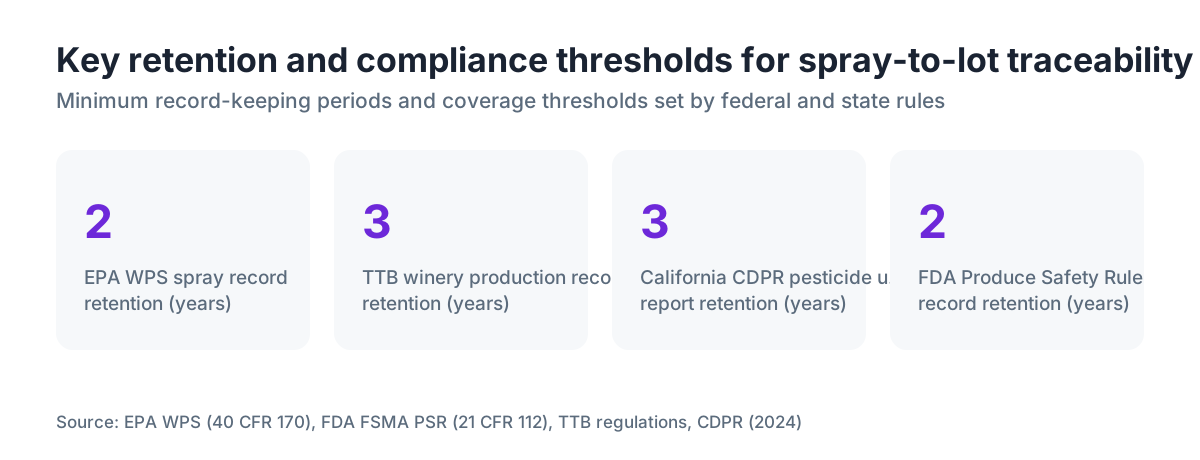
The EPA Worker Protection Standard (WPS) requires that pesticide application records be kept for at least two years and be accessible to agricultural workers and their designated representatives [3]. The WPS record must capture the product name, EPA registration number, active ingredient, date and location of application, and the end of any restricted-entry interval (REI). These records are a worker safety tool, not a food safety tool, but they are the same records you cross-reference when building traceability.
FIFRA, the Federal Insecticide, Fungicide, and Rodenticide Act, sets labeling requirements and restricts off-label use of any pesticide registered for commercial use, but it does not itself mandate how long commercial growers keep records beyond what state pesticide laws require [4]. Most western states require two to three years. California requires pesticide use reports to the County Agricultural Commissioner within one month of application, and those records stay on file for three years under the California Department of Pesticide Regulation [5].
The TTB, the Alcohol and Tobacco Tax and Trade Bureau, oversees wine labeling and production records. It does not specifically mandate spray-to-lot linkage, but it requires winery production records to be kept for three years, and its audit authority lets an examiner trace materials from source to finished product [6].
So here is the floor. Federal law tells you to keep spray records for at least two years and wine production records for at least three, and California adds a real-time reporting layer. None of those requirements explicitly demand that you link the two. The linkage is what makes either set of records useful in a crisis.
What information has to be in a spray record to support traceability?
A spray record that can actually do traceability work needs more than the WPS minimum. Here is what you need, and why each field matters for connecting to a lot code.
| Field | WPS Required? | Traceability Use |
|---|---|---|
| Application date | Yes | Matches to harvest date range and vintage |
| Block / vineyard ID | No (but standard practice) | The core link to lot code |
| Product name & EPA reg number | Yes | Residue ID if a complaint surfaces |
| Active ingredient(s) | Yes | MRL (maximum residue limit) reference |
| Rate applied (oz/ac or fl oz/100 gal) | No | PHI and MRL calculations |
| Pre-harvest interval (PHI) | No | Confirms harvest date was legal |
| Applicator name | Yes | Audit trail for certification |
| Equipment used | No | Useful for calibration disputes |
| Water volume / dilution | No | Helpful for residue modeling |
| REI end date/time | Yes | Worker safety compliance |
The block or vineyard ID is the single most important traceability field that WPS does not already require. Without a consistent block identifier, a spray record is an island. Cornell Cooperative Extension's guidance on vineyard record-keeping treats block-level granularity as the foundation of any useful production history [7].
Your block IDs need to be the same identifiers used in your cellar lot-coding system. If the vineyard calls it "Block 7" and the winery calls it "North Slope Cab," someone has to maintain a translation table, and that translation table is a single point of failure in any audit.
How do you actually link a spray record to a fermentation lot code?
The physical link happens at harvest. Field identity (block, varietal, harvest date) merges into cellar identity (tank, lot, fermentation code) right there at the crush pad. If the handoff does not capture the block ID, the chain breaks.
Here is a chain that works for most small to mid-sized operations:
- Block IDs are set in the vineyard map and stay constant year over year.
- Each spray record references the block ID (or block IDs if a spray covered multiple blocks).
- At harvest, the picking ticket or receive ticket records block ID, varietal, pick date, and weight. This ticket is the bridge document.
- The receiving log in the cellar assigns a fermentation lot number that includes or references the block ID and vintage year. Something like 2024-BLK07-CAB-001.
- The lot code on the finished wine traces back to the fermentation lot, which traces back to the picking ticket, which traces back to the block.
From that block, you can pull every spray record from pre-bloom through harvest. Say a question comes up about a sulfur application three weeks before pick. You have the application date, the product, the rate, and the PHI on record, and you can show in writing that the PHI was met.
WSU Extension's viticulture program recommends that spray records and harvest records share a common block identifier and that both document sets be stored together or cross-referenced by index [8]. That is exactly right. The simplest version is a folder, physical or digital, per block, per vintage, holding both the spray logs and the harvest sheets.
What is a pre-harvest interval (PHI) and how does it feed into traceability?
The pre-harvest interval is the number of days that must pass between the last application of a pesticide and harvest. It is listed on every pesticide label, and harvesting inside the PHI is a federal violation. PHI lengths for common vineyard materials range from 0 days (some sulfur products, some copper formulations) to 28 days or more for certain fungicides [4].
For traceability, the PHI record does two jobs. First, it documents legal compliance at the time of harvest. Second, it gives you the foundation for a maximum residue limit (MRL) defense if a buyer or importer flags a residue test. A spray record showing a product applied 30 days before harvest against a 14-day PHI is documentary evidence that the crop was handled correctly.
UC Davis Cooperative Extension has produced detailed guidance on tracking PHIs inside integrated pest management programs, and its IPM materials tie PHI records to product identity on the label [9]. That label-level reference matters. The PHI is label-specific, more than active-ingredient-specific. Two products with the same active ingredient can carry different PHIs depending on formulation.
The easiest move is to add a "harvest-legal after" date to every spray record row. That is just application date plus PHI. During harvest planning, you check that field against your target pick date. After harvest, that same field is part of your traceability evidence.
How does FDA FSMA affect winery and vineyard traceability?
The FDA Food Traceability Rule, published November 2022, establishes what FDA calls a "Food Traceability List" (FTL). As of this writing, wine grapes are not on the FTL, so the rule's most demanding requirements (critical tracking events, key data elements) do not directly apply to finished wine [2]. Two things are changing the practical picture anyway.
Major retailers now apply supply chain traceability requirements to wine suppliers that mirror or exceed FSMA standards, even where the regulations do not technically require it. A buyer for a national grocery chain will ask for traceability documentation that goes back to the farm.
The FDA Produce Safety Rule (21 CFR Part 112) does apply to covered produce, which includes wine grapes grown for commercial sale if the grower grosses more than $25,000 annually in sales of covered produce [1]. That rule requires agricultural water testing records, worker training records, and field activity records to be kept for two years. Those same records are the raw material of your spray-to-lot linkage.
The Produce Safety Rule requires covered farms to "establish and keep records sufficient to identify the food" and the "lot, batch, or other identifier" used in production [1]. That phrase is the regulatory foundation for the spray-record-to-lot-code linkage.
For a small winery producing fewer than 25,000 cases a year from its own estate vineyards, the full FSMA apparatus can feel distant. It will not feel distant the day a distributor in the EU or Canada asks for a pesticide use history attached to a specific lot.
What does a practical traceability paper trail look like on a small estate?
A small estate, say 20 to 80 acres and four to eight varietals, does not need enterprise software to build a defensible traceability chain. It needs consistency.
Here is the minimum working system, on paper or in a shared spreadsheet:
Vineyard spray log: One row per application. Columns: date, block ID, product, EPA reg number, active ingredient, rate, PHI, harvest-legal-after date, applicator. Keep it in a binder sorted by block and year, or a spreadsheet with one tab per year.
Harvest receiving log: One row per load. Columns: date, block ID, varietal, weight, tank or fermentation vessel assigned, fermentation lot code. The lot code format should include the vintage year, block ID or block abbreviation, and a sequential number. For example: 2024-B07-CAB-001.
Lot code index: A lookup table that maps each lot code to its source block IDs and harvest dates. Two columns. One page. This is the document an auditor actually looks at.
Cellar production log: Tracks everything that happens to a lot from crush through bottling, including additions, SO2 treatments, fining agents, and blending. If you blend lots, your lot code index has to show all source lots.
Four documents. Most small operations already have three of them in some form. The gap is usually that the spray log and the cellar production log live in different binders maintained by different people, and nobody ever built the lot code index. That one-page index is the whole point. Build it at crush, update it when you blend, file it with the other records.
How should blended wines handle the spray record linkage?
Blending is where traceability gets genuinely hard. When Lot 2024-B07-CAB-001 and Lot 2024-B12-CAB-002 are combined into a blend lot, every spray record from both source blocks becomes relevant to the finished wine.
The fix is to document the blend ratio and preserve all source lot codes in the final lot's record. A finished lot record might read: "2024-CAB-BLEND-001: 60% from 2024-B07-CAB-001, 40% from 2024-B12-CAB-002." From that, anyone doing a recall or residue investigation can pull the spray records for both Block 7 and Block 12.
For wines blended from purchased fruit or bulk wine, the same logic holds, but your traceability only reaches as far back as the supplier provided. This is a contractual issue as much as a record-keeping one. When you buy fruit or bulk, get the spray records. Ask before the deal closes, not after the wine is bottled. The best suppliers have them ready. Some do not.
The chain breaks entirely when estate wine gets topped with purchased bulk during processing. If that bulk has no spray history, the finished lot has a gap. Document the gap, name the supplier, and keep whatever records they did provide. A documented gap is defensible. An undocumented gap is not.
What software tools actually help with this linkage?
Spreadsheets work for small operations, but they break down under a few conditions: multiple users editing the same file, spray records stored in one application and cellar records in another, or an operation that needs formatted reports for auditors and buyers.
The platforms that handle this best treat block ID as a primary key shared across both field and cellar modules. A spray application entered in the field module automatically shows up in the traceability chain for any lot derived from that block.
VitiScribe was built around this block-centric model, with spray records, harvest tickets, and lot codes all linked through a consistent vineyard block identifier, so the spray-to-lot report generates without anyone manually cross-referencing documents.
When you evaluate software for this, ask three questions. Can a spray record reference a specific block? Can a harvest or receive record reference that same block? Can the system generate a single report showing all spray records for the blocks that contributed to a given lot code? If the answer to all three is yes, the software does the job. If the spray module and the cellar module are separate products from different vendors with no integration, you still have a manual linkage problem.
Cost varies widely. Purpose-built vineyard management platforms with cellar integration run roughly $3,000 to $15,000 per year for estate operations in the 50 to 500 acre range, based on commonly published pricing tiers. Standalone spray record apps with no cellar linkage run $300 to $1,500 per year. Those are fine for compliance, but they do not solve the traceability problem.
How do you handle traceability for purchased fruit vs. estate grapes?
Purchased fruit is the most common traceability gap in small winery operations, and it matters more than many owners realize.
Buy fruit from an independent grower and you are responsible for the wine made from it. If that wine ends up in a recall or a residue investigation, the question lands on your desk, not the grower's. Your ability to answer depends entirely on what records the grower gave you at delivery.
At minimum, get these from every fruit supplier at delivery: a completed spray log for the block or blocks that produced the fruit, covering the full season from dormancy through harvest; the EPA registration number and product name for every material applied; confirmation that all PHIs were observed; and the grower's signature on a pesticide use declaration, even a simple one.
Many larger commercial growers will have this ready. Small family growers may not, and asking can feel awkward. Frame it as a retailer requirement, because it increasingly is one. Growers who sell to wineries with real retail accounts are getting used to the request.
Attach the supplier's spray records to your receiving log for that delivery, with a note linking to the fermentation lot code you assigned. That is your documentation chain for purchased fruit. It is not as clean as an estate chain, but it is defensible.
A supplier who cannot or will not provide spray records is a business decision more than a record-keeping problem. Some wineries in premium markets now write spray record disclosure into the contract.
How long do you need to keep spray records and lot code documentation?
Three overlapping retention requirements set the minimum. Keep spray records at least two years under the EPA Worker Protection Standard [3]. State rules can run longer: California requires three years for pesticide use reports [5]. FSMA Produce Safety Rule records must be kept for two years [1]. TTB winery production records must be kept for three years [6].
The practical answer is to keep everything for at least three years, and keep anything tied to a recall or a dispute for seven to ten. If your wine has a release date years after harvest (reserve wines, late-release programs), run the retention clock from the date of final sale, not the date of production.
Digital records complicate this because storage media and software formats change. A spray log entered in a platform that goes out of business is a problem if you cannot export it in a readable format. Keep PDF or CSV exports alongside any proprietary system. A paper backup of the spray log and lot code index costs almost nothing and survives every software transition.
The TTB requires records kept in electronic format to be "accurate, complete, and available for inspection," which in practice means you need to produce a readable printout on short notice [6].
Frequently asked questions
What is the minimum information a spray record needs to support lot code traceability?
At minimum: application date, block or vineyard ID, product name and EPA registration number, active ingredient, rate applied, pre-harvest interval, and the resulting harvest-legal-after date. The block ID is the critical link. Without a consistent block identifier shared between your spray records and your cellar lot codes, no amount of other detail lets you trace a finished wine back to its field inputs.
Does FSMA require wineries to link spray records to lot codes?
Not explicitly, and wine is not on the FDA Food Traceability List. But the FSMA Produce Safety Rule (21 CFR Part 112) requires covered farms to keep records sufficient to identify the lot or batch associated with the food they produce. Wine grapes are covered produce. That requirement creates the foundation for spray-to-lot linkage, even if the rule does not spell it out by name.
How far back do spray records need to go for a given wine lot?
All the way back to the first application of the season that could affect the harvested fruit. For most vineyards, that means dormant-season materials through post-harvest applications on the same block. If a dormant copper spray could theoretically leave residue, document it. In practice, the most audited period is the 60 to 90 days before harvest, but there is no regulatory cap on the lookback.
What happens if a block received multiple applications of the same product during the season?
Each application gets its own row in the spray log. The lot code trace will show all applications on that block for the season. For residue purposes, the cumulative applications and rates can matter more than the last one. Keep each application separate and date-specific. Aggregating several applications into a single record is a common shortcut that creates problems during audits.
How do you trace a blended wine back to spray records from multiple blocks?
Maintain a blend record that lists every source lot and its percentage of the final blend. Each source lot links to a harvest receiving record, which links to a block ID. From the block ID, you pull all spray records for that block for the vintage year. A finished blend lot may draw from four or five blocks; document all of them. The lot code index should preserve all source lot codes.
Can I use a spreadsheet for spray-to-lot traceability, or do I need dedicated software?
A spreadsheet works if it is consistent and backed up. The key is using the same block IDs in your spray log tab and your harvest receiving tab. A third tab, a lot code index mapping each lot code to its source blocks and harvest dates, is the lookup tool an auditor uses. Spreadsheets break down when multiple people edit them at once or when the spray records and cellar records live in separate files maintained by different staff.
What do I give an auditor or buyer who asks to verify my spray records against a specific lot?
Give them the lot code index entry for that lot (showing source block IDs and harvest dates), the harvest receiving record for those blocks, and a printed or exported spray log filtered to those block IDs for the relevant season. Three documents. Most auditors are satisfied with a clear chain showing block to harvest to lot. Keep these together in a vintage folder, physical or digital, so retrieval takes minutes, not hours.
Do EPA Worker Protection Standard records satisfy food safety traceability requirements?
Partially. WPS records cover the core spray data (product, rate, date, REI), but they do not require block-level location identifiers or PHI documentation in a format that connects to lot codes. WPS records are a compliance floor, not a traceability solution. Adding a block ID column and a harvest-legal-after date column to your existing WPS log is usually all it takes to make those records traceability-ready.
How should a winery handle traceability when it buys bulk wine with no spray history?
Document the gap explicitly in your receiving record. Note the supplier, the volume, the lot or tank number they assigned, and whatever documentation they did or did not provide. A written request for spray records (even if declined) and any supplier declarations you did receive are worth keeping. An undocumented gap is a liability; a documented gap with a named supplier and a paper trail is defensible, if not ideal.
What is the difference between a pre-harvest interval and a maximum residue limit, and do I need to track both?
A PHI is a field-management rule: do not harvest before this many days after application. An MRL is a food safety standard: finished grapes and wine must not carry more than this concentration of a given residue. Observing the PHI is your primary compliance tool and your documentation defense. MRL testing is only required if a regulatory body or buyer demands it. Your spray records support both, but PHI compliance is what you document proactively.
How does California's pesticide use reporting system interact with private traceability records?
California requires growers to file a Pesticide Use Report (PUR) with the County Agricultural Commissioner within one month of each application. Those reports are public record and match the core WPS data fields. They do not include your internal block IDs or link to your lot codes. Your private spray log should match the PUR data exactly and add the block ID and PHI fields the PUR does not capture.
What format should lot codes be in to make traceability easier?
There is no required format, but a code that encodes the vintage year, block identifier, and a sequential number gives you the most information at a glance. Something like 2024-B07-CAB-001 tells you the vintage, the source block, the varietal, and the production sequence without opening another document. Whatever format you choose, use it consistently and document what each segment means in your lot code index.
Are there university extension resources for building a vineyard traceability system?
Yes. UC Davis Cooperative Extension has IPM and spray record resources tied to California grape production. Cornell Cooperative Extension has vineyard record-keeping guides covering block-level documentation. WSU Extension's viticulture program covers spray record management and harvest documentation for Pacific Northwest operations. All three programs post free downloadable templates or guidance documents that work as starting points.
How often should the spray record and lot code linkage be audited internally?
Once per vintage, after bottling and before the wine is released for sale, is the practical minimum. Pull three or four lot codes at random and trace each one back to block-level spray records. If the chain breaks anywhere, fix the process before the next vintage. Some operations run a mid-season check after harvest to catch gaps while the details are fresh and the people who know the answer are still around.
Sources
- FDA, FSMA Produce Safety Rule (21 CFR Part 112): FSMA Produce Safety Rule requires covered farms to keep records sufficient to identify the lot or batch associated with covered produce; applies to wine grape growers grossing more than $25,000 annually
- FDA, Food Traceability Rule (21 CFR Part 1, Subpart S): FDA Food Traceability Rule took effect January 2023 with full compliance required by January 20, 2026; wine grapes are not currently on the Food Traceability List
- EPA, Worker Protection Standard (40 CFR Part 170): WPS requires pesticide application records to be kept for at least two years and to be accessible to agricultural workers; required fields include product name, EPA registration number, active ingredient, date, location, and REI
- EPA, Federal Insecticide, Fungicide, and Rodenticide Act (FIFRA): FIFRA governs pesticide labeling and restricts off-label use; pre-harvest intervals are label-specific and legally binding
- California Department of Pesticide Regulation, Pesticide Use Reporting: California requires pesticide use reports to the County Agricultural Commissioner within one month of application; records are retained for three years
- TTB (Alcohol and Tobacco Tax and Trade Bureau), Winery Records and Reports: TTB requires winery production records to be kept for three years and records in electronic format must be accurate, complete, and available for inspection
- Cornell Cooperative Extension, Vineyard Record-Keeping Guides: Cornell Extension emphasizes block-level granularity as the foundation of any meaningful vineyard production history for traceability purposes
- WSU Extension, Viticulture and Vineyard Management: WSU Extension recommends that spray records and harvest records share a common block identifier and be stored together or cross-referenced by index
- UC Davis Cooperative Extension, Integrated Pest Management for Wine Grapes: UC Davis Cooperative Extension guidance ties PHI records to product label identity, noting that PHI is formulation-specific, not just active-ingredient-specific
- FDA, Requirements for Additional Traceability Records for Certain Foods (Final Rule): FDA Food Traceability Rule defines critical tracking events and key data elements for covered commodities; establishes the regulatory framework that retailer traceability requirements often mirror
Last updated 2026-07-10