Lipco vineyard sprayer: everything you need to know before you buy

TL;DR
- Lipco builds air-assisted tower sprayers for high-wire and VSP vineyards.
- A vertical column of nozzles replaces the single fan cone, which cuts drift and puts spray where powdery mildew and botrytis start: deep inside the fruit zone.
- Plan on $15,000 to $38,000 new, depending on tank size and tunnel configuration.
- Once you own one, calibration and WPS record-keeping are your two real compliance jobs.
What is a Lipco vineyard sprayer and how does it work?
Lipco is a French manufacturer that has built air-assisted sprayers since the 1970s. The vineyard line runs on a vertical tower design, sometimes called a tunnel or tower sprayer. A column of nozzles runs up a vertical boom instead of leaning on one centrifugal fan to throw spray outward and hope it lands. The tower pushes air and droplets horizontally into the fruit zone at several height-specific points. You are targeting the leaf surface and cluster zone, not blasting the whole air column above the vine.
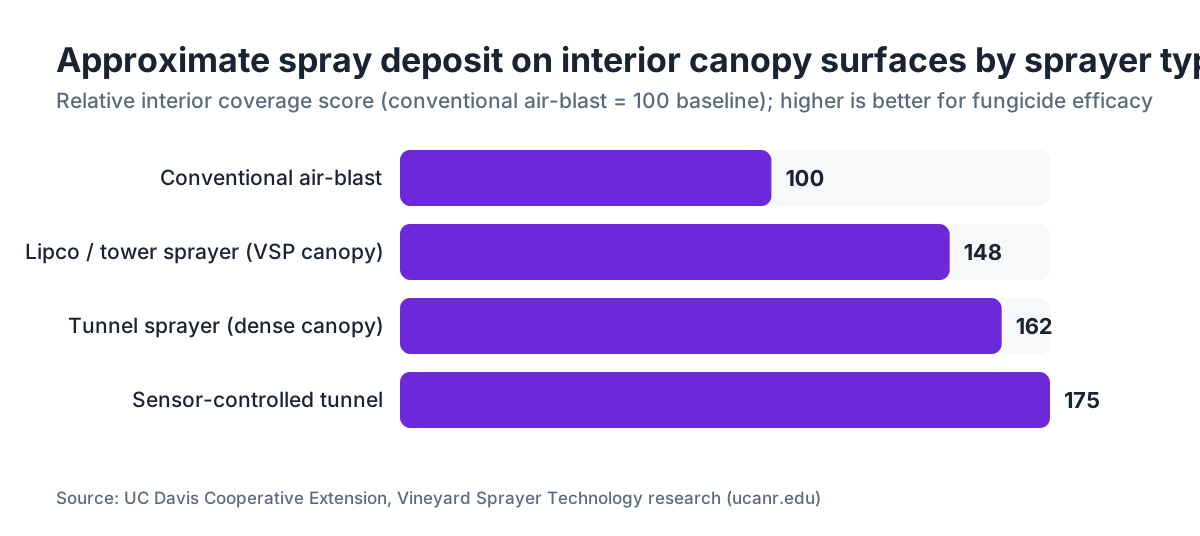
That difference shows up fast in a thick Syrah or Merlot canopy in July. A conventional axial-fan air-blast sprayer throws a cone of air that bounces off a dense wall and sends spray backward or skyward. The tower design reduces that rebound. Lower drift, better coverage on interior leaves where botrytis and powdery mildew actually start.
Lipco's most common vineyard model is the LT series (listed as the Lipco Tower or Lipco Viticulture Tower depending on the importer), offered in tank sizes from roughly 400 to 1,200 liters. The tower height adjusts, which matters if you run both VSP rows and Gobelet-trained blocks on the same property. It mounts on a standard three-point hitch or trails behind a tractor, and PTO-driven hydraulics power the fan and pump.
Here is the part nobody tells you upfront. Lipco equipment sells in the U.S. mainly through regional dealers and importers, not the big ag retailers. Parts lead times run longer than a domestic brand. If your nearest dealer is three states away, put that in the decision column before you fall in love with the coverage numbers.
What models does Lipco make for vineyards, and what are the differences?
Lipco's vineyard sprayers split into two families: the single-side tower and the double-side, or tunnel, configuration. The single-side unit sprays one side of the tractor and you make two passes per row. The tunnel brackets the row on both sides at once and cuts your spray time roughly in half.
The single-side tower is cheaper, lighter on the tractor's hydraulics, and easier to swing in short rows or tight headlands. Most operations in the 20 to 80 acre range that I have watched run this setup.
The double-side tunnel is heavier, costs more, and needs a wider headland for turns. Larger estates and custom spray contractors chasing 100-plus acres in a narrow weather window tend to buy it.
Tank sizes in the LT series commonly run 400L, 600L, 800L, and 1,000L. At 8 to 10 gallons per acre, a typical vineyard rate, a 400L tank covers roughly 10 to 13 acres per fill and a 1,000L tank covers about 25 to 33 acres. Fewer fills or a lighter loaded tractor is an operational trade, not a right answer.
Some LT units add end-row deflectors and drip guards on the nozzle bodies to shave off-target drift further. In states with tight drift rules, California under CDPR especially, those add-ons can be the difference between a warning and a fine [1].
| Model family | Tank range | Coverage (approx.) | Best for |
|---|---|---|---|
| LT Single-side | 400-800L | 10-20 ac/fill | Small vineyards, VSP, mixed trellis |
| LT Double-side tunnel | 600-1,200L | 15-30 ac/fill | Large estates, spray contractors |
| Trailed LT | 800-1,200L | 20-33 ac/fill | High-clearance, slope terrain |
Recent-year U.S. pricing runs roughly $15,000 to $22,000 for a single-side unit and $25,000 to $38,000 for a double-side tunnel, before dealer freight or assembly. Those figures come from importer price lists and dealer quotes shared in trade forums. Official MSRP shifts by importer and year, so treat them as a planning range, not a quote.
How does Lipco tower spray compare to a conventional air-blast sprayer?
The conventional air-blast sprayer, big axial fan and a radial nozzle ring, is still the workhorse in most American vineyards. It costs less to buy, parts are everywhere, and almost any farm shop can fix it. A decent 200-gallon (750L) air-blast unit from a domestic supplier like Rears or Gregoire runs $8,000 to $18,000 new. The Lipco tower costs more. That is the honest starting point.
The tower earns its premium in two specific spots: dense canopy walls and drift-sensitive locations.
UC Davis Cooperative Extension research on vineyard sprayer coverage found tower and tunnel sprayers laid down better spray deposits on interior canopy surfaces than conventional air-blast under moderate to high canopy density [2]. The air-blast unit coated the outer leaf layer beautifully and deposited far less on cluster zones inside the canopy [8]. That gap matters for fungicide performance, because powdery mildew and botrytis both start on the interior of the cluster.
Drift is the second argument. EPA's 2015 spray drift guidance and later state work identify nozzle proximity to the target and air volume calibration as the dominant drift variables [9]. A tower with nozzles physically close to the foliage puts down smaller off-target deposits than a fan-blast unit at the same speed [3]. If your vineyard borders a school, a creek with listed species, or a neighbor's organic block, that difference is money.
Here is the counterargument. Grow in an arid climate with open canopies (a dry-vintage Paso block, or eastern Washington Riesling you hedge hard) and a standard air-blast sprayer, calibrated right, hits the canopy just fine. The Lipco premium does not pay back. Vineyards in Paso Robles or similar dry regions with open, well-managed canopies often see less value in the tower.
My read: if canopy density is your problem and you sit within 300 feet of a sensitive site, the tower is worth it. If neither is true, there are cheaper ways to fix coverage.
How do you calibrate a Lipco tower sprayer properly?
Calibration is not optional, and it is not a once-a-season chore. Do it at the start of each season, after any nozzle change, and any time you switch products or target rates. Four steps, in order.
First, confirm nozzle output. Pull each nozzle body and run it into a catch container for exactly one minute at your operating pressure. Milliliters caught equals your output in mL/min. Compare that against the manufacturer's nozzle chart for your pressure. Replace any nozzle more than 10% over or under nominal. On an 8 to 12 nozzle tower this takes maybe 30 minutes and saves you from applying 20% too much fungicide all season.
Second, measure real field speed. Drive the tractor 100 meters at your intended spray speed on actual vineyard soil (not pavement), time it, and work out true speed. Tractor speedometers lie in low-range gears on soft ground, and half a mile per hour moves your per-acre rate more than you would guess.
Third, run the calibration math. The standard formula:
Gallons per acre = (output per nozzle in oz/min x number of nozzles x 495) / (row spacing in feet x speed in mph)
WSU Extension publishes a plain-language sprayer calibration worksheet for vineyard-scale gear that walks this through [4]. Cornell's viticulture program has similar calibration guidance tuned for Northeastern canopies [5].
Fourth, do a water-only test run. Drive the row at your calibrated settings, check tank volume remaining at the end, calculate what you applied, and compare to target. Adjust pressure or speed to dial it in.
On a Lipco specifically, set the tower height so nozzles line up with the fruit zone and upper canopy. The manual gives the adjustment points. The common mistake is setting tower height in spring and never re-checking as the canopy grows. By July your fruit zone may be two-thirds buried in foliage that was not there in May. Re-check tower position at least twice, once at shoot growth and once at canopy closure.
Log every calibration run. Date, nozzle size, pressure, speed, output per nozzle, calculated GPA. If you use VitiScribe for spray records, this is exactly the data you can attach to each block so a calibrated rate sits on file for every application.
What nozzle types work best on Lipco vineyard sprayers?
Lipco towers use standard threaded nozzle bodies, and most units accept ISO-standard flat-fan or hollow-cone inserts. Good news: you are not locked into proprietary tips.
For fungicide work where coverage is everything, hollow-cone nozzles (Albuz ATR or TeeJet TX series) are the traditional vineyard pick. They make a fine to medium droplet that penetrates leaf surfaces and wraps both sides of the leaf well. The trade-off is drift risk, especially at finer droplet sizes in wind.
Flat-fan tips at lower pressures (20 to 30 PSI) make coarser droplets, which cuts drift but can sacrifice some interior coverage. For under-vine herbicide work, where the tower is not doing contact canopy spraying anyway, flat-fan coarse droplets fit.
Air-induction (twin-fluid) nozzles keep spreading through European vineyards and suit Lipco tower setups well. They throw large droplets that resist drift, and the air bubble inside the droplet helps it break up and wet the leaf on impact. WSU and UC Davis both name air-induction nozzles as a primary drift-reduction tool in vineyards near sensitive sites [3][2].
One practical note. On a 10-nozzle tower, replacing every insert costs $80 to $200 depending on tip type. Do it. Worn nozzles running 15% over-output across a full season mean an over-application on every fungicide pass, which is both a product cost problem and a potential label violation.
What are the WPS and spray record requirements when using a Lipco sprayer?
The EPA Worker Protection Standard applies to any pesticide application on an agricultural establishment where workers are employed, no matter which sprayer you run [6]. The brand is irrelevant to WPS. The pesticide label and your field operations set compliance.
Start with restricted-entry intervals (REIs). Every label specifies one, usually 4 to 48 hours for common vineyard fungicides and insecticides. No worker enters a treated block until the REI expires unless they carry the label PPE and the handler has WPS training. EPA's WPS final rule, effective January 2017, tightened the application exclusion zone rules and added training mandates [6].
Then central posting. You keep a pesticide safety information display (the WPS safety poster plus the application information) at a central spot workers can reach. For any sprayer, you record the product applied, EPA registration number, location, date and time, and the REI [6].
Handler PPE comes next. The sprayer operator is a pesticide handler under WPS, and the label governs the gear. Many vineyard fungicides want long sleeves, waterproof gloves, and eye protection at minimum. Some systemic insecticides applied through air-blast require full coveralls and a respirator.
California layers on more through CDPR: written permits for certain restricted materials and county agricultural commissioner notification for some products [1]. Washington and Oregon run their own state pesticide rules on top of federal WPS.
Spray records are not technically a WPS document, but FIFRA Section 8 requires them for certified applicators, and many state licensing rules require them too. At minimum your records need date, time, block or field, product name and EPA number, rate applied, REI, applicator name, and equipment used. Keep them electronic and end-of-season reporting, crop insurance paperwork, and third-party audits (SIP, LODI, Napa Green) move a lot faster.
The vineyard sets your full compliance picture, but the sprayer is where it all physically happens, so equipment records and application records need to stay linked.
How much does a Lipco vineyard sprayer cost, and is it worth the price?
U.S.-market Lipco pricing runs about like this, based on importer pricing shared in industry forums and dealer quotes through 2024:
Single-side LT units (400-800L): $15,000 to $22,000
Double-side tunnel units (600-1,200L): $25,000 to $38,000
Freight and dealer assembly: $1,000 to $3,000 on top
That sits above most domestic air-blast options. A Gregoire or Rears air-blast sprayer in the 200 to 400 gallon range runs $8,000 to $18,000 new, and serviceable used units turn up for $3,000 to $8,000.
The payback argument rests on a few things. Better fungicide efficacy per pass can stretch spray intervals or let you skip a pass in a good weather window, and every pass costs tractor time, fuel, and product. Skip even two applications a season at $40 to $80 per acre in product cost and the math starts closing over a 5 to 10 year equipment life. That is the best case, and it assumes you actually have the canopy density problem the tower solves.
Parts and service is a real worry. Lipco is a European brand with U.S. distribution that swings by region. Midwest or Southeast, your dealer support may be thin. That is not a reason to walk away, but it is a reason to stock common wear parts (nozzle inserts, pump seals, pressure regulators) from day one.
My honest read. For a commercial vineyard over 50 acres in a disease-pressure region (Willamette Valley, Finger Lakes, Sonoma Coast), the Lipco tower competes seriously on total cost of ownership. For a 15-acre estate winery running six sprays a year in a dry climate, the premium is hard to justify.
How do you maintain a Lipco tower sprayer to extend its service life?
Sprayer maintenance is where operations lose money quietly. A neglected unit running 15% off calibration with two plugged nozzles has already burned more in wasted product and missed coverage than a real maintenance program would have cost.
After every use, flush the tank and lines with clean water and run the flush through the nozzles until it runs clear. This matters most with contact fungicides like captan or copper, which cake inside nozzle bodies and pump seals within hours of drying.
Before storage, drain completely, run a tank rinse with a little sprayer cleaner or dilute ammonia solution, flush again, and store with all caps off so residual moisture evaporates. Leave the pump bypass open. Drain the pump head and add a light oil through the suction port if you sit in a freezing climate.
Annual service items on a Lipco tower: pump diaphragms or pistons (check the manufacturer's hours schedule, typically 200 to 400 hours), pressure regulator calibration, suction filter replacement, all nozzle inserts for wear, and hose inspection for UV cracking. Budget $200 to $600 a year in parts for a unit running a normal small-vineyard season.
The tower structure is mostly steel. Check for rust at weld joints and pivot points every year, and grease all pivot fittings on the manual's schedule.
One thing operators skip: re-checking boom and tower height lockbolts mid-season. Vibration loosens them, and a tower that has crept two inches low in the bracket misses the top of your fruit zone on every pass.
What are the most common problems with Lipco vineyard sprayers, and how do you fix them?
From what surfaces most in extension workshops and equipment forums, these are the usual failure points on Lipco and similar European tower sprayers.
Pressure inconsistency. If downstream nozzle pressure reads different from your boom gauge, check the suction filter first. A partly clogged 50-mesh suction filter chokes flow enough to drop nozzle pressure while the boom gauge reads normal. Replace it.
Plugged nozzles. Dense contact fungicides and copper products clog orifices over time. Catch-cup the nozzles at the start of every spray day during heavy-use stretches. A plugged nozzle you never notice means a missing strip of coverage on every single pass.
Foaming. A badly foaming tank means either a suction-side air leak (the pump is drawing air along with liquid) or agitation that is too aggressive for the product. Check suction fittings and the O-ring at the pump inlet. Cut the agitation bypass flow if it keeps foaming.
Tower height drift. See the maintenance section. Fix it with thread locker or a locknut on the height bolt after you set it each season.
Hydraulic pressure fluctuation. Run the tower hydraulics off the tractor's external system and let PTO speed vary on hills, and your fan speed and pump output vary too. Holding a steady PTO RPM (usually 540) matters more for calibration accuracy than most people expect.
Without a nearby dealer, most pump and plumbing issues are solvable with generic parts from agricultural pump suppliers. Comet, AR, and Udor pumps are common in European sprayer OEM builds, and parts are widely available in the U.S. The tower structure itself is brand-specific.
How does a Lipco sprayer handle steep slopes or terraced vineyards?
This is a real limitation. Lipco tower units, like most trailed or mounted sprayers, are built for flat to moderate slope. The tower boom stays vertical by design, but the tank and tractor frame tilt on any grade. On cross-slope rows above roughly 15%, liquid surge in the tank starts messing with pump priming and pressure consistency. Steeper than that, it becomes a safety and performance problem.
For terraced vineyards on very steep grades, purpose-built mountain sprayers from suppliers like Nobili (Italy) or other European mountain-vineyard makers fit better. Some operators on moderate slopes run Lipco equipment with baffled tanks (baffling can be fabricated locally) to knock down surge.
If you farm a mountain winery or steep hillside vineyard, be specific with your dealer about average row slope before you commit to any tower sprayer. Ask for the manufacturer's stated maximum operating slope in the spec sheet and hold it against your real terrain.
In flat regions this is a non-issue. Most Central Valley California blocks, most of the Columbia Valley floor, and many Willamette Valley sites run a Lipco tower with no slope trouble.
How should you handle pesticide records and compliance documents for tower sprayer applications?
The sprayer you use does not change the records you need, but it does shape some of the fields. For a tower sprayer, your application record should capture actual output rate (GPA), operating pressure, nozzle type and size, and tower height setting. That detail matters if you ever hit a product label audit or need to show your rate stayed within label tolerances.
Under FIFRA Section 8, certified applicators keep pesticide application records for two years. The record must include product name, EPA registration number, total amount applied, location, date, and applicator license number [7]. Some state programs, California in particular, require added fields including wind speed and direction at time of application [1].
For third-party certifications like SIP (Sustainability in Practice), LODI Rules, and California Certified Organic (CCOF), spray records are audited documents. They have to be legible, retrievable, and matched to your tank mix log. Run 8 products across 12 blocks over 30 spray days and paper records still work, but they open real audit risk from transcription errors.
Keeping calibration records attached to application records closes a gap auditors notice. Show a record of 50 gallons per acre of a product labeled for 25 to 50 GPA and you need the calibration data proving you intended that rate. Without it, you are leaning on someone's memory.
A tool like VitiScribe links sprayer calibration data to individual block spray logs, the kind of connected documentation that speeds up third-party audits and covers you if a label compliance question lands.
Full spray record requirements vary by state. Cornell Cooperative Extension maintains a practical guide to pesticide recordkeeping for northeastern vineyards [5].
What alternatives to the Lipco tower sprayer should you compare before buying?
Several tower and tunnel alternatives deserve a head-to-head look before you sign anything.
Gregoire (France/USA) makes a tunnel sprayer line that competes directly with Lipco's LT series. U.S. parts support runs somewhat better for Gregoire in California thanks to longer dealer history in the state. Pricing is comparable.
CFR (Italy) builds vineyard tower and tunnel units with a strong following in the Pacific Northwest. Some WSU extension publications reference CFR and similar European designs in their sprayer efficiency comparisons [4].
Empas (Netherlands) makes precision canopy-sensing sprayers that use sonar or optical sensors to modulate output based on actual canopy density, row by row. They cost far more ($45,000 to $90,000 for a full sensor-equipped unit) but can cut product use 20 to 40% in trials. UC Davis Cooperative Extension has published on sensor-controlled sprayers as an emerging tool for water and pesticide reduction [2].
Domestic air-blast makers (Rears, FMC Victa, Hardi) stay the cost baseline. For most U.S. vineyards, these are the comparison point.
| Brand | Type | Approx. new price | U.S. parts support | Drift reduction |
|---|---|---|---|---|
| Lipco LT | Tower/tunnel | $15,000-$38,000 | Moderate | Good |
| Gregoire | Tunnel | $18,000-$40,000 | Good (CA/West) | Good |
| CFR | Tower | $14,000-$32,000 | Moderate (PNW) | Good |
| Empas (sensor) | Smart tunnel | $45,000-$90,000 | Limited | Excellent |
| Rears/Hardi | Air-blast | $8,000-$18,000 | Excellent | Moderate |
The right answer depends on canopy density, distance to sensitive sites, acreage, and budget. None of these is best for everyone.
Frequently asked questions
Where are Lipco sprayers manufactured?
Lipco is a French manufacturer. The vineyard sprayer line is built in France and imported to the U.S. through regional agricultural equipment dealers and specialty vineyard equipment importers. Because they are not built domestically, parts lead times can run 2 to 4 weeks longer than comparable American-made equipment, which is worth weighing in your purchase decision.
What tank sizes does the Lipco LT series come in?
The Lipco LT vineyard tower series comes in roughly 400L, 600L, 800L, and 1,000-1,200L configurations. At a typical rate of 8 to 10 gallons per acre, a 400L tank covers about 10 to 13 acres per fill and a 1,000L tank covers 25 to 33 acres per fill. Tank size mostly comes down to how far your fills sit from the field.
Can a Lipco tower sprayer be used on high-wire (GDC or Geneva Double Curtain) trellis systems?
Yes, with the right tower height adjustment. High-wire systems usually put the fruit zone 4 to 5 feet off the ground, and the Lipco tower's adjustable height covers that range. Re-set and verify tower height at the start of the season for high-wire blocks. Confirm the model's maximum tower height in the spec sheet before buying if you run GDC or similar high-canopy systems.
How often should I replace nozzles on my Lipco vineyard sprayer?
Replace hollow-cone and flat-fan inserts when output drifts more than 10% from the manufacturer's rated output at operating pressure. In practice that often means annually for high-use operators running 15 to 20 sprays a season. A set of inserts for a 10-nozzle tower runs $80 to $200. Worn nozzles that run over-rate are a label compliance issue more than a cost issue.
Does a Lipco sprayer meet California CDPR drift requirements?
No sprayer model is pre-approved by CDPR. Compliance depends on the product applied, label requirements, operating conditions (wind speed, distance to sensitive sites), and application technique. Tower and tunnel sprayers generally produce lower off-target drift than conventional air-blast units, but CDPR rules govern operator behavior and label compliance, not equipment type. Always check the pesticide label and your county agricultural commissioner's requirements.
What PTO horsepower does a Lipco tower sprayer require from the tractor?
PTO needs vary by model and tank size, but most Lipco LT vineyard tower units want 35 to 60 PTO horsepower. Larger double-side tunnel models at the 1,000L range may need 50 to 80 PTO hp. Check the specific model's spec sheet. Undersized PTO power causes fan speed fluctuation on slopes, which directly hits spray coverage consistency.
Is there a used market for Lipco vineyard sprayers in the U.S.?
A used market exists but it is thin. Lipco equipment shows up occasionally on Machinery Pete, TractorHouse, and regional farm auction platforms. Because the brand is less common here than in European markets, used pricing is not well established. Expect $6,000 to $15,000 for a serviceable used LT unit depending on age and condition. Have any used unit inspected by someone who knows European sprayer pump systems before buying.
How long does it take to spray one acre with a Lipco tower unit?
At 3 to 4 mph field speed and typical row spacing of 8 to 10 feet, a single-side Lipco tower unit covers roughly 40 to 60 vineyard acres per day in a normal operation. Double-side tunnel units can cover 80 to 100 acres per day. Those rates assume adequate fill stations, minimal downtime, and reasonable headland width for turns. Tight terraced rows or very short blocks cut effective acreage.
What is the EPA Worker Protection Standard requirement for sprayer operators in vineyards?
Under EPA's Worker Protection Standard (40 CFR Part 170), anyone applying pesticides in an agricultural setting is a pesticide handler and must receive WPS handler training, wear label-required PPE, and follow all label restrictions. Employers must maintain a pesticide safety information display and provide decontamination supplies. The WPS final rule was updated effective January 2017 with stricter application exclusion zone and training requirements.
Can I use a Lipco tower sprayer for herbicide applications under the vine?
The equipment can apply herbicide, but a canopy tower sprayer is the wrong tool for under-vine work. Under-vine herbicide needs shielded or directed nozzles at ground level to keep it off the foliage. Using a tower sprayer risks serious canopy and vine damage from drift or overspray. Use a separate shielded under-vine sprayer or a weed wiper for that application.
How do I store a Lipco vineyard sprayer at the end of the season?
Triple-rinse the tank with clean water, flush all lines and nozzles, and run a winterizing solution through the pump if you are in a freeze zone. Drain the pump completely and add a little pump oil through the inlet to protect seals. Store with all caps removed so moisture evaporates. Inspect hoses for cracking, replace worn nozzle inserts, and grease all pivot points before storage.
Does the Lipco tower sprayer reduce my spray product cost per acre?
It can, but there is no guarantee. Better canopy penetration can improve fungicide efficacy, which may let you stretch spray intervals in moderate pressure windows. Research cited by UC Davis and WSU shows tunnel and tower sprayers deposit more product on interior canopy surfaces than conventional air-blast, which is where disease pressure begins. Whether that turns into fewer passes depends on your disease pressure, varietal susceptibility, and canopy management.
What records do I need to keep for each Lipco sprayer application?
At minimum: date, block or field identifier, product name and EPA registration number, rate applied (gallons per acre and pounds of active ingredient), applicator name and license number, and the REI. Certified applicators keep records for two years under FIFRA Section 8. California and several other states require added fields including wind speed, direction, and temperature. Certifications like SIP and LODI Rules require these records to be audit-ready.
Is the Lipco sprayer suitable for organic vineyards?
The sprayer is organically neutral. It is just equipment. Organic compliance depends entirely on what goes in the tank. Copper, sulfur, and OMRI-listed biorationals all apply through a Lipco tower fine. The coverage characteristics actually help organic programs, because organic fungicides like sulfur and copper rely on protectant coverage rather than systemic activity, so better canopy penetration lifts efficacy directly.
Sources
- California Department of Pesticide Regulation (CDPR) - Pesticide Use Enforcement: California imposes additional spray permit, county agricultural commissioner notification, and drift control requirements beyond federal WPS for certain restricted materials
- UC Davis Cooperative Extension - Vineyard Sprayer Technology and Canopy Coverage: Tower and tunnel sprayers consistently produced better spray deposits on interior canopy surfaces compared to conventional air-blast sprayers under moderate to high canopy density; sensor-controlled sprayers can reduce product use by 20-40% in trials
- Washington State University Extension - Drift Reduction Technology in Vineyards: Nozzle proximity to the canopy and air volume calibration are the dominant drift variables; air-induction nozzles are recommended as a primary drift-reduction technology in vineyards near sensitive sites
- Washington State University Extension - Vineyard Sprayer Calibration Worksheet: WSU Extension provides a plain-language sprayer calibration worksheet for vineyard-scale equipment and references European tower sprayer designs in sprayer efficiency comparisons
- Cornell Cooperative Extension - Viticulture and Pesticide Recordkeeping: Cornell Extension offers calibration guidance adjusted for Northeastern canopy conditions and maintains a practical guide to pesticide recordkeeping requirements for northeastern vineyards
- U.S. EPA - Worker Protection Standard (40 CFR Part 170): EPA Worker Protection Standard requires handler training, label-required PPE, application exclusion zones, and central posting of pesticide safety information; final rule updated effective January 2017
- U.S. EPA - FIFRA Section 8 Pesticide Application Records: Under FIFRA Section 8, certified applicators must maintain pesticide application records for two years, including product name, EPA registration number, total amount applied, location, date, and applicator license number
- UC Davis Plant Sciences - Vineyard Sprayer Efficiency Study: UC Davis Plant Sciences research found air-blast sprayers produced excellent coverage on outer leaf layers but deposited significantly less material on cluster zones inside the canopy compared to tower designs
- U.S. EPA - Pesticide Spray Drift Guidance (2015): EPA 2015 Spray Drift guidance identifies nozzle proximity to target and air volume calibration as dominant drift variables for agricultural spray applications
- USDA National Agricultural Statistics Service (NASS) - Agricultural Chemical Use: Reference baseline for commercial vineyard spray equipment costs and application rates in U.S. wine grape production
Last updated 2026-07-10