LIVE certification pesticide use documentation for Pacific Northwest vineyards

TL;DR
- LIVE-certified vineyards in Oregon and Washington keep pesticide records that satisfy both state law and LIVE's audit checklist.
- Log the product, rate, date, applicator, target pest, REI, and PHI for every spray, plus wind conditions.
- Oregon says keep them three years (ORS 634.146), Washington two (WAC 16-228-1450).
- LIVE also scores your aggregate pesticide impact each year, and your records are the only proof.
What is LIVE certification and why does it set its own pesticide rules?
LIVE (Low Input Viticulture and Enology) is a nonprofit sustainability program based in the Pacific Northwest. It certifies vineyards and wineries against standards drawn from Integrated Pest Management, soil health, worker welfare, and ecosystem stewardship. Think of it as the regional sustainability credential that sits between Salmon-Safe and full organic. You can hold all three at once.
The program's pesticide requirements don't replace state law. They stack on top of it. LIVE scores every active ingredient you use with a pesticide impact calculator that weighs ecotoxicity, groundwater risk, and worker exposure. You have to stay below a threshold score each year, and you have to prove it with records. No records means no score. No score means a failed audit.
That's the part most managers miss when they first apply. LIVE isn't checking whether you sprayed something legal. It's checking whether your choices, added up across the season, kept your operation inside the environmental impact band the program requires. Your documentation is the only evidence you made those choices on purpose and logged them accurately [1]. If you're setting up your first compliant field records, our vineyard operations overview covers the block-level structure everything here depends on. For the audit-trail mechanics behind that structure, see our compliance guide.
What pesticide records does LIVE certification actually require?
LIVE's certification standards, checked during the annual audit, require each application record to carry these fields [1]:
- Product trade name and EPA registration number
- Active ingredient(s)
- Date and time of application
- Field or block applied to (with acreage)
- Application rate (per acre and total product used)
- Target pest or disease
- Application method and equipment
- Applicator name and, if applicable, license number
- Restricted Entry Interval (REI)
- Pre-Harvest Interval (PHI)
- Wind speed and direction at time of application
- Water source if the product is mixed with water
That list overlaps hard with what Oregon and Washington already require under their state pesticide recordkeeping statutes, and that's by design. A vineyard keeping good state-compliant records already has 80 to 90 percent of what LIVE needs. The gaps sit in the environmental fields: wind conditions, weather at the time of spray, and the LIVE-specific impact score.
WSU Extension's viticulture team publishes IPM guides that walk through which active ingredients carry high versus low LIVE point values [2]. If you're not looking at that table before you pick a product, you're making the paperwork harder than it has to be. Our spray-records guide breaks down how to build that field template once and reuse it every season.
How long do you have to keep pesticide records in Oregon and Washington?
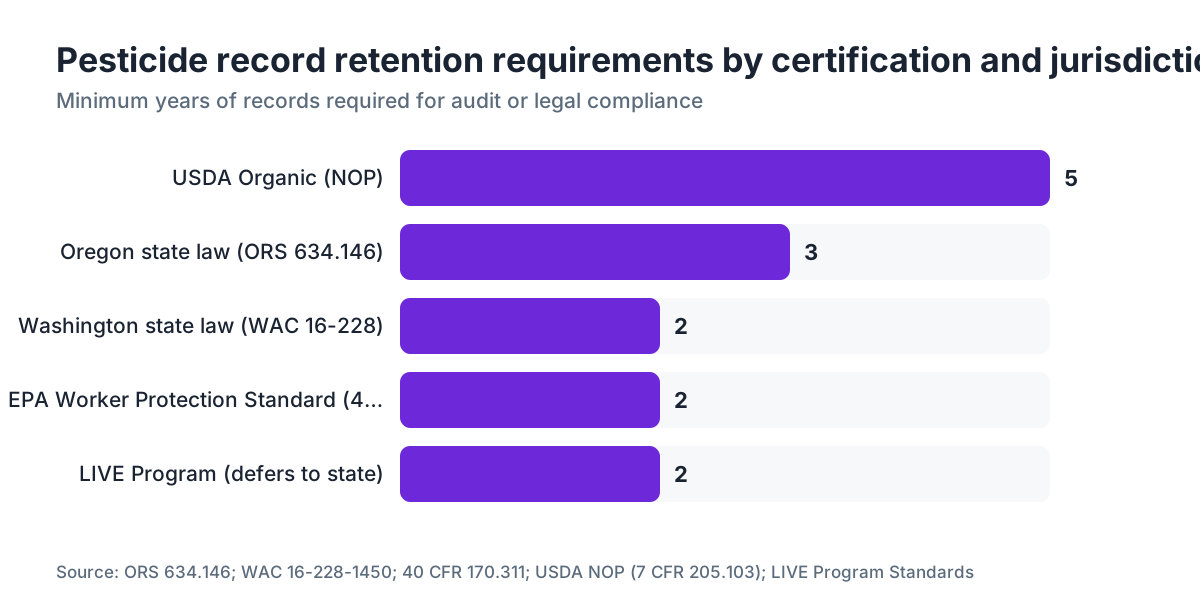
Oregon requires commercial pesticide applicators to keep application records three years from the date of application under ORS 634.146 [3]. Washington requires two years under WAC 16-228-1450 [4]. LIVE defers to whichever state you're in, so an Oregon vineyard needs three years of records ready for any audit.
Most managers I've talked to just keep everything five years. Storage is cheap. A drift complaint or a worker exposure claim where your records stop two years back is not cheap.
| Jurisdiction | Retention Requirement | Statute/Rule |
|---|---|---|
| Oregon | 3 years | ORS 634.146 |
| Washington | 2 years | WAC 16-228-1450 |
| LIVE Program | Matches state minimum | LIVE Standards v.2022 |
| EPA Worker Protection Standard | 2 years | 40 CFR 170.311 |
The EPA Worker Protection Standard (WPS) runs its own recordkeeping clock, separate from state law. Under 40 CFR 170.311, agricultural employers must keep pesticide application records accessible to workers and their designated representatives for two years [5]. This covers any pesticide applied to an establishment where workers may enter. For LIVE audits, having your WPS records already organized puts you about 70 percent of the way to satisfying the LIVE checklist. Our pesticide-recordkeeping reference lays out the retention rules for every certification side by side.
How does the LIVE pesticide impact scoring system work?
LIVE scores each pesticide product on three axes: environmental toxicity (aquatic organisms, beneficial insects, birds), human health hazard, and groundwater leaching potential. The model is adapted from the Swiss ecological indicator system and calibrated for Pacific Northwest conditions. Lower scores are better. Blow past the annual point threshold and you're looking at a failed certification or a required corrective action plan [1].
Most vineyards don't score by hand. LIVE provides a pesticide impact calculator, and some farm management software generates the input file automatically. The calculator is only as good as the records you feed it. A spray log that reads "fungicide applied, 2 oz/acre" with no product name can't be scored. Some audit frameworks treat a blank record as a maximum-impact application, which is worse than logging a high-scoring product honestly.
WSU's IPM program publishes annual fungicide and insecticide efficacy tables for wine grapes, and many entries note LIVE compatibility [2]. Copper is a good example. It's OMRI-listed and organic-approved, yet it carries a real ecotoxicity score in LIVE's calculator because of soil accumulation. That catches growers who assume "organic" and "low LIVE score" mean the same thing. They don't.
What are the most common documentation failures during a LIVE audit?
The LIVE audit pairs a paper review with a field visit. Auditors want a story that holds together: the spray log matches the pesticide invoices, the rates match the label, the listed applicator had authority to apply the product, and the recorded blocks match the farm map on file.
The common failures, based on the program's own guidance and extension materials, break down like this:
- Missing REI and PHI entries. Managers log the product and rate but skip the re-entry and pre-harvest interval. Both fields are required under WPS and LIVE.
- Applicator name missing or unreadable. If you use contract crews, get their license numbers on file before the season starts.
- Block ID doesn't match the certified acreage map. Split a block or replant a section without updating your LIVE farm map, and your records point to a block that doesn't exist in the audit file.
- Rates recorded in mixed units across the season. One entry says "4 oz/acre," another says "1 lb/100 gal." Both can be right, but the calculator can't reconcile them without conversion notes.
- Wind conditions left blank. Oregon and Washington both field plenty of drift complaints. Leave this blank and an auditor has a reason to doubt every other environmental claim in your file.
Cornell's grape IPM program has a spray record template that catches most of these gaps [6]. It's built for New York, but the field structure maps straight onto LIVE requirements, and it's free.
What format do LIVE pesticide records need to be in?
LIVE takes paper records, spreadsheets, and digital records from farm management software, as long as every required field is present and you can produce the records within a reasonable time when an auditor asks. No specific platform is mandated.
The trend runs toward digital anyway. Managers keeping paper logs spend somewhere between two and five hours a week on spray recordkeeping, depending on operation size and program complexity. Digital logs with pre-populated product libraries cut that down and reduce transcription errors, which is where a lot of audit failures start.
If you're shopping software, ask about four things: LIVE-compatible pesticide impact scoring, REI and PHI auto-population from the product label database, block-level acreage tracking, and export formats that match the LIVE audit submission template. VitiScribe was built for vineyard compliance workflows in the Pacific Northwest and Pacific Coast states, LIVE documentation structure included, so it's worth a look if you're spending real time on this each week.
One thing gets overlooked: your records have to be legible and retrievable fast. LIVE auditors can and do show up with minimal lead time. If your spray logs live in a water-stained binder in the equipment shed, sorted by year but not by block, you'll spend a rough afternoon reconstructing what happened. Cloud records solve this. So does a well-kept filing system. Pick one and stick to it.
How do state pesticide licensing requirements connect to your documentation?
Both Oregon and Washington require anyone applying restricted-use pesticides (RUPs) to hold a valid pesticide applicator license [3][4]. Your spray records need to show who applied each product and whether that product was an RUP. Not sure? Check the label. The EPA registration number and the "Restricted Use" classification are printed on every one.
Here's the LIVE angle. If an auditor finds an RUP application logged against an unlicensed applicator, that's bigger than a LIVE problem. It's a state enforcement issue. Both the Oregon Department of Agriculture and the Washington State Department of Agriculture run compliance inspection programs, and a failed LIVE audit that surfaces an unlicensed application can trigger a referral.
ODA's pesticide compliance program is reachable through its website [7]. WSDA's Pesticide Management Division handles Washington [8]. Both publish current fee schedules and license categories. Washington's commercial applicator license runs about $125 for a two-year period per the most recent fee schedule, but verify current fees directly with WSDA since these change.
How does the EPA Worker Protection Standard interact with LIVE documentation?
The WPS, revised in 2015 and administered under 40 CFR Part 170, sets minimum agricultural pesticide safety requirements for any vineyard with workers [5]. Its documentation rules cover a central posting with application info for anything sprayed in the past 30 days, application records accessible to workers and their designated representatives, and specific recorded fields for each application.
Those WPS fields overlap heavily with LIVE. EPA guidance states employers must record "the product name, EPA registration number, active ingredient(s), date of application, location, and REI" at minimum [5]. LIVE wants all of those plus more, so a WPS-compliant record is basically a LIVE record missing the environmental fields.
The practical move: build one template that satisfies both WPS and LIVE, and skip the second system entirely. Add wind speed, weather, and the LIVE impact score notation to your WPS template and one document covers both regimes. UC Davis Cooperative Extension publishes pesticide safety documentation guides for California winegrape growers [9]. Some regulatory details are California-specific, but the template structures port cleanly to Pacific Northwest operations.
What happens if your records are incomplete during a LIVE audit?
Incomplete records during a LIVE audit don't automatically mean decertification. The program runs a corrective action process. Find missing fields in a subset of records and you typically get a written finding with a deadline to either supply supporting documentation (invoices, labels, photographs) or submit a corrective action plan explaining how you'll fix the system going forward.
Repeated failures across audit cycles are a different animal. LIVE can suspend or revoke certification for persistent non-compliance. In practical terms, suspension means you lose the right to label your wine with LIVE and any Salmon-Safe co-certification during the suspension. For wineries selling through channels where a sustainability label moves product, that stings.
The clean approach: treat every spray event as an audit event. Fill in every field the same day you spray. Don't leave gaps to patch later from memory. Memory is terrible, and a spray log reconstructed a week after the fact is obvious to anyone who's reviewed a few hundred of them.
How do organic certification and LIVE certification documentation requirements compare?
This one comes up constantly, especially from growers holding or chasing both certifications. The short version: they overlap a lot but aren't interchangeable.
The USDA National Organic Program (NOP) requires an Organic System Plan that spells out your pest management strategy, plus annual recordkeeping documenting every input applied [10]. NOP records have to show only allowed materials were used, traceable back to the product's OMRI listing or approved status. You keep these five years under NOP regulations.
LIVE doesn't require organic-only inputs. It requires you to stay below a pesticide impact score threshold. A vineyard can be LIVE-certified using some synthetic fungicides as long as the total impact score holds within bounds. Flip it around, and an organically certified vineyard can fail a LIVE audit if heavy copper use pushed the ecotoxicity score too high.
| Requirement | LIVE | USDA Organic (NOP) |
|---|---|---|
| Allowed inputs | Any below score threshold | OMRI-listed/approved only |
| Record retention | State minimum (2-3 yrs) | 5 years |
| Third-party audit | Annual | Annual |
| Pesticide impact scoring | Required | Not required |
| Synthetic inputs permitted | Yes, within score limits | No |
Hold both and you design your record system around the strictest requirement in each category: five-year retention (NOP), full LIVE scoring, and NOP-compliant input verification. One system, two certifications.
What's the best recordkeeping system for a small Pacific Northwest vineyard?
Small vineyards, meaning under 20 acres, usually run the whole spray program with the owner and one or two employees. The pull is toward a paper notebook or a basic spreadsheet. Neither is wrong if the fields are right and you actually fill them in every time.
The minimum viable paper system: a preprinted form with every required field (the LIVE-specific ones included), stored in a waterproof binder somewhere workers can reach it per WPS posting rules, scanned to PDF at season's end, and backed up offsite. Costs almost nothing. Works fine for an operation doing 15 to 20 applications a year.
Once you're above that volume, or juggling multiple blocks with different program timing, a spreadsheet with conditional formatting that flags missing fields earns its keep. WSU Extension publishes free spray record templates built for Pacific Northwest conditions [2]. Download one, add the LIVE fields (wind, a LIVE score column), and you've got a working starting point.
For operations running 50-plus applications across multiple blocks, or anyone who's failed a LIVE audit on documentation, purpose-built vineyard record software earns the monthly cost. VitiScribe's free trial gives you a season to see whether automated REI and PHI population and LIVE score tracking saves enough time to justify it. The audit-ready export formats are the real payoff when your auditor arrives in August. Our spray-records guide compares paper, spreadsheet, and software setups in more detail.
What's different about pesticide documentation for Salmon-Safe co-certification?
Plenty of LIVE-certified Pacific Northwest vineyards also hold Salmon-Safe certification, administered by the nonprofit Salmon-Safe. Its auditors overlap with LIVE in many cases, and it evaluates pesticide use for aquatic toxicity risk, with close attention to pyrethroid insecticides, copper, and any product with high runoff potential.
Salmon-Safe doesn't run its own pesticide scoring calculator. It defers to the LIVE impact scores for that piece, but auditors also look at buffer zones, application timing relative to rain events, and proximity to drainage features. So your records need to capture the distance of the treated block from any surface water feature, the weather forecast at application time (more than current conditions), and equipment calibration records showing accurate delivery rates.
Buffer zone problems, specifically pyrethroid applications too close to a drainage ditch, are a recurring finding in Salmon-Safe audits of Pacific Northwest vineyards. If your blocks touch drainage features, note the buffer maintained for every nearby application right in the spray log. One line of text in the notes field has saved more than a few audits.
Frequently asked questions
How many years of pesticide records do I need to show a LIVE auditor?
LIVE requires records back to your most recent annual certification renewal. Practically, Oregon state law requires three years under ORS 634.146, and Washington requires two under WAC 16-228-1450. Bring at least the full state-required period to any audit. Most experienced managers keep five years as a buffer against disputes or complaints.
Can I use a paper spray log for LIVE certification or does it need to be digital?
Paper is fine. LIVE doesn't mandate digital recordkeeping. Your records just need every required field, legible handwriting, and fast retrieval. Paper becomes a problem when it's incomplete, hard to search by block or product, or stored where it deteriorates. If paper works for your operation and you fill it in every time, it works for LIVE.
What does the LIVE pesticide impact calculator score and where do I find it?
The calculator scores every product on ecotoxicity (aquatic organisms, beneficial insects), human health hazard, and groundwater leaching risk. Each product gets a number, and your annual total must stay below the program threshold. LIVE provides the calculator directly to certified operations and candidates. Contact the LIVE program office or your auditor to get the current version.
Does a certified organic vineyard automatically pass the LIVE pesticide documentation requirement?
No. Organic certification confirms you used only allowed inputs. LIVE confirms your inputs, even allowed ones, didn't exceed the ecotoxicity threshold. Heavy copper use, which is organic-approved, can push a vineyard above the LIVE limit because of soil accumulation and aquatic toxicity. You need LIVE-specific scoring documentation no matter your organic status.
What field information is required by the EPA Worker Protection Standard for pesticide records?
Under 40 CFR 170.311, WPS requires product name, EPA registration number, active ingredient(s), date of application, location and size of treated area, and the restricted entry interval. Records must be kept two years and stay accessible to workers and their designated representatives. LIVE requires all of these plus wind conditions, application method, and the PHI.
Do I need a pesticide applicator license to apply pesticides in my own vineyard in Oregon and Washington?
For restricted-use pesticides, yes. Both Oregon (ORS 634) and Washington (WAC 16-228) require a valid commercial or private applicator license to buy and apply RUPs. For general-use products a license isn't always required, but the application still must be recorded. Your spray log should note whether each product is an RUP and who the licensed applicator was.
What happens if I miss recording an application and discover it later during audit prep?
Reconstruct the record as accurately as you can from supporting evidence: purchase invoices, weather station data for that date, field notes, or equipment logs. Document clearly that the record was reconstructed, on what date, and from which sources. A reconstructed record with that annotation beats a blank every time. Auditors can tell honest reconstruction from fabrication.
Does the LIVE program check pesticide records against purchase invoices?
Some auditors cross-check invoices against spray logs during verification, especially when quantities look off. That's standard practice in third-party sustainability audits. Keep your pesticide purchase receipts and invoices for the same period as your spray records. Big gaps between what you bought and what you recorded applying raise flags.
What's the difference between REI and PHI and do both need to be in my spray record?
REI (restricted entry interval) is how long workers must stay out of treated areas after application. PHI (pre-harvest interval) is the minimum days between last application and harvest. Both are on every pesticide label. Both are required in LIVE spray records and WPS documentation. PHI matters most in years when disease pressure pushes you to spray late.
Can contract spray applicators create records that satisfy my LIVE documentation requirements?
Yes, if the contractor provides a completed record with all required fields. Many commercial spray contractors keep their own application records. Before the season, hand your contractor your record template and spell out which fields you need. Check the first record they return before assuming the rest will be complete. Filling gaps after the fact from contractor records is hard.
How does weather documentation in my spray log help during a LIVE audit?
Weather data, wind speed and direction especially, backs your claim that applications went out under conditions that limit drift and runoff. LIVE and Salmon-Safe auditors look for evidence of responsible timing. Oregon and Washington have both seen drift enforcement cases. A spray log with weather recorded at application time is your best defense in a complaint.
Does LIVE certification require documentation of pesticide applications in the winery, more than the vineyard?
LIVE certifies vineyard and winery operations separately. Winery certification has its own rules around sanitation chemical use and wastewater management, but the pesticide documentation described here applies mainly to the vineyard side. If you're pursuing dual certification, review LIVE's winery standards separately; they're structured differently from the field IPM documentation.
Are there WSU or OSU Extension resources to help with LIVE-compatible spray recordkeeping?
WSU Extension publishes annual IPM guides and spray record templates for Pacific Northwest wine grapes through its viticulture program site. Oregon State University Extension has grape pest management guides through its Department of Horticulture. Both publish fungicide and insecticide efficacy tables that flag LIVE-compatible products. Free resources worth bookmarking before each spray season.
Sources
- LIVE Program (Low Input Viticulture and Enology), Certification Standards: LIVE requires pesticide application records including product name, EPA registration number, applicator, rate, date, block, REI, PHI, and environmental conditions; uses a pesticide impact scoring calculator to assess aggregate environmental impact annually
- Washington State University Extension, Wine Grape Pest Management: WSU Extension publishes annual IPM guides and spray record templates for Pacific Northwest wine grapes, including fungicide and insecticide efficacy tables noting LIVE program compatibility
- Oregon Revised Statutes 634.146, Oregon Pesticide Control Act: Oregon requires commercial pesticide applicators to retain application records for three years from the date of application
- Washington Administrative Code 16-228-1450, WSDA Pesticide Regulations: Washington state requires pesticide application records to be retained for two years under WAC 16-228-1450
- U.S. EPA, Worker Protection Standard, 40 CFR Part 170: Under 40 CFR 170.311, agricultural employers must keep pesticide application records accessible to workers and their designated representatives for two years; required fields include product name, EPA registration number, active ingredients, date, location, and REI
- Cornell Cooperative Extension, Integrated Pest Management for New York and the Northeast, Grape Spray Record Templates: Cornell's grape IPM program provides spray record templates with field structures that map directly to LIVE certification documentation requirements
- Oregon Department of Agriculture, Pesticide Compliance Program: Oregon Department of Agriculture administers pesticide compliance inspections and applicator licensing under ORS 634
- Washington State Department of Agriculture, Pesticide Management Division: WSDA Pesticide Management Division administers applicator licensing and compliance for Washington state; commercial applicator license runs approximately $125 for a two-year period per published fee schedules
- UC Davis Cooperative Extension, Pesticide Safety and Documentation for Winegrape Growers: UC Davis Cooperative Extension publishes pesticide safety documentation guides for California winegrape growers with template structures applicable to Pacific Northwest WPS and third-party sustainability audit requirements
- USDA Agricultural Marketing Service, National Organic Program, Recordkeeping Requirements: USDA NOP requires certified organic operations to retain all records supporting their Organic System Plan, including pesticide input applications, for five years
Last updated 2026-07-10