Lyre trellis system: how it works and when it's worth it
TL;DR
- The lyre (or U-trellis) splits one vine into two diverging canopy walls, roughly doubling leaf-wall surface area compared to a single vertical shoot position.
- It can raise yield 20-40% and improve fruit quality on high-vigor sites, but establishment costs run 30-50% higher than VSP, and the system punishes you hard if vigor isn't high enough to fill both arms.
What is a lyre trellis system and how does it work?
The lyre trellis, sometimes called the U-trellis or open lyre, is a divided-canopy training system developed in the 1970s by Dr. Alain Carbonneau at INRAE in France. The name comes from the shape. A vine trunk rises from the soil to a Y-shaped base, then two cordons diverge outward at roughly 45-60 degrees, each carrying its own vertical canopy wall. Stand back and it looks like the stringed instrument.
The logic is simple. Grapevines grown in fertile soils or under irrigation produce more shoot growth than a single canopy wall can sensibly hold. Shade piles up, air movement dies, disease pressure climbs, and fruit quality drops even while tonnage stays fine. Splitting the canopy into two separate walls fixes most of that at once. Each wall gets its own light, its own airflow, its own spray window.
Each arm of the lyre runs parallel to the vine row. The two walls sit 60-100 cm apart at the top wire (roughly 24-40 inches). Shoots grow upward from each cordon, the same as in a standard VSP, but because the canopy is divided the interior of the vine stays open instead of turning into a dense, shaded thicket. Fruit hangs in the gap between the two walls, where morning sun and afternoon breeze reach it far better than in a closed single-wall system.[1]
The system was built for high-vigor situations. If your site can't fill both arms, you get weak, gappy canopy on two sides instead of decent canopy on one, and you've spent a lot more on trellis hardware to get there. Vigor match is the first decision, not the last.
How does the lyre compare to VSP, Scott Henry, and GDC?
Growers weighing divided-canopy systems usually put the lyre against three alternatives: vertical shoot position (VSP), Scott Henry, and the Geneva Double Curtain (GDC). Each handles vigor differently, and the right pick depends on your canopy mass, row orientation, and whether you harvest by machine.
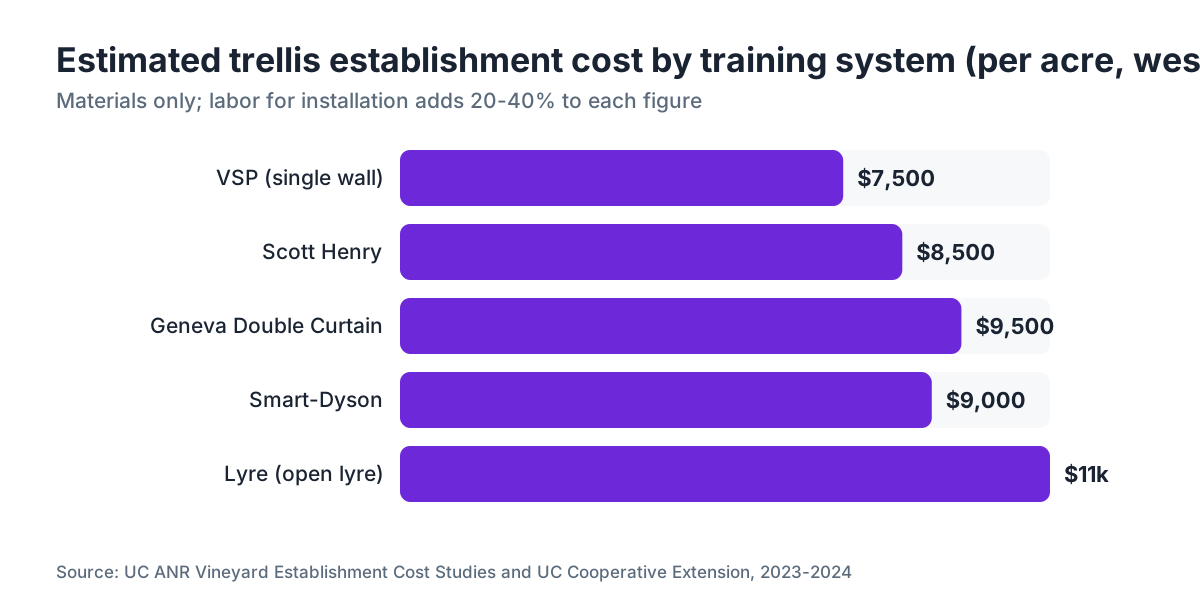
| System | Canopy walls | Shoot direction | Best for | Mech. harvest | Relative cost vs VSP |
|---|---|---|---|---|---|
| VSP | 1 | Up | Low-moderate vigor | Yes (with shaker) | Baseline |
| Scott Henry | 1 (divided vertically) | Up + down | Moderate-high vigor | Yes | +10-20% |
| GDC | 2 (horizontal) | Down | High vigor, flat terrain | Yes | +20-35% |
| Lyre (open lyre) | 2 (diverging upward) | Up | High vigor, hand harvest | Difficult | +30-50% |
| Smart-Dyson | 2 (split vertical) | Up + down | High vigor | Yes | +20-30% |
The GDC and lyre both split the canopy into two zones. The GDC runs both cordons horizontally with shoots dropping downward, while the lyre runs shoots upward from diverging arms. That upward shoot growth makes the lyre genuinely hard to run under a mechanical harvester. The harvesting head can't straddle the Y-shape the way it handles a flat trellis. Most commercial lyre blocks are still hand-harvested, which is a real cost anywhere harvest labor is tight.[2]
Scott Henry is often the smarter call if you want mechanical harvest compatibility and just need more wall area than VSP gives you. Cornell extension canopy-management work has consistently shown that for mechanically harvested blocks in North America, GDC and Scott Henry capture most of the quality benefit the lyre offers without the harvest-logistics headache.[3]
For hand-harvest premium wine blocks on high-vigor sites, the lyre earns its cost. For a machine-harvested volume block, think hard before you commit.
What yields and quality gains can you realistically expect from a lyre trellis?
Carbonneau's original Bordeaux trials and later European research found yield increases of 20-50% over single-wall systems on comparable high-vigor sites.[1] UC Davis divided-canopy summaries put the practical range at 20-40% for yield, with the caveat that quality gains are more consistent than yield gains because quality doesn't depend on having excess vigor to fill the extra wall area.[4]
The quality case is more nuanced than the yield numbers make it look. In a well-managed lyre, fruit in the gap between the two walls gets much better light interception. Research in the American Journal of Enology and Viticulture found that interior berry temperatures in divided canopies ran 2-4 degrees C cooler than comparable closed-canopy treatments on hot afternoons, which matters a lot for anthocyanin retention in red varieties.[5] Brix accumulation can actually slow slightly relative to closed canopies in very hot climates, which some warm-region growers treat as a benefit for keeping acid balance.
Botrytis pressure is the most consistently reported quality benefit in humid climates. Two open walls dry faster after rain or irrigation, so less standing moisture sits around the cluster zone. Cornell and WSU extension both name canopy division as one of the most effective structural moves for botrytis management, ahead of fungicide timing adjustments.[3][6]
Honest caveat: nobody has clean apples-to-apples yield data for every variety and climate. The Carbonneau trials were mostly Cabernet Sauvignon and Merlot under Bordeaux conditions, and the published range is wide. If you're making the investment call, the closest proxy is your current canopy's leaf area index (LAI). WSU extension recommends a target LAI of 1.5-3.0 for quality wine production. If your single-wall canopy runs above 4.0, you're a candidate for canopy division.[6]
What does it cost to establish a lyre trellis?
Lyre establishment costs more than VSP for three reasons that feed each other: the post structure is heavier, you need more wire runs, and the Y-arm hardware at the head of each post is a material cost VSP simply doesn't have.
Post spacing in a lyre block usually runs 5-6 meters between posts, a little wider than VSP's common 4-5 meters, because canopy mass spread across two walls creates different lateral load. End posts have to be heavier and better anchored to resist the outward tension the diverging arms create.
For materials alone, a reasonable estimate for a lyre trellis in the western U.S. as of 2024 runs $8,000-$14,000 per acre, depending on post material (treated wood vs. metal T-posts vs. steel H-braces), wire gauge, and how you fabricate the Y-arms. VSP on the same ground typically runs $5,000-$10,000 per acre. That 30-50% premium is real money, and it's mostly fixed no matter what your grapes eventually sell for.[7]
Installation labor is higher too. Setting the Y-arms and running four wire levels (two per wall) instead of two or three eats meaningfully more crew time than basic VSP. Some growers fabricate their own Y-arms from conduit or angle iron. Commercial Y-arm assemblies from trellis suppliers run $15-35 per post depending on adjustability and material.
The economics close fastest when you convert an already-established high-vigor block that's underperforming on VSP, because you skip the full per-vine establishment cost. You pay for new trellis hardware and retool existing vines over 2-3 seasons. That conversion path usually pencils out better than planting lyre from scratch, unless you have strong premium market commitments for the fruit.
During a capital-intensive establishment phase, tracking trellis materials, labor hours, and per-acre costs by block in a structured system (VitiScribe handles this kind of block-level cost allocation natively) makes end-of-year financial review and bank reporting much cleaner.
What vine spacing and row orientation work best with a lyre?
The lyre was designed for wide-row spacing, and that's still where it shines. Carbonneau's original recommendations called for row spacing of 2.5-3.5 meters, wider than the 1.5-2.5 meter rows common in premium VSP blocks. The reason is clearance. When each vine spreads two arms 60-100 cm apart at the canopy, adjacent rows need enough room that the walls don't shade each other during the morning and afternoon hours when oblique light matters most for interior fruit.[1]
Within-row spacing can be wider than VSP as well, commonly 1.2-1.8 meters between vines, because each plant carries more cordon length and more shoot positions. You aren't necessarily planting fewer vines per acre (row spacing widens more than within-row spacing narrows), but the density math works out differently than a tight VSP block.
Row orientation matters more with lyre than with VSP because you have two canopy walls and you want both to catch direct sun for a meaningful chunk of the day. North-south rows in the northern hemisphere generally perform best: the east-facing and west-facing walls of each arm each get direct morning or afternoon sun. East-west rows create an asymmetric light environment where the south-facing wall gets much more direct light than the north-facing one, which muddies ripening uniformity across the two arms.[4]
Slope complicates everything. On steep ground, holding consistent arm geometry is genuinely hard. The system was developed for flat to gently rolling terrain. Retrofitting lyre onto steep hillsides often leaves the Y-arms at inconsistent angles post by post, which creates uneven shoot distribution and canopy gaps. On slopes above roughly 15-20%, other divided-canopy approaches or a well-managed VSP with shoot thinning usually make more sense.
How do you prune and manage shoots on a lyre trellis?
Pruning a lyre isn't radically different from pruning a cordon-trained VSP vine. You're still working spurs on permanent cordon wood, targeting 2-node spurs spaced roughly 10-15 cm apart. The difference is that you have two cordons per vine instead of one, so total pruning weight per vine is higher and the work takes longer per plant.
Spur positioning on the lyre cordon should favor the upper surface and slightly outward-facing buds. You want shoots growing up and slightly out toward their own wall, not inward toward the gap or downward. Inward-growing shoots defeat the whole point of the divided canopy by re-creating shade in the central gap where your fruit is supposed to be getting light.
Spring shoot positioning is more time-sensitive with lyre than with VSP. On a single wall, a few shoots falling the wrong way are easy to catch and tuck. On a lyre, shoots that cross from one wall into the other can close the gap fast during the rapid growth phase between bloom and veraison. Most experienced lyre growers plan for at least one dedicated shoot-positioning pass per arm in late May or early June, meaning two systematic passes through the block instead of one. That's real labor cost that doesn't always show up in the first ROI model.
Hedging (mechanical shoot trimming) works well on lyre blocks. You can run the hedger along each arm separately, and the separation between walls makes it easier to reach both faces of each wall with a side-discharge hedger. This is one place where the lyre mechanizes more easily than growers expect.[2]
Fruit-zone leaf removal is often lighter on lyre than VSP because the open gap gives you passive air circulation and light that VSP only achieves through aggressive leaf pulling. On very humid sites you may still want selective leaf removal on the wall facing the prevailing afternoon breeze, but a well-managed lyre usually needs less canopy manipulation to hit the same microclimate targets.
How does the lyre affect spray coverage and pesticide records?
Spray coverage on a lyre is one of its genuine practical wins. The gap between the two walls gives an airblast sprayer direct access to the interior cluster zone and the interior canopy surface that a closed VSP canopy hides behind an outer leaf wall. University extension spray research has consistently found that divided-canopy systems get better internal coverage at equivalent spray volumes than single-wall systems.[6]
The geometry still needs attention. A standard airblast sprayer set up for single-wall VSP may need nozzle angle changes to direct product into both arms of the lyre. The spray cone has to reach the inward-facing surface of each wall and the cluster zone in the gap. Some applicators run slower ground speed through lyre blocks to compensate, which improves coverage but raises the gallons-per-acre rate. That matters for your records.
Under EPA's Worker Protection Standard (WPS), every pesticide application in an agricultural setting needs specific records no matter the trellis: product name, EPA registration number, application date, location, and re-entry interval (REI), all documented and accessible to workers.[8] EPA states the WPS "is aimed at reducing the risk of pesticide poisonings and injuries among agricultural workers and pesticide handlers." The lyre doesn't change what you record, but it can change your actual application rate and timing. If you slow down through lyre blocks, your per-acre gallons applied may differ from the label rate calculation you'd use for a standard-spacing VSP block. Keep those calculations in your spray record.
For IPM programs, the better spray penetration in a lyre canopy sometimes lets you tighten fungicide programs, particularly for botrytis and powdery mildew. Some growers report dropping one or two spray passes per season once the lyre canopy is fully established and properly managed, which partly offsets the higher establishment cost over time. Nobody should treat that as a guarantee, but the physical logic holds: better coverage means better efficacy from each application.[3]
Tracking block-level spray records with actual gallons applied, ground speed, and nozzle configuration gets a lot more practical when each block's application parameters live in the same place as your product records. Paper binder or digital tool like VitiScribe, the per-block detail is what saves you when your state ag department audits your pesticide use reports.
What varieties and climates suit the lyre best?
The lyre was born in Bordeaux and works best where Bordeaux faces its hardest problem: too much vigor. Heavy clay soils, high growing-season rainfall, and warm temperatures that drive vegetative growth before the vine shifts into reproductive mode are the natural habitat for this system. Cabernet Sauvignon, Merlot, Cabernet Franc, and Sauvignon Blanc have the most published lyre trial data behind them.[1][4]
In North America, the system has found its most consistent success on irrigated high-vigor sites in California's Central Valley and warmer parts of Paso Robles, and on moderately vigorous sites in Washington and Oregon where generous soil moisture and nitrogen push shoot growth past what a single wall manages well. The Paso Robles wineries region in particular mixes high-fertility valley-floor sites with lower-vigor benchland, so the system stays site-specific there even within a small geography.
For cool-climate varieties like Pinot Noir and Chardonnay, the lyre shows up much less, and there's a good reason. These varieties are usually grown in low-to-moderate vigor conditions where tighter spacing and a single-wall VSP give the light exposure and heat accumulation the variety needs to ripen. Split a low-vigor Pinot block into two arms and you just get two weak, gappy walls that neither ripen well nor fill a spray pattern efficiently.
Riesling and Gewurztraminer on cool sites land the same way. Warm-climate Zinfandel, Grenache, and Tempranillo on fertile soils are better candidates. Table grape growers in high-production systems have also adopted lyre-derived setups, sometimes called "T-trellis" or "Y-trellis" variants with horizontal rather than angled arms, specifically to maximize cluster exposure and size.
What are the main drawbacks and failure modes of the lyre?
Insufficient vigor is the most common failure mode, full stop. If the site doesn't generate enough shoot growth to fill two canopy walls, the lyre gives you two thin, gappy, sun-exposed canopies that burn fruit on hot afternoons and never build the leaf area for adequate photosynthesis. Sunburn on exposed clusters is a real yield and quality loss, not a theoretical worry.
The mechanical harvest problem is the second big drawback. Most commercial harvesters straddle the row and shake the trunk or catch wires. The Y-shaped lyre doesn't accommodate a standard over-the-row machine. Some custom harvester attachments exist, and a few manufacturers have built lyre-specific headers, but they're not widely available, they're expensive to rent or own, and in most regions you'll be hand-harvesting your lyre block. Where experienced harvest labor is scarce or costly, that's a genuine financial risk.[2]
Post and wire maintenance is harder than VSP. The Y-arm assemblies are stress points. Over time, outward tension from two loaded canopy walls can pull Y-arms downward or inward, which collapses the gap and defeats the canopy division. Annual inspection of every Y-arm and the anchor cables or posts that resist the outward pull is maintenance that often gets underestimated.
Mechanical pruning is complicated too. Standard over-the-row or side-discharge pruners handle single-wall VSP cleanly. For lyre, you either prune both arms by hand or make two machine passes per row, one per arm. Hedging works fine, as noted above, but dormant-pruning mechanization is limited.
The training period runs longer as well. Getting a vine properly established on a lyre, with two permanent cordons fully extended and carrying productive spur wood, takes 3-4 years from planting in most climates, against 2-3 years for VSP. You carry the fixed trellis cost an extra season before the system pays anything back.
How do you convert an existing VSP block to a lyre trellis?
Conversion is more common than planting lyre from scratch, and it's worth thinking through before you buy new hardware. The first question is whether the existing posts can carry the Y-arm addition and the new lateral loads. Many VSP posts, especially lighter T-posts or older wooden ones, can't. You may need to replace end posts and every third or fourth line post with heavier stock before adding the Y-arms.
The vine training side takes 2-3 seasons. In the first season, you pick one vigorous shoot from each existing cordon to become the new arm that will extend in the opposing direction from the trunk. You don't have two full cordons yet. You're growing the second arm from a head-trained cane or a basal shoot off the existing cordon. Many growers tie these developing shoots to temporary stakes or bamboo until the permanent Y-arm wire is set at the right height.
In the second season, you start establishing spur positions on both arms while the younger arm keeps extending. By the third season, you should have a functional divided canopy that begins delivering the yield and quality benefits you paid for.
Water and nitrogen management during conversion matters. You want enough vigor to fill both arms but not so much uncontrolled growth that the conversion shoots snap at the base or lay down poor wood. A modest cut in irrigation and nitrogen versus your pre-conversion inputs often gives you the controlled, moderate vigor that builds clean cordon structure without the brittleness that comes with too much push.
For blocks with very old, thick cordon wood carrying a lot of dead spur stubs (the cordon-decline problem), conversion to lyre is a good chance to retrain from younger, healthier basal wood rather than dragging decrepit old cordons into a new arm.
What do WSU, UC Davis, and Cornell say about divided-canopy systems?
All three major viticulture extension programs have published on divided-canopy systems, and their conclusions line up: canopy division works well on high-vigor sites, the quality benefits are real, but the system has to match site conditions to deliver.
WSU Extension's viticulture team, drawing on research from its Prosser, Washington station, has consistently recommended leaf area index assessment before you commit to any canopy modification. Their guidance puts the VSP breakeven around LAI 3.5-4.0: below that, manage within VSP; above it, consider division. They reference the lyre alongside GDC and Scott Henry as viable options, with the choice hinging mostly on mechanical harvest requirements.[6]
UC Davis, through its Viticulture and Enology department, has documented California trial results showing that in high-vigor Central Valley blocks, divided canopies improved color, anthocyanin concentration, and phenolic maturity in red varieties without letting sugar maturity race ahead of physiological maturity, a common problem in warm-climate closed-canopy reds.[4]
Cornell Cooperative Extension, serving the Finger Lakes and Hudson Valley, tends to stress the botrytis angle more than the yield angle, given the humid northeast. Its canopy management publications note that the air circulation from divided systems like lyre and Scott Henry cuts the number of fungicide applications needed for effective botrytis control, which matters both for cost and for pesticide record management under New York's rules.[3]
All three programs warn against treating any trellis system as universally superior. The theme that runs across all three bodies of work is essentially this: the best system is the one that matches your site's natural vigor. The lyre is one of the best tools for high-vigor sites and one of the worst choices for low-vigor sites, where you'd spend the whole season fighting the system instead of working with it.
Is the lyre trellis right for your vineyard?
This is the only question that actually matters once you understand the mechanics. The answer rides on five things: your current canopy LAI, your soil fertility and water supply, your labor situation at harvest, your tolerance for a 3-4 year payback on the extra trellis investment, and whether the fruit premium you can command justifies the cost structure.
If you're running a high-vigor block that shows shaded fruit, poor color in reds, stubborn botrytis despite good fungicide programs, and canopy so dense your airblast sprayer mostly coats the outer leaf wall and barely reaches the cluster zone, then a divided-canopy system deserves a serious look. The lyre is the right choice within that group if you have hand-harvest labor committed, you're planting or converting at wider row spacing, and you're targeting premium hand-crafted fruit over volume.
If you're machine-harvesting, look harder at Scott Henry or GDC first. They capture most of the same physiological benefits and play much nicer with standard harvest equipment.
If your site has moderate vigor you can manage with good VSP practices, shoot thinning, and timely leaf removal, you probably don't need the lyre. The incremental quality gain won't justify the 30-50% higher trellis cost and the slower harvest options.
For growers running multiple blocks across a vineyard operation, the real value is honest block-by-block assessment, not picking one system for the whole property. Some blocks warrant lyre. Others don't. Matching the system to the site is the whole game.
If you're tracking multiple blocks with different trellis systems, spray programs, and harvest methods, keeping that block-level data in one place makes your annual review and compliance reporting much faster. That's a genuine operational argument for a structured record system, whatever trellis you run.
Frequently asked questions
What is the difference between a lyre trellis and a Geneva Double Curtain?
Both are divided-canopy systems that split the vine into two walls. The GDC runs shoots downward from two horizontal cordons set wide apart, while the lyre angles two cordons upward in a Y shape with shoots growing up from each arm. GDC is more compatible with mechanical harvesters. The lyre gives better light exposure to upward-growing shoot tips and is usually chosen for hand-harvest premium blocks.
Can you use a mechanical harvester on a lyre trellis?
Standard over-the-row harvesters don't work well with the lyre's Y-shaped geometry. Some custom headers exist, but they're not widely available and most lyre blocks are hand-harvested. This is the single biggest operational constraint of the system. If mechanical harvest is a firm requirement, Scott Henry or GDC are better options that give similar canopy division benefits with better harvester compatibility.
How much does a lyre trellis cost per acre compared to VSP?
In the western U.S. as of 2024, lyre establishment runs roughly $8,000-$14,000 per acre in materials, versus $5,000-$10,000 for VSP, a premium of about 30-50%. The added cost comes from heavier post requirements, more wire runs per row, and the Y-arm hardware at the top of each post. Installation labor is also higher because running four wire levels instead of two takes more crew time.
What vine spacing should I use with a lyre trellis?
Carbonneau's original recommendations call for row spacing of 2.5-3.5 meters, wider than typical VSP. The extra width lets both canopy walls get full morning and afternoon sun without adjacent rows shading each other. Within-row spacing commonly runs 1.2-1.8 meters. North-south row orientation works best because both arms catch direct sunlight at different times of day, giving more uniform ripening across both walls.
How many years does it take for a lyre trellis to be fully productive?
Plan on 3-4 years from planting before a lyre block reaches full canopy expression and consistent yield. VSP typically hits full production in 2-3 years. The lyre takes longer because building two full permanent cordons with productive spur wood needs an extra season of deliberate arm-training. Converted blocks (VSP to lyre) also need 2-3 seasons of retraining before the divided canopy performs as intended.
What leaf area index indicates a block is a good candidate for the lyre?
WSU Extension recommends a target LAI of 1.5-3.0 for quality wine production. If your single-wall canopy runs above 4.0, that's a strong signal that canopy division makes sense. You can estimate LAI by point-quadrat sampling through the canopy midpoint or with a ceptometer. Consistent interior shading, poor fruit color, and botrytis in the cluster zone are field signs that track closely with excessive LAI.
Does a lyre trellis reduce powdery mildew and botrytis pressure?
Yes, consistently. The open gap between two walls improves air circulation through the cluster zone and lets spray reach the interior canopy surface and the fruit. Cornell and WSU extension both name canopy division as one of the most effective structural interventions for botrytis management. Better spray coverage means better fungicide efficacy per application. Some growers report dropping one or two spray passes per season once the lyre canopy is well-established.
Which grape varieties benefit most from the lyre trellis?
High-vigor varieties on fertile soils benefit most. Most published trials involve Cabernet Sauvignon, Merlot, Cabernet Franc, and Sauvignon Blanc, reflecting the system's Bordeaux origins. In North America, Zinfandel, Grenache, and Tempranillo on irrigated fertile soils are good candidates. Cool-climate varieties like Pinot Noir and Chardonnay generally aren't suited, because they're usually grown in low-vigor conditions where the lyre creates two weak walls instead of one productive one.
How do EPA Worker Protection Standard requirements apply to spraying a lyre trellis block?
The EPA Worker Protection Standard applies to all pesticide applications regardless of trellis system. You must record the product name, EPA registration number, application date, treated location, and re-entry interval for every application. The lyre's geometry may change your actual gallons-per-acre rate if you slow ground speed for coverage, so your records should reflect actual application parameters rather than defaulting to label-rate estimates meant for standard-spacing VSP blocks.
What are the most common mistakes when setting up a lyre trellis?
The four most common: using it on a low-vigor site (creating two thin weak walls), underestimating post and anchor requirements (the outward tension from two loaded arms is significant), failing to budget for the extra spring shoot-positioning labor, and not planning for hand harvest from the start. Forgetting the harvest-logistics problem until the first bearing year is an expensive surprise.
Can I convert my existing VSP block to a lyre without replanting?
Yes, conversion is more common than planting lyre from scratch. It takes 2-3 seasons of vine retraining and requires checking whether existing posts can handle the new loads. You'll likely need heavier end posts and possibly replacement of some line posts before adding Y-arm hardware. Vines train their second arm from a selected vigorous shoot, and the first full productive season from the converted canopy usually comes 3 seasons after you start.
Is the lyre trellis used in Bordeaux today?
It's far less common in Bordeaux now than when Carbonneau developed it. Appellation rules in many Bordeaux AOCs restrict or complicate non-traditional training systems, and the system fell somewhat out of favor as growers found simpler ways to manage vigor through rootstock selection, cover crops, and irrigation. It stays more common in research settings and in New World regions where appellation restrictions don't apply and high-vigor sites are common.
How does the lyre trellis affect frost risk in the spring?
The lyre positions buds and shoots higher off the ground than some low-training systems, which can cut exposure to the coldest air in frost-prone settings where cold air drains downhill. But the divided canopy means twice the number of primary bud positions exposed during a frost event. Net frost risk is roughly similar to VSP at comparable cordon heights. Row orientation and local air drainage matter far more than trellis choice for frost management.
Sources
- INRAE (Institut National de Recherche pour l'Agriculture, de l'Alimentation et de l'Environnement) -- Carbonneau lyre trellis original research: The lyre trellis was developed by Dr. Alain Carbonneau at INRAE in France in the 1970s; original trials showed yield increases of 20-50% over single-wall systems on high-vigor sites
- Sunridge Nurseries -- vineyard divided-canopy harvest compatibility notes: Lyre trellis blocks are primarily hand-harvested due to incompatibility with standard over-the-row mechanical harvesters; GDC and Scott Henry offer better mechanical harvest compatibility
- Cornell University College of Agriculture and Life Sciences / Cornell Cooperative Extension -- viticulture canopy management: Cornell extension cites canopy division as one of the most effective structural interventions for botrytis management and references lyre, GDC, and Scott Henry for high-vigor sites
- UC Davis Department of Viticulture and Enology -- canopy management and trellis systems: UC Davis places yield gains from divided-canopy systems at 20-40% for high-vigor sites and documents improvements in anthocyanin concentration and phenolic maturity in warm-climate red varieties; north-south row orientation recommended for lyre
- American Journal of Enology and Viticulture -- berry temperature and canopy microclimate research: Research published in AJEV found interior berry temperatures in divided canopies ran 2-4 degrees C cooler than comparable closed-canopy treatments on hot afternoons, with implications for anthocyanin retention
- Washington State University Viticulture and Enology -- canopy management and leaf area index guidance: WSU recommends a target LAI of 1.5-3.0 for quality wine production and advises canopy division evaluation when LAI exceeds approximately 4.0; notes improved spray penetration in divided-canopy systems and draws on research from its Prosser station
- University of California Agriculture and Natural Resources -- vineyard establishment cost and returns studies: Vineyard trellis establishment costs in western U.S. range from approximately $5,000-$10,000 per acre for VSP and $8,000-$14,000 per acre for divided-canopy systems like lyre, representing a 30-50% premium
- U.S. EPA -- Agricultural Worker Protection Standard (WPS), 40 CFR Part 170: Under EPA WPS 40 CFR Part 170, all pesticide applications in agricultural settings require records including product name, EPA registration number, application date, location, and re-entry interval, accessible to workers; EPA states the WPS is aimed at reducing the risk of pesticide poisonings and injuries among agricultural workers and handlers
- USDA National Agricultural Library -- viticulture and canopy management resources: Leaf area index assessment supports deciding between VSP and divided-canopy training systems for high-vigor vineyard sites
- University of California Cooperative Extension -- sample costs to establish and produce wine grapes: UC Cooperative Extension sample cost studies document per-acre vineyard establishment costs by training system, supporting the 30-50% trellis cost premium for divided-canopy versus single-wall VSP systems
Last updated 2026-07-09