Managing grapevine canker diseases: a field guide for growers
TL;DR
- Grapevine canker diseases, mainly Eutypa dieback, Botryosphaeria dieback, and Esca, are caused by wood-infecting fungi that enter through pruning wounds.
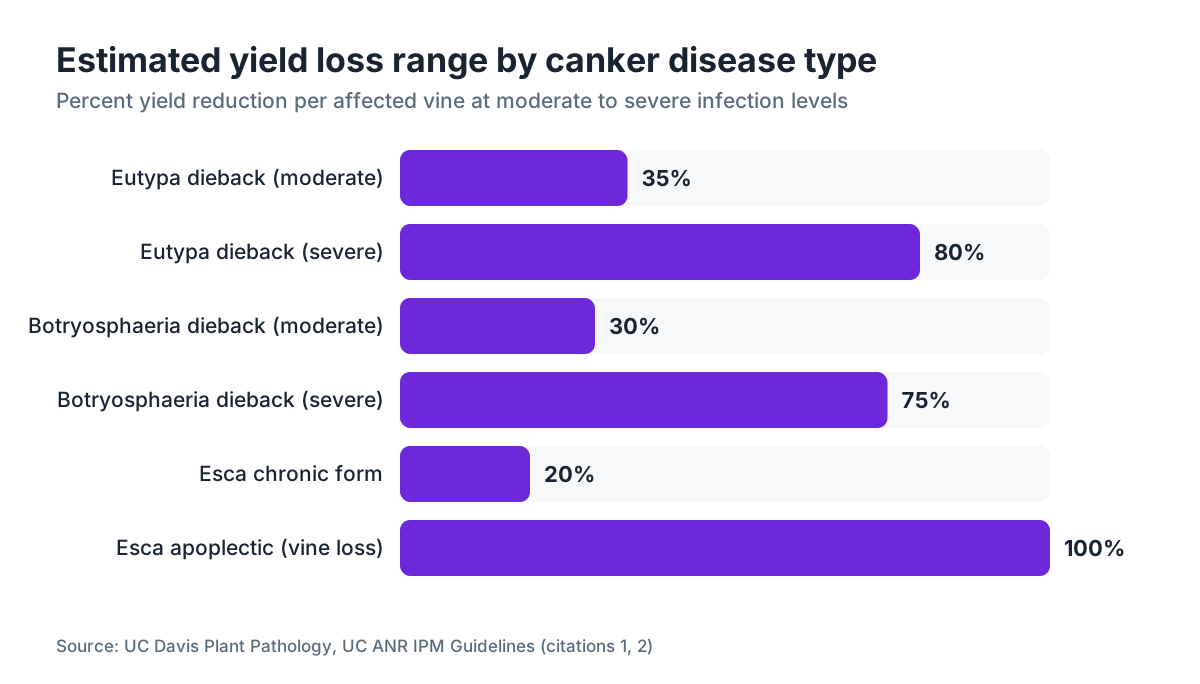
- They can kill cordons and cut yields 20-80% in infected blocks.
- Managing them takes wound-timing strategy, protectant fungicides, aggressive removal of dead wood, and multi-year patience.
- Once the wood is colonized, there is no cure.
What are grapevine canker diseases and why do they matter so much?
Canker diseases are fungal infections that get into grapevine wood through wounds, most often fresh pruning cuts, and then grow slowly through the cordon and trunk until the vine is functionally dead. The word 'canker' refers to the necrotic, discolored wood you find when you cross-section an infected arm or trunk. That tissue is dead and stays dead. The vine can't reabsorb it.
Three disease complexes dominate North American vineyards: Eutypa dieback (caused mainly by Eutypa lata), Botryosphaeria dieback (caused by a whole family of Botryosphaeriaceae fungi, including Lasiodiplodia theobromae and Diplodia seriata), and Esca (a complex involving Phaeomoniella chlamydospora, Phaeoacremonium minimum, and wood-rotting basidiomycetes). Phomopsis cane and leaf spot, caused by Diaporthe ampelina, is a fourth pathogen that can infect wood and cause dieback, though most growers think of it as a foliar problem. [1]
Here's what makes these diseases so nasty: they don't show up the season they infect. A wound infected in year one might not produce visible symptoms until year three or five, by which point the fungus has colonized several centimeters of cordon wood. By the time you see stunted spring growth, yellow wedge-shaped sectors in the canopy, or 'dead arm' symptoms, you've already lost years of yield. UC Davis Plant Pathology estimates Eutypa dieback alone costs California grape growers over $260 million a year in lost production and management costs. [2]
For a small or mid-sized operation, an infected block is the difference between a profitable harvest and one where you're just covering operating costs. The disease is slow, silent, and very hard to eradicate once it settles in.
Which fungi cause canker diseases in grapevines?
The pathogens are different enough that it pays to keep them separate in your head, because their biology decides when and how you respond.
Eutypa lata is the main culprit behind Eutypa dieback. It's an ascomycete that produces ascospores during wet weather, usually winter and early spring. Those spores travel on wind and rain and land on fresh pruning wounds. The fungus grows slowly through xylem toward the trunk, sometimes only a few centimeters a year, which is why symptoms lag infection by two to ten years. [1]
The Botryosphaeriaceae are a large family with multiple genera and species, all capable of causing dieback. Unlike Eutypa, many of these fungi are latent endophytes. They already live in your vine tissue in a dormant state and only turn pathogenic when the vine is stressed by drought, heat, or poor nutrition. This matters: a Botryosphaeria infection isn't always a wound-timing failure. Sometimes it's a stress management failure. [3]
Esca is the most complex and, honestly, the most poorly understood of the three. It involves multiple fungal species working together or in sequence, and it produces two distinct symptom types: a slow chronic form with interveinal chlorosis and leaf scorch that looks like nutrient deficiency, and a rapid apoplectic form where an entire vine wilts and dies inside a single season. Nobody has fully explained the apoplectic form mechanistically. [9]
Phomopsis dieback (Diaporthe ampelina) generally infects earlier in the season, when shoot tissue is still green, but cankered wood from overwintering infections can hold spores that re-infect wounds each spring. [4]
| Pathogen | Primary Entry Point | Spore Release | Symptom Lag |
|---|---|---|---|
| Eutypa lata | Pruning wounds | Wet winter/spring weather | 2-10 years |
| Botryosphaeriaceae spp. | Wounds + stressed tissue | Warm wet periods | 1-5 years |
| Phaeomoniella / Phaeoacremonium (Esca) | Pruning wounds | Spring-summer | 3-10+ years |
| Diaporthe ampelina | Green shoots + wounds | Early spring | 1-3 years |
What symptoms tell you a vine has a canker disease?
Aboveground symptoms are usually the last thing to appear, not the first. By the time you see them, the wood damage inside is already extensive.
For Eutypa dieback, look for stunted, chlorotic, narrow leaves on one or more canes coming off a single arm, sometimes called 'Eutypa stunt.' Those shoots are shorter than the healthy shoots next to them, the leaves cup or pucker, and the tissue may die back as the season goes on. Cut into the cordon or cane just below the affected area and you'll see a wedge of discolored wood, brown or gray, that follows the vascular tissue. [2]
Botryosphaeria dieback often shows up as dead arms or cordons, sometimes with dark brown internal wood discoloration that's more uniform than the Eutypa wedge. You might see varnished or orange-streaked wood in cross-section, depending on the species. Affected cordons may fail to push buds in spring, or push weakly and then die.
Esca's foliar symptoms get distinctive once you know them: interveinal chlorosis on mature leaves that starts at the margin, giving a 'tiger stripe' or 'dried-leaf' look, often with berry shrivel in late summer. The apoplectic form is sudden whole-vine wilt, usually in midsummer heat, which can pass for water stress until you cut into the trunk and find extensive internal rot.
Phomopsis dieback shows as dark, elliptical lesions at the base of shoots and at nodes. Infected tissue turns brown and the cane dies from the tip back.
The honest problem with diagnosis is that these symptoms overlap, and you can have two or three pathogens in one vine at once. A reliable call needs the fungus isolated in a plant pathology lab. Several university extension labs, including those connected to UC Davis and Washington State University, offer grape wood diagnostic services. [3][5]
When and how do grapevine canker fungi infect vines?
The infection calendar is what most growers get wrong, and it's where prevention actually lives.
Eutypa lata releases spores almost exclusively during rain events when temperatures are above roughly 10°C (50°F). In California's Central Valley and coastal regions, that window runs from about November through April. A pruning wound is most vulnerable in the first few hours to days after you make it. Susceptibility drops sharply after about two weeks as the callus starts to form, though wounds stay somewhat vulnerable for up to a month. [2]
That creates a real dilemma. You need to prune in winter and early spring to manage vine structure, but that's exactly when spores are flying. In regions with wet winters, the risk period and the pruning window line up almost perfectly. Pushing pruning to late in the dormant season, closer to bud swell, cuts infection pressure in trial after trial, because the wound heals faster in warmer temperatures and the vine is pushing harder. WSU research found that later pruning, in regions with wet winters, reduced Eutypa infection by a meaningful margin compared with early-season pruning. [5]
The Botryosphaeriaceae behave differently. Many produce spores during warmer, wetter spells, sometimes in summer, and their latent endophyte habit means drought stress in summer can switch on infections that entered through old wounds. A vine infected three years ago that stayed healthy under good irrigation might start showing symptoms the first time it hits a serious water deficit year.
Esca pathogens, mainly Phaeomoniella chlamydospora and Phaeoacremonium minimum, also enter through pruning wounds and track rainfall during the pruning period, much like Eutypa. Some research suggests they can enter through root injuries and soil too. [1]
Does pruning timing actually reduce canker disease infection?
Yes. This is probably the highest-leverage, zero-cost tool you have.
The core finding across trials: late pruning, closer to bud swell, cuts wound infection rates compared with early dormant pruning. The mechanism is simple. Warmer temperatures speed callus formation, so the wound closes faster. A wound made in late January or February in a warm region may callus over in 10 to 14 days. A wound made in November or December, in cold and wet conditions, can stay susceptible for four to six weeks. [2]
The tradeoff is labor logistics. Late pruning packs your labor into a narrower window, and in a large operation you may not have the crew to prune everything late. A practical compromise many growers use is 'double pruning': make a rough cut early, leaving a long spur or cane, then make the final precision cut later when conditions are better, so the wound you actually care about, the final structural one, gets made in warmer weather. UC Davis trials have supported this two-stage approach as a way to spread labor while still protecting the vine. [2]
Another timing move is to prune your oldest, most valuable vines first, in the late window, since those are both the hardest to replace and the most susceptible (larger wounds, slower healing). Young vines can take an early rough cut. You're still training them, and their wood is more vigorous.
Nobody has perfect data on exactly how much late pruning cuts canker incidence across every region and variety, because the answer swings on local weather. The closest consistent finding is a 30-50% reduction in Eutypa infection where pruning was delayed to within three to four weeks of bud break versus plots pruned in early dormancy. [2]
What fungicides protect pruning wounds from canker diseases?
Wound protectants are the second line of defense, and they work best applied within 24 hours of the cut.
The materials with the best efficacy data fall into a few groups:
Bordeaux mixture and other copper-based fungicides have a long track record and decent data against Eutypa and some Botryosphaeria species. They're cheap, widely available, and they fit organic programs. The catch: you have to hit every cut, which is labor-heavy at commercial scale. [4]
Thiophanate-methyl (sold as Rally or similar, depending on formulation) is a systemic with good efficacy data against Eutypa and Phomopsis. It's one of the most commonly recommended materials in conventional programs. Always check your current label. Registration status changes by state.
Tebuconazole and other DMI (demethylation inhibitor) fungicides have shown efficacy against Botryosphaeria species in some trials. UC Davis researchers have tested several DMI materials in wound-protection studies with meaningful results. [2]
Biological products, mainly Trichoderma-based materials like Vinevax or RootShield, work by colonizing the wound with a competitive fungus that crowds out the pathogen. Their efficacy is more variable than synthetic fungicides and leans hard on application timing and wound coverage. In trials, biologicals often trail synthetic protectants applied alone, but pairing a biological with a low-rate conventional fungicide has shown additive effects in some UC Davis trials. [2]
Paste formulations generally beat liquid sprays for wound protection because they stay in contact with the wound longer and don't wash off in the next rain. Commercial paste products exist that combine fungicide actives with a carrier that sticks to the cut surface.
The practical reality for most growers is that treating every cut in a large vineyard just isn't feasible. Prioritize cuts on mature cordons and trunks, large-diameter wounds, and cuts made in high-risk weather, meaning rain forecast within 24 to 48 hours of pruning.
A note on worker safety: any time you apply fungicides, especially systemic materials, you follow EPA Worker Protection Standard (WPS) requirements. That means keeping application records, posting treated areas, providing personal protective equipment, and observing re-entry intervals. [6]
How do you remove and manage infected wood already in your vineyard?
Once a canker is established, the fungus in that wood isn't going anywhere. No spray program kills a well-established trunk infection. The only tool is removal.
For moderate infections where only one or two arms show symptoms, cut back below the visible canker into healthy tissue. That means cutting until you see wood that's completely clean, white or cream, with zero discoloration. Leave even a small sector of brown wood and you've left live fungal mycelium, and the infection keeps marching. Cut further back than you think you need to. Then treat the new wound right away.
Trunk infections are harder. If the main trunk is infected, you can try a 'trunk renewal': train a new shoot from a sucker or low cane up as a replacement trunk, leaving the old infected trunk in place for now to keep the vine productive. Once the new trunk matures and can carry fruit, you remove the old one. This takes two to four years. It works, but it needs patience and you lose yield during the transition. [3]
Vines with severe Esca infections, especially ones that have already had apoplectic episodes, generally don't recover and should come out and get replanted. Leaving them in the row spreads the pathogen through soil contact and airborne spores.
Burn or haul off all removed wood. Don't leave it on the ground. Infected wood left in the vine row keeps producing spores for months. This is one of those steps that's easy to skip and genuinely costly to ignore. [1]
When you pull infected vines and replant, there's a real question about whether to replant in the same hole. For Esca, some evidence points to soil-based infection by Phaeomoniella, so fumigation or at least a full-season cover crop fallow before replanting is worth thinking about. The data isn't definitive, but it's the precautionary route most extension programs recommend. [5]
How bad is canker disease in terms of yield loss, and what's the economic damage?
The numbers are genuinely alarming, which is part of why canker management deserves more rigor than it usually gets.
UC Davis researchers estimate Eutypa dieback alone causes roughly $260 million in annual losses to California viticulture. [2] That figure covers both direct yield loss from diseased vines and indirect costs from replanting, vine training, and management programs.
In infected vineyards, yield losses from Eutypa-affected vines run from 20% to over 80% per vine, depending on how much of the cordon system is compromised. [2] A vine with half its cordon showing dead arm doesn't make half a crop. The remaining healthy cordon often overproduces in response, which creates its own quality problems.
Botryosphaeria dieback can cause similarly severe loss but tends to be patchier, showing up as scattered dead vines or arms rather than the progressive block-by-block spread more typical of Eutypa.
Esca's economic impact is harder to pin down because of how unpredictable the apoplectic form is. A grower can have a vineyard that looks fine in April and lose 5-10% of vines in a July heat wave. Nobody has good aggregate loss data across regions for Esca specifically, but block-level surveys in Napa and Sonoma counties have found Esca symptoms in more than 30% of vines in some older Cabernet Sauvignon blocks, based on UC Cooperative Extension field surveys. [11]
Here's the bottom line: canker management isn't optional for any operation trying to keep vines going past year 10. A wound protectant program almost always costs less than replanting 10-15% of your block every decade.
Are there resistant grapevine varieties or rootstocks?
Growers ask this constantly, and the honest answer is: somewhat, but not enough to make it your primary strategy.
Within Vitis vinifera, there's measurable variation in susceptibility to Eutypa lata. Some research suggests varieties with thick, waxy bark and faster wound-callusing rates, like some Grenache clones, are somewhat less susceptible than thin-barked varieties. But no commercially grown vinifera variety is truly resistant. Even the most 'tolerant' varieties in the trial data still show real infection under high inoculum pressure. [1]
Rootstock choice affects Esca expression more than Eutypa, likely because Esca pathogens can enter through roots and the rootstock's susceptibility affects how fast the infection moves into scion wood. Some older high-vigor rootstocks, like 1103 Paulsen and 140 Ruggeri, are anecdotally tied to lower Esca incidence in some European trials, but U.S. data is thin.
For new plantings, the more useful rootstock consideration is choosing certified disease-free material. Nursery-propagated wood has long been a major pathway for introducing Phaeomoniella chlamydospora and Phaeoacremonium minimum into new vineyards. Hot-water treatment of planting material at 50°C for 30 minutes has been shown to substantially reduce pathogen load in nursery wood. Some certified nurseries now offer hot-water-treated material. Ask specifically. [3][5]
The broader point: variety and rootstock selection shave your baseline risk a little, but they don't change the core management math. You still manage wound timing, apply protectants, and remove infected wood regardless of what you planted.
How do you set up a practical canker management program for your vineyard?
A real program runs on three tiers: prevention through wound management, early detection through regular wood inspections, and remediation through surgical removal and trunk renewal.
For prevention, start with a pruning calendar that pushes as many final cuts as possible into the late dormant period. In a region with wet winters, December and January cuts on permanent wood are your highest-risk activity. Train your crew to recognize that larger cuts (over 2.5 cm diameter) on cordons and trunks need protectant treatment immediately. Buy paste protectant in quantity and make it easy to apply in the field. A small brush and a belt-hung container gets used. A big jug left in the truck doesn't.
For detection, schedule a cross-section inspection of 5-10% of your mature vines each year, ideally during dormant pruning when you're already handling the wood. Cut into suspect arms and study the cross-section under good light. Keep a map of which blocks show discoloration and track it year over year. Block-level incidence maps built over three to five years show you where your problem is concentrated and where it's moving. This is exactly the kind of field record where a vineyard operations platform like VitiScribe makes tracking less painful: you log the inspection, photo the cross-section if it's bad, and the location ties to a block map automatically.
For remediation, build a trunk renewal budget. Realistically, any vineyard over 15 years old will have some percentage of vines needing renewal every year. A 1-2% annual renewal rate in a well-managed vineyard is achievable. A 5-10% annual rate means your prevention program isn't working and you're managing an epidemic, not a chronic condition.
Some growers in the San Joaquin Valley and the Paso Robles area run a dedicated crew for canopy scouting and wood inspections, separate from the pruning crew. See vineyards in Paso Robles wine country for examples of operations that work at this scale. The split keeps the pruning crew on speed and the inspection crew on accuracy. That's not feasible for everyone, but the underlying principle, that detection and remediation are separate jobs from pruning, holds.
Record-keeping for spray applications is non-negotiable for compliance. EPA WPS requires growers to keep records of pesticide applications including product, rate, date, and treated area. [6] California's Department of Pesticide Regulation also requires a permit for restricted-use materials and mandates submission of application records through County Agricultural Commissioners. [7] Keeping those records in one place, connected to your block maps, saves real time during audits.
What does recent research say about new canker disease treatments?
The last decade of research has focused on two areas: biological control and a better handle on the Botryosphaeriaceae complex.
On biological control, Trichoderma-based products have built up a meaningful body of trial data. A 2016 study published in Plant Disease evaluated multiple Trichoderma strains as wound protectants against Eutypa lata and found that some strains gave a 60-70% reduction in infection compared with untreated controls, though synthetic fungicides still came out ahead of the best biological treatments in most trials. The study concluded that 'biological control agents may be suitable components of integrated disease management programs' when combined with other practices. [8]
On the Botryosphaeriaceae complex, researchers at UC Davis and affiliated labs have put serious effort into cataloguing just how many species are involved. A 2011 study by Úrbez-Torres (now at AAFC) identified more than 25 Botryosphaeriaceae species capable of causing dieback in grapevines worldwide, with the community in any given vineyard shaped heavily by regional climate. [3] That matters for management because different species have different fungicide sensitivities and different relationships to vine stress.
There's also growing interest in trunk injection as a way to deliver systemic fungicides into established infected vines. Early data looks promising for slowing progression in already-infected vines, but this isn't mainstream yet, and the commercial products and protocols aren't well standardized for grapevines.
WSU's viticulture program has ongoing work on Esca epidemiology in Washington, particularly on how irrigation management and vine water stress interact with Esca expression. Preliminary results suggest that avoiding severe water stress from veraison through harvest significantly reduces apoplectic Esca incidence, which fits the known stress-activation behavior of the Botryosphaeriaceae pathogens involved. [5]
Cornell's viticulture extension program has published practical guides on integrated canker management for the Northeast, where Phomopsis dieback and Eutypa dieback are both economically significant and the wet spring climate drives high infection pressure. Their recommendation for a two-spray program, copper at pre-bud swell followed by thiophanate-methyl at early bud break, has solid field-trial support for Phomopsis suppression. [4]
How do canker diseases affect organic vineyards differently?
The short answer: organic growers have fewer effective tools, so the non-chemical steps carry even more weight.
Copper-based fungicides, Bordeaux mixture, and copper hydroxide are OMRI-listed and approved for organic production, and they do give meaningful wound protection against Eutypa and some other pathogens. The limitation is residual copper building up in soil over time, which California's Department of Pesticide Regulation has flagged as an environmental concern in some high-density organic districts. [7] Annual copper limits under the National Organic Program can constrain your spray program in high-pressure years. [10]
Biological controls, particularly Trichoderma-based products, fit naturally into organic programs and can be layered with copper to improve overall protection. The labor of applying paste to individual wounds is the same whether the material is organic or conventional.
The non-chemical strategies (late pruning, double pruning, aggressive wood removal, monitoring and early detection) are just as effective in organic programs as in conventional ones. If anything, organic growers should invest more in pruning timing discipline precisely because their protectant options are narrower.
One underused tool in organic systems is a wax-based wound sealant with no fungicide component. It doesn't protect as well as a fungicide paste, but it cuts wound desiccation and may slow spore germination by putting a physical barrier over the cut. It's better than nothing on large wounds you can't treat with a registered material in time.
Frequently asked questions
What is the most common canker disease in California grapevines?
Eutypa dieback, caused by Eutypa lata, is the most economically significant canker disease in California vineyards, with estimated annual losses over $260 million statewide. Botryosphaeria dieback is close behind, and its prevalence climbs in blocks that hit drought stress or other physiological stress. Both are present in virtually every established wine grape region in the state.
Can you cure a vine that already has a canker disease?
No. No treatment eliminates an established canker fungus from colonized wood. The only remediation is cutting back below all discolored tissue to completely clean wood, then treating the new wound with a protectant fungicide. If the trunk itself is infected, trunk renewal, training a new shoot as a replacement, is the only path to keeping the vine productive long-term.
How long after pruning is a grapevine wound susceptible to infection?
Wounds are most susceptible in the first 24-72 hours after cutting. Susceptibility drops substantially as callus tissue forms, a process that takes 10-14 days in warm conditions but can stretch to four to six weeks in cold, wet winter weather. Applying wound protectant within 24 hours of cutting is the most effective timing.
Does pruning in rain increase canker disease risk?
Yes, significantly. Eutypa lata and several Botryosphaeriaceae species release spores during rain events. Pruning during or right before rain creates fresh wounds exactly when airborne spore concentrations peak. If you can't delay pruning, apply wound protectant immediately after cutting, before the next rain hits.
What does Eutypa dieback look like on a grapevine?
The classic aboveground symptom is stunted, cupped, chlorotic shoots on one arm or cordon sector while the wood next to it looks healthy. Internally, a cross-section of the affected arm shows a wedge or V-shaped zone of brown or gray wood following the vascular tissue. Symptoms typically appear two to ten years after the initial wound infection.
What is the best fungicide for protecting grapevine pruning wounds?
Paste formulations of thiophanate-methyl or tebuconazole have the best efficacy data for Eutypa and Botryosphaeria dieback. Bordeaux mixture is the top choice for organic programs. Applying any protectant as a paste rather than a spray gives better wound coverage and rain fastness. Apply within 24 hours of pruning for best results.
How does Esca differ from Eutypa dieback in grapevines?
Esca involves multiple fungal species and produces two distinct syndromes: a chronic form with tiger-stripe leaf chlorosis and berry shrivel, and an apoplectic form where a whole vine wilts and dies suddenly in midsummer. Eutypa dieback causes the characteristic stunted, cupped shoots and internal wood wedge discoloration but rarely kills a vine outright. Both need cross-section inspection for a confident field call.
How do you prevent canker diseases when replanting infected vineyard blocks?
Remove all infected vine material and roots thoroughly. Fallow the block for one full growing season if Esca is suspected, since some Esca pathogens may persist in soil. Source certified, hot-water-treated nursery material to avoid introducing pathogens on planting stock. Hot-water treatment at 50°C for 30 minutes substantially reduces Phaeomoniella and Phaeoacremonium load in propagation wood.
Are there any grapevine varieties resistant to canker diseases?
No commercially grown Vitis vinifera variety is truly resistant to Eutypa lata, Botryosphaeria, or Esca. Some varieties are moderately less susceptible thanks to bark characteristics or wound-callusing speed, but the gap isn't large enough to make variety selection a meaningful management strategy. All vinifera varieties in commercial production need the same wound management protocols.
What records do I need to keep for canker disease spray applications?
Federal EPA Worker Protection Standard requires records of pesticide applications including product name, EPA registration number, application date, location, and rate for at least two years. In California, growers must also file restricted-use pesticide applications with the County Agricultural Commissioner. Keep these records organized by block and date so they're ready for any compliance audit.
What is double pruning and does it actually help with canker diseases?
Double pruning means making a rough early-season cut that leaves extra wood, then coming back for the final precision cut closer to bud swell, when warmer temperatures speed wound callusing. The final cut, the one that creates the permanent structural wound, gets made in lower-risk conditions. UC Davis trials support this approach for reducing Eutypa infection while spreading labor across a wider pruning window.
How do I tell canker disease symptoms apart from nutrient deficiency or herbicide drift?
The key difference is distribution and wood anatomy. Canker symptoms appear in sectors defined by the cordon structure, hitting shoots from one arm while neighboring arms stay healthy. Nutrient deficiency and herbicide effects spread more evenly across the canopy. A cross-section cut into a suspect arm that shows discolored wedge or streaked wood points strongly to canker disease rather than a nutritional or chemical cause.
How much does a canker management program cost per acre?
Wound protectant materials run roughly $20 to $80 per acre per year depending on product choice and rate, not counting labor. Labor for paste application on individual cuts can add $100-$300 per acre in commercial vineyards depending on vine density and pruning style. Trunk renewal labor and vine replacement varies widely, but budgeting $500-$1,500 per affected vine is realistic for full removal and retraining.
Sources
- UC ANR, Grape: Eutypa Dieback and Other Canker Diseases - UC IPM Pest Management Guidelines: Overview of canker disease pathogens including Eutypa lata, Botryosphaeriaceae, Esca complex, and Phomopsis; symptom descriptions and biology
- UC Davis Plant Pathology, Eutypa Dieback of Grapevine: Eutypa dieback costs California grape growers over $260 million annually; yield losses range from 20-80% per infected vine; support for late and double pruning strategies
- Úrbez-Torres J.R., 2011, Plant Disease - Botryosphaeriaceae species in grapevines: More than 25 Botryosphaeriaceae species capable of causing dieback in grapevines worldwide; latent endophyte behavior activated by vine stress
- Cornell Cooperative Extension, Grape Disease Management Guidelines: Two-spray program of copper at pre-bud swell followed by thiophanate-methyl at early bud break for Phomopsis suppression; Bordeaux mixture efficacy against canker pathogens
- Washington State University Extension, Grapevine Trunk Diseases: Later pruning reduces Eutypa infection; hot-water treatment of nursery stock at 50°C for 30 minutes reduces Phaeomoniella and Phaeoacremonium load; Esca and irrigation management research
- U.S. EPA, Worker Protection Standard for Agricultural Pesticides: WPS requires maintenance of pesticide application records, posting of treated areas, PPE provision, and re-entry interval compliance for agricultural pesticide applications
- California Department of Pesticide Regulation, Pesticide Use Reporting: California growers must report restricted-use pesticide applications to County Agricultural Commissioners; copper accumulation in soil flagged as environmental concern
- Mutawila et al., 2016, Plant Disease - Trichoderma biological control of Eutypa lata: Some Trichoderma strains provided 60-70% reduction in Eutypa infection compared to untreated controls; biological control agents described as 'suitable components of integrated disease management programs'
- UC ANR, Grapevine Esca (Black Measles): Esca involves Phaeomoniella chlamydospora, Phaeoacremonium minimum, and basidiomycetes; apoplectic form mechanism not fully explained; symptom descriptions
- USDA National Organic Program, Organic Regulations on Copper Use: Copper-based materials approved for organic production under NOP; annual copper use restrictions apply
- UC Cooperative Extension, Grapevine Trunk Disease Survey Napa/Sonoma: Esca symptoms found in more than 30% of vines in some older Cabernet Sauvignon blocks surveyed in Napa and Sonoma counties
Last updated 2026-07-09