Vineyard wind machines for frost protection: how they work and what they cost
TL;DR
- Wind machines protect vineyards from radiation frost by pulling warmer air from an inversion layer above the vines down to bud level.
- A single machine covers 10 to 20 acres, costs $15,000 to $40,000 installed, and works best when the inversion differential is at least 3 to 5°F.
- They do almost nothing in advective (wind-driven) frost events.
How do wind machines actually protect vines from frost?
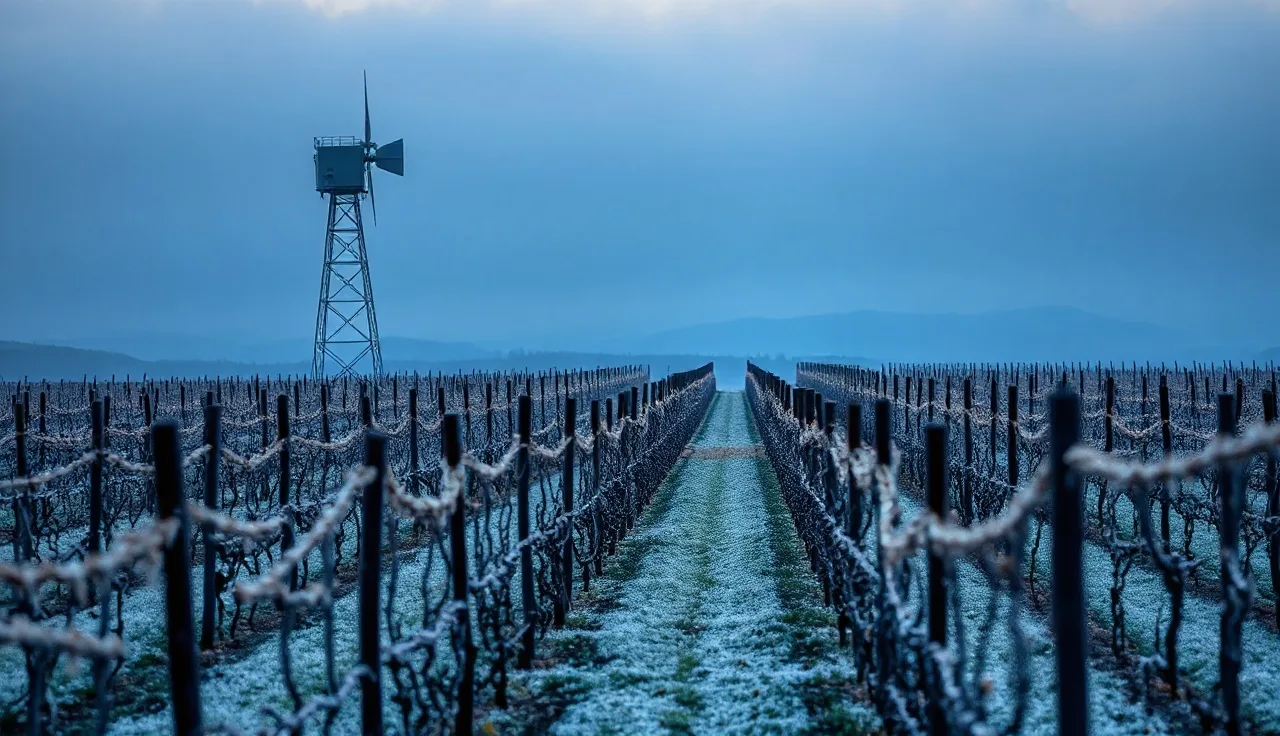
Radiation frosts create a temperature inversion. Cold air, being denser, settles at ground level and in low spots while warmer air sits 50 to 150 feet above the vineyard floor. A wind machine is a giant, slowly rotating fan that breaks up that layering and drags the warmer air down to bud level.
The propeller (typically 20 to 24 feet across, mounted 30 to 40 feet up) turns at 50 to 100 RPM and sweeps a full 360-degree arc, usually completing one rotation every 4 to 7 minutes [1]. The slow sweep is deliberate. A faster spin would just chop the air. The slow arc keeps pulling the warm air column down continuously.
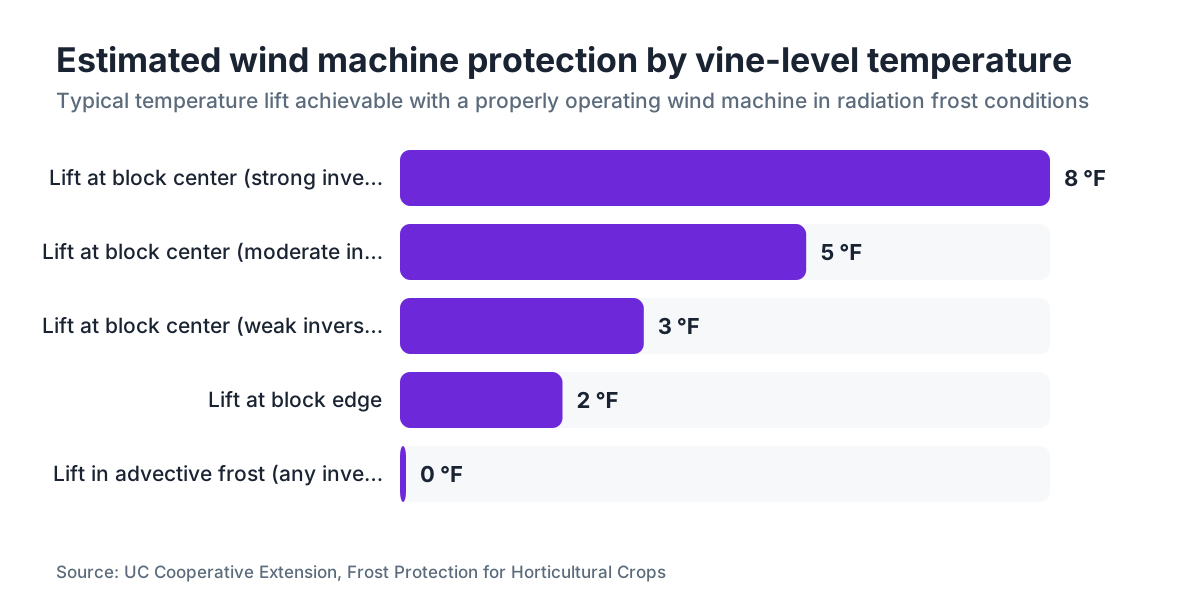
On a calm radiation frost night with a strong inversion, a wind machine can raise vine-level temperatures by 3 to 8°F, sometimes more [1]. That's often the difference between a crop and a write-off.
But the physics only work if the inversion actually exists. If you're in the middle of an advective frost, with wind already moving and a cold air mass coming through at all altitudes, a wind machine does almost nothing. This is the single biggest thing growers misunderstand before they buy one.
UC Cooperative Extension has documented that most economically significant frost events in California's premium wine regions are radiation frosts, not advective, which is part of why wind machines became the dominant active protection method in those areas [1].
What types of wind machines are available and how do they differ?
Three main categories: engine-driven units (by far the most common), electric units, and helicopter services (same inversion-mixing principle, rented instead of owned).
Engine-driven machines run on propane or diesel. Propane wins on most sites because the engines start reliably in cold weather and propane stores well in the field. Expect to burn 3 to 8 gallons of propane per hour depending on engine size, typically 70 to 120 horsepower [2]. Diesel machines exist, but cold-start reliability is a real worry. You don't want to learn your diesel won't turn over at 28°F at 2 a.m.
Electric machines are growing where the grid is reliable. They cost more to install because you have to run adequate electrical service out to a remote block, but operating costs are lower and they start instantly with no fuel logistics. In regions with cheap electricity or on-site solar, price them seriously.
| Machine Type | Typical Installed Cost | Coverage | Fuel/Operating Cost | Cold-Start Reliability |
|---|---|---|---|---|
| Propane engine | $18,000, $40,000 | 10 to 20 acres | $15, $40/hr | Excellent |
| Diesel engine | $15,000, $35,000 | 10 to 20 acres | $10, $25/hr | Fair to poor |
| Electric | $20,000, $50,000 (incl. electrical) | 10 to 20 acres | $3, $10/hr | Excellent |
| Helicopter (rental) | $300, $600/hr | Variable | N/A (contract) | Depends on availability |
Helicopters work on the same mixing principle and can reach terrain where fixed machines don't cover well. The problem is availability. When a frost event hits a whole region at once, every grower is calling the same helicopter service. Pre-season contracts help, but this method is less reliable than owning your own machine [3].
There's also a hybrid path: stacking a wind machine with undertree micro-sprinklers or overhead sprinklers. Each method has its own operating range and they don't always complement each other cleanly, but in very cold events some growers run both.
How much does a vineyard wind machine cost, installed?
Installed cost for a propane engine-driven machine runs $18,000 to $40,000 in most markets as of 2024 to 2025, with most single-tower units landing in the $22,000 to $32,000 range before site prep [2]. That range moves with engine size, tower height, and whether the site needs grading, a concrete pad, or propane tank infrastructure.
The propane tank itself, if you don't already have one, adds $1,500 to $4,000 depending on size. Electric machines need grid infrastructure. Running three-phase power to a remote block can cost $5,000 to $20,000 on its own, depending on distance from the meter.
Annual maintenance is real money too. Budget $800 to $2,000 a year for oil changes, propeller inspection, belt or chain service, and engine tune-ups. Skipping it is how you end up with a machine that won't start on the one night you need it. WSU extension and other programs recommend a full pre-season service in late February, before the frost window opens [4].
Depreciation matters for planning. Most growers and accountants treat wind machines as 10 to 15 year assets, though well-kept units run 20-plus years. The per-acre math is simple. A $28,000 machine covering 15 acres over 12 years works out to roughly $155 per acre per year before fuel and maintenance. Set that against a single frost year losing 40 to 60% of a $3,000-per-ton Chardonnay crop, and the decision makes itself.
How many acres does one wind machine cover?
The rule of thumb is 10 to 20 acres per machine, and WSU extension puts the typical effective radius at roughly 600 to 900 feet from the tower base [4]. Terrain changes that math a lot. Flat, uniform blocks with no obstructions land toward the upper end. Rolling ground, tree lines, or blocks with real elevation change inside them compress coverage hard.
Low spots and frost pockets almost always need supplemental protection even with a machine running. Cold air drains into those depressions and pools there, and the machine struggles to pull enough warm air down to offset that drainage.
For blocks bigger than 20 acres you have two options: add machines, or accept that the outer edges get less protection. Multiple machines set to overlap their coverage zones are the right call for high-value varietals. For lower-value fruit, the economics shift.
When you site the tower, UC Cooperative Extension guidance is to place it as centrally as possible in the block and keep the propeller at 30 to 40 feet, which puts it well into the inversion layer on most nights [1]. Towers that sit too low underperform every time.
What temperature triggers should you use to start and stop a wind machine?
The answer depends on your critical bud damage temperatures, which change with growth stage and variety. Dormant buds tolerate down to about 15°F, but green tissue after budbreak takes damage at 30 to 32°F for many varieties [5]. Cabernet Sauvignon and other Vitis vinifera in early shoot growth are typically hurt at 28 to 30°F. Past bloom, the thresholds shift again.
Cornell's viticulture extension publishes a table of critical temperatures by growth stage worth keeping posted in the farm office [5]. The pattern: damage thresholds climb as the season moves through budbreak, shoot growth, and bloom. A spring frost after budbreak does more harm at a milder temperature than a mid-winter cold snap does deep in dormancy.
For startup, most growers set automated triggers (thermostats or remote controllers) to start the machine when air temperature at vine level hits 35 to 36°F. That buffer above the 32°F damage threshold covers the 15 to 30 minutes it takes the machine to reach full mixing and stabilize the block. Starting at exactly 32°F is too late.
Shutdown is less obvious. Don't kill the machine the moment temperatures climb above freezing at sunrise. On clear mornings, reradiation from cold soil and wet vine surfaces can push temperatures back down in the first 20 to 30 minutes after sunrise even as the air warms. The standard advice is to keep running until ambient temperature is solidly above 34°F and climbing, usually 30 to 60 minutes after sunrise [4].
Remote monitoring earns its keep here. Getting up to check a thermometer at 2 a.m. every night in April is not sustainable. Automated frost alarms with SMS or app alerts, wired to vineyard-level sensors, are worth the money. Tools like VitiScribe let you log temperature events alongside your field records, so you keep a documented operational history that matters for crop insurance claims.
Do wind machines work in every frost event, or just some?
No. Wind machines are built for radiation frosts only. A radiation frost happens on calm, clear nights when the ground radiates heat up into a clear sky, ground-level temperatures fall, and the classic inversion layer forms. These are the most common frost events in California's Central Valley, in parts of Oregon's Willamette Valley, and across many Intermountain West wine regions.
An advective frost is a different animal. It arrives with a cold air mass moving through the region, often with wind. There's no inversion. The cold is consistent at all altitudes. Running a wind machine in an advective frost does essentially nothing protective, and some practitioners argue it can make things slightly worse by increasing convective heat loss from vines. WSU extension puts the practical threshold at roughly 5 mph sustained wind. Above that, you're probably in advective conditions and the machine won't help [4].
The practical takeaway: know your local frost climatology before you spend a dime. If your region's frost events are mostly advective, a wind machine isn't your answer. Micro-sprinklers, which work by exploiting the latent heat released when water freezes, protect in both frost types, though they carry their own water use and infrastructure costs.
You can pull regional frost data from your state climate office or from NOAA's Applied Climate Information System, which publishes historical weather event records by location [6].
How does wind machine frost protection compare to sprinkler irrigation systems?
These are genuinely different tools with different risk profiles, and choosing between them (or stacking them) deserves a clear-eyed look.
Wind machines work roughly between 25 and 32°F at vine level in radiation frost conditions. Below about 25°F, the inversion differential usually isn't large enough to protect even with the machine running. Above 32°F, you're not in danger. So the operating window is narrow and specific [1].
Undertree micro-sprinklers and overhead sprinklers protect a different way: they exploit the latent heat of freezing. Water releases 80 calories per gram as it turns from liquid to ice, which holds the ice/water interface at exactly 32°F. As long as the system keeps delivering water and ice keeps forming, the bud stays at 32°F no matter how cold the air gets. That means sprinklers can protect in much colder events, even advective frosts, as long as the water holds out [7].
The downsides are real. Water use is heavy (50 to 150-plus gallons per acre per hour for overhead systems). You need pumping capacity and reservoir storage. If the system fails mid-event or the water runs dry, the ice that already formed becomes an insulating trap that can lock temperatures at damaging levels. Overhead ice loading also breaks canes in wet years.
Most growers in moderate-risk regions run wind machines as the primary tool and keep sprinklers as backup or for the coldest nights. In very high-risk regions (think Willamette Valley floor blocks, or Napa Valley floor blocks), some operations run both in layered protection.
If you want to see how growers in paso robles wineries country or south coast winery operations handle it, the mix varies with frost exposure and local water rights.
What are the noise and neighbor considerations for operating wind machines?
A propane wind machine at full speed puts out roughly 85 to 95 decibels at 50 feet [2]. At 500 feet, that's still 65 to 75 dB, about conversation level, but sustained through the night. In farm country this is usually legal. Where vineyards border housing, it turns into a real community relations problem.
Some counties in California and Oregon have noise ordinances that reach even agricultural operations during nighttime hours. Check your county's agricultural noise exemptions specifically before assuming you're covered. Most jurisdictions that have wrestled with this carve out exemptions for frost protection, but they're not universal.
Electric machines are much quieter, typically 60 to 70 dB at 50 feet, and that's a strong argument for electric near residential neighbors [2].
Then there's the permit question. Many counties require a building or conditional use permit for the tower itself, even though the machine is agricultural. Tower heights above 35 feet sometimes trigger extra review. Call your county planning department before you pour the pad. Getting this wrong means tearing out work or operating without proper permits, which creates liability.
What worker safety rules apply to wind machine operation and maintenance?
Wind machine maintenance and proximity work falls under general agricultural equipment safety. The EPA's Worker Protection Standard governs pesticide-related activities in and around vineyards [8], but machine-specific safety during non-spray work falls mainly under OSHA's agricultural standards (29 CFR Part 1928) and state-level Cal/OSHA or equivalent rules.
The rotating propeller is the primary hazard. Never service a machine while it's running or with the engine key in the ignition. A lock-out/tag-out procedure matters here the same way it does for any powered equipment. Make sure everyone who approaches the machine understands the propeller's reach, and that some machines can start rotating if the auto-start thermostat trips while someone is working near the base.
For propane units, routine engine maintenance is standard small-engine safety: good ventilation, no smoking near fuel connections, correct regulator upkeep. Propane tank placement and setback distances are governed by NFPA 58, the Liquefied Petroleum Gas Code, which sets minimum distances from structures and property lines based on tank capacity [9]. A 500-gallon tank requires a 10-foot setback from structures. Larger tanks require more.
Keep solid records: maintenance, startup events, temperature logs, and any worker proximity incidents. That's good practice and often required if you're in a county or state with agricultural labor regulations. Logging it in a consistent system, paper or a platform like VitiScribe, makes compliance audits much simpler.
How do you know if your wind machine actually worked on a given frost night?
Most growers don't think this through until they're standing in a half-damaged block trying to explain the pattern. A well-functioning machine on a radiation frost night creates a measurable temperature gradient. Vine level at the block center should read warmer than the block edges, and definitely warmer than outside the machine's range.
The right way to verify is a multi-point monitoring setup: sensors inside the protection radius at vine level, sensors at the block edges, and a reference sensor well outside coverage. If every sensor shows the same temperature all night, either the frost wasn't a radiation event (no inversion to mix) or the machine wasn't doing its job.
Data loggers that record continuously at 5 to 15 minute intervals are cheap (under $100 each for basic units) and give you a clean record. After an event you can read the curves and see exactly when the machine started, how fast temperatures stabilized, and whether the protected zone held above the critical threshold.
That data pays off directly on crop insurance claims. If you took partial damage and need to prove you ran protection equipment, time-stamped temperature logs plus machine run-time records are what adjusters actually want. USDA Risk Management Agency guidance on Actual Production History policies treats active frost protection as a factor in loss adjustment [10].
WSU's viticulture program recommends calibrating sensors annually and checking their placement, since sensors that shift position or get shaded by canopy growth give misleading reads by midsummer. You don't notice until the next spring's frost season, when it's too late [4].
What's the best way to finance and depreciate a wind machine purchase?
Wind machines qualify as agricultural equipment under Section 179 of the U.S. Tax Code, which means you can potentially deduct the full purchase price in the year of purchase instead of depreciating it over the asset's life [11]. The Section 179 deduction limit for 2024 is $1,220,000 (adjusted periodically), which covers essentially any single machine or fleet upgrade.
Bonus depreciation stepped down from 100% to 60% for 2024 and keeps phasing out through 2026 under current law. So bonus depreciation stacked with or instead of Section 179 is still useful, just less powerful than it was in 2022 to 2023. Talk to your agricultural CPA about which approach fits your income.
Farm Service Agency loans, particularly Operating Loans and Ownership Loans, can finance equipment purchases. The USDA's Environmental Quality Incentives Program has, in some years, offered cost-share for frost protection infrastructure, though availability varies by state and funding cycle. Check with your local NRCS office for current programs [12].
Some equipment dealers offer financing directly, usually at rates tied to prime plus 1 to 2 points. Shop that against ag-focused bank loans. Buying multiple machines at once for a larger operation usually gives you more negotiating room on both price and financing terms.
What maintenance schedule keeps a wind machine reliable through frost season?
Pre-season service in late February or early March is the baseline. That means an engine oil and filter change, checking and tensioning or replacing all belts and chains, inspecting propeller blades for cracks or stress fractures, checking every fastener on the tower and prop hub, testing the thermostat auto-start, running the machine through a full rotation cycle, and topping off the propane tank.
A cracked propeller blade is not cosmetic. Propeller failure at operating speed is catastrophic. Any crack, delamination, or impact damage on a blade pulls the machine from service until the blade is replaced or professionally assessed.
Mid-season: if you run the machine 30-plus hours during an event, check the oil before you rely on it again. High-cycle springs chew through oil life faster than the calendar suggests.
Post-season: drain or stabilize fuel on gasoline-blend engines, treat propane systems per manufacturer spec, lubricate the rotation mechanism, and cover or store the control box if it's exposed to weather.
Keep a maintenance log. Record the date, work performed, hours on the engine, and any parts replaced. That's standard for warranty compliance and makes diagnosis faster when something fails. Most manufacturers publish recommended service intervals in the owner's manual, and those intervals, not generic guidelines, govern your warranty coverage.
Frequently asked questions
At what outside temperature should I start my wind machine?
Set your auto-start thermostat to trigger at 35 to 36°F at vine level. This gives the machine 15 to 30 minutes to reach full mixing before temperatures drop to the 32°F damage threshold. Starting at exactly 32°F is too late. Calibrate your sensor placement annually, since sensor position drift causes meaningful errors in trigger timing.
How much propane does a vineyard wind machine use per night?
A typical 70 to 120 horsepower propane engine burns 3 to 8 gallons per hour. On a moderate frost night running 4 to 6 hours, expect 15 to 40 gallons. On extended cold events running 8 to 10 hours across multiple nights, consumption climbs fast. Keep your tank topped before forecast frost periods. Running out mid-event is a common and avoidable loss.
Can I use a wind machine during an advective frost?
No, not effectively. Wind machines only work in radiation frost conditions where a temperature inversion exists. Advective frosts arrive with a moving cold air mass at consistent temperatures across all altitudes, so there's no warm air above to mix down. WSU extension puts the practical cutoff at about 5 mph sustained wind. Above that, assume advective conditions and don't expect protection.
How far apart should multiple wind machines be placed?
For overlapping coverage, most extension programs recommend spacing machines so their effective radii (roughly 600 to 900 feet each) overlap by 20 to 30%. In flat, uniform blocks that usually means one machine per 15 acres, placed every 700 to 900 feet. In irregular terrain or blocks with frost pockets, set machines closer to those low-elevation zones, which carry the highest risk.
Do wind machines need a permit?
Often yes, at least for the tower structure. Many counties require a building permit or conditional use permit for structures above a set height (commonly 35 feet). Agricultural exemptions exist in many jurisdictions but aren't universal. Check with your county planning department before installation. In some regions, a conditional use permit also requires a noise study or neighbor notification process.
What's the effective temperature range where a wind machine actually helps?
Wind machines give meaningful protection in the roughly 25 to 32°F range at vine level during radiation frost conditions. Below 25°F, the inversion differential is rarely large enough to protect adequately. Above 32°F, you're not in frost danger. For temperatures below 25°F, water-based systems like sprinklers or other methods are needed, because the inversion simply doesn't supply enough warm air.
How do I know my wind machine is actually raising temperatures in my block?
Install multiple temperature data loggers: at least two at vine level inside the protection radius, one at the block edge, and one reference sensor outside coverage. On a working radiation frost night, the center sensors should read 3 to 8°F warmer than the edge and outside sensors. If all sensors show the same temperature, either the event is advective or your machine isn't functioning correctly.
Can one wind machine protect an irregularly shaped block?
It depends on the shape and size. A long, narrow block that fits within the machine's effective radius works fine. An L-shaped or fragmented block may leave corners or arms outside effective coverage. For complex shapes, plot the machine's coverage circle against your block boundary on a satellite image before committing to a single placement. Sometimes two smaller machines cover the geometry better than one large one.
Is an electric wind machine better than a propane one?
Electric machines have lower operating costs, start instantly without fuel logistics, and run quieter, which matters near residential neighbors. The tradeoff is higher installation cost (you need adequate electrical service to a remote field location) and dependence on grid reliability. In areas with solid grid infrastructure and residential neighbors, electric is increasingly the better choice. In remote blocks, propane stays more practical.
What varietals are most sensitive to spring frost damage?
Early-budding varietals carry the highest risk. Chardonnay, Pinot Noir, and Merlot typically break bud 1 to 3 weeks earlier than late-budding varieties like Cabernet Sauvignon, which widens their spring frost exposure window. Cornell's viticulture extension publishes critical damage temperatures by variety and growth stage. Chardonnay in early shoot growth is often damaged at 29 to 30°F, while the same variety dormant survives well below 20°F.
Does frost protection affect my crop insurance claim?
Yes. Under USDA Risk Management Agency Actual Production History policies, you're typically required to use good farming practices, including active frost protection when it's available and economically practical. Failing to run protection equipment you own can affect your claim. Time-stamped temperature logs and machine run-time records are the documentation adjusters want. Keep those records for at least three crop years.
How much does it cost to run a wind machine for a full frost season?
Fuel costs swing widely with season severity. In a mild spring with 3 to 4 events each lasting 4 to 6 hours, a propane machine might consume 200 to 400 gallons total at roughly $2.50 to $4.00 per gallon, so $500 to $1,600 in fuel. A severe spring with 10-plus events could hit $3,000 to $6,000. Add $800 to $2,000 annual maintenance and you're at $1,300 to $8,000 per machine per year.
Can I rent a wind machine instead of buying one?
Rentals for fixed wind machines are uncommon. Most units are sold, not rented. Helicopter frost protection is the rental equivalent, running $300 to $600 per hour by pre-season contract. The availability problem with helicopters is real: regional frost events mean every grower in the area calls at once, and contracts don't guarantee specific response times. Owning your machine is the only way to be sure it runs exactly when you need it.
Sources
- UC Cooperative Extension, Frost Protection for Horticultural Crops: Wind machines can raise vine-level temperatures 3 to 8°F during radiation frost inversions; most economically significant frost events in California wine regions are radiation frosts; optimal propeller height is 30 to 40 feet.
- Oregon State University Extension Service, Wind Machines for Frost Protection in Vineyards: Propane engine-driven machines burn 3 to 8 gallons per hour at 70 to 120 hp; installed cost $18,000, $40,000; noise roughly 85 to 95 dB at 50 feet; electric machines roughly 60 to 70 dB at 50 feet.
- Oregon State University Extension Service, Frost Protection in Vineyards: Helicopter frost protection availability is constrained during regional frost events when multiple growers require service simultaneously; pre-season contracts recommended.
- Washington State University Extension, Frost and Freeze Protection for Grapes: Effective radius 600 to 900 feet per machine; advective frost threshold approximately 5 mph sustained wind; pre-season service recommended late February; keep machines running 30 to 60 minutes after sunrise; annual sensor calibration recommended.
- Cornell Cooperative Extension, Viticulture Critical Damage Temperatures by Growth Stage: Dormant buds survive to approximately 15°F; early shoot growth of Chardonnay damaged at 29 to 30°F; damage thresholds vary by variety and growth stage.
- NOAA Applied Climate Information System: Historical frost event climatology and frost type classification data available by location from NOAA's regional climate centers.
- UC Cooperative Extension, Micro-Sprinkler and Overhead Sprinkler Frost Protection: Overhead sprinkler systems use latent heat of freezing to protect vines; water use 50 to 150+ gallons per acre per hour; effective in advective and radiation frost events while water supply holds.
- EPA Worker Protection Standard for Agricultural Pesticides: EPA WPS governs pesticide-related activities and worker safety in agricultural settings including vineyards.
- NFPA 58, Liquefied Petroleum Gas Code: NFPA 58 specifies minimum setback distances for LP-gas containers from structures based on tank capacity; 500-gallon tank requires 10-foot setback.
- USDA Risk Management Agency, Actual Production History Policy: APH crop insurance requires use of good farming practices including active frost protection where economically practical; documentation of protection operations relevant to loss adjustment.
- IRS, Section 179 Deduction for Agricultural Equipment: Agricultural equipment including wind machines qualifies for Section 179 expensing; 2024 deduction limit $1,220,000.
Last updated 2026-07-09