Mettle fungicide in vineyards: full spray guide for grape growers

TL;DR
- Mettle 125 ME (tebuconazole) is a FRAC group 3 DMI fungicide used in vineyards mostly against powdery mildew, black rot, and Botrytis.
- The rate is 4 to 8 fl oz per acre, the pre-harvest interval is 7 days, and the seasonal maximum is 24 fl oz per acre.
- Rotate with non-DMI modes of action to slow resistance.
What is Mettle fungicide and why do vineyard managers use it?
Mettle 125 ME is a sterol demethylation inhibitor (DMI) fungicide, FRAC group 3, with tebuconazole as its active ingredient at 125 grams per liter. It controls several fungal diseases that cost you money in wine and table grape vineyards: powdery mildew (Erysiphe necator), black rot (Guignardia bidwellii), and Botrytis bunch rot (Botrytis cinerea). Some labels list Phomopsis cane and leaf spot coverage too, though the efficacy data there is thinner.
Here's why DMIs took hold in vineyards. They move into plant tissue instead of sitting on the surface, so they work from the inside. That gives you some curative activity within roughly 24 to 72 hours of infection, depending on disease pressure and temperature. Protectants like sulfur or copper only work ahead of infection. Mettle buys you a short window to catch an event you missed.
That same systemic strength is what created the biggest headache with DMIs as a class: resistance. Powdery mildew populations hit with repeated DMI sprays drift toward reduced sensitivity over a season or two. So Mettle should never be your only tool. It works best inside a rotation that includes multi-site protectants and other FRAC groups. [1]
Mettle 125 ME is registered by Nichino America. Read the product label in hand before every application. Labels get revised, and the one on your container is the legal document, not this article.
What diseases does Mettle control in grapevines?
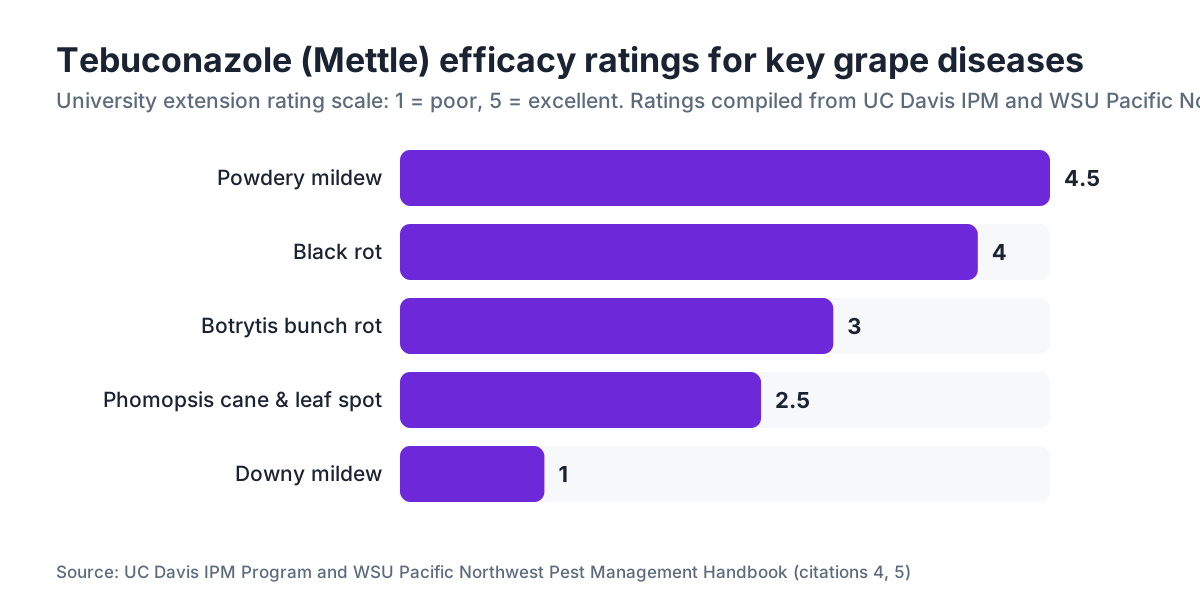
Powdery mildew is the main target and the disease where Mettle has the most field history in grapes. Erysiphe necator wrecks berry quality and cluster set once it establishes, and it thrives in the mild, dry conditions common across western wine regions. Mettle's curative window makes it a fair rescue option early in an epidemic. It is not a replacement for a preventive program timed right. [2]
Black rot is the second listed target. Guignardia bidwellii is mostly a wet-climate disease. It shows up in the eastern United States, the Finger Lakes, the Hudson Valley, and some Pacific Northwest sites with heavy spring rain. Infection-period models like NEWA (the Network for Environment and Weather Applications, run by Cornell) help you narrow down when black rot protection is actually needed. That matters, because a DMI spray you didn't need just stacks resistance pressure for nothing. [3]
Botrytis control with Mettle is moderate at best. Most extension programs, including UC Davis IPM, put FRAC group 7 (SDHI) and group 17 (phenylpyrroles like fludioxonil) ahead of DMIs for Botrytis. Use Mettle on Botrytis only inside a rotation built around those stronger modes of action. [4]
Phomopsis cane and leaf spot appears on some Mettle labels. Washington State University's efficacy tables rate tebuconazole only fair to good against Phomopsis, well behind the strong ratings mancozeb and captan earn at early-season timing. [5]
What are the correct Mettle application rates and timing for grapes?
The Mettle 125 ME label allows 4 to 8 fluid ounces per acre on grapes. Most extension recommendations land on 6 fl oz per acre as the working rate during peak disease pressure, with 4 fl oz used at lower-pressure timings or when Mettle rides along in a tank mix with a multi-site protectant like sulfur.
Timing follows the disease pressure model, not the calendar. In practice, spray intervals in California, Oregon, and Washington run 10 to 14 days apart when conditions favor powdery mildew, tightening to 7 to 10 days during wet springs when black rot pressure climbs too. The phenological windows that matter most are pre-bloom (5 to 10% bloom), full bloom, early fruit set, and bunch closure. Growers get burned most often by missing the pre-bloom and bloom sprays.
The seasonal maximum is 24 fl oz per acre. That's three full-rate (8 fl oz) applications, or six at 4 fl oz. University resistance guidelines go tighter: cap DMI applications at 2 to 3 per season no matter what the label allows, and always separate DMI sprays with at least one application from a different FRAC group. [1][4]
Water volume matters more than most growers admit. Mettle needs real canopy penetration to work, and 20 gallons per acre on a dense mid-season canopy will under-deliver. Extension recommendations point to 50 to 100 gallons per acre by ground rig depending on canopy density, with air-blast calibration matched to the vine wall you're actually covering. [5]
What is the pre-harvest interval (PHI) and re-entry interval (REI) for Mettle in vineyards?
The pre-harvest interval for Mettle 125 ME in grapes is 7 days. That's one of the shorter PHIs among systemic fungicides in vineyards, which is why Mettle sometimes gets pulled into that narrow late-season window between bunch closure and harvest when Botrytis pressure spikes. Seven days is seven days, though. Apply on day 8 before harvest and you're legal. Apply on day 6 and you're not, no matter how small the dose.
The restricted-entry interval under the EPA Worker Protection Standard is 12 hours. After a Mettle application, workers and handlers can't enter the treated vineyard for 12 hours unless they're wearing the full PPE listed on the label. This is federal law, not a suggestion. The WPS also requires the REI to be posted at the field entry point and logged in your pesticide records. [6]
Early-entry work like scouting during the REI needs double notification, PPE, and usually a trained handler present. My advice is simpler: schedule spray days so crews can work other blocks during the REI window. Twelve hours is easy to plan around.
Handlers applying Mettle need chemical-resistant gloves (barrier laminate or butyl rubber at minimum), protective eyewear, a long-sleeved shirt, and long pants per the label. Respirator requirements change with formulation and application method, so check the label in hand. The EPA WPS page has the current training and posting requirements. [6]
How does resistance develop and how do you manage it with Mettle?
DMI resistance in powdery mildew is real, not a warning label abstraction. Field populations with reduced sensitivity to tebuconazole and its FRAC group 3 cousins have been documented in California vineyards, European vineyards, and beyond. The mechanism is mostly CYP51 target-site mutations that cut the fungicide's binding without killing it entirely. That's quantitative resistance, or shifting sensitivity: the population doesn't flip to full immunity overnight, but efficacy erodes step by step under selection pressure. [1]
The fix is FRAC rotation. Never run two DMI sprays back to back. Put a multi-site protectant (sulfur, copper, mancozeb where registered) or a non-DMI systemic (FRAC 11 strobilurins, FRAC 7 SDHIs) between Mettle applications. Cornell's viticulture extension and UC Davis both publish annual fungicide efficacy tables organized by FRAC code. [2][4]
Strobilurin resistance (FRAC 11) in powdery mildew is also documented, and in some populations it's more complete than DMI resistance. So you can't just swap Mettle for Pristine or Luna and call it solved. A realistic rotation for a California vineyard under heavy mildew pressure might run: sulfur, Mettle 6 fl oz, sulfur, Quintec (FRAC 13), sulfur, Luna Experience (FRAC 3+7), then reassess. Note that Luna Experience also carries a DMI (fluopyram plus tebuconazole), so it counts against your DMI total.
Keep records of every FRAC group and application date. That's more than tidy agronomy. It's the exact information you need to show a resistance management program to a crop insurance adjuster or a sustainable winegrowing auditor.
Can you tank-mix Mettle with other vineyard pesticides?
Yes, and sulfur is the partner you'll reach for most. The combination adds residual multi-site protection from the sulfur while the tebuconazole handles systemic activity. There are no documented antagonistic effects between Mettle and sulfur at standard rates, and plenty of growers run this pairing for most of their mid-season sprays.
Mixing Mettle with copper-based fungicides is common too, especially in organic transition programs where you're trying to stretch coverage on a tight budget. Copper has documented activity against downy mildew (Plasmopara viticola) and early Botrytis, though its efficacy varies by formulation and rate.
Watch the oil-based adjuvants. Some horticultural oils raise phytotoxicity risk with DMI fungicides, especially on young tissue. The Mettle label lists which adjuvants are compatible and which need caution. Read that section before you add anything.
For insecticide tank mixes, jar test any unfamiliar combination before you dump it in the tank. Some pyrethroid and organophosphate formulations cause precipitation or viscosity changes with certain fungicides. A jar test takes five minutes and saves you a plugged screen in the middle of a spray day. [5]
Record every tank-mix combination in your spray records. Many state agriculture departments require the full product list, more than the primary pesticide. If you run a field records platform like VitiScribe, the tank-mix field exists so you're not rebuilding this from memory at audit time.
What do spray records for Mettle applications need to include?
Federal law under FIFRA (the Federal Insecticide, Fungicide, and Rodenticide Act) requires commercial applicators to keep records for restricted-use pesticides for at least 2 years. Tebuconazole products including Mettle 125 ME are general-use, not restricted-use, at labeled rates in most states. But state law is often stricter and covers general-use products too. California DPR, for one, requires records for all pesticide applications by licensed applicators, general or restricted, kept at least 3 years and reported monthly to the county agricultural commissioner. [7][9]
At a minimum, a Mettle spray record should capture applicator name and license number, application date, start and end time, target crop (grapes, variety if known), the specific block or field ID, equipment type, spray volume (gallons per acre), product name and EPA registration number, amount applied, and target pest. Many growers also log wind speed and direction, temperature, humidity, and vine growth stage. That extra data isn't legally required in most states, but it's how you judge your program's timing after the season.
The Worker Protection Standard layers its own requirements on top. Workers and handlers must have access to the application information, including the product's safety data sheet, within 30 days of the application. So your records need to be reachable, not buried in a binder in the winery office. [6]
If you grow under a third-party sustainability certification (Lodi Rules, LIVE, SIP, CCOF), auditors read your spray records and cross-check FRAC group usage. Clean, searchable records by product and FRAC group are genuinely useful, more than a box to check.
How does Mettle compare to other DMI fungicides used in vineyards?
Several DMI fungicides compete with Mettle. The table below lines up the common ones by active ingredient, rate range, PHI, and primary labeled disease targets in grapes.
| Product | Active ingredient | FRAC | Rate (per acre) | PHI (days) | Primary grape targets |
|---|---|---|---|---|---|
| Mettle 125 ME | Tebuconazole | 3 | 4 to 8 fl oz | 7 | PM, black rot, Botrytis |
| Rally 40WSP | Myclobutanil | 3 | 1.25 to 2.5 oz (wt) | 7 | PM, black rot, Phomopsis |
| Elite 45DF | Tebuconazole | 3 | 2 to 4 oz (wt) | 7 | PM, black rot |
| Procure 480SC | Triflumizole | 3 | 4 to 8 fl oz | 14 | PM |
| Tilt 3.6E | Propiconazole | 3 | 4 fl oz | 7 | PM (some states) |
| Luna Experience | Fluopyram + tebuconazole | 7+3 | 6 to 8.6 fl oz | 7 | PM, Botrytis |
All of these share the FRAC group 3 resistance bucket, so rotating among them does nothing for resistance selection. Rally (myclobutanil) has long been the most-used vineyard DMI in California, partly from familiarity and cost. Tebuconazole formulations like Mettle and Elite deliver similar efficacy and have performed comparably in university trial data from WSU and Cornell. [2][5]
Luna Experience (Bayer) is a premix of tebuconazole (FRAC 3) and fluopyram (FRAC 7). You get two modes of action in one pass and strong Botrytis data, but it costs a lot more per acre than straight Mettle, and both modes still count toward their own seasonal maximums. Worth it at bunch closure under high Botrytis risk. Probably overkill at bloom unless your site has a documented resistance problem with single-site fungicides.
What are the environmental and toxicity considerations for Mettle in vineyards?
Tebuconazole's EPA toxicology classification is Category III (slightly toxic) for oral and inhalation exposure and Category II (moderately toxic) for eye irritation. It carries the signal word CAUTION on the Mettle 125 ME label. That's the lowest of the three signal categories (the others being WARNING and DANGER), which reflects a relatively mild acute toxicity profile for handlers. [6]
Aquatic organisms are a different story. Tebuconazole is highly toxic to aquatic invertebrates, with documented effects at parts-per-billion concentrations in controlled studies. The Mettle label carries standard aquatic buffer language: don't apply directly to water, protect riparian areas. If your vineyard sits next to a creek, wetland, or irrigation canal, don't skim this. Drift into water during or after application is a real environmental liability and a possible state water board violation. [6]
Some European regulatory assessments classify tebuconazole as a possible endocrine disruptor, though EPA's current US registration does not apply that designation at labeled rates. This distinction comes up in sustainability certification talks, especially for programs with stricter environmental screening.
Groundwater risk is moderate. Tebuconazole's soil half-life runs roughly 50 to 200 days depending on soil type, organic matter, and conditions, with low to moderate leaching potential. Sandy, low-organic soils in high-rainfall regions carry more leaching risk than clay-heavy or high-organic-matter soils. [8]
What do university extension programs recommend for Mettle in an integrated spray program?
UC Davis IPM publishes annual grape fungicide efficacy ratings that rank tebuconazole (the active in Mettle) good to excellent for powdery mildew, with a note to rotate out of FRAC 3 every 2 to 3 applications. Their full-season program leans on sulfur as the backbone. It's cheap, it works, and mildew has no resistance to it. Systemic fungicides including DMIs stay reserved for high-pressure periods, curative sprays, and bloom protection where sulfur alone may fall short. [4]
Cornell's viticulture program, through the New York State IPM Program, runs disease forecasting through NEWA and publishes the Pest Management Guidelines for Grapes. That guide covers tebuconazole with specific notes for eastern conditions, where black rot and downy mildew matter more than they do in California. Cornell's stance on DMI stewardship matches UC Davis: cap it at 2 to 3 applications per season and always rotate FRAC groups. [3]
Washington State University's extension viticulture team publishes the annual Pacific Northwest Pest Management Handbook with grape fungicide sections. WSU trial data from eastern Washington generally shows tebuconazole performing well for powdery mildew in that semi-arid climate, with the caveat that irrigation and canopy density move efficacy as much as product choice does. [5]
All three programs post their efficacy tables free online. Cross-referencing them while you build your season spray calendar is worth the hour, especially across multiple blocks with different disease histories. Tools like VitiScribe let you attach a spray program template to a block record so the whole field team works from one plan.
To see how other vineyard operations structure spray programs and compliance documentation, reading certification requirements alongside extension recommendations gives you the fullest picture.
How do you calibrate a sprayer for accurate Mettle applications?
Calibration is where the gap between what you planned to apply and what actually hit the vine gets ugly. Mettle is only as accurate as the machine delivering it. An uncalibrated air-blast sprayer can be off 20 to 40% in delivered volume, which means you're either applying at half the labeled rate (wasted money, exposed vines) or over the labeled rate (a violation).
Start the calibration check by measuring actual ground speed in the vineyard, at the gear and throttle setting you spray with. Skip the tractor's speedometer. Time a known distance with a stopwatch. Then measure output from each nozzle over a set period and add them into a gallons-per-minute total for the sprayer. With ground speed, row spacing, and output, you calculate delivered gallons per acre and adjust nozzle type, size, or pressure to hit your target.
Nozzle wear gets underestimated constantly. Replace any nozzle delivering 10% or more above its rated output. Check nozzle output at season start, mid-season, and any time application looks off. Ceramic and stainless nozzles wear slower than brass, but they still need checking. [5]
For Mettle in particular, that 24 fl oz per acre seasonal cap makes accurate volume tracking a compliance issue, more than an agronomy one. If you can't verify your applied rate, you can't certify you stayed under the seasonal maximum on your records.
What should you do if Mettle isn't working as expected?
If powdery mildew breaks through after a properly timed, properly calibrated Mettle spray, the diagnosis splits four ways: timing failure, coverage failure, resistance, or misidentification.
Timing failure is the most common. Mettle's curative window is roughly 24 to 72 hours after infection under favorable conditions. Spray on day 4 or 5 after an infection event and you're past that window, with limited activity on established colonies. Sulfur applied ahead of the infection period would have done more.
Coverage failure comes next. A full-rate spray that never reaches the fruiting zone on a dense bilateral Guyot canopy might as well be a partial rate. Check canopy penetration by clipping water-sensitive paper cards at several canopy positions before a calibration pass.
If timing and coverage both check out and you still have breakthrough, resistance is possible, especially after more than 2 to 3 seasons leaning on FRAC 3 without rotation. You can't test DMI resistance in the field, but a university plant pathology lab can run sensitivity assays on collected samples. Ask your state extension specialist for the sampling protocol.
Last, confirm you're looking at powdery mildew and not something else. Downy mildew (Plasmopara viticola) can look superficially similar on leaf surfaces, but it's a completely different organism (an oomycete, not a true fungus), and tebuconazole has no registered activity against it. Downy mildew needs phosphonate or QoI chemistry. [4]
Frequently asked questions
What is the active ingredient in Mettle fungicide?
Mettle 125 ME contains tebuconazole at 125 grams per liter. Tebuconazole is a triazole fungicide in FRAC group 3 (sterol demethylation inhibitors). It's the same mode of action as myclobutanil (Rally) and propiconazole (Tilt), which matters for resistance management: rotating among them does nothing to reduce selection pressure because they all inhibit the same enzyme.
How many times can you apply Mettle per season in a vineyard?
The Mettle 125 ME label allows a maximum of 24 fluid ounces per acre per season. At the 8 fl oz maximum rate, that's three applications. At the common 6 fl oz rate, that's four. Most university extension programs (UC Davis, Cornell, WSU) recommend capping total DMI applications at 2 to 3 per season regardless of the label maximum, to manage resistance in powdery mildew populations.
What is the pre-harvest interval for Mettle in grapes?
The pre-harvest interval for Mettle 125 ME in grapes is 7 days. The last application must be made at least 7 days before harvest. Always verify the PHI on the specific label in your possession, since label language can change between product revisions.
Is Mettle effective against downy mildew in grapevines?
No. Tebuconazole has no registered efficacy against grape downy mildew (Plasmopara viticola). Downy mildew is an oomycete, not a true fungus, and FRAC group 3 fungicides do not work against it. For downy mildew, use phosphonate-based fungicides (FRAC 33), QoI strobilurins (FRAC 11) where still effective, or mandipropamid (FRAC 40) per your local extension guidelines.
Can Mettle be used in organic vineyards?
No. Tebuconazole is a synthetic fungicide and is not approved for certified organic production. Organic vineyards rely on OMRI-listed materials such as sulfur, copper-based fungicides, potassium bicarbonate, or microbial fungicides like Bacillus subtilis products for powdery mildew and other diseases. Check your certifier's approved materials list before any application.
What PPE is required when applying Mettle in a vineyard?
The Mettle label requires handlers to wear chemical-resistant gloves (barrier laminate or butyl rubber minimum), protective eyewear, and a long-sleeved shirt with long pants. Some application methods require added respiratory protection; check the label for your equipment type. The restricted-entry interval is 12 hours under the EPA Worker Protection Standard, during which workers without required PPE cannot enter the treated area.
How long do you have to wait before workers can re-enter a vineyard after a Mettle application?
The re-entry interval (REI) for Mettle 125 ME is 12 hours. Under the EPA Worker Protection Standard, workers and handlers without required PPE cannot enter the treated vineyard until 12 hours have passed after application. The REI must be posted at the field entry point and recorded in your pesticide records. Early re-entry with PPE requires additional handler training and supervision.
Does Mettle have systemic or curative activity against powdery mildew?
Yes. As a DMI fungicide, tebuconazole moves systemically into plant tissue and can stop established powdery mildew infections applied within roughly 24 to 72 hours of the initial infection event. Beyond that window, activity on established colonies drops off. It works best as a protectant applied before or right around forecasted infection periods, with curative use saved for a spray window missed by a day or two.
What records are legally required after applying Mettle in a commercial vineyard?
At minimum, commercial applicators in most states must record applicator name and license number, application date, field location, product name and EPA registration number, amount applied, target pest, and equipment. California DPR requires monthly reporting to county agricultural commissioners and 3-year retention. Federal FIFRA requires 2-year retention for restricted-use pesticides; state rules for general-use products vary. WPS requires worker-accessible posting within 30 days of application.
How does tebuconazole resistance develop and can it be reversed?
Tebuconazole resistance in powdery mildew develops through CYP51 target-site mutations that reduce fungicide binding. It's quantitative (gradual erosion of efficacy) rather than a single flip to complete resistance. Once a population shifts, you can't reverse it, but rotating FRAC groups limits further selection pressure. University data suggests 2 to 3 consecutive seasons of heavy DMI reliance can measurably shift population sensitivity; rotate every 2 to 3 applications at most.
What FRAC group is Mettle and why does it matter for spray programs?
Mettle is FRAC group 3 (DMI/triazole). FRAC group designations tell you which fungicides share a resistance mechanism, so you know which rotations actually diversify selection pressure and which ones just relabel the same problem. Any two FRAC 3 products (Mettle, Rally, Elite, Tilt, Procure) count toward the same resistance bucket. Rotate with FRAC 11 (strobilurins), FRAC 7 (SDHIs), FRAC 13 (quinoxyfen), or multi-site FRAC M (sulfur, copper) to manage resistance properly.
Is Mettle safe to apply near water or riparian areas in a vineyard?
No, not without precautions. Tebuconazole is highly toxic to aquatic invertebrates and the label prohibits direct application to water. Buffer zones from water bodies are required under the label, and EPA-registered label language specifies drift management near riparian areas. If your vineyard has creeks, irrigation canals, or wetlands next to blocks, set a clear no-spray buffer and adjust nozzle selection and boom height to cut drift.
How does Mettle compare to Rally (myclobutanil) for vineyard powdery mildew?
Both are FRAC group 3 DMIs and share the same resistance bucket. University trial data from Cornell and UC Davis generally shows comparable powdery mildew efficacy between tebuconazole and myclobutanil at their labeled rates. Cost per acre differs by market and supplier. Rally at 1.25 to 2.5 oz (wt) per acre has a longer use history in California vineyards; Mettle's tebuconazole formulation may claim marginally broader disease spectrum on some labels. Neither is better for resistance avoidance since they share FRAC 3.
What water volume should I use when spraying Mettle in a dense vineyard canopy?
For ground-rig air-blast application, most extension guidelines recommend 50 to 100 gallons per acre depending on canopy density and growth stage. Early-season sprays on small canopies work at lower volumes; mid-season on a dense bilateral cordon trellis needs higher volume to reach the fruit zone. Under-dilution is a common cause of poor fungicide performance independent of product choice. Always calibrate to verify actual delivered volume against your target.
Sources
- FRAC (Fungicide Resistance Action Committee), FRAC Code List: Tebuconazole is FRAC group 3 (DMI/triazole); field populations with reduced sensitivity documented in powdery mildew; recommendation to limit DMI applications and rotate FRAC groups
- Cornell University Cooperative Extension, New York State IPM Program, Pest Management Guidelines for Grapes: Tebuconazole rated good to excellent for powdery mildew and black rot; recommendation to limit DMI applications per season and rotate FRAC groups
- Cornell University, Network for Environment and Weather Applications (NEWA), Grape Disease Models: NEWA disease forecasting models help growers time fungicide applications for black rot and other grape diseases based on weather data
- UC Davis Integrated Pest Management Program, Grape Fungicide Efficacy Guidelines: Tebuconazole rated good to excellent for powdery mildew; UC Davis recommends sulfur as backbone with systemic fungicides including DMIs for high-pressure periods; Botrytis best controlled with FRAC 7 or 17 chemistry
- Washington State University Extension, Pacific Northwest Pest Management Handbooks: Tebuconazole rated fair to good for Phomopsis vs strong ratings for mancozeb and captan; performs well for powdery mildew in eastern Washington trials; sprayer calibration and water volume guidance
- US EPA, Worker Protection Standard for Agricultural Pesticides: WPS REI requirements, handler PPE requirements, posting and record-keeping obligations; tebuconazole signal word CAUTION (Category III oral/inhalation, Category II eye); aquatic toxicity language on label
- California Department of Pesticide Regulation, Pesticide Use Reporting: California requires pesticide application records for all licensed applicators retained 3 years and submitted monthly to county agricultural commissioners
- EPA, Pesticide Fact Sheet: Tebuconazole (Registration Decision): Tebuconazole soil half-life 50 to 200 days depending on conditions; low to moderate leaching potential; not classified as endocrine disruptor at labeled US rates
- US EPA, Federal Insecticide, Fungicide, and Rodenticide Act (FIFRA), 7 U.S.C. 136 et seq.: FIFRA requires commercial applicators to retain pesticide application records for restricted-use pesticides for a minimum of 2 years
Last updated 2026-07-09